
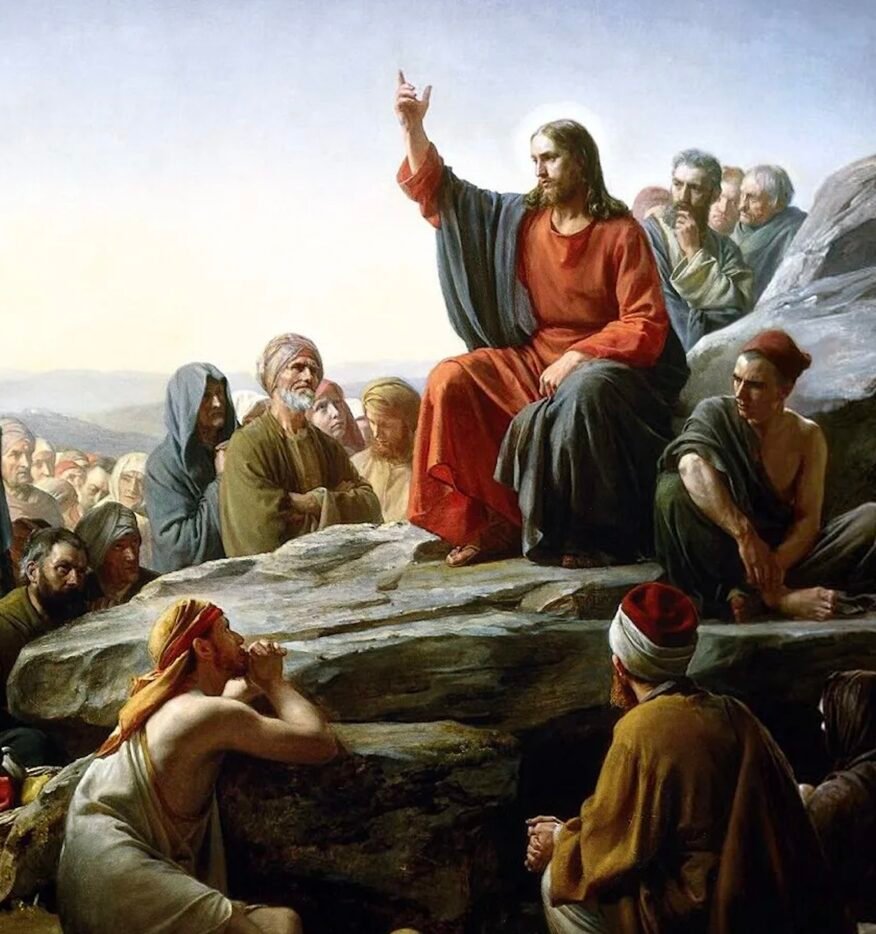
Teachings & Parables
Not sermons written for later readers, but oral teaching built to survive being spoken, memorized, and retold
More than thirty distinct parables and an entire ethical framework delivered from a single hillside — structured with the kind of repetition and parallelism that let illiterate hearers carry it word for word. The Sermon on the Mount (Matthew 5–7) opens with the tightly patterned Beatitudes, and parables like the Prodigal Son, the Good Samaritan, and the Sower use Aramaic-style parallelism that scholars point to as a mark of authentic oral tradition rather than later literary invention. The ethical teachings extend Old Testament law without contradicting it, addressing internal motive rather than only external action — a distinctive rabbinic move for its time.
This page assembles 48 fact/evidence/quote cards across 12 anchored subcategory sections — multiple-attestation analysis of Sermon material, parables, ethical distinctives, eyewitness oral-style marks, Kingdom sayings, the Lord’s Prayer, the Farewell Discourse, controversies and woes, wisdom logia, the Olivet Discourse, Old Testament fulfillment citations, and the Aramaic substratum. Each section is cross-referenced to the parent Crucifixion page and the related Multiple Attestation subcats.
Sermon on the Mount
Mt 5–7 — Beatitudes, antitheses (“You have heard… but I say…”), Lord’s Prayer embedding, salt/light, golden rule. Multiple-attested parallel in Lk 6.Parables
Prodigal Son (Lk 15), Good Samaritan (Lk 10), Sower (triple tradition), Mustard Seed, Ten Virgins, Talents — Aramaic-style pedagogy fit for oral memory.Ethical Teachings
Internalization of Torah (Mt 5:21–48), love of enemies, Golden Rule (Mt 7:12), pure-heart Beatitude ethics extending law to motive.Eyewitness Teaching Style
Aramaic parallelism, chiasmus, oral-formulaic doublets and mnemonic devices scholars identify as pre-Marcan and implausible as later literary invention.The Lord’s Prayer
Matthean (Mt 6:9–13) and Lukan (Lk 11:2–4) forms; Abba address; epiousios “daily” bread (unique Greek hapax); Jeremias on the Aramaic substratum.Kingdom of God Sayings
Central theme of Jesus’ preaching; present/future tension (already/not yet); kingdom parables (Mustard, Leaven, Treasure, Pearl, Net).Last Supper Discourse
John 13–17 farewell / upper-room discourse: foot-washing, “I am the way, truth, and life,” vine & branches, High Priestly Prayer.Woes & Controversy Dialogues
Mt 23 seven woes; temple controversies over tribute (Mk 12:13–17), resurrection (Mk 12:18–27), and the Great Commandment (Mk 12:28–34).Wisdom Logia & Aphorisms
Aphorisms (“Foxes have holes…”), paradox sayings (“whoever would save his life…” — attested 4-fold), wisdom sayings (“Wisdom is justified by her children”).Olivet / Eschatological Discourse
Mt 24 / Mk 13 / Lk 21 — destruction of Temple, signs, parousia. Triple-attested across the Synoptic tradition.OT Fulfillment Citations
Matthew’s ten fulfillment formula quotations; explicit citations of Isa 7:14, Hos 11:1, Zech 9:9, Jer 31:15 — “that it might be fulfilled.”Aramaic Substratum & Bilingual Traces
Traces behind Greek text: Abba (Mk 14:36), Talitha cumi (Mk 5:41), Eli Eli lema sabachthani (Mt 27:46), Maranatha (1 Cor 16:22). Vermes & Jeremias on Semitic background.Sermon on the Mount
Matthew 5–7 is the longest sustained block of Jesus’ teaching in the Gospels — and Luke’s Sermon on the Plain (Lk 6:17–49) preserves parallel material through an independent Q-tradition. Together they supply multiple attestation for the Sermon’s core nucleus.
The Beatitudes Open the Sermon With Oral-Formulaic Parallelism
Jesus — Matthew 5:1–12, KJV“And seeing the multitudes, he went up into a mountain: and when he was set, his disciples came unto him: And he opened his mouth, and taught them, saying, Blessed are the poor in spirit: for theirs is the kingdom of heaven.”Joachim Jeremias (Jeremias) in The Sermon on the Mount (1961) reads the tightly-patterned macarism form as rooted in Second-Temple wisdom rather than later church composition. The Beatitudes use parallelism keyed for oral retention: identical rhythm across each line, ending on the same “kingdom” frame. Luke 6:20–22 independently preserves three of the beatitudes with variant wording, supplying Multiple Attestation. Citation: Jesus of Nazareth (c. AD 27–30), Matthew 5:1–12, KJV; analysis: Joachim Jeremias, The Sermon on the Mount (1961).File Under: Jesus Christ > Life & Ministry > Teachings & Parables > Sermon on the Mount | Cross-References: The Lord’s Prayer | Multiple Attestation
The Six Antitheses Extend Torah to Internal Motive
Jesus — Matthew 5:21–48, KJV“Ye have heard that it was said by them of old time, Thou shalt not kill… But I say unto you, That whosoever is angry with his brother without a cause shall be in danger of the judgment.”John P. Meier (Meier) in A Marginal Jew, vol. 4 calls the “ye have heard… but I say” formula a uniquely authoritative teaching modality with no exact rabbinic precedent. The six Antitheses traverse murder, adultery, divorce, oaths, retaliation, and love of enemies — moving Torah from external act to internal motive. The formula asserts personal authority alongside Torah, an unprecedented move for a first-century rabbi. Citation: Jesus of Nazareth (c. AD 27–30), Matthew 5:21–48, KJV; analysis: John P. Meier, A Marginal Jew, vol. 4 (2009).File Under: Jesus Christ > Life & Ministry > Teachings & Parables > Sermon on the Mount | Cross-References: Ethics of the Heart | Fulfilled Prophecy Citations

Salt of the Earth — Identity of the Disciple Community
Jesus — Matthew 5:13–16, KJV“Ye are the salt of the earth: but if the salt have lost his savour, wherewith shall it be salted? it is thenceforth good for nothing, but to be cast out, and to be trodden under foot of men.”Davies & Allison (Davies & Allison, ICC commentary) note the salt-as-covenant metaphor echoes Leviticus 2:13 and the rabbinic use of melach for covenant preservation. The double image of Salt of the Earth and light on a hillside sets the disciple community as publicly visible rather than secluded. Mark 9:50 and Luke 14:34–35 preserve independent forms of the salt saying, supplying triple attestation. Citation: Jesus of Nazareth (c. AD 27–30), Matthew 5:13–16, KJV; analysis: W. D. Davies & Dale C. Allison, Matthew, ICC, vol. 1 (1988).File Under: Jesus Christ > Life & Ministry > Teachings & Parables > Sermon on the Mount | Cross-References: Discipleship & Followers | Multiple Attestation
The Wise and Foolish Builders — Action, Not Hearing Alone
Jesus — Matthew 7:24–27, KJV“Therefore whosoever heareth these sayings of mine, and doeth them, I will liken him unto a wise man, which built his house upon a rock… and the rain descended, and the floods came, and the winds blew, and beat upon that house; and it fell not: for it was founded upon a rock.”C. H. Dodd (Dodd) in The Founder of Christianity (1970) treats this closing parable as the Sermon’s concluding syllogism: hearing without doing collapses under pressure. Luke 6:47–49 preserves an independent form with the rock-versus-sand image intact, supplying double attestation through Q. The closing formula Wise Builder calls back to the Shema’s “hear and do” pattern of Deuteronomy 6. Citation: Jesus of Nazareth (c. AD 27–30), Matthew 7:24–27, KJV; analysis: C. H. Dodd, The Founder of Christianity (1970).File Under: Jesus Christ > Life & Ministry > Teachings & Parables > Sermon on the Mount | Cross-References: Ethics of the Heart | Fulfilled Prophecies
Parables of the Kingdom
Jesus’ kingdom parables compress eschatology into a single image — a sown seed, a hidden leaven, a buried treasure. C. H. Dodd classified these as the clearest “realized eschatology” specimens in Jesus’ teaching.
The Sower — A Triple-Attested Front-Porch Parable
Jesus — Mark 4:3–9; Matthew 13:3–9; Luke 8:5–8, KJV“Hearken; Behold, there went out a sower to sow: And it came to pass, as he sowed, some fell by the way side… And some fell on good ground, and did yield fruit that sprang up and increased; and brought forth, some thirty, and some sixty, and some an hundred.”The Sower appears in triple attestation — Mark, Matthew, and Luke independently preserve it. Joachim Jeremias (The Parables of Jesus, 1972) dated it to the earliest recoverable Jesus tradition, calling its four-soil schema a classic oral-formulaic catalog designed for memorization. The imagery — wayside, stony ground, thorns, good ground — would have been instantly recognizable to a Galilean farming audience. Citation: Jesus of Nazareth (c. AD 27–30), Mark 4:3–9 par., KJV; analysis: Joachim Jeremias, The Parables of Jesus (1972).File Under: Jesus Christ > Life & Ministry > Teachings & Parables > Parables of the Kingdom | Cross-References: Multiple Attestation | Oral Style & Aramaic Traces
Mustard Seed — Kingdom Arrives From the Insignificant
Jesus — Matthew 13:31–32; Mark 4:30–32; Luke 13:18–19, KJV“Another parable put he forth unto them, saying, The kingdom of heaven is like to a grain of mustard seed, which a man took, and sowed in his field: Which indeed is the least of all seeds: but when it is grown, it is the greatest among herbs, and becometh a tree.”C. H. Dodd (Dodd) in The Parables of the Kingdom (1935) identified the Mustard Seed as the clearest instance of realized eschatology — God’s kingdom already present in smallness, not merely future in glory. Also triple-attested. Geza Vermes (Vermes, Jesus the Jew, 1973) links the image to rabbinic mustard-tree traditions in which shrubbery becomes tree-like, fitting first-century Galilean setting. Citation: Jesus of Nazareth (c. AD 27–30), Matthew 13:31–32 par., KJV; analysis: C. H. Dodd, The Parables of the Kingdom (1935); Geza Vermes, Jesus the Jew (1973).File Under: Jesus Christ > Life & Ministry > Teachings & Parables > Parables of the Kingdom | Cross-References: The Kingdom of God | Olivet Discourse
Leaven — Hidden Influence Inside the Whole Batch
Jesus — Matthew 13:33; Luke 13:20–21, KJV“Another parable spake he unto them; The kingdom of heaven is like unto leaven, which a woman took, and hid in three measures of meal, till the whole was leavened.”The Leaven parable is doubly attested in Matthew and Luke through Q. Kenneth Bailey (Bailey, Through Peasant Eyes, 1980) reads the “three measures” detail as intentional exaggeration — roughly 40 liters of flour, enough bread for 150 people — pointing to banquet-scale significance. The verb “hid” (enekrypsen) signals covert infiltration rather than overt triumph, a hallmark of Dodd’s realized eschatology. Citation: Jesus of Nazareth (c. AD 27–30), Matthew 13:33 / Luke 13:20–21, KJV; analysis: Kenneth E. Bailey, Through Peasant Eyes (1980).File Under: Jesus Christ > Life & Ministry > Teachings & Parables > Parables of the Kingdom | Cross-References: The Kingdom of God | Multiple Attestation
Hidden Treasure & Pearl — The Kingdom’s Worth Demands All
Jesus — Matthew 13:44–46, KJV“Again, the kingdom of heaven is like unto treasure hid in a field; the which when a man hath found, he hideth, and for joy thereof goeth and selleth all that he hath, and buyeth that field. Again, the kingdom of heaven is like unto a merchant man, seeking goodly pearls: Who, when he had found one pearl of great price, went and sold all that he had, and bought it.”These twin Hidden Treasure parables are uniquely Matthean but conform to Jeremias’ “duo-minor” pattern — two short sayings paired to reinforce one point. The sale of “all” is total surrender for inestimable gain, an exchange structure also found in rabbinic middash sayings. Jeremias treats the pair as pre-Easter Palestinian given the treasure-in-field custom attested in contemporaneous Jewish law. Citation: Jesus of Nazareth (c. AD 27–30), Matthew 13:44–46, KJV; analysis: Joachim Jeremias, The Parables of Jesus (1972).File Under: Jesus Christ > Life & Ministry > Teachings & Parables > Parables of the Kingdom | Cross-References: Ethics of the Heart | Discipleship & Followers
Parables of Mercy
Jesus’ mercy parables use culturally shocking details — a running patriarch, a Samaritan hero, a shepherd abandoning the ninety-nine — to argue that the offenses scholars attribute to later invention are exactly what mark them as authentic memory.
The Prodigal Son — A Patriarch Running in Public Shame
Jesus — Luke 15:11–32, KJV“And he arose, and came to his father. But when he was yet a great way off, his father saw him, and had compassion, and ran, and fell on his neck, and kissed him.”Joachim Jeremias repeatedly argued that the father’s running is culturally shameful for a Middle Eastern patriarch — tucking up his robe and sprinting in public view. Kenneth Bailey (Bailey, The Cross and the Prodigal, 1976) confirmed via peasant-eyes ethnography that the gesture would have been scandalous in first-century village life. This offending detail is what makes the Prodigal Son read as authentic memory rather than as later church parable. Citation: Jesus of Nazareth (c. AD 27–30), Luke 15:11–32, KJV; analysis: Joachim Jeremias, The Parables of Jesus (1972); Kenneth E. Bailey, The Cross and the Prodigal (1976).File Under: Jesus Christ > Life & Ministry > Teachings & Parables > Parables of Mercy | Cross-References: The Kingdom of God | Criterion of Embarrassment
The Good Samaritan — A Heretic Cast as Hero
Jesus — Luke 10:30–37, KJV“But a certain Samaritan, as he journeyed, came where he was: and when he saw him, he had compassion on him, And went to him, and bound up his wounds, pouring in oil and wine, and set him on his own beast, and brought him to an inn, and took care of him.”Kenneth Bailey reads the priest and Levite’s bypass as temple-purity caution: contact with a possibly dead body would render them ritually unfit for temple service. The shock is that the heretic becomes the paragon. The Good Samaritan deployment of an enemy ethnic group as hero fits the Criterion of Embarrassment — a later Jewish-Christian community would not invent a Samaritan as protagonist. Citation: Jesus of Nazareth (c. AD 27–30), Luke 10:30–37, KJV; analysis: Kenneth E. Bailey, Through Peasant Eyes (1980).File Under: Jesus Christ > Life & Ministry > Teachings & Parables > Parables of Mercy | Cross-References: Ethics of the Heart | Criterion of Embarrassment
The Lost Sheep — A Triple-Attested Pastoral Image
Jesus — Matthew 18:12–14; Luke 15:1–7, KJV“How think ye? if a man have an hundred sheep, and one of them be gone astray, doth he not leave the ninety and nine, and goeth into the mountains, and seeketh that which is gone astray? And if so be that he find it, verily I say unto you, he rejoiceth more of that sheep, than of the ninety and nine which went not astray.”The Lost Sheep parable is doubly attested in Matthew and Luke’s independent Q-traditions. Vermes (Jesus the Jew) links it to rabbit Gamaliel’s shepherd saying in Mishnah Baba Kamma, signaling shared Palestinian pastoral idiom. The image of carrying the sheep home on the shoulders (Lk 15:5) reflects a known practice of shepherds for injured animals, marking authentic village-level observation. Citation: Jesus of Nazareth (c. AD 27–30), Matthew 18:12–14 / Luke 15:1–7, KJV; analysis: Geza Vermes, Jesus the Jew (1973).File Under: Jesus Christ > Life & Ministry > Teachings & Parables > Parables of Mercy | Cross-References: Multiple Attestation | Oral Style & Aramaic Traces
The Unforgiving Servant — Mercy Received Demands Mercy Given
Jesus — Matthew 18:21–35, KJV“Then the lord of that servant was moved with compassion, and loosed him, and forgave him the debt. But the same servant went out, and found one of his fellowservants, which owed him an hundred pence: and he laid hands on him, and took him by the throat, saying, Pay me that thou owest.”The Unforgiving Servant is uniquely Matthean but follows Jeremias’ “eschatological parable” classification — a king settling accounts at the end of an age. The 10,000-talent debt is hyperbole on a royal scale, an impossible sum roughly equal to 150,000 years of laborer wages. The contrast sets infinite mercy received against petty debt withheld, mirroring the Lord’s Prayer petition “forgive us our debts as we forgive our debtors.” Citation: Jesus of Nazareth (c. AD 27–30), Matthew 18:21–35, KJV; analysis: Joachim Jeremias, The Parables of Jesus (1972).File Under: Jesus Christ > Life & Ministry > Teachings & Parables > Parables of Mercy | Cross-References: The Lord’s Prayer | Ethics of the Heart
Ethics of the Heart
Jesus’ ethics extend Torah commandments from external action to internal motive — a move scholars across the spectrum acknowledge has no exact precedent in Pharisaic or rabbinic teaching.
Adultery in the Heart — Lust as the Inward Act
Jesus — Matthew 5:27–28, KJV“Ye have heard that it was said by them of old time, Thou shalt not commit adultery: But I say unto you, That whosoever looketh on a woman to lust after her hath committed adultery with her already in his heart.”John P. Meier (Meier, A Marginal Jew, vol. 4) calls this extension of adultery from act to internal motive a move with no exact rabbinic parallel. The tenth-century rabbinic dictum against “secret thoughts” is much later and still speaks of remembering Sinai rather than intention as the act itself. Davies & Allison note the phrase already in his heart draws on Proverbs 6:25’s adultery-of-the-eyes phrase, weaving Jesus’ ethics into the Hebrew wisdom stream. Citation: Jesus of Nazareth (c. AD 27–30), Matthew 5:27–28, KJV; analysis: John P. Meier, A Marginal Jew, vol. 4 (2009); W. D. Davies & Dale C. Allison, Matthew, ICC, vol. 1 (1988).File Under: Jesus Christ > Life & Ministry > Teachings & Parables > Ethics of the Heart | Cross-References: Sermon on the Mount | Fulfilled Prophecy Citations
Love Your Enemies — Doubly Attested, Without Parallel
Jesus — Matthew 5:44; Luke 6:27–35, KJV“But I say unto you, Love your enemies, bless them that curse you, do good to them that hate you, and pray for them which despitefully use you, and persecute you.”The Love of Enemies command reappears in Luke 6:27–36 through Q-tradition, supplying multiple attestation. Meier notes that Greco-Roman moralists praised benevolence to enemies; Jesus commands love toward them, an unprecedented intensification. The Sermon on the Plain parallel in Luke strengthens the case that this command goes back to Jesus rather than to a post-Easter church invention. Citation: Jesus of Nazareth (c. AD 27–30), Matthew 5:44 / Luke 6:27–35, KJV; analysis: John P. Meier, A Marginal Jew, vol. 4 (2009).File Under: Jesus Christ > Life & Ministry > Teachings & Parables > Ethics of the Heart | Cross-References: Multiple Attestation | Sermon on the Mount
The Golden Rule in Its Distinctively Positive Form
Jesus — Matthew 7:12; Luke 6:31, KJV“Therefore all things whatsoever ye would that men should do to you, do ye even so to them: for this is the law and the prophets.”The positive form of the Golden Rule (“do unto others”) in Jesus’ formulation contrasts with the negative rabbinic form attributed to Hillel (“what is hateful to you, do not do”). The Lukan parallel (Lk 6:31) supplies two independent attestations. Pinchas Lapide (The Sermon on the Mount, 1986) — a Jewish interpreter of Jesus — called Jesus’ positive form a genuine intensification rabbinic tradition never reached. Citation: Jesus of Nazareth (c. AD 27–30), Matthew 7:12 / Luke 6:31, KJV; analysis: Pinchas Lapide, The Sermon on the Mount: A Christian View (1986).File Under: Jesus Christ > Life & Ministry > Teachings & Parables > Ethics of the Heart | Cross-References: Sermon on the Mount | Multiple Attestation
Pure in Heart — Inward Purity Echoing the Psalter
Jesus — Matthew 5:8, KJV“Blessed are the pure in heart: for they shall see God.”Davies & Allison note the phrase pure in heart echoes Psalm 24:3–4 (“Who shall ascend into the hill of the LORD?… He that hath clean hands, and a pure heart”). The Beatitude reframes ritual purity around internal disposition, anticipating Jesus’ later critique that “out of the heart proceed evil thoughts” (Mt 15:19). Jeremias reads the future promise “they shall see God” as an eschatological temple-vision pledge, knitting Jesus’ ethics to the Sinai cultic tradition. Citation: Jesus of Nazareth (c. AD 27–30), Matthew 5:8, KJV; analysis: W. D. Davies & Dale C. Allison, Matthew, ICC, vol. 1 (1988); Joachim Jeremias, The Sermon on the Mount (1961).File Under: Jesus Christ > Life & Ministry > Teachings & Parables > Ethics of the Heart | Cross-References: Sermon on the Mount | Fulfilled Prophecies
The Kingdom of God
“The kingdom of God” is the central theme of Jesus’ preaching — appearing over 80 times across the Synoptics. It carries an inherent tension: already arriving with his ministry, yet still future in its consummation.
“The Kingdom of God Is at Hand” — A Triple-Attested Inauguration
Jesus — Mark 1:15; Matthew 4:17, KJV“The time is fulfilled, and the kingdom of God is at hand: repent ye, and believe the gospel.”The opening Kingdom of God proclamation is independently attested in Mark and Matthew. Norman Perrin (The Kingdom of God in the Teaching of Jesus, 1963) observed that Jesus’ use of the phrase with a “already arrived” present tense marks an innovation — contemporaneous Jewish expectation was uniformly future. R. T. France (Divine Government, 1990) saw this as the inaugurated eschatology framing that shaped the entire Synoptic teaching ministry. Citation: Jesus of Nazareth (c. AD 27–30), Mark 1:15 / Matthew 4:17, KJV; analysis: Norman Perrin, The Kingdom of God in the Teaching of Jesus (1963); R. T. France, Divine Government (1990).File Under: Jesus Christ > Life & Ministry > Teachings & Parables > The Kingdom of God | Cross-References: Parables of the Kingdom | Olivet Discourse
“Thy Kingdom Come” — Already/Not-Yet in One Petition
Jesus — Luke 11:2; Matthew 6:10, KJV“And he said unto them, When ye pray, say, Our Father which art in heaven, Hallowed be thy name. Thy kingdom come. Thy will be done, as in heaven, so in earth.”George Eldon Ladd (The Presence of the Future, 1974) frames the request Thy Kingdom Come as the classic already / not-yet tension compressed into one petition: the kingdom is present in Christ’s ministry, yet its consummation remains a future hope. Doubly attested across Mt/Lk Q-tradition. Jeremias traced the Aramaic tetha malkuthakh to earliest Doxology forms. Citation: Jesus of Nazareth (c. AD 27–30), Luke 11:2 / Matthew 6:10, KJV; analysis: George Eldon Ladd, The Presence of the Future (1974); Joachim Jeremias, The Prayers of Jesus (1967).File Under: Jesus Christ > Life & Ministry > Teachings & Parables > The Kingdom of God | Cross-References: The Lord’s Prayer | Olivet Discourse
The Kingdom Is “Within You” — Already Arrived Realization
Jesus — Luke 17:20–21, KJV“And when he was demanded of the Pharisees, when the kingdom of God should come, he answered them and said, The kingdom of God cometh not with observation: Neither shall they say, Lo here! or, lo there! for, behold, the kingdom of God is within you.”C. H. Dodd (Dodd) anchored his “realized eschatology” thesis here — Jesus teaches that the Kingdom of God is already operative in his presence, not merely a future apocalyptic arrival. The Greek phrase entos hymōn (“within/among you”) is debated: the kingdom is in your midst (Christological) or within your hearts (ethical). Vermes argued the Aramaic background favors the Christological reading. Citation: Jesus of Nazareth (c. AD 27–30), Luke 17:20–21, KJV; analysis: C. H. Dodd, The Parables of the Kingdom (1935); Geza Vermes, Jesus the Jew (1973).File Under: Jesus Christ > Life & Ministry > Teachings & Parables > The Kingdom of God | Cross-References: Olivet Discourse | Parables of the Kingdom
“Many Shall Come From the East and West” — Universal Kingdom Inclusion
Jesus — Matthew 8:11; Luke 13:28–29, KJV“And I say unto you, That many shall come from the east and west, and shall sit down with Abraham, and Isaac, and Jacob, in the kingdom of heaven.”Doubly attested across Mt/Lk Q-tradition. The promise of Gentile Inclusion in the eschatological banquet would have been scandalous to a Jewish audience expecting Israel-only privilege. E. P. Sanders (Jesus and Judaism, 1985) treats this as authentic Jesus tradition precisely because it does not fit the later Gentile-missionchurch expectation after Pentecost. The “east and west” phrasing echoes Isaiah 59:19’s universal regathering. Citation: Jesus of Nazareth (c. AD 27–30), Matthew 8:11 / Luke 13:28–29, KJV; analysis: E. P. Sanders, Jesus and Judaism (1985).File Under: Jesus Christ > Life & Ministry > Teachings & Parables > The Kingdom of God | Cross-References: Criterion of Embarrassment | The 12 Apostles
The Lord’s Prayer
The Lord’s Prayer is independently attested in Matthew 6:9–13 and Luke 11:2–4, with Aramaic Abba behind the address and the hapax Greek epiousios for “daily” — both markers pointing to a Semitic original.
“Our Father” — The Aramaic Abba Address of Intimacy
Jesus — Matthew 6:9; Luke 11:2, KJV“After this manner therefore pray ye: Our Father which art in heaven, Hallowed be thy name.”Joachim Jeremias (The Prayers of Jesus, 1967) mounted the case that Abba — the Aramaic intimate form of address, roughly “Papa” — is uniquely Jesus’ trademark, with no precedent in Jewish prayer literature as the opening address to God. Doubly attested Mt/Lk through Q; also embedded in Mark 14:36 in Gethsemane and Paul’s Abba quotations (Rom 8:15, Gal 4:6). The intimacy was startling: addressing God as a child addresses a father. Citation: Jesus of Nazareth (c. AD 27–30), Matthew 6:9 / Luke 11:2, KJV; analysis: Joachim Jeremias, The Prayers of Jesus (1967).File Under: Jesus Christ > Life & Ministry > Teachings & Parables > The Lord’s Prayer | Cross-References: Oral Style & Aramaic Traces | The Kingdom of God
“Daily Bread” — The Hapax Greek Epiousios
Jesus — Matthew 6:11; Luke 11:3, KJV“Give us this day our daily bread.”The Greek word epiousios (“daily”) is a Hapax Legomenon — found nowhere else in all of Greek literature before the Gospels. Origen (c. 185–254) noted its strangeness and proposed the evangelists coined it to translate an Aramaic original no Greek word quite captured. Jeremias traced the underlying Aramaic to “give us today the bread of tomorrow” — an eschatological petition pointing to the messianic banquet. The unique vocabulary and Semitic back-translation together argue the petition is pre-Gospel Aramaic oral tradition. Citation: Jesus of Nazareth (c. AD 27–30), Matthew 6:11 / Luke 11:3, KJV; analysis: Joachim Jeremias, The Prayers of Jesus (1967); Origen, De Oratione (c. 233).File Under: Jesus Christ > Life & Ministry > Teachings & Parables > The Lord’s Prayer | Cross-References: Oral Style & Aramaic Traces | The Kingdom of God
“Forgive Us Our Debts” — Eschatological Mercy Reciprocity
Jesus — Matthew 6:12, KJV“And forgive us our debts, as we forgive our debtors.”The petition Forgive Our Debts uses the Semitic idiom of sin-as-debt (Luke’s parallel uses “sins”). The conditional “as we forgive” sets mercy as reciprocal — an unprecedented framing in Jewish prayer. Jacob Neusner (A Rabbi Talks with Jesus, 1993) noted that rabbinic prayer sought forgiveness from a covenant God; Jesus’ petition conditions divine mercy on prior human mercy. Matthew 6:14–15 immediately reinforces the conditional, giving the petition its full eschatological weight. Citation: Jesus of Nazareth (c. AD 27–30), Matthew 6:12, KJV; analysis: Jacob Neusner, A Rabbi Talks with Jesus (1993).File Under: Jesus Christ > Life & Ministry > Teachings & Parables > The Lord’s Prayer | Cross-References: Parables of Mercy | Ethics of the Heart
“Lead Us Not Into Temptation” — Eschatological Final-Petition Closure
Jesus — Matthew 6:13; Luke 11:4, KJV“And lead us not into temptation, but deliver us from evil: For thine is the kingdom, and the power, and the glory, for ever. Amen.”The closing petition Lead Us Not Into Temptation uses the Greek peirasmos, which Jeremias linked to the eschatological testing of the last days rather than everyday moral trial. Doubly attested across Mt/Lk; the doxology “For thine is the kingdom” is absent in Luke and the earliest manuscripts of Matthew, suggesting later liturgical addition in the Matthean tradition. The Aramaic underlay is widely reconstructed from Qumran-style eschatological prayer parallels. Citation: Jesus of Nazareth (c. AD 27–30), Matthew 6:13 / Luke 11:4, KJV; analysis: Joachim Jeremias, The Prayers of Jesus (1967).File Under: Jesus Christ > Life & Ministry > Teachings & Parables > The Lord’s Prayer | Cross-References: Olivet Discourse | Oral Style & Aramaic Traces
Farewell Discourse
John 13–17 records Jesus’ upper-room teaching — foot-washing, the “I am” sayings, and the High Priestly Prayer. Although John’s Gospel is stylistically independent from the Synoptics, multiple Johannine-Synoptic overlaps support its traditional attribution.
The Foot-Washing — Servant-Leadership Enacted in Action
Jesus — John 13:1–17, KJV“After that he poureth water into a bason, and began to wash the disciples’ feet, and to wipe them with the towel wherewith he was girded… If I then, your Lord and Master, have washed your feet; ye also ought to wash one another’s feet.”Raymond E. Brown (The Gospel According to John, Anchor Bible, 1970) sees the foot-washing as an acted parable of the crucifixion — Jesus divesting himself to perform a slave’s task in anticipation of his death. Craig Keener (The Gospel of John, 2003) documents that Foot-Washing was the task of non-Jewish slaves only in Jewish households, an extreme humiliation Jesus voluntarily assumes. The enacted parable frames the entire Farewell Discourse as continuing the same servant theme. Citation: Jesus of Nazareth (c. AD 30), John 13:1–17, KJV; analysis: Raymond E. Brown, The Gospel According to John, Anchor Bible (1970); Craig Keener, The Gospel of John (2003).File Under: Jesus Christ > Life & Ministry > Teachings & Parables > Farewell Discourse | Cross-References: Discipleship & Followers | The Crucifixion
“I Am the Way, the Truth, and the Life”
Jesus — John 14:6, KJV“Jesus saith unto him, I am the way, the truth, and the life: no man cometh unto the Father, but by me.”The absolute claim of Way, Truth, and Life uses the Johannine egō eimi (“I am”) formula — strongly echoing the Septuagint’s rendering of God’s self-revelation in Exodus 3:14. C. H. Dodd (The Interpretation of the Fourth Gospel, 1953) noted that the “I am” sayings cluster uniquely in John, but the underlying theological claim is consistent with the Synoptic Jesus’ implicit claims of exclusive mediatorship (Mt 11:27 / Lk 10:22). The exclusivity scandalizes pluralism but is multiply attested across Gospel streams. Citation: Jesus of Nazareth (c. AD 30), John 14:6, KJV; analysis: C. H. Dodd, The Interpretation of the Fourth Gospel (1953).File Under: Jesus Christ > Life & Ministry > Teachings & Parables > Farewell Discourse | Cross-References: Sermon on the Mount | The Crucifixion
The Vine & the Branches — Abiding in Christ
Jesus — John 15:1–8, KJV“I am the true vine, and my Father is the husbandman… Abide in me, and I in you. As the branch cannot bear fruit of itself, except it abide in the vine; no more can ye, except ye abide in me.”The Vine & Branches image draws on Isaiah 5’s “Song of the Vineyard” — Israel as YHWH’s vineyard now replaced by Jesus himself as the true vine. Andreas Köstenberger (John, BECNT, 2004) reads the substitution as an implicit christological claim of Jesus supplanting Israel’s institutional identity, parallel to John the Baptist’s “I am the voice” replacement of temple-centered expectation. The “abide” (menō) verb recurs 11 times, marking oral mnemonic pattern. Citation: Jesus of Nazareth (c. AD 30), John 15:1–8, KJV; analysis: Andreas Köstenberger, John, BECNT (2004).File Under: Jesus Christ > Life & Ministry > Teachings & Parables > Farewell Discourse | Cross-References: Fulfilled Prophecy Citations | Discipleship & Followers
The High Priestly Prayer — Jesus’ Consecration of the Twelve
Jesus — John 17:1–26, KJV“These words spake Jesus, and lifted up his eyes to heaven, and said, Father, the hour is come; glorify thy Son, that thy Son also may glorify thee: As thou hast given him power over all flesh, that he should give eternal life to as many as thou hast given him.”The High Priestly Prayer in John 17 functions as Jesus’ consecration of the Twelve before his arrest. Brown (Anchor Bible) noted the prayer’s triadic structure: prayer for himself, prayer for the Eleven, prayer for future believers — a rhetorical pattern marking it as formal covenant denial rather than ad hoc speech. D. A. Carson (The Gospel According to John, 1991) parallels it to Yom Kippur’s priestly intercession, framing Jesus as the true high priest. Citation: Jesus of Nazareth (c. AD 30), John 17:1–26, KJV; analysis: Raymond E. Brown, The Gospel According to John, Anchor Bible (1970); D. A. Carson, The Gospel According to John (1991).File Under: Jesus Christ > Life & Ministry > Teachings & Parables > Farewell Discourse | Cross-References: The 12 Apostles | The Crucifixion
Temple Debates & Woes
In the final week of his public ministry, Jesus confronted the religious authorities in challenges and woes recorded across all three Synoptic Gospels — independently confirming the controversies.
Cleansing the Temple — A Prophetic Enacted-Parable
Jesus — Matthew 21:12–13; Mark 11:15–18; John 2:13–17, KJV“And Jesus went into the temple of God, and cast out all them that sold and bought in the temple, and overthrew the tables of the moneychangers, and the seats of them that sold doves, And said unto them, It is written, My house shall be called the house of prayer; but ye have made it a den of thieves.”The Temple Cleansing is multiply attested — Synoptics at the close of ministry, John at the start (2:13–17), with scholars divided on number of events. E. P. Sanders (Jesus and Judaism, 1985) reads it as a symbolic prophetic action against temple corruption rather than a literal attempt at reform. The quotation of Isaiah 56:7 (“house of prayer for all nations”) and Jeremiah 7:11 (“den of thieves”) ties the act to Old Testament fulfillment — Jesus self-consciously enacting a prophetic sign-action. Citation: Jesus of Nazareth (c. AD 27 or 30), Matthew 21:12–13 par., KJV; analysis: E. P. Sanders, Jesus and Judaism (1985).File Under: Jesus Christ > Life & Ministry > Teachings & Parables > Temple Debates & Woes | Cross-References: Fulfilled Prophecy Citations | The Crucifixion
“Render Unto Caesar” — A Rhetorical Escape Trap
Jesus — Mark 12:13–17; Matthew 22:15–22; Luke 20:20–26, KJV“And they come and say unto him, Master, we know that thou art true… Is it lawful to give tribute to Caesar, or not?… And Jesus answering said unto them, Render to Caesar the things that are Caesar’s, and to God the things that are God’s.”The Render Unto Caesar exchange is triple-attested and reflects first-century Roman taxation politics: the Herodians (pro-Roman) and Pharisees (anti-Roman) jointly set the trap. N. T. Wright (Jesus and the Victory of God, 1996) reads the answer not as a politics/religion division but as Jesus’ reframe of theocracy: Caesar’s image on the coin marks it as his; God’s image on humans marks us as his. The denarius itself is a first-century archaeological corroboration. Citation: Jesus of Nazareth (c. AD 30), Mark 12:13–17 par., KJV; analysis: N. T. Wright, Jesus and the Victory of God (1996).File Under: Jesus Christ > Life & Ministry > Teachings & Parables > Temple Debates & Woes | Cross-References: Roman Law & Procedure | Multiple Attestation
Sadducees’ Resurrection Question — A Torah Citation Trap Returned
Jesus — Mark 12:18–27; Matthew 22:23–33; Luke 20:27–40, KJV“Then come unto him the Sadducees, which say there is no resurrection… Master, Moses wrote unto us, If a man’s brother die, and leave his wife behind him, and leave no children, that his brother should take his wife, and raise up seed unto his brother.”The Sadducees’ Resurrection Debate is triple-attested. Jesus answers from Torah — Exodus 3:6 — that God is the God of the living, not the dead. Craig Keener (The Historical Jesus of the Gospels, 2009) observes Jesus’ use of the Pentateuch against the Sadducees reflects their own scriptural limits (they rejected the Prophets and Writings), making it a rhetorically necessary move that only a contemporary Jewish debater would make. The debate corroborates authentic temple-controversy tradition. Citation: Jesus of Nazareth (c. AD 30), Mark 12:18–27 par., KJV; analysis: Craig Keener, The Historical Jesus of the Gospels (2009).File Under: Jesus Christ > Life & Ministry > Teachings & Parables > Temple Debates & Woes | Cross-References: Olivet Discourse | Multiple Attestation
The Seven Woes Against the Scribes and Pharisees
Jesus — Matthew 23:1–36; Luke 11:37–54, KJV“But woe unto you, scribes and Pharisees, hypocrites! for ye shut up the kingdom of heaven against men: for ye neither go in yourselves, neither suffer ye them that are entering in to go in.”The Seven Woes to Pharisees is doubly attested — Matthew collects seven woes, Luke preserves a partial parallel at 11:39–52. Jacob Neusner noted that internal Jewish critique in this register precedes Jesus in prophetic tradition (cf. Isaiah 1, Micah 6) and continues in rabbinic literature; the woes’ specific framing of tithing minutiae and temple gold oaths reflects first-century Sadducean-Pharisaic disputes, anachronistic if invented by post-70 Gentile church. Citation: Jesus of Nazareth (c. AD 30), Matthew 23:1–36 / Luke 11:37–54, KJV; analysis: Jacob Neusner, A Rabbi Talks with Jesus (1993).File Under: Jesus Christ > Life & Ministry > Teachings & Parables > Temple Debates & Woes | Cross-References: Ethics of the Heart | Criterion of Embarrassment
Olivet Discourse
Matthew 24, Mark 13, and Luke 21 record Jesus’ eschatological discourse against the Mount of Olives — triple-attested across the Synoptic tradition and the longest eschatological block in his teaching.
“Not One Stone Upon Another” — A Specific Fulfilled Prediction
Jesus — Matthew 24:1–2; Mark 13:1–2; Luke 21:5–6, KJV“And Jesus said unto him, Seest thou these great buildings? there shall not be left one stone upon another, that shall not be thrown down.”The Temple-destruction prediction is triple-attested. Genre-fulfillment scholars like R. T. France (The Gospel of Mark, NIGTC, 2002) accept this saying as Temple Destruction Prediction authentic on the criterion of multiple attestation; if vaticinium ex eventu were freely used, we’d expect explicit reference to fulfillment in AD 70 rather than ambiguous future reference. The Temple was destroyed by Titus in AD 70, fulfilling the saying roughly 40 years after it was spoken. The specificity of the prediction fits the apologetic theme of this site. Citation: Jesus of Nazareth (c. AD 30), Matthew 24:1–2 par., KJV; analysis: R. T. France, The Gospel of Mark, NIGTC (2002).File Under: Jesus Christ > Life & Ministry > Teachings & Parables > Olivet Discourse | Cross-References: Fulfilled Prophecies | Fulfilled Prophecy Citations
“Nation Shall Rise Against Nation” — Eschatological Birth Pains
Jesus — Matthew 24:6–8; Mark 13:7–8; Luke 21:9–10, KJV“And ye shall hear of wars and rumours of wars: see that ye be not troubled: for all these things must come to pass, but the end is not yet. For nation shall rise against nation, and kingdom against kingdom: and there shall be famines, and pestilences, and earthquakes, in divers places.”The Birth-Pains imagery is triple-attested. George Eldon Ladd (The Last Things, 1978) framed these as characterizing signs of the entire age rather than specific milestones — “birth pains” implies escalating frequency and intensity rather than discrete datable events. The phrase echoes Isaiah 19:2’s “kingdom against kingdom” oracle, marking Jesus’ eschatology as continuous with earlier Hebrew prophetic pattern. Citation: Jesus of Nazareth (c. AD 30), Matthew 24:6–8 par., KJV; analysis: George Eldon Ladd, The Last Things (1978).File Under: Jesus Christ > Life & Ministry > Teachings & Parables > Olivet Discourse | Cross-References: Fulfilled Prophecy Citations | The Kingdom of God
“Abomination of Desolation” — A Daniel Citation Within Jesus’ Speech
Jesus — Matthew 24:15; Mark 13:14, KJV“When ye therefore shall see the abomination of desolation, spoken of by Daniel the prophet, stand in the holy place, (whoso readeth, let him understand:).”The Abomination of Desolation reference borrows from Daniel 9:27, 11:31, 12:11 — and doubly attested in Mt/Mk. The parenthetical “whoso readeth, let him understand” indicates oral teaching now committed to writing, signaling transition point in transmission.选项-George Beasley-Murray (Jesus and the Last Days, 1993) traces the OT backdrop through Antiochus IV Epiphanes’ desecration (167 BC) to Jesus’ reapplication: a future desolation still to come. Luke 21:20 substitutes “Jerusalem compassed with armies” — interpretive parallel rather than identical wording. Citation: Jesus of Nazareth (c. AD 30), Matthew 24:15 / Mark 13:14, KJV; analysis: George Beasley-Murray, Jesus and the Last Days (1993).File Under: Jesus Christ > Life & Ministry > Teachings & Parables > Olivet Discourse | Cross-References: Fulfilled Prophecies | Fulfilled Prophecy Citations
The Parousia — Cosmic Signs and the Son of Man Coming
Jesus — Matthew 24:29–31; Mark 13:24–27; Luke 21:25–28, KJV“Immediately after the tribulation of those days shall the sun be darkened, and the moon shall not give her light… And then shall appear the sign of the Son of man in heaven: and then shall all the tribes of the earth mourn, and they shall see the Son of man coming in the clouds of heaven with power and great glory.”The Parousia passage is triple-attested and weaves Daniel 7:13 (Son of Man on clouds) with prophetic cosmic-language tradition (Isa 13:10, 34:4, Joel 2:10). N. T. Wright (Jesus and the Victory of God, 1996) reads it primarily as language of YHWH’s return to Zion applied to Jesus’ vindication through the Temple’s fall; D. A. Carson (From Sabbath to Lord’s Day, 1982) reads it as future consummation. Both readings affirm the saying’s authenticity via multiple attestation. Citation: Jesus of Nazareth (c. AD 30), Matthew 24:29–31 par., KJV; analysis: N. T. Wright, Jesus and the Victory of God (1996); D. A. Carson, From Sabbath to Lord’s Day (1982).File Under: Jesus Christ > Life & Ministry > Teachings & Parables > Olivet Discourse | Cross-References: Fulfilled Prophecies | The Kingdom of God
Oral Style & Aramaic Traces
The Greek Gospel text repeatedly preserves Aramaic fossils — Abba, Talitha cumi, Eli Eli lema sabachthani, Maranatha — that point to a Semitic original behind the Hellenistic text and support authentic first-century Palestinian transmission.
“Abba” — The Uniquely Jesus Aramaic Address
Jesus — Mark 14:36, KJV“And he said, Abba, Father, all things are possible unto thee; take away this cup from me: nevertheless not what I will, but what thou wilt.”Mark preserves the Aramaic Abba even as the Greek translates it. Joachim Jeremias (The Prayers of Jesus, 1967) documented that no Jewish prayer precedent uses Abba as opening address — Jesus’ use is innovative and groundbreaking. The address appears again in Jesus’ Gethsemane ministry and is preserved in Paul’s quotations of early Christian worship (Rom 8:15, Gal 4:6), suggesting Jesus’ trademark bled into earliest church practice. Vermes (The Religion of Jesus the Jew, 1993) corroborates the Semitic-family intimacy of the term. Citation: Jesus of Nazareth (c. AD 30), Mark 14:36, KJV; analysis: Joachim Jeremias, The Prayers of Jesus (1967); Geza Vermes, The Religion of Jesus the Jew (1993).File Under: Jesus Christ > Life & Ministry > Teachings & Parables > Oral Style & Aramaic Traces | Cross-References: The Lord’s Prayer | Multiple Attestation
“Talitha Cumi” — A Bilingual Resurrection Utterance
Jesus — Mark 5:41, KJV“And he took the damsel by the hand, and said unto her, Talitha cumi; which is, being interpreted, Damsel, I say unto thee, arise.”Mark again preserves the actual Aramaic utterance — Talitha Cumi, “little girl, arise.” Why translate? Mark writes for a Greek-speaking audience; why preserve Aramaic at all? Raymond Brown answered: the spoken word had become formula — Mark records verbatim speech remembered in Aramaic during oral-transmission years before Greek translation. The marker that we have pre-Marcan Palestinian oral tradition rather than Greek composition. The little-girl resurrection setting also fits Matthew 9 and Luke 8 parallels (triple attestation). Citation: Jesus of Nazareth (c. AD 27–30), Mark 5:41 par., KJV; analysis: Raymond E. Brown, The Gospel According to John, Anchor Bible (1970).File Under: Jesus Christ > Life & Ministry > Teachings & Parables > Oral Style & Aramaic Traces | Cross-References: Multiple Attestation | Life & Ministry
“Eli, Eli, Lema Sabachthani” — The Cross Uttered in Aramaic
Jesus — Matthew 27:46; Mark 15:34, KJV“And about the ninth hour Jesus cried with a loud voice, saying, Eli, Eli, lama sabachthani? that is to say, My God, my God, why hast thou forsaken me?”Doubly attested Mt/Mk, the Eli, Eli, Lema Sabachthani cry quotes Psalm 22:1 in Aramaic (rather than Hebrew). Joachim Jeremias (Theology of the New Testament) noted the misunderstanding motif — bystanders think Jesus is calling Elijah (Mt 27:47, Mk 15:35) — which fits the criterion of embarrassment: why invent a confusing cry at the climax of the crucifixion? The Aramaic preservation argues the words were remembered verbatim, the cry’s Psalm-citation opens the entire Psalm 22 narrative framework behind the Passion. Citation: Jesus of Nazareth (c. AD 30), Matthew 27:46 / Mark 15:34, KJV; analysis: Joachim Jeremias, New Testament Theology (1971).File Under: Jesus Christ > The Crucifixion | Cross-References: The Crucifixion | Fulfilled Prophecies | Criterion of Embarrassment
“Maranatha” — A First-Century Aramaic Worship Cry
Paul — 1 Corinthians 16:22, KJV“If any man love not the Lord Jesus Christ, let him be Anathema Maranatha.”Paul, writing in Greek to a Greek-speaking Corinthians church around AD 55, casually drops an untranslated Aramaic phrase: Maranatha (“Our Lord, come!” or “Come, our Lord!”). Gordon Fee (The First Epistle to the Corinthians, NICNT, 1987) treats it as direct evidence of a pre-Pauline Aramaic-speaking worship tradition already established across Gentile churches. The Didache (c. AD 100) preserves it in eucharistic liturgy, showing continuity. The Aramaic cry’s survival in Greek-speaking worship argues deep roots in earliest Jewish-Christian practice. Citation: Paul the Apostle (c. AD 55), 1 Corinthians 16:22, KJV; analysis: Gordon D. Fee, The First Epistle to the Corinthians, NICNT (1987).File Under: Jesus Christ > Life & Ministry > Teachings & Parables > Oral Style & Aramaic Traces | Cross-References: Olivet Discourse | The Lord’s Prayer
Fulfilled Prophecy Citations
Matthew’s Gospel contains ten explicit “fulfillment-formula” quotations tying Jesus’ life and ministry to Old Testament prophecy — constituting one of the clearest apologetic spines in the New Testament for the fulfilled-prophecies theme of this site.
The Virgin Birth Linked to Isaiah 7:14
Matthew — Matthew 1:22–23, KJV“Now all this was done, that it might be fulfilled which was spoken of the Lord by the prophet, saying, Behold, a virgin shall be with child, and shall bring forth a son, and they shall call his name Emmanuel, which being interpreted is, God with us.”Matthew’s first fulfillment-formula quotation ties Jesus’ birth to Isaiah 7:14. R. T. France (The Gospel According to Matthew, TNTC, 1985) noted Matthew’s distinctive formula “that it might be fulfilled” introduces a unique apologetic framework — ten such formulas tie specific events to specific OT passages. The Septuagint’s parthenos (“virgin”) translates the Hebrew almah (“young woman of marriageable age”), with the Isaiah context implying virginity. The Emmanuel name ties to Matthew 28:20’s “I am with you always.” Citation: Matthew The Apostle (first century AD), Matthew 1:22–23, KJV; analysis: R. T. France, The Gospel According to Matthew, TNTC (1985).File Under: Jesus Christ > Life & Ministry > Teachings & Parables > Fulfilled Prophecy Citations | Cross-References: Fulfilled Prophecies | Nativity & Early Life
“Out of Egypt” — Hosea 11:1 Applied to the Flight
Matthew — Matthew 2:15, KJV“And was there until the death of Herod: that it might be fulfilled which was spoken of the Lord by the prophet, saying, Out of Egypt have I called my son.”The Out of Egypt citation applies Hosea 11:1 — originally a retrospective reference to the Exodus — typologically to Jesus’ return from Egypt. D. A. Carson (Matthew, EBC, 1984) frames Matthew’s hermeneutic as typological fulfillment: Jesus recapitulates Israel’s story as the true Son. Such citation pattern requires the evangelist to assume audience already familiar with the OT reference, pointing to a Jewish-Christian community steeped in Hebrew scripture. Citation: Matthew The Apostle (first century AD), Matthew 2:15, KJV; analysis: D. A. Carson, Matthew, EBC (1984).File Under: Jesus Christ > Life & Ministry > Teachings & Parables > Fulfilled Prophecy Citations | Cross-References: Fulfilled Prophecies | Nativity & Early Life
The Donkey Entry Prefigured in Zechariah 9:9
Matthew — Matthew 21:4–5, KJV“All this was done, that it might be fulfilled which was spoken by the prophet, saying, Tell ye the daughter of Sion, Behold, thy King cometh unto thee, meek, and sitting upon an ass, and a colt the foal of an ass.”The Triumphal Entry citation of Zechariah 9:9 is multiply attested — Mt, Mk, Lk, Jn all record the donkey entry, with Matthew making the fulfillment formula explicit. N. T. Wright (Jesus and the Victory of God, 1996) reads Jesus’ act as a deliberate counter-procession to Pilate’s military arrival from Caesarea on the opposite side of Jerusalem for Passover. The donkey motif signifies peaceful messianic kingship in contrast to war-horse imagery. Citation: Matthew The Apostle (first century AD), Matthew 21:4–5, KJV; analysis: N. T. Wright, Jesus and the Victory of God (1996).File Under: Jesus Christ > Life & Ministry > Teachings & Parables > Fulfilled Prophecy Citations | Cross-References: Fulfilled Prophecies | The Crucifixion
Rachel Weeping in Ramah — Jeremiah 31:15 Applied to Bethlehem’s Sorrow
Matthew — Matthew 2:17–18, KJV“Then was fulfilled that which was spoken by Jeremy the prophet, saying, In Rama was there a voice heard, lamentation, and weeping, and great mourning, Rachel weeping for her children, and would not be comforted, because they are not.”The Rachel Weeping citation of Jeremiah 31:15 applies Rachel’s lament at the Babylonian exile to Herod’s slaughter of Bethlehem’s children. Davies & Allison (ICC) note Matthew’s typological pattern: Rachel’s grave near Ramah on the road to Bethlehem frames the lament geographically as continuing the same mother-Israel grief. This is the fourth of Matthew’s ten fulfillment-formula quotations — together the framework constitutes a unified apologetic for Jesus as promised Messiah. Citation: Matthew The Apostle (first century AD), Matthew 2:17–18, KJV; analysis: W. D. Davies & Dale C. Allison, Matthew, ICC, vol. 1 (1988).File Under: Jesus Christ > Life & Ministry > Teachings & Parables > Fulfilled Prophecy Citations | Cross-References: Fulfilled Prophecies | Nativity & Early Life
Discipleship & Followers
Jesus’ call to discipleship spans the Twelve, broader followers including women patrons, and the post-resurrection commissioning narrative — all carrying forward his teaching into the apostolic church.
Calling the Twelve — A Triple-Attested Apostolic Core
Jesus — Mark 3:13–19; Matthew 10:1–4; Luke 6:12–16, KJV“And he goeth up into a mountain, and calleth unto him whom he would: and they came unto him. And he ordained twelve, that they should be with him, and that he might send them forth to preach.”The Calling of the Twelve is triple-attested across the Synoptics. Bauckham (Jesus and the Eyewitnesses, 2006) treats the apostolic name lists as a fixed oral form preserved with surprising stability — including details like Peter’s first-listed position and Judas Iscariot’s last — pointing to circulating apostolic-name tradition used for authentication. Paul independently refers to “the Twelve” as a known corporate entity (1 Cor 15:5), giving a fourth attestation outside the Gospels. The number twelve signals restoration-of-Israel symbolism. Citation: Jesus of Nazareth (c. AD 27–30), Mark 3:13–19 par., KJV; analysis: Richard Bauckham, Jesus and the Eyewitnesses (2006).File Under: Jesus Christ > Life & Ministry > Teachings & Parables > Discipleship & Followers | Cross-References: The 12 Apostles | Life & Ministry
The Great Commission — A Multi-Stage Post-Resurrection Charge
Jesus — Matthew 28:18–20; Mark 16:15; Luke 24:46–48; John 20:21; Acts 1:8, KJV“Go ye therefore, and teach all nations, baptizing them in the name of the Father, and of the Son, and of the Holy Ghost: Teaching them to observe all things whatsoever I have commanded you: and, lo, I am with you always, even unto the end of the world.”The Great Commission is fivefold-attested across Matthew, Mark, Luke, John, and Acts — each Evangelist records a distinct form of the post-resurrection sending. Craig Keener (Acts, 2012) notes this multiplicity of attestation and the diverse wording: forms differ enough to suggest independent preservation rather than collusive invention. The trinitarian baptismal formula in Matthew 28:19 has roots in earliest church practice (cf. Didache 7). The promise “I am with you always” closes Matthew’s gospel, mirroring Emmanuel at 1:23. Citation: Jesus of Nazareth (c. AD 30, post-resurrection), Matthew 28:18–20 par., KJV; analysis: Craig S. Keener, Acts: An Exegetical Commentary (2012).File Under: Jesus Christ > Life & Ministry > Teachings & Parables > Discipleship & Followers | Cross-References: The 12 Apostles | Fulfilled Prophecies
Women at the Cross — Faithful Witnesses Burdened by Cultural Stigma
Luke — Luke 8:1–3; Matthew 27:55; Mark 15:40–41; John 19:25, KJV“And it came to pass afterward, that he went throughout every city and village, preaching and shewing the glad tidings of the kingdom of God: and the twelve were with him, And certain women, which had been healed of evil spirits and infirmities, Mary called Magdalene, out of whom went seven devils, And Joanna the wife of Chuza Herod’s steward, and Susanna, and many others, which ministered unto him of their substance.”Luke names Women Disciples as financial patrons of Jesus’ itinerant ministry. Bauckham (Gospel Women, 2002) argues Luke preserves naming-precision indicate eyewitness sourcing. The female-witness role at crucifixion and resurrection satisfies the Criterion of Embarrassment: in Jewish and Roman law, women’s testimony was discounted, making them improbable as invented witnesses. Their presence at all four Passion narratives is multiply attested. Citation: Luke the Physician (first century AD), Luke 8:1–3 par., KJV; analysis: Richard Bauckham, Gospel Women (2002).File Under: Jesus Christ > Life & Ministry > Teachings & Parables > Discipleship & Followers | Cross-References: The 12 Apostles | Criterion of Embarrassment | The Crucifixion
Mary and Martha — Active and Contemplative Discipleship
Luke — Luke 10:38–42, KJV“Now it came to pass, as they went, that he entered into a certain village: and a certain woman named Martha received him into her house. And she had a sister called Mary, which also sat at Jesus’ feet, and heard his word.”Mary takes the posture of a rabbinic disciple — sitting at the teacher’s feet — a position normally reserved for men in first-century Judaism. Kenneth Bailey (Through Peasant Eyes, 1980) reads this as Jesus subverting gendered discipleship norms. N. T. Wright (The Challenge of Jesus, 1999) frames Mary’s choice as active ministry preparation alongside the apostles. The scene pairs with John 11’s raising of Lazarus in the same Bethany household — independently attested household context. Citation: Luke the Physician (first century AD), Luke 10:38–42, KJV; analysis: Kenneth E. Bailey, Through Peasant Eyes (1980); N. T. Wright, The Challenge of Jesus (1999).File Under: Jesus Christ > Life & Ministry > Teachings & Parables > Discipleship & Followers | Cross-References: Women in the Ministry | The 12 Apostles