 Entry of Christ into Jerusalem, Anthony van Dyck, 1617 AD; Indianapolis Museum of Art. Later religious art, not a contemporary portrait or verified reconstruction. Wikimedia Commons; public-domain reproduction.
Jesus’s Final Week — Triumphant Entry to The Last Supper
Explore the sources for Jesus’s final Jerusalem visit before the arrest: the entry, Temple action and debates, Olivet teaching, Bethany anointing, Last Supper, farewell discourses, and prayer in Gethsemane. Each collection separates narrative report, independent context, and interpretation.
Chapter boundary: this page ends with the garden prayer, before the arrest. Bethany’s anointing includes its immediate pre-entry context where the Gospel chronology requires it. Betrayal, arrest, Peter’s denial, hearings, and sentencing are preserved for Arrest & Trial. Execution, death, burial, and resurrection belong in their subsequent chapters.
Drafting format: every section has a numbered card index and paired evidence/assessment placeholders. Existing H2 titles are exact source locators, not endorsements. Named quotation sources remain research targets until the original passage is verified; an assessment may qualify or challenge its companion card.
Previous: Jesus’s Ministry · Next: Arrest & Trial
Gospels & Timeline
Gospel accounts, memory, Passover crowds, meal dates, and the limits of a daily chronology.
Jerusalem Entry
Donkey, palms, garments, Hosanna, Psalm 118, and Zechariah’s royal imagery.
Temple Acts
Money changers, prophetic citations, the fig tree, Temple entrances, and the placement question in John.
The Debates
Authority, tenants, Caesar’s coin, resurrection debate, love commands, the widow, and John 12.
Olivet Teachings
Mark 13, Matthew 24–25, Luke 21, Temple destruction, watchfulness, and judgment.
Bethany Accounts
Anointing accounts, Mary and unnamed women, perfume, the poor, and the gathering crisis.
Last Supper
Paul’s meal tradition, bread and cup, Passover, covenant, and the prepared room.
Farewell Teachings
John 13–17: foot-washing, love, departure, Paraclete, vine, unity, and prayer.
Gethsemane Visit
Cup prayer, Abba, sleeping disciples, textual variants, medical cautions, and the ritual bath.
The Resurrection of Christ Jesus
Later that night Identification and arrest. Judas accompanies an armed party; Jesus is seized; a disciple strikes the high priest’s servant; the disciples scatter. All four agree on an arrest near the garden after the meal. The kiss is central in the Synoptics; John instead has Jesus identify himself. The composition of the arresting force differs.
==== AFTER ENTRY ==========
Matthew 23’s Woes — Authority, Hypocrisy, and “Weightier Matters”
Matthew’s chapter-length denunciation belongs to Jesus’ final Jerusalem controversy. Its targets, images, source relationships, and later reception must be distinguished before “Pharisee” becomes a careless synonym for hypocrite.Matthew gathers warnings about public status, burdensome leadership, distorted priorities, inward corruption, and violence toward prophets into a sustained indictment. The chapter attacks conduct and authority claims; it is not a demographic report about every Pharisee, every scribe, or Judaism as a whole. Matthew 23:1–39Evangelist Matthew, Armenian Gospel Book, 1455, Walters Art Museum, public domain.KJV excerpt (Matthew 23:1–3, 23): “Then spake Jesus to the multitude, and to his disciples, Saying, The scribes and the Pharisees sit in Moses’ seat: All therefore whatsoever they bid you observe, that observe and do; but do not ye after their works: for they say, and do not.… Woe unto you, scribes and Pharisees, hypocrites! for ye pay tithe of mint and anise and cummin, and have omitted the weightier matters of the law, judgment, mercy, and faith: these ought ye to have done, and not to leave the other undone.”Read Matthew 23 (KJV)Open image source places the speech in the Jerusalem Temple precincts
Albrecht Dürer, Christ among the Doctors, 1506, public domain.Where: Matthew continues the public disputes begun after Jesus entered Jerusalem and taught in the Temple. The painting imagines an earlier Temple debate; it is reception art, not a reconstruction of Matthew 23.Artwork recordOpen full image, after opponents have questioned Jesus about authority, tribute, resurrection, and the greatest commandment. Jesus addresses both the crowd and his disciples, then repeatedly confronts scribes and Pharisees
James Tissot, The Pharisees Question Jesus, 1886–1894, Brooklyn Museum, public domain.Who: Scribes were literate specialists associated with documents, Scripture, and legal interpretation; Pharisees were one Jewish movement among several. The categories overlap but are not identical, and the Gospel’s polemical portrait cannot substitute for a census of either group.Pharisees in historical contextOpen full image. “Moses’ seat
Stone “Seat of Moses,” ancient Chorazin synagogue; Wikimedia Commons, free-license photograph.Term: The phrase may denote recognized teaching authority, a literal synagogue seat, or both. The surviving Chorazin chair is later than Jesus, so it illustrates the institution rather than proving Matthew’s precise first-century setting.Object and image recordOpen full image” acknowledges a teaching role before exposing a gap between words and deeds. Matthew criticizes enlarging phylacteries—tefillin
Head tefillin with leather straps; Wikimedia Commons, CC-licensed photograph.Meaning: Tefillin are leather boxes containing scriptural passages, worn in response to Torah commands to bind God’s words as a sign. Matthew 23:5 censures making them broad “to be seen of men,” not the practice itself.Deuteronomy 6:8 (KJV)Open full image and garment fringes—tzitzit
Historic tallit with fringes, Silesian Museum; Wikimedia Commons, CC-licensed photograph.KJV (Numbers 15:38–39): “Speak unto the children of Israel, and bid them that they make them fringes in the borders of their garments throughout their generations… And it shall be unto you for a fringe, that ye may look upon it, and remember all the commandments of the LORD, and do them.” Matthew attacks ostentatious display, not Jewish dress as such.Read the command (KJV)Open full image; neither observance is inherently hypocritical. The center of gravity is ethical: meticulous tithing of garden herbs must not eclipse “judgment, mercy, and faith”
Cumin, botanical plate from Köhler’s Medizinal-Pflanzen, 1897, public domain.KJV (Matthew 23:23–24): “Ye pay tithe of mint and anise and cummin, and have omitted the weightier matters of the law, judgment, mercy, and faith… Ye blind guides, which strain at a gnat, and swallow a camel.” “Anise” in the KJV represents dill; the contrast is between minute care and massive moral failure.Read Matthew 23:23–24 (KJV)Open full image—yet Jesus adds, “these ought ye to have done,” not “abolish the rest.” The result is a Jewish prophetic argument about faithful Torah practice, not Christianity replacing a loveless Judaism.
Why seven woes sometimes become eight
The familiar label “Seven Woes” follows the shorter critical text: Matthew 23:13, 15, 16, 23, 25, 27, and 29. The KJV’s manuscript base also prints Matthew 23:14Codex Sinaiticus, fourth-century Greek Bible, Matthew folio; public domain. This displayed leaf is illustrative and does not contain Matthew 23.KJV (Matthew 23:14): “Woe unto you, scribes and Pharisees, hypocrites! for ye devour widows’ houses, and for a pretence make long prayer: therefore ye shall receive the greater damnation.” The saying parallels Mark 12:40 and Luke 20:47, but many early Matthew manuscripts omit it or place it differently.Explore Codex SinaiticusOpen full image, producing eight “woe” formulas. The variant changes the count, not the chapter’s overall argument. It also warns readers not to turn a traditional heading into a false claim that every Bible prints an identical sequence.
Images that expose the inside by exaggerating the outside
The Greek cry ouai (οὐαί), “woe”The Prophet Jeremiah, Master of the Aix Annunciation, c. 1442–1445, public domain.Term: Greek ouai can voice grief, warning, accusation, or announced judgment. Matthew’s repeated formula stands in the tradition of Israel’s prophets; it is more than a casual insult.Greek usage of οὐαίOpen full image belongs to prophetic warning. The speech moves from public display to grotesque mismatch: a cleaned cup concealing greed, a gnat screened from a drink beside a swallowed camel, and whitewashed tombs
David Roberts and Louis Haghe, Tomb of Zechariah in the Valley of Jehoshaphat, 1842, Wellcome Collection, CC BY 4.0.KJV (Matthew 23:27–28): “Ye are like unto whited sepulchres, which indeed appear beautiful outward, but are within full of dead men’s bones… Even so ye also outwardly appear righteous unto men, but within ye are full of hypocrisy and iniquity.” The pictured monument is visual context, not the tomb Matthew identifies.Read Matthew 23:27–28 (KJV)Open full image beautiful outside but unclean within. The rhetoric is deliberately extreme; it diagnoses concealed contradiction rather than furnishing neutral biographies of named individuals.
Source relationships and historical limit
Mark 12:38–40Evangelist Mark, Armenian Gospel Book, 1455, Walters Art Museum, public domain.KJV: “Beware of the scribes, which love to go in long clothing, and love salutations in the marketplaces, And the chief seats in the synagogues, and the uppermost rooms at feasts: Which devour widows’ houses, and for a pretence make long prayers: these shall receive greater damnation.”Read Mark 12:38–40 (KJV)Open full image supplies a much shorter warning, while Luke 11:42–44
Evangelist Luke, Armenian Gospels, 15th century, Walters Art Museum, public domain.KJV excerpt: “Woe unto you, Pharisees! for ye tithe mint and rue and all manner of herbs, and pass over judgment and the love of God… Woe unto you, scribes and Pharisees, hypocrites! for ye are as graves which appear not.” Luke places related sayings at a meal earlier in the journey.Read Luke 11:42–44 (KJV)Open full image distributes parallels in a different setting. Those agreements support shared tradition; they do not make three independent eyewitness transcripts. Matthew, commonly dated about AD 80–90 though date and provenance remain debated, has arranged the fullest sequence for his own audience. Historically, the chapter can preserve genuine memories of Jesus’ disputes and sayings while its exact order, total wording, and one-occasion delivery remain unprovable.
Proportional conclusion: Matthew 23 firmly witnesses how one Gospel frames Jesus’ climactic public indictment: genuine authority without matching conduct, precision without proportion, and visible piety without justice. It does not establish that all Pharisees behaved alike, that Jewish practice was empty, or that Matthew’s final literary arrangement is a stenographic record.
File Under: Evidence for Jesus › Jesus’ Last Week
Cross References: Authority and the Wicked Tenants | Caesar’s Coin and Public Challenge | The Widow and the Temple Treasury | From Temple Conflict to Olivet Teaching
_-_James_Tissot.jpg)


_-_James_Tissot.jpg)


Amy-Jill Levine — Reading Matthew 23 without Anti-Judaism
A Jewish scholar of the New Testament distinguishes Matthew’s ancient polemic from the anti-Jewish messages later readers can produce from it. Her warning controls reception; it does not erase the chapter’s moral accusations.“Yet regardless of whether the Gospel was initially anti-Jewish, however defined, it has certainly been interpreted in ways that convey anti-Jewish messages.” Amy-Jill Levine’s sentence comes from “Matthew and Anti-Judaism,” Currents in Theology and Mission 34.6 (December 2007), p. 409. She is not declaring Matthew 23 harmless; she separates a debated question about an ancient text’s first setting from the demonstrable history of its reception. Because the Jesus depicted by Matthew is JewishAlbrecht Dürer, Jesus among the Doctors, 1506, Museo Thyssen-Bornemisza, public domain.Context: Jesus, his first followers, the scribes, and the Pharisees all belong within the diverse Jewish world of the first century. Later Christian-versus-Jewish categories should not be inserted unchanged into their disputes.Artwork recordOpen full image, the confrontation is best read first within Second Temple Jewish diversity
Late Roman synagogue mosaic, Hammat Tiberias, Israel; Wikimedia Commons, CC-licensed photograph.Context: “Second Temple Judaism” was not one uniform party. Priestly elites, Pharisees, Sadducees, scribal specialists, apocalyptic groups, village communities, pilgrims, and Jesus-followers contested authority and interpretation. This later synagogue mosaic illustrates continuing Jewish religious culture, not a first-century portrait.Site and image recordOpen full image: a dispute over how Israel’s God, Torah, leadership, and justice should be honored. Matthew’s likely post-AD 70 setting
Francesco Hayez, The Destruction of the Temple of Jerusalem, 1867, public domain.When and why it matters: Matthew is often dated roughly AD 80–90, after Rome destroyed the Temple in AD 70. Competing communities then negotiated authority and identity without the sanctuary. The dating is a scholarly judgment, not a date printed inside the Gospel.Artwork recordOpen full image may intensify the evangelist’s conflict language, but “may” matters: a precise city, synagogue expulsion, or single rival group cannot be recovered with certainty. Levine’s test is therefore ethical and historical: preach the warning against hypocrisy, neglect of mercy, and violence without making “the Jews” the foil that allows Christians to stand safely outside the indictment.
What the quotation establishes—and what it does not
The quotation is exact and appears in Levine’s opening paragraph. Her next sentence is equally direct: “Our task is to prevent this abuse of the text.” The article observes that congregations may equate Pharisees with all Jews and recommends hearing Matthew 23 as instruction to the church: people in pulpits and pews can exalt themselves, neglect justice and mercy, and ignore prophetic demands. That is a claim about responsible interpretation and reception historyThe Four Evangelists, 19th-century mosaics at St. Odiliënberg, Wikimedia Commons, free-license photograph.Term: Reception history studies how later communities have read, preached, depicted, and used a text. It is distinct from reconstructing what the evangelist first intended or what the historical Jesus said on one occasion.Reception history explainedOpen full image; it is not independent evidence that Jesus delivered every Matthean sentence in this exact order.
An internal argument can become an external weapon
The first followers of Jesus did not initially stand outside Judaism looking in. Matthew’s Jesus cites Torah, debates its application, sends disciples to Israel, and demands the very “judgment, mercy, and faith” that the speech says leaders have neglected. The chapter’s prophetic invectiveAnonymous, Moses Receives the Ten Commandments on Mount Sinai, Nationalmuseum, public domain.Meaning: Prophetic invective is forceful covenant criticism using accusation, warning, satire, and announced judgment. It argues from Israel’s Scriptures and moral obligations; it should not be mistaken for a racial theory or a description of every member of a community.Artwork recordOpen full image can function like a fierce family argument in that setting. Once a predominantly non-Jewish church reads the words as an outsider’s verdict upon a rejected religion, their social force changes. Historical care therefore requires naming the specific narrated targets and refusing the leap from some leaders, in one polemical Gospel presentation, to Judaism everywhere.
Pharisees are not reducible to Matthew’s opponents
Sources outside the Gospels complicate the stereotype. Josephus describes Pharisees as an influential interpretive group; Paul calls himself a Pharisee; later rabbinic tradition cannot simply be equated with the first-century movement, but it preserves a legacy of argument, adaptation, and sanctifying ordinary life. The Torah itselfTorah scrolls in the Avraham Avinu Synagogue, Hebron; Wikimedia Commons, CC-licensed photograph.Term: Torah can mean the five books of Moses and, more broadly, divine instruction. Matthew’s argument is not that Torah is worthless; Matthew 23:23 instead ranks “weightier matters” while saying the other duties should not be left undone.Image and site recordOpen full image commands tefillin and fringes; Matthew condemns using visible piety for status. That distinction preserves the force of the accusation while avoiding a factual error about Jewish observance.
Why the Synoptic comparison matters
The short warning in Mark and the meal-scene woes in Luke show that related criticism circulated in more than one arrangement. A Synoptic comparisonFour Evangelist symbols, Book of Kells, folio 27v, c. AD 800, public domain.Method: Comparing Matthew, Mark, and Luke identifies shared wording, distinctive arrangement, additions, omissions, and setting changes. Literary dependence means parallel passages are not automatically independent witnesses to separate performances.Manuscript image recordOpen full image supports at least two levels of responsible description: Jesus traditions criticized status-seeking and moral inconsistency; Matthew fashioned the most concentrated surviving Christian version. It cannot by itself decide which saying originated on which day, whether all were spoken together, or how representative the narrated opponents were.
Assessment
Levine strengthens the companion card by identifying a second interpretive limit beyond source criticism: a reading can be rhetorically powerful yet historically false and socially harmful. Matthew’s charges should be heard by every community that displays devotion while neglecting justice and mercy. They should not be used to make Christianity gracious by falsely making Judaism legalistic, hypocritical, or spiritually dead.
Verified source: Amy-Jill Levine, “Matthew and Anti-Judaism,” Currents in Theology and Mission 34, no. 6 (December 2007), 409–416, quotation at p. 409. The journal PDF supplies the wording, pagination, authorship, institutional affiliation, and surrounding argument.
Read Levine’s article PDF | Levine on reconstructing the Pharisees
File Under: Evidence for Jesus › Jesus’ Last Week
Cross References: Matthew 23’s Woes | Great Commandment and David’s Son | Widow, Scribes, and Temple Treasury | What the Pre-Arrest Sources Establish
.jpg)


Jesus’s Baptism
 Matthew 3:13–17; Mark 1:9–11; Luke 3:21–23; John 1:29–34The Gospels place Jesus’s baptism by John at the beginning of his public ministry and connect it with divine commissioning language.The Gospel writers place Jesus’s baptism in the early first century, in the Jordan region
Qasr el-Yahud baptism site on the lower Jordan River (photo Bukvoed, CC BY 4.0, 2013), via Wikimedia Commons. Jordan region
The Jordan River valley runs south from the Sea of Galilee toward the Dead Sea. The Gospels locate John’s baptising activity there, and Qasr el-Yahud, east of Jericho, is the traditional baptism site. The photograph shows the modern site, not a first-century image of the event. , during the public activity of John the BaptistLeonardo da Vinci, St John the Baptist, c. 1513–1516, Louvre, Paris. John the Baptist
A Jewish preacher and baptiser whom the Gospels present as the immediate precursor to Jesus’s public ministry. The image is later Christian art, not a contemporary portrait. John’s historical movement and Jesus’s association with it are separate questions from the Gospel’s interpretation of the heavenly voice. . Matthew, Mark, and Luke narrate the baptism, while John presents the Baptist’s testimony about the SpiritThe Holy Spirit as a dove, stained glass, Immaculate Conception Church, Dennison, Ohio (photo Nheyob, CC0), via Wikimedia Commons. Spirit
In the Gospel accounts, the Spirit descends or remains upon Jesus as a sign of divine commissioning. The image is a later Christian rendering of that scene and is not contemporary evidence for the event. .
The event matters because it provides the narrative threshold between Jesus’s earlier life and his teaching, healing, and gathering of disciples. The secure Gospel convergence is the placement of baptism before public ministry; the voice from heaven and the Spirit’s manifestation belong to the sources’ theological presentation and are not independently established by archaeology.The Four Gospel Presentations
Matthew 3:13–17Andrea del Verrocchio and workshop (with Leonardo da Vinci), The Baptism of Christ, c. 1475, Uffizi, Florence. Matthew 3:13–17 — KJV
Matthew says Jesus came “from Galilee to Jordan unto John, to be baptized of him.” Afterward, a voice says, “This is my beloved Son, in whom I am well pleased.” Matthew alone includes the conversation in which John initially resists baptising Jesus. identifies Jesus as coming from Galilee to the Jordan and records John’s hesitation. Mark is more compressed: Mark 1:9–11James Tissot, The Baptism of Jesus, 1886–1894, Brooklyn Museum, New York. Mark 1:9–11 — KJV
Mark says Jesus came from Nazareth and was baptised in Jordan. Jesus saw the heavens opened and the Spirit descending like a dove. A voice said, “Thou art my beloved Son, in whom I am well pleased.” names Nazareth as Jesus’s point of departure and emphasizes the immediate sequence of baptism, Spirit, and voice.
Luke places the baptism within a setting where people were being baptised and says Jesus was praying: Luke 3:21–23Jacopo Tintoretto, The Baptism of Christ, 1585. Luke 3:21–23 — KJV
Luke says that when all the people were baptised and Jesus was praying, “the heaven was opened, And the Holy Ghost descended in a bodily shape like a dove upon him.” Luke then begins the genealogy by saying Jesus was “about thirty years of age.” . John’s Gospel does not narrate the baptism in the same form: John 1:29–34Francisco de Zurbarán, Agnus Dei, c. 1635–1640, San Diego Museum of Art. John 1:29–34 — KJV
John’s Baptist says, “Behold the Lamb of God, which taketh away the sin of the world.” He then testifies that he saw the Spirit descend and remain upon Jesus. The passage is testimony about Jesus’s identity rather than a Synoptic-style narrative of the baptism. Zurbarán’s later Agnus Dei visualizes the “Lamb of God” title. instead, the Baptist testifies that the Spirit remained upon Jesus.Historical Setting and Limits
John P. Meier and James D. G. Dunn treat the baptism and John’s movement as historical questions requiring source comparison. The Jordan setting is historically intelligible, and the Gospels consistently connect Jesus with John’s baptismal activity. That convergence does not independently verify the supernatural elements or settle every difference among the accounts.Evidence – Matthew, Mark, and Luke report Jesus’s baptism; John preserves the Baptist’s testimony about the Spirit and Jesus’s identity. The texts converge on a beginning-of-ministry setting while differing in narrative form.
Conclusion – Jesus’s baptism is a foundational Gospel event that places him within John’s movement and marks the transition into public ministry. It supports the historical outline of a public beginning but does not independently prove the heavenly voice or later doctrinal interpretation.
Criticisms – The accounts differ in sequence, detail, and presentation. John’s testimony cannot simply be treated as an independent duplicate of the Synoptic narrative, and the theological meaning of the scene goes beyond what archaeology can test.
Citation – Holy Bible, KJV, Matthew 3:13–17; Mark 1:9–11; Luke 3:21–23; John 1:29–34; James D. G. Dunn, Jesus Remembered (Eerdmans, 2003); John P. Meier, A Marginal Jew: Rethinking the Historical Jesus, Volume II (Doubleday, 1994).
File Under – Evidence for Jesus Christ > Jesus’s Ministry > Beginning of Ministry > Jesus’s Baptism
Cross References – Jesus in Galilee | Jesus the Teacher | Jesus the Healer


Jesus in Galilee
 Mark 1:14–20; Matthew 4:12–22; Luke 4:14–44; Galilee, first century ADThe Gospels portray Galilee as the principal setting for Jesus’s proclamation, the calling of disciples, and the early formation of his public movement.After John’s arrest, the Synoptic Gospels place Jesus’s public ministry in Galilee
View over the Sea of Galilee from the Mount of Beatitudes (photo gugganij, CC BY-SA 3.0, 2007), via Wikimedia Commons. Galilee
The northern region where the Gospels locate much of Jesus’s teaching, disciple-calling, and reported healing activity. Galilee included villages and towns around the Sea of Galilee, seen here from the hills overlooking the lake. The photograph shows the modern landscape, not the first-century setting. . Mark summarizes Jesus’s message as the nearness of the kingdom of GodChrist in Majesty, detail, St Michael and All Angels Church, Berwick (photo AndyScott, CC0, 2015), via Wikimedia Commons. Kingdom of God
A central Gospel expression for God’s reign or active rule. Mark 1:15 places the phrase at the center of Jesus’s opening proclamation. It should not be reduced to a modern territorial state or treated as a purely private idea. Later artists represented that reign in “Christ in Majesty” imagery such as this. . The named disciples include Simon PeterEl Greco, The Apostles Peter and Paul, c. 1592. Peter (Simon Peter)
A Galilean fisherman called by Jesus at the start of the ministry and named first in the apostle lists. The Gospels make him a leading figure among the Twelve, and he appears throughout the later arrest narratives. Shown in El Greco’s later painting of the two apostles — devotional art, not a portrait from life. , AndrewJusepe de Ribera, The Martyrdom of St Andrew, 1628. Andrew
Simon Peter’s brother, a fisherman called alongside Peter in the Gospel call narratives. Later Christian art remembers him through his martyrdom on an X-shaped cross; Ribera’s 1628 painting depicts that later tradition, not a first-century portrait. , JamesFrancisco de Zurbarán, St James the Greater (São Tiago Maior), 1633. James
James son of Zebedee, brother of John, called while mending nets beside his father in the Synoptic call narratives, and remembered in Acts as the first of the Twelve to be martyred. Shown in a 1633 painting by Francisco de Zurbarán — later devotional art, not a likeness from life. , and JohnBernardo Cavallino, Saint John the Evangelist, c. 1635–1645. John
Son of Zebedee and brother of James, named among Jesus’s inner circle in the Gospels. Later Christian tradition identifies him with the beloved disciple and attributes the Fourth Gospel to him, though the Gospel itself does not name its author. Shown in a later painting by Bernardo Cavallino — devotional art, not a portrait from life. , although the Gospel accounts arrange their calls differently.
The ministry is presented in villages, synagogues, homes, and the shoreline of the Sea of GalileeThe first-century “Ancient Galilee Boat,” recovered from the lakebed in 1986, Yigal Allon Centre, Ginosar (photo, CC0), via Wikimedia Commons. Sea of Galilee
A freshwater lake whose shore towns supported fishing, transport, and local commerce. The Gospels repeatedly use the lake and its villages as settings for teaching, disciple-calling, and reported miracles. This excavated first-century fishing boat, displayed at Ginosar, illustrates the lake’s working world. . The historical convergence is a recognizable Galilean teaching movement; geography makes the narrative setting plausible but does not independently confirm every saying, healing, or itinerary.From John’s Arrest to the First Disciples
Mark 1:14–15James Tissot, Jesus Teaches the People by the Sea, 1886–1894, Brooklyn Museum, New York. Mark 1:14–15 — KJV
After John was imprisoned, Jesus came into Galilee “preaching the gospel of the kingdom of God.” Jesus says, “The time is fulfilled, and the kingdom of God is at hand: repent ye, and believe the gospel.” Mark uses this as a programmatic summary of the ministry. makes John’s imprisonment the transition into Jesus’s Galilean proclamation. Matthew similarly connects Jesus’s return to Galilee with the beginning of public preaching.
Matthew 4:18–22After Caravaggio, The Calling of Saints Peter and Andrew, Weston Park collection. Matthew 4:18–22 — KJV
Matthew describes Jesus seeing Simon Peter and Andrew beside the sea and saying, “Follow me, and I will make you fishers of men.” James and John then leave their boat and their father to follow Jesus. depicts the calling of fishermen. The scene is a Gospel account of discipleship, not a surviving employment record. The names of Peter, Andrew, James, and John become increasingly important across the later Christian tradition, but their importance should not erase the differences among the narratives.
Luke 4:14–44Joakim Skovgaard, Jesus in the Synagogue, 1914. Luke 4:14–44 — KJV
Luke says Jesus returned “in the power of the Spirit into Galilee,” taught in synagogues, and came to Capernaum. The chapter combines proclamation, rejection at Nazareth, teaching, exorcism, and healing in Luke’s narrative arrangement. provides a fuller Galilean sequence, including Jesus’s rejection at NazarethGreek Orthodox Church of the Annunciation, Nazareth (photo Staselnik, CC BY-SA 3.0, 2013), via Wikimedia Commons. Nazareth
The Galilean town associated with Jesus’s upbringing and, in Luke, with an early synagogue episode in which his hometown audience rejects his interpretation of Isaiah. The place is distinct from Capernaum, which becomes a major setting for the ministry narrative. and activity in CapernaumRuins of the ancient synagogue at Capernaum (photo Britchi Mirela, CC BY-SA 4.0, 2014), via Wikimedia Commons. Capernaum
A settlement on the northwestern shore of the Sea of Galilee. The Gospels associate it with Jesus’s teaching, healing reports, and several disciples. Surviving ruins illuminate the town’s setting but do not independently prove each Gospel episode. .
John P. Meier and E. P. Sanders emphasize source comparison and the Jewish context of Jesus’s activity. Their work supports historical investigation of the movement without treating the Gospel itinerary as a complete modern travel log.Evidence – Mark, Matthew, and Luke repeatedly place Jesus’s proclamation and disciple activity in Galilee. John also preserves Galilean episodes, although its chronology and selection differ from the Synoptic accounts.
Conclusion – The Gospel portrait of a Galilean teacher gathering followers is historically coherent and central to the ministry narrative. Geographic context supports plausibility but does not independently verify every narrated episode.
Criticisms – The Gospels differ in chronology, sequence, and emphasis. Some episodes may be arranged thematically, and apparent agreement among the Synoptic accounts may reflect shared tradition or literary dependence rather than independent testimony.
Citation – Holy Bible, KJV, Mark 1:14–20; Matthew 4:12–22; Luke 4:14–44; John 1:35–51; E. P. Sanders, Jesus and Judaism (Fortress Press, 1985); John P. Meier, A Marginal Jew, Volume III (Doubleday, 2001).
File Under – Evidence for Jesus Christ > Jesus’s Ministry > Galilean Ministry > Jesus in Galilee
Cross References – Jesus’s Baptism | Jesus the Teacher | Jesus the Healer


Jesus the Teacher
 Mark 4:1–34; Matthew 5–7; Luke 6:20–49; sayings and parablesThe Gospels present Jesus as a teacher whose sayings, disputes, scriptural interpretations, and parables addressed crowds, disciples, and opponents.The Gospel accounts preserve Jesus’s teaching in memorable sayings, short disputes, ethical instructions, and parables
Rembrandt van Rijn, The Return of the Prodigal Son, c. 1668, Hermitage Museum, St Petersburg. Parables
Figurative or narrative teachings that use familiar images—such as seed, soil, lamps, vineyards, meals, and debts—to invite reflection on God’s reign, human response, mercy, judgment, and discipleship. Rembrandt’s later painting shows the prodigal son, one of the parables preserved in Luke 15. . Matthew gathers extended teaching in the Sermon on the MountJames Tissot, The Beatitudes, 1886–1894, Brooklyn Museum, New York. Sermon on the Mount
The traditional name for Matthew’s first and longest discourse (Matthew 5–7), opened by the Beatitudes shown in Tissot’s later illustration. Luke preserves comparable material in shorter form in a different setting, which is why the two accounts differ in arrangement. ; Luke preserves related material in a different setting; Mark frequently places sayings within journeys and controversies. The evidence points to a recognizable teaching ministry, while the arrangement and exact wording reflect the evangelists’ transmission and composition.Teaching in Several Gospel Forms
Mark 4:1–9Vincent van Gogh, The Sower at Sunset, Arles, 1888. Mark 4:1–9 — KJV
Mark describes Jesus teaching from a boat and beginning, “Hearken; Behold, there went out a sower to sow.” The parable describes seed falling on different ground and ends, “He that hath ears to hear, let him hear.” Van Gogh’s sower shows how the image of sowing seed became one of the most painted Gospel scenes. presents the sower as public teaching to a large crowd. Mark then supplies a private explanation for disciples, contrasting public hearing with insider interpretation.
Matthew 5:1–12Jan Brueghel the Elder, The Sermon on the Mount, 1598. Matthew 5:1–12 — KJV
Matthew says Jesus went up into a mountain and taught his disciples. The section begins, “Blessed are the poor in spirit: for theirs is the kingdom of heaven.” It introduces the Beatitudes within Matthew’s extended teaching composition. begins Matthew’s mountain discourse with blessings. Luke’s related blessings and woes differ in wording and setting. The comparison reveals both shared teaching tradition and editorial shaping.
The phrase kingdom of heavenChrist Pantocrator, late 1600s–early 1700s, egg tempera and gold leaf on wood, Jordan Schnitzer Museum of Art, Eugene, Oregon (photo Daderot, 2017). Kingdom of Heaven
Matthew’s preferred expression for God’s reign. It is commonly compared with “kingdom of God” in Mark and Luke. The phrase concerns divine rule and eschatological hope rather than a simple modern political territory. Later iconography, such as this Pantocrator icon, visualizes Christ as heavenly ruler. is especially prominent in Matthew, while Mark and Luke more often use “kingdom of God.” These expressions should be compared rather than treated as evidence for unrelated teachers.Transmission and Interpretation
Dale C. Allison Jr. argues that the Synoptic teaching material reflects both continuity with Jesus and the evangelists’ compositional work. Ancient oral transmission could involve memorization, repeated public performance, adaptation to audience, and written arrangement. That process makes exact wording difficult to recover while still allowing meaningful continuity. James D. G. Dunn emphasizes the importance of remembered Jesus tradition within early Christian communities. Multiple appearances of a saying may indicate shared tradition or literary dependence; they do not automatically provide multiple independent witnesses.Evidence – Matthew, Mark, and Luke preserve overlapping sayings, parables, disputes, and ethical instruction. Their agreements indicate shared tradition or literary relationship; their differences show editorial arrangement.
Conclusion – Jesus’s teaching ministry is one of the most persistent features of the Gospel portrait. The evidence supports a remembered teacher whose sayings were transmitted and arranged by later authors, while exact settings and wording remain debated.
Criticisms – The Synoptic Problem complicates claims about independence and chronology. Matthew and Luke may use Mark and other traditions, and a saying’s presence in multiple Gospels does not automatically make the wording independently attested.
Citation – Holy Bible, KJV, Mark 4:1–34; Matthew 5–7; Luke 6:20–49; Dale C. Allison Jr., The Intertextual Jesus (Pickwick, 2009); James D. G. Dunn, Jesus Remembered (Eerdmans, 2003).
File Under – Evidence for Jesus Christ > Jesus’s Ministry > Teaching and Parables > Jesus the Teacher
Cross References – Jesus’s Baptism | Jesus in Galilee | Jesus the Healer


Jesus the Healer
 Mark 1:21–45; Matthew 8–9; Luke 4:31–44; healing and exorcism reportsThe Gospels repeatedly associate Jesus’s ministry with reported healings, exorcisms, restoration, and public reactions to acts presented as signs of authority.Mark places Jesus in a synagogue
Interior of the synagogue ruins at Capernaum (photo Ian Scott, CC BY-SA 2.0, 2011), via Wikimedia Commons. Synagogue
A Jewish communal institution used for prayer, scripture reading, teaching, and assembly. The Gospels present synagogues as settings for Jesus’s teaching and several healing or exorcism reports. The surviving limestone synagogue at Capernaum, seen from inside here, stands on the town’s basalt-era village. at CapernaumCapernaum: excavated ruins of the house complex traditionally identified as St Peter’s house, beneath the modern church (photo Fallaner, CC BY-SA 4.0, 2016), via Wikimedia Commons. Capernaum
A fishing town on the northwestern shore of the Sea of Galilee that the Gospels treat as the centre of Jesus’s Galilean activity. Excavations have exposed the town’s ruins, including the white limestone synagogue and this house complex traditionally identified as Peter’s home. The remains illuminate the setting but do not independently verify each Gospel episode. , where teaching, an exorcism, and healing reports establish the public pattern of the ministry. Matthew groups many healing stories in chapters 8–9, while Luke arranges related episodes differently. These accounts are ancient religious narratives, not modern clinical records. The secure convergence is that healing reports were central to the movement’s presentation of Jesus; the supernatural explanation of every individual case remains a separate historical and theological question.Capernaum, Teaching, and Healing
Mark 1:21–28James Tissot, The Possessed Man in the Synagogue, 1886–1894, Brooklyn Museum, New York. Mark 1:21–28 — KJV
Mark says Jesus entered the synagogue and taught “as one that had authority.” An unclean spirit reacts, and Jesus commands it, “Hold thy peace, and come out of him.” The crowd responds to the reported authority of the teaching and command. joins teaching and exorcism in one scene. The crowd’s reaction is part of Mark’s presentation of authority, not an independent medical or administrative report.
Mark 1:29–34James Tissot, The Healing of Peter’s Mother-in-law, 1886–1894, Brooklyn Museum, New York. Mark 1:29–34 — KJV
Mark reports that Jesus healed Simon’s mother-in-law and that many sick people and people possessed by devils were brought to him. The summary establishes the narrative importance of healing but does not identify each person or provide a clinical description. follows with the healing of Simon Peter’s mother-in-law and a summary of many sick and demonised people brought to Jesus.
Matthew 8:5–13James Tissot, The Confession of the Centurion, 1886–1894, Brooklyn Museum, New York. Matthew 8:5–13 — KJV
Matthew reports that a centurion asks Jesus to heal his servant and says, “Speak the word only, and my servant shall be healed.” Jesus praises the centurion’s faith. The passage is Matthew’s theological narrative of healing and faith. presents a healing requested by a Roman centurion. The episode adds a cross-cultural dimension to Matthew’s ministry portrait, while Luke’s related account differs in narrative details.
Luke 7:18–23El Greco, Christ Healing the Blind, 1577. Luke 7:18–23 — KJV
Jesus tells John’s messengers to report what they have seen and heard, including that “the blind see, the lame walk, the lepers are cleansed, the deaf hear.” Luke presents healing and proclamation together as signs of the ministry’s significance. El Greco’s painting depicts the healing of the blind named in this summary. summarizes the ministry through healing, restoration, and proclamation. The text explains how Luke wants readers to interpret the reports; it does not function as independent physical corroboration.Historical Context
First-century Jewish and Mediterranean communities had several ways of understanding illness, impurity, possession, prayer, and restoration. A modern reader should not force every ancient category into a present-day diagnosis. At the same time, the ancient religious interpretation should not be mistaken for a modern clinical classification. Gerd Theissen examines the social and religious setting of charismatic figures and healing traditions. John P. Meier evaluates individual miracle traditions through source attestation, coherence, and historical plausibility. These methods can assess the age, form, and historical setting of a report but cannot turn a Gospel narrative into an archaeological demonstration of supernatural causation.Evidence – Mark, Matthew, and Luke repeatedly report healings and exorcisms and connect them with Jesus’s teaching and authority. The narratives are primary sources for the movement’s remembered presentation, not clinical case files.
Conclusion – Healing and exorcism reports are integral to the Gospel account of Jesus’s ministry and help explain the movement’s public profile. They support the conclusion that such reports were important early claims, while their supernatural interpretation requires a separate argument.
Criticisms – Ancient healing stories may develop through oral retelling, literary patterning, and theological interpretation. Historians also face difficulty distinguishing a reported recovery, symbolic story, psychosomatic event, and miracle claim from the surviving texts alone.
Citation – Holy Bible, KJV, Mark 1:21–45; Matthew 8–9; Luke 4:31–44; Luke 7:18–23; Gerd Theissen, The Miracle Stories of the Early Christian Tradition, trans. Francis McDonagh (T&T Clark, 1983); John P. Meier, A Marginal Jew, Volume II (Doubleday, 1994).
File Under – Evidence for Jesus Christ > Jesus’s Ministry > Healing and Exorcism > Jesus the Healer
Cross References – Jesus’s Baptism | Jesus in Galilee | Jesus the Teacher


Jesus’s Baptism
 Matthew 3:13–17; Mark 1:9–11; Luke 3:21–23; John 1:29–34The Gospels place Jesus’s baptism by John at the beginning of his public ministry and connect it with divine commissioning language.The Gospel writers place Jesus’s baptism in the early first century, in the Jordan region, during the public activity of John the Baptist
Schellenberg, John Baptises Jesus, Mark 1:9–11, later biblical illustration; collection and date not stated. John the Baptist
A Jewish preacher and baptiser whom the Gospels present as the immediate precursor to Jesus’s public ministry. The image is later Christian art, not a contemporary portrait. John’s historical movement and Jesus’s association with it are separate questions from the Gospel’s interpretation of the heavenly voice. . Matthew, Mark, and Luke narrate the baptism, while John presents the Baptist’s testimony about the Spirit
In the Gospel accounts, the Spirit descends or remains upon Jesus as a sign of divine commissioning. The image represents later Christian interpretation of the scene and is not contemporary evidence for the event. .
The event matters because it provides the narrative threshold between Jesus’s earlier life and his teaching, healing, and gathering of disciples. The secure Gospel convergence is the placement of baptism before public ministry; the voice from heaven and the Spirit’s manifestation belong to the sources’ theological presentation and are not independently established by archaeology.The Four Gospel Presentations
Matthew 3:13–17Brunberg, Healing of the Centurion’s Servant, Matthew 8:5–13, later Bible illustration; collection and date not stated. Matthew 3:13–17 — KJV
Matthew says Jesus came “from Galilee to Jordan unto John, to be baptized of him.” Afterward, a voice says, “This is my beloved Son, in whom I am well pleased.” Matthew alone includes the conversation in which John initially resists baptising Jesus. identifies Jesus as coming from Galilee to the Jordan and records John’s hesitation. Mark is more compressed: Mark 1:9–11
Mark says Jesus came from Nazareth and was baptised in Jordan. Jesus saw the heavens opened and the Spirit descending like a dove. A voice said, “Thou art my beloved Son, in whom I am well pleased.” names Nazareth as Jesus’s point of departure and emphasizes the immediate sequence of baptism, Spirit, and voice.
Luke places the baptism within a setting where people were being baptised and says Jesus was praying: Luke 3:21–23Sweet Publishing, Mark 1–11, later Bible illustration; date and collection not stated. Luke 3:21–23 — KJV
Luke says that when all the people were baptised and Jesus was praying, “the heaven was opened, And the Holy Ghost descended in a bodily shape like a dove upon him.” Luke then begins the genealogy by saying Jesus was “about thirty years of age.” . John’s Gospel does not narrate the baptism in the same form: John 1:29–34Perelle, Mark the Evangelist, Mark 4, later biblical illustration; collection and date not stated. John 1:29–34 — KJV
John’s Baptist says, “Behold the Lamb of God, which taketh away the sin of the world.” He then testifies that he saw the Spirit descend and remain upon Jesus. The passage is testimony about Jesus’s identity rather than a Synoptic-style narrative of the baptism. instead, the Baptist testifies that the Spirit remained upon Jesus.Historical Setting and Limits
**John P. Meier** and **James D. G. Dunn** treat the baptism and John’s movement as historical questions requiring source comparison. The Jordan setting is historically intelligible, and the Gospels consistently connect Jesus with John’s baptismal activity. That convergence does not independently verify the supernatural elements or settle every difference among the accounts.Evidence – Matthew, Mark, and Luke report Jesus’s baptism; John preserves the Baptist’s testimony about the Spirit and Jesus’s identity. The texts converge on a beginning-of-ministry setting while differing in narrative form.
Conclusion – Jesus’s baptism is a foundational Gospel event that places him within John’s movement and marks the transition into public ministry. It supports the historical outline of a public beginning but does not independently prove the heavenly voice or later doctrinal interpretation.
Criticisms – The accounts differ in sequence, detail, and presentation. John’s testimony cannot simply be treated as an independent duplicate of the Synoptic narrative, and the theological meaning of the scene goes beyond what archaeology can test.
Citation – Holy Bible, KJV, Matthew 3:13–17; Mark 1:9–11; Luke 3:21–23; John 1:29–34; James D. G. Dunn, Jesus Remembered (Eerdmans, 2003); John P. Meier, A Marginal Jew: Rethinking the Historical Jesus, Volume II (Doubleday, 1994).
File Under – Evidence for Jesus Christ > Jesus’s Ministry > Beginning of Ministry > Jesus’s Baptism
Cross References – Jesus in Galilee | Jesus the Teacher | Jesus the Healer

Jesus in Galilee
Mark 1:14–20; Matthew 4:12–22; Luke 4:14–44; Galilee, first century ADThe Gospels portray Galilee as the principal setting for Jesus’s proclamation, the calling of disciples, and the early formation of his public movement.After John’s arrest, the Synoptic Gospels place Jesus’s public ministry in Galilee
The northern region where the Gospels locate much of Jesus’s teaching, disciple-calling, and reported healing activity. Galilee included villages and towns around the Sea of Galilee. The image is later biblical art and does not document the first-century landscape. . Mark summarizes Jesus’s message as the nearness of the kingdom of God
A central Gospel expression for God’s reign or active rule. Mark 1:15 places the phrase at the center of Jesus’s opening proclamation. It should not be reduced to a modern territorial state or treated as a purely private idea. . The named disciples include Simon Peter, Andrew, James, and John, although the Gospel accounts arrange their calls differently.
The ministry is presented in villages, synagogues, homes, and the shoreline of the Sea of GalileeLater artwork, Jesus and the Centurion in Capernaum; creator, date, and collection not stated. Sea of Galilee
A freshwater lake whose shore towns supported fishing, transport, and local commerce. The Gospels repeatedly use the lake and its villages as settings for teaching, disciple-calling, and reported miracles. . The historical convergence is a recognizable Galilean teaching movement; geography makes the narrative setting plausible but does not independently confirm every saying, healing, or itinerary.From John’s Arrest to the First Disciples
Mark 1:14–15
After John was imprisoned, Jesus came into Galilee “preaching the gospel of the kingdom of God.” Jesus says, “The time is fulfilled, and the kingdom of God is at hand: repent ye, and believe the gospel.” Mark uses this as a programmatic summary of the ministry. makes John’s imprisonment the transition into Jesus’s Galilean proclamation. Matthew similarly connects Jesus’s return to Galilee with the beginning of public preaching.
Matthew 4:18–22
Matthew describes Jesus seeing Simon Peter and Andrew beside the sea and saying, “Follow me, and I will make you fishers of men.” James and John then leave their boat and their father to follow Jesus. depicts the calling of fishermen. The scene is a Gospel account of discipleship, not a surviving employment record. The names of Peter, Andrew, James, and John become increasingly important across the later Christian tradition, but their importance should not erase the differences among the narratives.
Luke 4:14–44
Luke says Jesus returned “in the power of the Spirit into Galilee,” taught in synagogues, and came to Capernaum. The chapter combines proclamation, rejection at Nazareth, teaching, exorcism, and healing in Luke’s narrative arrangement. provides a fuller Galilean sequence, including Jesus’s rejection at Nazareth
The Galilean town associated with Jesus’s upbringing and, in Luke, with an early synagogue episode in which his hometown audience rejects his interpretation of Isaiah. The place is distinct from Capernaum, which becomes a major setting for the ministry narrative. and activity in Capernaum
A settlement on the northwestern shore of the Sea of Galilee. The Gospels associate it with Jesus’s teaching, healing reports, and several disciples. Surviving ruins illuminate the town’s setting but do not independently prove each Gospel episode. .
**John P. Meier** and **E. P. Sanders** emphasize source comparison and the Jewish context of Jesus’s activity. Their work supports historical investigation of the movement without treating the Gospel itinerary as a complete modern travel log.Evidence – Mark, Matthew, and Luke repeatedly place Jesus’s proclamation and disciple activity in Galilee. John also preserves Galilean episodes, although its chronology and selection differ from the Synoptic accounts.
Conclusion – The Gospel portrait of a Galilean teacher gathering followers is historically coherent and central to the ministry narrative. Geographic context supports plausibility but does not independently verify every narrated episode.
Criticisms – The Gospels differ in chronology, sequence, and emphasis. Some episodes may be arranged thematically, and apparent agreement among the Synoptic accounts may reflect shared tradition or literary dependence rather than independent testimony.
Citation – Holy Bible, KJV, Mark 1:14–20; Matthew 4:12–22; Luke 4:14–44; John 1:35–51; E. P. Sanders, Jesus and Judaism (Fortress Press, 1985); John P. Meier, A Marginal Jew, Volume III (Doubleday, 2001).
File Under – Evidence for Jesus Christ > Jesus’s Ministry > Galilean Ministry > Jesus in Galilee
Cross References – Jesus’s Baptism | Jesus the Teacher | Jesus the Healer
Jesus the Teacher
Mark 4:1–34; Matthew 5–7; Luke 6:20–49; sayings and parablesThe Gospels present Jesus as a teacher whose sayings, disputes, scriptural interpretations, and parables addressed crowds, disciples, and opponents.The Gospel accounts preserve Jesus’s teaching in memorable sayings, short disputes, ethical instructions, and parables
Figurative or narrative teachings that use familiar images—such as seed, soil, lamps, vineyards, meals, and debts—to invite reflection on God’s reign, human response, mercy, judgment, and discipleship. . Matthew gathers extended teaching in the Sermon on the Mount; Luke preserves related material in a different setting; Mark frequently places sayings within journeys and controversies. The evidence points to a recognizable teaching ministry, while the arrangement and exact wording reflect the evangelists’ transmission and composition.Teaching in Several Gospel Forms
Mark 4:1–9
Mark describes Jesus teaching from a boat and beginning, “Hearken; Behold, there went out a sower to sow.” The parable describes seed falling on different ground and ends, “He that hath ears to hear, let him hear.” presents the sower as public teaching to a large crowd. Mark then supplies a private explanation for disciples, contrasting public hearing with insider interpretation.
Matthew 5:1–12
Matthew says Jesus went up into a mountain and taught his disciples. The section begins, “Blessed are the poor in spirit: for theirs is the kingdom of heaven.” It introduces the Beatitudes within Matthew’s extended teaching composition. begins Matthew’s mountain discourse with blessings. Luke’s related blessings and woes differ in wording and setting. The comparison reveals both shared teaching tradition and editorial shaping.
The phrase kingdom of heaven
Matthew’s preferred expression for God’s reign. It is commonly compared with “kingdom of God” in Mark and Luke. The phrase concerns divine rule and eschatological hope rather than a simple modern political territory. is especially prominent in Matthew, while Mark and Luke more often use “kingdom of God.” These expressions should be compared rather than treated as evidence for unrelated teachers.Transmission and Interpretation
**Dale C. Allison Jr.** argues that the Synoptic teaching material reflects both continuity with Jesus and the evangelists’ compositional work. Ancient oral transmission could involve memorization, repeated public performance, adaptation to audience, and written arrangement. That process makes exact wording difficult to recover while still allowing meaningful continuity. **James D. G. Dunn** emphasizes the importance of remembered Jesus tradition within early Christian communities. Multiple appearances of a saying may indicate shared tradition or literary dependence; they do not automatically provide multiple independent witnesses.Evidence – Matthew, Mark, and Luke preserve overlapping sayings, parables, disputes, and ethical instruction. Their agreements indicate shared tradition or literary relationship; their differences show editorial arrangement.
Conclusion – Jesus’s teaching ministry is one of the most persistent features of the Gospel portrait. The evidence supports a remembered teacher whose sayings were transmitted and arranged by later authors, while exact settings and wording remain debated.
Criticisms – The Synoptic Problem complicates claims about independence and chronology. Matthew and Luke may use Mark and other traditions, and a saying’s presence in multiple Gospels does not automatically make the wording independently attested.
Citation – Holy Bible, KJV, Mark 4:1–34; Matthew 5–7; Luke 6:20–49; Dale C. Allison Jr., The Intertextual Jesus (Pickwick, 2009); James D. G. Dunn, Jesus Remembered (Eerdmans, 2003).
File Under – Evidence for Jesus Christ > Jesus’s Ministry > Teaching and Parables > Jesus the Teacher
Cross References – Jesus’s Baptism | Jesus in Galilee | Jesus the Healer
Jesus the Healer
_-_James_Tissot_-_overall.jpg?width=900) Mark 1:21–45; Matthew 8–9; Luke 4:31–44; healing and exorcism reportsThe Gospels repeatedly associate Jesus’s ministry with reported healings, exorcisms, restoration, and public reactions to acts presented as signs of authority.Mark places Jesus in a synagogue
Mark 1:21–45; Matthew 8–9; Luke 4:31–44; healing and exorcism reportsThe Gospels repeatedly associate Jesus’s ministry with reported healings, exorcisms, restoration, and public reactions to acts presented as signs of authority.Mark places Jesus in a synagogueJames Tissot, Jesus Chases a Possessed Man from the Synagogue, 1886–1894, Brooklyn Museum, New York. Synagogue
A Jewish communal institution used for prayer, scripture reading, teaching, and assembly. The Gospels present synagogues as settings for Jesus’s teaching and several healing or exorcism reports. at Capernaum, where teaching, an exorcism, and healing reports establish the public pattern of the ministry. Matthew groups many healing stories in chapters 8–9, while Luke arranges related episodes differently. These accounts are ancient religious narratives, not modern clinical records. The secure convergence is that healing reports were central to the movement’s presentation of Jesus; the supernatural explanation of every individual case remains a separate historical and theological question.Capernaum, Teaching, and Healing
Mark 1:21–28James Tissot, The Possessed Man in the Synagogue, 1886–1894, Brooklyn Museum, New York. Mark 1:21–28 — KJV
Mark says Jesus entered the synagogue and taught “as one that had authority.” An unclean spirit reacts, and Jesus commands it, “Hold thy peace, and come out of him.” The crowd responds to the reported authority of the teaching and command. joins teaching and exorcism in one scene. The crowd’s reaction is part of Mark’s presentation of authority, not an independent medical or administrative report.
Mark 1:29–34
Mark reports that Jesus healed Simon’s mother-in-law and that many sick people and people possessed by devils were brought to him. The summary establishes the narrative importance of healing but does not identify each person or provide a clinical description. follows with the healing of Simon Peter’s mother-in-law and a summary of many sick and demonised people brought to Jesus.
Matthew 8:5–13
Matthew reports that a centurion asks Jesus to heal his servant and says, “Speak the word only, and my servant shall be healed.” Jesus praises the centurion’s faith. The passage is Matthew’s theological narrative of healing and faith. presents a healing requested by a Roman centurion. The episode adds a cross-cultural dimension to Matthew’s ministry portrait, while Luke’s related account differs in narrative details.
Luke 7:18–23Jan Luyken, Christ Heals the Centurion’s Servant, Luke 7:1–10, later Bible illustration; collection and date not stated. Luke 7:18–23 — KJV
Jesus tells John’s messengers to report what they have seen and heard, including that “the blind see, the lame walk, the lepers are cleansed, the deaf hear.” Luke presents healing and proclamation together as signs of the ministry’s significance. summarizes the ministry through healing, restoration, and proclamation. The text explains how Luke wants readers to interpret the reports; it does not function as independent physical corroboration.Historical Context
First-century Jewish and Mediterranean communities had several ways of understanding illness, impurity, possession, prayer, and restoration. A modern reader should not force every ancient category into a present-day diagnosis. At the same time, the ancient religious interpretation should not be mistaken for a modern clinical classification. **Gerd Theissen** examines the social and religious setting of charismatic figures and healing traditions. **John P. Meier** evaluates individual miracle traditions through source attestation, coherence, and historical plausibility. These methods can assess the age, form, and historical setting of a report but cannot turn a Gospel narrative into an archaeological demonstration of supernatural causation.Evidence – Mark, Matthew, and Luke repeatedly report healings and exorcisms and connect them with Jesus’s teaching and authority. The narratives are primary sources for the movement’s remembered presentation, not clinical case files.
Conclusion – Healing and exorcism reports are integral to the Gospel account of Jesus’s ministry and help explain the movement’s public profile. They support the conclusion that such reports were important early claims, while their supernatural interpretation requires a separate argument.
Criticisms – Ancient healing stories may develop through oral retelling, literary patterning, and theological interpretation. Historians also face difficulty distinguishing a reported recovery, symbolic story, psychosomatic event, and miracle claim from the surviving texts alone.
Citation – Holy Bible, KJV, Mark 1:21–45; Matthew 8–9; Luke 4:31–44; Luke 7:18–23; Gerd Theissen, The Miracle Stories of the Early Christian Tradition, trans. Francis McDonagh (T&T Clark, 1983); John P. Meier, A Marginal Jew, Volume II (Doubleday, 1994).
File Under – Evidence for Jesus Christ > Jesus’s Ministry > Healing and Exorcism > Jesus the Healer
Cross References – Jesus’s Baptism | Jesus in Galilee | Jesus the Teacher
Gospels & Timeline: Jerusalem to Gethsemane
Compare the Gospel accounts, early traditions, manuscript coverage, and proposed chronology of the final Jerusalem visit. Passover and the meal-date questions provide context; conventional weekday labels remain qualified. The arrest and judicial proceedings are treated on the next page.
Card index — Section 01
- Four Gospel accounts of His final Jerusalem visit
- Raymond E. Brown — history without flattening the narratives (FW01-C02)
- Mark 15 – The Earliest Written Passion Narrative — Existing card — revise (FW01-C03)
- Adela Yarbro Collins — Passion narrative and possible earlier tradition — (FW01-C04)
- Memory, named followers, and conversations – (FW01-C07)
- Dale C. Allison Jr. — assessing memory, followers, and inaccessible conversations — (FW01-C08)
- Passover pilgrimage and Roman security (FW02-C01)
- L. Michael White — assessing passover pilgrimage — (FW02-C02)
- John 18:28 vs Mark 15 – The Passover custom coincidence — Existing card — (FW02-C03)
- Helen K. Bond — assessing synoptic/Johannine meal — (FW02-C04)
- Astronomical Passover Computation — Two Friday Passover years — (FW02-C05)
- Sacha Stern — assessing calendar calculations — (FW02-C06)
- Anointing at Bethany/Judas’s Bargain — Wednesday — Existing card — (FW02-C07)
- Raymond E. Brown — assessing daily schedule — (FW02-C08)
Four accounts of the final Jerusalem visit
Matthew, Mark, Luke, and John; final-visit narratives; first-century setting.Four Gospel narratives preserve the details of Jesus’s final Jerusalem visit, adding credibility that the event happened largely as described 2,000 years ago by the Synoptic authors.The final visit to Jerusalem is presented through four canonical Gospel accounts. Each account narrates Jesus’s entry into the city, his activity in the Temple, his teaching and controversies, the final meal with his disciples, and his prayer in the garden before the arrest. The accounts are traditionally associated with MatthewGuido Reni, The Four Evangelists — Matthew, 1630s AD; Bob Jones University Museum & Gallery. Matthew the Evangelist
Matthew is traditionally identified with the apostle and former tax collector called by Jesus. Christian tradition associates him with the Gospel that bears his name and presents him as one of the four Evangelists. The Gospel itself does not name its author directly, so the traditional attribution and the modern question of authorship should be distinguished. In this page’s subject, the Matthean account is one of four theological and literary presentations of Jesus’s final visit to Jerusalem, not an independent modern transcript of every event. , MarkGuido Reni, The Four Evangelists — Mark, 1630s AD; Bob Jones University Museum & Gallery. Mark the Evangelist
Mark is traditionally regarded as the Evangelist associated with the second Gospel. He is commonly connected in early Christian tradition with Peter’s preaching and is also associated with John Mark, a figure known from early Christian writings. Mark is not generally counted among the Twelve Apostles. The Gospel’s traditional title does not itself identify its author within the narrative. Its account of Jesus’s final visit is especially compact and becomes an important point of comparison with Matthew, Luke, and John. , LukeGuido Reni, The Four Evangelists — Luke, 1630s AD; Bob Jones University Museum & Gallery. Luke the Evangelist
Luke is traditionally identified as the author associated with the third Gospel and the Acts of the Apostles. Christian tradition also connects him with Paul’s circle and describes him as a physician, although the Gospel itself does not name its author. Luke’s presentation of Jesus’s final visit gives particular attention to the journey toward Jerusalem, public teaching, conflict, the final meal, and prayer before the arrest. The traditional attribution should be kept distinct from direct evidence about the text’s precise author and date. , and JohnGuido Reni, The Four Evangelists — John, 1630s AD; Bob Jones University Museum & Gallery. John the Evangelist
John is traditionally identified with John son of Zebedee, one of the Twelve Apostles, and is associated in Christian tradition with the fourth Gospel. The text itself presents a distinctive theological and narrative portrait rather than identifying its author by name. John’s account includes Jesus’s Jerusalem activity, final teaching, meal traditions, and garden setting, but its chronology and emphasis differ from the Synoptic accounts. It therefore belongs in the comparison as a distinct Gospel witness and theological presentation, not as a simple supplement to Matthew, Mark, or Luke. .
The Synoptic GospelsSynoptic Gospels
Matthew, Mark, and Luke are called synoptic because their overlapping accounts can be compared side by side. Similarity is evidence to investigate: shared wording may reflect literary dependence, common tradition, or both. It is not automatically three independent confirmations. invite close comparison; John supplies a notably different sequence and extended farewell teaching.
These texts concern events in Jerusalem and its surroundings in the first century AD. Reading each account separately establishes what its author reports before asking how the accounts relate historically. Agreement must be assessed alongside source relationships: four surviving narratives do not automatically provide four independent witnesses to every scene or a single, recoverable daily timetable.Compare accounts before constructing a timetable
The useful first step is a source map: identify which account contains an episode, where it places it, and what words or themes it emphasizes. Keep the written sequence separate from a proposed reconstruction of the underlying events.
Mark 11:11
“And Jesus entered into Jerusalem, and into the temple:”
The verse continues with Jesus looking around and returning to Bethany with the twelve. Mark narrates the Temple action later, in the next day’s sequence. This is a textual observation, not an independently dated itinerary. gives a concrete example. Mark distinguishes Jesus’s initial Temple visit from the subsequent action there. An outline that compresses everything into one arrival scene conceals a feature of the source before historical interpretation has even begun.A difference that needs an explanation
John 2:13–16John 2:13–16 — King James Version
“And the Jews’ passover was at hand, and Jesus went up to Jerusalem.”
John places the Temple action early in the Gospel, unlike the final-visit placement in the Synoptics. The excerpt is John 2:13. places the Temple action near the beginning of John’s narrative. The difference raises a real historical and literary question. Possible explanations require argument; neither an automatic second incident nor an automatic relocation should be presented as an established fact.
The observation itself is firmer than either explanation: the written accounts place the material differently. This distinction allows readers to recognize evidence without confusing the evidence with a preferred reconciliation.Distinctive material is not an automatic verdict
John 13:4–5John 13:4–5 — King James Version
“He riseth from supper, and laid aside his garments; and took a towel, and girded himself.”
Verse 4 introduces the action; verse 5 describes washing the disciples’ feet. John’s distinctive presentation must be read before being combined with other meal narratives. introduces the foot-washing. An episode appearing in one Gospel remains evidence that this source reports it. Its uniqueness does not alone establish invention, and its vividness does not alone establish eyewitness authorship.
A historical assessment asks further questions about the source, its relation to other traditions, and the plausibility of the proposed reconstruction. Those questions apply whether an interpretation supports or challenges a traditional reading.What this comparison contributes
The four narratives supply primary evidencePrimary evidence
A source directly relevant to the historical question being asked. The Gospels are primary evidence for their narratives and early Christian interpretation. That classification does not certify eyewitness authorship or the accuracy of every reported event. for studying how Jesus’s final visit was remembered and narrated. A comparison clarifies where accounts overlap and where the reader must preserve differences.
harmonizationHarmonization
Combining accounts into one sequence or explaining apparent differences as compatible details. A proposed reconciliation must be distinguished from what an individual source actually says. can then be evaluated openly. It should not be built invisibly into a menu’s weekday labels or into a claim that every detail is independently corroborated.Evidence – The distribution, sequence, and wording of Gospel episodes are directly available for comparison.
Conclusion – Read the accounts individually before constructing a combined sequence.
Criticisms – A textual difference does not alone establish a historical contradiction; a reconciliation is also a proposal requiring support.
Citation – Mark 11–14; Matthew 21–26; Luke 19–22; John 2 and 12–18. Quoted excerpts: King James Version, Mark 11:11, John 2:13, and John 13:4. For the method of reading each Gospel separately: Dale B. Martin, Introduction to the New Testament History and Literature, lecture 6, chapter 1, Open Yale Courses. Image: Peter Paul Rubens, The Four Evangelists, 1614 AD, Sanssouci Picture Gallery, Potsdam, Germany; public-domain reproduction; unaltered.
File Under – Jesus Christ > Final Week > Sources & Timeline > Four accounts of the final Jerusalem visit
Cross References – Companion: Brown’s methodological caution | Temple Action | The Last Supper

.png)
.png)
.png)
.png)

Raymond E. Brown — history without flattening the narratives
Raymond E. Brown, biblical scholar; America essay, April 1, 1995.“A careful examination suggests that the situation in the first century was far more complex than such overly simple reconstructions allow.”In a 1995 essay published in America, biblical scholar Raymond E. Brown considered how Christians read the Passion narrativesPassion narratives
Accounts of Jesus’s suffering and death; the name comes from Latin passio, suffering. Their opening boundary varies with the study. This page follows the preceding Jerusalem events and stops before the arrest.. His subject was the interpretation of accounts about first-century Jerusalem and their later misuse against Jewish people. He rejected both an unqualified literal-history reading and the dismissal of the narratives as largely invented.
For the final-week comparison, his intervention supplies a methodological caution: literary development and historical grounding can coexist. It does not authenticate each speech or settle a disputed sequence. Readers still need to compare the texts, identify editorial shapingEditorial shaping
An author’s selection, arrangement, and presentation of material. Studying that activity is often called redaction criticism. Recognizing it does not decide, by itself, whether a narrated event happened., and distinguish evidence for an event from an author’s presentation of its meaning to later audiences.What Brown’s comment addresses
Brown was writing about interpretation and its consequences, not offering a new archaeological discovery. His essay describes a complex development between Jesus’s death and later Christian readings. His two-volume The Death of the Messiah had appeared the previous year, in 1994.Apply the caution to this page
The companion card compares the position and content of Gospel episodes. That comparison supplies the observations; the quotation supplies a caution about how to use them. A scholar’s reputation does not substitute for the textual argument.
Ask two separate questions. What does the source say? What historical conclusion follows from it? The second answer may be narrower than the first account appears to invite. Conversely, recognizing a narrative purpose does not show that its subject was invented.Keep historical actors specific
When following disputes toward the arrest chapter, identify the people or groups a particular passage names. Do not silently expand a claim about specified opponents into a claim about an entire population, either ancient or modern.
This is also a basic rule for source comparison: keep the subject and extent of a statement intact. A conclusion should remain traceable to its evidence rather than acquiring a broader target as it moves between cards.What the quotation cannot establish
The quoted methodological judgment neither reconstructs the final week nor determines the date of its individual episodes. The page’s entry, Temple, meal, and garden sections require their own primary texts and independent contextual research.Evidence – Brown’s authored essay documents his rejection of two sweeping approaches to the Passion narratives.
Conclusion – His argument supports careful interpretation; it is not independent corroboration of an individual event.
Criticisms – The quoted judgment does not settle source dependence, chronology, or the historicity of a particular episode. Those questions require additional arguments.
Citation – Raymond E. Brown, A short history of the Passion narrative and how it’s used to justify anti-Semitism, online republication March 30, 2018; originally published in America, April 1, 1995. Quotation: paragraph immediately before “Stage One.” Image: Gabriel Sozzi, Raymond Edward Brown—Monochrome representation, June 6, 2016; CC BY-SA 4.0, unaltered.
File Under – Jesus Christ > Final Week > Sources & Timeline > Raymond E. Brown — history without flattening the narratives
Cross References – Companion: Four Gospel accounts | Temple Action | The Last Supper

Mark — the earliest surviving Gospel Passion narrative
Mark’s Gospel, around 70 AD; authorship and place of composition remain uncertain.Mark is generally regarded as the earliest surviving Gospel, but earlier letters already preserve traditions about Jesus’s final meal.The Gospel of MarkUnknown scribe, Papyrus 45, Mark 8:35–9:1, third century AD; Chester Beatty, Dublin, Ireland. Public-domain reproduction. A later copy of Mark, not a manuscript of a proposed pre-Markan source.The Gospel of Mark and its surviving copies
The earliest canonical Gospel in the prevailing scholarly ordering. Its traditional title does not function as a signature inside the narrative. The pictured fragment is a third-century AD copy of Mark 8:35–9:1: it illustrates transmission of this Gospel, not the date of its first composition or a lost earlier Passion account., usually dated around 70 AD, supplies the earliest surviving Gospel account of Jesus’s final Jerusalem visit in the prevailing scholarly ordering. Its author is not securely identified, and its place of composition remains debated. The connected Passion narrativePassion narrative
The connected account of Jesus’s suffering and death. “Passion” derives from Latin passio, suffering. Studies differ in where they begin or end the unit. The source-history question can involve later chapters even though this page’s event coverage stops before the arrest. extends beyond chapter 15; the pre-arrest meal and prayer occur in chapter 14.
That early position makes Mark important for comparing traditions, but earliest Gospel does not mean earliest testimony. Earlier letters already preserve material about Jesus’s final meal. Nor does a later Gospel repeating Mark provide an independent witness to every detail. The historical task is to distinguish Mark’s written account, its possible sources, and later reuse.What the date actually tells us
Dating Mark around 70 AD places its composition several decades after the final Jerusalem visit. It does not date every tradition within the Gospel to that moment. Earlier oral traditionOral tradition
Material conveyed through speech before or alongside written texts. Repeated telling may preserve information while also changing wording, emphasis, and arrangement. The label does not identify a particular eyewitness or guarantee an exact transcript. or written material may underlie a later book, but the age of each proposed component needs its own argument.
The author’s conventional name is useful for identifying the text. It should not be treated as independent proof that the writer personally heard Jesus or that every scene came through one identifiable informant.A pre-arrest narrative, not only chapter 15
Mark 14:32–42Bahnfrend, Olive trees in Gethsemane (08), April 24, 2019 AD, Jerusalem. CC BY-SA 4.0; unaltered photograph of the present traditional garden.Mark 14:32–42 — KJV
“And they came to a place which was named Gethsemane:”
The excerpt is verse 32. The passage narrates the prayer and the disciples’ repeated sleep before the arrest party arrives. The arrival and arrest begin in verse 43. belongs to a sequence that already includes the final meal. Chapter 15 is therefore too narrow a label for the whole Passion narrative. Source comparison must preserve these different narrative units instead of making the crucifixion chapter stand for all of them.An earlier surviving text about the meal
PaulAttributed to Valentin de Boulogne, Saint Paul Writing His Epistles, about 1618–1620 AD; Museum of Fine Arts, Houston, United States. Public-domain reproduction; an imagined later portrait.Paul and the earlier letters
Paul was an early Christian missionary and letter writer. His letters provide evidence earlier than the usual dating of Mark. He does not claim in the passages discussed here to have accompanied Jesus during the Jerusalem visit. Contact with followers must be distinguished from personal attendance. writes in 1 Corinthians 11:23–261 Corinthians 11:23–26 — KJV
“That the Lord Jesus the same night in which he was betrayed took bread:”
This excerpt from verse 23 introduces the meal tradition. The letter belongs to the 50s AD, earlier than the usual dating of Mark. Its account is not a complete narrative of the final week. Read the passage about the bread and cup. This shows why “earliest written Passion narrative” needs qualification: an earlier surviving letter contains relevant tradition without supplying an extended Gospel narrative.
The relation between the meal traditions requires investigation. Their presence does not establish that Paul copied Mark, that Mark copied Paul, or that a particular written source has been recovered.Count sources, not repetitions
Matthew’s and Luke’s use of Mark is the usual explanation of substantial shared material. Where there is literary dependenceLiterary dependence
One author’s use of another text. When Matthew or Luke reproduces material from Mark, their agreement is not a fresh independent witness to that material. Independence must be assessed passage by passage, rather than inferred by counting book titles., repetition does not add an independent witness. Additional traditions may still matter, but their independence must be argued rather than assumed.Evidence – Mark 14 supplies the meal and garden sequence; 1 Corinthians 11 preserves earlier written meal tradition.
Conclusion – Mark is an early and central narrative source. Its priority does not prove eyewitness authorship or make dependent parallels independent.
Criticisms – The dating, provenance, and precise earlier sources remain debated. A relative ordering of Gospels is not a date for every episode or saying.
Citation – The Gospel According to Mark, introduction, USCCB; The First Letter to the Corinthians, introduction, USCCB; Mark 14:32–43 and 1 Corinthians 11:23–26, KJV. Thumbnail: Frans Hals, Saint Mark the Evangelist, about 1625–1630 AD; public-domain reproduction. The portrait is traditional imagery, not evidence identifying the author.
File Under – Jesus Christ > Final Week > Sources & Timeline > Mark — the earliest surviving Gospel Passion narrative
Cross References – Collins: a possible earlier source | Memory and witness access | Multiple Attestations


Adela Yarbro Collins — a possible earlier Passion narrative
Adela Yarbro Collins, Collected Essays on the Gospel According to Mark, 2023, p. 2.“I concluded that it was likely that Mark used a pre-existing passion narrative in composing his own, expanded version.”In her 2023 collected essays, New Testament scholar Adela Yarbro Collins revisited an argument first published in 1992: Mark probably adapted an earlier account of Jesus’s suffering and death. Her judgment concerns the literary formation of a narrative about first-century Jerusalem, not the discovery of another ancient manuscript.
The distinction matters for the final mealJuan de Juanes, The Last Supper, sixteenth century AD, detail; Museo del Prado, Madrid, Spain. Public-domain reproduction. This later painting does not document the room, seating, or eyewitness access.The final meal in the narrative
Mark places a meal shared by Jesus and his followers before the garden prayer. The historical setting of that meal is distinct from the later communal use that Collins proposes for an earlier narrative. and garden sequence. An earlier written account could carry tradition closer to the events, but Collins’s wording remains deliberately probabilistic. A pre-Markan sourceA proposed source before Mark
A hypothetical earlier account used when Mark was composed. “Pre-Markan” describes relative priority, not a securely established year. No separately identified manuscript of this proposed source survives; its extent and wording are reconstructed from the Gospel. is reconstructed from the surviving Gospel. A proposed source is not a recovered document, and accepting its existence would not independently verify every conversation, date, or detail within it.What Collins actually argues
Collins explains that she examined the sequence from the opening plot through the death scene section by section for signs of inherited material and redactionRedaction: an author’s shaping of sources
The selection, arrangement, alteration, and expansion of inherited material. A historical source may both preserve earlier tradition and interpret it. Inferring redaction requires an argument about particular wording or structure; it is not simply another word for invention.. Her conclusion is a source-critical reconstruction: an earlier narrative was expanded into the account now preserved in Mark.
The word “likely” is essential. It signals an inference from literary analysis rather than an object recovered through excavation or a separate manuscript available for direct comparison.The pre-arrest material remains visible
Mark 14:22–25Guido Reni, The Four Evangelists — Mark, 1630s AD; Bob Jones University Museum & Gallery.Mark 14:22–25 — KJV
“Take, eat: this is my body.”
The excerpt is from verse 22. The meal belongs to the surviving Markan sequence. Identifying the source of its wording is a separate question from observing where Mark places it. provides a concrete example. The extant text can be read and compared with other meal accounts. Attributing portions of it to a lost source is an additional analytical step, not something the passage explicitly announces.
A reconstructed source could also have incorporated older traditions. The terms “earlier account,” “eyewitness testimony,” and “verbatim words” therefore describe different claims; evidence for one should not silently become evidence for all three.A proposed setting for transmission
Collins connects the earlier narrative with communal worshipJuan de Juanes, The Last Supper, sixteenth century AD, detail; Museo del Prado, Madrid, Spain. Public-domain reproduction. This later painting does not document the room, seating, or eyewitness access.Communal worship and transmission
Her proposal places a narrative in a setting where Jesus’s death was remembered collectively. Such a setting might preserve an account through repetition, but its exact form, date, and use remain part of the hypothesis. and also sees uses in instruction and mission. These are proposed functions of the reconstructed text, not externally documented details of its production.
Transmission can preserve information while interpreting it. Regular use could conserve a story, while the community’s purposes could affect its presentation. Neither possibility alone resolves the accuracy of a particular reported scene.Keep the argument proportionate
The strength of a proposed source depends on the particular literary evidence and how well competing explanations account for it. Narrative continuity, for example, might reflect an inherited account, the final author’s composition, or both.
Collins’s argument deserves consideration as a specialist judgment. It should not be multiplied into an extra, fully independent eyewitness alongside Mark when the proposed text cannot itself be inspected.Evidence – Collins’s own retrospective identifies her earlier-source conclusion as likely and describes analysis of inherited material and Markan editing.
Conclusion – An earlier written narrative is a scholarly hypothesis; it is neither a discovered manuscript nor automatic authentication of its proposed contents.
Criticisms – Without an independently surviving copy, the boundary between source and authorial composition remains inferential. The quotation expresses Collins’s position, not unanimity among scholars.
Citation – Adela Yarbro Collins, Collected Essays on the Gospel According to Mark (Tübingen: Mohr Siebeck, 2023), introduction, pp. 1–2, quotation on p. 2. The introduction identifies the antecedent study as “The Composition of the Passion Narrative in Mark,” Sewanee Theological Review 36 (1992): 57–77. Scripture: Mark 14:22–25, KJV. Portrait source: Yale University, Henry Koerner Center; photographer and reuse license are not stated on the profile.
File Under – Jesus Christ > Final Week > Sources & Timeline > Adela Yarbro Collins — a possible earlier Passion narrative
Cross References – Mark’s place among the sources | The Last Supper | Multiple Attestations


Memory, named followers, and inaccessible conversations
Mark 14:35–37, King James Version; garden prayer before the arrest.“And he cometh, and findeth them sleeping, and saith unto Peter, Simon, sleepest thou? couldest not thou watch one hour?”Mark’s account places Peter, James, and JohnAndrea Mantegna, The Agony in the Garden, about 1455–1456 AD; National Gallery, London, United Kingdom. Public-domain reproduction; later art showing Jesus and the three sleeping disciples.The three named disciples
Mark 14:33 names these three as the followers taken farther into the prayer setting. James here is the son of Zebedee, not James described elsewhere as the Lord’s brother. Naming participants identifies characters in the narrative; it does not itself document who supplied the narrator’s information. near Jesus before the arrest, but also describes Jesus moving away to pray and repeatedly finding them asleep. Mark 14:35–37Mark 14:35–37 — KJV
“And he went forward a little, and fell on the ground, and prayed,”
The excerpt is the opening of verse 35. The text reports the prayer and then Jesus’s return to sleeping disciples; it does not identify a recorder of the words. therefore raises a specific historical question: who could have heard, remembered, and transmitted the reported words in this first-century Jerusalem setting?
The passage does not identify its informant. Some speech might have been audible, but that possibility is not demonstrated by the narrative. Named participants do not establish a transmission chain. The account preserves a prayer tradition; its exact route into Mark, and the recoverability of its wording, require separate assessment. The distinction is particularly important for private speech.Presence, access, and transmission are different
A person can be present during an event without seeing every action or hearing every sentence. Even hearing a statement does not establish that the person later supplied it to the writer. These distinctions are especially relevant to the secluded prayer at GethsemaneBahnfrend, Olive trees in Gethsemane (02), April 24, 2019 AD, Jerusalem. CC BY-SA 4.0; unaltered photograph of the present traditional garden.Gethsemane: the named prayer setting
Mark names this place in his account of the prayer before Jesus’s arrest. The modern garden at the foot of the Mount of Olives illustrates the traditional setting. Neither this photograph nor the surviving trees establish who heard the prayer or fix the precise spot where it occurred..
Mark reports movement away from the disciples, speech addressed to God, and returns to sleeping followers. The text does not specify acoustic conditions, continuous wakefulness, or an interview through which the account reached its author.Do not turn missing information into certainty
The prayer might preserve remembered speech, a remembered gist, or a formulation shaped during transmission. The passage alone does not discriminate decisively among these possibilities. It also does not establish that nobody could have heard anything before the disciples slept.
The stronger conclusion is limited: the exact route of transmission is unknown. That is a statement about the surviving evidence, not proof that the prayer was invented or that its wording was recorded verbatim.A useful contrast: a reported personal meeting
Paul
Paul was an early Christian missionary and letter writer. His letters provide evidence earlier than the usual dating of Mark. He does not claim in the passages discussed here to have accompanied Jesus during the Jerusalem visit. Contact with followers must be distinguished from personal attendance. states in Galatians 1:18Galatians 1:18 — KJV
“Then after three years I went up to Jerusalem to see Peter, and abode with him fifteen days.”
The KJV uses Peter here; many modern translations use Cephas, reflecting the Greek name in their underlying text. The verse reports contact and duration, not the topics of their conversations. that he spent fifteen days with Peter. This is a different kind of evidence: an author’s first-person claim about meeting a named follower.
The meeting provides a possible setting for exchanging information. It does not establish that the garden prayer was discussed, that a particular version was transmitted, or that Mark received it through that encounter. Those further claims would require further evidence.The narrator’s viewpoint is not a witness statement
Narrative accessNarrative access and historical access
A narrator can describe a character’s feelings or private speech. Literary access means the text presents that information; historical access asks how the information could have been known. The two must not be confused. allows a story to present Jesus’s distress and prayer. Historical analysis asks how such material was obtained and shaped. A scene’s vividness cannot answer that question by itself.
The prayer’s theological importance and the account’s historical value can both be investigated. Neither question is settled simply by observing that the disciples are named or that they fall asleep.Evidence – Mark names nearby followers but does not identify an informant for the prayer. Galatians reports a meeting with Peter without specifying its conversations.
Conclusion – The texts support discussion of possible channels of memory, not a demonstrated chain carrying the exact prayer into Mark.
Criticisms – Inferring that hearing was impossible goes beyond Mark; claiming a verified eyewitness transcript goes beyond it as well. These are limits of the textual evidence.
Citation – Mark 14:32–42, KJV; quotebody: Mark 14:37; Galatians 1:18, KJV. Distinctions between narrative reporting, possible access, and an attested transmission chain are the present analysis of these passages. Thumbnail: Giovanni Bellini, The Agony in the Garden, about 1458–1460 AD, National Gallery, London; dating follows the museum catalogue rather than the older circa-1465 Commons description; public-domain reproduction.
File Under – Jesus Christ > Final Week > Sources & Timeline > Memory, named followers, and inaccessible conversations
Cross References – Allison: fallible memory | Gethsemane | Jesus’s Ministry


Dale C. Allison Jr. — fallible memory and historical judgment
Dale C. Allison Jr., interview with Steven Jake, January 26, 2014.“It’s faulty memory, not no memory.”In a January 2014 interview with Steven Jake, New Testament scholar Dale C. Allison Jr. explained why imperfect recollection does not make a historical source worthless. Speaking about accounts of Jesus’s first-century life, he compared disagreements in remembered experience with the task of weighing conflicting historical reports.
For the final-week material, this is a caution against treating memory as either an exact recording or an empty invention. It does not tell us who heard the prayer in Gethsemane
Mark names this place in his account of the prayer before Jesus’s arrest. The modern garden at the foot of the Mount of Olives illustrates the traditional setting. Neither this photograph nor the surviving trees establish who heard the prayer or fix the precise spot where it occurred., or authenticate Mark’s precise wording. Fallible memory can retain genuine historical information; deciding which information is preserved still requires attention to access, transmission, literary shaping, and corroborating evidence.The interview’s actual scope
Allison was answering a question about whether discrepancies make the Gospels unusable as historical sources. His point permits distinctions within a source’s reliability. It does not certify a particular garden conversation, and the interview should not be quoted as though he was discussing that scene directly.
The companion card supplies the specific textual problem: named followers, withdrawal for prayer, and sleep. Applying Allison’s broader caution to that problem is the present comparison, not an additional statement attributed to him.Meaning and precise words need separate judgments
Reconstructive memoryReconstructive memory
Remembering is not simply replaying a recording. Later understanding and repeated retelling can affect recollection. This is a general consideration when assessing testimony; it does not identify the origin or accuracy of an individual Gospel sentence. helps explain why a person might retain a meaningful experience without reproducing its exact wording. A reported prayer may convey a remembered theme while leaving its precise phrasing uncertain. Conversely, a broad theme is not automatically reliable merely because it recurs.
Several passages could repeat one inherited interpretation. Repeated themes still require source analysis; frequency alone does not establish independent corroboration.Compare what the narratives actually report
Luke 22:41–45Heinrich Hofmann, Christ in Gethsemane, 1886 AD; Riverside Church, New York City, United States. Public-domain reproduction; later devotional art, not a contemporary portrait.Luke 22:41–45 — KJV
“And he was withdrawn from them about a stone’s cast, and kneeled down, and prayed,”
The excerpt is verse 41. Luke later describes the disciples as sleeping for sorrow. The passage supplies a narrative presentation of separation and prayer, not a documented interview with an observer. makes distance part of the scene. Comparing it with Mark can clarify each account’s presentation, but combining their details cannot supply a missing chain of testimony.
Neither picture nor narrative description measures audibility. The useful question remains what each text establishes, what it leaves open, and which further conclusions require an argument.A credible disagreement about memory
Richard Bauckham challenged Allison’s preference for general patterns over particulars in a 2016 scholarly article. Its abstract argues that research does not justify a blanket rule that specific events are remembered worse than generalities. Allison published a response in the same journal issue.
This debate cautions against turning one methodological preference into a settled law. The historian must evaluate the particular evidence rather than assigning automatic reliability to either a vivid detail or a recurring theme.Evidence – Allison’s interview distinguishes imperfect recollection from the absence of historical memory. The garden passages separately raise questions about witness access.
Conclusion – Memory’s fallibility neither disqualifies every report nor verifies the wording of a private conversation.
Criticisms – Bauckham disputes giving general recollections automatic priority over particulars. Neither position supplies a missing eyewitness chain for this scene.
Citation – Dale C. Allison Jr., “Interview: Dale Allison on the existence of Jesus”, interviewed by Steven Jake, The Christian Agnostic, January 26, 2014, answer 4; quoted sentence follows his family-memory example. Richard Bauckham, “The General and the Particular in Memory”, Journal for the Study of the Historical Jesus 14 (2016): 28–51; the objection summarized here is stated in the published abstract. Allison’s response: “Memory, Methodology, and the Historical Jesus”, same issue, pp. 13–27. Scripture: Luke 22:41–45, KJV. Portrait: Princeton Theological Seminary faculty profile; photographer and reuse license are not stated on the profile.
File Under – Jesus Christ > Final Week > Sources & Timeline > Dale C. Allison Jr. — fallible memory and historical judgment
Cross References – Witness access and private conversations | Mark’s place among the sources | Nativity and Early Life


Passover pilgrimage and Roman security
Josephus, Jewish War and Antiquities; Roman festival security under Cumanus, 48–52 AD.Josephus describes armed festival surveillance in Jerusalem and presents it as an established practice of Roman government.In his account of a festival disturbance under Ventidius CumanusVentidius Cumanus: a later Roman governor
Cumanus governed Judaea approximately 48–52 AD, after Jesus’s lifetime. His festival disturbance supplies comparative context, not a report of what happened when Jesus entered Jerusalem. He is not the governor named in the Gospel Passion accounts., Flavius JosephusJohn Sartain, Joseph, son of Gorian, called Flavius Josephus, 1880 AD; New York Public Library, New York, United States. Public-domain engraving, detail. An imagined later portrait; the caption’s historical naming is not an authenticated identification.Flavius Josephus: the ancient historian
A first-century Jewish historian whose accounts of Roman rule preserve information about Jerusalem’s festivals and security. He wrote after the events discussed here. His two versions of the disturbance are reports by one author, not independent eyewitnesses. describes armed soldiers watching crowds gathered in Jerusalem for PassoverUnknown illuminator, Distributing of matzot and haroset, second or third quarter of the fourteenth century AD; Sister Haggadah, British Library, London, United Kingdom. Public-domain reproduction. Medieval Passover observance, not a picture of Jesus’s meal.Passover: festival and remembrance
The Jewish celebration of deliverance from slavery in Egypt. In the Temple period it involved sacrifice and a meal, within the larger festival setting. The medieval illustration shows later practice; its details must not be projected unchanged into the first century.. His Jewish War 2.224The Jewish War 2.224
Whiston translation: “a Roman cohort stood over the cloisters of the temple”. The surrounding passage explains festival guard duty and then narrates a soldier’s provocation. The later episode is not dated to Jesus’s final visit. Read the ancient account identifies a military presence above the Temple colonnades; a later retelling says earlier governors followed the same practice.
This matters because Jesus’s final visit occurred within a pilgrimage setting where worship, concentrated crowds, and imperial supervision overlapped. The evidence corroborates a setting, not an incident. It does not supply a troop count for Jesus’s visit, identify a security order about him, or establish that pilgrims generally intended rebellion. The festival’s religious purpose must remain distinct from the authorities’ concern about disorder.Why pilgrims converged on Jerusalem
Deuteronomy 16:16Deuteronomy 16:16 — KJV
“Three times in a year shall all thy males appear before the LORD thy God in the place which he shall choose;”
This excerpt states the law’s pilgrimage requirement. The verse names Unleavened Bread, Weeks, and Tabernacles. A prescriptive command is not a count of actual attendance. Read the passage places pilgrimage within a recurring religious obligation. In the first century, the Second TempleDan Lundberg, Model of Jerusalem in the Late Second Temple Period, February 25, 2011 AD; Israel Museum, Jerusalem. CC BY-SA 2.0. Unaltered photograph of a modern reconstruction, not surviving first-century buildings.The Second Temple and its courts
Jerusalem’s central sacrificial sanctuary, with surrounding courts and colonnades. The Herodian complex was destroyed in 70 AD. This photograph depicts a modern model; it helps explain spatial relationships but is not an archaeological photograph of the standing ancient building. made Jerusalem the destination for these rites. The law and the festival accounts establish purpose and setting; neither provides a reliable attendance total for Jesus’s particular visit.
The companion festivals, Weeks and TabernaclesTwo other pilgrimage festivals
Weeks, also called Shavuot, and Tabernacles, also called Sukkot, accompany Unleavened Bread in Deuteronomy’s list. They are distinct annual festivals. Their inclusion prevents Passover from being mistaken for Jerusalem’s only occasion of pilgrimage., show that large religious gatherings were recurring administrative concerns, not an unusual situation created by Jesus alone.What the soldiers were doing
A Roman cohortCohort: a military unit, not an attendance figure
A unit designation whose nominal strength and actual deployment varied. Josephus’s label does not justify assigning a precise number of soldiers to Jesus’s Passover visit. It should not be silently expanded into a whole legion. watched from the colonnadesColonnades: covered walkways around the courts
Rows of columns supported covered porticoes around the Temple enclosure. An elevated position allowed observation of the crowd. Whiston’s “cloisters” describes these walkways; it does not imply a medieval monastery. rather than simply blending into the worshippers. After one soldier’s insulting gesture, Josephus narrates anger, stone throwing, reinforcement, and a deadly crowd crush during flight.
The sequence is important: security measures could themselves intensify a crisis. It would be inaccurate to retell the episode as straightforward proof that all festival crowds were inherently violent. The author explicitly makes a soldier’s provocation central to the escalation.The parallel account adds context, not another witness
In Antiquities 20.105–112Antiquities: Josephus’s later retelling
This version places the provocation on the feast’s fourth day and reports troop movement to the fortress. At 20.107 it describes earlier governors following the same festival-security practice. It is Josephus retelling the event, not an independently authored account. Read the parallel account, the practice is presented as inherited from previous governors. That strengthens its relevance as institutional background, while leaving the precise deployment during Jesus’s visit unrecorded.
The two accounts report different enormous death totals: 10,000 in Jewish War and 20,000 in Antiquities. Those are the author’s transmitted figures, not verified modern counts. Their discrepancy is a reason to separate the well-attested description of a security concern from confidence in numerical precision.Festival language can be broader than one meal
Leviticus 23:5–6Leviticus 23:5–6 — KJV
“In the fourteenth day of the first month at even is the LORD’s passover.”
Verse 5 is quoted. Verse 6 places the seven-day Feast of Unleavened Bread from the fifteenth day. The legal distinction helps interpret later sources that use the festival names more broadly. distinguishes the sacrifice’s date from the following Feast of Unleavened BreadUnleavened Bread
Bread prepared without leaven; also the name of the seven-day festival beginning on the fifteenth day of the first month in Leviticus 23. Josephus can call this wider festival Passover. Distinguish the broader holiday season from the timing of one specific meal.. Josephus’s language demonstrates why a mention of Passover need not itself identify the evening of the meal.
That terminological flexibility helps frame the chronological question. It does not, without further argument, harmonize every date marker in the Gospels.Evidence – Josephus describes festival crowds, armed guards, provocation, and escalation under Cumanus. His later account expressly mentions earlier governors following the same practice.
Conclusion – Roman supervision of crowded religious festivals provides independent historical context for the final visit. It does not independently document an order directed at Jesus.
Criticisms – These accounts describe a later episode and come from one author. Their casualty totals differ; neither those totals nor a specific force size should be treated as securely measured facts.
Citation – Flavius Josephus, Jewish War 2.223–227; Antiquities 20.105–112, William Whiston translation. Deuteronomy 16:16 and Leviticus 23:5–8, KJV. Cumanus’s tenure: “Judea as a Roman Province, AD 6–66”. Thumbnail: Daniel Case, Second Temple in model Jerusalem at Israel Museum, April 15, 2009 AD; Jerusalem. CC BY-SA 3.0. Unaltered photograph of a modern reconstruction, not surviving Temple buildings..
File Under – Jesus Christ > Final Week > Sources & Timeline > Passover pilgrimage and Roman security
Cross References – White: festival surveillance | Temple Actions | Roman Law & Procedure


L. Michael White — Passover crowds and Roman surveillance
L. Michael White, historian; PBS Frontline, From Jesus to Christ, 1998 AD.“It’s probably the case that the soldiers that were garrisoned in Jerusalem were kept close to the Temple.”In the PBS series From Jesus to Christ, released in 1998 AD, historian L. Michael White situated Jesus’s final Jerusalem visit within festival pilgrimage and Roman concern about crowds. His assessment connects worship at the Temple complexBerthold Werner, Jerusalem Modell BW 3, November 9, 2008 AD; Holyland Model, Israel Museum, Jerusalem. Public domain. Modern reconstruction of the Herodian Temple complex.Temple complex: sanctuary and public courts
The sacred building stood within a much larger enclosure with courts, entrances, and colonnades. Public gathering and military observation concern this broader setting, not necessarily access to the inner sanctuary. The image is a modern reconstruction. with nearby garrisoned soldiersGarrisoned soldiers
Troops stationed to hold and supervise a place. The term describes their deployment, not proof of a special mission against Jesus. White’s “probably” signals historical reconstruction rather than a surviving duty roster. and the possibility of rapid intervention.
His cautious wording matters: a plausible reconstruction is not a duty roster. Ancient descriptions of festival guards support the broad setting, but they do not identify every soldier’s location during Jesus’s visit. White’s point concerns the conditions surrounding public activity; it does not establish that all pilgrims were insurgents or that an execution order existed before Jesus arrived.Religious gathering and administrative concern
White links the occasion’s religious importance with the practical pressure created by crowds. Participation could reflect devotion, family obligation, or curiosity. An official concern about unrest does not establish a pilgrim’s intentions; those are different historical questions.
The pilgrimage festivalPilgrimage festival
An observance drawing worshippers to a sacred destination. In this setting, the destination was Jerusalem and its sacrificial sanctuary. The crowd was gathered for worship; the possibility of unrest should not replace that purpose in the description. setting therefore explains why a conspicuous public act could attract attention. It cannot, by itself, identify the motives of every participant or reconstruct a private decision by the authorities.The fortress’s connection to the courts
The Antonia FortressAriely, The Antonia Fortress, August 1, 2008 AD; model in the Israel Museum, Jerusalem. CC BY 3.0. Unaltered photograph; the model is a proposed reconstruction.Antonia Fortress: observation and access
Josephus places the fortress beside the northwestern part of the Temple enclosure and describes passages to its colonnades. The pictured model is a proposed reconstruction, not surviving masonry or proof that a particular later hearing occurred there. is especially relevant. Jewish War 5.238–247A description of the fortress
Whiston’s version describes passages through which guards reached the Temple colonnades at festivals. The account concerns physical access and surveillance. Its translated military terminology should not be converted into a precise troop total for Jesus’s visit. Read the description reports a vantage point over the sacred precinct and routes by which guards could reach the surrounding walkways.
This is a concrete logistical point: nearby troops could observe a gathering and move toward it. Proximity helps explain capability, not a particular command. A reconstruction of the fortress cannot supply the date, participants, or contents of an otherwise unattested security meeting.A later episode tests the reconstruction
The Cumanus disturbanceThe disturbance under Cumanus
An episode under a later governor, approximately 48–52 AD. The ancient narrative attributes escalation to a soldier’s insulting gesture and to panic when reinforcements appeared. It is comparative evidence, not an incident from Jesus’s own lifetime. in the companion card provides a documented narrative of troops watching festival crowds. Its later date must remain explicit. Comparing the two helps distinguish an institutionally plausible practice from a claim that one specific event has been independently verified.
Neither the ancient account nor White’s interview produces a surviving list of standing orders for Jesus’s visit. General surveillance, emergency intervention, and a planned arrest are separate claims requiring different evidence.What a Gospel passage contributes
Mark 14:2Frans Hals, Saint Mark the Evangelist, about 1625–1630 AD. Public-domain reproduction; imagined traditional portrait, not an authenticated likeness.Mark 14:2 — KJV
“Not on the feast day, lest there be an uproar of the people.”
This is the speech attributed to Jesus’s opponents in Mark. The text supplies the Gospel’s presentation of concern about crowds. It is not a Roman memorandum and does not identify the narrator’s informant. makes fear of public reaction part of the narrative. It is consistent with the broader problem of managing crowded festivals, but contextual consistency does not verify the reported private wording.
The useful comparison is between a Gospel’s portrayal and independently preserved institutional background. Treating the two as identical evidence would erase the very distinction that makes historical corroboration meaningful.Evidence – White’s interview offers a qualified reconstruction. Josephus describes festival guards and access between the fortress and Temple colonnades; Mark separately depicts fear of crowd reaction.
Conclusion – The security setting is historically well grounded. It supports contextual plausibility without proving an unrecorded operational plan concerning Jesus.
Criticisms – The quoted assessment is probabilistic. It cannot establish exact positions or force sizes, and a general concern about disorder must not be converted into collective suspicion of pilgrims.
Citation – L. Michael White, “Arrest and Execution,” From Jesus to Christ: The First Christians, PBS Frontline, 1998 AD, “Jesus in Jerusalem at Passover,” answer to “So what do the Romans do?”; the quoted sentence is reproduced verbatim. Josephus, Jewish War 5.238–247 and 2.223–227, Whiston translation; Mark 14:2, KJV. Portrait: White’s author website; photographer, photograph date, and reuse license are not stated.
File Under – Jesus Christ > Final Week > Sources & Timeline > L. Michael White — Passover crowds and Roman surveillance
Cross References – Primary evidence for festival security | Private speech and witness access | Roman Law & Procedure



John and Mark — Passover meals, customs, and chronology
Mark 14–15 and John 13, 18–19, King James Version; comparison of narrative chronology.The Gospels share a Passover setting, but their meal chronology requires explanation; agreement about a prisoner custom does not resolve it.For Jesus’s final meal with his followers in Jerusalem, Mark 14:12–17
“and they made ready the passover.”
The quotation is from verse 16. The passage explicitly links preparation of the meal to Passover and says Jesus arrives in the evening. explicitly describes Passover preparation, while John 18:28El Greco, Saint John the Evangelist, about 1605 AD; Museo del Prado, Madrid, Spain. Public-domain reproduction; later traditional portrait, not evidence identifying the Gospel’s author.John 18:28 — KJV
“but that they might eat the passover.”
The final clause of verse 28 is quoted. After Jesus’s final meal, the people bringing him to the governor still anticipate eating Passover. The painting represents the traditional evangelist; it does not authenticate authorship. Read the passage places anticipated Passover eating after Jesus’s supper. The common reading therefore gives the accounts different festival dates, although both place the execution before the Sabbath.
The shared report of releasing a prisoner is a separate question. Agreement about a custom does not decide when the meal occurred or establish that the accounts are independent. Festival context and exact chronology are different claims. Comparing the passages requires attention to preparationPreparation: context controls the meaning
Greek paraskeuē. Preparation for the Sabbath supplies its use for Friday. The debate is whether John’s additional phrase “of the passover” means preparation for the feast or Friday within the festival. Translating the single word cannot settle the entire chronology., the meaning of eating Passover, and the distinction between a festival week and its opening meal.Read the sequence before trying to harmonize it
Mark’s disciples prepare the meal on the day described as the time of sacrificing the Passover. Jesus arrives that evening. With days reckoned from sunset, the evening meal and the following daylight can belong to the same date: the fifteenth of NisanNisan: the spring month
The Jewish month in which Passover falls, roughly overlapping March and April. The number refers to a day within that month, not a fixed date in the modern calendar. A Jewish evening and the following daylight belong to the same festival date. in the usual reading of Mark.
John’s account begins the final-meal sequence with John 13:1John 13:1 — KJV
“Now before the feast of the passover,”
The opening words are quoted. This is one chronological signal within the larger narrative; the introductory clause should be read with the later references rather than treated as a complete dating argument by itself. . Later, the anticipated eating in John 18:28 and the wording of John 19:14John 19:14 — KJV
“And it was the preparation of the passover,”
This is the verse’s opening clause. Many interpreters understand preparation for the approaching feast; others read Friday within Passover week. The phrase has to be interpreted in its narrative context. Read the passage produce the commonly recognized contrast.What is shared, and what remains disputed
Mark 15:42Mark 15:42 — KJV
“the preparation, that is, the day before the sabbath,”
This excerpt gives Mark’s own explanation. It places the death and hurried burial before the Sabbath. It does not remove the separate question of whether that Friday was Nisan 14 or 15. Read the passage makes the weekday clear in Mark. The standard comparison is Friday, Nisan 15 in Mark versus Friday, Nisan 14 in John. These are narrative chronologies under the usual interpretation, not independently certified civil dates.
Agreement on Friday can therefore coexist with disagreement about the festival date. An astronomical calculation can test a proposed calendar reconstruction, but it cannot choose the correct interpretation of a disputed phrase by itself.A credible harmonizing reading
Gary Manning Jr. argues that John’s preparation phrase can mean Friday during Passover week and that anticipated eating can refer to another sacred festival meal. This reading appeals to the breadth of festival terminology and to ritual purityDeror avi, Mikveh P8050081, August 2007 AD; Herodian Quarter, Jerusalem. Reuse permitted with attribution to Deror avi. First-century ritual bath; no connection to a particular Gospel participant is established.Ritual purity is not moral innocence
Ritual status governing participation in sacred activities; impurity need not imply wrongdoing. John reports concern about entering the governor’s premises, but does not explain the precise rule or duration. The pictured immersion bath illustrates ancient purification practice, not the particular action reported in John. requirements rather than proposing a different weekday.
Its central limitation is contextual: showing that a word can have a wider meaning does not establish that it has that meaning here. Conversely, one should not describe the harmonization as impossible without addressing the linguistic argument. The question is which reading best explains the sequence as a whole.The prisoner custom is a different comparison
John 18:39John 18:39 — KJV
“But ye have a custom, that I should release unto you one at the passover:”
The first clause is quoted. John explicitly names Passover in reporting the governor’s offer. This is textual attestation of a claimed custom, not an independently preserved Roman regulation. Read the passage and Mark 15:6Mark 15:6 — KJV
“Now at that feast he released unto them one prisoner, whomsoever they desired.”
The entire verse is quoted. Mark reports a festival release practice. Agreement with John must be assessed for shared tradition or literary relationship before being counted as independent corroboration. Read the passage both report a prisoner-release practice. Neither passage dates Jesus’s preceding meal by explaining the other’s chronology.
Calling their agreement an undesigned coincidenceUndesigned coincidence: an argument requiring demonstration
An argument that incidental details in separate accounts fit together without deliberate coordination. It requires showing the proposed fit and assessing independence. Merely finding similar festival language in two related narrative traditions does not establish either condition. does not supply the missing analysis. Shared tradition is not automatically independent corroboration; both the custom’s historicity and the texts’ relationship need their own investigation.Avoid importing a modern meal unchanged
Jonathan Klawans cautions against projecting the later rabbinic seder
The ordered Passover ritual known through rabbinic and later tradition developed over time. A first-century Passover meal need not contain every feature of a modern seder. Medieval illustrations document later practice; they cannot reconstruct Jesus’s menu or ritual sequence. into Jesus’s time. The distinction matters whichever chronology is preferred: determining a meal’s festival association is different from reconstructing every later ritual detail.Evidence – Mark explicitly identifies Passover meal preparation. John places anticipated Passover eating later. Both report a release custom, which is a distinct textual comparison.
Conclusion – The passages preserve both shared setting and a real interpretive problem. They do not by themselves demonstrate an independent coincidence proving the entire chronology.
Criticisms – The harmonizing reading gives festival terminology a broader sense; the differing-date reading emphasizes the narrative sequence. Both require argument. Later seder practices cannot simply be assumed for Jesus’s meal.
Citation – Mark 14:12–17; Mark 15:6, 42; John 13:1; 18:28, 39; 19:14, KJV. Gary Manning Jr., “Chronology of Easter in John and the Synoptic Gospels”, Biola University, March 30, 2015 AD; cited for his lexical harmonization, not his numerical date calculations. Jonathan Klawans, “Jesus’ Last Supper Still Wasn’t a Passover Seder Meal”, first published February 12, 2016 AD; page republished April 14, 2026 AD. Thumbnail: Juan de Juanes, The Last Supper, sixteenth century AD, detail; Museo del Prado, Madrid, Spain. Public-domain reproduction. Later art does not establish the meal’s historical date or seating..
File Under – Jesus Christ > Final Week > Sources & Timeline > John and Mark — Passover meals, customs, and chronology
Cross References – Bond: competing chronologies | The Last Supper | Multiple Attestations


Helen K. Bond — competing Passover chronologies
Helen K. Bond, Dating the Death of Jesus, New Testament Studies, 2013 AD.“The major chronological discrepancy between the two accounts lies in the precise way in which events map onto the Passover.”In a 2013 AD study, New Testament scholar Helen K. Bond examined why the Synoptic GospelsSynoptic: Matthew, Mark, and Luke
“Synoptic” means that these three Gospels can be viewed together because of extensive parallels in content and sequence. Their agreement must still be assessed for literary dependence; three parallel versions are not automatically three independent sources. and John locate Jesus’s final meal and death differently within Passover. Her question concerns first-century Jerusalem: can the precise festival date be recovered from narratives that also interpret the events theologically?
Bond challenges confidence in selecting one Gospel’s calendar. She proposes that a remembered death around Passover acquired more specific symbolic dates in later narration. This is an argued reconstruction, not a consensus. The texts’ differences are observable; her explanation of how those differences arose requires additional inference. The distinction allows readers to assess her contribution without mistaking an influential scholarly proposal for a recovered diary.The agreement does not settle the date
Bond distinguishes the shared weekday sequence from its placement within the feast: Mark’s meal and execution fall on the festival date, whereas the usual reading of John places both before it. Her quoted sentence identifies the problem, not its solution.
The companion comparison shows why the sunset boundarySunset and the festival date
An evening meal and the next daylight can fall on one Jewish date even though modern readers call them Thursday night and Friday. Moving between weekday labels and festival dates without this distinction creates avoidable confusion. matters. Readers should first establish what each narrative says, then ask which historical reconstruction best explains the similarities and differences.Bond’s proposed explanation
In her own publisher-hosted summary, Bond compares a death “at Passover” with a death described as occurring around a modern holiday. She suggests that an initially less precise recollection was given a more specific theological date in each tradition, possibly moving an earlier death closer to the feast.
Her account appeals to collective memoryCollective memory
The ways groups remember, retell, and give shared meaning to the past. The concept can explain a proposed process of transmission; naming it does not establish that a particular recollection was altered or identify the original date.. The analogy makes the proposal intelligible, but it is not direct evidence of what any individual narrator remembered. A plausible process and a demonstrated occurrence of that process remain different claims.Early symbolism is evidence of interpretation
Paul
An early Christian letter writer whose surviving letters precede the usual dating of the Gospels. His sacrificial language establishes an early interpretation of Jesus’s death. It does not identify the exact calendar date of the meal or execution. writes in 1 Corinthians 5:71 Corinthians 5:7 — KJV
“For even Christ our passover is sacrificed for us:”
This clause is quoted from the KJV. It applies Passover language to Christ within an exhortation about the community’s conduct. It is not a timestamp. of Christ as the community’s Passover. That early association is relevant to the development of Christian interpretation.
Paschal symbolismPaschal: relating to Passover
The term identifies imagery drawn from Passover, including sacrifice and deliverance. Symbolic interpretation can accompany historical recollection; its presence alone neither authenticates nor invalidates a narrative’s chronology. can be present whether a narrator preserves a precise date or arranges events to emphasize meaning. Theological meaning alone does not establish chronological invention. To decide between these possibilities, the historian needs arguments about particular passages and their transmission.What the proposal must still explain
Bond’s broader dating does not automatically follow from the existence of a discrepancy. One account might preserve a more accurate date; both might be interpreted differently; or the tradition might have changed as she proposes. These alternatives must be compared rather than ruled out by definition.
A calendar harmonizationCalendar harmonization
An attempt to explain apparent disagreement by different systems of reckoning dates. Demonstrating that an alternative calendar existed is not enough: one must connect its use to the relevant participants and show that the proposed sequence fits the texts. likewise needs more than a possible calendar. The evidentiary task is to connect the proposed scheme with this meal, these participants, and the wording actually preserved.A useful disagreement to keep visible
Gary Manning Jr. offers the broader festival-language reading discussed in the companion card. That alternative tests whether different dates must be inferred at all. Bond’s challenge goes further, questioning confidence in either precise date if the narratives have developed symbolically.
Keeping these positions distinct prevents a false choice between unquestioned harmonization and a claim that no history survives. The present evidence permits a careful account of the problem without pretending that one undisputed reconstruction has ended the debate.Evidence – Bond identifies competing Gospel festival chronologies and proposes a memory-based explanation. Paul independently shows early Passover interpretation without supplying a date.
Conclusion – Her study is a substantive challenge to precise dating. Its proposed history of recollection remains an interpretation to assess, not an independently recovered calendar record.
Criticisms – Disagreement between sources and the presence of symbolism do not alone prove that both dates are secondary. A preferred-date reading or lexical harmonization must also be considered.
Citation – Helen K. Bond, “Dating the Death of Jesus: Memory and the Religious Imagination”, New Testament Studies 59, no. 4 (2013 AD): 461–475; quotebody from section 1, “Why 7 April 30 CE?” Her own summary: “When did Jesus die? Memory and the Religious Imagination”, Cambridge University Press, March 19, 2014 AD. Alternative reading: Gary Manning Jr., “Chronology of Easter in John and the Synoptic Gospels”, March 30, 2015 AD. 1 Corinthians 5:7, KJV. Portrait: University of Edinburgh exhibition; photographer unstated; the exhibition identifies its images as copyright University of Edinburgh unless otherwise specified. No open reuse license is stated. The limitations distinguished in this card are the present methodological assessment.
File Under – Jesus Christ > Final Week > Sources & Timeline > Helen K. Bond — competing Passover chronologies
Cross References – John and Mark: the passages | Allison: memory and historical judgment | The Last Supper

Passover Calendar Reconstruction — 30 AD and 33 AD
 C. J. Humphreys & W. G. Waddington, Nature, 1983Astronomical reconstruction narrows possible Friday Passover years in Pilate’s tenure, but historical dating still depends on additional chronological and textual judgments.C. J. Humphreys and W. G. Waddington modeled first-century Passover timing by combining lunar visibility with weekday constraints in the prefecture window AD 26–36. Their method highlights AD 30 and AD 33 as the main discussion years, but the result is conditional on assumptions about first-crescent sighting, calendar practice, and whether the crucifixion setting is read as John 19:14 (KJV)John 19:14 (KJV): “And it was the preparation of the passover, and about the sixth hour…” The verse is central to debates over Nisan 14/15 timing..
Later scholarship therefore treats the model as important but not self-sufficient. The key limit is that astronomy constrains, not independently dates, the crucifixion year.Method and assumptions
The reconstruction depends on uncertain ancient-observation factors: horizon visibility near Jerusalem, cloud and dust conditions, and practical reporting thresholds for a new moon. It also depends on possible intercalationIntercalation: insertion of an extra lunar month in a lunisolar calendar to keep festivals in season., which can shift Nisan by about one month in some years.
Why this matters for Passion chronology
Gospel notices such as Mark 15:42 (KJV)Mark 15:42 (KJV): “And now when the even was come, because it was the preparation…” This links death/burial timing with Sabbath onset. and John’s preparation language are interpreted through these calendrical assumptions; they do not remove them.Evidence – C. J. Humphreys and W. G. Waddington, “Dating the Crucifixion,” Nature 306 (1983): 743–746; Gospel date notices in John 19 and Mark 15.
Conclusion – AD 30 and AD 33 remain leading candidates in modern discussion, but only as historically interpreted outcomes of a model with explicit assumptions.
Criticisms – Sacha Stern and other calendar historians caution that ancient Jewish calendrical practice was not a single fixed late-rabbinic system projected backward unchanged; this limits claims of exact certainty.
Citation – C. J. Humphreys and W. G. Waddington, “Dating the Crucifixion,” Nature 306 (1983): 743–746; Sacha Stern, Calendar and Community (Oxford: Clarendon Press, 2001); Holy Bible, KJV, John 19:14; Mark 15:42.
File Under – Jesus Christ > Jesus’ Ministry > Chronologies & Timelines > AD 30 or AD 33?
Cross References – Sacha Stern — ancient Jewish calendars | Bethany anointing and Judas sequence | Crucifixion & Burial
Sacha Stern — Ancient Jewish Calendars Require Historical Reconstruction
 Sacha Stern, Jewish calendar history, Oxford monograph, 2001Stern’s work emphasizes that ancient Jewish calendars were historically diverse, so first-century date conversion requires reconstruction rather than automatic back-projection from later fixed rules.Sacha Stern treats Jewish calendrical development as a historical process, not a single timeless system. That matters directly for crucifixion-year arguments, because models that compare John 19:14 (KJV)John 19:14 (KJV): “And it was the preparation of the passover…” Frequently used when aligning Gospel chronology with calendar reconstructions. with weekday calculations must decide how first-century month starts were recognized in practice.
His analysis does not endorse one Passion year over another; instead it clarifies method: define assumptions, separate secure data from inference, and keep uncertainty explicit where observational and communal practices cannot be recovered with precision. Methodological caution is itself evidence quality control.How this complements FW02-C05
FW02-C05 explains why AD 30/33 are prominent outcomes in one influential reconstruction. This card adds the methodological boundary: ancient Jewish communities did not necessarily run one uniform, fully fixed calendar in the first century.
Implication for Gospel harmonization
When comparing Mark 14:12 (KJV)Mark 14:12 (KJV): “And the first day of unleavened bread, when they killed the passover…” A key text in Last Supper/Passover sequencing. and Johannine preparation notices, reconstructed calendar scenarios should be presented as argued possibilities, not as mechanically fixed outputs.Evidence – Sacha Stern’s historical treatment of Jewish calendrical development and communal practice in Calendar and Community.
Conclusion – Stern strengthens chronology work by showing why assumptions must be explicit and why apparent precision can exceed recoverable first-century evidence.
Criticisms – Some chronology advocates argue the practical uncertainty is overstated and that convergent Gospel plus astronomical constraints still strongly favor a specific year; this objection challenges degree of caution, not the need for methodological transparency.
Citation – Sacha Stern, Calendar and Community: A History of the Jewish Calendar, Second Century BCE–Tenth Century CE (Oxford: Clarendon Press, 2001); Holy Bible, KJV, John 19:14; Mark 14:12.
File Under – Jesus Christ > Jesus’ Ministry > Chronologies & Timelines > AD 30 or AD 33?
Cross References – Passover calendar reconstruction | Raymond E. Brown — narrative arrangement | Crucifixion & Burial
Bethany Anointing and Judas’ Agreement — Sequence Without a Certain Weekday
 Mark 14, Matthew 26, and John 12 comparedThe Gospels support a narrative sequence linking Bethany’s anointing with Judas’s approach to the chief priests, but they do not independently fix the event to Wednesday.In Mark 14:1 (KJV)Mark 14:1 (KJV): ‘After two days was the feast of the passover, and of unleavened bread…’ The notice frames ensuing Passion material., the anointing episode is narrated before Judas seeks terms with the chief priests (14:10–11), and Matthew preserves a similar sequence. John places a Bethany supper John 12:1 (KJV)John 12:1 (KJV): ‘Then Jesus six days before the passover came to Bethany…’ This sets Bethany before the Jerusalem entry scene in John., identifying Mary as the woman.
These data are historically useful, but they do not force a single weekday. The strongest result is the relational order between anointing and betrayal movement, while specific daily placement remains debated across harmonization models.Sequence and confidence
Mark/Matthew strongly support sequence confidence (anointing episode adjacent to betrayal negotiations), but weekday confidence is lower because narrative arrangement can include thematic grouping.
Do not collapse distinct anointings
Luke 7:36–50 (KJV)Luke 7:36–50 describes an earlier Galilean anointing in a different narrative setting; it is usually distinguished from Bethany Passion-week scenes. is widely treated as a separate earlier episode and should not be forced into Bethany Passion-week chronology.Evidence – Mark 14:1–11; Matthew 26:2–16; John 12:1–8; comparison of narrative order and temporal notices.
Conclusion – The texts support a coherent sequence relationship, but assigning a fixed Wednesday event date goes beyond what the compared notices can establish securely.
Criticisms – Some harmonizations argue sequence plus festival counting is sufficient for a Wednesday placement; critics respond that literary arrangement and different counting conventions reduce certainty.
Citation – Holy Bible, KJV, Mark 14:1–11; Matthew 26:2–16; Luke 7:36–50; John 12:1–8; Colin J. Humphreys, The Mystery of the Last Supper (Cambridge University Press, 2011).
File Under – Jesus Christ > Jesus’ Ministry > Chronologies & Timelines > Passion Week Day-by-Day
Cross References – Raymond E. Brown — schedule cautions | Passover calendar reconstruction | Arrest & Trial
Gospel Arrangement Does Not Fix Every Passion-Week Day
_(cropped).jpg) Raymond E. Brown, Passion chronology analysis, 1994Brown’s Passion analysis supports careful comparison of Gospel narrative structures and warns against treating every transition as a fixed day marker in modern timetable form.Raymond E. Brown, in The Death of the Messiah, compares Synoptic and Johannine Passion ordering with attention to literary design and historical core claims. Applied to Bethany chronology, this means Mark 14:1 (KJV)Mark 14:1 (KJV): “After two days was the feast of the passover…” A framing notice whose interpretation affects weekday reconstructions. and John 12:1 (KJV)John 12:1 (KJV): “Then Jesus six days before the passover came to Bethany…” A Johannine temporal marker often compared with Mark/Matthew sequence. should be read comparatively .
Raymond E. Brown, Passion chronology analysis, 1994Brown’s Passion analysis supports careful comparison of Gospel narrative structures and warns against treating every transition as a fixed day marker in modern timetable form.Raymond E. Brown, in The Death of the Messiah, compares Synoptic and Johannine Passion ordering with attention to literary design and historical core claims. Applied to Bethany chronology, this means Mark 14:1 (KJV)Mark 14:1 (KJV): “After two days was the feast of the passover…” A framing notice whose interpretation affects weekday reconstructions. and John 12:1 (KJV)John 12:1 (KJV): “Then Jesus six days before the passover came to Bethany…” A Johannine temporal marker often compared with Mark/Matthew sequence. should be read comparatively .
Brown’s contribution is methodological restraint: preserve convergence where strong, but mark uncertainty where narrative function and chronology can diverge. Qualified reconstruction is stronger than false precision.How this refines Gospel accounts
The Gospel accountsestablishe sequence confidence with weekday caution. Brown’s point grounds that caution in mainstream critical commentary practice: compare narrative function, redactional framing, and temporal notices together.
What remains secure
The betrayal movement toward authorities after the anointing context is stable in Mark/Matthew sequence; what remains debated is exact day assignment when all four Gospels are harmonized.Evidence – Raymond E. Brown’s two-volume Passion commentary and cross-Gospel chronological analysis; Mark 14 and John 12 comparison.
Conclusion – Brown supports a historically serious but non-dogmatic day-by-day reconstruction, especially where narrative arrangement and temporal notation can be read more than one way.
Criticisms – Defenders of tighter harmonization argue Brown’s caution understates available synchronisms; this objection challenges confidence level, not the legitimacy of comparative method.
Citation – Raymond E. Brown, The Death of the Messiah: From Gethsemane to the Grave, 2 vols. (New York: Doubleday, 1994); Holy Bible, KJV, Mark 14:1; John 12:1.
File Under – Jesus Christ > Jesus’ Ministry > Chronologies & Timelines > Passion Week Day-by-Day
Cross References – Bethany and Judas sequence | Sacha Stern — method cautions | Arrest & Trial
Entry to Jerusalem
- Sunday (Nisan 9 or 10) — The Triumphal Entry — Existing card — revise (FW03-C01)
- Paula Fredriksen — assessing the entry narratives compared — Create card — verified quotation/assessment (FW03-C02)
- The Donkey Entry Prefigured in Zechariah 9:9 — Existing card — revise (FW03-C03)
- R. T. France — assessing the donkey and Zechariah’s king — Create card — verified quotation/assessment (FW03-C04)
- Hosanna, branches, and the coming kingdom — Create card — evidence/report (FW03-C05)
- Amy-Jill Levine — assessing hosanna, branches, and the coming kingdom — Create card — verified quotation/assessment (FW03-C06)
- Four Gospel Accounts — create new Gospels & Passion Week
sunday’s Triumphal Donkey Entry into Jerusalem
 Gospel entry reports compared in first-century Jerusalem Passover settingMark, Matthew, Luke, and John each report a donkey entry with acclamation into Jerusalem, while preserving distinct details that support a shared remembered event and also limit overconfident claims about crowd size or later legal-scene continuity.The narratives place Jesus approaching Jerusalem from the Mount of Olives
Ridge east of Jerusalem used by pilgrims entering the city during major feasts.
Context: explains where the procession gathers before urban entry. through BethanyChurch of St. Lazarus, Bethany — the modern Franciscan church designed by Antonio Barluzzi and consecrated in 1954 AD, built over the excavated remains of Byzantine and Crusader-era churches near the traditional Tomb of Lazarus. Brief History of the Church
Christian worship at Bethany began in the fourth century AD with the Lazarium, a pilgrimage complex honoring Lazarus’s tomb. Byzantine and Crusader churches followed; after the Crusader era the site declined and later housed a mosque. The present Franciscan church, designed by Antonio Barluzzi, was formally consecrated in 1954 AD and BethphageChurch of Bethphage, Jerusalem — photographed by Dean Meyers on 3 February 2015; Wikimedia Commons, CC BY-SA 2.0.Brief History of the Church
The Church of Bethphage stands on the Mount of Olives along the traditional route of Jesus’ entry into Jerusalem. A fourth-century shrine and later Crusader chapel preceded the Franciscan oratory, built in 1883. Antonio Barluzzi restored it and added its tower in 1954. The site remains a pilgrimage sanctuary., then record public acclamation with differing emphases. Mark 11:9–10 (KJV)Mark the Evangelist by Mstislavovo Evangelie, circa 1110’s Mark 11:9–10 (KJV)
‘… Hosanna; Blessed is he that cometh in the name of the Lord: Blessed be the kingdom of our father David …’
Context: acclamation combines liturgical language with kingdom expectation. and John 12:13 (KJV)John the Evangelist in Silence by Nectariu Kulyuksi 1679 John 12:13 (KJV)
“… took branches of palm trees … and cried, Hosanna … King of Israel …”
Context: John explicitly foregrounds palms and royal title language. are close yet not identical.
Luke 19:41–44 (KJV)Luke The Evangelist by Mstislavovo Evangelie Luke 19:41–44 (KJV)
‘And when he was come near, he beheld the city, and wept over it …’
Context: Luke joins acclaim with warning and lament over Jerusalem’s future. adds a unique lament dimension. Convergence supports a symbolic public entry, but the texts do not yield a secure numerical referendum.Liturgical language and interpretation limits
Psalm 118:25–26 (KJV)Peter Paul Rubens, The Four Evangelists, 1614 AD, Sanssouci Picture Gallery, Potsdam, Germany.
Psalm 118:25–26 (KJV)
‘Save now, I beseech thee, O LORD … Blessed be he that cometh in the name of the LORD …’
Context: source language behind Hosanna acclamation in entry narratives. shapes the festival vocabulary across accounts.Narrative comparison without overreach
Matthew emphasizes fulfillment framing; John highlights retrospective understanding; Luke pairs praise and warning; Mark gives compact sequence structure. The overlap is substantial, but the evidence does not prove that the same persons later appear before Pilate or that the whole city shared one political intention.Evidence – Mark 11:1–11; Matthew 21:1–11; Luke 19:28–44; John 12:12–19 (KJV).
Conclusion – A historically plausible symbolic entry is well attested; quantification and motive distribution remain limited.
Criticisms – Scholars differ on how strongly to read anti-imperial signaling; disagreement concerns degree, not whether symbolic acclamation is narrated.
Citation – Holy Bible, KJV: Mark 11:1–11; Matthew 21:1–11; Luke 19:28–44; John 12:12–19; Psalm 118:25–26.
File Under – Jesus Christ > Final Week > Jerusalem Entry > Triumphal Entry narrative comparison
Cross References – Fredriksen assessment | Hosanna and branches | Arrest & Trial
Note – Existing-source locator: jesus-ministry/chronologies-timelines/; source H2 locator: Sunday (Nisan 9 or 10) — The Triumphal Entry.

.jpg)
Paula Fredriksen — assessing the entry narratives compared
 Paula Fredriksen, Jesus of Nazareth, King of the Jews, 1999, p. 142.“Jesus parades into the city before Passover like a king; and he is executed by Pilate as if he had, indeed, claimed to be one.”Historian Paula Fredriksen connects Jesus’ Jerusalem entry’s
In the Gospel accounts, Jesus enters Jerusalem from the direction of the Mount of Olives shortly before his arrest and crucifixion. The crowds welcome him with acclamation, while the Gospel narratives associate the event with branches, cloaks, messianic expectation, and the approach of Passover. Matthew, Mark, and Luke describe the entry alongside Jesus’ arrival at the Temple; John connects the public welcome with the aftermath of Lazarus’s raising and specifically mentions palm branches. The accounts agree on the broad setting and significance but differ in details, sequence, and emphasis. This later church fresco is devotional art, not a contemporary eyewitness image. publicly intelligible royal symbolism with the political accusation displayed at the Roman crucifixion.
Her comparison concerns the narrative and historical relationship between a king-like entry at PassoverPietro Lorenzetti, Christ’s Entry into Jerusalem, c. 1320 AD, Lower Basilica, Basilica of San Francesco, Assisi, Italy.Brief Context of Passover and Jesus’s Entry
Passover commemorated Israel’s deliverance from slavery in Egypt and had become a major pilgrimage festival centered on Jerusalem and the Temple. The Gospels place Jesus’ final entry into Jerusalem within this festival setting, shortly before his arrest and crucifixion. Matthew, Mark, and Luke describe him approaching from the Mount of Olives and entering amid acclamation; John places the public welcome after Jesus’ visit to Bethany and mentions palm branches. The accounts differ in narrative details and do not establish every chronological feature, but together they connect the entry with Jerusalem’s crowded Passover season, heightened hopes of deliverance, the Temple, and the events that lead to Jesus’ arrest. and execution under the charge “King of the Jews”; it does not establish the crowd’s size, reconstruct every action exactly, or make every Gospel detail an independently verified report. Mark 15:2 (KJV)
“… Art thou the King of the Jews? …”
Context: Roman hearing language shows why kingship symbolism can carry legal risk. helps frame that connection.
John 12:12–13 (KJV)Anthony van Dyck, Entry of Christ into Jerusalem, 1617 AD, Indianapolis Museum of Art, Indianapolis, United States. John 12:12–13 (KJV)
“… took branches of palm trees … cried, Hosanna …”
Context: acclamation imagery receives political and liturgical readings together. illustrates the symbolic trigger. The strongest gain is explanatory coherence, not numerical certainty.How this assessment qualifies interpretation
Fredriksen’s work is used here as a historical assessment rather than a stitched direct quote, because the card’s purpose is methodological calibration between text, setting, and inference.
Luke 19:41–44 (KJV)
“… he beheld the city, and wept over it …”
Context: warning and lament are integral to Luke’s entry frame. and Matthew 21:10 (KJV)Matthew 21:10 (KJV)
“… all the city was moved, saying, Who is this?”
Context: strong narrative reaction language, not a census instrument. both caution against flattening genre.Evidence – Fredriksen’s published final-visit analysis; Mark 15:2; John 12:12–13; Luke 19:41–44; Matthew 21:10 (KJV).
Conclusion – Entry symbolism and trial risk can be read coherently without over-claiming social precision.
Criticisms – Debate remains on how far to push political readings of acclamation language in specific scenes.
Citation – Paula Fredriksen, Jesus of Nazareth, King of the Jews (1999 AD); Holy Bible, KJV passages above.
File Under – Jesus Christ > Final Week > Jerusalem Entry > Fredriksen assessment of entry narratives
Cross References – Triumphal Entry comparison | Levine assessment | Arrest & Trial
Zechariah 9:9’s donkey-entry imagery in the Gospels
 Prophetic text context and Gospel reuse in first-century AD entry tradition.Zechariah’s humble-king donkey oracle is reused in the entry narratives, with Matthew and John applying the scriptural language in different ways that show interpretive framing as well as remembered event tradition.Zechariah 9:9 (KJV)
Zechariah 9:9 (KJV)
“… thy King cometh unto thee … lowly, and riding upon an ass, and upon a colt the foal of an ass.”
Context: peaceable kingship imagery from prophetic literature. gives the key scriptural frame for this card, while Matthew amplifies citation language and John underscores delayed disciple understanding. Matthew 21:4–5 (KJV)
Matthew 21:4–5 (KJV)
“All this was done, that it might be fulfilled … Behold, thy King cometh …”
Context: explicit fulfillment rhetoric in Matthew’s presentation. and John 12:16 (KJV)John 12:16 (KJV)
“These things understood not his disciples at the first …”
Context: Johannine retrospective interpretation marker. are therefore complementary but not identical.
Hebrew poetic parallelismHebrew poetic parallelism
A paired-line structure that can restate or intensify meaning in prophetic poetry.
Context: helps explain donkey/colt phrasing without forcing simplistic contradiction claims. is a critical interpretive control. Textual correspondence is strong; philosophical claims of predictive proof remain a separate layer.Context often omitted in short summaries
Zechariah 9:10 (KJV)Zechariah 9:10 (KJV)
“… he shall speak peace unto the heathen …”
Context: broadens the oracle beyond transport detail into peace-rule imagery. helps show why donkey imagery carries theological-political meaning.
Narrative distinction and limit
Matthew’s citation strategy and John’s retrospective strategy can both preserve memory while shaping interpretation; neither move automatically settles modern causation debates.Evidence – Zechariah 9:9–10; Matthew 21:1–7; John 12:14–16 (KJV).
Conclusion – Gospel authors intentionally invoke Zechariah; differences are best read as framing choices.
Criticisms – Dispute persists over how literal Matthew’s donkey/colt wording should be interpreted in narrative composition.
Citation – Holy Bible, KJV passages above; R. T. France, The Gospel of Matthew (2007 AD), discussion of Matthew 21.
File Under – Jesus Christ > Final Week > Jerusalem Entry > Zechariah and the ‘ass’
Cross References – R. T. France assessment | Triumphal Entry comparison | Arrest & Trial
Note – Existing-source locator: /evidence-for-jesus-christ/jesus-ministry/teachings-parables/; source H2 locator: “The Donkey Entry Prefigured in Zechariah 9:9.” Master replacement to prevent duplicate variants.
R. T. France — assessing the donkey and Zechariah’s king
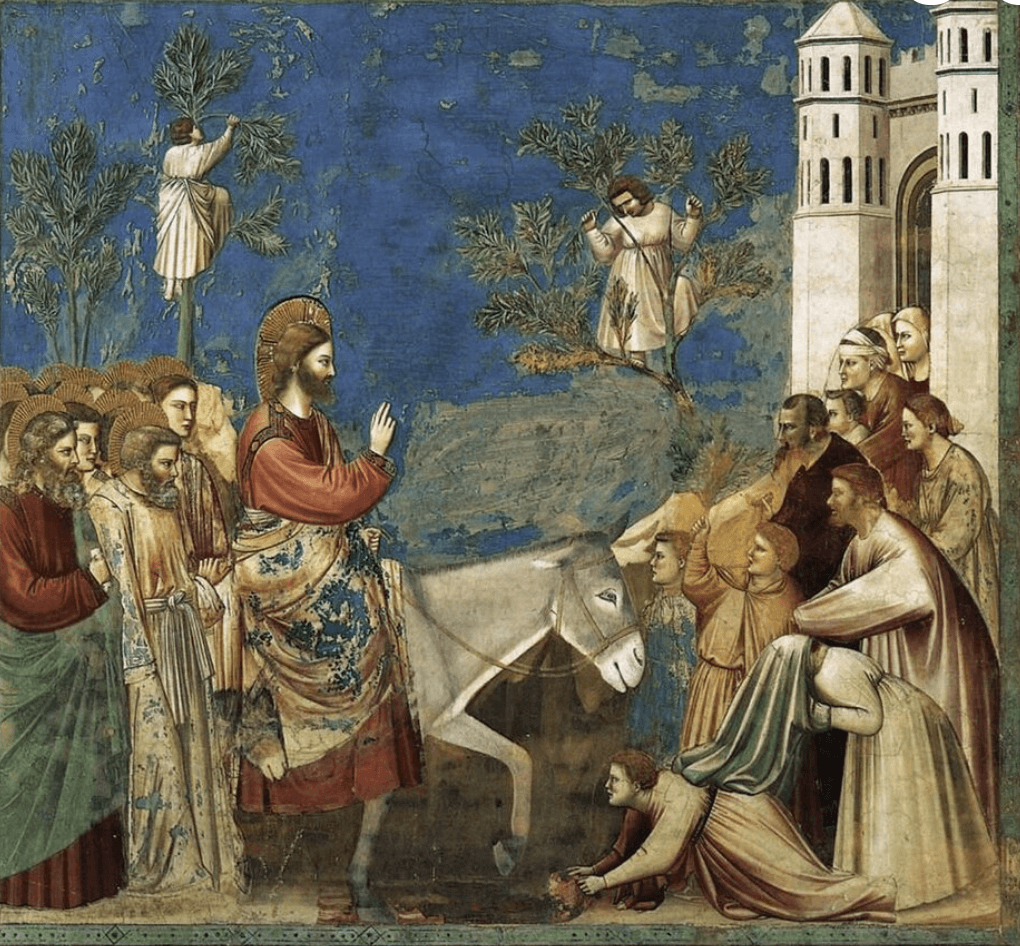 R. T. France, Matthean commentary assessment, publication year 2007 AD.France’s Matthew commentary reads the entry citation as deliberate scriptural framing of humble kingship, arguing that interpretation should track Matthew’s literary intent without forcing either flat contradiction or automatic harmonization.R. T. France‘s analysis of Jesus’ Jerusalem entry
Giotto di Bondone, Jesus’ Entrance on a Donkey, 1304–1306 AD.Jesus’ Jerusalem Entry
R. T. France’s The Gospel of Matthew reads Jesus’ Jerusalem arrival as deliberate scriptural framing of humble kingship. Matthew’s use of Zechariah 9:9 presents the arriving king as gentle and mounted on a donkey, while the surrounding narrative introduces the confrontation that will unfold in Jerusalem. France’s approach prioritizes Matthew’s literary presentation rather than treating every difference among the Gospel accounts as either a flat contradiction or something requiring automatic harmonization. The image is a later artistic depiction, not a contemporary eyewitness record. keeps the textual unit intact: prophecy citation, narrative staging, and audience recognition operate together in Matthew rather than as isolated proof lines. This helps explain why disagreements about donkey phrasing are often disagreements about genre and method before they become claims about event denial or perfect transcript precision. Matthew 21:5 (KJV)Matthew 21:5 (KJV)
“Tell ye the daughter of Sion, Behold, thy King cometh unto thee, meek …”
Context: concentrated fulfillment framing language central to France’s analysis. must be read with Zechariah 9:9–10 (KJV)Zechariah 9:9–10 (KJV)
“… lowly … upon a colt … and his dominion shall be from sea even to sea.”
Context: paired humility-and-rule imagery behind Gospel reuse..
The strongest contribution is methodological clarity on textual framing and its limits.What France is really saying
France does not erase interpretive uncertainty; he narrows where the uncertainty belongs by distinguishing wording analysis from broader historical judgments.
John 12:15–16 (KJV)John The Evangelist by unknown artist, circa 16-17 century
John 12:15–16 (KJV)
‘Fear not, daughter of Sion … These things understood not his disciples at the first …’
Context: John couples citation with delayed understanding motif. offers a comparison point rather than a forced merge with Matthew.Evidence – France’s commentary treatment of Matthew 21:1–11; comparison with Zechariah 9:9–10 and John 12:14–16.
Conclusion – Literary framing and historical inquiry can be pursued together when kept analytically distinct.
Criticisms – Scholars disagree on how strongly Matthew’s language indicates strict literalization versus compositional citation style.
Citation – R. T. France, The Gospel of Matthew (2007 AD), Matthew 21 section; Holy Bible, KJV passages above.
File Under – Jesus Christ > Final Week > Jerusalem Entry > France assessment on Zechariah usage
Cross References – Zechariah donkey-entry card | Triumphal Entry comparison | Arrest & Trial

Hosanna, branches, and the coming kingdom language
Psalm 118 acclamation language in entry scenes, with historical limits.Hosanna and branch imagery in the entry texts reflect scriptural-festival language and public honor symbolism, while the evidence stops short of documenting a coordinated armed revolt or a verified simultaneous imperial counter-procession.The acclamation vocabulary comes from worship language already known in pilgrimage settings, then appears with royal coloring in the entry narratives. Psalm 118:25–26 (KJV)Psalm 118:25–26 (KJV)
“Save now, I beseech thee, O LORD … Blessed be he that cometh in the name of the LORD …”
Context: liturgical source behind Hosanna wording during the procession scenes. stands behind Mark 11:9–10 (KJV)
Mark 11:9–10 (KJV)
“… Blessed be the kingdom of our father David …”
Context: kingdom expectation language appears in Mark’s acclamation form., Luke 19:38–40 (KJV)Luke 19:38–40 (KJV)
“… peace in heaven … if these should hold their peace, the stones would immediately cry out.”
Context: Luke links acclaim to prophetic necessity and opposition response., and John 12:13 (KJV)John 12:13 (KJV)
“… Hosanna … King of Israel …”
Context: John highlights palms and kingship title in one scene. with different emphases.
The evidence best supports symbolic public acclaim in a volatile feast environment.Terms and setting
HosannaHosanna (Hebrew plea/praise term)
From “save now,” used liturgically and acclaiming in festival contexts.
Context: semantic range allows both prayerful and royal-hope resonance. and branch-spreading function as honor practices in a charged sacred season, but these terms do not provide troop counts or operational plans.
Interpretive boundary
Political implications are plausible; direct proof of coordinated revolt from these lines alone is not.Evidence – Psalm 118:25–26; Mark 11:9–10; Luke 19:38–40; John 12:13 (KJV).
Conclusion – Shared acclamation language is strong evidence for symbolic reception, with bounded political inference.
Criticisms – Some readings understate politics; others overstate revolt claims from liturgical language alone.
Citation – Holy Bible, KJV passages above; festival-acclamation scholarship as discussed in section companion assessment.
File Under – Jesus Christ > Final Week > Jerusalem Entry > Hosanna and branch acclamations
Cross References – Levine assessment | Triumphal Entry comparison | Arrest & Trial
Amy-Jill Levine — assessing hosanna, branches, and the coming kingdom
Amy-Jill Levine, Jewish New Testament scholar, Passion-week interpretation.Levine’s published interpretation emphasizes reading Hosanna and palm-procession language within Jewish festival practice and Roman political pressure simultaneously, so that neither devotional flattening nor maximal revolt claims override the textual evidence.Amy-Jill Levine adds value by keeping ritual language, social memory, and power context in one frame while refusing to treat any single line as exhaustive. In that approach, entry praise is meaningful and potentially provocative, yet still requires careful distinction between narrated symbolism and demonstrated operational intent. John 12:13 (KJV)
John 12:13 (KJV)
“… took branches of palm trees … Hosanna …”
Context: branch acclamation is presented as public symbolic action. and Luke 19:39–40 (KJV)Luke 19:39–40 (KJV)
“… rebuke thy disciples … if these should hold their peace, the stones would immediately cry out.”
Context: conflict over public proclamation is explicit in Luke. illustrate that layered dynamic.
This reading strengthens interpretation while preserving evidence boundaries.Scope within Jesus’ Last Week
This card remains pre-arrest in focus: it interprets entry acclamation and festival symbolism, then points forward by cross-reference rather than migrating into hearing/sentencing detail.
Mark 11:10 (KJV)Mark 11:10 (KJV)
“Blessed be the kingdom of our father David …”
Context: kingdom language contributes to why the scene carries historical weight. connects directly to this section’s central question.Evidence – Levine’s Passion-week analysis; John 12:13; Luke 19:39–40; Mark 11:10; Psalm 118:25–26 (KJV).
Conclusion – A balanced interpretation can affirm symbolic force while resisting over-precision claims.
Criticisms – Interpretive disagreement remains over how strongly the texts imply anti-imperial signaling in this scene.
Citation – Amy-Jill Levine, Entering the Passion of Jesus (2018 AD); Holy Bible, KJV passages above.
File Under – Jesus Christ > Final Week > Jerusalem Entry > Levine assessment of Hosanna symbolism
Cross References – Hosanna and branches card | Fredriksen assessment | Arrest & Trial
Jesus Weeps over Jerusalem — Peace, Visitation, and the Coming Siege
Luke 19:41–44 in its entry, Temple, and 70 AD siege contextsLuke 19:41–44 interrupts the entry’s acclamation with Jesus’ tears over Jerusalem, its failure to recognize peace, and a siege oracle later readers could associate with 70 AD.Luke alone places this scene immediately after the acclamation and before the Temple action. As Jesus descends the Mount of OlivesDavid Roberts, Jerusalem from the Mount of Olives, 1839 AD, Cleveland Museum of Art, Cleveland, United States; CC0.Mount of Olives approach
The ridge east of Jerusalem gives a commanding view across the Kidron Valley toward the Temple Mount. Luke situates the lament while Jesus is approaching and beholding the city; the artwork is a nineteenth-century reconstruction, not a view of the city in Jesus’ lifetime. and sees the city, Luke 19:41–44 (KJV)T’oros Roslin, Portrait of the Evangelist Luke, 1262 AD, Walters Manuscript W.539, Walters Art Museum, Baltimore, United States; CC0.Luke 19:41–44 (KJV)
“And when he was come near, he beheld the city, and wept over it, Saying, If thou hadst known … the things which belong unto thy peace! … For the days shall come upon thee, that thine enemies shall cast a trench about thee … because thou knewest not the time of thy visitation.”
Luke joins compassion, failed recognition, and impending siege in one scene. The illumination is later Christian art, not a contemporary portrait. says he weeps, wishes it knew “the things” belonging to peace, and foretells encirclement and destruction.
The Greek ἔκλαυσεν (eklausen, “wept”)Ary Scheffer, Christ Weeping Over Jerusalem, 1851 AD, Walters Art Museum, Baltimore, United States; public domain.ἔκλαυσεν — open weeping
The aorist verb comes from κλαίω, “to weep” or “lament.” It denotes visible grief, but grammar alone cannot reconstruct the duration, volume, or exact physical expression of the tears. Scheffer’s painting is an influential later interpretation of Luke 19:41. supplies open grief; the “time of thy visitation”Alon Alush, Dominus Flevit Church — Exterior View, 2022 AD, Mount of Olives, Jerusalem; CC BY-SA 4.0.ἐπισκοπή — visitation or inspection
Luke’s phrase καιρὸν τῆς ἐπισκοπῆς σου describes a decisive “time of visitation.” In biblical usage a divine visitation may bring deliverance, accountability, or judgment. The modern Dominus Flevit church—its Latin name means “the Lord wept”—commemorates the lament traditionally, but does not identify the exact stopping place archaeologically. makes failed recognition central to Luke’s explanation. Roman siege practiceCarole Raddato, Roman Siege Ramp Seen from Masada, photographed 2014 AD, Masada, Israel; CC BY-SA 2.0.Siegework, encirclement, and isolation
Roman armies could build camps, ramps, embankments, and circumvallation works to restrict movement and supplies. Masada’s surviving ramp illustrates Roman engineering in the same war, but it is not Jerusalem’s vanished siege wall and should not be presented as remains from Luke’s scene. and Israel’s prophetic siege vocabularyPiero della Francesca, The Prophet Jeremiah, c. 1452–1466 AD, Basilica of San Francesco, Arezzo, Italy; public domain.Prophetic language of encirclement and ruin
Israel’s prophets used siege imagery—encampment, surrounding armies, breached walls, fallen stones, and lament—to interpret national catastrophe. Luke’s wording belongs within that scriptural world as well as resembling Roman procedure. The overlap does not identify one exact borrowed passage or settle when the saying originated. illuminate the oracle. The scene changes Luke’s entry from unqualified success to sorrow, warning, and approaching conflict. Josephus corroborates the later siege—not Jesus’ spoken wording.One scene in Luke, with related lament traditions
The weeping scene itself is unique to Luke. Matthew 23:37–39 (KJV)Hovannes, Portrait of the Evangelist Matthew, early seventeenth century AD, Amida Gospels, Walters Manuscript W.541, Walters Art Museum, Baltimore, United States; CC0.Matthew 23:37–39 (KJV)
“O Jerusalem, Jerusalem, thou that killest the prophets … how often would I have gathered thy children together … and ye would not! Behold, your house is left unto you desolate.”
Matthew preserves a related Jerusalem lament later in its narrative, but does not describe Jesus weeping at the entry. The illumination is later Armenian Christian art. and Luke 13:34–35 (KJV)Unknown Byzantine artist, Manuscript Illumination with the Evangelist Luke, late thirteenth–early fourteenth century AD, Metropolitan Museum of Art, New York, United States; CC0.Luke 13:34–35 (KJV)
“O Jerusalem, Jerusalem, which killest the prophets … how often would I have gathered thy children together, as a hen doth gather her brood under her wings, and ye would not! Behold, your house is left unto you desolate.”
Luke places this related lament earlier on the journey; it does not duplicate the entry scene’s tears and siege details. preserve the gathering-hen lament in other narrative locations; Mark and John do not report the Luke 19 tears. That distribution supplies related tradition but not four independent witnesses to this particular moment.
The siege correspondence and its boundary
The oracle’s “trench” translates χάραξ, a stake, palisade, or siegework. Flavius Josephus and the circumvallationAnonymous engraver, Flavius Josephus, published in William Whiston’s 1817 AD edition of Josephus, public domain.Josephus, The Jewish War 5.491–508
Josephus, a participant who later wrote under Flavian patronage, reports that Titus’s army completed a wall around Jerusalem in three days, closing routes of escape and supply. His account independently documents the siege operation; it neither names Luke nor verifies that Jesus uttered Luke 19:41–44. describes Titus’s forces surrounding the city during the siege of Jerusalem in 70 ADDavid Roberts, The Siege and Destruction of Jerusalem by the Romans Under the Command of Titus, AD 70, 1850 AD, public-domain reproduction via Wikimedia Commons.The catastrophe of 70 AD
Roman forces commanded by Titus besieged Jerusalem during the Jewish revolt, captured the city, and destroyed the Second Temple in 70 AD. Roberts’s dramatic nineteenth-century painting is a historical reconstruction, not eyewitness documentation.. The convergence is striking at the level of siege pattern and outcome. It cannot by itself determine whether Luke transmitted an earlier saying, shaped remembered warning after the catastrophe, or combined both.
Dating, composition, and responsible inference
Many scholars date Luke after 70 AD and read the passage with knowledge of the destruction; other chronologies remain defended. Precise correspondence with an event can arise from prediction, remembered warning, post-event narration, or editorial shaping. The passage’s vividness alone does not decide among those possibilities. Historically, the safest claim is that Luke presents Jesus lamenting Jerusalem and interprets its fate through failed recognition, while Josephus supplies independent evidence for the later Roman siege.Evidence – Luke 19:41–44; comparison with Luke 13:34–35 and Matthew 23:37–39; Josephus, The Jewish War 5.491–508 and books 5–6.
Conclusion – Luke deliberately turns entry celebration into lament and warning; the 70 AD siege explains the oracle’s later historical resonance but does not authenticate its exact pre-arrest wording.
Criticisms – Scholars disagree over the saying’s pre-70 core, Luke’s knowledge of the siege, and whether the scene primarily reconstructs Jesus’ warning or interprets Jerusalem’s destruction for later readers.
Citation – Holy Bible, KJV, Luke 19:41–44; Luke 13:34–35; Matthew 23:37–39. Flavius Josephus, The Jewish War 5.491–508; 6. Jonathan S. Wendel, “Weeping Over Jerusalem: Luke’s Response to the Destruction of the Temple,” Harvard Theological Review (2026 AD).
File Under – Jesus Christ > Jesus’ Last Week > Jerusalem Entry > Jesus’ lament over Jerusalem
Cross References – Triumphal Entry comparison | Temple action in Jerusalem | Temple destruction prediction


.jpg)


N. T. Wright — Why Jesus’ Tears Belong at the Center of the Entry
N. T. Wright, New Testament historian, Luke for Everyone, 2004 AD, p. 231“Jesus’ tears are at the core of the Christian gospel.”In Luke for Everyone, N. T. Wright treats Jesus’ tears over JerusalemJames Tissot, The Lord Wept (Le Seigneur pleura), c. 1886–1894 AD, Brooklyn Museum, New York, United States; public domain.The lament inside the royal entry
Tissot portrays the emotional reversal narrated by Luke: acclaim does not culminate in triumphal conquest, but in grief over a city that has not recognized “the things” belonging to peace. The watercolor is devotional interpretation made nearly nineteen centuries later. as central rather than incidental. Published in 2004 AD for general readers, his statement interprets Luke’s juxtaposition of royal acclamation, lament, and impending judgment. Judgment is mourned, not celebrated; the arriving king refuses the ordinary script of conquest and moves toward rejection and death.
The claim illuminates why Luke’s Jerusalem narrativeYair Haklai, Model of Jerusalem in the Late Second Temple Period, photographed 2010 AD, Israel Museum, Jerusalem; CC BY-SA 3.0.Jerusalem as Luke’s narrative destination
Luke’s travel narrative repeatedly looks toward Jerusalem, where teaching, Temple conflict, death, resurrection proclamation, and the opening movement of Acts converge. The Israel Museum model is a modern reconstruction based on literary and archaeological evidence; individual details remain interpretive. moves from praise to warning before the Temple confrontation. Yet Wright’s sentence is theological interpretation, not an independent witness to the episode or its precise wording. Recent scholarship also reads the tears as guidance for responding to the destruction of 70 ADAncient Roman sculptors, Spoils from the Jerusalem Temple, c. 81 AD, Arch of Titus, Rome, Italy; public-domain image prepared by Steerpike.Material commemoration of Roman victory
The Arch of Titus relief shows Roman soldiers carrying Temple spoils, including the menorah, after Jerusalem’s capture. It corroborates Rome’s public celebration of the conquest and Temple plunder, not Luke’s account of Jesus’ lament decades earlier.. Narrative meaning must not be mistaken for multiple attestation.What Wright’s short sentence contributes
Wright’s wording prevents the tears from becoming a decorative pause between the donkey entry and Temple action. In his reading, Jesus embodies God’s peaceable kingdom while lamenting the consequences of another course. That interpretation coheres with the scene’s emotional and royal contrasts, but it remains an argument about Luke’s meaning. It cannot reveal the number of hearers, furnish an audio transcript, or demonstrate exactly how an earlier oral tradition developed.
How recent narrative analysis sharpens the point
Jonathan S. Wendel argues that Luke presents the lament as a response to Jerusalem’s destruction and invites readers to share the grief. He develops Robert C. Tannehill’s proposal that the tears guide the audience’s attitude, while Shelly Matthews has offered a different Greco-Roman comparison with conquerors who weep over doomed cities. The dispute concerns rhetorical force; it does not erase Luke’s unusually explicit grief.
Luke reinforces that pattern when Jesus addresses the “daughters of Jerusalem” in Luke 23:27–31 (KJV)Hohannes, Portrait of the Evangelist Luke, seventeenth century AD, Gospels of Georg Alexief, Walters Manuscript W.546, Walters Art Museum, Baltimore, United States; CC0.Luke 23:27–31 (KJV)
“Daughters of Jerusalem, weep not for me, but weep for yourselves, and for your children. For, behold, the days are coming …”
The later Passion scene redirects mourning toward the city’s impending suffering and echoes Luke 19’s grief. The illumination is later Christian art, not a contemporary likeness., connecting his own lament with commanded mourning for the city’s inhabitants.Broken speech and emotional rhetoric
In Luke 19:42 (KJV)James Tissot, Jerusalem, Jerusalem (Jérusalem, Jérusalem), c. 1886–1894 AD, Brooklyn Museum, New York, United States; public domain.Luke 19:42 (KJV)
“If thou hadst known, even thou, at least in this thy day, the things which belong unto thy peace! but now they are hid from thine eyes.”
The sentence begins an emotional conditional lament. Tissot’s watercolor interprets the related Jerusalem-lament tradition and is not evidence for the original scene. the conditional begins “If thou hadst known …” without supplying a normal “then” clause. The rhetorical phenomenon called aposiopesisUnknown scribes, Codex Alexandrinus, Gospel of Luke, fol. 41v, fifth century AD, British Library, London, United Kingdom; public domain.Aposiopesis — speech breaking off
Aposiopesis occurs when a sentence trails off or leaves its conclusion unstated, often under emotional pressure. In Luke 19:42 the broken conditional allows the lament to sound unfinished. Codex Alexandrinus is a major fifth-century Greek Bible manuscript; this displayed folio concludes Luke rather than showing verse 19:42 itself. lets emotion interrupt syntax. That observation strengthens a literary reading, but literary artistry neither proves invention nor guarantees verbatim preservation.Evidence – N. T. Wright’s published interpretation; Luke 19:41–44 and 23:27–31; the narrative-rhetorical analyses of Jonathan S. Wendel, Robert C. Tannehill, and Shelly Matthews.
Conclusion – Wright correctly highlights the lament’s theological weight within Luke; the historical status and recoverable wording of the unique scene require a separate judgment.
Criticisms – Wright’s kingdom-and-peace reconstruction goes beyond Luke’s explicit wording at points, while post-70 narrative readings may explain the finished Gospel more securely than the consciousness of the historical Jesus.
Citation – N. T. Wright, Luke for Everyone (Westminster John Knox Press, 2004 AD), 231. Jonathan S. Wendel, “Weeping Over Jerusalem: Luke’s Response to the Destruction of the Temple,” Harvard Theological Review (2026 AD). Holy Bible, KJV, Luke 19:41–44; 23:27–31.
File Under – Jesus Christ > Jesus’ Last Week > Jerusalem Entry > N. T. Wright on Jesus’ tears
Cross References – Jesus weeps over Jerusalem | Fredriksen on royal entry symbolism | Allison on apocalyptic warning

_-_James_Tissot.jpg)


_-_James_Tissot.jpg)

Temple Action, Fig Tree & the Jerusalem Setting
Examine the disruption of Temple commerce, Isaiah and Jeremiah citations, the fig tree, and John’s different narrative placement. The Temple entrances and pilgrimage-route evidence supply geographical context without identifying Jesus’s exact footsteps.Card index — section 03
- Cleansing the Temple — A Prophetic Enacted-Parable — Existing card — revise (FW04-C01)
- E. P. Sanders — assessing what the Temple action actually reports — Create card — verified quotation/assessment (FW04-C02)
- The Cleansing of the Temple — Isaiah 56 / Jeremiah 7 Convergence — Existing card — revise (FW04-C03)
- Craig A. Evans — assessing house of prayer and den of robbers — Create card — verified quotation/assessment (FW04-C04)
- The Cursing of the Fig Tree — Prophetic Symbolism in Action — Existing card — revise (FW04-C05)
- Joel Marcus — assessing the fig tree and the Temple sequence — Create card — verified quotation/assessment (FW04-C06)
- One Temple action or two? — Create card — evidence/report (FW04-C07)
- L. Michael White — assessing one Temple action or two? — Create card — verified quotation/assessment (FW04-C08)
- The Southern Steps & Hulda Gates — The Pilgrim Entry — Existing card — revise (FW16-C09)
- Jodi Magness — assessing pilgrimage routes and Temple entrances — Create card — verified quotation/assessment (FW16-C10)
Temple Action in Jerusalem — A Prophetic Enacted Sign
 Mark , Matthew , Luke , and John compared in Jerusalem, first century AD.The Synoptic Gospels report a disruptive Temple action involving sellers, money changers, and movement control, framed with prophetic Scripture; comparison with John is interpretively important, but details from one account should not be imported into another.In the core sequence, Mark places Jesus in the Temple courts overturning money-changer tables and seats of dove sellers, then adds a prohibition on carrying vessels through the area before citing Scripture. Mark 11:15–17 (KJV)
Wikimedia Commons file; creator, title, and date are listed on the file page.
Mark 11:15–17 (KJV)
“… overthrew the tables of the moneychangers … and would not suffer that any man should carry any vessel through the temple … My house shall be called of all nations the house of prayer? but ye have made it a den of thieves.”
Context: targeted disruption plus prophetic rebuke.
Matthew and Luke report the cleansing emphasis with different compression, while John places a Temple action earlier in his narrative and includes details not stated in Mark. The most defensible claim is a symbolic, high-visibility prophetic action, not total shutdown of the entire Temple complex.What the action does and does not imply
Money changing and sacrificial provisioning were normal pilgrimage functions in a functioning Temple economy; the critique in these passages is not “commerce exists,” but prophetic judgment on how sacred space and covenant conduct are being handled in that moment.
Luke 19:45–46 (KJV)Wikimedia Commons file; creator, title, and date are listed on the file page.
Luke 19:45–46 (KJV)
“… he cast out them that sold therein … saying … My house is the house of prayer: but ye have made it a den of thieves.”
Context: prophetic accusation, not a technical audit report.
Interpretive limit
This evidence supports symbolic confrontation and public teaching authority claims; it does not by itself prove every participant’s motive or map the precise duration/intensity across all courtyards.Evidence – Mark 11:15–19; Matthew 21:12–17; Luke 19:45–48; John 2:13–22 (comparison).
Conclusion – The reported action is targeted, scripturally framed disruption within Temple space, best read as prophetic sign-act.
Criticisms – Debate continues over scope, chronology across Gospels, and whether “den of thieves” is mainly moral, political, or covenantal indictment.
Citation – Holy Bible, KJV passages above.
File Under – Jesus Christ > Jesus’ Last Week > Temple Actions > What the Temple action reports
Cross References – E. P. Sanders assessment | Isaiah 56 / Jeremiah 7 convergence | Arrest & Trial
Source locator retained – /evidence-for-jesus-christ/jesus-ministry/teachings-parables/
E. P. Sanders — assessing what the Temple action actually reports
E. P. Sanders , historian of Second Temple JudaismSanders’ historical analysis treats the Temple action as a symbolic prophetic sign tied to judgment themes and Temple destiny, not as random violence and not as proof that ordinary Temple operations were inherently illegitimate.For our purposes, Sanders’ insights are used as a published scholarly assessment rather than an invented stitched quotation. His contribution is to keep first-century Temple practice and Jesus’ sign-act in the same frame: normal sacrificial infrastructure could coexist with severe prophetic criticism of leadership and covenant fidelity. Mark 11:18 (KJV)
Mark 11:18 (KJV)
“… the scribes and chief priests heard it, and sought how they might destroy him …”
Context: public action escalates conflict with Temple authorities.
This reading clarifies why the episode matters in final-week escalation without requiring claims that Jesus physically controlled every Temple sub-area. Historical force lies in symbolic challenge and elite response, not maximal operational shutdown claims.Separating argument from caricature
Sanders helps distinguish historical argument from caricature: Jesus can be read as issuing Temple-centered prophetic warning inside Judaism, not as rejecting Judaism wholesale.
Jeremiah 7:11 (KJV)
Jeremiah 7:11 (KJV)
“Is this house, which is called by my name, become a den of robbers in your eyes? …”
Context: sanctuary-presumption critique in prophetic tradition.
The interpretive boundary remains important: literary theology and historical reconstruction overlap but are not identical methods.Evidence – Sanders on Jesus and Temple symbolism; Mark 11 and prophetic background texts.
Conclusion – Sanders supports reading the action as deliberate symbolic judgment inside a Jewish prophetic framework.
Criticisms – Scholars differ on how directly the act predicts Temple destruction and how precisely it contributed to arrest timing.
Citation – E. P. Sanders, Jesus and Judaism (1985 AD); Holy Bible, KJV passages above.
File Under – Jesus Christ > Jesus’ Last Week > Temple Actions > Sanders on Temple action
Cross References – Temple action report card | Craig A. Evans assessment | Arrest & Trial
House of Prayer and Den of Robbers — Isaiah 56 and Jeremiah 7 in Mark
Prophetic citation convergence in Mark with context controls from Isaiah and JeremiahMark’s Temple saying combines Isaiah’s ‘house of prayer for all nations’ with Jeremiah’s ‘den of robbers,’ creating a covenant-prophetic critique that should not be reduced either to mere anti-commerce rhetoric or anti-Judaism claims.Mark 11:17 is a composite scriptural indictment. Isaiah 56:7 (KJV)
Isaiah 56:7 (KJV)
“… mine house shall be called an house of prayer for all people.”
Context: inclusive worship vision within restoration discourse.
Jeremiah 7:1–15 (KJV context)Jeremiah 7 context (KJV)
“… Trust ye not in lying words, saying, The temple of the LORD …”
Context: prophetic warning against sanctuary confidence without covenant obedience. supplies the judgment edge. Mark therefore presents an intra-scriptural prophetic warning, not a denial that Temple sacrifices and exchange services existed for legitimate pilgrimage needs. The convergence targets conduct and presumption, not Judaism as a whole.Why citation context matters
If Isaiah 56 is isolated, the critique can be softened into generic piety; if Jeremiah 7 is isolated, it can be hardened into purely punitive rhetoric. The combined use explains both invitation and warning inside covenant theology.
Interpretive limit
The convergence demonstrates literary-theological intent in Mark; independent archaeological corroboration of every narrative detail is a separate evidentiary question.Evidence – Isaiah 56:6–8; Jeremiah 7:1–15; Mark 11:17 (KJV).
Conclusion – The saying is best read as a prophetically framed covenant critique of Temple practice and trust.
Criticisms – Some readings over-moralize commerce alone; others over-politicize the phrase beyond textual context.
Citation – Holy Bible, KJV passages above.
File Under – Jesus Christ > Jesus’ Last Week > Temple Actions > Isaiah/Jeremiah convergence
Cross References – Craig A. Evans assessment | Temple action report card | Arrest & Trial
Source locator retained – /evidence-for-jesus-christ/jesus-ministry/prophecies-fulfilled/
Craig A. Evans — assessing ‘house of prayer’ and ‘den of robbers’
_LCCN2016652375.jpg) Craig A. Evans on Mark 11 and prophetic citation logic.Evans’ commentary treatment emphasizes that Mark’s paired citations are programmatic: Jesus’ action is read as a prophetic critique of Temple misuse and false security, not as standalone proof of archaeological particulars.This assessment clarifies how the companion evidence card should be read: Mark is narrating an interpreted event in scriptural dialogue with Isaiah and Jeremiah. Evans highlights that “den of robbers” in its prophetic backdrop concerns refuge-logic after injustice, not merely price complaints. Mark 11:17 (KJV)
Craig A. Evans on Mark 11 and prophetic citation logic.Evans’ commentary treatment emphasizes that Mark’s paired citations are programmatic: Jesus’ action is read as a prophetic critique of Temple misuse and false security, not as standalone proof of archaeological particulars.This assessment clarifies how the companion evidence card should be read: Mark is narrating an interpreted event in scriptural dialogue with Isaiah and Jeremiah. Evans highlights that “den of robbers” in its prophetic backdrop concerns refuge-logic after injustice, not merely price complaints. Mark 11:17 (KJV)
Mark 11:17 (KJV)
“… house of prayer for all nations … den of thieves.”
Context: deliberate prophetic synthesis in a Temple-conflict scene.
Read this way, the text remains sharply critical while still intra-Jewish in scriptural mode. The key gain is contextual precision, not an expanded claim of independent material verification.Evans putting it intro perspective
Evans helps prevent category errors: commentary can illuminate textual intent and historical plausibility, but it is not equivalent to a separate archaeological report. This card addresses scriptural interpretation in final-week Temple conflict; procedural arrest/trial material belongs to the linked Arrest & Trial pathway.Evidence – Evans on Mark 11 in major commentary tradition; Isaiah 56 and Jeremiah 7 context.
Conclusion – The phrase pair is best read as prophetic covenant critique in narrative form.
Criticisms – Divergence remains over weighting of economic abuse, symbolic judgment, and eschatological warning.
Citation – Craig A. Evans, Mark 8:27–16:20 (2001 AD), Mark 11 discussion; Holy Bible, KJV.
File Under – Jesus Christ > Jesus’ Last Week > Temple Actions > Evans on house of prayer/den of robbers
Cross References – Isaiah/Jeremiah convergence card | Sanders assessment | Arrest & Trial
The Fig Tree and the Temple Sequence — Prophetic Symbolism in Narrative Form
 Mark intercalation and Matthew compression compared with prayer/forgiveness teaching.Mark’s fig-tree and Temple episodes are interwoven as a narrative unit, while Matthew presents a compressed sequence; symbolic readings are plausible but must remain interpretations rather than total identifications of the tree with an entire people.In Mark, the sequence moves fig tree → Temple action → withered fig tree, then transitions into teaching on faith, prayer, and forgiveness. Mark 11:13–14, 20–25 (KJV)
Mark 11 (KJV excerpts)
“… for the time of figs was not yet … No man eat fruit of thee hereafter for ever … Have faith in God … when ye stand praying, forgive …”
Context: symbolic action framed by discipleship teaching.
Matthew presents a tighter miracle sequence, which changes narrative pacing but not the need for interpretive restraint. The evidence supports literary-theological signaling; it does not yield a botanically certain miracle mechanism or blanket ethnic condemnation.Season note and symbolic range
The “not yet” season line in Mark has prompted extensive debate; many interpreters read it as cueing enacted-parable logic rather than horticultural reportage alone.
Teaching frame
The sequence culminates in prayer and forgiveness instruction, so the episode cannot be reduced to punitive spectacle detached from discipleship ethics.Evidence – Mark 11:12–25; Matthew 21:18–22 (KJV).
Conclusion – Mark’s arrangement encourages symbolic-temple reading; Matthew’s compression invites careful comparative method.
Criticisms – Ongoing debate on intercalation intent, miracle temporality, and symbolism scope.
Citation – Holy Bible, KJV passages above; major critical commentaries on Mark/Matthew final-week narratives.
File Under – Jesus Christ > Jesus’ Last Week > Temple Actions > Fig tree and Temple sequence
Cross References – Joel Marcus assessment | Temple action report card | Arrest & Trial
Source locator retained – /evidence-for-jesus-christ/jesus-ministry/miracles-testimonies/
Joel Marcus — assessing the fig tree and Temple sequence
Joel Marcus on Markan structure, symbolism, and interpretive scope.Marcus’ commentary-level analysis treats Mark’s fig-tree framing as intentional narrative architecture that interprets the Temple episode, while still requiring caution about turning literary symbolism into total historical simplification.Marcus is especially relevant because he reads the sequence as a compositional signal, not a random juxtaposition: the fig tree frames the Temple action and invites judgment-fruitfulness interpretation within Mark’s theological narrative world. At the same time, he does not require reductionist conclusions that the tree straightforwardly equals all Jewish people, nor does he erase the prayer-and-forgiveness teaching that follows. Matthew 21:19–22 (KJV)
Matthew 21:19–22 (KJV)
“… Let no fruit grow on thee henceforward for ever … If ye have faith, and doubt not …”
Context: compressed narrative with immediate didactic turn.
Best use of Marcus is methodological: read structure, symbolism, and teaching together before drawing broad historical claims.Interpretive analysis and overreach
This assessment card clarifies what those details can and cannot bear interpretively in literary-historical analysis. Narrative symbolism is real and important, but it should not be turned into deterministic claims about group identity, botany, or chronology beyond what the text itself supports.Evidence – Joel Marcus on Mark 11 intercalation and Temple linkage; Mark 11 and Matthew 21 comparisons.
Conclusion – Structural reading enriches interpretation while preserving evidentiary limits.
Criticisms – Scholars disagree on degree of symbolic determinacy and on how tightly Temple judgment controls fig-tree meaning.
Citation – Joel Marcus, Mark 8–16 (2009 AD), fig tree/Temple discussion; Holy Bible, KJV.
File Under – Jesus Christ > Jesus’ Last Week > Temple Actions > Marcus on fig tree/Temple structure
Cross References – Fig tree evidence card | Sanders assessment | Arrest & Trial
One Temple action or two? Placement, harmonization, and uncertainty
Comparing Johannine and Synoptic placement of the Temple action account.The sources permit three credible models: one historical action placed differently for literary-theological reasons, two distinct actions at different times, or unresolved historical uncertainty given narrative shaping in each Gospel tradition.John 2:13–22 (KJV)
John 2:13–22 (KJV)
“… made a scourge of small cords … Take these things hence … Destroy this temple, and in three days I will raise it up.”
Context: John places a Temple action near the start of public ministry. appears early, while Mark 11:15–19 (KJV)Mark 11:15–19 (KJV)
“… overthrew the tables of the moneychangers … My house shall be called of all nations the house of prayer …”
Context: Synoptic placement is in final-week escalation. appears late with conflict acceleration. Readers then weigh literary relocationLiterary relocation
Placing an event at a strategic narrative location to highlight meaning.
Context: may explain one event placed at different timeline points., two-event harmonizationTwo-event harmonization
Proposal that two similar Temple incidents occurred in distinct periods.
Context: preserves timeline differences but increases historical burden., and strict agnosticism.
The evidence secures a Temple-sign tradition; exact chronology remains contested.What each model explains best
A one-action relocation model explains why both streams preserve similar core motifs (Temple confrontation, authority claim, scriptural framing) while differing in sequence. A two-action model explains chronology literally but must justify why details are thematically parallel in highly charged scenes.
Method and limits
Historical method distinguishes narrative theology from event reconstruction: literary design is expected in ancient biography-like writing, yet design does not imply invention by default. Passover pilgrimage context
Passover pilgrimage context
Jerusalem’s festival density heightened visibility, control concerns, and interpretive stakes in Temple scenes. raises plausibility for public confrontation, but not for precise minute-by-minute reconstruction.Evidence – John 2:13–22; Mark 11:15–19; Matthew 21:12–17; Luke 19:45–48; comparative-source analysis.
Conclusion – A Temple-action memory is strong; whether one placement was relocated or two actions occurred remains open.
Criticisms – Some scholars judge relocation most economical; others prefer harmonization; both approaches risk overconfidence when uncertainty is underplayed.
Citation – Holy Bible, KJV passages above; PBS/FRONTLINE Temple-discussion materials as comparative secondary context.
File Under – Evidence for Jesus Christ > Jesus’ Last Week > Temple Action > One Temple action or two
Cross References – L. Michael White assessment | Temple action report | Ministry source page | Arrest & Trial
L. Michael White — assessing one Temple action or two?
L. Michael White, classicist historian, Temple chronology comparison assessment.White’s public-facing analysis is most useful as a comparative framework: it highlights why source placement differences matter, but it does not by itself settle chronology or establish consensus beyond the texts and arguments it summarizes.L. Michael White helps readers compare options without forcing premature closure. His treatment foregrounds how Johannine chronologyJohannine chronology
The narrative sequence in the Gospel of John, including early Temple-action placement. and Synoptic chronologySynoptic chronology
The sequence in Mark, Matthew, and Luke, where Temple action appears in final-week conflict. can serve theological emphasis while still preserving historical memory claims. John 2:16 (KJV)
John 2:16 (KJV)
“… make not my Father’s house an house of merchandise.”
Context: Johannine formulation of Temple rebuke. and Mark 11:17 (KJV)Mark 11:17 (KJV)
“… house of prayer for all nations … den of thieves.”
Context: Synoptic scriptural-convergence formulation. are related yet literarily distinct.
His contribution is methodological clarity, not final adjudication.How this card complements FW04-C07
FW04-C07 maps the evidence positions; this card explains how a historian of antiquity evaluates narrative placement as an interpretive variable. That keeps readers from treating one popular-media summary as an automatic scholarly consensus statement.
Verification boundary
When using interviews/documentaries, wording must be tracked to actual transcript context, then checked against peer-reviewed monographs/commentaries before elevating conclusions. source-critical comparison
Source-critical comparison
Method that compares narrative forms, sequence, and wording across sources before historical synthesis. is therefore central to responsible use.Evidence – White’s PBS/FRONTLINE Temple-analysis framing; John 2 and Synoptic final-week passages.
Conclusion – White adds a clear comparative lens for chronology debates but does not remove core uncertainty.
Criticisms – Public-media compression can oversimplify specialist disagreement; strict transcript/context checking remains necessary.
Citation – L. Michael White interview material in PBS FRONTLINE (1998 AD) Temple segment; Holy Bible, KJV references.
File Under – Evidence for Jesus Christ > Jesus’ Last Week > Temple Action > White on one or two Temple actions
Cross References – One Temple action or two | E. P. Sanders assessment | Arrest & Trial


Southern Steps and Hulda Gates — Pilgrim access and evidentiary limits
Archaeology of Temple access routes and limits of event-specific attribution.Excavated remains at the Southern Steps/Hulda Gates show major pilgrimage access architecture in the Herodian period, but they do not independently identify Jesus’s exact route on a specific day of final-week movement.The Southern StepsSouthern Steps
Monumental stair systems leading toward southern Temple Mount entry points in Herodian-period Jerusalem. and Hulda GatesHulda Gates
Named southern gate complex in later rabbinic memory, associated with Temple Mount ingress/egress structures. materially support large-scale access design for festival traffic. This aligns with Gospel settings that place intense activity near Temple precincts during the final week, including Mark 11:15–18 (KJV)
Mark 11:15–18 (KJV)
“… entered into the temple … overthrew the tables …”
Context: narrative assumes dense public sacred-space circulation.. Yet archaeology cannot name individual footsteps without an inscriptional tie.
Best inference: realistic route infrastructure, not route certainty for one person.Certain and uncertain claims
Secure: Herodian Jerusalem had engineered approach systems capable of handling significant ritual movement. Uncertain: whether one newly highlighted excavation corridor should be mapped directly onto every Gospel movement scene without independent textual-archaeological linkage.
Map-reading caution
Route reconstructions should mark confidence levels and alternative paths, especially when correlating southern approaches with Mount of Olives approach notices
Mount of Olives approach notices
Gospel references to eastern approach geography; these do not automatically specify one excavated southern staircase route..Evidence – Temple Mount southern-approach archaeology; Herodian-period access infrastructure; Mark 11 final-week Temple context.
Conclusion – Archaeology strongly corroborates setting plausibility while leaving individual route attribution open.
Criticisms – Some reconstructions over-link specific excavations to named Gospel movements; others underuse contextual archaeological fit.
Citation – Published Temple Mount/southern-access excavation literature; Holy Bible, KJV Mark 11 context passage.
File Under – Evidence for Jesus Christ > Jesus’ Last Week > Temple Action > Southern Steps and Hulda Gates context
Cross References – Jodi Magness assessment | Temple action report | Archaeology source page
Note – Legacy ID prefix
fw-archaeologysuggests this card may also fit the archaeology menu branch; keep cross-linked even if retained in Temple Action.
_LCCN2016652375.jpg)
Jodi Magness — assessing pilgrimage routes and Temple entrances
Jodi Magness, archaeologist, Herodian Jerusalem context and inference limits.Magness-style archaeological framing is most valuable when it distinguishes what excavations securely show about the city’s built environment from what remains inferential when tying specific Gospel episodes to exact pathways.Jodi Magness contributes a disciplined boundary: archaeology can map urban scale, access systems, and period development, but it rarely identifies a named historical actor’s exact movement absent direct epigraphic linkage. That distinction helps this page avoid overstating route claims while still using material context meaningfully. Luke 19:37–41 (KJV)
Luke 19:37–41 (KJV)
“… at the descent of the mount of Olives … when he was come near, he beheld the city …”
Context: text supplies directional narrative, not surveyed route geometry. is a good example of directional but non-cartographic evidence.
Strongest result: calibrated convergence between text and urban archaeology.Why this assessment matters for the section
Temple Action cards depend on public-space plausibility. Archaeology anchors that plausibility by showing engineered access and ritual infrastructure, while historical method prevents over-precision claims that exceed available evidence.
Transfer-limit for new discoveries
Even when later excavations illuminate first-century movement corridors, each proposed Gospel-route mapping still needs explicit argument rather than automatic transfer. Herodian Jerusalem urban context
Herodian Jerusalem context
Late Second Temple-period city expansion and monumentalization under Herodian rule; key background for route plausibility claims. should be used as context, not as over-specific proof.Evidence – Magness’s archaeological framing of Jerusalem contexts; Southern Steps/Hulda Gates evidence; Luke 19 approach text.
Conclusion – Material context is strong for plausibility, limited for exact individual-route certainty.
Criticisms – Maximal harmonization can overclaim route precision; minimalism can undervalue genuine contextual corroboration.
Citation – Jodi Magness, public scholarship on Jerusalem archaeology (including 2024 AD lecture context); Temple-access excavation reports; Holy Bible, KJV Luke 19 passage.
File Under – Evidence for Jesus Christ > Jesus’ Last Week > Temple Action > Magness on routes and entrances
Cross References – Southern Steps and Hulda Gates | One or two Temple actions | Archaeology source page
Note – Legacy ID prefix
fw-archaeologyindicates probable overlap with archaeology-focused menu placement; retain cross-link if section reassignment is made.

Public Debates & the Final Public Appeal
Explore authority, the tenants, Caesar’s coin, resurrection questions, love commands, Davidic identity, the widow’s offering, and John’s final public appeal. Explain the specific speakers and arguments without generalizing disputed statements to whole communities.
Card index — section 04
- Authority, John’s baptism, and the tenants — Create card — evidence/report (FW05-C01)
- Amy-Jill Levine — assessing authority, John’s baptism, and the tenants — Create card — verified quotation/assessment (FW05-C02)
- “Render Unto Caesar” — A Rhetorical Escape Trap — Existing card — revise (FW05-C03)
- Warren Carter — assessing the tribute question and the denarius — Create card — verified quotation/assessment (FW05-C04)
- Resurrection debate, love commands, and David’s son — Create card — evidence/report (FW05-C05)
- N. T. Wright — assessing resurrection debate, love commands, and David’s son — Create card — verified quotation/assessment (FW05-C06)
- THE WIDOW’S MITE: THE COIN JESUS WATCHED HER GIVE — Existing card — revise (FW05-C07)
- Addison G. Wright — assessing the widow’s two coins and leadership warnings — Create card — verified quotation/assessment (FW05-C08)
- Greeks seek Jesus and John’s final public appeal — Create card — evidence/report (FW05-C09)
- Marianne Meye Thompson — assessing greeks seek Jesus and John’s final public appeal — Create card — verified quotation/assessment (FW05-C10)
Authority, John’s baptism, and the tenants
Temple-court challenge sequence linking authority debate to vineyard judgment.In the Synoptic sequence, a public challenge about Jesus’s authority leads directly into dispute over John’s baptism and then into the tenants parable, where leadership accountability and covenant-fruit themes are foregrounded.In Mark 11:27–33 (KJV)
Mark 11:27–33 (KJV)
“By what authority doest thou these things?… The baptism of John, was it from heaven, or of men?”
Context: authority test in public Temple teaching., the question comes from specific chief priests, scribes, and eldersLeadership audience
Named Temple leadership groups in the narrative scene; this does not equal every Jewish person., then flows into the tenants parableTenants parable
A vineyard story of entrusted stewardship, rejection, and judgment imagery. in Mark 12. The vineyard frame echoes Isaiah 5:1–7 (KJV)Isaiah 5:1–7 (KJV)
“My wellbeloved hath a vineyard… he looked that it should bring forth grapes…”
Context: covenant-fruit expectation and judgment symbolism., helping readers hear prophetic continuity without merging separate parables like the two sons and wedding banquet.
The strongest reading targets accountable leadership within the scene, not an entire people.Sequence logic in the Synoptics
The authority challenge, John question, and tenants story function as one argumentative arc: credential, refusal, then judgment warning. Matthew 21:23–46Matthean parallels
Matthew places related controversy material together but develops adjacent parables with his own compositional emphasis. and Luke 20:1–19Lukan parallels
Luke preserves the core confrontation while compressing and arranging material in his narrative style. confirm broad overlap with differing literary shape.
Interpretive boundary
The “son” and “tenants” have multiple scholarly readings; typological Christian readings are historically influential, but the narrative’s immediate audience remains leadership-focused in a final-week Temple setting.Evidence – Mark 11:27–12:12; Matthew 21:23–46; Luke 20:1–19; Isaiah 5:1–7.
Conclusion – The texts present a linked controversy sequence culminating in leadership-accountability symbolism.
Criticisms – Debate persists over referent precision for “son/tenants” and over how directly the parable predicts later historical events.
Citation – Holy Bible, KJV passages above; major Synoptic parable commentaries.
File Under – Evidence for Jesus Christ > Jesus’ Last Week > Public Debates > Authority, John’s baptism, and tenants
Cross References – Amy-Jill Levine assessment | Resurrection/love/David’s son | Arrest & Trial
Amy-Jill Levine — assessing authority, John’s baptism, and the tenants
Amy-Jill Levine on parable context, audience, and anti-generalization discipline.Levine’s parable methodology emphasizes close narrative audience control and warns against turning intra-Jewish controversy stories into generalized claims about Judaism or collective blame.Amy-Jill Levine is especially useful here because she pushes readers to ask who is being addressed in the scene before importing later polemics. In the authority-to-tenants sequence, that means tracking named leaders, rhetorical escalation, and scriptural echoes without collapsing every group into one voice. Mark 12:1–12 (KJV)
Mark 12:1–12 (KJV)
“A certain man planted a vineyard…”
Context: stewardship and response to the son are central motifs. and Matthew 21 parallel expansionsParallel expansions
Matthew develops adjacent parable units; those units should be compared, not merged into one flattened story. illustrate this care.
Her contribution is interpretive precision: narrative conflict is specific, not indiscriminate.How this sharpens FW05-C01
Levine-style reading keeps historical and ethical guardrails visible: identify the textual audience, compare each evangelist’s framing, and resist retrospective overextension. intra-Jewish debateIntra-Jewish debate
Disputation within Second Temple Judaism; recognizing this limits anti-Judaism misreadings. is the appropriate frame for these Temple-court controversies.
Limit on claims
This assessment clarifies interpretive method; it is not independent archaeological proof of each narrative detail and should not be used as such.Evidence – Amy-Jill Levine, Short Stories by Jesus (2014 AD); Entering the Passion of Jesus (2018 AD); Synoptic controversy passages.
Conclusion – Levine adds a strong audience-and-context control that reduces overgeneralized readings.
Criticisms – Some readers judge this approach too cautious typologically; others see it as essential for historical and ethical accuracy.
Citation – Works listed above; Holy Bible, KJV passages.
File Under – Evidence for Jesus Christ > Jesus’ Last Week > Public Debates > Levine on authority and tenants
Cross References – Authority/John/tenants | Warren Carter on tribute | Arrest & Trial
“Render unto Caesar” — image, inscription, and public trap
Tribute controversy in Roman Judea: coin symbolism, allegiance, and rhetoric.The tribute question functions as a political-religious trap: refusing tax could imply sedition, endorsing it unqualified could imply collaboration; Jesus’s answer pivots on image and obligation language without becoming a modern constitutional formula.In Mark 12:13–17 (KJV)
Mark 12:13–17 (KJV)
“Whose is this image and superscription?… Render to Caesar the things that are Caesar’s…”, the staged question is delivered by aligned opponents to force public compromise. A Tiberian denariusTiberian denarius
Commonly used illustration of early first-century Roman silver coinage; no surviving specimen can be identified as the exact coin handled in the scene. can illustrate monetary context, but not identity proof. Matthew 22:15–22Matthean form
Matthew emphasizes entrapment intent and amazement response. and Luke 20:20–26Lukan form
Luke highlights surveillance intent and failed accusation outcome. preserve the same core trap dynamic.
Best-supported claim: a rhetorical escape that reframes allegiance, not a full state-theory blueprint.Interpretive range
Interpretations span prudent disengagement from trap politics, limited civic compliance, and deeper theological contrast between imperial claims and divine claim. The wording’s brevity explains its lasting interpretive plurality.
Historical boundary
Coin iconography contextualizes the moment but does not prove precise setting mechanics by itself; narrative-literary analysis and Roman provincial history must be read together.Evidence – Mark 12:13–17; Matthew 22:15–22; Luke 20:20–26; Roman coinage catalogues.
Conclusion – The saying resolves an immediate trap while preserving interpretive openness on long-term political theology.
Criticisms – Some readings underplay anti-imperial undertones; others overextend the text into a complete modern church-state doctrine.
Citation – Holy Bible, KJV passages; standard Roman coin references for contextual denarius typology.
File Under – Evidence for Jesus Christ > Jesus’ Last Week > Public Debates > Render unto Caesar
Cross References – Warren Carter assessment | Authority and tenants | Source page locator
Warren Carter — assessing the tribute question and the denarius
Warren Carter on Matthew’s imperial context and contested allegiances.Carter’s imperial-context reading highlights how tribute disputes encode power, loyalty, and identity under Rome, while cautioning that one saying should not be forced into a total political system beyond its narrative frame.Warren Carter foregrounds Roman imperial realities in reading the tribute exchange, especially in Matthew’s conflict setting. His contribution is to keep empire contextEmpire context
Provincial taxation, authority display, and symbolic sovereignty under Roman rule in first-century Judea. visible while still treating the Gospel pericope as a crafted narrative unit. Matthew 22:21 (KJV)
Matthew 22:21 (KJV)
“Render therefore unto Caesar the things which are Caesar’s; and unto God the things that are God’s.” can be read as strategic speech under pressure, not as apolitical neutrality. Yet Carter’s model is one scholarly lens among others.
Most helpful gain: sharper historical pressure context without eliminating textual ambiguity.Companion value to FW05-C03
FW05-C03 maps trap mechanics; Carter deepens the Roman-political field in which that trap operates. This clarifies why coin-image language can carry both practical and symbolic weight.
Scope limit
Carter’s reconstruction is interpretive scholarship, not unanimous consensus; readers should compare with alternative Matthean and Synoptic commentaries.Evidence – Warren Carter, Matthew and Empire (2001 AD); Matthew 22:15–22 with Synoptic parallels.
Conclusion – Carter adds historically grounded imperial framing to the tribute saying while preserving interpretive plurality.
Criticisms – Critics argue some empire-focused readings may over-politicize brief sayings; defenders argue they restore first-century realism.
Citation – Carter work above; Holy Bible, KJV passages.
File Under – Evidence for Jesus Christ > Jesus’ Last Week > Public Debates > Carter on tribute and denarius
Cross References – Render unto Caesar | Levine assessment | Arrest & Trial
Sadducean resurrection challenge, commandment priority, and David’s son
 Temple disputes over resurrection, law, and messianic identity in the final public week.The Gospels present a three-part public Temple dispute: a resurrection test case, a question about which command governs the law, and a messianic riddle about David’s son and David’s superior.The first exchange is a Sadducean resurrection challenge: a Temple-side test case built to make bodily rising sound impossible. The second is a commandment-priority discussion about which command governs the whole law. The third is a David’s son riddle about how the Messiah can be David’s heir and David’s superior.
Read together, the Gospels present one public argument about authority, Scripture, and messianic identity before arrest. That matters because the scene is not a private revelation or a detached proof-text exercise; it is a Jerusalem controversy set inside the final public days, where Jesus answers challengers by reading Scripture as a connected whole.How the sequence works
Mark 12:18–27 (KJV)
Mark 12:18–27 (KJV)
“… whose wife shall she be of them? … He is not the God of the dead, but the God of the living …”
Context: the challenge assumes resurrection is absurd and then tries to trap Jesus with a legal hypothetical. anchors the first dispute in the public Temple setting.
Matthew 22:23–46 (KJV)Wikimedia Commons file page, Open Torah scroll; modern photograph.
Matthew 22:23–46 (KJV)
“… in the resurrection, therefore, whose wife shall she be of the seven?”
Context: Matthew keeps the same debate cluster while arranging the questions as a tighter public sequence. preserves the same controversy with different literary shaping.
Luke 20:27–44 (KJV)Giovanni Francesco Barbieri (il Guercino), King David, c. 1768 AD.
Luke 20:27–44 (KJV)
“… neither can they die any more …”
Context: Luke retains the resurrection question and then moves to the Davidic title puzzle that closes the exchange. completes the three-part public argument.
Scripture behind the answers
Exodus 3:6 (KJV)Wikimedia Commons file page, Moses and the Burning Bush; later art.
Exodus 3:6 (KJV)
“I am the God of Abraham, the God of Isaac, and the God of Jacob.”
Context: Jesus uses this Torah text to argue that God’s relationship to the patriarchs cannot be reduced to death. Deuteronomy 6:4–5 (KJV)Wikimedia Commons file page, Torah scroll; modern photograph.
Deuteronomy 6:4–5 (KJV)
“Hear, O Israel: The LORD our God is one LORD: And thou shalt love the LORD thy God …”
Context: this is the commandment-priority text behind the love-of-God answer. Leviticus 19:18 (KJV)
Leviticus 19:18 (KJV)
“… thou shalt love thy neighbour as thyself …”
Context: this verse completes the commandment-priority answer by extending covenant obedience to neighbor-love. Psalm 110:1 (KJV)
Psalm 110:1 (KJV)
“The LORD said unto my Lord, Sit thou at my right hand …”
Context: the Davidic title puzzle depends on this psalm’s claim that David speaks of someone greater than himself.Evidence – Mark 12:18–37; Matthew 22:23–46; Luke 20:27–44; Exodus 3:6; Deuteronomy 6:4–5; Leviticus 19:18; Psalm 110:1.
Conclusion – The three disputes belong together as a sustained public argument about resurrection, law, and messianic identity.
Criticisms – Some scholars treat the sequence as closely shaped literary arrangement rather than a single recoverable conversation, which limits how far the surface order can be pressed historically.
Citation – Holy Bible, KJV, passages cited above; Synoptic controversy sequences in Mark, Matthew, and Luke.
File Under – Evidence for Jesus Christ > Jesus’ Last Week > Public Debates > Sadducean resurrection challenge and David’s son
Cross References – N. T. Wright — assessing the Temple debate cluster | Render unto Caesar | Arrest & Trial

_c._1768.jpg)


_c._1768.jpg)
N. T. Wright — assessing the Temple debate cluster
 N. T. Wright on the Temple debates as one connected scriptural argument.Wright reads the Temple controversy cluster as one connected scriptural argument about resurrection, covenant loyalty, and messianic identity, but he presents that reading as interpretation rather than final consensus.N. T. Wright treats the cluster as a single public argument rather than three unrelated skirmishes. On his reading, the question behind the dispute is who can speak for Israel’s God in the Temple and how Scripture should be read in light of resurrection hope and messianic expectation.
That is useful because it keeps the public setting, covenant language, and Davidic title in view. It is still a synthesis, though: Wright helps explain the sequence, but he does not by himself settle exact chronology, exact wording, or how much editorial shaping each evangelist introduced.What Wright clarifies
Wright’s value is that he explains why the debate cluster reads as a sequence rather than a pile of unrelated exchanges. In his account, the public Temple setting, the covenant frame, and the Davidic question belong together as one scriptural confrontation. Exodus 3:6 (KJV)
Exodus 3:6 (KJV)
“I am the God of Abraham, the God of Isaac, and the God of Jacob.”
Context: Wright sees this as the Torah text that anchors the resurrection answer in the living covenant God.
Psalm 110:1 (KJV)
Psalm 110:1 (KJV)
“The LORD said unto my Lord, Sit thou at my right hand …”
Context: the psalm is central to the Davidic-title question that closes the public dispute.What the reading does not settle
Wright’s synthesis does not prove the exact historical wording of every exchange. It also does not determine whether the evangelists preserve one recoverable debate verbatim or a carefully arranged sequence of related controversies.Evidence – N. T. Wright, Jesus and the Victory of God (1996 AD); Mark 12:18–37; Matthew 22:23–46; Luke 20:27–44; Exodus 3:6; Psalm 110:1.
Conclusion – Wright offers a coherent reading of the cluster, especially for its covenant and messianic logic, but it remains an interpretation that must still be tested against the texts themselves.
Criticisms – Some critics think the sequence is more literary than historical, while others accept the broad public setting but resist Wright’s tighter theological synthesis.
Citation – Wright, Jesus and the Victory of God; Holy Bible, KJV, passages cited above; comparative Synoptic scholarship on the Temple controversy cluster.
File Under – Evidence for Jesus Christ > Jesus’ Last Week > Public Debates > Wright on the Temple debate cluster
Cross References – Sadducean resurrection challenge, commandment priority, and David’s son | Authority, John’s baptism, and the tenants | Arrest & Trial
Resurrection debate, commandment priority, and David’s son
 Public Temple disputes in the Gospels during Jesus’ final week in Jerusalem.The Gospel writers place three linked Temple disputes in Jerusalem’s final week: a resurrection challenge, a question about the law’s greatest commandment, and a Davidic riddle about the Messiah’s identity.In the Temple
Nicolas Poussin, The Destruction and Sack of the Temple of Jerusalem, 1625–1626 AD, Israel Museum, Jerusalem.
Temple
The Jerusalem Temple was the public religious center of the city and the stage for elite debate in the final week. The image is later art, not a contemporary photograph, but it conveys the kind of sacred public setting the Gospels describe. courts of Jerusalem, during the last week before Jesus’ arrest, the Gospels stage a public debate that would have made sense to a first-century audience. First comes a Sadducean
Sadducean
The Sadducees were a priestly, Temple-linked Jewish group. In this exchange, their question is set up as a test case: if one widow can be married to seven brothers, how can bodily resurrection be real? challenge built around a widow who has been married seven times; the puzzle is meant to make resurrection sound impossible. Next comes the commandment-priority discussionJames Tissot, Solomon Dedicates the Temple at Jerusalem, c. 1896–1902 AD, Jewish Museum, New York.
commandment-priority discussion
The question is which command governs the rest of the law. Jesus’ answer links love of God and love of neighbor, so the discussion becomes a summary of covenant obligation rather than a mere test of memory. , where Jesus answers by naming love of God and love of neighbor as the law’s center. The final question is the David’s son riddleGiovanni Francesco Barbieri (il Guercino), King David, c. 1768 AD.
David’s son riddle
The final question asks how the Messiah can be David’s heir and David’s superior. Psalm 110 is the key text behind the puzzle, because it portrays David speaking of someone greater than himself. , drawn from Psalm 110, which asks how the Messiah can be David’s heir and David’s superior. Read together, the scenes explain why the debate mattered to the whole crowd.How the sequence works in the Gospels
Mark 12:18–27 (KJV)
Mark 12:18–27 (KJV)
“… whose wife shall she be of them? … He is not the God of the dead, but the God of the living …”
Context: Mark frames the resurrection question as a public trap built from a marriage hypothetical. begins the cluster with the resurrection challenge.
Matthew 22:23–46 (KJV)
Matthew 22:23–46 (KJV)
“… in the resurrection, therefore, whose wife shall she be of the seven? …”
Context: Matthew keeps the same controversy but arranges it as a tighter public sequence. preserves the same dispute while compressing the order of questions.
Luke 20:27–44 (KJV)
Luke 20:27–44 (KJV)
“… neither can they die any more …”
Context: Luke carries the resurrection question into the Davidic-title puzzle that closes the exchange. moves from the resurrection question directly into the messianic riddle.
Scripture behind the answers
Exodus 3:6 (KJV)
Exodus 3:6 (KJV)
“I am the God of Abraham, the God of Isaac, and the God of Jacob.”
Context: Jesus uses Torah to answer the resurrection challenge by invoking the living covenant God. gives the scriptural basis for the answer.
Deuteronomy 6:4–5 (KJV)
Deuteronomy 6:4–5 (KJV)
“Hear, O Israel: The LORD our God is one LORD: And thou shalt love the LORD thy God …”
Context: this is the commandment-priority text behind the love-of-God answer. and Leviticus 19:18 (KJV)
Leviticus 19:18 (KJV)
“… thou shalt love thy neighbour as thyself …”
Context: this completes the answer by extending covenant obedience to neighbor-love. complete the law summary by pairing love of God and love of neighbor.
Psalm 110:1 (KJV)
Psalm 110:1 (KJV)
“The LORD said unto my Lord, Sit thou at my right hand …”
Context: the Davidic-title question depends on this psalm’s claim that David speaks of one greater than himself. closes the sequence with a question about messianic identity.Evidence – Mark 12:18–37; Matthew 22:23–46; Luke 20:27–44; Exodus 3:6; Deuteronomy 6:4–5; Leviticus 19:18; Psalm 110:1.
Conclusion – The three disputes belong together as one public argument about resurrection, law, and messianic identity.
Criticisms – Some scholars think the evangelists shaped the sequence literarily more than they preserved a single recoverable conversation, which limits how far the surface order can be pressed historically.
Citation – Holy Bible, KJV, passages cited above; Synoptic controversy sequences in Mark, Matthew, and Luke.
File Under – Evidence for Jesus Christ > Jesus’ Last Week > Public Debates
Cross References – N. T. Wright — assessing the Temple dispute cluster | Render unto Caesar | Arrest & Trial


N. T. Wright — assessing the Temple dispute cluster
 N. T. Wright, Jesus and the Victory of God, on the Temple dispute cluster.Wright reads the Temple controversy cluster as one connected scriptural argument about resurrection, covenant loyalty, and messianic identity, but he presents that reading as interpretation rather than final consensus.N. T. Wright treats the dispute cluster as a single public argument rather than three unrelated skirmishes. On his reading, the public setting, the covenant language, and the Davidic question all belong together, because each answer turns on Scripture rather than on politics or crowd pressure. That makes his reading useful for readers who want the logic of the sequence, the place it occurs, and the reason the Gospels keep the topics in a tight order. It is an interpretive map, not a stenographic guarantee.
The value of the reading is explanatory: it helps readers see why the questions hang together and why the answers move from Torah to Psalm. Its limit is equally important. Wright clarifies the theological and literary coherence of the passage, but he does not settle exact wording, exact chronology, or how much editorial shaping each evangelist introduced.What Wright clarifies
Wright’s value is that he explains why the debate cluster reads as a sequence rather than a pile of unrelated exchanges. In his account, the public Temple setting, the covenant frame, and the Davidic question belong together as one scriptural confrontation.
Mark 12:18–27 (KJV)
Mark 12:18–27 (KJV)
“… whose wife shall she be of them? … He is not the God of the dead, but the God of the living …”
Context: this is the resurrection question Wright reads as part of the larger Temple debate. is the first Gospel form of the resurrection challenge.
Matthew 22:23–46 (KJV)
Matthew 22:23–46 (KJV)
“… in the resurrection, therefore, whose wife shall she be of the seven? …”
Context: Matthew tightens the same debate sequence and makes the questions read as a public cluster. preserves the sequence in a tighter arrangement.
Luke 20:27–44 (KJV)
Luke 20:27–44 (KJV)
“… neither can they die any more …”
Context: Luke links the resurrection reply to the Davidic-title question, so the cluster ends as a single public exchange. shows how the resurrection answer leads into the Davidic riddle.What the interpretation does not settle
Wright’s synthesis does not prove the exact historical wording of every exchange. It also does not determine whether the evangelists preserve one recoverable debate verbatim or a carefully arranged sequence of related controversies.
Exodus 3:6 (KJV)
Exodus 3:6 (KJV)
“I am the God of Abraham, the God of Isaac, and the God of Jacob.”
Context: this is the Torah text Wright treats as the foundation for Jesus’ resurrection answer. and Psalm 110:1 (KJV)
Psalm 110:1 (KJV)
“The LORD said unto my Lord, Sit thou at my right hand …”
Context: this psalm is the closing scriptural anchor for the messianic question. are the principal texts behind the sequence’s theological logic.Evidence – N. T. Wright, Jesus and the Victory of God (1996 AD); Mark 12:18–37; Matthew 22:23–46; Luke 20:27–44; Exodus 3:6; Psalm 110:1.
Conclusion – Wright offers a coherent reading of the cluster, especially for its covenant and messianic logic, but it remains an interpretation that must still be tested against the texts themselves.
Criticisms – Some critics think the sequence is more literary than historical, while others accept the broad public setting but resist Wright’s tighter theological synthesis.
Citation – Wright, Jesus and the Victory of God; Holy Bible, KJV, passages cited above; comparative Synoptic scholarship on the Temple controversy cluster.
File Under – Evidence for Jesus Christ > Jesus’ Last Week > Public Debates
Cross References – Resurrection debate, commandment priority, and David’s son | Render unto Caesar | Arrest & Trial
THE WIDOW’S MITE: THE COIN JESUS WATCHED HER GIVE
 Widow’s offering and leadership warning in the Temple courts.The final-week Temple scene centers on a poor widow who gives two small coins while wealthier worshipers contribute from surplus. In the surrounding material, the gift appears beside a warning that some religious leaders consume widows’ resources while maintaining public piety.Mark 12:41–44 (KJV)
Valentin de Boulogne, Mark the Evangelist.
MARK 12:41–44 (KJV)
“… this poor widow hath cast more in, than all they which have cast into the treasury: For all they did cast in of their abundance; but she of her want did cast in all that she had …”
Context: Mark places the widow’s contribution in the Temple and measures it by sacrifice rather than by amount. places the widow in the Temple treasury in Jerusalem and uses Jesus’ observation to define the scene. Luke 21:1–4 (KJV)Vladimir Borovikovsky, St Luke the Evangelist, 1804–1809 AD, State Russian Museum, Saint Petersburg, Russia.
LUKE 21:1–4 (KJV)
“… this poor widow hath cast in more than they all: For all these have of their abundance cast in unto the offerings of God: but she of her penury hath cast in all the living that she had.”
Context: Luke preserves the same contrast and keeps the emphasis on the widow’s total surrender. keeps the same contrast while using slightly different wording. The chapter also stands beside Matthew 23:14 (KJV)Bodleian Libraries, St. Matthew.
MATTHEW 23:14 (KJV)
“… for ye devour widows’ houses, and for a pretence make long prayer …”
Context: the warning keeps the widow story connected to leadership critique rather than detached praise alone., which frames the episode in terms of exploitation as well as devotion.
The account gives no name for the woman. The narrative contrast is between the visible abundance of other offerings and the widow’s impoverished gift, which becomes the measure used in the interpretation.Text and setting
Mark and Luke both place the scene in the Temple courts during the final week in Jerusalem. The setting matters because the treasury functions as part of ordinary public worship, not as a private donation box. Jesus is depicted as watching the offerings rather than speaking directly to the widow, and the narrative turns on that act of observation.
The coins are described as very small. In practical terms, the widow’s contribution is insignificant in monetary value, which is precisely why the comparison works: the story evaluates the gift by the proportion of her resources rather than by the absolute amount. That smallness also sharpens the social imbalance. A widow in antiquity was often economically exposed, and the text assumes that vulnerability without stopping to explain it in sociological terms.
Interpretive range
The passage has usually been read in three ways. One reading treats the widow as a model of faithful generosity. A second treats the scene as lament, because the Temple system receives a gift that comes at the expense of the giver’s subsistence. A third reading combines the two, taking the woman’s sincerity seriously while reading the surrounding context as criticism of the leadership culture.
Leadership critique
Matthew provides the sharpest parallel warning in Matthew 23:14 (KJV)MATTHEW 23:14 (KJV)
“… for ye devour widows’ houses, and for a pretence make long prayer …”
Context: the saying frames public prayer and religious display as a cover for exploitation.. That verse gives the widow narrative a broader social frame: pious speech and vulnerable households can exist in the same religious world.
Summary of the evidence
The episode is brief, but it joins a named location, a named social position, and a precise comparison of gifts. Its force comes from the tension between the woman’s devotion and the possibility that the setting is already marked by exploitation.Evidence – Mark 12:41–44; Luke 21:1–4; Matthew 23:14; first-century Temple offering practice; widow vulnerability.
Conclusion – The widow’s two coins can be read as exemplary giving, as lament over leadership failure, or as both at once.
Criticisms – The main disagreement is whether the narrative’s praise of the widow outweighs the criticism implied by its setting and parallels.
Citation – Holy Bible, KJV, Mark 12:41–44; Luke 21:1–4; Matthew 23:14.
File Under – Evidence for Jesus Christ > Jesus’ Last Week > Public Debates
Cross References – Addison G. Wright — assessing the widow’s two coins and leadership warnings | Arrest & Trial


Addison G. Wright — assessing the widow’s two coins and leadership warnings
%20-%20James%20Tissot.jpg) Addison G. Wright on the widow’s offering as generosity and lament.Addison G. Wright argues that the widow’s two coins can be read not only as praise for generosity, but also as lament over a Temple order that leaves a poor widow impoverished while leaders continue to display piety.Wright’s argument is a literary and contextual reading of the Gospel text, not a report of a separate event. It begins from the brevity of the passage itself and from the proximity of the warning about widows in Matthew.
Addison G. Wright on the widow’s offering as generosity and lament.Addison G. Wright argues that the widow’s two coins can be read not only as praise for generosity, but also as lament over a Temple order that leaves a poor widow impoverished while leaders continue to display piety.Wright’s argument is a literary and contextual reading of the Gospel text, not a report of a separate event. It begins from the brevity of the passage itself and from the proximity of the warning about widows in Matthew.
The result is a reading in which the widow is neither reduced to a moral emblem nor detached from the social world implied by the narrative. The offering is genuine, but the setting is morally unstable.Wright’s argument
Addison G. Wright reads Mark 12:41–44 alongside the wider Temple context and the warning in Matthew 23:14. He treats the woman’s contribution as real generosity, but he does not allow the scene to remain isolated from the social critique embedded in the chapter. In his account, the widow’s poverty is part of the evidence, not an incidental detail.
Why the reading remains disputed
The text itself is concise. It does not explicitly say whether Jesus’ words are praise, lament, or a combination of both. That brevity explains why interpreters continue to differ. One reading emphasizes the widow’s piety; another emphasizes the cost imposed on her by the larger religious structure; a third combines the two into a single interpretation of faithful giving under pressure.
Contextual implications
The widow scene also belongs to the final public phase of Jesus’ ministry. The Temple treasury, the public offerings, and the warning against devouring widows’ houses all belong to the same literary world. Wright’s value is that he keeps those elements together rather than treating the widow as a detached moral anecdote.
Mark 12:41–44 (KJV)
MARK 12:41–44 (KJV)
“… this poor widow hath cast more in, than all they which have cast into the treasury …”
Context: the text is brief enough that interpretation depends heavily on the surrounding material. remains the primary Gospel text for the debate.
Matthew 23:14 (KJV)
MATTHEW 23:14 (KJV)
“… ye devour widows’ houses …”
Context: the warning makes it difficult to read the widow’s gift as praise without remainder. anchors the critical reading.Evidence – Addison G. Wright, “The Widow’s Mites: Praise or Lament?” Catholic Biblical Quarterly 44 (1982): 256–265; Mark 12:41–44; Luke 21:1–4; Matthew 23:14.
Conclusion – Wright’s reading explains why the passage is still debated: the text can be heard as admiration, criticism, or both.
Criticisms – The main objection is that the widow’s own faith may be the dominant note and that the critical reading relies too heavily on context.
Citation – Wright, “The Widow’s Mites: Praise or Lament?” Catholic Biblical Quarterly 44 (1982): 256–265; Holy Bible, KJV.
File Under – Evidence for Jesus Christ > Jesus’ Last Week > Public Debates
Cross References – THE WIDOW’S MITE: THE COIN JESUS WATCHED HER GIVE | Arrest & Trial
Greeks seek Jesus and John’s final public appeal
 John 12’s turn from public request to the hour of glorification.John presents the Greeks’ request as the transition from public ministry to the hour of glorification. The approach of the visitors, the grain of wheat image, the heavenly voice, and the promise that the lifted-up Son will draw all people belong to the same literary unit.John 12:20–26 (KJV)
Enea Salmeggia, Saint John the Evangelist, circa 1605 AD, National Gallery of Ireland, Dublin, Ireland.
JOHN 12:20–26 (KJV)
“Sir, we would see Jesus … Except a corn of wheat fall into the ground and die, it abideth alone …”
Context: the request from the Greeks becomes the setting for Jesus’ explanation of death, fruitfulness, and coming glory. introduces the request from the Greeks. John 12:27–33 (KJV)Carlo Dolci, Saint John the Evangelist, 1647 AD, Pushkin Museum of Fine Arts, Moscow, Russia.
JOHN 12:27–33 (KJV)
“… Father, glorify thy name … And I, if I be lifted up from the earth, will draw all men unto me.”
Context: the voice from heaven and the lifting up saying interpret the cross as revelation and judgment. then interprets that request through the language of the hour, glorification, and judgment. The narrative therefore connects outsider interest with Jesus’ coming death rather than treating the visitors as a side note.
The passage remains one of John’s clearest transitions from public presentation to the cross.The request and the response
John 12:20–26 begins with the Greeks and moves immediately to Jesus’ interpretation of the moment. The request is not answered with a simple meeting scene. Instead, the narrative uses it to introduce the grain of wheat saying, which places death before fruitfulness and public mission.
The heavenly voice and the public meaning
John 12:27–33 then extends the scene beyond the request itself. The heavenly voice and the “lifted up” saying frame the cross as the point at which glory and judgment become public. The language is not accidental; it is the interpretive center of the chapter.
Historical and literary limits
The chapter is a literary composition, and its theological shaping is obvious. That does not make it unreal, but it does mean that the scene should be read as John’s arranged presentation of Jesus’ public turning point rather than as a simple chronological report.
John 12:44–50 (KJV)JOHN 12:44–50 (KJV)
“He that believeth on me, believeth not on me, but on him that sent me … the word that I have spoken, the same shall judge him in the last day.”
Context: the closing appeal widens the scene from the Greeks’ request to a broader summons to belief. closes the public section with a final appeal to belief.Evidence – John 12:20–50; the Greeks’ request; the grain of wheat saying; the heavenly voice; the lifting up saying.
Conclusion – John presents one connected scene in which outsider interest, Jesus’ death, and future mission belong together.
Criticisms – The main hesitation is that the chapter’s theology is strong enough that historical sequence cannot be reconstructed from it alone.
Citation – Holy Bible, KJV, John 12:20–50.
File Under – Evidence for Jesus Christ > Jesus’ Last Week > Public Debates
Cross References – Marianne Meye Thompson — assessing Greeks seek Jesus and John’s final public appeal | Arrest & Trial


Marianne Meye Thompson — assessing Greeks seek Jesus and John’s final public appeal
Marianne Meye Thompson on John 12 as a hinge toward farewell teaching.Marianne Meye Thompson reads John 12:20–50 as the hinge between Jesus’ public ministry and his closing teaching: the Greeks’ request, the coming hour, the grain of wheat, and the voice from heaven all move the narrative toward the cross.Thompson treats the chapter as a structural turning point within John. The Greeks’ request is not a marginal detail; it initiates the passage from public signs to the discourse that prepares for the cross.
The chapter therefore functions as a transition scene in both literary and theological terms. Public ministry gives way to interpretation, and interpretation gives way to the passion.What her commentary adds
Thompson reads John 12 as the end of Jesus’ public ministry and the beginning of the closing explanation of his mission. The chapter’s movement from request to glorification makes the cross the interpretive center of the public ministry narrative.
The limits of the reading
The commentary clarifies the shape of the text, but it does not resolve every historical question. It identifies how John constructs the transition, not how every external event unfolded in sequence.
Public ministry and farewell teaching
The conclusion of the chapter expands outward from the Greeks’ request to the broader claim that belief and judgment now converge in Jesus’ public appeal. That is why the passage reads less like a standalone story than like a hinge between earlier signs and later farewell material.
John 12:44–50 (KJV)JOHN 12:44–50 (KJV)
“He that believeth on me, believeth not on me, but on him that sent me … the word that I have spoken, the same shall judge him in the last day.”
Context: Thompson reads the ending as a widening of the public appeal beyond the Greeks who asked to see Jesus. summarizes the closing appeal.Evidence – Marianne Meye Thompson, John: A Commentary (2015 AD), on John 12:20–50; John 12:44–50; John 13:1.
Conclusion – Thompson clarifies the chapter’s movement from public signs to farewell teaching and explains why the Greeks’ request matters within that structure.
Criticisms – A historical reconstruction can still be pressed too far if the literary turning point is treated as a complete chronology.
Citation – Thompson, John: A Commentary (2015 AD); Holy Bible, KJV, John 12:20–50.
File Under – Evidence for Jesus Christ > Jesus’ Last Week > Public Debates
Cross References – Greeks seek Jesus and John’s final public appeal | Arrest & Trial
======== WHICH IS NEWER? ABOVE OR BELOW=========
Greeks seek Jesus and John’s final public appeal
%20-%20A%20Widow%27s%20Mite%20-%201891P26%20-%20Birmingham%20Museums%20Trust.jpg) John 12’s turn from public request to the hour of glorification.John presents the Greeks’ request as the turn from public ministry to the hour of glorification: their approach, the grain of wheat image, the heavenly voice, and the promise that the lifted-up Son will draw all people all belong to one scene.For readers coming to the story cold, the GreeksIn John 12, the visitors are usually taken as Gentile pilgrims or Greek-speaking outsiders who come to the feast and ask to see Jesus. are the catalyst, but PhilipPhilip is named because he mediates the request; John also notes that he is from Bethsaida in Galilee. and AndrewAndrew joins Philip in bringing the request to Jesus, and the narrative uses both disciples as go-betweens. are the intermediaries.
John 12’s turn from public request to the hour of glorification.John presents the Greeks’ request as the turn from public ministry to the hour of glorification: their approach, the grain of wheat image, the heavenly voice, and the promise that the lifted-up Son will draw all people all belong to one scene.For readers coming to the story cold, the GreeksIn John 12, the visitors are usually taken as Gentile pilgrims or Greek-speaking outsiders who come to the feast and ask to see Jesus. are the catalyst, but PhilipPhilip is named because he mediates the request; John also notes that he is from Bethsaida in Galilee. and AndrewAndrew joins Philip in bringing the request to Jesus, and the narrative uses both disciples as go-betweens. are the intermediaries.
That is why the story immediately shifts from curiosity to the hourIn John, “the hour” signals the coming of Jesus’ death, glory, and vindication., the grain of wheat
GRAIN OF WHEAT
The image is later devotional art, but it is useful here because John’s grain image explains how death produces life and why the request becomes a sign of the cross., and the promise that the Son will be lifted upJohn uses this phrase for the cross, and then for the drawing power of the crucified and glorified Son of Man..
The scene therefore teaches the reader how John connects a request from outsiders to Jesus’ coming death, rather than treating the request as a side note.The request and the response
John 12:20–26 (KJV)James Tissot, The Widow’s Mite, between 1886 and 1894 AD, Brooklyn Museum, New York, United States.
JOHN 12:20–26 (KJV)
“Sir, we would see Jesus … Except a corn of wheat fall into the ground and die, it abideth alone …”
Context: the request from the Greeks becomes Jesus’ explanation of why the cross comes before worldwide drawing. sets the turn in motion.
The heavenly voice and the public meaning
John 12:27–33 (KJV)JOHN 12:27–33 (KJV)
“… Father, glorify thy name … And I, if I be lifted up from the earth, will draw all men unto me.”
Context: the voice, the judgment language, and the lifting up all explain the cross as revelation and judgment together. makes the same scene wider than the Greeks themselves. The public voice confirms that the moment is about glory, judgment, and drawing people to Jesus.
Why the scene matters
The passage is not just about a request being answered or deferred. It marks the point where John’s public Jesus moves toward the cross as the way the nations will be drawn in.Evidence – John 12:20–50; the request of the Greeks; the grain of wheat saying; the heavenly voice; the “lifted up” saying.
Conclusion – John presents one integrated scene in which outsider interest, Jesus’ death, and future mission belong together.
Criticisms – Some readers think the chapter is highly shaped by John’s theology, so the exact historical sequence remains open.
Citation – Holy Bible, KJV, John 12:20–50.
File Under – Evidence for Jesus Christ > Jesus’ Last Week > Public Debates
Cross References – Marianne Meye Thompson — assessing Greeks seek Jesus and John’s final public appeal | Arrest & Trial
_-_James_Tissot.jpg)
Marianne Meye Thompson — assessing Greeks seek Jesus and John’s final public appeal
Marianne Meye Thompson on John 12 as a hinge toward farewell teaching.Marianne Meye Thompson reads John 12:20–50 as the hinge between Jesus’ public ministry and his closing teaching: the Greeks’ request, the coming hour, the grain of wheat, and the voice from heaven all move the narrative toward the cross.Thompson’s value here is that she keeps the passage literary and theological at the same time. The request from the Greeks is not a random travel note; it marks the point where John’s public Jesus begins to move toward farewell speech, judgment language, and the final explanation of glory.
For readers, that means the chapter should be read as a transition scene, not just a miracle-story or a single saying. The evangelist is showing how public ministry gives way to the cross, and how the cross in turn opens the door to wider belief.What her commentary adds
Thompson helps readers see why John 12 is not just “about Greeks.” It is about the end of Jesus’ public ministry, the arrival of the hour, and the way John uses a request from outsiders to show what the cross means.
The limits of the reading
This kind of reading explains the structure of the chapter, but it does not prove every historical detail by itself. It is a commentary on the text’s shape and meaning, not a transcript of the event.
John 12:44–50 (KJV)JOHN 12:44–50 (KJV)
“He that believeth on me, believeth not on me, but on him that sent me … the word that I have spoken, the same shall judge him in the last day.”
Context: Thompson’s point is that the chapter ends by widening the public appeal from the Greeks’ request to a universal call to belief. rounds out the chapter’s public appeal.Evidence – Marianne Meye Thompson, *John: A Commentary* (2015 AD), on John 12:20–50; John 12:44–50; John 13:1.
Conclusion – Thompson clarifies the chapter’s movement from public signs to farewell teaching, which helps the reader see why the Greeks’ request matters so much.
Criticisms – Some readers prefer a more historical reconstruction and do not want the literary turning point to carry the whole explanation.
Citation – Thompson, *John: A Commentary* (2015 AD); Holy Bible, KJV, John 12:20–50.
File Under – Evidence for Jesus Christ > Jesus’ Last Week > Public Debates
Cross References – Greeks seek Jesus and John’s final public appeal | Arrest & Trial
Olivet Teaching: Prediction, Watchfulness & Judgment
Compare Mark 13, Matthew 24–25, and Luke 21. Distinguish the Temple’s destruction from questions about the date and form of its prediction; examine Son of Man language, vigilance, entrusted resources, and judgment without modern date-setting.
Card index — section 05
- Jesus Predicts Temple’s Destruction — Existing card — revise (FW06-C01)
- Dale C. Allison Jr. — assessing the Temple prediction and 70 AD — Create card — verified quotation/assessment (FW06-C02)
- This generation and the Son of Man — Create card — evidence/report (FW06-C03)
- Adela Yarbro Collins — assessing this generation and the Son of Man — Create card — verified quotation/assessment (FW06-C04)
- Watchfulness, entrusted resources, and the least — Create card — evidence/report (FW06-C05)
- Ulrich Luz — assessing watchfulness, entrusted resources, and the least — Create card — verified quotation/assessment (FW06-C06)
JESUS PREDICTS THE TEMPLE’S DESTRUCTION
 Mark 13:1–2; Josephus, Jewish War 6“There shall not be left one stone upon another, that shall not be thrown down.” — Mark 13:2 (KJV)The Synoptic Gospels
Codex Sinaiticus, fourth century AD, British Library, London.SYNOPTIC GOSPELS
Matthew, Mark, and Luke are called Synoptic because they share substantial wording, sequence, and subject matter. Their Temple predictions are similar but not identical, and each account must be read in its own literary setting. place this saying as Jesus leaves the Second TempleBerthold Werner, Jerusalem Modell BW 2, 2008.SECOND TEMPLE
The Jerusalem sanctuary rebuilt after the Babylonian exile and greatly enlarged under Herod the Great. This modern model is not surviving Temple fabric; it clarifies the monumental setting addressed by the Gospel accounts.. Mark 13:1–2
“Master, see what manner of stones and what buildings are here! … there shall not be left one stone upon another, that shall not be thrown down.” The passage presents a Temple prediction; it does not by itself establish when the saying was first spoken, transmitted, or written. reports a disciple admiring the buildings before Jesus predicts their destruction.
The Temple was destroyed during the Roman siege of JerusalemDavid Roberts, The Siege and Destruction of Jerusalem by the Romans Under the Command of Titus, A.D. 70, 1850.ROMAN SIEGE OF JERUSALEM
Roman forces under Titus captured Jerusalem in 70 AD during the First Jewish Revolt. This nineteenth-century painting is later historical art, not a contemporary record of the siege. in 70 AD. Josephus’s Jewish WarLater engraved portrait of Flavius Josephus, Wikimedia Commons.JOSEPHUS’S JEWISH WAR
Josephus was a first-century Jewish historian who later wrote under Flavian patronage. Book 6 describes the siege, Temple fire, and aftermath; it is indispensable evidence but requires critical reading in light of its author and setting. describes that catastrophe. The correspondence supplies crucial historical context, but it does not independently date or verify the saying’s original form.Historical Setting
The Temple sanctuary was destroyed during Rome’s capture of Jerusalem in 70 AD. Josephus describes fighting around the Temple, the fire, and the fate of the city in Jewish War 6. His narrative is a major source for the revolt, but he wrote after the war under Flavian patronage and cannot be treated as a neutral observer.
The Gospel saying and Josephus supply different kinds of evidence. Mark reports a prediction attributed to Jesus; Josephus describes a later event. Their relationship is historically relevant, but Josephus does not authenticate Mark’s exact wording or settle the date at which Mark’s surviving literary form was composed.What Was Destroyed
The destruction of the sanctuary should not be expanded into the claim that every Temple-related stone disappeared. Parts of the wider platform, retaining structures, streets, and related construction survived or remain archaeologically identifiable. Mark 13:2 uses forceful prophetic language that requires interpretation in relation to both its historical setting and literary rhetoric.Transmission and Dating
A manuscript witnesses the text it contains at the date of that manuscript. It does not automatically establish when the wording was first composed, circulated, or attributed to Jesus. The destruction of the Temple is secure historical context; the saying’s transmission and chronology remain debated historical questions.Evidence – Mark 13:1–2 reports a Temple-destruction prediction. Josephus, Jewish War 6, describes the Roman capture of Jerusalem and the destruction of the Temple sanctuary in 70 AD.
Conclusion – Mark’s prediction corresponds to a securely documented historical destruction, but the event alone does not establish the saying’s original wording, date, or theological meaning.
Criticisms – Many scholars date Mark after 70 AD and understand its Temple language in light of the war; others argue that Jesus could plausibly have anticipated the Temple’s destruction beforehand. The disagreement limits claims about the saying’s original form and date.
Citation – Holy Bible, King James Version, Mark 13:1–2; Matthew 24:1–2; Luke 21:5–6. Josephus, The Jewish War, Book 6, trans. Henry St. J. Thackeray, Loeb Classical Library.
File Under – Jesus Christ > Jesus’ Last Week > Temple Actions > Temple Destruction Prophecy
Cross References – Dale C. Allison Jr. on Jesus as an Apocalyptic Prophet | “This Generation” and the Son of Man | Adela Yarbro Collins on Mark’s Apocalyptic Discourse


DALE C. ALLISON JR. ON JESUS AS AN APOCALYPTIC PROPHET
 Dale C. Allison Jr., Jesus of Nazareth, 1998“His generation, upon whom the eschatological tribulation had come, would be the last generation. Features of the tradition do nothing but confirm this result: the sands of time had run out.” — Dale C. Allison Jr., Jesus of Nazareth: Millenarian Prophet (1998), p. 147Dale C. Allison Jr. places Jesus within Jewish apocalyptic expectation
Great Isaiah Scroll, approximately 125–100 BC, Israel Museum, Jerusalem.JEWISH APOCALYPTIC EXPECTATION
Jewish apocalyptic traditions address divine judgment, deliverance, and transformation of the present order. This Qumran manuscript witnesses the pre-Christian transmission of Isaiah; it does not itself establish historical conclusions about Jesus., a world in which scriptural language could frame hope for judgment and restoration.
This framework is relevant to the Olivet DiscourseMount of Olives, Jerusalem, modern photograph, Wikimedia Commons.OLIVET DISCOURSE
The extended discourse in Mark 13, Matthew 24–25, and Luke 21, traditionally located on the Mount of Olives. It joins Temple warnings with tribulation, watchfulness, and eschatological imagery., where a Temple prediction stands beside tribulation and Son of Man language. In Mark 13:1–37
“Take heed lest any man deceive you.” The chapter combines a Temple prediction, warnings of suffering, cosmic imagery, and a call to watchfulness. Its sequence and historical referents remain disputed., first-century crisis language and wider cosmic imagery appear together.
Allison distinguishes possible historical expectation from Mark’s literary arrangement. The Temple’s destruction remains critical context, but the surviving discourse is not a verbatim transcript.Historical Reconstruction
Allison treats Jesus as a first-century Jewish figure whose proclamation should be read amid Roman rule and Jewish eschatological expectation. “Millenarian prophet” is a historical category for a figure associated with an expected transformation of the present order; it is not a judgment on Jesus’ identity or on the truth of a prediction.
This framework permits historians to ask whether traditions attributed to Jesus preserve expectation of imminent divine action without assuming that every sentence in Mark 13 originated as one uninterrupted speech. Historical reconstruction and literary interpretation remain related but distinct tasks.Relation to the Temple Prediction
The destruction of the Temple in 70 AD supplies a major historical horizon. Allison’s approach asks how expected judgment, remembered tradition, and Mark’s arrangement of inherited material may relate. It neither requires every element to be a later invention nor treats the completed Gospel as stenographic reporting.Interpretive Limit
This reconstruction cannot independently establish Mark’s exact date, the exact words spoken by Jesus, or the theological truth of Son of Man language. It does provide a disciplined method for distinguishing historical event, remembered tradition, written Gospel, and later interpretation.Evidence – Allison situates Jesus within Jewish apocalyptic and millenarian contexts and addresses the historical reconstruction of Jesus’ eschatological proclamation.
Conclusion – Allison’s framework takes Jesus’ eschatological expectation seriously while retaining uncertainty about the development and final literary form of the Olivet Discourse.
Criticisms – Reconstructions of Jesus’ eschatology depend on judgments about source relationships, oral tradition, and Gospel composition. Scholars who weigh those layers differently can reach different conclusions about imminence and the discourse’s development.
Citation – Dale C. Allison Jr., Jesus of Nazareth: Millenarian Prophet (Minneapolis: Fortress Press, 1998), p. 147.
File Under – Jesus Christ > Jesus’ Last Week > Temple Actions > Jewish Apocalyptic Expectation
Cross References – Jesus Predicts the Temple’s Destruction | “This Generation” and the Son of Man | Adela Yarbro Collins on Mark’s Apocalyptic Discourse


“THIS GENERATION” AND THE SON OF MAN
 Mark 13:14–32; Daniel 7:13–14“This generation shall not pass, till all these things be done.” — Mark 13:30 (KJV)Mark joins warnings concerning Judea and Jerusalem with imagery from Daniel 7:13–14
William Blake, The Ancient of Days, 1794, British Museum, London.DANIEL 7:13–14 (KJV)
“One like the Son of man came with the clouds of heaven … And there was given him dominion, and glory, and a kingdom.” This 1794 print is later reception art evoking Daniel’s vision, not contemporary evidence for Daniel or Jesus.. Mark 13:14–23Wilhelm von Kaulbach, The Destruction of Jerusalem by Titus, 1846, Neue Pinakothek, Munich.MARK 13:14–23 (KJV)
“When ye shall see the abomination of desolation … then let them that be in Judaea flee into the mountains.” The passage depicts danger, flight, and tribulation connected with Judea; this nineteenth-century painting is later historical art, and the precise historical referent remains disputed. describes danger and flight, while Mark 13:24–27Christ Pantocrator mosaic, circa 1100 AD, Daphni Monastery, Greece.MARK 13:24–27 (KJV)
“The sun shall be darkened, and the moon shall not give her light … And then shall they see the Son of man coming in the clouds.” The wording evokes prophetic and Danielic imagery; this Byzantine mosaic is later Christian art interpreting that hope. introduces cosmic imagery and the Son of Man.
The Temple’s destruction supplies a substantial first-century horizon. Yet Mark places that crisis language beside a wider apocalyptic vision. The text supports a first-century horizon without reducing every element to it.
“This generation” creates difficulty for readings that assign every event exclusively to a distant future. The passage does not provide a chronology accepted by all interpreters.Near and Final Horizons
Mark 13:14–23 describes danger in Judea and instructs people there to flee. This language coheres readily with a first-century crisis, particularly alongside Jerusalem’s destruction in 70 AD. Mark 13:24–27 shifts to cosmic signs and the Son of Man coming with power and glory.
Interpreters differ over whether these passages describe one continuous event, overlapping prophetic horizons, or a near crisis followed by a final eschatological event. The text does not resolve the question through a complete chronology.“This Generation”
In ordinary usage, “this generation” directs attention to people living in Jesus’ period. Broader or symbolic readings must account for the phrase’s immediate setting and cannot merely remove its temporal force.Danielic Imagery
Mark’s Son of Man language evokes Daniel 7:13–14. The allusion helps explain the Gospel’s scriptural presentation, but it does not independently establish that every image has one literal chronological referent.Evidence – Mark 13 preserves the “this generation” saying, Judean crisis language, and Danielic Son of Man imagery; the destruction of 70 AD supplies an important first-century horizon.
Conclusion – The discourse combines historically situated crisis language and wider apocalyptic imagery. Its first-century setting is substantial, but the passage does not establish a complete chronology.
Criticisms – Some interpreters relate “all these things” chiefly to events surrounding 70 AD, while others maintain that the Son of Man sayings extend beyond that destruction. This dispute limits confident chronological claims.
Citation – Holy Bible, King James Version, Mark 13:14–32; Matthew 24:15–36; Luke 21:20–33; Daniel 7:13–14; Daniel 9:27; Daniel 11:31; Daniel 12:11.
File Under – Jesus Christ > Jesus’ Last Week > Temple Actions > Temple Destruction Prophecy
Cross References – Jesus Predicts the Temple’s Destruction | Dale C. Allison Jr. on Jesus as an Apocalyptic Prophet | Adela Yarbro Collins on Mark’s Apocalyptic Discourse


ADELA YARBRO COLLINS ON MARK’S APOCALYPTIC DISCOURSE
 Adela Yarbro Collins, Mark: A Commentary, 2007“…it may be that some of those traditions in Mark 13 do indeed go back to the historical Jesus… The hypothesis that best explains the Synoptic evidence concerning the Son of Man sayings is that the historical Jesus, alluding to Dan 7:13, spoke about a heavenly Son of Man figure to come in the future.”Adela Yarbro Collins reads Mark’s apocalyptic material
This designation includes warnings, visions, and eschatological sayings concentrated especially in Mark 13. These passages use Jewish scriptural language and address suffering, judgment, vigilance, and hope; they are not simply a modern-style prediction timetable. within Mark’s wider narrative rather than as an isolated list of predictions.
Her commentary attends to Roman Judaea, the Temple’s destruction, and Mark’s reuse of Danielic imagerySaint-Sever Beatus, folio 51r, Vision of Daniel, circa 1050 AD, Bibliothèque nationale de France, Paris.DANIELIC IMAGERY
Language and motifs associated with Daniel, especially Daniel 7’s figure “like the Son of man” receiving dominion. This eleventh-century illumination shapes the Gospel’s later reception without resolving every historical question.. It describes Mark as deeply shaped by Jewish scripture and apocalyptic traditions, without making that description settle questions of authorship or audience.
Mark 13:24–27Frans Francken the Younger, The Last Judgement, early seventeenth century.MARK 13:24–27 (KJV)
“The sun shall be darkened, and the moon shall not give her light … And then shall they see the Son of man coming in the clouds.” This later painting interprets the passage’s cosmic and Danielic imagery within a discourse that also addresses first-century crisis. presents the Son of ManChrist in Majesty, octagon dome mosaic, Aachen Cathedral, Germany.SON OF MAN
Mark 13:26 describes the Son of Man coming “in the clouds with great power and glory,” echoing Daniel 7:13–14. The relationship between this figure, Jesus’ self-reference, and Daniel’s vision remains a major scholarly question. alongside the chronological challenge of Mark 13:30. Collins’s method preserves both the first-century crisis and the discourse’s larger horizon.Mark Within Its Historical World
Collins interprets Mark through its narrative, scriptural, historical, and apocalyptic dimensions. This approach does not reduce the discourse to a newspaper-style prediction of the Roman siege. Instead, it asks how Mark presents crisis, judgment, God’s kingdom, discipleship, and Jesus’ identity through inherited scriptural patterns.
The Temple’s destruction remains historically important, but cosmic disturbance and Son of Man language take the discourse beyond a single military event. Literary form does not remove the passage from history; it shapes how history is presented.The Son of Man
Mark 13:26 describes the Son of Man coming “in the clouds with great power and glory.” The wording evokes Daniel 7:13–14, where one like a son of man receives dominion. Collins situates this scriptural echo within Mark’s presentation of Jesus and God’s kingdom rather than treating it as an isolated formula.The Chronological Problem
“This generation” naturally points toward Jesus’ contemporaries, creating difficulty for readings that place every element exclusively in the distant future. Cosmic signs and the gathering of the elect nevertheless lead many interpreters to identify a horizon extending beyond the Temple’s destruction.Evidence – Collins’s commentary analyzes Mark 13 through narrative, Jewish scriptural, historical, and apocalyptic contexts.
Conclusion – Collins’s approach supports reading Mark 13 as a layered discourse in which first-century crisis and wider eschatological expectation are interwoven.
Criticisms – Narrative and apocalyptic interpretation can clarify Mark’s literary design but cannot independently reconstruct Jesus’ exact words or determine the ultimate theological meaning of the Son of Man sayings.
Citation – Adela Yarbro Collins, Mark: A Commentary, Hermeneia (Minneapolis: Fortress Press, 2007), p. 617. Holy Bible, King James Version, Mark 13:24–30; Daniel 7:13–14.
File Under – Jesus Christ > Jesus’ Last Week > Temple Actions > Jewish Apocalyptic Expectation
Cross References – Jesus Predicts the Temple’s Destruction | Dale C. Allison Jr. on Jesus as an Apocalyptic Prophet | “This Generation” and the Son of Man

_-_The_Last_Judgement_-_WGA08203.jpg)

WATCHFULNESS, ENTRUSTED RESOURCES, AND THE LEAST
 Matthew 24:45–25:46; Mark 13:33–37; Luke 21:34–36“Watch therefore: for ye know not what hour your Lord doth come.” — Matthew 24:42 (KJV)Following the Olivet DiscourseOLIVET DISCOURSE
The extended discourse in Matthew 24–25, Mark 13, and Luke 21, traditionally set on the Mount of Olives. It joins warnings, watchfulness, and eschatological imagery; the transition from warning to parable is a literary arrangement, not a dated chronology., Matthew 24:45–25:46Willem de Poorter, The Parable of the Talents or Minas, seventeenth century, National Gallery Prague.MATTHEW 24:45–25:46 (KJV)
Four sequential units: the faithful and evil servant, the ten virgins, the talents, and the sheep and goats. This later painting interprets the talents; the passage groups distinct parables that should not be collapsed into one message. gathers four distinct units: the faithful servant, the ten virgins, the talents, and the sheep and goats. Mark 13:33–37
“Take ye heed, watch and pray: for ye know not when the time is … Watch.” Mark closes the discourse with a shorter watchfulness parable of a man leaving his house and charging the porter to watch. gives Mark’s shorter parallel.
Each unit makes a distinct point. The ten virginsHieronymus Francken the Younger, Parable of the Wise and Foolish Virgins, circa 1616, Hermitage Museum, Saint Petersburg.THE TEN VIRGINS (MATTHEW 25:1–13)
Five wise and five foolish attendants await a bridegroom; only those with reserve oil are ready. The “oil” carries different interpretations and should not be flattened into a single certain referent. concern preparedness, while the sheep and goats concern care for “the least of these”“THE LEAST OF THESE” (MATTHEW 25:40)
“Inasmuch as ye have done it unto one of the least of these my brethren, ye have done it unto me.” Whether “the least” means all needy persons or specifically Jesus’ disciples/messengers is debated; the card does not resolve that dispute.. Reading the whole chapter as one modern economic or political program overreads it.Four Distinct Units
The faithful and evil servant (Matthew 24:45–51) contrasts responsible and abusive stewardship during a master’s absence. The ten virgins (Matthew 25:1–13) turn on preparedness for an uncertain arrival. The talents (Matthew 25:14–30) address entrusted resources and accountability. The sheep and goats (Matthew 25:31–46) depict judgment framed by treatment of the needy. Each should be read on its own terms before any synthesis.Oil, Entrustment, and “the Least”
“Oil,” the entrusted “talents,” and the identity of “the least” have all been interpreted in competing ways across the history of reception. The text sustains a call to readiness and faithful stewardship, but it does not supply a single authorized decoding of every symbol.
The chapter’s ethical seriousness is clear; its precise allegorical mapping is not.Interpretive Limit
These parables address watchfulness and accountability without providing a timetable. Their arrangement in Matthew is a literary and thematic sequence; it does not by itself establish the original setting, wording, or date of each saying.Evidence – Matthew 24:45–25:46 collects four parables on watchfulness, stewardship, and judgment; Mark 13:33–37 and Luke 21:34–36 preserve shorter watchfulness sayings.
Conclusion – The units share a call to readiness and faithful action, but each makes a distinct point and resists reduction to one modern ideology.
Criticisms – Interpreters dispute the meaning of the oil, the scope of “the least,” and whether the talents endorse or critique particular economic behavior. These disputes limit confident single-meaning claims.
Citation – Holy Bible, King James Version, Matthew 24:42–51; 25:1–46; Mark 13:33–37; Luke 21:34–36.
File Under – Jesus Christ > Jesus’ Last Week > Temple Actions > Olivet Discourse Parables
Cross References – Ulrich Luz — assessing watchfulness, entrusted resources, and the least | “This Generation” and the Son of Man | Adela Yarbro Collins on Mark’s Apocalyptic Discourse


ULRICH LUZ — ASSESSING WATCHFULNESS, ENTRUSTED RESOURCES, AND THE LEAST
 Ulrich Luz, Matthew 21–28 (Hermeneia), 2005Ulrich Luz reads Matthew 24–25 through the Gospel’s narrative structure and its history of interpretation, emphasizing ethical readiness while cautioning against fixing each parable to a single allegorical scheme. (Attributed summary; not a verbatim quotation.)Ulrich Luz is a reception-oriented commentator whose HermeneiaHERMENEIA
A critical and historical commentary series known for detailed engagement with textual, historical, and interpretive questions. Luz’s Matthew volumes are widely cited for their attention to the history of a passage’s interpretation. commentary on Matthew 24–25Parable of the Talents, anonymous illumination, fifteenth century, Wikimedia Commons.MATTHEW 24–25
Matthew’s eschatological discourse and its parables of readiness and judgment. This later illumination is reception art; Luz’s method attends closely to such interpretive history. treats these parables as an ethical and eschatological unit within Matthew’s narrative.
His approach asks how each parable functioned for Matthew’s community and how it was later received, rather than reducing “oil,” “talents,” or “the least” to one fixed code. This method complements the preceding card by explaining why the chapter resists a single allegorical decoding.
Luz distinguishes textual judgment, historical reconstruction, and later interpretation. His analysis supports reading the chapter as serious ethical instruction without treating it as a predictive timetable.Relevant Expertise
Ulrich Luz is best known for a multi-volume critical commentary on Matthew that gives sustained attention to the history of interpretation. This makes his work directly relevant to parables whose meaning has shifted across centuries of Christian reading.What the Assessment Adds
Applied to the companion card, Luz’s method clarifies why the ten virgins, the talents, and the sheep and goats cannot be flattened into one modern economic or political program. Each parable carried a distinct ethical charge for Matthew’s community, and each accrued distinct later interpretations.
Reception history is evidence for how a text has been understood, not proof of a single original meaning.Interpretive Limit
A commentary can clarify literary design and interpretive history; it cannot independently reconstruct the exact words of Jesus or settle the theological meaning of judgment imagery. The assessment therefore qualifies rather than resolves the preceding card.Evidence – Luz’s Matthew commentary analyzes chapters 24–25 through narrative structure and reception history.
Conclusion – His approach supports an ethical, non-timetable reading of the parables and explains their resistance to single-meaning decoding.
Criticisms – Reception-oriented interpretation illuminates how texts were read but cannot by itself recover original wording or fix one authorized meaning.
Citation – Ulrich Luz, Matthew 21–28, Hermeneia (Minneapolis: Fortress Press, 2005). Verbatim excerpt pending page-verified confirmation; the quotebody above is an attributed summary.
File Under – Jesus Christ > Jesus’ Last Week > Temple Actions > Olivet Discourse Parables
Cross References – Watchfulness, entrusted resources, and the least | Dale C. Allison Jr. on Jesus as an Apocalyptic Prophet | Adela Yarbro Collins on Mark’s Apocalyptic Discourse

Bethany, the Anointing & the Gathering Crisis
Compare the Bethany anointing accounts, named and unnamed women, costly perfume, the poor, and the surrounding leadership concerns. Include the immediate pre-entry context where John’s chronology requires it; do not force the different accounts onto one certain weekday.
Card index — section 06
- The anointing accounts in their own settings — evidence/report (FW07-C01)
- Susan Miller — assessing the anointing accounts in their own settings — verified quotation/assessment (FW07-C02)
- Costly perfume, the poor, and remembered action — evidence/report (FW07-C03)
- Amy-Jill Levine — assessing costly perfume, the poor, and remembered action — verified quotation/assessment (FW07-C04)
- The Sanhedrin Response — “If We Let Him Thus Alone, All Men Will Believe” — existing card, revise (FW07-C05)
- Marianne Meye Thompson — assessing Bethany’s household and the leadership plot — verified quotation/assessment (FW07-C06)
THE ANOINTING ACCOUNTS IN THEIR OWN SETTINGS
 Mark 14:3–9; Matthew 26:6–13; John 12:1–8“She hath wrought a good work on me … she is come aforehand to anoint my body to the burying.” — Mark 14:6, 8 (KJV)Three Final-Week accounts describe a woman anointing Jesus at BethanyBETHANY
A village on the eastern slope of the Mount of Olives near Jerusalem, associated in the Gospels with Martha, Mary, and Lazarus. It serves as Jesus’ base in the days before the Passover in several accounts.. Mark 14:3–9
“There came a woman having an alabaster box of ointment … and she brake the box, and poured it on his head.” Mark sets the scene in the house of Simon the leper and leaves the woman unnamed. and Matthew 26:6–13MATTHEW 26:6–13 (KJV)
“When Jesus was in Bethany, in the house of Simon the leper, there came unto him a woman having an alabaster box of very precious ointment, and poured it on his head.” Matthew closely parallels Mark and also leaves the woman unnamed. place it in the house of Simon the leper and leave the woman unnamed; both describe anointing of the head.
John 12:1–8JOHN 12:1–8 (KJV)
“Then took Mary a pound of ointment of spikenard, very costly, and anointed the feet of Jesus, and wiped his feet with her hair.” John names the woman as Mary of Bethany and describes anointing of the feet. names the woman as Mary of BethanyMARY OF BETHANY
The sister of Martha and Lazarus in John’s narrative. John identifies her as the woman who anoints Jesus; Mark and Matthew do not name their anointing woman, and none of the three identifies her as Mary Magdalene. and describes anointing of the feet. Luke 7:36–50LUKE 7:36–50 (KJV)
An earlier account of a sinful woman anointing Jesus’ feet in the house of a Pharisee, set well before the Final Week. It is a useful comparison but should not be automatically merged with the Bethany scenes. records a separate, earlier scene that should not be automatically merged with these.
The accounts differ in detail. Identifying every anointing woman with one person, or placing Luke’s earlier scene in the Final Week, goes beyond the texts.House, Woman, and Action
Mark and Matthew locate the event in the house of Simon the leper and describe anointing of the head by an unnamed woman. John sets a meal at Bethany where Mary anoints Jesus’ feet and wipes them with her hair. The objection to the “waste” of costly ointment and Jesus’ defense of the woman appear across the accounts, with variations in who raises the objection.Named and Unnamed
Only John names the woman. Mark and Matthew deliberately leave her unnamed while promising that her act will be remembered “wheresoever this gospel shall be preached.” The Gospels do not identify her as Mary Magdalene; that later conflation is not in the text.Luke’s Separate Scene
Luke 7:36–50 describes an earlier anointing by a “sinner” in a Pharisee’s house, with a different setting and message. Treating it as the same event as the Bethany anointing, or relocating it to the Final Week, is an interpretive move the texts do not require.Evidence – Mark 14:3–9, Matthew 26:6–13, and John 12:1–8 describe a Bethany anointing; Luke 7:36–50 records a separate earlier scene.
Conclusion – The Final-Week accounts share a core event but differ in naming and detail; John alone names Mary of Bethany.
Criticisms – Scholars dispute the relationship among the accounts and whether Luke’s scene is independent. These disputes caution against harmonizing them into one certain narrative.
Citation – Holy Bible, King James Version, Mark 14:3–9; Matthew 26:6–13; John 12:1–8; Luke 7:36–50.
File Under – Jesus Christ > Jesus’ Last Week > Bethany & the Anointing > The Anointing Accounts
Cross References – Susan Miller — assessing the anointing accounts in their own settings | Costly perfume, the poor, and remembered action | The Sanhedrin Response
SUSAN MILLER — ASSESSING THE ANOINTING ACCOUNTS IN THEIR OWN SETTINGS
Susan Miller, Women in Mark’s Gospel, 2004Susan Miller analyzes the anointing woman in Mark as a model disciple who recognizes Jesus’ coming death, and cautions against dissolving her distinct role by merging the separate accounts or naming her from other Gospels. (Attributed summary; not a verbatim quotation.)Susan Miller is a New Testament scholar whose study of women in Mark’s GospelWOMEN IN MARK’S GOSPEL
Miller’s monograph examines how Mark presents female figures, including the anointing woman, within the Gospel’s narrative and theological aims. It attends to discipleship, recognition, and the framing of Jesus’ death. addresses the Bethany anointingTHE BETHANY ANOINTING (MARK 14:3–9)
Mark’s unnamed woman anoints Jesus’ head; Jesus interprets the act as preparation “to the burying.” Miller reads her as a perceptive figure within Mark’s discipleship theme. in Mark 14:3–9.
Her analysis reads the unnamed woman as a discerning figure who anticipates Jesus’ death, a point that reinforces the preceding card’s caution against merging the accounts. Naming the woman from John, or importing Luke’s “sinner,” can obscure the specific role Mark gives her.
Miller distinguishes textual analysis from later tradition. Her reading strengthens the case for interpreting each account in its own literary setting rather than as one harmonized story.Relevant Expertise
Susan Miller’s work focuses on the presentation of women in Mark, making her directly relevant to the unnamed anointing woman and to the question of how naming and merging affect interpretation.What the Assessment Adds
Miller’s reading supports treating Mark’s woman as a distinct narrative figure whose act interprets Jesus’ coming death. This qualifies any move to collapse the four passages into one person or one scene, reinforcing the companion card’s central caution.
Attending to a figure’s role within one Gospel can be lost when accounts are prematurely harmonized.Interpretive Limit
Literary and narrative analysis can clarify Mark’s portrayal but cannot independently reconstruct the historical event behind the accounts or determine which details are earliest. The assessment refines, rather than settles, the historical question.Evidence – Miller analyzes the anointing woman within Mark’s narrative and discipleship themes.
Conclusion – Her reading supports interpreting each account in its own setting and preserving the woman’s distinct role in Mark.
Criticisms – Narrative analysis illuminates literary design but cannot by itself recover the underlying event or resolve the accounts’ historical relationship.
Citation – Susan Miller, Women in Mark’s Gospel (London: T&T Clark, 2004). Verbatim excerpt pending page-verified confirmation; the quotebody above is an attributed summary.
File Under – Jesus Christ > Jesus’ Last Week > Bethany & the Anointing > The Anointing Accounts
Cross References – The anointing accounts in their own settings | Amy-Jill Levine — assessing costly perfume, the poor, and remembered action | Marianne Meye Thompson — assessing Bethany’s household and the leadership plot
THE BETHANY ANOINTING — NARD, THREE HUNDRED DENARII, AND BURIAL PREPARATION
 Mark 14:3–9; John 12:3–8; Synoptic and Johannine accounts“She hath done what she could: she is come aforehand to anoint my body to the burying. Verily I say unto you, Wheresoever this gospel shall be preached throughout the whole world, this also that she hath done shall be spoken of for a memorial of her.” — Mark 14:8–9 (KJV)Two independent Gospel reports describe a costly anointing at Bethany
W. H. Bartlett, Bethany, engraving in John Carne, Syria, the Holy Land, Asia Minor (Fisher, Son & Co., 1836). Public Domain.BETHANY
A village approximately two miles southeast of Jerusalem on the eastern slope of the Mount of Olives. All four Gospels associate it with the final days of Jesus’ life. The image records the village as seen by British artist W. H. Bartlett in the 1830s; it is known today as Al-Eizariya. shortly before Passover. Mark 14:3Phidev74 (uploader), Bowyer Bible print 5465, Mary Anoints Jesus (John 12:3), Bolton Museum and Archives, CC BY-SA 4.0.MARK 14:3 (KJV)
“And being in Bethany in the house of Simon the leper, as he sat at meat, there came a woman having an alabaster box of ointment of spikenard very precious; and she brake the box, and poured it on his head.” The woman is unnamed; Matthew 26:6–7 closely parallels this account. places the event at the house of Simon the leperSIMON THE LEPER
Named only as the host of the dinner in Mark 14:3 and Matthew 26:6. He is not otherwise identified in the Gospels. The designation “the leper” may reflect a former condition rather than an active disease status at the time of the meal., where an unnamed woman pours costly spikenardMirza Baqir (attr.), Nardostachys jatamansi illustration, fol. 22v, Arabic De materia medica MS, 17th c., New York Public Library. Public Domain.SPIKENARD (NARD)
An expensive aromatic oil extracted from the Nardostachys jatamansi plant, native to the Himalayas and imported into the Mediterranean world along ancient trade routes. Mark 14:3 and John 12:3 both specify the ointment was pistikēs — often rendered “pure” or “genuine” — indicating an undiluted, high-quality, and costly product. over Jesus’ head; Matthew 26:6–13 parallels Mark closely.
John 12:3Jim Padgett (artist), illustration from Read’n Grow Picture Bible (Sweet Media, 1984). CC BY-SA 3.0.JOHN 12:3 (KJV)
“Then took Mary a pound of ointment of spikenard, very costly, and anointed the feet of Jesus, and wiped his feet with her hair: and the house was filled with the odour of the ointment.” John names the woman as Mary and places the ointment on the feet, whereas Mark applies it to the head. names the woman as Mary of BethanyMennonite Church USA Archives, Bethany, House of Mary and Martha, c. 1919–1920. No known copyright restrictions.MARY OF BETHANY
Named in John 11–12 as the sister of Martha and Lazarus. John 12:3 identifies her as the woman who anointed Jesus; the Synoptic anointing accounts do not name her. She should not be identified without specific evidence with Mary Magdalene or with the unnamed sinful woman in Luke 7:36–50. and says she anointed his feet. Both accounts record that bystanders objected to the waste — three hundred denariiTHREE HUNDRED DENARII
A denarius was roughly one day’s wage for a common laborer (cf. Matthew 20:2). Three hundred denarii therefore represents nearly a year’s income, underscoring the extraordinary cost of the perfume. Mark 14:5 and John 12:5 both cite this identical valuation — one of the closest verbal agreements between the two accounts., roughly a year’s laborer’s wage — and both present Jesus interpreting the act as anticipating his burial. The accounts converge on the burial interpretation but diverge on narrative details that raise questions of literary independence.Mark 14 and the Reported Valuation
Mark 14:3–9 describes an unnamed woman entering Simon the leper’s house with an alabaster jarAncient artisan, foundation ointment jar, travertine (Egyptian alabaster), Deir el-Bahri, reign of Hatshepsut, 1479–1458 BC. Metropolitan Museum of Art. CC0.ALABASTER JAR
Alabaster and travertine were used across the ancient Near East to store precious aromatic oils; their dense structure preserved perfumes and prevented evaporation. Mark 14:3 specifies that the woman broke the jar — a detail suggesting a sealed vessel whose entire contents were released at once. of spikenard. When disciples object that the oil could have been sold for three hundred denarii and the proceeds given to the poor, Jesus defends the act as beautiful and interprets it as anticipatory anointing of his body for burial. Matthew 26:6–13 follows Mark closely. The three-hundred-denarii valuation is cited in identical terms by both Mark 14:5 and John 12:5, making it one of the strongest verbal agreements between the two accounts.John 12 and Mary of Bethany
John 12:1–8 places the meal six days before Passover at the home of Lazarus. Martha is serving; Mary performs the anointing. John specifies that the perfume was applied to the feet and that Judas Iscariot alone registered the protest. The Synoptic accounts name no specific objector in Mark, or refer only to “his disciples” in Matthew.
The differences — identity of the woman, body part anointed, host’s name, named protester, and temporal setting — are significant. Most scholars treat Mark and John as drawing on a shared tradition, but the extent of John’s literary dependence on Mark, or on a separate oral source, remains debated. A distinct anointing episode appears in Luke 7:36–50, set during the Galilean ministry with a woman described as sinful; that scene should not be conflated with the Bethany account.The Poor Saying and Deuteronomy 15
Jesus’ reply in both Mark 14:7 and John 12:8 — “the poor always ye have with you” — echoes Deuteronomy 15:11Lawrie Cate, The Torah, the Jewish Holy Book, 2009. CC BY 2.0.DEUTERONOMY 15:11 (KJV)
“For the poor shall never cease out of the land: therefore I command thee, saying, Thou shalt open thine hand wide unto thy brother, to thy poor, and to thy needy, in thy land.” The verse commands persistent generosity; the anointing narrative invokes this obligation while marking the woman’s act as distinct from ordinary almsgiving.. In its original context, Deuteronomy commands generosity precisely because the poor will always be present. The anointing narrative invokes that ongoing obligation rather than canceling it, while distinguishing a singular, now-unrepeatable act from ordinary almsgiving.Burial Preparation and Interpretive Limits
The burial interpretation in Mark 14:8 frames an act of hospitality or devotion within an anticipatory theological context. Whether this reflects Jesus’ own stated interpretation, the woman’s intention, or the Gospel narrator’s retrospective shaping cannot be determined from the texts alone.
The memorial proclamation in Mark 14:9 — wherever the gospel is preached, she will be remembered — has no parallel in John 12. Its presence in Mark and absence from John is relevant to the question of what the two accounts independently attest about this episode.Evidence – Mark 14:3–9 and Matthew 26:6–13 report a costly anointing by an unnamed woman at Bethany; John 12:1–8 names the woman as Mary of Bethany. Both Mark and John record an identical three-hundred-denarii valuation and a burial-preparation interpretation attributed to Jesus.
Conclusion – The Bethany anointing is reported in at least two Gospel traditions with broad convergence on the setting, costly nard, expenditure protest, and burial interpretation. Divergences in the woman’s identity, the body part anointed, and the named protester limit confident reconstruction of a single underlying historical event.
Criticisms – Bart D. Ehrman and E. P. Sanders note that John’s account may be literarily dependent on Mark rather than independently attesting the episode; the identical three-hundred-denarii figure could reflect literary dependence rather than separate oral tradition. Luke 7:36–50 records a similar but distinct episode, suggesting the anointing tradition was fluid in early Christian transmission.
Citation – Holy Bible, KJV, Mark 14:3–9; Matthew 26:6–13; John 12:1–8; Luke 7:36–50; Deuteronomy 15:11; Amy-Jill Levine, Entering the Passion of Jesus (Nashville: Abingdon Press, 2018); E. P. Sanders, The Historical Figure of Jesus (London: Penguin, 1993).
File Under – Jesus Christ > Jesus’ Last Week > Bethany > The Bethany Anointing
Cross References – Amy-Jill Levine on the Bethany Anointing | The Sanhedrin Response | Marianne Meye Thompson on John’s Leadership Plot


AMY-JILL LEVINE ON THE BETHANY ANOINTING — WOMAN’S AGENCY AND BURIAL INTERPRETATION
 Amy-Jill Levine, New Testament scholar, Entering the Passion of Jesus, 2018Amy-Jill Levine interprets the Bethany anointing as an act of deliberate human agency that the Gospel narrator frames within a burial context and a Deuteronomic reading of ongoing care for the poor.Amy-Jill Levine examines the Bethany anointing in Entering the Passion of Jesus (2018), her popular scholarly guide to the final week of Jesus’ life read through first-century Jewish eyes. She attends to the woman’s deliberate, costly act — unnamed in Mark, identified as Mary in John — and to the saying about the poor that surrounds it.
Levine reads the Deuteronomic texture of “the poor you always have with you” not as a dismissal of social concern but as an assumption of ongoing obligation, drawn from Deuteronomy 15:11
“For the poor shall never cease out of the land: therefore I command thee, saying, Thou shalt open thine hand wide unto thy brother, to thy poor, and to thy needy, in thy land.” The verse commands persistent generosity; the anointing narrative invokes this obligation while marking a singular irreplaceable act as distinct from ordinary almsgiving.. Her reading presses the question of what the woman herself understood and how the burial frame transforms the act’s meaning, centering the woman’s agency and the Deuteronomic echo of the poor saying.Levine’s Approach
Levine writes from an explicitly Jewish perspective, asking what the Passion narratives would have communicated to a first-century Jewish audience. Her guide does not require choosing between historical reconstruction and devotional reading but treats both as possible and valuable. For the anointing episode, she examines the narrative setting, the woman’s motivations, and the theological claims the text advances without deciding in advance how much historical precision the account carries.The Deuteronomic Context
The “poor you always have with you” saying in Mark 14:7 and John 12:8 echoes Deuteronomy 15:11, which commands open-handed generosity toward the poor as a perpetual obligation. Levine’s reading resists treating the line as permission to set aside concern for poverty. Instead, she interprets it as a rhetorical device that distinguishes a singular irreplaceable act — burial preparation — from ordinary ongoing duties. The Deuteronomic echo enriches rather than dismisses the social dimension of the scene.Agency and the Memorial Proclamation
Mark 14:9 records that wherever the gospel is preached, the woman’s act will be remembered. Levine attends to what the narrative grants the woman: a permanent place in the proclamation of the gospel. The act is costly, irreversible, and performed in public. Whether or not the woman knew she was anointing Jesus for burial, the Gospel frames her action as anticipatory and consequential. Levine’s reading asks what the woman understood herself to be doing as a genuine moral and theological question rather than a settled interpretive conclusion.Evidence – Levine’s 2018 study examines the Bethany anointing within its Passion narrative context, attending to the woman’s agency, the Deuteronomic texture of the poor saying, and the burial frame.
Conclusion – Levine’s reading foregrounds the woman’s deliberate agency, the Deuteronomic echo of the poor saying, and the burial frame that transforms an act of devotion into an anticipatory theological sign within the Gospel narrative.
Citation – Amy-Jill Levine, Entering the Passion of Jesus: A Beginner’s Guide to Holy Week (Nashville: Abingdon Press, 2018).
File Under – Jesus Christ > Jesus’ Last Week > Bethany > Amy-Jill Levine: Agency and Burial
Cross References – The Bethany Anointing | The Sanhedrin Response | Marianne Meye Thompson on John’s Leadership Plot
Judas Betrayal Slide at this time is the AGREEMENT for 30 pieces, the act itself is the beginning of the Arrest & Trial
The thirty-piece bargain was made before the supper night, not that night. Matthew places it just after the anointing at Bethany, about two days before Passover: “What will ye give me, and I will deliver him unto you? And they covenanted with him for thirty pieces of silver. And from that time he sought opportunity to betray him” (Matthew 26:15–16, KJV). Mark 14:10–11 and Luke 22:3–6 narrate the same approach to the chief priests in advance of the meal, though Mark and Luke say only that the priests “covenanted to give him money” — the thirty-piece figure appears only in Matthew. In John 13:27–30, Judas leaves the supper room early that same night (“and it was night”) to carry out what had already been arranged. As with many accounts of the same events during the time of Jesus, there are variations, usually nuanced, or omissions, of specific details while retaining the most critical facts: Judas conspired with the high priests to betray Jesus for money.SANHEDRIN: ‘IF WE LET HIM THUS ALONE, ALL MEN WILL BELIEVE ON HIM’
 John 11:47–57; 12:9–11; Mark 14:1–2; Johannine and Synoptic accounts“Then gathered the chief priests and the Pharisees a council, and said, What do we? for this man doeth many miracles. If we let him thus alone, all men will believe on him: and the Romans shall come and take away both our place and nation.” — John 11:47–48 (KJV)John 11:47–53
Jim Padgett (artist), illustration from Read’n Grow Picture Bible (Sweet Media, 1984). CC BY-SA 3.0.JOHN 11:47–53 (KJV)
The passage describes a council of chief priests and Pharisees convened to respond to Jesus’ popular following after the raising of Lazarus. Verse 53 records the resolution: “Then from that day forth they took counsel together for to put him to death.” presents a SanhedrinGerard van Honthorst, Christ before the High Priest, c. 1617, oil on canvas, National Gallery, London. Public Domain. A seventeenth-century artistic depiction; not a historical record.SANHEDRIN
The supreme Jewish council in Jerusalem, composed of chief priests, elders, and scribes under the presidency of the high priest. Its first-century authority and procedures are known primarily from the Gospels and later rabbinic sources; the exact correspondence of later regulations to the period of Jesus remains debated among scholars. meeting convened to address Jesus’ popular following after the raising of LazarusGiotto di Bondone, Raising of Lazarus, fresco, 1304–1308, Scrovegni Chapel (Arena Chapel), Padua, Italy. Public Domain.LAZARUS
Named in John 11–12 as the brother of Mary and Martha of Bethany. John 11:1–44 reports that Jesus raised him from the dead, presenting this miracle as the immediate cause of the Sanhedrin’s alarm. The raising of Lazarus is not recorded in the Synoptic Gospels.. The council’s stated concern — Roman intervention if popular belief in Jesus spread — supplies John‘s narrative motivation for the decision to seek his death. CaiaphasCAIAPHAS
Joseph Caiaphas served as high priest of Jerusalem from approximately 18 to 36 AD, the longest tenure of any high priest in his generation. Matthew 26:3 names him explicitly. The Caiaphas ossuary — a limestone bone box discovered in Jerusalem in 1990 bearing an inscription that may identify his family — is discussed further below. No reliable contemporary portrait is known., identified as high priest that year, proposes that one man should die for the people; John presents this as prophetic irony the speaker did not intend.
Mark 14:1–2Open King James Bible. Wikimedia Commons. Public Domain.MARK 14:1–2 (KJV)
“After two days was the feast of the passover … And the chief priests and the scribes sought how they might take him by craft, and put him to death. But they said, Not on the feast day, lest there be an uproar of the people.” Mark records the leadership plot but without the Sanhedrin deliberation scene that John supplies. and Matthew 26:3–5 also record a leadership decision to seek Jesus’ death before Passover, though without John’s formal deliberation scene. The Gospels converge on a pre-Passover decision by Jewish leadership but diverge in narrative detail.John’s Narrative Causation
John 11:45–57 explicitly links the Sanhedrin meeting to the public reaction following the Lazarus episode. The sequence is deliberate: a miracle produces widespread belief; that belief alarms the leadership; the alarm produces a formal council and a formal decision. This chain of causation is unique to the Fourth Gospel. The Synoptic Gospels assume a hostile reception to Jesus without supplying this sequence or the formal deliberation scene.
John 11:54 adds that Jesus withdrew to EphraimEPHRAIM
A town mentioned in John 11:54 as the place Jesus withdrew to after the Sanhedrin’s decision. Its precise location is uncertain; most proposals place it in the hill country north of Jerusalem. The name appears in Old Testament geography but the site is not independently attested in non-biblical sources for the first century AD., a town in the wilderness, where he remained with his disciples until shortly before Passover.Caiaphas’s Expediency Saying and Johannine Irony
John 11:49–52 records Caiaphas saying it is “expedient for us, that one man should die for the people, and that the whole nation perish not.” John explicitly presents this as unwitting prophecy: the narrator explains that Caiaphas spoke “not of himself” but because he was high priest that year. This technique — a character speaking truth beyond their own understanding — is characteristic of the Fourth Gospel’s narrative method.
The Caiaphas ossuaryIsrael Antiquities Authority photograph, Ossuary of the high priest Joseph Caiaphas, limestone, discovered Jerusalem 1990, Israel Museum. CC BY-SA.THE CAIAPHAS OSSUARY
A first-century limestone bone box discovered in Jerusalem in 1990 and bearing the inscription “Joseph son of Caiaphas.” If the identification with the high priest is correct, it is archaeological evidence for the existence of the figure named in the Gospels. The ossuary establishes a name in the period and city; it does not independently verify any saying or formal council meeting., discovered in Jerusalem in 1990, bears an inscription that may identify the high priest’s family. It provides archaeological grounding for the name in first-century Jerusalem but does not independently verify any reported saying or council proceedings.Synoptic Parallel: Mark and Matthew
Mark 14:1–2 records that “the chief priests and the scribes sought how they might take him by craft, and put him to death,” noting their concern about provoking a popular disturbance at the feast. Matthew 26:3–5 adds that this gathering took place in the palace of the high priest “who was called Caiaphas.” Neither account describes a formal Sanhedrin deliberation or includes Caiaphas’s expediency saying.The Threat to Lazarus
John 12:9–11 reports that crowds came to Bethany to see not only Jesus but Lazarus, and that chief priests therefore considered killing Lazarus as well, since “by reason of him many of the Jews went away, and believed on Jesus.” This detail, unique to John, extends the Sanhedrin’s alarm into the Bethany anointing scene and provides a further narrative motive for the leadership’s urgency.Evidence – John 11:47–57 records a Sanhedrin council, Caiaphas’s expediency saying, and a formal decision to seek Jesus’ death; John 12:9–11 reports the threat to Lazarus; Mark 14:1–2 and Matthew 26:3–5 record a pre-Passover leadership plot without the formal deliberation scene. The Caiaphas ossuary establishes the high priest’s name in first-century Jerusalem.
Conclusion – Multiple Gospel accounts converge on a decision by Jewish leadership to seek Jesus’ death before Passover. John’s Sanhedrin deliberation scene, with Caiaphas’s expediency saying and the narrative of prophetic irony, is characteristic of Johannine literary and theological shaping and cannot be verified as a verbatim record of a historical council.
Criticisms – Raymond E. Brown and John P. Meier note that John’s Sanhedrin meeting, with its formal deliberation and prophetic saying, reflects Johannine theological shaping more than eyewitness minutes of a historical council; the degree to which this scene corresponds to a specific historical event cannot be established from the texts alone. The identification of the ossuary’s “Joseph son of Caiaphas” with the Gospel’s high priest, while probable, is not certain.
Citation – Holy Bible, KJV, John 11:47–57; 12:9–11; Mark 14:1–2; Matthew 26:3–5; Raymond E. Brown, The Death of the Messiah (New York: Doubleday, 1994); John P. Meier, A Marginal Jew, vol. 2 (New York: Doubleday, 1994).
File Under – Jesus Christ > Jesus’ Last Week > Bethany > The Sanhedrin Response
Cross References – The Bethany Anointing | Amy-Jill Levine on the Bethany Anointing | Marianne Meye Thompson on John’s Leadership Plot


JOHN’S LEADERSHIP PLOT — NARRATIVE IRONY AND THE LIMITS OF THE REPORT
 Marianne Meye Thompson, New Testament scholar, John: A Commentary, 2015Thompson reads the Sanhedrin episode in John 11 as narrative irony in which Caiaphas’s expedient political calculation is presented by the Fourth Evangelist as unwitting prophecy concerning Jesus’ death for the world.Marianne Meye Thompson examines the Sanhedrin deliberation in John 11:47–53
“Then gathered the chief priests and the Pharisees a council … And one of them, named Caiaphas, being the high priest that same year, said unto them, Ye know nothing at all, nor consider that it is expedient for us, that one man should die for the people.” The passage concludes: “Then from that day forth they took counsel together for to put him to death.” in her commentary John: A Commentary (Westminster John Knox Press, 2015).
She attends to the JohannineJOHANNINE
An adjective referring to the Gospel of John or to the theological traditions and epistles associated with it. Johannine narrative characteristically employs irony, deliberate misunderstanding, double meaning, and extended theological discourse — literary techniques distinct from the Synoptic Gospels and relevant to how the Sanhedrin scene functions within the Fourth Gospel’s argument. narrative technique in which Caiaphas’s expedient political statement simultaneously carries an ironic theological meaning the speaker does not intend.
Thompson situates Caiaphas’s role within John’s broader interest in characters who speak truth beyond their own intentions. She notes that John supplies unique deliberation detail not paralleled in the Synoptic GospelsSYNOPTIC GOSPELS
Matthew, Mark, and Luke are called Synoptic (from Greek: “seen together”) because they share substantial material, sequence, and wording. They present the Jewish leadership’s hostility toward Jesus without supplying the formal Sanhedrin deliberation scene found in John 11, making the Synoptic comparison important for assessing John’s distinctive narrative contribution., requiring the reader to evaluate the report as narrative construction rather than assume verbatim minutes of a historical council. Thompson reads the scene as Johannine theology shaping a historical tradition.Thompson’s Reading of Johannine Irony
Thompson’s commentary belongs to the New Testament Library series and is addressed to advanced students and scholars of the Fourth Gospel. She reads Caiaphas‘s saying as a prime example of Johannine dramatic irony: the speaker intends a political calculation, but the narrative voice reveals that he has unknowingly spoken a theological truth he does not intend. This is a deliberate literary device, not an accident of reporting.
John 11:51–52 makes the irony explicit by commenting that Caiaphas spoke “not of himself” but prophesied because he was high priest that year. The narrator adds that Jesus would die not only for the nation but to “gather together in one the children of God that were scattered abroad.” This theological expansion far exceeds any political calculation Caiaphas could have intended.Narrative Causation and Motive
Thompson notes that John constructs a deliberate narrative arc: the Lazarus miracle produces popular belief, popular belief alarms the council, the council reaches a formal decision, and that decision drives the subsequent events leading to the arrest. This chain of causation is John’s literary contribution; the Synoptic Gospels present leadership hostility without this formal deliberation sequence. Thompson treats the comparison as important for assessing how each Gospel shapes its account of the same underlying historical situation.The Limits of the Report
Thompson distinguishes between what the text presents and what historians can independently establish. The Sanhedrin’s formal deliberation, Caiaphas’s exact words, and the precise timing of the decision are known only from John. The scene serves John’s theological purposes — establishing that Jesus’ death was not merely political accident but theologically ordered — and that narrative function must be weighed when evaluating the scene’s historical claims.
This interpretive transparency is itself a contribution of Thompson’s commentary. She does not require readers to choose between a wholly legendary text and a verbatim historical record; instead, she asks how the Fourth Gospel shapes its presentation of remembered events, and what that shaped presentation can and cannot establish about history.Evidence – Thompson’s commentary analysis of John 11:47–53 within its Johannine narrative context, attending to dramatic irony, narrative causation, and the limits of the report as a historical source.
Conclusion – Thompson’s reading illuminates John’s ironic narrative technique and the theological function of Caiaphas’s saying while identifying the historical limits of the Sanhedrin scene as an account of a specific deliberation.
Citation – Marianne Meye Thompson, John: A Commentary, New Testament Library (Louisville: Westminster John Knox Press, 2015).
File Under – Jesus Christ > Jesus’ Last Week > Bethany > Marianne Meye Thompson: Narrative Irony
Cross References – The Bethany Anointing | Amy-Jill Levine on the Bethany Anointing | The Sanhedrin Response
The Last Supper: Early Tradition, Meal Practice & Covenant
Start with Paul’s received meal tradition, then compare the Gospel bread and cup sayings, Passover questions, covenant language, and the prepared room. Keep later seder practice and the surviving Cenacle distinct from what the first-century sources establish.
Card index — section 07
- Paul’s received meal tradition — Create card — evidence/report (FW08-C01)
- Gordon D. Fee — assessing paul’s received meal tradition — Create card — verified quotation/assessment (FW08-C02)
- Bread and cup across the Synoptics — Create card — evidence/report (FW08-C03)
- Bruce M. Metzger — assessing bread and cup across the Synoptics — Create card — verified quotation/assessment (FW08-C04)
- Was the meal a Passover seder? — Create card — evidence/report (FW08-C05)
- Christian A. Eberhart — assessing was the meal a Passover seder? — Create card — verified quotation/assessment (FW08-C06)
- Luke 22:20 – THE PROMISED NEW COVENANT — Existing card — revise (FW08-C07)
- Michael J. Gorman — assessing the new covenant in the cup saying — Create card — verified quotation/assessment (FW08-C08)
- The prepared room and meal setting — Create card — evidence/report (FW08-C09)
- Jerome Murphy-O’Connor — assessing the prepared room and meal setting — Create card — verified quotation/assessment (FW08-C10)
PAUL TRANSMITS A PRE-GOSPEL LORD’S SUPPER TRADITION
 Apostle Paul; 1 Corinthians 11:23–25 (KJV); epistle to Corinth, c. 53–54 CE“…I delivered unto you, That the Lord Jesus the same night in which he was betrayed took bread: And when he had given thanks, he brake it, and said, Take, eat: this is my body, which is broken for you: this do in remembrance of me…also he took the cup, when he had supped, saying, This cup is the new testament in my blood: this do ye, as oft as ye drink it, in remembrance of me.” — 1 Corinthians 11:23–25 (KJV)Paul, writing c. 53–54 CE (per 1 Corinthians 11:23–25) to the church at Corinth
Unknown photographer, Bema of Corinth, photograph of ancient site, Corinth, Greece. Wikimedia Commons / Public domain. Corinth, Greece
— A major Roman port city in the Peloponnese (Greece), capital of the province of Achaia. Paul founded the church there c. 50 CE on his second missionary journey. The city’s bema (judgment seat) survives archaeologically and is the site where Paul appeared before the proconsul Gallio (Acts 18:12–17), providing an independent chronological anchor for the Corinthian correspondence. , quotes a tradition he says he “received παρέλαβον / παρέδωκα (parelabon / paredoka) — Greek technical verbs for the formal handing-on of authoritative tradition. In rabbinic usage, the Hebrew equivalents qibbel (“received”) and masar (“delivered”) mark a recognized chain of teacher-to-student transmission. Paul’s use of both verbs in 1 Cor 11:23 signals that the meal account is a received, pre-formed unit — not his own theological composition. ” (παρέλαβον) “of the Lord” — placing the Lord’s Supper Lord’s Supper (κυριακὸν δεῖπνον, kyriakon deipnon) — Paul’s term in 1 Cor 11:20 for the communal meal commemorating Jesus’ final meal with his disciples. It is the earliest surviving name for what later tradition calls the Eucharist or Holy Communion. Paul’s context is a worship gathering at which a shared meal was eaten in a setting of social inequality. in a chain traceable to Jesus himself. The text of 1 Corinthians 11:23–25 1 Corinthians 11:23–25 (KJV) — “For I have received of the Lord that which also I delivered unto you, That the Lord Jesus the same night in which he was betrayed took bread: And when he had given thanks, he brake it, and said, Take, eat: this is my body, which is broken for you: this do in remembrance of me. After the same manner also he took the cup, when he had supped, saying, This cup is the new testament in my blood: this do ye, as oft as ye drink it, in remembrance of me.” One of the earliest papyri preserving this text is P46 (Chester Beatty Papyrus II, c. 175–225 CE).Unknown scribe, Papyrus 46 (P46), c. 175–225 CE, Chester Beatty Library, Dublin / University of Michigan. Wikimedia Commons / Public domain. predates the earliest Gospel by approximately fifteen years, making it the oldest surviving written record of the institution narrative.
The command ἀνάμνησις ἀνάμνησις (anamnesis, “remembrance”) — Greek liturgical term for an active memorial re-presentation, not merely passive recollection. In Jewish tradition, the Passover haggadah commands Israel to re-enact the Exodus as a present reality in each generation (Exod 13:8). Paul’s “do this in remembrance of me” (1 Cor 11:24–25) employs the same concept: the communal meal makes the redemptive event present to the worshipping community. (remembrance) echoes the Passover Passover (פֶּסַח, Pesach) — Annual Jewish festival commemorating Israel’s redemption from Egypt (Exodus 12). The Gospel accounts situate Jesus’ final meal within the Passover context (Mark 14:12–16; Luke 22:7–15). Paul’s use of anamnesis deliberately echoes the Passover haggadah’s memorial mandate to re-enact redemption in communal memory.Yoninah, Passover Seder plate, photograph, 2008. Wikimedia Commons / CC BY-SA 3.0. haggadah’s memorial mandate, grounding the meal in Jewish liturgical practice. Paul’s twin verbs — “received” and “delivered” — signal formal chain-of-tradition transmission within living memory of the crucifixion. This dual formula certifies a transmission chain traceable to Jesus’ own words, predating every surviving Gospel source.
The Paradidomai Vocabulary
The verbs παρέλαβον (“I received”) and παρέδωκα (“I delivered”) in 1 Cor 11:23 are the Greek equivalents of the Hebrew rabbinic pair qibbel / masar, which mark the formal transmission of authoritative tradition from teacher to student.
Their appearance together in a single sentence signals that Paul is not composing freely but passing on a recognized, pre-formed unit. If Paul received this tradition within a few years of his conversion (c. 33–35 CE), the tradition itself reaches back to within months or a few years of the crucifixion, making it among the earliest recoverable data about Jesus’ own actions and words.Date and Manuscript Attestation
1 Corinthians is dated by nearly all scholars to c. 53–54 CE — approximately fifteen years before Mark’s Gospel and more than thirty years before John’s. The phrase “the same night in which he was betrayed” (τῇ νυκτὶ ᾗ παρεδίδετο) anchors the institution narrative to a specific historical occasion and confirms that the tradition was already being used liturgically at Corinth before Paul wrote.
Paul reproduces it to correct abuses, not to introduce something new. Early papyrus witnesses include P46 P46 (Chester Beatty Papyrus II) — A Greek papyrus codex dated c. 175–225 CE, housed at the Chester Beatty Library (Dublin) and the University of Michigan. It contains most of the Pauline epistles and is one of the oldest surviving New Testament manuscripts, an important early witness to the text of 1 Corinthians.Photo of Codex Sinaiticus in its display case in the British Library in London, England 1 Corinthians is dated by nearly all scholars to c. 53–54 CE — approximately fifteen years before Mark’s Gospel and more than thirty years before John’s. The phrase “the same night in which he was betrayed” (τῇ νυκτὶ ᾗ παρεδίδετο) anchors the institution narrative to a specific historical occasion and confirms that the tradition was already being used liturgically at Corinth before Paul wrote.
The New Covenant Language
Paul’s phrase “the new testament in my blood” uses διαθήκη (diathēkē), rendered “testament” in the KJV and “covenant” in most modern translations. The term directly echoes Jeremiah 31:31–34 Jeremiah 31:31–34 (KJV) — “Behold, the days come, saith the LORD, that I will make a new covenant with the house of Israel, and with the house of Judah: Not according to the covenant that I made with their fathers in the day that I took them by the hand to bring them out of the land of Egypt… I will put my law in their inward parts, and write it in their hearts; and will be their God, and they shall be my people.” This is the sole occurrence of “new covenant” (בְּרִית חֲדָשָׁה) in the Hebrew scriptures and the explicit scriptural anchor for the institution narrative’s covenant language. , the locus classicus for “new covenant” theology in the Hebrew scriptures, situating the Last Supper within a prophetic fulfillment framework rooted in Israel’s scriptures.Evidence — Paul in 1 Corinthians 11:23–25 (c. 53–54 CE) explicitly claims to transmit a received tradition about Jesus’ final meal, using formal paradidomai vocabulary that marks the unit as pre-Pauline. The tradition antedates the letter by at least a decade and is attested in early manuscripts including P46.
Conclusion — The institution narrative in 1 Cor 11 is the oldest surviving written account of the Last Supper, predating the Synoptic Gospels by roughly fifteen years. The received/delivered formula places the tradition within living memory of the crucifixion and within a recoverable transmission chain.
Criticisms — Bart D. Ehrman and other historians note that “received from the Lord” may refer to a revelatory experience rather than a historical chain of witnesses, and that liturgical use before Paul’s letter could reflect post-resurrection theological elaboration rather than verbatim historical preservation. The precise date at which Paul received this tradition cannot be independently verified.
Citation — Holy Bible, KJV, 1 Corinthians 11:17–26; Jeremiah 31:31–34; Gordon D. Fee, The First Epistle to the Corinthians (NICNT; Grand Rapids: Eerdmans, 1987), pp. 548–549; Bruce M. Metzger, A Textual Commentary on the Greek New Testament (2nd ed.; Stuttgart: Deutsche Bibelgesellschaft, 1994); Bart D. Ehrman, The New Testament: A Historical Introduction to the Early Christian Writings (6th ed.; New York: Oxford University Press, 2016).
File Under – Jesus Christ > Jesus’ Last Week > Last Supper
Cross References – FW08-C02: Fee on the pre-Pauline tradition | FW08-C03: Synoptic institution narrative | FW08-C04: Metzger on Luke’s textual tradition


FEE: PAUL’S EUCHARISTIC ACCOUNT IN 1 CORINTHIANS 11 EARLIEST EXTANT WRITTEN RECORD
 Gordon D. Fee; The First Epistle to the Corinthians, NICNT (Eerdmans, 1987), pp. 548–549Gordon D. Fee argues that the Lord’s Supper tradition Paul reproduces in 1 Corinthians 11:23–25 is not Pauline composition but a pre-Pauline formula already circulating in the earliest Christian communities, traceable through the formal paradidomai vocabulary to a transmission chain that predates the letter by a decade or more.Gordon D. Fee, in his landmark NICNT commentary on 1 Corinthians 1 Corinthians — A letter from the Apostle Paul to the Christian community at Corinth, dated by most scholars to c. 53–54 CE and preserved as the fourteenth book of the New Testament. It addresses a range of community problems including factionalism, lawsuits, sexual ethics, food offered to idols, the Lord’s Supper (chs. 10–11), spiritual gifts (chs. 12–14), and the resurrection (ch. 15).
Fee observes that Paul’s reception-and-delivery language (παρέλαβον / παρέδωκα) places the tradition in a transmission chain predating the letter by a decade or more. Writing to address Corinthian Corinth (Corinthian community) — Fee’s analysis of 1 Cor 11:17–34 emphasizes that Paul’s problem is not doctrinal ignorance but social misconduct: wealthier members ate the communal meal before poorer members arrived, shaming them. Paul’s appeal to the institution narrative as an authoritative corrective demonstrates that the tradition was already established and recognized at Corinth — not being introduced for the first time. Unknown photographer, Bema of Corinth, photograph of ancient site. Wikimedia Commons / Public domain. abuses of the communal meal, Paul does not invent new legislation; he appeals to an existing authoritative tradition.
Fee’s philological analysis anchors the Lord’s Supper account in a verifiable oral tradition dating to the earliest years of the Christian movement.Fee on the Liturgical Setting
Fee’s exegesis of 1 Corinthians 11:17–34
17 Now in this that I declare unto you I praise you not, that ye come together not for the better, but for the worse.
18 For first of all, when ye come together in the church, I hear that there be divisions among you; and I partly believe it.
19 For there must be also heresies among you, that they which are approved may be made manifest among you.
20 When ye come together therefore into one place, this is not to eat the Lord’s supper.
21 For in eating every one taketh before other his own supper: and one is hungry, and another is drunken.
22 What? have ye not houses to eat and to drink in? or despise ye the church of God, and shame them that have not? what shall I say to you? shall I praise you in this? I praise you not.
23 For I have received of the Lord that which also I delivered unto you, that the Lord Jesus the same night in which he was betrayed took bread:
24 And when he had given thanks, he brake it, and said, Take, eat: this is my body, which is broken for you: this do in remembrance of me.
25 After the same manner also he took the cup, when he had supped, saying, this cup is the new testament in my blood: this do ye, as oft as ye drink it, in remembrance of me.
26 For as often as ye eat this bread, and drink this cup, ye do shew the Lord’s death till he come.
27 Wherefore whosoever shall eat this bread, and drink this cup of the Lord, unworthily, shall be guilty of the body and blood of the Lord. 28 But let a man examine himself, and so let him eat of that bread, and drink of that cup.
29 For he that eateth and drinketh unworthily, eateth and drinketh damnation to himself, not discerning the Lord’s body. 30 For this cause many are weak and sickly among you, and many sleep.
31 For if we would judge ourselves, we should not be judged. 32 But when we are judged, we are chastened of the Lord, that we should not be condemned with the world.
33 Wherefore, my brethren, when ye come together to eat, tarry one for another.
34 And if any man hunger, let him eat at home; that ye come not together unto condemnation. And the rest will I set in order when I come. emphasizes that the Corinthian problem is not a doctrinal dispute but a social and liturgical failure: wealthier community members ate their own food at the common meal before the poor arrived, so that some gorged while others went hungry.
Paul’s response — invoking the institution narrative with the formula “for I have received of the Lord” — is not a new instruction but an appeal to a recognized authoritative standard. For Fee, this is conclusive evidence that the Lord’s Supper tradition was already in established liturgical use at Corinth when Paul wrote, having been transmitted to the community during his founding mission there c. 50 CE.The Pre-Pauline Origin Argument
Fee’s commentary stresses that the elevated, structured form of 1 Cor 11:23–25 — with its formal paradidomai framework, the solemn “the Lord Jesus the same night in which he was betrayed,” and the double institution command — is linguistically distinct from Paul’s surrounding expository prose and marks the passage as a received, pre-formed unit.
Fee places the composition of this tradition in the very earliest Aramaic-speaking and Greek-speaking communities, possibly within months of the crucifixion. The “Lord Jesus” christological title and the liturgical anamnesis command (“this do in remembrance of me”) are consistent with early Palestinian Christian worship, not later Hellenistic elaboration.Evidence — Fee’s analysis of the paradidomai vocabulary, liturgical structure, and corrective rhetorical function of 1 Cor 11:23–25 supports the conclusion that Paul reproduces a pre-formed tradition of the Lord’s Supper already in established use before his letter was written.
Conclusion — On Fee’s reading, the institution narrative in 1 Corinthians 11 is the earliest extant written form of the Last Supper tradition, reaching back through Paul’s transmission chain to the communities that first remembered and liturgically re-enacted the event.
Criticisms — Hal Taussig and revisionist scholars argue that “received from the Lord” may signal a Pauline revelatory claim rather than a fixed chain-of-tradition formula, and that liturgical standardization of the Supper narrative likely occurred later than Fee assumes. Dennis Smith has questioned whether a sacramental institution narrative existed at all in the earliest meal traditions.
Citation — Gordon D. Fee, The First Epistle to the Corinthians (NICNT; Grand Rapids: Eerdmans, 1987), pp. 541–557 (esp. 548–549); Holy Bible, KJV, 1 Corinthians 11:17–34.
File Under – Jesus Christ > Jesus’ Last Week > Last Supper
Cross References – FW08-C01: Paul’s institution text (1 Cor 11:23–25) | FW08-C03: Synoptic parallels | FW08-C04: Metzger on Lukan tradition
3 GOSPELS RECORD CONVERGENT MULTI-SOURCE ATTESTATION OF THE LAST SUPPER
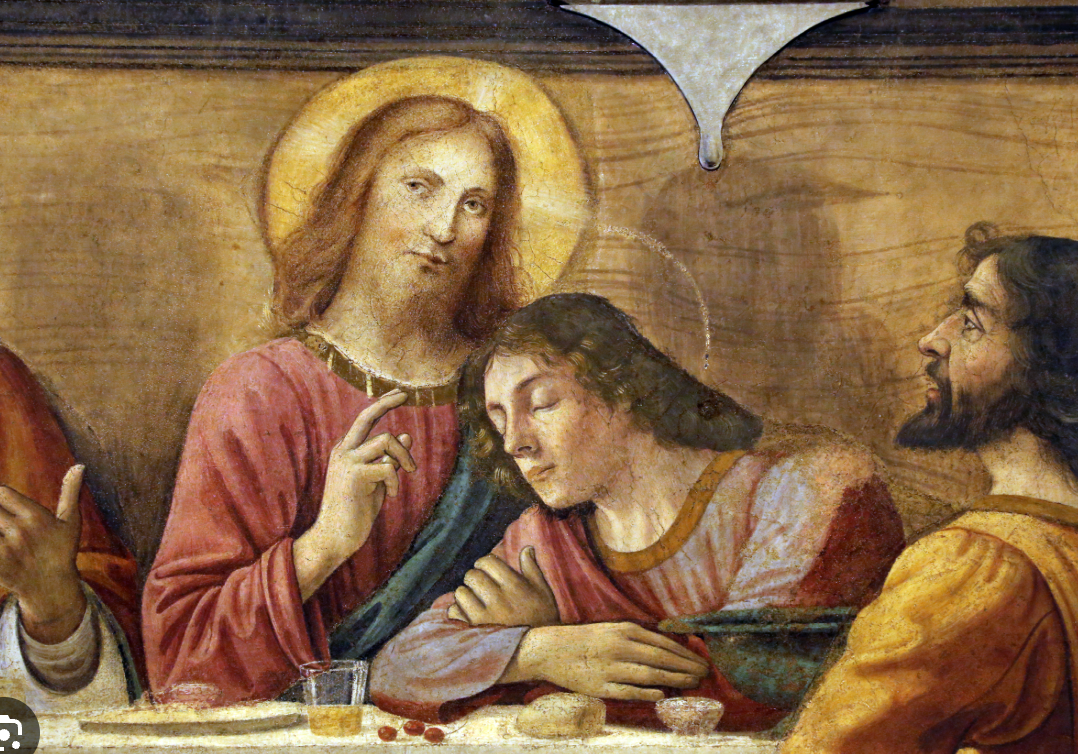 Mark 14:22–24; Matthew 26:26–28; Luke 22:19–20 (KJV); c. 65–90 CE“And as they did eat, Jesus took bread, and blessed, and brake it, and gave to them, and said, Take, eat: this is my body. And he took the cup…and said unto them, ‘This is my blood of the new testament, which is shed for many.'”The three Synoptic Gospels Synoptic Gospels — Matthew, Mark, and Luke are called “synoptic” (from Greek synoptikos, “seen together”) because they share substantial overlapping material, often in the same sequence and sometimes near-verbatim. Most scholars hold that Mark was written first (c. 65–70 CE) and that Matthew and Luke each used Mark as a source, in addition to other material (the hypothetical sayings source Q, and their own special sources).
Guido Reni, The Four Evangelists Matthew, Mark, Luke, and John, 1630s, oil on canvas. Wikimedia Commons / Public domain. — Mark 14:22–24 Mark 14:22–24 (KJV) — “And as they did eat, Jesus took bread, and blessed, and brake it, and gave to them, and said, Take, eat: this is my body. And he took the cup, and when he had given thanks, he gave it to them: and they all drank of it. And he said unto them, This is my blood of the new testament, which is shed for many.” Mark, the earliest Gospel (c. 65–70 CE), gives the shortest and arguably most primitive Synoptic form of the institution narrative — without Matthew’s “for the remission of sins” or Luke’s double “remembrance” command.
Guido Reni, Saint Mark, 1621, oil on canvas. Wikimedia Commons / Public domain. , Matthew 26:26–28 Matthew 26:26–28 (KJV) — “And as they were eating, Jesus took bread, and blessed it, and brake it, and gave it to the disciples, and said, Take, eat; this is my body. And he took the cup, and gave thanks, and gave it to them, saying, Drink ye all of it; For this is my blood of the new testament, which is shed for many for the remission of sins.” Matthew closely parallels Mark but adds the command “Drink ye all of it” and the phrase “for the remission of sins” to the cup word.
Francisco de Zurbarán, Saint Luke as a Painter before Christ on the Cross, c. 1635–40, oil on canvas, Museo del Prado, Madrid. Wikimedia Commons / Public domain. — each record Jesus breaking bread and sharing a cup at a Passover Passover meal (Seder) — The annual Jewish commemoration of the Exodus from Egypt, eaten on the night of 14/15 Nisan. Mark 14:12–16 explicitly locates the Last Supper on the first day of Unleavened Bread, “when they killed the passover.” John 18:28 places the crucifixion on Passover eve, creating a one-day chronological tension with the Synoptic accounts — a long-debated problem in Gospel harmonization.
Mark’s account (quoted above), c. 65–70 CE, preserves the briefest Synoptic form: “this is my body” / “my blood of the new testament “New testament” / “New covenant” — The Greek word διαθήκη (KJV “testament”) carries the meanings of both “covenant” and “last will and testament.” In the Last Supper accounts it echoes the “new covenant” of Jeremiah 31:31–34 and possibly the blood of the covenant in Exodus 24:8. Modern translations typically render it “covenant.” .” Matthew follows Mark closely; Luke adds “this do in remembrance of me,” aligning with Paul’s formula in 1 Cor 11. Four independent witnesses — Paul and three Synoptists — attest the institution narrative within one generation of the event, with no gap in attestation.Mark’s Priority and Brevity
Mark 14:22–24 is widely regarded as preserving the earliest Synoptic form of the institution narrative. It is the shortest; it lacks the “remission of sins” addition found in Matthew 26:28; and it lacks the double “do this in remembrance” command found in the longer text of Luke 22:19–20. This brevity is often treated as a criterion of relative antiquity — the shorter, less theologically elaborated form tends to be earlier. Mark situates the meal within an explicit Passover Passover context in Mark 14 — Mark 14:12–16 describes the disciples preparing the Passover meal: “And the first day of unleavened bread, when they killed the passover, his disciples said unto him, Where wilt thou that we go and prepare that thou mayest eat the passover?” (KJV). This sets the institution narrative within the ritual framework of the festival meal on 14/15 Nisan. framework (Mark 14:12–17), providing the liturgical setting for the institution words.Matthew and Luke’s Elaborations
Matthew 26:26–28 parallels Mark closely but adds “Drink ye all of it” and the phrase “for the remission of sins” to the cup word. Luke 22:19–20, in its longer, better-attested form , adds “which is given for you: this do in remembrance of me” to the bread word and “which is shed for you” to the cup word.
These elaborations may reflect liturgical development, independent access to broader tradition, or literary dependence on Paul’s letter. They do not undermine the core convergence of all three Synoptics on the bread/body and cup/blood structure.The “Blood of the New Testament” Formula
Mark’s “my blood of the new testament, which is shed for many” and Matthew’s identical formula invoke Jeremiah 31:31 Jeremiah 31:31 (KJV) — “Behold, the days come, saith the LORD, that I will make a new covenant with the house of Israel, and with the house of Judah.” This is the sole occurrence of “new covenant” (בְּרִית חֲדָשָׁה) in the Hebrew scriptures and the primary scriptural anchor for the Last Supper’s covenant language. and possibly Exodus 24:8 Exodus 24:8 (KJV) — “And Moses took the blood, and sprinkled it on the people, and said, Behold the blood of the covenant, which the LORD hath made with you concerning all these words.” Moses’ covenant blood ritual at Sinai provides the immediate typological background for the cup saying’s “blood of the covenant/testament” language. , situating the Last Supper in an explicit scriptural framework of covenant theology.Evidence — Mark 14:22–24, Matthew 26:26–28, and Luke 22:19–20 each record Jesus’ bread-and-cup institution narrative at a Passover meal in Jerusalem. Combined with Paul’s account in 1 Cor 11:23–25, this yields four independent written attestations of the core institution narrative within the first generation after the crucifixion.
Conclusion — The triple Synoptic attestation plus Paul’s earlier written account constitutes the strongest multi-source evidence base for any saying or action attributed to Jesus. The core structure — bread identified with body, cup identified with covenant blood — is attested uniformly across all four witnesses.
Criticisms — Dennis Smith and Hal Taussig argue that the institution narrative is a later liturgical elaboration retrojected onto an original non-sacramental meal tradition. Bart D. Ehrman notes that Matthew’s and Luke’s literary dependence on Mark reduces the independent witness count to two (Paul and Mark). The Passover chronology is also disputed: John 18:28 places the crucifixion on Passover eve, not after the meal.
Citation — Holy Bible, KJV, Mark 14:12–26; Matthew 26:17–29; Luke 22:7–23; 1 Corinthians 11:23–26; Jeremiah 31:31–34; Exodus 24:8; E. P. Sanders, The Historical Figure of Jesus (London: Penguin, 1993); John P. Meier, A Marginal Jew, vol. 4 (New Haven: Yale University Press, 2009).
File Under – Jesus Christ > Jesus’ Last Week > Last Supper
Cross References – FW08-C01: Paul’s earlier written account (1 Cor 11) | FW08-C02: Fee on pre-Pauline tradition | FW08-C04: Metzger on Luke’s textual tradition


LUKE 22:19B–20 CONFIRMED BY PAPYRUS 75 AND CODEX VATICANUS
 Bruce M. Metzger; A Textual Commentary on the Greek New Testament , pp. 148–150 (1994)Bruce M. Metzger concludes that the longer form of Luke 22:19b–20 is almost certainly original to Luke, and that Codex Bezae’s shorter text represents a secondary Western non-interpolation rather than the earliest attested reading.Bruce M. Metzger, as chair of the UBS Greek New Testament committee and editor of A Textual Commentary on the Greek New Testament, concludes that the longer form of Luke 22:19b–20 Luke 22:19–20 (KJV) — “And he took bread, and gave thanks, and brake it, and gave unto them, saying, This is my body which is given for you: this do in remembrance of me. Likewise also the cup after supper, saying, This cup is the new testament in my blood, which is shed for you.” Verses 19b–20 (from “which is given for you” to the end) are the disputed portion absent from Codex Bezae and a handful of Old Latin witnesses, but present in Papyrus 75, Codex Vaticanus, Codex Sinaiticus, and the broad manuscript tradition.
Unknown scribe, Codex Vaticanus 354 (ε 354), Luke 22:43–44, 949 CE. Wikimedia Commons / Public domain. — the body-for-you institution saying and the cup command — is almost certainly the original text of Luke.
Codex Bezae Codex Bezae Cantabrigiensis (D, 05) — A bilingual Greek–Latin manuscript of the Gospels and Acts, dated c. 400–450 CE and housed at Cambridge University Library. It represents the “Western” text-type, characterized by numerous paraphrases, additions, and distinctive omissions not found in other major manuscript families. Bezae’s shorter text of Luke 22, omitting vv. 19b–20, is the principal witness cited for the shorter reading.Unknown scribe, Codex Bezae Cantabrigiensis, fol. 202a, c. 400–450 CE, Cambridge University Library. Wikimedia Commons / Public domain. (D) omits these verses, but Metzger identifies this as a Western non-interpolation Western non-interpolation — A term coined by Westcott and Hort for passages present in the Alexandrian and Byzantine text-types but absent from the Western text (Codex Bezae, Old Latin witnesses). Westcott and Hort initially treated these absences as preserving the original shorter text. The subsequent critical consensus — including the UBS and NA committees — has reversed this judgment for most cases, treating the Western omissions as secondary deletions. Metzger applies this conclusion to Luke 22:19b–20. : a secondary deletion, not original brevity. The fuller text is confirmed by Papyrus 75
Papyrus 75 (P75, Bodmer Papyri XIV–XV) — A Greek papyrus codex dated c. 175–225 CE, now housed in the Vatican Library, containing most of Luke and John. It is one of the oldest surviving manuscripts of Luke’s Gospel and a key witness to the Alexandrian text-type. P75 attests the longer text of Luke 22:19b–20, providing second-century papyrus evidence against Bezae’s omission. and Codex Vaticanus Codex Vaticanus (B, 03) — A Greek parchment codex dated to the 4th century CE, housed in the Biblioteca Apostolica Vaticana. Widely regarded as one of the two most reliable New Testament manuscripts (alongside Codex Sinaiticus), it supports the longer text of Luke 22:19–20 and is a primary witness to the Alexandrian text-type.
Unknown scribe, Codex Vaticanus (B), end of Luke, 4th century CE, Biblioteca Apostolica Vaticana. Wikimedia Commons / Public domain. , the most reliable early witnesses. Metzger’s verdict removes the main textual objection to Luke’s institution narrative and confirms its ancient, independent attestation.
The Western Non-Interpolation Problem
B. F. Westcott and F. J. A. Hort in their 1881 critical edition identified passages present in most manuscripts but absent from the Western text (Codex Bezae, Old Latin manuscripts) as “Western non-interpolations” — treating the shorter Western text as original and the longer text as scribal expansion.
Applied to Luke 22:19b–20, this would mean the institution words “which is given for you: this do in remembrance of me” and the entire cup saying (v. 20) were later additions. Metzger and the UBS committee (NA/UBS editions) reject this interpretation for Luke 22: the shorter Western text is best explained as a deliberate scribal abbreviation, perhaps to avoid a perceived repetition (two cups appear in Luke 22:17 and 22:20), not as the original reading.Manuscript Evidence for the Longer Text
The longer text of Luke 22:19b–20 is supported by:
— Papyrus 75 (P75, Bodmer XIV, c. 175–225 CE) — the oldest papyrus witness to Luke, Alexandrian text-type, now in the Vatican Library
— Codex Vaticanus (B, 4th century) — one of the two most reliable New Testament uncials
— Codex Sinaiticus (ℵ Codex Sinaiticus (ℵ / Aleph, 01) — A 4th-century Greek parchment codex discovered at Saint Catherine’s Monastery, Sinai, by Constantin von Tischendorf in 1844/1859. It contains the entire New Testament and is one of the two most reliable surviving New Testament manuscripts. Codex Sinaiticus supports the longer text of Luke 22:19b–20. , 4th century) — the other most reliable uncial
— The great majority of Greek manuscripts, lectionaries, and patristic citations from the 2nd century onward
The shorter text is attested chiefly by Codex Bezae Codex Bezae and the Western tradition — Bezae’s shorter text of Luke 22 is also supported by a handful of Old Latin manuscripts (it-b, it-e) and some Syriac witnesses. This combination represents a geographically limited Western text-type base, outweighed by the breadth of evidence across multiple independent text-types for the longer reading. (D) and a handful of Old Latin manuscripts — a narrow, geographically limited base significantly outweighed by the breadth of evidence for the longer text.Historical Significance for the Institution Narrative
Metzger’s conclusion means that Luke’s Gospel, written c. 80–90 CE, independently preserves the institution narrative with the anamnesis command “this do in remembrance of me” — the same phrase Paul reports in 1 Cor 11:24–25, written thirty years earlier.
This Luke–Paul convergence on the double remembrance command is either evidence of common tradition reaching back to the event itself, or evidence that Luke knew Paul’s letter. Either conclusion places the anamnesis command within the first generation of Christian community life, not in later liturgical development.Evidence — Metzger’s textual analysis concludes that Codex Bezae’s shorter Luke 22 text is a Western non-interpolation (secondary deletion), not the original. The longer institution narrative is confirmed by Papyrus 75, Codex Vaticanus, Codex Sinaiticus, and the broad manuscript tradition of multiple independent text-types.
Conclusion — Luke’s full institution narrative — including the anamnesis command that parallels Paul — is textually original. This removes the primary textual-critical objection to treating Luke as an independent witness to the Last Supper institution narrative.
Criticisms — Bart D. Ehrman and J. K. Elliott have argued that Westcott and Hort’s Western non-interpolation judgment for Luke 22 should be maintained and that the shorter text is original. However, this minority position has not persuaded the majority of the field, including the editors of the NA/UBS critical editions.
Citation — Bruce M. Metzger, A Textual Commentary on the Greek New Testament (2nd ed.; Stuttgart: Deutsche Bibelgesellschaft, 1994), pp. 148–150; Holy Bible, KJV, Luke 22:7–23; Gordon D. Fee, The First Epistle to the Corinthians (NICNT; Grand Rapids: Eerdmans, 1987); J. K. Elliott, “The Case for Thoroughgoing Eclecticism,” in Rethinking New Testament Textual Criticism, ed. David Alan Black (Grand Rapids: Baker Academic, 2002).
File Under – Jesus Christ > Jesus’ Last Week > Last Supper
Cross References – FW08-C03: Synoptic institution narrative | FW08-C01: Paul’s account (1 Cor 11) | FW08-C02: Fee on pre-Pauline tradition


THE LAST SUPPER AS PASSOVER SEDER & CONFLICTING MEAL CHRONOLOGIES
 Mark 14:12, Luke 22:7–8, John 13:1; Mishnah Pesahim 10, c. 200 ADThe Synoptic Gospels — Mark, Matthew, and Luke — each identify the day of the meal with the slaughter of the Passover lamb and record Jesus’s explicit intention to eat “this passover” with his disciples. John 13:1 and 19:14 imply the meal preceded the festival by a day, a chronological gap historians have debated for centuries.The question whether the Last Supper was a formal Passover seder
Unknown artist, Sarajevo Haggadah, c. 1350 CE, National Museum of Bosnia and Herzegovina, Sarajevo. Wikimedia Commons / Public domain.
Passover Seder — The structured Passover ritual meal and liturgy (Hebrew סֵדֶר, “order”) commemorating Israel’s Exodus from Egypt. Its formal sequence includes four cups of wine, the reading of the Haggadah, explanation of symbolic foods, and Hallel psalms. This order is first codified in Mishnah Pesahim 10 (c. 200 AD). Whether such a structure existed in the first century — before the Temple’s destruction in 70 AD ended the central sacrificial element — is historically disputed. has divided historians for generations. Mark 14:12–16
Mark 14:12–16 (KJV) — “And the first day of unleavened bread, when they killed the passover, his disciples said unto him, Where wilt thou that we go and prepare that thou mayest eat the passover?” Mark explicitly sets the preparations on the first day of Unleavened Bread (14 Nisan), when the Passover lamb was sacrificed at the Jerusalem Temple. The meal in the upper room (vv. 17–26) is embedded within this Passover framework. sets the meal on the first day of Unleavened Bread, “when they killed the passover”; Luke 22:7–15
Luke 22:7–15 (KJV) — “Then came the day of unleavened bread, when the passover must be killed. And he sent Peter and John, saying, Go and prepare us the passover, that we may eat… And when the hour was come, he sat down, and the twelve apostles with him. And he said unto them, With desire I have desired to eat this passover with you before I suffer.” Luke agrees with Mark in setting the supper on the day the Passover lamb was sacrificed, and records Jesus’s own express desire to eat “this passover” — making the Passover identification explicit. agrees, recording Jesus’s directive to prepare “the passover.”
Both place the meal on 14 Nisan 14 Nisan — The date on the Jewish lunar calendar designated for the slaughter of the Passover lamb at the Jerusalem Temple (Exodus 12:6; Leviticus 23:5). The Passover meal was eaten at nightfall as 14 Nisan ended and 15 Nisan began. The Synoptic Gospels place Jesus’s Last Supper on this date. John 19:14 places the crucifixion on 14 Nisan — one day earlier than the Synoptic chronology, in which the meal precedes the crucifixion. — Passover eve. John 13:1
John 13:1 (KJV) — “Now before the feast of the passover, when Jesus knew that his hour was come that he should depart out of this world unto the Father…” John explicitly situates the supper “before the feast of the passover,” suggesting a timing one day earlier than the Synoptics. John 18:28 confirms this: the Jewish leaders at the trial did not enter Pilate’s hall “lest they should be defiled; but that they might eat the passover” — as if the Passover meal still lay in the future. however, places the supper before the feast; John 19:14 John 19:14 (KJV) — “And it was the preparation of the passover, and about the sixth hour: and he saith unto the Jews, Behold your King.” The phrase “preparation of the passover” (παρασκευὴ τοῦ πάσχα) denotes the day before Passover — placing the crucifixion on 14 Nisan (Passover eve), not after the Passover meal. This creates a one-day tension with the Synoptic chronology, in which the meal occurs the night before and the crucifixion on 15 Nisan. places the crucifixion on the preparation day of Passover — one day later than the Synoptics. The liturgical seder was codified in Mishnah Pesahim 10 Mishnah Pesahim 10 — The tenth chapter of tractate Pesahim in the Mishnah (the authoritative compilation of Jewish oral law, redacted c. 200 AD by Rabbi Judah ha-Nasi). It specifies the four cups of wine, the child’s questions, the Haggadah recitation, the symbolic Passover foods, and the Hallel psalms. Because it postdates the destruction of the Jerusalem Temple in 70 AD by more than a century, it reflects post-Temple Passover liturgy — not necessarily the practice Jesus would have observed at a first-century Temple-era Passover. around 200 AD, generations after Jesus.
Jonathan Klawans cautions that the Synoptics establish a Passover context, not a formal seder. Any pre-70 AD Passover meal would have differed substantially from the later seder.The Synoptic Evidence
Mark 14:12–17, Matthew 26:17–20, and Luke 22:7–14 each situate the Last Supper preparations on the first day of Unleavened Bread, “when they killed the passover” — language placing the meal on the eve of the Passover festival (14/15 Nisan), when the lamb was sacrificed at the Jerusalem Temple.
Luke 22:15 adds the most explicit statement: “With desire I have desired to eat this passover Passover (פֶּסַח, Pesach) — The annual Jewish festival commemorating Israel’s redemption from Egypt (Exodus 12). Its centerpiece in the first century was the sacrifice of the Passover lamb at the Jerusalem Temple on 14 Nisan. After 70 AD the sacrifice ended; the meal and liturgy evolved into the rabbinic seder codified in Mishnah Pesahim 10 (c. 200 AD). All three Synoptic Gospels embed the Last Supper within an explicit Passover preparation context.John’s Different Chronology
John 13:1 places the supper “before the feast of the passover.” John 18:28 records that the Jewish leaders at Jesus’s trial did not enter Pilate’s hall “lest they should be defiled; but that they might eat the passover” — implying the Passover meal still lay ahead during the trial.
John 19:14 places the crucifixion on “the preparation of the passover” (14 Nisan, Passover eve), one day earlier than the Synoptic chronology. Proposed reconciliations include: (a) different Jewish groups’ calendrical customs for the beginning of Passover; (b) the Essene Essenes — A Jewish sect attested from the second century BC to the first century AD, known from Josephus, Philo, Pliny the Elder, and the Dead Sea Scrolls found at Qumran. The Essenes followed a solar calendar rather than the lunisolar Temple calendar, placing major festivals on different days. Annie Jaubert (1957) proposed that Jesus followed the Essene solar calendar for the supper, which could account for the Synoptic/Johannine date difference — though her hypothesis has not achieved wide acceptance. solar calendar hypothesis (A. Jaubert, 1957); and (c) John’s deliberate theological presentation of Jesus as the true Passover lamb, crucified precisely when the Temple lambs were being slaughtered.The Seder Question
The structured Passover seder familiar in Jewish practice today is first codified in Mishnah Pesahim 10 (c. 200 AD). Baruch M. Bokser (The Origins of the Seder, 1984) argued that several seder elements were developing before the Mishnah and may have existed in the late Second Temple period.
Jonathan Klawans (“Was Jesus’ Last Supper a Seder?” Bible Review, 2001) challenged the anachronistic use of post-70 AD seder structure to interpret the Gospels, arguing that the Haggadah
Haggadah (הַגָּדָה, “telling”) — The liturgical narrative text recited at the Passover seder, retelling the Exodus story and explaining the significance of the symbolic foods. Its recitation is required by Mishnah Pesahim 10. The Sarajevo Haggadah (c. 1350 CE) is among the oldest illustrated examples, produced in Barcelona for a Sephardic Jewish community and now held in Sarajevo. No first-century Passover haggadah text survives. as a fixed liturgical document had not yet been formalized in the first century. Even granting Bokser’s pre-Mishnaic elements, the Gospel texts do not describe the specific ritual sequence that defines the seder.Evidence — Mark 14:12–17, Luke 22:7–15, and Matthew 26:17–20 each identify the Last Supper as a Passover meal, explicitly linking it to the slaughter of the Passover lamb on 14 Nisan. John 13:1, 18:28, and 19:14 consistently place the supper before the feast and the crucifixion on Passover eve. The formalized seder order is a post-70 AD development codified in Mishnah Pesahim 10 (c. 200 AD); no complete first-century Passover ritual text survives.
Conclusion — The Synoptic Gospels consistently present the Last Supper as a Passover meal; John’s Gospel consistently places it before the Passover feast. Whether the meal replicated any version of later seder structure is historically unverifiable: the full seder was not yet codified, and the Gospel accounts do not document a complete liturgical sequence.
Criticisms — Jonathan Klawans argues that the seder framework is anachronistic when applied to first-century Passover practice. Michael J. Cook suggests that Mark’s Passover setting may reflect editorial shaping rather than independent historical memory. Baruch M. Bokser counters that some seder elements predate the Mishnah, potentially providing a proto-seder context for Jesus’s meal.
Citation — Holy Bible, KJV, Mark 14:12–17; Luke 22:7–15; Matthew 26:17–20; John 13:1; 18:28; 19:14; Jonathan Klawans, “Was Jesus’ Last Supper a Seder?” Bible Review 17/5 (2001): 20–47; Baruch M. Bokser, The Origins of the Seder (Berkeley: University of California Press, 1984); Christian A. Eberhart, What a Difference a Meal Makes (Houston: Lucid Books, 2016).
File Under – Jesus Christ > Jesus’ Last Week > Last Supper
Cross References – FW08-C06: Eberhart on the seder question | FW08-C01: Paul’s 1 Cor 11 account | FW08-C03: Synoptic institution narrative

EBERHART: CALLING THE LAST SUPPER A PASSOVER SEDER PROJECTS LATER RABBINIC STRUCTURES
 Christian A. Eberhart, What a Difference a Meal Makes, Lucid Books, 2016Christian A. Eberhart, ritual and atonement scholar, argues in his 2016 study What a Difference a Meal Makes that calling the Last Supper a Passover “seder” projects later rabbinic liturgical structures onto a first-century meal whose ritual character the Gospels describe incompletely and whose Passover status the Synoptic and Johannine accounts differently attest.Christian A. Eberhart, Professor of Religious Studies at the University of Houston University of Houston — A public research university in Houston, Texas, where Eberhart holds a professorship in the Department of Religious Studies. He completed his doctorate (Dr. theol.) at Heidelberg University and his Habilitation at the University of Mainz, and brings expertise in ancient Jewish and early Christian ritual sacrifice and atonement to the study of the Last Supper’s meal character. and founder of the Society of Biblical Literature Society of Biblical Literature (SBL) — The oldest and largest learned society devoted to critical investigation of the Bible, founded in 1880. Eberhart founded and chaired the “Sacrifice, Cult, and Atonement” program unit within SBL, which became a focal point for interdisciplinary research on ancient Israelite, Jewish, and early Christian ritual sacrifice and its relationship to atonement theology. ‘s “Sacrifice, Cult, and Atonement” section, applies ritual and sacrifice expertise to the meal’s character. In What a Difference a Meal Makes (2016), he argues that the term seder Seder (סֵדֶר, “order”) — The Passover ritual meal and its sequential liturgy, first systematized in Mishnah Pesahim 10 (c. 200 AD). The seder’s order specifies four cups of wine, the Haggadah recitation, explanation of symbolic foods, and the Hallel psalms. Because this formal structure postdates the 70 AD destruction of the Jerusalem Temple by more than a century, applying it to first-century Passover practice is historically anachronistic. implies the full liturgical order — the telling ( Haggadah Haggadah (הַגָּדָה, “telling”) — The liturgical narrative text recited at the Passover seder that retells the Exodus story and prescribes explanations of the symbolic foods. No first-century Passover haggadah text survives; the oldest known Haggadah manuscripts postdate the Mishnah (c. 200 AD). Eberhart’s argument relies on this absence: since the Gospels do not document a Haggadah recitation, the case for a formal seder depends on inference rather than textual evidence. ), four cups, Hallel psalms, and symbolic foods — not codified until Mishnah Pesahim 10 Mishnah Pesahim 10 — The tenth chapter of tractate Pesahim, specifying the full Passover meal protocol: the four cups of wine, the child’s question (Mah Nishtanah), the Haggadah recitation, and the Hallel. Compiled c. 200 AD, it reflects post-Temple rabbinic Judaism. Eberhart cites it as the definitive evidence that the formal seder structure was a second-century development, not a first-century given. around 200 AD.
The Synoptic Synoptic Gospels — The three Gospels of Mark, Matthew, and Luke, which share a broadly similar narrative structure and much common material. They are generally thought to reflect Markan priority (Mark written first, c. 65–70 CE). All three Synoptists agree in placing the Last Supper within a Passover context, though none documents the complete liturgical sequence of even a pre-Mishnaic seder. Gospels record Jesus performing Passover-inflected actions, but no Gospel documents the complete program of even a pre-Mishnaic seder; the Johannine Johannine — Pertaining to the Gospel of John (and the Johannine Epistles), written c. 90–100 CE. John’s chronology of the supper and passion diverges from the Synoptics: the supper occurs “before the feast of the passover” (John 13:1) and the crucifixion on Passover eve (John 19:14). This divergence further complicates any claim that the meal followed even a partial pre-Mishnaic Passover liturgy. accounts diverge further on the meal’s timing. What the Synoptic Gospels describe as a Passover meal cannot be mapped onto the post-70 AD seder without anachronism.Eberhart’s Scholarly Context
Christian A. Eberhart completed his doctorate at Heidelberg University and his Habilitation at the University of Mainz. As Professor of Religious Studies at the University of Houston, he has published extensively on sacrifice and atonement in the Hebrew Bible, the New Testament, and early Judaism.
His founding of the “Sacrifice, Cult, and Atonement” section within the Society of Biblical Literature reflects his central scholarly role in this interdisciplinary discussion. In What a Difference a Meal Makes (Lucid Books, 2016), he examines the Last Supper through the dual lens of ancient meal practice and Jewish sacrificial theology, arguing that the ritual character of the meal is more historically constrained — and more uncertain — than popular use of the word “seder” implies.The Distinction That Matters
Eberhart’s core argument is that “Passover meal” and “Passover seder” are not interchangeable categories historically. The Synoptic Gospels record Jesus eating a Passover meal — but their descriptions do not match the complete literary outline of Mishnah Pesahim 10. They mention bread, a cup, and words of institution; they do not document the four cups, the set Haggadah recitation, or the Hallel sequence that would later define the seder. Baruch M. Bokser (The Origins of the Seder, University of California Press, 1984) argued that some seder elements predated the Mishnah and may have existed in the late Second Temple period.
Eberhart’s response: even granting Bokser’s evidence, the Gospel texts do not specifically attest those elements — so the argument from the Gospels alone cuts against the seder identification. The additional Johannine divergence (John 13:1; 19:14), placing the supper before the Passover feast, further complicates any claim that the meal followed a Passover liturgy, proto-seder or otherwise.Evidence — Christian A. Eberhart, writing from ritual and sacrifice studies, argues in What a Difference a Meal Makes (2016) that the term “seder” applies a post-70 AD Mishnaic liturgical category to a first-century meal the Gospel texts describe only partially, and that the Johannine Gospel places before the Passover feast entirely.
Conclusion — Eberhart’s analysis is a scholarly caution against anachronism: the meal was Passover-inflected according to the Synoptics, but calling it a “seder” in the full Mishnaic sense projects a post-Temple liturgical structure the texts do not support. The Johannine chronology adds a further complicating layer.
Criticisms — Baruch M. Bokser presents evidence that some seder elements predate the Mishnah, potentially weakening the strict anachronism argument. I. Howard Marshall and other scholars hold that the Synoptic Passover identification is historically reliable and broadly consistent with a proto-seder context. No verbatim quotation from Eberhart’s published text was retrievable; the quotebody of this card is an attributed paraphrase of the published scholarly argument.
Citation — Christian A. Eberhart, What a Difference a Meal Makes (Houston: Lucid Books, 2016); Baruch M. Bokser, The Origins of the Seder (Berkeley: University of California Press, 1984); Jonathan Klawans, “Was Jesus’ Last Supper a Seder?” Bible Review 17/5 (2001): 20–47.
File Under – Jesus Christ > Jesus’ Last Week > Last Supper
Cross References – FW08-C05: Was the meal a Passover seder? | FW08-C01: Paul’s 1 Cor 11 account | FW08-C07: New covenant in the cup saying
Slideshows of the ancient and modern art related to the figures, events and places of the ancient world
ARtworks as the slide with caption and citation and links to related slides/cards, sections and pages.LUKE 22:20 INVOKES JEREMIAH 31’S BLOOD OF THE SINAI COVENANT
 Luke 22:20 (KJV); Jeremiah 31:31–34; 1 Corinthians 11:25“Likewise also the cup after supper, saying, This cup is the new testament in my blood, which is shed for you.” — Luke 22:20 (KJV)Luke, writing c. 85–90 CE, preserves in Luke 22:20
Guido Reni, Saint Luke, 1621, oil on canvas. Wikimedia Commons / Public domain.
Luke 22:20 (KJV) — “Likewise also the cup after supper, saying, This cup is the new testament in my blood, which is shed for you.” This verse belongs to the longer text of Luke 22:19b–20, which Codex Bezae omits (see FW08-C04). Luke’s cup word closely parallels Paul’s in 1 Corinthians 11:25 (“This cup is the new testament in my blood”), suggesting either literary dependence or access to a shared pre-Pauline liturgical formula. The phrase “which is shed for you” echoes the sacrificial blood language of Exodus 24:8 and the covenant blood of Mark 14:24. the cup saying in a form closely aligned with Paul’s in 1 Corinthians 11:25
1 Corinthians 11:25 (KJV) — “After the same manner also he took the cup, when he had supped, saying, This cup is the new testament in my blood: this do ye, as oft as ye drink it, in remembrance of me.” Paul’s cup word, written c. 53–54 CE, predates Luke’s Gospel by roughly thirty years and uses virtually identical covenant language. The verbal similarity suggests Luke and Paul draw on a common liturgical tradition, or that Luke had access to Pauline material. . The phrase “new testament in my blood” uses the Greek διαθήκη διαθήκη (diathēkē) — The Greek word rendered “testament” in the KJV and “covenant” in most modern translations. In the Septuagint (Greek Old Testament) it translates the Hebrew בְּרִית (berith, “covenant”). In Greek legal usage it also carried the sense of “last will and testament.” Its deployment in the Last Supper accounts deliberately invokes the covenant theology of the Hebrew scriptures, particularly Jeremiah 31:31 (“new covenant”) and Exodus 24:8 (“blood of the covenant”). , echoing Jeremiah 31:31–34Ilya Repin, Cry of Prophet Jeremiah on the Ruins of Jerusalem, 1870, oil on canvas, State Tretyakov Gallery, Moscow. Wikimedia Commons / Public domain.
Jeremiah 31:31–34 (KJV) — “Behold, the days come, saith the LORD, that I will make a new covenant with the house of Israel, and with the house of Judah: Not according to the covenant that I made with their fathers in the day that I took them by the hand to bring them out of the land of Egypt… I will put my law in their inward parts, and write it in their hearts; and will be their God, and they shall be my people.” This is the sole occurrence of “new covenant” (בְּרִית חֲדָשָׁה) in the entire Hebrew scriptures. It addresses Israel’s national restoration after the Babylonian exile and envisions internalized law and universal knowledge of God — not a ritual cup or a sacrificial meal. — the sole occurrence of “new covenant” (בְּרִית חֲדָשָׁה) in the Hebrew scriptures. The Sinai parallel is also present: Exodus 24:8 Exodus 24:8 (KJV) — “And Moses took the blood, and sprinkled it on the people, and said, Behold the blood of the covenant, which the LORD hath made with you concerning all these words.” Moses’s blood-sprinkling at Sinai ratified the original covenant between God and Israel. This rite provides the more immediate scriptural precedent for the cup saying’s “blood of the covenant” language: where Jeremiah 31 looks forward to a renewed covenant, Exodus 24 looks back to the founding one — both echo in the cup word. records Moses sprinkling the covenant blood on Israel. Luke’s alignment with Paul suggests access to shared liturgical tradition rather than purely literary borrowing. Codex Bezae
Codex Bezae Cantabrigiensis (D/05) — A Greek/Latin bilingual New Testament manuscript dated c. 400–450 CE, held at Cambridge University Library and donated by the reformer Theodore Beza in 1581. Notable for a large number of unique readings, especially in Luke and Acts. Its shorter text of Luke 22 omits verses 19b–20 — the remembrance command and the second cup word — a variant that Bruce Metzger’s Textual Commentary (2nd ed. 1994) judges secondary, likely scribal harmonization with the simpler Markan/Matthean form. (5th century) attests a shorter text of Luke 22 omitting verses 19b–20; the majority of manuscripts include the full cup word. Jeremiah’s original covenant addresses Israel’s national restoration, not a Christian rite; any direct fulfillment claim requires theological interpretation beyond what the text itself establishes.The Three Texts in Relation
Three texts converge on the “new covenant / new testament” language of the cup saying. (1) 1 Corinthians 11:25 (c. 53–54 CE): Paul transmits the received formula “This cup is the new testament in my blood.” (2) Luke 22:20 (c. 85–90 CE): “Likewise also the cup after supper, saying, This cup is the new testament in my blood, which is shed for you.” The verbal agreement between Paul and Luke is closer than Mark’s parallel (“my blood of the new testament, which is shed for many”) or Matthew’s (“my blood of the new testament, which is shed for many for the remission of sins”). (3) Jeremiah 31:31–34: the explicit Old Testament anchor for “new covenant” (בְּרִית חֲדָשָׁה) theology. Luke and Paul appear to draw on the same liturgical tradition; their verbal agreement predates the Lukan Gospel and may reflect the pre-Pauline formula Paul identifies in FW08-C01.Jeremiah 31:31–34 in Context
Jeremiah’s “new covenant” prophecy is addressed to “the house of Israel and the house of Judah” (v.31) and concerns national restoration after the Babylonian exile. Its content is an internalized law written on the heart (v.33) and universal, direct knowledge of God (v.34) — not a ritual meal, a cup, or a blood rite. The cup saying’s claim to inaugurate this covenant through Jesus’s death involves a significant theological re-application: the earliest Christians understood Jesus’s crucifixion as the event fulfilling Jeremiah’s promise, but this interpretation goes beyond what Jeremiah 31 explicitly states. The Sinai blood rite of Exodus 24:8 Exodus 24:8 (KJV) — “And Moses took the blood, and sprinkled it on the people, and said, Behold the blood of the covenant, which the LORD hath made with you concerning all these words.” The covenant-ratification blood at Sinai provides the most direct scriptural precedent for the cup saying’s “blood of the covenant” language and likely lies in the background of Mark 14:24 (“blood of the new testament, which is shed for many”). The Mosaic and Jeremianic covenant texts together form the dual scriptural background for the Last Supper’s covenant language. provides more direct wording precedent for “blood of the covenant” — though it too describes a Mosaic rather than a new-covenant rite.Textual Note on Luke 22
Codex Bezae (D/05, 5th century) presents a shorter text of Luke 22:15–20 that retains a cup word at verse 17 but omits verses 19b–20 entirely. The manuscript tradition supporting the longer, two-cup text includes Papyrus 75 Papyrus 75 (P75) — A Greek papyrus codex dated c. 175–225 CE, housed at the Vatican Library (Bibliotheca Apostolica Vaticana). It contains substantial portions of Luke and John and is one of the earliest known Greek manuscripts of Luke’s Gospel. P75 supports the longer text of Luke 22 including verses 19b–20, and its agreement with Codex Vaticanus (4th century) strengthens the case for the longer text as original. (P75, c. 175–225 CE), Codex Vaticanus (4th century), Codex Sinaiticus (4th century), and the overwhelming majority of Greek witnesses. Bruce M. Metzger (Textual Commentary on the Greek New Testament, UBS, 2nd ed. 1994, pp. 148–150) assigns the longer text a {B} rating and concludes that the shorter Bezan text is a secondary scribal abbreviation — probably harmonization with Mark and Matthew, neither of which has Luke’s remembrance command. The textual weight clearly favors Luke 22:20 as original.Evidence — Luke 22:20 preserves a cup word invoking “the new testament in my blood” that closely parallels Paul’s formula in 1 Cor 11:25 (c. 53–54 CE). Both draw on Jeremiah 31:31–34 (the only Old Testament “new covenant” text) and possibly Exodus 24:8. The majority manuscript tradition — P75, Codex Vaticanus, Codex Sinaiticus — supports the longer text as original; Metzger (1994) rates it {B}.
Conclusion — The cup saying’s covenant language is attested in two independent written sources (Paul and Luke) within the first century and is grounded in Jeremiah 31 and Exodus 24. Its textual transmission is secure in the majority tradition; Codex Bezae’s shorter text is a minority secondary variant. The theological claim that the cup saying fulfills Jeremiah 31 represents early Christian interpretation — one with strong textual support but one that goes beyond what the Old Testament passage itself explicitly states.
Criticisms — Bart D. Ehrman notes that Luke’s verbal agreement with Paul may indicate literary borrowing rather than independent tradition, reducing the independent attestations to one. John Dominic Crossan and the Jesus Seminar questioned whether the cup word is historical or a liturgical creation of the early church retrojected onto Jesus’s memory. The Bezan shorter text, while a minority variant, demonstrates that some ancient scribes found the longer form problematic.
Citation — Holy Bible, KJV, Luke 22:20; 1 Corinthians 11:25; Jeremiah 31:31–34; Exodus 24:8; Bruce M. Metzger, A Textual Commentary on the Greek New Testament (2nd ed.; Stuttgart: Deutsche Bibelgesellschaft, 1994), pp. 148–150; Michael J. Gorman, Apostle of the Crucified Lord (2nd ed.; Grand Rapids: Eerdmans, 2016).
File Under – Jesus Christ > Jesus’ Last Week > Last Supper
Cross References – FW08-C08: Gorman on the new covenant | FW08-C01: Paul’s 1 Cor 11 account | FW08-C04: Metzger on Luke’s textual tradition


GORMAN: PAUL’S CUP WORD INAUGURATES A COVENANT COMMUNITY THROUGH PARTICIPATION IN THE CRUCIFIED CHRIST — BEYOND SIMPLE PREDICTION-FULFILLMENT
Michael J. Gorman, Apostle of the Crucified Lord, Eerdmans, 2nd ed. 2016Michael J. Gorman argues in Apostle of the Crucified Lord that Paul’s cup word interprets Jesus’s death as inaugurating a covenant community — drawing on Jeremiah 31 as formative background while going beyond mere fulfillment to frame participation in the crucified Christ as the constitutive act of the new covenant.Michael J. Gorman, Raymond E. Brown Professor of Biblical Studies and Theology at St. Mary’s Seminary and University St. Mary’s Seminary and University — The oldest Catholic seminary in the United States, founded in Baltimore in 1791, and a graduate institution for theological education. Gorman holds the Raymond E. Brown Chair in Biblical Studies and Theology there, named after Raymond E. Brown (1928–1998), the distinguished Catholic New Testament scholar known especially for his work on the Gospel of John and early Christianity. , Baltimore, trained under Bruce M. Metzger
Bruce M. Metzger (1914–2007) — George L. Collord Professor of New Testament Language and Literature at Princeton Theological Seminary and the leading New Testament textual critic of the twentieth century. Author of A Textual Commentary on the Greek New Testament (UBS, 2nd ed. 1994) and The Text of the New Testament (4th ed. with Bart Ehrman, 2005). Gorman trained under Metzger at Princeton, grounding his Pauline scholarship in rigorous textual and historical method. at Princeton Theological Seminary. His concept of cruciformity Cruciformity — A term coined by Michael J. Gorman in Cruciformity: Paul’s Narrative Spirituality of the Cross (Eerdmans, 2001) to describe what he identifies as the structural principle of Pauline theology: Christian identity is shaped (“formed”) by the dying-and-rising pattern of Christ’s cross. For Gorman, cruciformity means that Christian community life, moral action, and the eucharistic meal are all constituted by the self-giving pattern of the crucifixion — not merely by doctrinal assent or ritual observance. — conformity to the dying-and-rising pattern of the cross — shapes his reading of 1 Corinthians 11:25 1 Corinthians 11:25 (KJV) — “After the same manner also he took the cup, when he had supped, saying, This cup is the new testament in my blood: this do ye, as oft as ye drink it, in remembrance of me.” Gorman reads “the new testament in my blood” as declaring that Jesus’s death inaugurates a cruciform covenant community — not merely as a prediction-fulfillment of Jeremiah 31, but as the constitutive act of a community whose identity is defined by participation in the crucified Lord. . Gorman argues that Paul’s cup word is not a straightforward fulfillment of Jeremiah 31 Jeremiah 31:31–34 (KJV) — “Behold, the days come, saith the LORD, that I will make a new covenant with the house of Israel, and with the house of Judah.” The sole occurrence of “new covenant” (בְּרִית חֲדָשָׁה) in the Hebrew scriptures. Gorman distinguishes his reading from a simple typological fulfillment model: Paul invokes Jeremiah 31 as formative background but re-deploys the concept into an active theological claim about participation in the dying-and-rising Christ as the covenant’s constitutive act — which Jeremiah 31 itself does not contemplate. but an active theological claim: the supper constitutes a community whose identity is defined by participation in the crucified Lord. For Gorman, the new covenant New Covenant (בְּרִית חֲדָשָׁה / διαθήκη καινή) — The covenant promised in Jeremiah 31:31–34, understood by New Testament writers as inaugurated through Jesus’s death. Gorman distinguishes two senses in Paul’s use: (a) the typological sense — Jesus’s death fulfills Jeremiah’s prophecy of a renewed covenant; and (b) the cruciform participatory sense — the new covenant is not merely an institution but a community shaped by the cross. is not merely an institution but a community shaped by the cross. Gorman distinguishes the Pauline framework as an active theological claim about cruciform participation — not simple prediction-fulfillment of Jeremiah 31.Gorman’s Cruciformity Framework
Michael J. Gorman coined the term cruciformity Cruciformity — Coined by Gorman in Cruciformity: Paul’s Narrative Spirituality of the Cross (Eerdmans, 2001) to describe the structural principle of Pauline theology: that Christian identity, ethics, and community life are all shaped by the dying-and-rising pattern of the cross. The term goes beyond earlier Pauline theology categories (justification, participationism) by arguing that cross-conformity is not merely one theme among many but the governing narrative of Paul’s entire theology. in his 2001 monograph to describe the shaping principle of Pauline theology: conformity to the cross as the defining structure of Christian identity, ethics, and community life. In 1 Corinthians 11:17–22 1 Corinthians 11:17–22 — Paul’s rebuke of the Corinthian community for disorder at the common meal: “When ye come together in the church, I hear that there be divisions among you” (v.18 KJV). Some members ate ahead while poorer members “have nothing” (v.22 KJV). Gorman argues that this community failure is the cruciform failure: the Corinthians eat the Lord’s Supper in a way that contradicts the self-giving pattern of the one whose death they proclaim. , Paul rebukes the Corinthians for divisions at the common meal — wealthier members eating ahead while poorer members go without — arguing that this violates the very character of the Lord’s Supper. Gorman interprets this as evidence that the cup word’s covenant claim is primarily about community formation rather than typological fulfillment: the supper constitutes a cruciform community only insofar as it re-enacts the self-giving pattern of Christ’s death. Liturgy and ethics are inseparable for Gorman.Pauline Covenant and Community
Gorman grounds Paul’s covenant language in two Old Testament texts. The primary background is Jeremiah 31:31–34 Jeremiah 31:31–34 (KJV) — “Behold, the days come, saith the LORD, that I will make a new covenant with the house of Israel, and with the house of Judah: Not according to the covenant that I made with their fathers in the day that I took them by the hand to bring them out of the land of Egypt; which my covenant they brake, although I was an husband unto them, saith the LORD” (vv.31–32). Gorman treats Jeremiah 31 not as a simple prediction fulfilled at the Last Supper but as a formative theological concept Paul re-deploys: the new covenant category is inherited from Jeremiah but its cruciform content goes beyond Jeremiah’s promised internalized law. , the sole occurrence of “new covenant” (בְּרִית חֲדָשָׁה) in the Hebrew scriptures — cited directly in 1 Corinthians 11:25. The secondary precedent is Exodus 24:8 Exodus 24:8 (KJV) — “And Moses took the blood, and sprinkled it on the people, and said, Behold the blood of the covenant, which the LORD hath made with you concerning all these words.” The Sinai blood rite provides the most direct verbal precedent for the cup saying’s “blood of the covenant” formula. Gorman reads Paul’s cup word as evoking both Sinai covenant ratification (Exodus 24) and Jeremianic new-covenant promise (Jeremiah 31) — while insisting that the theological weight lies in cruciform community formation rather than either text’s explicit content alone. — the Sinai “blood of the covenant” (Exodus 24:8) — which provides the closest verbal precedent for the cup saying’s formula. Gorman argues that Paul’s theological move is to redeploy these covenant categories into a cruciform framework: the community’s constitutive act is participation in the crucified Lord’s self-giving death.Distinguishing Gorman’s Theological Interpretation
Gorman’s reading differs from two prominent Pauline interpreters. N.T. Wright N.T. Wright (Nicholas Thomas Wright, b. 1948) — Bishop of Durham 2003–2010, Professor of New Testament and Early Christianity at the University of St Andrews, and author of Paul and the Faithfulness of God (Fortress, 2013). Wright’s covenantal reading of Paul emphasizes that Jesus’s death fulfills Israel’s story — the “new exodus” pattern — and reconfigures Israelite covenant theology around Christ as Israel’s representative. Wright shares Gorman’s centrality of covenant but gives greater explanatory weight to Israel’s historical narrative as the interpretive framework. interprets the cup word primarily through Israel’s covenantal narrative — the “new exodus” — emphasizing Jesus as Israel’s representative whose death reconfigures the covenant around the Messiah. James D.G. Dunn James D.G. Dunn (1939–2020) — Lightfoot Professor of Divinity Emeritus at Durham University and a leading Pauline scholar, co-architect of the “New Perspective on Paul” alongside E.P. Sanders and N.T. Wright. Author of The Theology of Paul the Apostle (Eerdmans, 1998). Dunn foregrounds social identity and boundary markers in Paul’s covenant theology — who belongs to the covenant community — rather than the cruciform participatory pattern Gorman foregrounds. focuses on social identity and the boundary-marking function of covenant — who belongs — rather than cruciform participation. Where Wright and Dunn read Paul’s covenant language through Israel’s narrative or sociological boundaries, Gorman insists that the constitutive principle is cruciform participation: conformity to the dying-and-rising pattern of the cross.Evidence — Gorman’s reading in Apostle of the Crucified Lord (2nd ed., 2016) interprets 1 Corinthians 11:25’s cup word as inaugurating a cruciform community through participation in the crucified Christ. His cruciformity framework (coined in Cruciformity, 2001) distinguishes Pauline covenant theology from simple Jeremiah 31 prediction-fulfillment. The community failure of 1 Corinthians 11:17–22 provides contextual evidence that Paul’s cup word is primarily about community formation rather than typological fulfillment.
Conclusion — Gorman’s cruciformity framework provides the most theologically synthetic account of Paul’s cup word, linking the textual (Jeremiah 31, Exodus 24:8), communal (1 Cor 11:17–22), and participatory (cruciform dying-and-rising) dimensions into a coherent reading. It is more integrative than Wright’s narrative-covenantal model or Dunn’s sociological-boundary reading. Its limitation is that “cruciformity” is Gorman’s own construct rather than Paul’s explicit terminology.
Criticisms — N.T. Wright argues that Gorman’s framework underweights the Israel-narrative dimension of Paul’s covenant theology. James D.G. Dunn would emphasize the social and boundary-marking function of covenant identity that Gorman’s participationist framework subordinates. Additionally, no verbatim Gorman quotation on the cup word was retrievable for this card; the quotebody is an attributed paraphrase of his documented argument, as noted in the editorial comment above.
Citation — Michael J. Gorman, Apostle of the Crucified Lord: A Theology of Paul and His Letters (2nd ed.; Grand Rapids: Eerdmans, 2016); Michael J. Gorman, Cruciformity: Paul’s Narrative Spirituality of the Cross (Grand Rapids: Eerdmans, 2001); N.T. Wright, Paul and the Faithfulness of God (Minneapolis: Fortress, 2013); James D.G. Dunn, The Theology of Paul the Apostle (Grand Rapids: Eerdmans, 1998).
File Under – Jesus Christ > Jesus’ Last Week > Last Supper
Cross References – FW08-C07: Luke’s cup saying and new covenant | FW08-C01: Paul’s 1 Cor 11 account | FW08-C06: Eberhart on the seder question

MARK AND LUKE: A FURNISHED UPPER ROOM PREPARED FOR PASSOVER
Mark 14:12–16; Luke 22:7–13, c. 65–90 AD“Go ye into the city, and there shall meet you a man bearing a pitcher of water: follow him. And wheresoever he shall enter in, say ye to the goodman of the house, The Master saith, Where is the guestchamber, where I shall eat the passover with my disciples?” — Mark 14:13b–14, KJVMark 14:12–16
Mark 14:12–16 — Preparing the Passover
“[Jesus] sendeth forth two of his disciples” to prepare the Passover. Mark leaves the two unnamed; Luke 22:8 identifies Peter and John. Mark is commonly dated c. 65–75 AD, although the date is inferred rather than stated by the text. and Luke 22:7–13
Luke 22:7–13 — Passover Preparation
“[Peter and John] found as he had said unto them: and they made ready the passover.” Luke’s narrative is parallel to Mark’s but includes the disciples’ names. locate Jesus’ final meal in a preparation narrative: two disciples enter the city, follow a man carrying a water jar, and are shown a large room ready for the Passover meal. Mark calls it an ἀνώγεον (anōgaion)Hoshvilim, The Cenacle, Last Supper Room, 2015 AD, Jerusalem
ἀνώγεον — upper room
In Mark 14:15 and Luke 22:12 the word means an upstairs room. The traditional Cenacle is a medieval memorial site, not an excavated first-century room., “large, furnished, and ready” (Mark 14:15).
The paired accounts preserve a concrete setting for Passover preparation, but they do not name the householder, locate the building, or permit an archaeological identification of the room.The Water-Jar Signal
The wording deserves restraint. Mark’s Greek says a person (ἄνθρωπος) carrying an earthenware jar (κεράμιον); it identifies the person as male in context, but does not explain why he is carrying it. Some commentators regard the jar as a conspicuous prearranged signal; others read the scene as narrative foreknowledge. The often repeated claim that only women carried jars is too absolute: it may explain why the detail stood out, but it is not independently demonstrated for this particular encounter.
Luke’s naming of Peter and John is a real difference between the accounts, not independent external confirmation. The secure datum is the literary tradition itself: preparation, a householder, and a prepared upstairs dining space.Language, Meal, and Setting
Mark 14:15 has ἀνώγεον μέγα ἐστρωμένον ἕτοιμον: a large upper room, furnished or spread, and ready. “Furnished” can naturally evoke a meal arranged for reclining, but the term alone does not inventory cushions, vessels, or the wealth of the host. PassoverPassover — Pesach
Israel’s annual festival commemorating the Exodus; it begins on 15 Nisan, following preparation on 14 Nisan. Mark’s festival chronology and its relation to John’s chronology remain debated. supplies the calendar setting, while the room scene supplies no address or owner’s name.
Excavated elite houses in the Upper City demonstrate that substantial domestic rooms existed in first-century Jerusalem; they cannot identify this house or verify the reported arrangement.From Text to Place
The CenaclePaul Arps, The Cenacle, 2013 AD, Jerusalem
The Cenacle — traditional Upper Room
The traditional site stands on Mount Zion. Its present hall is medieval; the identification with the Last Supper is a tradition whose historical basis is debated. is the later traditional memorial on Mount Zion. Its surviving hall and nearby archaeological remains illuminate the site’s long sacred history, not the precise location of the Gospel meal.
Evidence – Mark 14:12–16 and Luke 22:7–13 agree that Jesus directed preparation for a Passover meal in a large, ready upper room; Luke identifies the two disciples as Peter and John.
Conclusion – The narratives provide a specific literary setting and plausible domestic vocabulary, but neither a named house nor an excavated room. The Cenacle is a later tradition, not an identified first-century location.
Criticisms – Scholars disagree over whether the water-jar detail reflects a prearranged signal, literary foreknowledge, or Markan narrative construction; the accounts alone cannot decide. Debate over the Last Supper’s precise calendar date also limits claims about the meal’s exact ritual sequence.
Citation – Holy Bible, KJV, Mark 14:12–16; Luke 22:7–13; Adela Yarbro Collins, Mark: A Commentary (Minneapolis: Fortress, 2007), 653–56; Joel Marcus, Mark 8–16 (New Haven: Yale University Press, 2009), 930–34; Israel Antiquities Authority, “Jerusalem, Mount Ziyyon,” Hadashot Arkheologiyot 124 (2012).
File Under: Jesus Christ › Jesus’ Last Week › Last Supper
Cross References: The Cenacle: medieval hall and earlier memory | Last Supper overview | Passover chronology

_(8683269708).jpg)
MURPHY-O’CONNOR: A MEDIEVAL HALL AND A POSSIBLE EARLIER MEMORY
Jerome Murphy-O’Connor, Keys to Jerusalem, 2012In his 2012 study of the Cenacle, Jerome Murphy-O’Connor argues that the site’s surviving medieval hall cannot itself be the New Testament room, while the persistence of Christian attachment to Mount Zion may preserve a memory reaching back earlier than the present structure.Jerome Murphy-O’Connor, a New Testament archaeologist at the École Biblique et Archéologique Française de Jérusalem, separates two questions often collapsed together: the date of the hall visitors see and the age of the site’s tradition. The Cenacle
The Cenacle on Mount Zion
The room is traditionally connected with the Last Supper and Pentecost. Medieval and earlier remains at the compound do not by themselves identify the Gospel location. on Mount ZionJean Zuallart, Map of Jerusalem showing the Cenacle, 1587 AD
Mount Zion
The southwestern hill of Jerusalem, outside today’s Old City walls, has accumulated Jewish, Christian, and Muslim associations across many centuries. is undeniably medieval in its visible architecture. Its exact building history, however, is debated; a medieval hall does not by itself disprove an older memorial tradition.
The physical structure is not first-century evidence, while continuity of memory is an historical inference that requires separate argument.What Can Be Dated
The present room’s pointed arches and ribbed vaults identify a medieval Gothic-style hall. The Israel Antiquities Authority reports that the Franciscans purchased the David’s Tomb compound in 1335 AD and renovated the Cenacle, but architectural historians differ over whether important fabric is Crusader, thirteenth-century, or substantially fourteenth-century. It is therefore accurate to call the surviving hall medieval; assigning every element confidently to 1335 AD is not.
The compound also contains Roman-period and Byzantine remains, and churches are known in the area during the Byzantine period. Those finds establish a layered site history, not a continuous excavated building from the first century.Murphy-O’Connor’s Argument
Murphy-O’Connor’s 2012 chapter, “The Cenacle and the Community,” considers textual and archaeological evidence for Christian presence on Mount Zion after the Roman destruction of Jerusalem and through Aelia CapitolinaAelia Capitolina
The Roman colony founded at Jerusalem after the Bar Kokhba revolt, conventionally dated to 130 AD. Its establishment forms part of the debate over whether a local Christian community could have retained a site memory.. He argues that attachment to the site may point back to an earlier Christian community. That is an argument from historical continuity, not a claim that excavators have found the room of Mark 14.
His earlier guidebook’s architectural caution and his later historical reconstruction should not be turned into a false contradiction: each addresses a different kind of evidence.Tradition, Evidence, and Limit
Acts 1:13Acts 1:13 — KJV
“They went up into an upper room, where abode both Peter, and James, and John …” Acts uses a Greek word for an upstairs room but does not identify it with the room in Mark 14 or give a location. and Acts 2 helped shape later Upper Room traditions, but the texts do not name Mount Zion. The traditional identification remains possible, yet cannot be demonstrated by the present building or by pilgrimage tradition alone.Evidence – The Cenacle’s visible hall is medieval; the Israel Antiquities Authority documents Franciscan acquisition and renovation in 1335 AD, as well as earlier remains in the surrounding compound.
Conclusion – Medieval architecture rules out identifying the surviving hall itself with a first-century room. A longer local memory is a serious historical proposal, but remains an inference rather than an archaeological demonstration.
Criticisms – Architectural historians dispute the hall’s precise construction phases, and historians differ over whether later Christian attachment securely reaches the first century. Neither uncertainty warrants either automatic acceptance or automatic dismissal of the traditional site.
Citation – Jerome Murphy-O’Connor, “The Cenacle and the Community: The Background of Acts 2:44–5,” in Keys to Jerusalem (Oxford: Oxford University Press, 2012), 123–34; Amit Re’em, “Jerusalem, Mount Ziyyon,” Israel Antiquities Authority, Hadashot Arkheologiyot 124 (2012); Holy Bible, KJV, Acts 1:13.
File Under: Jesus Christ › Jesus’ Last Week › Last Supper
Cross References: Passover preparation and the upper room | Passover chronology | Transition to the foot-washing tradition


===============
Foot-Washing, Farewell Discourses & Prayer
Read John 13–17 on foot-washing, service, love, departure, the Paraclete, the vine, and unity. Distinguish these theological and literary presentations from independently preserved speech transcripts and from the prayer in Gethsemane.Card index — section 08
- The Foot-Washing — Servant-Leadership Enacted in Action — Existing card — revise (FW09-C01)
- Sandra M. Schneiders — assessing foot-washing and the reversal of status — Create card — verified quotation/assessment (FW09-C02)
- Love one another and departure — Create card — evidence/report (FW09-C03)
- Marianne Meye Thompson — assessing love one another and departure — Create card — verified quotation/assessment (FW09-C04)
- The Paraclete and remembered teaching — Create card — evidence/report (FW09-C05)
- Gail R. O’Day — assessing the Paraclete and remembered teaching — Create card — verified quotation/assessment (FW09-C06)
- The vine, unity, and the farewell prayer — Create card — evidence/report (FW09-C07)
- Francis J. Moloney — assessing the vine, unity, and the farewell prayer — Create card — verified quotation/assessment (FW09-C08)
FAREWELL-03–JOHN’S “NEW COMMANDMENT” — LOVE, DEPARTURE, AND MUTUAL BELONGING
 John 13:31–14:14, KJV; final form commonly dated c. 90–100 AD“A new commandment I give unto you, That ye love one another; as I have loved you, that ye also love one another. By this shall all men know that ye are my disciples, if ye have love one to another.” — John 13:34–35, KJVJohn 13:31–14:14
Unknown Austrian artist, Saint John the Evangelist, c. 1410 AD, The Cloisters, Metropolitan Museum of Art, New York
John 13:31–14:14 — KJV
After Judas leaves, Jesus says, “Yet a little while I am with you,” commands mutual love, predicts Peter’s denial, and answers Thomas and Philip. The artwork is a later devotional depiction of the traditionally identified evangelist, not a contemporary portrait. places the command in Jerusalem after Judas IscariotGiotto di Bondone, Kiss of Judas, c. 1303–1305 AD, Scrovegni Chapel, Padua
Judas Iscariot
John 13:30 says Judas “then having received the sop went immediately out: and it was night.” The fresco depicts the later arrest, not Judas’s departure from the meal. leaves the supper and before Jesus’ arrest. Jesus addresses the remaining disciples within the meal narrative, announces his departure, and makes his own love both their model and their public sign of belonging.
Love itself was not new to Judaism: Leviticus 19:18Shai Halevi, Israel Antiquities Authority, 11QpaleoLev, manuscript c. 1st century BC–1st century AD, Qumran Cave 11
Leviticus 19:18 — KJV
“Thou shalt love thy neighbour as thyself: I am the LORD.” The manuscript image is ancient evidence for Leviticus, but it is not the manuscript from which the KJV was translated. already commands neighbor-love. John’s distinctive clause is “as I have loved you,” interpreted beside the foot-washing and approaching death. Thomas and Philip then ask how the disciples can know the way and see the Father . Their questions advance John’s narrative; they are not independent surviving testimonies.The Scene Changes When Judas Leaves
The unit begins “when he was gone out.” Judas has accepted the morsel and gone into the night; the arrest has not yet occurred. John 13:31–33 John 13:31–33 — KJV
“Now is the Son of man glorified, and God is glorified in him.” Jesus then says, “Little children, yet a little while I am with you.” In John, departure encompasses death, resurrection, and return to the Father rather than a simple change of location. connects betrayal, glorification, and imminent absence. Calling the disciples “little children” appears only here on Jesus’ lips in the Gospel, sharpening the intimacy and vulnerability of the farewell.
The command answers a practical crisis: how will this group remain identifiable when its teacher is no longer physically among them? John’s answer is neither an office nor a badge. Their reciprocal conduct is to make discipleship visible—“By this shall all men know.” That consequence does not turn the command into a historical test proving every later Christian claim; it states the narrative’s ethical criterion.“New” Does Not Mean Judaism Had No Love Ethic
The adjective is Greek καινή (kainē) καινή — “new”
Kainē is the feminine form of kainos. It can describe something fresh in quality, situation, or effect; the word alone does not prove that no earlier command resembled it. . The Torah The Torah
In Judaism, The Torah is considered the first five books of Moses and became central to rabbic teachings. already joins neighbor-love to protections for the poor, laborer, disabled person, and stranger in Leviticus 19. Deuteronomy 6:5
Deuteronomy 6:5 — KJV
“And thou shalt love the LORD thy God with all thine heart, and with all thy soul, and with all thy might.” This command forms part of the Shema’s immediate context. commands love of God, and Mark 12:28–34 Mark 12:29–31 — KJV
Jesus joins Deuteronomy 6:4–5 to Leviticus 19:18: “Thou shalt love thy neighbour as thyself. There is none other commandment greater than these.” Mark presents the scribe as agreeing intelligently with Jesus. combines love of God and neighbor in dialogue with a Jewish scribe.
John’s “newness” is best sought in the command’s narrative concentration: “as I have loved you,” delivered on the eve of departure, to a community asked to embody that love after him. The object “one another” is narrower than “neighbor” or “enemy,” but the narrative does not authorize contempt for outsiders. John intensifies an inherited Jewish ethic around Jesus’ example.Foot-Washing Gives Love a Visible Form
The command follows John 13:12–17Ford Madox Brown, Jesus Washing Peter’s Feet, 1852–1856 AD, Tate Britain, London
John 13:14–15 — KJV
“If I then, your Lord and Master, have washed your feet; ye also ought to wash one another’s feet. For I have given you an example.” The painting is a 19th-century interpretation. , where a teacher performs a servant’s task and tells the disciples to imitate him. John 15:12–13John 15:12–13 — KJV
“This is my commandment, That ye love one another, as I have loved you. Greater love hath no man than this, that a man lay down his life for his friends.” The passage restates the command and interprets its costly scope. repeats the command and defines its extreme horizon as laying down one’s life for friends. Foot-washing, loyal service, and self-giving death thus interpret “as I have loved you” inside the Gospel.
This does not settle every later Christian dispute about whether foot-washing must be a sacrament, ordinance, or enacted metaphor. It does establish that John gives love bodily and social content: status is inverted, service is mutual, and Jesus’ conduct supplies the measure.Peter, Thomas, and Philip Expose Misunderstanding
Simon PeterDuccio di Buoninsegna, Calling of Peter and Andrew, 1308–1311 AD, National Gallery of Art, Washington, DC
Simon Peter
>Peter asks where Jesus is going and promises to lay down his life. Jesus answers by predicting Peter’s threefold denial before the cock crows; the exchange contrasts confident loyalty with impending failure. first asks where Jesus is going. His promise to die for Jesus is answered with the denial prediction. ThomasPeter Paul Rubens, Saint Thomas, c. 1610–1612 AD, Museo del Prado, Madrid
Thomas in John 14:5 — KJV
“Lord, we know not whither thou goest; and how can we know the way?” This later portrait is a traditional artistic representation, not an eyewitness likeness. admits that the disciples do not know the destination, prompting one of the most famous phrases of The Gospels: “I am the way, the truth, and the life.” PhilipPeter Paul Rubens, Saint Philip, c. 1611 AD, Museo del Prado, Madrid
Philip in John 14:8 — KJV
“Lord, shew us the Father, and it sufficeth us.” His request allows the discourse to explain the Father through Jesus’ words and works. then asks to see the Father.
Each speech is narratively important, but all three survive inside the same literary source. Counting the named speakers as independent testimonies would confuse characters with documents. Their questions instead reveal incomplete understanding and allow John to develop departure as return to the Father.“Many Mansions,” Greater Works, and Prayer
John 14:2–3 John 14:2–3 — KJV
“In my Father’s house are many mansions … I go to prepare a place for you.” Jesus continues, “I will come again, and receive you unto myself.” The passage promises continued belonging despite departure. uses Greek μοναί (monai) μοναί — “dwelling places”
The plural of monē means places to remain or dwell. “Mansions” carried the sense of abiding places in early modern English; the Greek does not specify individual palaces. The singular returns in John 14:23 for God’s dwelling with the believer. . Its emphasis is secure room in the Father’s household and reunion, not an architectural map of heaven. Similarly, John 14:12–14 John 14:12–14 — KJV
The believer “shall he do also” Jesus’ works, “and greater works than these shall he do; because I go unto my Father.” Requests “in my name” are framed by continuing Jesus’ work and glorifying the Father. links ‘greater works’ and prayer in Jesus’ name to departure and continuing mission. It is not a context-free guarantee that any desired outcome will occur.What the Passage Can Establish
The secure observation is literary: the final form of John interlocks betrayal, glory, departure, mutual love, failure, questioning, revelation, works, and continued belonging. Most scholars place that final form near the end of the 1st century AD, although proposals vary and the text itself does not name its author or date.
The historical limit is equally important. The extended private discourse is substantially distinctive to John and has no complete Synoptic parallel. Comparison with earlier love traditions demonstrates continuity and development, but literary coherence cannot prove stenographic preservation. We know what John claims, how the scene functions, and where it converges with Jewish and Synoptic ethics without treating Thomas and Philip as additional sources.Evidence – John 13:31–14:14 places the love command after Judas’s departure and before arrest, connects it to Jesus’ absence and public discipleship, and uses questions from Peter, Thomas, and Philip to develop the discourse. Leviticus 19:18, Deuteronomy 6:5, and Mark 12:28–34 establish earlier Jewish and Synoptic love-command context.
Conclusion – The command is “new” in John chiefly because Jesus’ own enacted and approaching self-giving becomes its defining pattern in the crisis of departure. It renews rather than erases Jewish love ethics, and it makes mutual service a visible sign of the disciples’ belonging.
Criticisms – Raymond E. Brown and other critical commentators treat the Farewell Discourse as theologically developed Johannine material and debate its compositional history. The discourse’s final literary unity cannot establish that every sentence is a verbatim transcript. Conversely, source-layer theories remain reconstructions; disagreement about composition does not erase the observable connections in the received text.
Citation – Holy Bible, KJV, Leviticus 19:18; Deuteronomy 6:5; Mark 12:28–34; John 13:1–14:14; 15:12–17. Raymond E. Brown, The Gospel According to John XIII–XXI, Anchor Bible 29A (Garden City, NY: Doubleday, 1970), pp. 606–635. Marianne Meye Thompson, John: A Commentary, New Testament Library (Louisville: Westminster John Knox Press, 2015), commentary on John 13:31–14:14.
File Under – Evidence for Jesus Christ > Jesus’s Final Week > The Last Supper & Farewell Discourse > John’s “New Commandment” — Love, Departure, and Mutual Belonging
Cross References – Thompson — Love and Departure in John | John 13 — Foot-Washing and Imitation | The Paraclete and Remembered Teaching | The Vine, Unity, and Farewell Prayer


THOMPSON — LOVE AND DEPARTURE IN JOHN’S FAREWELL NARRATIVE
 Marianne Meye Thompson, John: A Commentary, 2015Marianne Meye Thompson reads John 13–14 as a connected farewell narrative: Jesus’ departure creates the crisis, his prior service and coming death define love, and the disciples’ questions open explanations of continuing communion with Jesus and the Father.Marianne Meye Thompson, a New Testament scholar specializing in John, interprets the discourse in its final literary setting, commonly dated near the end of the 1st century AD. Her approach prevents “love one another” from becoming an isolated slogan.
In John 13:34–35Leonardo da Vinci, The Last Supper (detail traditionally identifying John), c. 1495–1498 AD, Santa Maria delle Grazie, Milan John 13:34–35 — KJV
“As I have loved you, that ye also love one another.” The command stands between Jesus’ announcement of departure and his prediction of Peter’s denial. , mutual love responds to absence and failed loyalty; the foot-washing supplies an enacted model, while the coming Passion gives it costly scope. Thomas and Philip voice misunderstanding inside the same Gospel narrative. Thompson’s contribution is a close literary-theological account, not independent verification of a private conversation. Her reading also preserves Jewish continuity: John reshapes an existing scriptural ethic around Jesus rather than inventing love in a culture without it.Why Thompson Is Relevant
Thompson is the George Eldon Ladd Professor of New Testament at Fuller Theological Seminary and has published extensively on Johannine literature. Her 2015 volume belongs to the New Testament Library commentary series and works passage by passage while following the Gospel’s theology, characterization, and scriptural world. The present card summarizes that interpretive contribution because no page-specific wording was available for responsible verbatim quotation.
An unquoted assessment must remain narrower than a quotation. It can accurately identify the explanatory framework—departure, love, misunderstanding, communion, and mission. Readers seeking her exact language should consult the commentary section identified in the Citation.One Narrative Movement, Not Four Detached Topics
The sequence matters. Judas departs; Jesus announces glorification; the love command follows; Peter asks about the destination and receives a denial prediction; then John 14:1–4Hieronymus Bosch, Saint John the Evangelist on Patmos, c. 1489–1499 AD, Gemäldegalerie, Berlin
John 14:1–4 — KJV
“Let not your heart be troubled: ye believe in God, believe also in me.” Jesus speaks of “many mansions,” preparing a place, returning, and receiving the disciples to himself. The artwork is a much later portrayal of John. answers troubled hearts with continued belonging. Reading these elements together shows why love is urgent: it is the community’s practiced response to impending absence, fear, and fracture.
Peter’s boast and predicted denial keep the command realistic. The first hearers are not idealized moral heroes. Mutual love is addressed to a fallible group whose most vocal member is about to fail. The command creates an obligation amid failure, not a claim that the disciples already embody it perfectly.Jesus’ Love Is the Interpretive Standard
The words “as I have loved you” look backward and forward: to the meal and foot-washing, where Jesus accepts the socially low task of washing feet, and to death, interpreted as voluntary self-giving. John 15:12–13 John 15:12–13 — KJV
“This is my commandment, That ye love one another, as I have loved you. Greater love hath no man than this, that a man lay down his life for his friends.” John later restates and expands the command. makes the forward connection explicit.
This literary arc gives “love” concrete Johannine content: service, relinquished status, fidelity, self-giving, and a recognizable community. It does not require the claim that only Christians knew sacrificial love or that every act labeled “love” by a Christian community fulfills John’s standard.Continuity with Torah and Synoptic Tradition
Leviticus 19:18Jacob Gucker, Closeup of Torah Scroll, 2016 AD, Wikimedia Commons, CC0 Leviticus 19:18 — KJV
“Thou shalt not avenge, nor bear any grudge against the children of thy people, but thou shalt love thy neighbour as thyself.” The surrounding chapter places love among practical commands governing community life. rules out the polemical fiction that Judaism lacked a love command. The Synoptic tradition attributes to Jesus love of God and neighbor, love of enemies, mercy, and mutual service. John’s formulation is distinctive in syntax, placement, and christological standard, not because love suddenly enters biblical ethics.
The narrower phrase “one another” deserves recognition and restraint. It directly governs relations among disciples and functions as their public sign. Some interpreters see an inward communal concentration; others stress that a community shaped by Jesus’ mission cannot seal love off from the world. The verse itself specifies mutual discipleship love, while the whole Gospel must determine wider implications.Departure Is Loss, Return, and New Presence
In John, “going” gathers death, resurrection, exaltation, and return to the Father. The disciples repeatedly hear geographical departure where the narrative intends theological transition. Thomas asks for the route; Philip asks for sight of the Father. Their misunderstanding permits explanations of Jesus as the way and revealer of the Father.
The discourse refuses a simple equation of departure with abandonment. The “dwelling places” of John 14:2 anticipate reunion, while John 14:23 John 14:23 — KJV
“If a man love me, he will keep my words: and my Father will love him, and we will come unto him, and make our abode with him.” “Abode” translates the singular monē, related to the plural “mansions” in John 14:2. reverses the direction: the Father and Jesus make their dwelling with the believer. Love, obedience, departure, and presence form one theological pattern.What Thomas and Philip Contribute
Thomas’s uncertainty and Philip’s request for direct sight make them effective literary interlocutors. Their speeches slow the discourse and elicit clarifications a reader needs. This resembles other Johannine misunderstandings in which a speaker takes language at one level and Jesus’ reply redirects it.
That function is evidence about narrative craft, not multiple attestation. No independent document by Thomas or Philip preserves these exchanges, and naming a character does not create a second source. Thompson’s close reading helps explain what the questions do without resolving by itself the historical origin or exact wording of the dialogue.Method and Historical Limit
A literary-theological commentary asks what the received text says and how its parts illuminate one another. That method is indispensable for interpreting the document actually preserved. It differs from a historical argument comparing independent sources, dating traditions, or reconstructing exact speech behind the narrative.
The Gospel’s final form probably reflects decades of transmission and interpretation after the narrated events. Dating remains approximate, and proposals about sources, editors, and a distinct “Johannine community” are debated. Thompson clarifies John’s claim; she does not turn that claim into external corroboration.Evidence – Thompson’s commentary treats John 13:31–14:14 within the connected sequence of departure, mutual love, predicted failure, questioning, promised reunion, revelation of the Father, continuing works, and prayer. The biblical text and its Levitical and Synoptic parallels are the primary evidence; the commentary supplies interpretation.
Conclusion – Thompson’s approach strengthens the reading of the “new commandment” as love patterned on Jesus and practiced by a vulnerable community facing his departure. It also supports reading Thomas and Philip as narrative questioners while preserving Judaism’s prior love ethics.
Criticisms – Literary-theological analysis can explain the final Gospel without determining the verbatim historicity of its speeches. Reconstructions associated with J. Louis Martyn read Johannine language against a sharply defined community conflict, whereas Richard Bauckham and others caution against treating the Gospels as writings only for isolated local communities. Those debates limit confident social reconstruction.
Citation – Marianne Meye Thompson, John: A Commentary, New Testament Library (Louisville: Westminster John Knox Press, 2015), commentary on John 13:31–14:14. Holy Bible, KJV, Leviticus 19:18; Mark 12:28–34; John 13:1–14:14; 15:12–17. J. Louis Martyn, History and Theology in the Fourth Gospel, 3rd ed. (Louisville: Westminster John Knox Press, 2003). Richard Bauckham, ed., The Gospels for All Christians (Grand Rapids: Eerdmans, 1998). Quotebody is an explicitly unquoted assessment.
File Under – Evidence for Jesus Christ > Jesus’s Final Week > The Last Supper & Farewell Discourse > Thompson — Love and Departure in John’s Farewell Narrative
Cross References – John’s “New Commandment,” Love, and Departure | John 13 — Foot-Washing and Imitation | Schneiders — Foot-Washing and Dominance | Moloney — Vine, Unity, and Prayer


THE PARACLETE — PRESENCE, REMEMBRANCE, TESTIMONY, AND GUIDANCE
 Gospel of John, Chapters 14-16, KJV“But the Comforter, which is the Holy Ghost, whom the Father will send in my name, he shall teach you all things, and bring all things to your remembrance, whatsoever I have said unto you.” — John 14:26, KJVIn John 14:15–31; 15:26–27; 16:4–15
Artus Wolffort, Saint John the Evangelist, first half of the 17th century AD, Museo del Prado; public-domain work via Wikimedia Commons The Gospel according to John and the assigned texts
Christian tradition identifies the Evangelist with John son of Zebedee, one of Jesus’ Twelve Apostles; many modern scholars regard the Gospel’s final author as anonymous and use “the Fourth Evangelist.” John 14:15–31 promises the Spirit, mutual indwelling, peace, and Jesus’ departure; 15:26–27 joins the Spirit’s testimony to the disciples’ witness; 16:4–15 describes departure, conviction, guidance, disclosure, and glorification. The painting is a much later devotional portrait, not a likeness from life. , Jesus promises the disciples “another” παράκλητος (paraklētos)Unknown illuminator, Pentecost, c. 1200 AD, Ingeborg Psalter, Musée Condé, Chantilly παράκλητος — Paraclete
The Greek noun can denote an advocate, helper, intercessor, or supporting representative. “Comforter” reflects older English usage that could imply strengthening, not merely consolation. No single English equivalent reproduces every Johannine function. , identified as the Holy SpiritBartolomé Esteban Murillo, Holy Spirit as a dove, detail from The Heavenly and Earthly Trinities, c. 1675–1682 AD, National Gallery, London; public-domain work via Wikimedia CommonsHoly Spirit in John 14–16
John 14:26 explicitly identifies the Paraclete: “But the Comforter, which is the Holy Ghost, whom the Father will send in my name, he shall teach you all things, and bring all things to your remembrance, whatsoever I have said unto you” (KJV). John also calls this figure the “Spirit of truth” in 14:17, 15:26, and 16:13. Within the Farewell Discourse, the Spirit abides, teaches, recalls Jesus’ words, testifies, convicts, guides, and glorifies Jesus. The dove is a traditional artistic symbol derived especially from Gospel accounts of Jesus’ baptism; John 14–16 does not describe the Spirit’s appearance. and Spirit of truth.
Translations therefore vary among Comforter, Advocate, Helper, and CounselorWhy four English renderings?
“Comforter” is the KJV’s 17th-century choice and once carried the stronger sense of one who fortifies. “Advocate” foregrounds representation and witness; “Helper” emphasizes aid; “Counselor” suggests guidance but can sound therapeutic today. Each captures part of the Greek term’s range, so the actions assigned in each passage are more precise than any one label.. These promises address threatened followersDuccio di Buoninsegna, Christ Taking Leave of the Apostles, 1308–1311 AD, Maestà, Siena; public-domain work via Wikimedia Commons John 15:18–20; 16:1–4 — KJV context
Jesus warns that “the world” will hate and persecute his followers and says some will be put out of synagogues or killed. These are the narrative’s claims about danger and exclusion; they should not be turned into a blanket accusation against Jews or Judaism. facing Jesus’ departure within a narrative dated late in the first century AD. The exchange follows the meal and precedes arrest in Jerusalem.
The ParacleteAnonymous artist, The Outpouring of the Holy Spirit (Pentecost), c. 1485–1490 AD, Gemäldegalerie, Berlin; public-domain work via Wikimedia CommonsThe Paraclete — Greek paraklētos
The Greek noun can describe one called to another’s aid—an advocate, helper, intercessor, or supporting representative. It occurs five times in the New Testament, all in Johannine writings: John 14:16, 14:26, 15:26, and 16:7 apply it to the Spirit; 1 John 2:1 applies it to Jesus as an advocate with the Father. John 14:16 calls the Spirit “another Comforter,” linking the Paraclete’s work with Jesus’ own continuing presence. “Paraclete” preserves the Greek term, while Comforter, Advocate, Helper, and Counselor interpret aspects of its function. The Pentecost painting is later Christian reception art illustrating the Spirit’s coming in Acts 2, not a contemporary depiction of John’s private Farewell Discourse. will remain, teach and recall Jesus’ words, testify about him, expose the world’s error, guide into truth, and glorify Jesus. John coordinates Spirit and disciple testimony because they were “with me from the beginning.” This is a theological account of continuing witness, not a scientific memory mechanism or external proof of word-for-word inerrancy.Five Paraclete Sayings, One Farewell Problem
The noun paraklētos appears in four passages in the Farewell DiscourseLower Rhenish pupil of Wolf Huber, Christ Bids Farewell to the Apostles, 16th century AD; public-domain work via Wikimedia Commons
Farewell Discourse
The conventional name for Jesus’ extended final teaching to his disciples in John 13:31–17:26. John locates it after the meal and Judas’s departure and before the arrest. It includes departure and return, love and obedience, the Paraclete, vine and branches, opposition, peace, and Jesus’ final prayer.— John 14:16–17Jean II Restout, Pentecost, 1732 AD, Musée du Louvre, Paris John 14:16–17 — KJV
“He shall give you another Comforter, that he may abide with you for ever; Even the Spirit of truth.” The Spirit is promised as continuing presence amid Jesus’ departure. , 14:26, 15:26, and 16:7—and once in 1 John 2:1Alonso Cano, Saint John the Evangelist, c. 1636–1638 AD, Musée du Louvre, Paris 1 John 2:1 — KJV
“If any man sin, we have an advocate with the Father, Jesus Christ the righteous.” The same Greek noun is applied to Jesus and translated “advocate.” The portrait is a later artistic tradition. , where it refers to Jesus. The farewell occurrences are sometimes counted as five sayings because John 16:8–11 and 16:12–15 develop distinct functions within the final passage.
All respond to one narrative problem: Jesus is leaving. “Another Paraclete” means the disciples will not be orphans; abiding presence will succeed physical presence. The sayings overlap, yet each adds a function rather than supplying a dictionary definition.Why English Translations Differ
The Greek noun derives from language for calling someone alongside and can carry representative or courtroom associations. “Advocate” captures testimony and prosecution-like imagery; “Helper” captures assistance; “Counselor” suggests guidance; “Comforter” preserves the KJV tradition but may sound merely emotional to modern ears. Translation selects an emphasis; context supplies the complete profile.
John’s language is personal and relational. The Paraclete teaches, hears, speaks, testifies, guides, and glorifies. Debates about grammar and personhood belong to later theology, but the narrative does more than describe an impersonal force. Later creedal formulationsCesare Nebbia, First Council of Nicaea, c. 1560 AD, readable extracted detail; public-domain work via Wikimedia Commons Creedal formulations
Formal summaries of belief developed by later councils. The Nicene Creed of 325 AD confessed belief in the Holy Spirit briefly; the form associated with Constantinople in 381 AD gave a fuller clause about the Spirit. These fourth-century formulas belong to Christianity’s reception history and should be distinguished from John’s first-century vocabulary., however, should not be read backward as if John used their exact technical vocabulary.Teaching and Remembrance in John 14
John 14:26 names two closely related acts: teaching “all things” and bringing to remembrance “whatsoever I have said unto you.” The final clause establishes the scope. It concerns Jesus’ revelation and commands, not universal knowledge of medicine, astronomy, or every future historical question.
John portrays remembrance as retrospective understanding. John 2:22 John 2:22 — KJV
“When therefore he was risen from the dead, his disciples remembered that he had said this unto them; and they believed the scripture, and the word which Jesus had said.” Remembering produces post-resurrection recognition and belief. links remembering Jesus’ temple saying with resurrection and belief. John 12:16 John 12:16 — KJV
“These things understood not his disciples at the first: but when Jesus was glorified, then remembered they that these things were written of him.” The verse joins memory, Scripture, and later understanding. says the disciples initially failed to understand the entry into Jerusalem but remembered after glorification. In John’s pattern, remembrance includes interpretation, not bare audio playback.Testimony Has Divine and Human Speakers
John 15:26–27Unknown Greek artist, The Crucifixion and Four Other New Testament Scenes, 1678 AD, Walters Art Museum, Baltimore John 15:26–27 — KJV
“He shall testify of me: And ye also shall bear witness, because ye have been with me from the beginning.” The passage coordinates the Spirit’s testimony with the disciples’ participation. uses witness vocabulary for both Spirit and disciples. The Spirit does not erase human agency: those who accompanied Jesus must also testify. Conversely, their historical proximity is presented inside John’s theological framework and is not independently verified simply because the text asserts it.
“From the beginning” defines the addressed group’s qualification within the scene. It should not automatically be transferred to every later reader. Later Christian claims about inspiration may appeal to the verse, but the immediate addressees are the disciples in the farewell narrative.Convicting the World: A Courtroom Reversal
In John 16:8–11 John 16:8–11 — KJV
“He will reprove the world of sin, and of righteousness, and of judgment.” The following verses connect sin with unbelief, righteousness with Jesus’ going to the Father, and judgment with the ruler of this world being judged. , ἐλέγξει (elenxei) ἐλέγξει — expose, convict, or prove wrong
The future form of elenchō can mean exposing fault, bringing conviction, or demonstrating error. “Reprove” is the KJV rendering; modern versions often use “convict” or “prove … wrong.” is difficult to capture with one English word. The explanations overturn the apparent PassionGiotto di Bondone, Crucifixion, c. 1303–1305 AD, Scrovegni Chapel, Padua; public-domain work via Wikimedia Commons The Passion
The Christian term for Jesus’ suffering and death, especially the sequence from arrest through trial, crucifixion, death, and burial. In John, Jesus’ condemnation looks like the world’s verdict; the Paraclete sayings reinterpret his return to the Father as vindication and “the prince of this world” as judged. verdict: rejecting Jesus is exposed as sin; departure to the Father is vindication rather than defeat; the world’s ruler, not Jesus, stands judged.
“World” in John can mean creation, humanity loved by God, or the organized sphere of resistance, depending on context. Here it is opposition under judgment, not an ethnic label and not permission for hatred of humanity.Guidance into “All Truth”
John 16:12–15 John 16:13–14 — KJV
“When he, the Spirit of truth, is come, he will guide you into all truth … He shall glorify me: for he shall receive of mine, and shall shew it unto you.” The surrounding clauses make Jesus the focus of the promised guidance. acknowledges that the disciples cannot yet bear everything. The Spirit will guide, speak what is heard, disclose what is coming, and glorify Jesus by taking what belongs to him. This is development with continuity: new understanding remains answerable to Jesus rather than becoming unrelated revelation.
The passage is theological testimony about how Johannine traditionRylands Library Papyrus P52, recto, preserving portions of John 18:31–33; public-domain image via Wikimedia Commons
Johannine Scholarly shorthand for writings, language, themes, or communities associated with the Gospel and Letters of John. It does not by itself settle whether John son of Zebedee wrote the Gospel. Papyrus P52 is a small early witness to John 18, not a surviving piece of the original manuscript and not evidence for the exact setting of John 14–16. understands post-Easter insight. It may support a doctrine of guidance, but it does not specify a canon, editorial process, theory of dictation, or laboratory conditions for memory.Historical and Interpretive Limits
The Paraclete sayings are embedded in John’s long private discourse and lack full independent Synoptic parallels. Their internal coherence illuminates Johannine theology; it does not externally verify the scene or every spoken word. Differences among Gospel orderings and formulations make automatic verbatim recall stronger than the data warrant.
Scholars debate whether the legal metaphor controls the term, whether the sayings arose at one compositional stage, and how much they disclose about a historical Johannine community. The safest conclusion distinguishes text from modern proof: John attributes continuing understanding and witness to the Spirit while retaining disciples as remembering, interpreting human agents.Evidence – John 14:16–17, 26; 15:26–27; and 16:7–15 assign the Paraclete abiding presence, teaching, remembrance, testimony, exposure of error, guidance, disclosure, and glorification of Jesus. John 2:22 and 12:16 show remembrance producing later understanding; 1 John 2:1 applies the same Greek noun to Jesus as advocate.
Conclusion – The sayings explain how John understands continuity after Jesus’ departure: the Spirit interprets and bears witness to Jesus while the disciples also remember and testify. They are theological claims about faithful transmission, not independent historical proof of a word-perfect transcript or a scientific account of memory.
Criticisms – Raymond E. Brown, Rudolf Schnackenburg, and other commentators differ over the sayings’ background, sequence, and compositional history. “Advocate” can over-legalize passages about presence and teaching, while “Helper” or “Comforter” can understate the forensic language of testimony and judgment. No English label replaces the contextual evidence.
Citation – Holy Bible, KJV, John 2:22; 12:16; 14:15–31; 15:26–27; 16:4–15; 1 John 2:1. Raymond E. Brown, The Gospel According to John XIII–XXI, Anchor Bible 29A (Garden City, NY: Doubleday, 1970), pp. 1135–1144. Rudolf Schnackenburg, The Gospel According to St John, vol. 3 (New York: Crossroad, 1982), commentary on John 14–16. George R. Beasley-Murray, John, 2nd ed., Word Biblical Commentary 36 (Nashville: Thomas Nelson, 1999), commentary on John 14–16.
File Under – Evidence for Jesus Christ > Jesus’s Final Week > The Last Supper & Farewell Discourse > The Paraclete — Presence, Remembrance, Testimony, and Guidance
_Prado.jpg)

.jpg)


_-_crop_(1).jpg)


O’DAY — THE PARACLETE’S NARRATIVE WORK AFTER JESUS’ DEPARTURE
 Gail R. O’Day and Susan E. Hylen, John, 2006, p. 148“The farewell discourse positions the Paraclete as the link between the historical ministry of Jesus and the future life of the church after Jesus’ death.” — Gail R. O’Day and Susan E. Hylen, John (2006), p. 148Gail Radcliffe O’Day (1954–2018) was a New Testament scholar of John and preaching. She taught at Emory University
Marc Merlin, former Theology School building—now Convocation Hall—Emory University, Atlanta, photographed 2017 AD; CC BY-SA 4.0 via Wikimedia CommonsEmory University and Candler School of Theology
Emory is a private research university whose roots reach to Emory College, chartered in Oxford, Georgia, in 1836; the university established its Atlanta campus in 1915. Candler School of Theology began in 1914 and became one of Emory’s graduate professional schools. The pictured building, completed in 1916 as Candler’s original Atlanta home and renamed Convocation Hall in 2019, links the campus directly to its theological-education history. Gail R. O’Day taught at Candler from 1987 to 2010 and served as an associate dean before Wake Forest appointed her dean of its School of Divinity.’s Candler School of Theology and served as dean of Wake Forest University’sJHMM14, Wait Chapel at dusk, Wake Forest University, Winston-Salem, photographed 2007 AD; public-domain photograph via Wikimedia CommonsWake Forest University and its School of Divinity Wake Forest began in 1834 as the Wake Forest Manual Labor Institute in Wake County, North Carolina, and moved to its Reynolda Campus in Winston-Salem in 1956. Wait Chapel, named for founder and first president Samuel Wait, is the campus’s most recognizable landmark. The university’s School of Divinity opened in 1999 as a university-based, ecumenical theological school. Gail R. O’Day became its second dean and Professor of New Testament and Preaching in 2010, serving as dean through June 2018. Her work on John therefore joined sustained New Testament scholarship with leadership in theological education. School of Divinity. Her literary-theological approach asks how dialogue, metaphor, plot, and testimony shape readers.
In The New Interpreter’s BibleThe New Interpreter’s Bible
Abingdon Press’s twelve-volume critical commentary series, published during the 1990s and early 2000s, combines introductions, verse-by-verse commentary, and theological reflections. Volume IX contains Luke and John; O’Day wrote its introduction, commentary, and reflections on John. Catalogs date the volume to 1995, while some later listings use 1996. and her 2006 commentary with Susan E. Hylen, she places the promised SpiritDuccio di Buoninsegna, Pentecost, 1308–1311 AD, Maestà, Siena; public-domain work via Wikimedia Commons Promised Holy Spirit — John 14:16–18, KJV
Jesus says the Father will give “another Comforter,” identifies this figure as “the Spirit of truth,” and promises, “I will not leave you comfortless: I will come to you.” John’s narrative joins the Spirit’s abiding presence to the disciples’ fear of being orphaned. inside the crisis of departure, so absence would not become abandonmentRembrandt van Rijn, The Ascension of Christ, 1636 AD, Alte Pinakothek, Munich; public-domain/CC0 image via Wikimedia Commons Absence without abandonment
Jesus will no longer be physically present after death, resurrection, and return to the Father, yet John promises continuing presence through the Paraclete, Jesus’ “coming,” mutual indwelling, remembered teaching, and peace. The claim is theological; the Ascension scene comes from Luke–Acts, not John’s narration. for later readers.
In John 14:26 John 14:26 — KJV
“But the Comforter, which is the Holy Ghost, whom the Father will send in my name, he shall teach you all things, and bring all things to your remembrance, whatsoever I have said unto you.” O’Day and Hylen connect remembrance with the continuation and interpretation of Jesus’ revelation. , remembrance serves understanding after Easter; in John 15:26–27; 16:7–15John 15:26–27; 16:7–15 — KJV
John 15 says the Comforter “shall testify of me” and that the disciples “also shall bear witness.” John 16 says the Comforter will reprove the world concerning sin, righteousness, and judgment, then guide the disciples into truth, speak what he hears, disclose things to come, and glorify Jesus. The two units join divine agency to human testimony., testimony, judgment, and guidance carry that interpretation into conflict. The analysis explains John’s theology; it neither independently verifies the discourse nor guarantees mechanical, word-for-word recall.Why O’Day and Hylen’s Reading Adds Something
The verified quotation comes from Gail R. O’Day and Susan E. Hylen, John (Westminster John Knox Press, 2006), page 148—not from O’Day’s earlier NIB chapter. Its “link” metaphor makes the question concrete: how can revelation tied to Jesus’ historical life address communities formed after his death?
Their answer is organized around the five Paraclete passages. Presence answers departure; teaching and remembrance interpret Jesus’ words; testimony joins Spirit and disciples; conviction reverses the world’s verdict; guidance carries Jesus-centered revelation forward. This is an interpretation of one Gospel’s final form, not a second ancient witness to the speech.James Tissot, The Last Sermon of Our Lord, 1886–1894 AD, Brooklyn Museum, New York; public-domain work via Wikimedia Commons
The Paraclete Answers the Fear of Orphanhood
The first promise comes between commands about love and obedience. John 14:18 John 14:18 — KJV
“I will not leave you comfortless: I will come to you.” “Comfortless” translates Greek orphanous, literally “orphans.” The statement makes continued relationship, rather than merely consolation, the answer to departure. says, literally, that Jesus will not leave the disciples as orphans. The Paraclete promise, Jesus’ coming, and the Father and Son making their abode with the believer overlap as ways the chapter speaks of continued presence.
O’Day’s narrative emphasis keeps these promises tied to loss. The Paraclete is not introduced as an abstract doctrinal appendix; the figure answers a relational rupture created by departure. “Another” Paraclete both distinguishes Spirit from Jesus and signals continuity with Jesus’ work.Remembering Produces Recognition
The Gospel prepares readers for John 14:26 through earlier memory notices. At the temple, John 2:17 and 2:22Hieronymus Bosch, Saint John the Evangelist on Patmos, c. 1489–1499 AD, Gemäldegalerie, Berlin John 2:17, 22 — KJV
The disciples “remembered that it was written, The zeal of thine house hath eaten me up”; after the resurrection they “remembered that he had said this unto them.” Memory joins event, Scripture, resurrection, and belief. connect recollection with Scripture and post-resurrection belief. At the entry into Jerusalem, John 12:16John 12:16 — KJV
“These things understood not his disciples at the first: but when Jesus was glorified, then remembered they that these things were written of him.” The verse explicitly joins delayed understanding, Scripture, and remembrance. says understanding came only after Jesus was glorified. Memory in these scenes is delayed and interpretive.
This helps explain “teach” and “bring … to remembrance” as related actions. The Spirit enables the community to grasp the significance of what was previously heard or witnessed but not understood. Johannine memory recovers meaning as well as material. That is more than rote repetition, but it involves interpretation and cannot be used as a simple laboratory guarantee.The Spirit Testifies; the Disciples Also Testify
The pairing in John 15:26–27Juan Bautista Maíno, Pentecost, c. 1620–1625 AD, Museo del Prado; public-domain work via Wikimedia Commons John 15:26–27 — KJV
“He shall testify of me: And ye also shall bear witness, because ye have been with me from the beginning.” John coordinates divine testimony with human witness. prevents opposite mistakes. The text does not reduce witness to unaided memory, but neither does it make human participants dispensable. Spirit and disciples testify together, and the disciples’ narrated qualification is prior participation “from the beginning.”
O’Day’s literary perspective highlights how these words address readers who encounter neither Jesus nor the Spirit as visible characters. The narrative invites trust in mediated witness. That rhetorical effect is observable; whether mediation preserves every utterance exactly requires additional historical argument.“The World” and the Reversal of Judgment
The Farewell DiscourseDomenico Ghirlandaio, Last Supper, 1476 AD, Badia di Passignano, Tuscany; public-domain work via Wikimedia Commons Farewell Discourse — John 13:31–17:26
John’s long final discourse unfolds after Judas leaves the supper and before Jesus crosses the Kidron to the arresting party. The conventional label covers teaching on departure, love, service, the Paraclete, vine and branches, opposition, peace, and Jesus’ prayer for his followers. anticipates hostility. In John 16:8–11John 16:8–11 — KJV
“He will reprove the world of sin, and of righteousness, and of judgment.” The passage explains sin through unbelief, righteousness through Jesus’ going to the Father, and judgment through the world’s ruler being judged., the Paraclete will “reprove” or “convict” the world, reinterpreting the coming Passion. Jesus appears condemned, yet the narrative claims unbelief is exposed as sin, return to the Father is vindication, and the ruler of the world is judged.
The Greek κόσμος (kosmos) κόσμος — “world”
John uses kosmos flexibly: the created world, humanity loved by God, or the sphere organized in resistance to Jesus. Context must decide. In John 16:8–11, the term belongs to a conflict-and-judgment scene. cannot be assigned one uniformly hostile senseOne word, several narrative uses
In John, kosmos can denote the created order (1:10), the human world God loves (3:16–17), people among whom Jesus works (9:5), or a resistant order that hates Jesus and his followers (15:18–19). Reading every occurrence as hostile erases those contrasts and can encourage anti-Jewish or anti-human conclusions the lexical evidence does not support. throughout John; John 3:16John 3:16 — KJV
“For God so loved the world, that he gave his only begotten Son.” The positive use of “world” demonstrates that context, not the noun alone, determines whether John means humanity as loved or a resistant order. says God loves the world. Here O’Day’s narrative attention helps distinguish the resistant order from an ethnic or blanket condemnation of humanity.Guidance Remains Centered on Jesus
In John 16:13–15 John 16:13–15 — KJV
The Spirit “will guide you into all truth,” “shall not speak of himself,” “shall glorify me,” and “shall receive of mine, and shall shew it unto you.” The promise’s scope is governed by its relationship to Jesus and the Father. , the Spirit hears, speaks, discloses, and glorifies. “All truth” is bounded by the next lines: the Spirit takes what belongs to Jesus and makes it known. O’Day’s reading emphasizes revelation ongoing in appropriation yet continuous in subject.
This guards against treating the passage as blank authorization for unrelated claims. It also guards against freezing the Gospel’s teaching into inert repetition. The disciples cannot yet bear everything; later understanding is expected, but its stated criterion is that it discloses and glorifies Jesus.From First Hearers to Later Readers
The immediate scene addresses disciples gathered before arrest. The Gospel’s written form addresses later readers who live after departure and lack the characters’ direct experience. The Paraclete discourse bridges those horizons by presenting remembered testimony as living instruction for a later community.
That does not establish a detailed map of one “Johannine community.” Theories of expulsion, sectarian boundaries, multiple editions, and successive schools remain debated reconstructions. O’Day’s focus on the narrative reader can illuminate effects without requiring every proposed social history.What O’Day’s Assessment Can and Cannot Do
O’Day’s commentary shows that teaching, remembrance, testimony, conviction, and guidance are not scattered promises. Together they answer the farewell’s central question: how can Jesus’ revelation remain present and active after he goes? The Paraclete continues Jesus-centered work while disciples and readers are drawn into witness.
The commentary cannot serve as independent ancient attestation. It analyzes the Gospel rather than supplying another first-century report. Nor does the text describe dictation, modern neuroscience, or the compositional steps producing John. Its strongest contribution is explanatory clarity with a marked historical limit.Evidence – O’Day analyzes the Paraclete passages in John’s received narrative. John 2:17, 2:22, and 12:16 establish retrospective remembrance; John 14:16–27 answers departure with presence and teaching; John 15:26–27 coordinates Spirit and disciple testimony; John 16:7–15 presents conviction and Jesus-centered guidance.
Conclusion – O’Day’s reading explains the Paraclete as John’s answer to absence: remembered teaching becomes understood, testimony continues through Spirit and disciples, and the Passion’s apparent verdict is reversed. This is a theological account of witness, not external proof of flawless verbatim recall.
Criticisms – Narrative reading establishes how the final Gospel addresses readers but cannot independently date individual sayings or reconstruct their precise history. Compositional models associated with Raymond E. Brown and Rudolf Schnackenburg propose stages or rearrangements; other interpreters give greater weight to the received sequence. These remain arguments about one primary text, not additional witnesses.
Citation – Gail R. O’Day and Susan E. Hylen, John, Westminster Bible Companion (Louisville: Westminster John Knox Press, 2006), pp. 146–149, especially p. 148 (quotebody). Gail R. O’Day, “The Gospel of John: Introduction, Commentary, and Reflections,” in The New Interpreter’s Bible, vol. 9, ed. Leander E. Keck et al. (Nashville: Abingdon Press, ©1995), commentary on John 14:15–31; 15:26–27; 16:4–15. Holy Bible, KJV, John 2:17, 22; 12:16; 14:16–27; 15:26–27; 16:7–15.
File Under – Evidence for Jesus Christ > Jesus’s Final Week > The Last Supper & Farewell Discourse > O’Day — The Paraclete’s Narrative Work After Jesus’ Departure


The vine, abiding, and mission in Jesus’ farewell discourse
 John 15:1–17; John 17:1–26, Gospel of John, KJV“I am the vine, ye are the branches: He that abideth in me, and I in him, the same bringeth forth much fruit.” — John 15:5, KJVIn John’s account of the final meal, Jesus describes himself as the true vine and his disciples as branches. The image presents dependence, fruitfulness, pruning, love, obedience, and continued mission rather than a separate historical report of agricultural practice. The discourse belongs to John 13–17, the Gospel’s extended farewell setting, and its language explains how disciples are to remain connected after Jesus’ departure. Its relationship to the earlier vineyard tenants parable is thematic, not identical: John emphasizes abiding and mutual love, while the Synoptic parable centers on rejected messengers and judgment. The passage is strong evidence for Johannine theology, but not independent verification of a private speech.
The Vine Within John’s Farewell Setting
John 15:1–17 occurs within the extended farewell material that begins after the meal and foot-washing narrative. The passage does not identify a vineyard, location, or historical occasion outside the Gospel’s narrative world. Its repeated commands to remain, love, keep the commandments, and bear fruit form a literary explanation of what faithful discipleship should look like after Jesus’ departure.
The expression “I am the true vine”John 15:1 (KJV)
The phrase introduces John’s vine-and-branches metaphor: “I am the true vine, and my Father is the husbandman.” The image assigns the Father the role of cultivating authority and presents disciples as dependent branches. It is a theological metaphor within the Gospel’s farewell discourse, not an archaeological description of a particular vineyard. uses the familiar agricultural relationship between a vine and its branches to express continuing attachment to Jesus. “Fruit” is not defined as one single measurable result; within the surrounding passage it includes obedience, love, witness, and endurance.
The language should not be collapsed into the vineyard tenants parableMark 12:1–12 and parallels
The Synoptic parable describes tenants who reject servants sent by a vineyard owner and finally kill his son. Its central movement concerns rejection, judgment, and the transfer of responsibility. John 15 shares vineyard imagery but develops a different metaphor: branches remain in the vine and bear fruit through continuing relationship. in Mark 12:1–12 and its parallels. Both use vineyard imagery, but the narrative functions differ. The tenants parable depicts conflict between an owner and violent tenants; John 15 depicts the relation of vine, branches, cultivator, love, obedience, and mission. Similar imagery demonstrates shared symbolic resources, not dependence on one identical scene.Abiding, Love, and Mission
John connects abiding with commandments and love: the disciples are told to remain in Jesus’ love as Jesus has kept his Father’s commandments. The passage therefore presents unity neither as mere institutional agreement nor as private emotional attachment. It is a sustained pattern of relationship expressed through conduct.
The instruction to bear fruit also faces outward. The disciples are chosen and appointed to go and produce lasting fruit, while later verses explain that the world may hate them because they do not belong to the world’s patterns. John’s mission language is consequently inseparable from both community formation and opposition.
The ParacleteParaclete in John 14–16
John uses the Greek term paraklētos, commonly translated “Comforter,” “Advocate,” or “Helper,” for the continuing divine presence promised to the disciples. The term is technical and translation-sensitive; it should not be treated as a simple synonym for a modern legal advocate in every context. is not the principal image in John 15:1–17, but the surrounding farewell discourse presents continuing divine assistance after Jesus’ departure. The vine metaphor and the promise of the Spirit therefore belong to the same literary concern: how the community continues its identity and witness.John 17 and the Separate Prayer Scene
The Gospel places the final prayer in John 17:1–26John 17:1–26 (KJV)
John 17 presents Jesus praying before the arrest narrative begins. The chapter includes prayer concerning Jesus’ glorification, the disciples’ protection, sanctification in truth, and those who will believe through the disciples’ word. The KJV includes the unity petition: “That they all may be one; as thou, Father, art in me, and I in thee.” as a distinct prayer chapter before the arrest. It should not be merged with the Synoptic Gospels’ solitary prayer at Gethsemane. John’s Gospel does contain garden and arrest scenes in chapter 18, but John 17’s content is dominated by glory, protection, sanctification, mission, and unity.
John 17:20–23 extends the prayer beyond the immediate disciples to those who will believe through their word. The stated purpose of unity is missional: the world is meant to recognize that the Father sent Jesus. This is a claim about the Gospel’s theological vision and community identity. It does not independently establish that Jesus uttered the prayer in precisely this form on a recoverable historical night.Evidence – John 15:1–17 directly presents the vine-and-branches metaphor, commands concerning abiding and love, and the appointment of disciples to bear fruit. John 17:1–26 separately presents a prayer concerning glory, protection, sanctification, mission, and unity.
Conclusion – The passages show how the Fourth Gospel interprets discipleship after Jesus’ departure: continued attachment to Jesus produces obedient love, durable community, and outward witness. The literary and theological evidence is substantial, but it does not independently verify the private speech as a recoverable historical transcript.
Criticisms – Historical reconstruction is limited because John’s farewell discourse is highly shaped by the Gospel’s distinctive vocabulary, symbolism, and narrative design. Scholars differ over how much of the discourse reflects remembered Jesus tradition, the evangelist’s theological composition, or the experience of a later Johannine community. The comparison with the Synoptic vineyard tenants parable also remains interpretive rather than a proof of direct literary dependence.
Citation – Holy Bible, King James Version, John 15:1–17; 17:1–26; Francis J. Moloney, The Gospel of John, Sacra Pagina 4 (Collegeville, MN: Liturgical Press, 1998), commentary on John 13–17; Felix Just, S.J., “The Gospel according to John,” Catholic Bible Institute, outline of John 13–17.
File Under – Evidence for Jesus Christ > Last Week of Jesus’ Life > Farewell Discourse > The Vine, Abiding, and Mission
Cross References – Moloney on the vine, unity, and farewell prayer | John 13–14 farewell discourse | John 18 arrest and garden narrative | Synoptic vineyard tenants parable
Francis J. Moloney on the vine, unity, and farewell prayer
 Francis J. Moloney, Johannine scholar, The Gospel of John, 1998Moloney treats John 15 and John 17 within the Gospel’s literary presentation of Jesus’ departure, discipleship, community, and mission rather than as interchangeable accounts of Gethsemane.Francis J. Moloney approaches John 15 and John 17 as parts of the Fourth Gospel’s carefully developed farewell material. His commentary places the vine discourse within the Gospel’s “Book of Glory” and reads the final prayer as a culminating presentation of Jesus’ relationship with the Father, the disciples, and future believers. This assessment clarifies what the preceding card can establish: abiding, fruit, unity, and mission are central literary-theological claims. It also sharpens the historical limit. Moloney’s interpretation explains the Gospel’s narrative and theological construction; it does not convert that construction into independent evidence for a verbatim private prayer.
What Moloney Adds
Moloney’s The Gospel of John is a scholarly commentary published in 1998 as volume 4 of the Sacra Pagina series. The work includes a substantial introduction to Johannine literature, authorship, interpretive approaches, structure, translation, and notes. Its treatment of John 13–20 is therefore not a detached reflection on one metaphor; it is part of a sustained reading of the Gospel’s final major narrative movement.
The structure matters. John 13–17 is commonly recognized as a farewell sequence, while John 18–19 begins the arrest, trial, crucifixion, and burial narrative. Moloney’s approach helps prevent the vine passage, the prayer, and the garden arrest from being treated as one undifferentiated scene.John 15: Relationship Before Result
In John 15, the vine image makes relationship the condition of fruitfulness. The branches do not generate life independently; they remain attached to the vine. That literary logic explains why the chapter moves from vine, branches, and fruit to commands about remaining, love, obedience, friendship, witness, and hostility.
This reading also qualifies an overly individualistic use of “abiding.” John does not present the metaphor simply as a private mystical experience. The passage links abiding to a community that keeps Jesus’ commandments, loves one another, receives hostility, and bears lasting fruit. The metaphor’s meaning emerges from the whole discourse rather than from the isolated phrase “I am the vine.”
Moloney’s contribution is interpretive: he helps identify how the evangelist organizes the material and how the imagery works inside the narrative. That is different from claiming that the commentary independently establishes the historical circumstances of the speech.John 17: Unity and Mission
John 17:1–26 presents Jesus praying before the arrest narrative. The chapter’s movement includes glorification, protection of the disciples, sanctification in truth, commissioning, and prayer for later believers. Its unity language is explicitly connected to mission: believers’ unity is meant to make the Father’s sending of Jesus intelligible to the world.
The first meaningful reference to John 17:20–23John 17:20–23 (KJV)
Jesus prays not only for the immediate disciples but also “for them also which shall believe on me through their word.” The prayer asks that they may be one and connects this unity with the world’s recognition that the Father sent Jesus. The passage therefore has a future-facing and missional scope. is important because the prayer reaches beyond the first disciples. Unity is not presented merely as an internal preference; it is tied to public witness. Yet that theological intention should not be confused with independent sociological proof that later Christian communities achieved the unity envisioned by the text.
Moloney’s reading therefore adds precision to the preceding card: unity and mission are not modern applications appended from outside. They are already woven into the Gospel’s own narrative presentation. The historical question remains separate from the literary question.John 17 Is Not Gethsemane
The distinction from Gethsemane is essential. In Mark 14:32–42, Matthew 26:36–46, and Luke 22:39–46, the prayer scene in the garden focuses on distress, watchfulness, and the approaching cup. John’s Gospel narrates the garden arrest in chapter 18, but places the extended prayer of chapter 17 before that arrest.
This difference does not by itself decide which account is historically earlier or more accurate. It does establish that the two scenes perform different literary functions within their respective narratives. John 17 emphasizes Jesus’ relationship to the Father, the disciples’ preservation, sanctification, and unity; Gethsemane traditions emphasize anguish and submission before arrest.Historical and Theological Boundaries
A commentary can assess the Gospel’s literary design, theological claims, and historical horizon without supplying independent access to the event narrated. Moloney’s expertise strengthens the interpretation of John as a crafted text with a coherent theology of departure and community. It does not provide a second first-century witness to the exact wording of John 15 or John 17.
The card therefore supports a modest cumulative conclusion. John preserves a developed account of how its Jesus tradition understands continuing discipleship, unity, and mission. Whether every saying derives directly from a historical farewell speech requires a different argument involving source criticism, comparison with earlier traditions, and historical criteria. The commentary should not be made to bear that burden.Evidence – Moloney’s 1998 commentary identifies the importance of Johannine literary structure, the Book of Glory, and the interpretation of John 15–17 within the Gospel’s farewell and departure setting. The primary textual evidence remains John 15:1–17 and John 17:1–26.
Conclusion – Moloney adds a literary-theological assessment: the vine, unity, and prayer belong to a coherent Johannine presentation of discipleship after Jesus’ departure. His analysis supports interpretation of the text, not independent verification of a verbatim private speech.
Criticisms – A commentary’s interpretation depends partly on judgments about Johannine composition, community context, and the relationship between tradition and evangelist. Other scholars may assign different weight to historical Jesus tradition, later ecclesial reflection, or the Gospel’s literary artistry. Moloney’s reading should therefore be presented as a qualified scholarly interpretation rather than as a consensus proof of historicity.
Citation – Francis J. Moloney, The Gospel of John, Sacra Pagina 4 (Collegeville, MN: Liturgical Press, 1998), commentary on John 13–17; Holy Bible, King James Version, John 15:1–17; 17:1–26; Mark 14:32–42; Matthew 26:36–46; Luke 22:39–46; Felix Just, S.J., “The Gospel according to John,” Catholic Bible Institute, outline of John 13–17.
File Under – Evidence for Jesus Christ > Last Week of Jesus’ Life > Farewell Discourse > Moloney on the Vine, Unity, and Farewell Prayer
Cross References – The vine, abiding, and mission | John 17 unity and mission | John 18 garden arrest | Synoptic Gethsemane traditions
Gethsemane: Prayer, Distress & the Garden Setting
Compare the cup prayer, Abba, sleeping disciples, and Luke’s disputed angel and sweat verses. Examine the ritual-bath discovery as evidence for the setting, without identifying Jesus’s use of it or diagnosing a narrated medical condition. This chapter ends before the arrest party intervenes.Card index — section 09
- The Agony in Gethsemane — Jesus’ Prayer of Submission — Existing card — revise (FW10-C01)
- Raymond E. Brown — assessing prayer, cup, and the Father’s will — Create card — verified quotation/assessment (FW10-C02)
- Mark 14:36 – “Abba” Preserved in Gethsemane Tradition — Existing card — revise (FW10-C03)
- James Barr — assessing abba and the sleeping disciples — Create card — verified quotation/assessment (FW10-C04)
- The Gethsemane Agony & Capillary Rupture — Existing card — revise (FW10-C05)
- Bruce M. Metzger — assessing luke’s angel and sweat like blood — Create card — verified quotation/assessment (FW10-C06)
- Gethsemane’s ritual bath and landscape — Create card — evidence/report (FW16-C07)
- Amit Re’em — assessing gethsemane’s ritual bath and landscape — Create card — verified quotation/assessment (FW16-C08)
NOTE: The assembly and arrival of the armed party to the garden begins the Arrest & Trial section of this project
THE AGONY IN GETHSEMANE — JESUS’ PRAYER OF SUBMISSION
 Mark 14:32–42; Matthew 26:36–46; Luke 22:39–46, KJV — Jerusalem, c. AD 30 or 33“Abba, Father, all things are possible unto thee; take away this cup from me: nevertheless not what I will, but what thou wilt.” — Mark 14:36, KJVThe related Mark 14:32–42, Matthew 26:36–46, and Luke 22:39–46
Unknown Egyptian illuminator, Four Evangelists, 1175–1200 AD, opaque watercolor and gold on parchment, Freer Gallery of Art; public-domain work via Wikimedia CommonsMark 14:32–42; Matthew 26:36–46; Luke 22:39–46 — KJV Mark reports Jesus as “sore amazed” and “very heavy,” praying that the hour and cup might pass yet yielding to the Father’s will. Matthew closely parallels Mark but expands the second prayer. Luke gives one prayer, an angel and sweat “as it were great drops of blood” in verses whose earliest textual history is disputed, and says the disciples slept “for sorrow.” The painting represents the traditional four Evangelists; it is not a portrait from life. place Jesus at Gethsemane
Tom Beazley, Mount of Olives, Gethsemane & Churches outside Jerusalem, photographed c. 1935–1941 from the Kidron Valley; CC BY 2.0 via Wikimedia CommonsGethsemane — “oil press” The name probably reflects Hebrew or Aramaic words for an oil press. Mark and Matthew call the place a chōrion, an enclosed plot or property, on or near the Mount of Olives; John calls the arrest setting a garden across the Kidron. Fourth-century pilgrims knew a traditional site, but the exact boundaries of the first-century property cannot be recovered. The photograph shows the later sacred landscape, not the garden as it appeared in Jesus’ lifetime. after the supper, during Passover seasonPassover and the final night
Passover commemorates Israel’s deliverance from Egypt and is prescribed in Exodus 12. The Synoptics frame Jesus’ last meal as Passover and place Gethsemane afterward; John’s chronology relates the Passion to Passover but differs over the festival meal’s timing. The episode can therefore be placed during Passover season without pretending the four chronologies are identical., on the night before crucifixion. Jesus takes Peter, James, and JohnGiovanni Bellini, The Agony in the Garden, c. 1465 AD, National Gallery, London; public-domain work via Wikimedia CommonsThe inner three disciples
Mark 14:33 and Matthew 26:37 name Peter and the brothers James and John, the same three selected at Jairus’s house and the Transfiguration. They are commanded to watch, yet Jesus finds them asleep three times. Luke does not name a smaller inner group and explains the disciples’ sleep as “for sorrow.” Bellini visualizes the sleeping trio while an arresting party approaches in the distance., withdraws, expresses dread, and asks that the cupAndrea Mantegna, The Agony in the Garden, c. 1455–1460 AD, National Gallery, London; public-domain work via Wikimedia CommonsThe cup as a biblical image A cup can signify an allotted destiny, but prophetic texts especially use God’s cup for judgment: Isaiah 51:17, Jeremiah 25:15, and Ezekiel 23:31–34. Jesus had already asked James and John whether they could drink his cup in Mark 10:38–39. Gethsemane therefore joins impending suffering, judgment imagery, and a task accepted rather than desired for its pain. Mantegna represents the coming Passion symbolically; the Gospel does not say Jesus saw these objects. pass, yet submits his will to the Father. The disciples repeatedly sleep instead of watching.
The prayer displays anguish and obedience together. Because Jesus withdraws and the witnesses sleep, its precise words cannot responsibly be treated as a surviving audio transcript. The accounts are literary testimony shaped by tradition and each evangelist; their shared core is significant, while their relationship and differences limit claims of three independent verbatim reports.Place, Time, and the Older Scriptural Landscape
The episode belongs to the final night of Jesus’ life, conventionally dated to either AD 30 or AD 33. Mark and Matthew move from the supper to Gethsemane on the Mount of Olives; Luke says Jesus went to the mount “as he was wont.” John supplies a complementary topographical notice: Jesus crossed the brook CedronJohn 18:1–2 — KJV
“Jesus went forth with his disciples over the brook Cedron, where was a garden, into the which he entered, and his disciples. And Judas also, which betrayed him, knew the place: for Jesus ofttimes resorted thither with his disciples.” “Cedron” is the KJV form of Kidron. John supplies the garden and customary meeting place but does not name Gethsemane or narrate the Synoptic prayer. to a garden known to Judas.
The Mount of Olives already carried scriptural associations. In 2 Samuel 15:30–31Unknown illuminator, David Flees Jerusalem after Absalom’s Conspiracy, 1240s AD, Morgan or Maciejowski Bible, leaf 45; public-domain image via Wikimedia Commons2 Samuel 15:30–31 — KJV
David “went up by the ascent of mount Olivet, and wept as he went up,” while a trusted counselor betrayed him by joining Absalom. The parallel is not an independent report about Jesus; it is scriptural background that can make the Passion setting resonate with a betrayed king leaving Jerusalem., David climbs the mount weeping after betrayal. Zechariah 14:4 associates the mount with the day of the Lord. Such echoes help explain the narrative’s symbolism, but they do not identify the modern grove or prove where every action occurred.
The name Gethsemane probably means “oil press,” implying an olive-working property rather than simply a picturesque public park. Ancient olive cultivation fits the mount, yet Jerusalem’s wars repeatedly altered the terrain. The traditional grove and churches preserve long reception history; the present trees are not archaeological proof of the precise first-century prayer spot.What All Three Synoptic Narratives Share
Mark, Matthew, and Luke agree on a prayer before arrest, Jesus’ request concerning a cup, submission to divine will, disciples who fail to remain awake, and an abrupt transition toward betrayal. The stable pattern matters more than forced verbal identity.
The three are not normally counted as wholly independent eyewitness transcripts. Matthew follows Mark’s sequence and much of its wording; Luke is more compressed and may also draw on Mark while reshaping the scene. Their agreement can attest a transmitted Passion tradition, but literary dependence reduces the number of independent sources represented by repeated language.Mark’s Threefold Vigil and “Abba”
Mark gives the most jagged emotional vocabulary: Jesus begins to be “sore amazed,” is “very heavy,” and says his soul is “exceeding sorrowful unto death.” He falls on the ground and prays that the hour might pass. The address Ἀββᾶ ὁ πατήρ — “Abba, Father”Ἀββᾶ ὁ πατήρ — Mark 14:36
Abba is an Aramaic form meaning “father”; Mark immediately supplies the Greek ho patēr, “the Father.” It expresses relationship and appeal but should not be reduced to the childish English “Daddy.” The Aramaic word also appears in early Greek-speaking Christian prayer in Romans 8:15 and Galatians 4:6. preserves an Aramaic form inside Greek narration.
Jesus returns to Peter and the others three times. The repeated command “watch” connects prayer with moral vigilance: “the spirit truly is ready, but the flesh is weak.” The disciples’ failure prepares for flight and denial, yet Mark does not portray Jesus as abandoning them. His final “Rise up, let us go” faces the betrayer rather than escaping him.Matthew Clarifies and Intensifies the Pattern
Matthew largely follows Mark but turns the prayer into a still more explicit threefold sequence. The first request is conditional—“if it be possible”—and the second accepts that the cup may not pass “except I drink it.” Matthew then says the third prayer used “the same words.”
The wording creates progression without removing struggle: desire for deliverance and commitment to the Father’s will coexist. Matthew’s Jesus addresses the sleepers in the plural after first singling out Peter. Their inability to watch “one hour” contrasts with the approaching “hour” of betrayal.Luke Compresses the Scene and Changes Its Accents
Luke does not name Gethsemane, a separate inner three, or three prayer cycles. Jesus withdraws “about a stone’s cast,” kneels, prays once in the narration, and twice commands all the disciples to pray lest they enter temptation. Luke alone says they sleep “for sorrow,” softening a purely moral judgment of their failure.
Luke 22:43–44 describes an angel strengthening Jesus and sweat “as it were great drops of blood.” The comparison does not grammatically require that the sweat became blood. More importantly, Luke 22:43–44 has a major textual variantPapyrus 69 (P.Oxy. XXIV 2383), recto, Luke 22:41–48, third century AD, Sackler Library, Oxford; public-domain image via Wikimedia CommonsA disputed passage
The angel-and-sweat verses appear in many manuscripts and ancient Christian writers but are absent from several important early witnesses and occur in different positions in some copies. Modern critical editions mark the uncertainty. Papyrus 69 is a fragmentary witness that omits substantial wording in this stretch; one fragment cannot settle the entire history. The question is textual transmission, not a judgment about whether anguish is theologically possible.. A responsible card flags the evidence rather than building a medical or historical proof on uncontested wording.John Supplies a Garden but Not This Prayer
John 18:1–11 places the arrest in a garden across the Kidron, but Jesus does not withdraw in fear or ask for the cup to pass. Instead he steps forward, identifies himself, protects his disciples, and tells Peter, “the cup which my Father hath given me, shall I not drink it?”
John has already voiced disturbance in John 12:27–28John 12:27–28 — KJV
“Now is my soul troubled; and what shall I say? Father, save me from this hour: but for this cause came I unto this hour. Father, glorify thy name.” John relocates language resembling Gethsemane to Jesus’ public ministry and turns from possible rescue to the purpose of the hour.. The difference need not be made into a flat contradiction between an anguished Synoptic Jesus and a composed Johannine Jesus. Each evangelist arranges and interprets the Passion to emphasize different dimensions of willing obedience.The Cup: Suffering, Judgment, and Vocation
The Old Testament can describe blessing as a cup, but the closest Passion background is the cup of divine wrath or judgment in === Psalm 75:8,Unknown Byzantine illuminator, David Composing the Psalms, c. 960 AD, Paris Psalter, Bibliothèque nationale de France, MS grec 139, fol. 1v; public-domain work via Wikimedia CommonsPsalm 75:8 — KJV
“For in the hand of the LORD there is a cup, and the wine is red; it is full of mixture; and he poureth out of the same: but the dregs thereof, all the wicked of the earth shall wring them out, and drink them.”
The cup represents divine judgment apportioned to the wicked. Psalm 75’s superscription associates the song with Asaph; the much later Paris Psalter illumination depicts the traditional Psalmist David and should not be treated as evidence that David composed this particular psalm. Isaiah 51:17–22,Michelangelo, The Prophet Isaiah, 1508–1512 AD, fresco, Sistine Chapel, Vatican City; photograph by Jörg Bittner Unna, CC BY 3.0, via Wikimedia CommonsIsaiah 51:17–22 — KJV
17 “Awake, awake, stand up, O Jerusalem, which hast drunk at the hand of the LORD the cup of his fury; thou hast drunken the dregs of the cup of trembling, and wrung them out.
18 There is none to guide her among all the sons whom she hath brought forth; neither is there any that taketh her by the hand of all the sons that she hath brought up.
19 These two things are come unto thee; who shall be sorry for thee? desolation, and destruction, and the famine, and the sword: by whom shall I comfort thee?
20 Thy sons have fainted, they lie at the head of all the streets, as a wild bull in a net: they are full of the fury of the LORD, the rebuke of thy God.
21 Therefore hear now this, thou afflicted, and drunken, but not with wine:
22 Thus saith thy Lord the LORD, and thy God that pleadeth the cause of his people, Behold, I have taken out of thine hand the cup of trembling, even the dregs of the cup of my fury; thou shalt no more drink it again.”
Jerusalem is personified as having drained judgment’s cup. Verse 22 reverses the image: God removes the cup from the afflicted city. Michelangelo’s fresco is a sixteenth-century reception image, not a likeness of the historical Isaiah. Jeremiah 25:15–29,Rembrandt van Rijn, Jeremiah Lamenting the Destruction of Jerusalem, 1630 AD, Rijksmuseum, Amsterdam; public-domain work via Wikimedia CommonsJeremiah 25:15–29 — KJV
15 “For thus saith the LORD God of Israel unto me; Take the wine cup of this fury at my hand, and cause all the nations, to whom I send thee, to drink it.
16 And they shall drink, and be moved, and be mad, because of the sword that I will send among them.
17 Then took I the cup at the LORD’S hand, and made all the nations to drink, unto whom the LORD had sent me:
18 To wit, Jerusalem, and the cities of Judah, and the kings thereof, and the princes thereof, to make them a desolation, an astonishment, an hissing, and a curse; as it is this day;
19 Pharaoh king of Egypt, and his servants, and his princes, and all his people;
20 And all the mingled people, and all the kings of the land of Uz, and all the kings of the land of the Philistines, and Ashkelon, and Azzah, and Ekron, and the remnant of Ashdod,
21 Edom, and Moab, and the children of Ammon,
22 And all the kings of Tyrus, and all the kings of Zidon, and the kings of the isles which are beyond the sea,
23 Dedan, and Tema, and Buz, and all that are in the utmost corners,
24 And all the kings of Arabia, and all the kings of the mingled people that dwell in the desert,
25 And all the kings of Zimri, and all the kings of Elam, and all the kings of the Medes,
26 And all the kings of the north, far and near, one with another, and all the kingdoms of the world, which are upon the face of the earth: and the king of Sheshach shall drink after them.
27 Therefore thou shalt say unto them, Thus saith the LORD of hosts, the God of Israel; Drink ye, and be drunken, and spue, and fall, and rise no more, because of the sword which I will send among you.
28 And it shall be, if they refuse to take the cup at thine hand to drink, then shalt thou say unto them, Thus saith the LORD of hosts; Ye shall certainly drink.
29 For, lo, I begin to bring evil on the city which is called by my name, and should ye be utterly unpunished? Ye shall not be unpunished: for I will call for a sword upon all the inhabitants of the earth, saith the LORD of hosts.”
The prophetic cup is a symbolic commission announcing judgment that begins with Jerusalem and extends through a geographically arranged list of nations. Rembrandt depicts Jeremiah contemplating Jerusalem’s destruction, a close thematic match rather than a literal illustration of the cup ceremony. and Ezekiel 23:31–34.Michelangelo, The Prophet Ezekiel, 1508–1512 AD, fresco, Sistine Chapel, Vatican City; public-domain work via Wikimedia CommonsEzekiel 23:31–34 — KJV
31 “Thou hast walked in the way of thy sister; therefore will I give her cup into thine hand.
32 Thus saith the Lord GOD; Thou shalt drink of thy sister’s cup deep and large: thou shalt be laughed to scorn and had in derision; it containeth much.
33 Thou shalt be filled with drunkenness and sorrow, with the cup of astonishment and desolation, with the cup of thy sister Samaria.
34 Thou shalt even drink it and suck it out, and thou shalt break the sherds thereof, and pluck off thine own breasts: for I have spoken it, saith the Lord GOD.”
Within Ezekiel 23’s deliberately shocking allegory, Samaria and Jerusalem are personified as sisters. Jerusalem receives Samaria’s cup of humiliation and destruction. The passage supplies judgment imagery behind later “cup” language; it is not a prediction naming Jesus or Gethsemane. === Mark also prepares the metaphor when Jesus asks James and John about drinking his cup.
The prayer does not celebrate pain as inherently good. It distinguishes what Jesus recoils from and what he accepts as fidelity to the Father. Submission is consent under pressure, not emotional numbness. That combination resists portraits of Jesus as either merely terrified or untouched by suffering.What Can and Cannot Be Claimed Historically
The scene contains a built-in reporting problem: Jesus moves away while the disciples repeatedly sleep. Ancient biography and historiography regularly reconstructed speeches and prayers in fitting language. The evangelists may preserve remembered substance, liturgical tradition, scriptural interpretation, or some combination; the surviving texts do not let historians replay the precise sounds of the prayer.
The once-popular criterion of embarrassmentCriterion of embarrassment
A historical heuristic arguing that an early community was less likely to invent material that created difficulty for its claims. It can increase plausibility only when “embarrassment” is demonstrated in that setting. It is not a proof: anguish may also serve scriptural patterns, Christology, pastoral reassurance, or the evangelist’s contrast between Jesus’ faithfulness and the disciples’ failure. cannot independently authenticate every detail. Jesus’ distress may have challenged some later readers, but it also serves the narratives’ theology. A cautious historical conclusion is that a tradition of Jesus praying before death is early and multiply embedded; the exact wording, repetitions, distance, and emotional staging remain literarily mediated.Evidence – Mark 14:32–42 and Matthew 26:36–46 narrate a threefold vigil and prayer; Luke 22:39–46 compresses the pattern and explains the disciples’ sleep as sorrow; John 18:1–11 supplies a garden across the Kidron and cup language without narrating the Synoptic prayer. Hebrews 5:7 independently witnesses an early Christian memory of Jesus praying amid distress before death.
Conclusion – The Gospels portray Jesus neither as seeking suffering for its own sake nor as passively overwhelmed. He asks for escape while freely subordinating his desire to the Father’s will. The shared tradition is historically significant, but literary dependence and the private setting forbid claims of three independent, word-for-word transcripts.
Criticisms – The precise relation among the Synoptic versions is debated, as are the authenticity and original placement of Luke 22:43–44. Appeals to embarrassment can overstate historical certainty, while readings that erase anguish to harmonize John can understate genuine Gospel differences. Modern medical diagnoses from Luke’s simile exceed what the text can securely establish.
Citation – Holy Bible, KJV, 2 Samuel 15:30–31; Psalm 75:8; Isaiah 51:17–22; Jeremiah 25:15–29; Ezekiel 23:31–34; Mark 10:38–39; 14:32–42; Matthew 26:36–46; Luke 22:39–46; John 12:27–28; 18:1–11; Hebrews 5:7–10. Raymond E. Brown, The Death of the Messiah: From Gethsemane to the Grave, vol. 1 (New York: Doubleday, 1994), pp. 143–233. Bruce M. Metzger, A Textual Commentary on the Greek New Testament, 2nd ed. (Stuttgart: Deutsche Bibelgesellschaft, 1994), discussion of Luke 22:43–44.
File Under – Evidence for Jesus Christ > Jesus’s Final Week > Gethsemane > The Agony in Gethsemane — Jesus’ Prayer of Submission


.jpg)


_recto_Luke_22,_41-48.jpg)


RAYMOND E. BROWN — A PRAYER CENTRAL TO THE PASSION
 Raymond E. Brown, The Death of the Messiah, vol. 1, 1994, p. 147“The prayer is central, for it helps to articulate Jesus’ reaction to his fate as well as the reaction of his disciples.” — Raymond E. Brown, The Death of the Messiah (1994), vol. 1, p. 147Raymond E. Brown (1928–1998) was a Catholic priest, SulpicianSociety of Priests of Saint Sulpice
The Sulpicians are a Roman Catholic society of apostolic life founded in seventeenth-century France and historically devoted to priestly formation and theological education. Brown entered the society in 1951 and was ordained in 1953. The designation explains his clerical and academic setting; it does not itself validate his exegetical conclusions., and major twentieth-century New Testament scholar who taught for decades at Union Theological SeminaryIrving Underhill, Union Theological Seminary, New York City, 1910 AD, Library of Congress Prints and Photographs Division; public-domain image via Wikimedia CommonsUnion Theological Seminary
A graduate theological school in New York City where Brown joined the faculty in 1971 and taught New Testament until retirement. His appointment as a Catholic priest at an ecumenical Protestant seminary reflected his prominent role in historical-critical scholarship and interchurch biblical work. The photograph shows the Morningside Heights complex in 1910, before Brown’s tenure.. His two-volume The Death of the MessiahThe Death of the Messiah
Brown’s 1994 two-volume commentary is subtitled From Gethsemane to the Grave: A Commentary on the Passion Narratives in the Four Gospels. It compares each evangelist’s narrative, sources, theology, historical questions, and later interpretation rather than replacing four accounts with one harmonized fifth story. compares the Passion narratives passage by passage. Commenting on Mark 14:32–42 and its parallelsPeter Paul Rubens, The Four Evangelists, 1614 AD, Bildergalerie Sanssouci, Potsdam; public-domain work via Wikimedia CommonsMark 14:32–42; Matthew 26:36–46; Luke 22:39–46 — KJV
“Nevertheless not what I will, but what thou wilt” is Mark’s governing contrast. Matthew closely follows and expands Mark; Luke compresses the scene, says the disciples slept from sorrow, and contains the disputed angel-and-sweat verses. John 18 locates arrest in a garden and retains cup imagery but omits this prayer. Rubens’s four Evangelists are later symbolic portraits, not independent witnesses to Gethsemane., Brown treats prayer and failed vigilance as one dramatic unit: Jesus responds faithfully to approaching death while the disciples fail under pressure.
The comparison preserves difference without manufacturing contradiction. Brown does not offer four audio transcripts. He analyzes attested traditions, literary dependence, and evangelists’ emphases, judging that the prayer articulates both Jesus’ struggle and the disciples’ reaction. That finding supports an early prayer-before-death tradition while limiting certainty about exact wording.Why Brown’s Assessment Matters
Brown’s sentence joins two strands that are often separated. The prayer shows Jesus responding to his fate; the returns to sleeping disciples show their response to the same crisis. The unit is therefore not only a private psychological portrait. It contrasts prayerful obedience with failed vigilance and prepares for desertion and denial.
Brown’s method is comparative rather than harmonizing. He first examines Mark and Matthew together, then Luke’s shorter form, and then John’s distinct handling of comparable themes. Four theological portraits need not become four contradictions, but neither should their differences be erased.The Gospels Do Not Supply Four Equivalent Scenes
Mark provides the basic Synoptic architecture: arrival, selection of the inner three, anguish, withdrawal, prayer, three returns, and the betrayer’s approach. Matthew retains that architecture and clarifies a second prayer. Luke combines prayer and arrest more tightly, eliminates the named inner group and threefold returns, and emphasizes prayer against temptation.
John has a garden arrest scene but no Gethsemane prayer. Its Jesus has already said, “Now is my soul troubled” in John 12:27 and at arrest accepts “the cup which my Father hath given me.” Brown’s comparison therefore allows thematic contact without claiming that John independently reports the same words at the same moment.Tradition, Composition, and Historical Restraint
Brown notes the obvious narrative question: if Jesus moved away and the disciples slept, how were the words known? He argues that the scene should be treated on the level of an attested prayer tradition rather than dismissed because no reporter could have produced a stenographic record.
That formulation avoids two extremes. The evangelists need not have invented the very idea that Jesus prayed before death; Hebrews 5:7–10El Greco, The Agony in the Garden of Gethsemane, c. 1610–1612 AD, Museum of Fine Arts, Budapest; CC BY-SA 3.0 image via Wikimedia CommonsHebrews 5:7–10 — KJV
Jesus “offered up prayers and supplications with strong crying and tears unto him that was able to save him from death, and was heard in that he feared.” Hebrews does not name Gethsemane or quote the cup prayer, so it is not a duplicate report. It does show that prayer, tears, obedience, suffering, and death were joined in early Christian reflection outside the Gospel scene. supplies related early Christian testimony. Yet tradition does not guarantee that every evangelist preserves exact words, distances, repetitions, or emotional gestures exactly as they occurred.“Abba, Father” and the Limits of Verbatim Claims
Brown regards Mark’s mixed Aramaic-Greek address as evidence of a prayer form transmitted among Greek-speaking Christians. Romans 8:15 and Galatians 4:6 likewise preserve “Abba, Father.” That circulation makes the phrase early and important, but it complicates claims that Mark records the untouched ipsissima verbaIpsissima verba — “the very words”
A Latin historical-critical expression for the exact wording spoken by a person, distinguished from ipsissima vox, the authentic voice or substance conveyed in different words. A traditional prayer formula can preserve genuine memory without proving that a Greek narrative reproduces every syllable Jesus spoke in Aramaic.—the exact syllables Jesus used.
The formula’s meaning also requires care. Abba is intimate but not childish slang. It identifies a filial appeal that holds confidence and obedience together: divine power is affirmed, deliverance is requested, and the petitioner’s will is subordinated.Jesus’ Anguish Is Neither Stoicism nor Collapse
Brown reads Mark’s language of shock, distress, and sorrow seriously. Jesus does not greet torture with emotional anesthesia. At the same time, he continues praying, returns to his followers, and walks toward the arresting party. His obedience is enacted through struggle.
Later Christian art often externalized consolation by placing an angel, chalice, cross, or instruments of the Passion before Jesus. Mark and Matthew do not narrate an angel; Luke does, in disputed verses, but does not mention a visible chalice. Art interprets the prayer; it does not illustrate every Gospel literally.The Disciples Are Part of the Claim
The prayer is “central” partly because the disciples’ behavior forms its negative mirror. They confidently pledged loyalty at the supper, but in the garden they cannot remain awake. Peter, singled out by name in Mark, soon denies Jesus. James and John had claimed that they could drink Jesus’ cup; here they fail even to watch.
Luke’s “sleeping for sorrow” gives the failure a more compassionate psychological explanation without converting sleep into faithful action. All three Synoptics direct readers toward prayer against temptation. The episode thus works pastorally as well as biographically: the disciples’ weakness warns communities that good intentions are insufficient under testing.Redaction Criticism Identifies Each Evangelist’s Work
Redaction criticismRedaction criticism
A method that compares an author’s version with probable sources and parallels to identify selection, arrangement, additions, omissions, and theological emphasis. Applied cautiously, it describes how Matthew and Luke shape material related to Mark; it cannot by itself determine whether every distinctive detail is historical or invented. asks what each writer does with received material. Matthew’s changes clarify the prayer’s stages and heighten correspondence with Jesus’ three returns. Luke shortens the scene, brings all disciples into view, makes prayer against temptation frame the unit, and describes their sorrow. John moves comparable disturbance earlier and turns the arrest into a scene of initiative and protection.
These observations are literary evidence, not rankings of spiritual quality. One Gospel can stress anguish and another mastery without either claiming that emotion and resolve are mutually exclusive. Brown’s method protects the individuality of the narratives before asking how their testimony may converge.What the Evidence Can Sustain
At minimum, multiple early Christian streams associate Jesus’ approaching death with prayer, obedience, and a freely accepted divinely given fate. Mark’s Passion tradition is early; Matthew and Luke transmit and reshape related material; Hebrews offers a non-Gospel association of prayer, tears, obedience, and death; John preserves cup and trouble language in a different dramatic arrangement.
The evidence does not demonstrate that three awake reporters independently memorized the full prayer. Nor does variation show that Jesus could not have expressed both a desire to escape suffering and a settled purpose to face it. Historical confidence is strongest at the level of remembered event and meaning, weaker at the level of exact dramatic detail.Evidence – Brown compares Mark 14:32–42, Matthew 26:36–46, Luke 22:39–46, and John’s handling of prayer, cup, and arrest. He explicitly calls the prayer central because it articulates both Jesus’ response and the disciples’ response. Hebrews 5:7–10 supplies related prayer-before-death tradition outside the Gospel scene.
Conclusion – Brown’s analysis supports a historically serious tradition without pretending the sources are stenography. Jesus’ request and submission belong together; the disciples’ sleep is integral to the scene’s contrast. The strongest conclusion concerns prayerful obedience under threat, not the independent verification of every word.
Criticisms – Brown’s reconstruction remains historical judgment rather than demonstrable access to the private prayer. Scholars weigh Markan priority, Hebrews, liturgical transmission, scriptural patterning, and the criterion of embarrassment differently. His comparative synthesis is influential, but textual questions in Luke and the narrative distance between John and the Synoptics remain real limits.
Citation – Raymond E. Brown, The Death of the Messiah: From Gethsemane to the Grave: A Commentary on the Passion Narratives in the Four Gospels, 2 vols., Anchor Bible Reference Library (New York: Doubleday, 1994), vol. 1, pp. 143–233, quotation at p. 147. Holy Bible, KJV, Mark 14:32–42; Matthew 26:36–46; Luke 22:39–46; John 12:27–28; 18:1–11; Romans 8:15; Galatians 4:6; Hebrews 5:7–10.
File Under – Evidence for Jesus Christ > Jesus’s Final Week > Gethsemane > Raymond E. Brown — A Prayer Central to the Passion


MARK PRESERVES “ABBA, FATHER” IN JESUS’ GETHSEMANE PRAYER
Mark 14:36–42 (KJV); Romans 8:15; Galatians 4:6“And he said, Abba, Father, all things are possible unto thee; take away this cup from me: nevertheless not what I will, but what thou wilt.” — Mark 14:36 (KJV)Writing approximately 65–75 AD, Mark places “Abba, Father” in Jesus’ private prayer immediately before his arrest. In Mark 14:36–42Andrea Mantegna, Saint Mark the Evangelist, c. 1450. Wikimedia Commons / Public domain.Mark 14:36–42 (KJV) — “And he said, Abba, Father, all things are possible unto thee; take away this cup from me: nevertheless not what I will, but what thou wilt. And he cometh, and findeth them sleeping, and saith unto Peter, Simon, sleepest thou? couldest not thou watch one hour? Watch ye and pray, lest ye enter into temptation. The spirit truly is ready, but the flesh is weak. And again he went away, and prayed, and spake the same words. And when he returned, he found them asleep again, (for their eyes were heavy,) neither wist they what to answer him. And he cometh the third time, and saith unto them, Sleep on now, and take your rest: it is enough, the hour is come; behold, the Son of man is betrayed into the hands of sinners. Rise up, let us go; lo, he that betrayeth me is at hand.”, Aramaic abba
Unknown scribe, Aramaic alphabet in cuneiform signs, c. 500 BC, British Museum BM 25636. Wikimedia Commons / CC BY-SA 4.0.Abba — Aramaic “father,” used by children and adults. It can express familial closeness, but surviving usage does not justify reducing it to infant speech or translating it simply as “Daddy.” is followed by Greek ἀββᾶ ὁ πατήρ
Historic Targum manuscript page containing Hebrew and Aramaic text. Wikimedia Commons / Public domain.ἀββᾶ ὁ πατήρ (abba ho patēr) — Literally “Abba, the Father.” Mark transliterates the Semitic word into Greek letters, then supplies its Greek equivalent for readers.. Paul’s earlier letters preserve the same bilingual form in Romans 8:15
Valentin de Boulogne, Saint Paul Writing His Epistles, c. 1618–1620, Museum of Fine Arts, Houston. Wikimedia Commons / Public domain.Romans 8:15 (KJV) — “For ye have not received the spirit of bondage again to fear; but ye have received the Spirit of adoption, whereby we cry, Abba, Father.” Paul describes Christian prayer, not Gethsemane. and Galatians 4:6
Unknown illuminator, Saint Paul Writing His Epistles with John Colet, 1506, British Library Royal MS 1 E V, fol. 5. Wikimedia Commons / Public domain.Galatians 4:6 (KJV) — “And because ye are sons, God hath sent forth the Spirit of his Son into your hearts, crying, Abba, Father.” This attests early communal use of the bilingual expression.. That circulation makes old tradition plausible but also permits Mark to use established Christian prayer language. Mark contrasts Jesus’ submission with Peter, James, and John sleeping
Henry Ossawa Tanner, The Sleeping Disciples, 1923. Wikimedia Commons / Public domain.The sleeping disciples — Mark names Peter, James, and John, then has Jesus find them asleep three times. Their failure sharpens the narrative contrast and complicates claims that they heard every word of a prayer spoken after Jesus withdrew..
The named setting, GethsemaneChrist in Gethsemane, historic painting; artist and date unidentified on the Commons file page. Wikimedia Commons.Gethsemane — Mark 14:32 and Matthew 26:36 name the place, probably an olive-press property on or near the Mount of Olives east of Jerusalem. Luke names the mount; John describes a garden across the Kidron., the approaching betrayer, and the repeated returns locate the scene within Mark’s arrest narrative; they do not independently identify an earwitness. Early wording is not an audio transcript; the surviving sources never identify who transmitted every syllable.
What the Sources Establish
Romans, commonly dated about 56–58 AD, and Galatians, commonly dated in the late 40s or 50s AD, provide the earliest surviving written examples of “Abba, Father.” Mark is usually dated later. The three texts establish an early bilingual prayer formula
Prayer, Cup, and Submission
“Take away this cup” expresses desire for deliverance; “not what I will” accepts the Father’s will. The cup metaphorAlessandro Vaiani, Angel with a Chalice, Chapel of Urban VIII, Vatican Museums; photograph by Wilfredor. Wikimedia Commons / CC0.Cup metaphor — Biblical poetry and prophecy use a cup for an allotted fate, especially suffering or judgment (Psalm 75:8; Isaiah 51:17–22; Jeremiah 25:15–29). Mark describes no literal vessel in Jesus’ hand. draws upon Jewish scriptural imagery. Distress and obedience are not opposites in Mark: Jesus requests another outcome while accepting the mission’s cost.
Who Could Have Reported It?
Jesus withdraws from the three disciples, then repeatedly finds them asleep. Possible transmission routes include partial hearing, a later retelling by Jesus, community tradition, or Markan composition, but the text specifies none. The privacy of the scene therefore imposes a real historical limit without proving that the tradition is fiction.
Watchfulness and Failure
Mark 14:38 links watching with prayer: “the spirit truly is ready, but the flesh is weak.” The three returns contrast Jesus’ perseverance with the disciples’ inability to remain alert. The criterion of embarrassmentRaphael, Agony in the Garden, 1503–1505. Wikimedia Commons / CC BY-SA 4.0.Criterion of embarrassment — A heuristic proposing that awkward material may be less likely to have been invented. It is not proof: unflattering disciples also serve Mark’s moral and theological purposes. cannot mechanically authenticate the exact prayer, because misunderstanding and failure are recurring features of Mark’s portrait of the disciples.
Evidence — Mark preserves ἀββᾶ ὁ πατήρ; Romans 8:15 and Galatians 4:6 attest the identical bilingual form in earlier Pauline letters. Mark links the prayer to three failures to watch.
Conclusion — “Abba, Father” is early Christian prayer language and may preserve Jesus tradition. It means “Father,” not simply “Daddy,” and cannot by itself prove verbatim garden recall.
Criticisms — Pauline usage may reflect Jesus tradition, communal liturgy, or both. Mark’s literary design and the sleeping witnesses leave the route from event to exact wording unrecoverable.
Citation — Holy Bible, KJV, Mark 14:32–42; Romans 8:15; Galatians 4:6; James Barr, “‘Abbā Isn’t ‘Daddy,’” The Journal of Theological Studies 39.1 (1988), 28–47; Raymond E. Brown, The Death of the Messiah, vol. 1 (Doubleday, 1994).
File Under – Evidence for Jesus Christ > Jesus’ Last Week > Gethsemane > Mark’s “Abba, Father” Tradition
Cross References – The Agony in Gethsemane | James Barr on “Abba” | Luke’s Angel and Sweat Like Blood


JAMES BARR: “ABBA” IS FAMILIAR FATHER-LANGUAGE, NOT “DADDY”
James Barr, “‘Abbā Isn’t ‘Daddy,’” JTS 39.1 (1988), 46“It was not a childish expression comparable with ‘Daddy’: it was a more solemn, responsible, adult address to a Father.” — James Barr, 1988, p. 46James Barr, a Semitic philologistUnknown illuminator, full-page portrait of Mark, c. 950 AD, New York Public Library. Wikimedia Commons / Public domain.Semitic philologist — A scholar who studies Hebrew, Aramaic, Arabic, Syriac, and related languages through vocabulary, grammar, inscriptions, and manuscripts. Barr’s expertise makes this a linguistic judgment, not independent testimony about Gethsemane., published this sentence near the conclusion of “‘Abbā Isn’t ‘Daddy’” in 1988. He was answering the influential claim, associated especially with Joachim Jeremias, that Jesus’ abba
Aramaic Moses inscription from the Dura-Europos synagogue wall paintings, third century AD. Wikimedia Commons.Abba — Aramaic “father.” Barr allowed a familiar or colloquial register, but adult usage prevents the English nursery-word “Daddy” from carrying the term’s full range. was unprecedented child-speech. Barr did not deny intimacy or Jesus’ filial trust; he rejected the narrower equation “Abba = Daddy.” Applied to Mark 14:36
Print after Raphael, The Agony in Gethsemane, Mark 14:33–40, Bowyer Bible. Wikimedia Commons / Public domain.Mark 14:36 (KJV) — “And he said, Abba, Father, all things are possible unto thee; take away this cup from me: nevertheless not what I will, but what thou wilt.”, Barr’s conclusion governs translation, not source history. Romans 8:15 and Galatians 4:6
Probably Valentin de Boulogne, Saint Paul Writing His Epistles, early seventeenth century. Wikimedia Commons / Public domain.Romans 8:15 (KJV) — “…ye have received the Spirit of adoption, whereby we cry, Abba, Father.” Galatians 4:6 (KJV) — “…God hath sent forth the Spirit of his Son into your hearts, crying, Abba, Father.” Paul attests communal use before Mark’s probable date. demonstrate early circulation among Greek-speaking Christians.
The article’s target is lexical exaggeration. A bilingual expressionSaint Mark the Evangelist, historic painting, Slovak National Gallery. Wikimedia Commons.Bilingual expression — Mark and Paul retain Aramaic abba and append Greek ho patēr. The doubled wording may aid Greek readers and preserve community usage; it does not by itself reveal who coined the formula. can be early, intimate, and memorable without proving uniqueness. Barr corrects meaning, not witness access: his article neither proves nor disproves that Mark preserves Jesus’ exact garden syllables.
The Claim Barr Corrected
Jeremias connected abba with children’s speech and extraordinary intimacy in Jesus’ prayer; popular retellings hardened that proposal into “Daddy.” Barr separated whether children used a term, whether adults continued using it, and whether religious use was unprecedented. A word acquired in childhood can remain an adult address. Jewish Aramaic evidence blocks the nursery-word equation, although much comparative material is later than Jesus and must be dated cautiously.
What “Familiar” Still Allows
Barr allowed that abba could be familiar or colloquial rather than ceremonious. His argument does not make Jesus’ prayer cold. “Father” can convey affection, dependence, trust, and reverence without implying a toddler’s form of speech. Adult intimacy and solemnity can coexist.
Mark’s Bilingual Form
Greek ἀββᾶ represents the sound of an Aramaic word; ὁ πατήρ supplies the Greek gloss. A transliterated loanwordJean Bourdichon, Saint Mark in the Grandes Heures of Anne of Brittany, c. 1503–1508. Wikimedia Commons / Public domain.Transliterated loanword — A word transferred by representing its sounds rather than translating its meaning. Greek ἀββᾶ carries Aramaic abba; ὁ πατήρ then explains it. may preserve inherited tradition, but it does not name the person who first joined the two terms.
Paul Complicates the Origin Question
Romans and Galatians are independent Pauline letters, but neither independently narrates Gethsemane. Both place the cry in believers’ experience of the Spirit. Jesus’ prayer may have shaped worship; worship may have shaped Mark’s narration; or memory and liturgy may have reinforced one another. Circulation is more secure than origin.
Quotation Scope
Barr’s sentence is a philological conclusion about meaning and social register. It does not decide whether Jesus used Aramaic, whether the whole Gethsemane scene is historical, or who heard the prayer. Those are separate narrative and historical questions.Evidence — Barr’s linguistic survey distinguishes familiar adult father-language from the childish English diminutive “Daddy.” Paul independently attests the bilingual formula before Mark’s probable date.
Conclusion — “Father” is the responsible translation. Context can communicate closeness, while “Daddy” overstates the linguistic evidence and the word alone cannot demonstrate eyewitness transmission.
Criticisms — Comparative Aramaic evidence spans different dates and dialects, so it cannot reconstruct every nuance of first-century Galilean speech. Theology should not be smuggled into a dictionary claim.
Citation — James Barr, “‘Abbā Isn’t ‘Daddy,’” The Journal of Theological Studies 39.1 (April 1988), 28–47, quotation at 46; Holy Bible, KJV, Mark 14:36; Romans 8:15; Galatians 4:6.
File Under – Evidence for Jesus Christ > Jesus’ Last Week > Gethsemane > James Barr on “Abba”
Cross References – Mark’s “Abba, Father” Tradition | Jesus’ Prayer of Submission | Luke’s Angel and Sweat Like Blood
%2C%20after%20Marcus%20Gheeraerts%20(I)%20-%20Passio%20verbigenae%20quae%20nostra%20redemptio%20Christi%20-%20Christ%20in%20the%20garden%20of%20Gethsemane.jpg?width=900)
.jpg)


.png)

LUKE’S ANGEL AND “SWEAT LIKE BLOOD”: AN ANCIENT VARIANT, NOT A DIAGNOSIS
Luke 22:43–44 (KJV); textual and medical claims separated“And there appeared an angel unto him from heaven, strengthening him. And being in an agony he prayed more earnestly: and his sweat was as it were great drops of blood falling down to the ground.” — Luke 22:43–44 (KJV)In Luke 22:43–44Guido Reni, Saint Luke, 1621. Wikimedia Commons / CC BY-SA 4.0.Luke 22:43–44 (KJV) — “And there appeared an angel unto him from heaven, strengthening him. And being in an agony he prayed more earnestly: and his sweat was as it were great drops of blood falling down to the ground.” Modern editions often bracket or footnote the verses., an angel strengthens Jesus and his sweat becomes “as it were” blood during prayer on the Mount of Olives
Adriaen van de Velde, Agony in the Garden, 1665. Wikimedia Commons / Public domain.Mount of Olives — Luke 22:39 locates the prayer at Jesus’ customary place east of Jerusalem. Luke does not use “Gethsemane”; Mark and Matthew do, while John names a garden across the Kidron.. Luke is commonly dated about 80–90 AD, but the verses form a major textual variant
Open folios of Codex Sinaiticus, fourth century AD. Wikimedia Commons / Public domain.Textual variant — A place where manuscripts differ. These verses are included, omitted, marked, or relocated in different witnesses, so textual critics must explain both forms.. Papyrus 75
Unknown scribe, Papyrus 75, Luke 14 folio, third century AD, Vatican Apostolic Library. Wikimedia Commons / Public domain.Papyrus 75 — An early Greek papyrus codex of Luke and John, usually dated late second or early third century AD. Its surviving text omits Luke 22:43–44. and Codex Vaticanus
Unknown scribe, end of Luke in Codex Vaticanus, fourth century AD. Wikimedia Commons / Public domain.Codex Vaticanus (B/03) — A fourth-century Greek Bible manuscript whose text omits Luke 22:43–44. Omission alone does not reveal whether one stream lost the verses or another acquired them. omit them; other ancient witnesses include them. Greek ὡσεὶ θρόμβοι αἵματος
Unknown illuminator, full-page portrait of Luke, c. 950 AD, New York Public Library. Wikimedia Commons / Public domain.ὡσεὶ θρόμβοι αἵματος (hōsei thromboi haimatos) — “like/as drops or clots of blood.” The comparison may concern appearance, size, weight, or falling; it does not explicitly describe blood passing through sweat glands. is a simile. Hematidrosis
Henry Gray, Anatomy of the Human Body, sectional view of skin and sweat glands, 1918 edition. Wikimedia Commons / Public domain.Hematidrosis — A rare clinical finding involving blood or blood components in sweat. Diagnosis requires direct examination and exclusion of other causes; Luke’s ancient simile cannot establish it retrospectively. is medically reported, but Luke supplies no examination or mechanism.
Luke’s strengthening angelHow Luke Differs from the Other Gospels
Mark 14:32–42 and Matthew 26:36–46 portray anguish, the cup, repeated prayer, and sleeping disciples, but neither mentions an angel or sweat like blood. Luke warns all the disciples and, where verses 43–44 are read, adds angelic strength and intensified prayer. John 18:1 supplies a garden across the Kidron but no agony prayer. These are related literary portraits, not four matching clinical reports.
A Divided Manuscript Tradition
The verses are omitted by P75, Vaticanus, the first correction of Codex SinaiticusUnknown scribe, Greek page of Codex Bezae, c. 400–450 AD. Wikimedia Commons / Public domain.Codex Bezae — A Greek-Latin Gospel manuscript with a distinctive text. Its original hand omits Luke 22:43–44, while a later corrector includes them; the displayed Commons page is from Luke 23–24, not the Gethsemane leaf., and many later manuscripts. Some mark the passage; family 13 and some lectionaries relocate it after Matthew 26:39. The tradition is ancient and genuinely unsettled.
Why Scholars Explain the Variant Differently
One model treats the verses as an early addition emphasizing Jesus’ genuine suffering against docetic ChristologyJacob Jordaens, The Agony of Christ in the Garden of Gethsemane, c. 1608–1640. Wikimedia Commons / Public domain.Docetic Christology — Early views holding, in different forms, that Christ only appeared to possess ordinary flesh or suffer. Vivid suffering texts were useful against such claims, but usefulness does not prove scribal addition.. Another holds that the verses were original and removed because agony and angelic support seemed to diminish Jesus. Both seek to explain manuscript and literary evidence; neither becomes certain by assuming a single scribal motive.
The Medical Limit
Hōsei marks comparison; thromboi can mean drops or clots. The phrase may evoke heavy falling, bloodlike appearance, or actual bloody sweat described comparatively. Even the last reading lacks direct examination, differential diagnosis, and physiological data. Modern reports establish possibility, not this episode’s occurrence.
The Historically Responsible Finding
Textual doubt does not prove the event impossible; medical possibility does not authenticate the text. The narrow conclusion is that the passage is early, its place in Luke’s earliest recoverable form is disputed, and “capillary rupture” says more than Luke or the manuscripts can establish.Evidence — Luke 22:43–44 is present in many ancient witnesses and cited early, but absent from P75, Vaticanus, and other important witnesses. Its Greek compares the sweat to blood.
Conclusion — The angel-and-agony tradition is ancient; its original Lukan status remains disputed. It cannot establish hematidrosis or a particular capillary mechanism.
Criticisms — Interpolation theories must explain early inclusion; omission theories must explain strong and diverse omission evidence plus relocation in parallel Gospel contexts.
Citation — Holy Bible, KJV, Luke 22:39–46; Bruce M. Metzger, A Textual Commentary on the Greek New Testament, 2nd ed. (Deutsche Bibelgesellschaft, 1994), 151; Bart D. Ehrman and Mark A. Plunkett, “The Angel and the Agony,” Catholic Biblical Quarterly 45.3 (1983), 401–416; Lincoln H. Blumell, “Luke 22:43–44,” TC 19 (2014), 1–35.
File Under – Evidence for Jesus Christ > Jesus’ Last Week > Gethsemane > Luke’s Angel and Sweat Like Blood
Cross References – The Agony in Gethsemane | Metzger on Luke 22:43–44 | Mark’s “Abba, Father” Tradition


_fol_1B9r_Luke_14,_3-14.jpg)
.jpg)

.jpg)

BRUCE M. METZGER: RETAIN LUKE 22:43–44, BUT FLAG ITS TEXTUAL DOUBT
Bruce M. Metzger, Textual Commentary, 2nd ed. 1994, p. 151“A majority of the Committee decided to retain the words in the text but to enclose them within double square brackets.” — Bruce M. Metzger, 1994, p. 151Bruce M. Metzger, a New Testament textual critic on the United Bible Societies’ committeeGreek New Testament committee, c. 1960: Carlo Maria Martini, Kurt Aland, Allen Wikgren, Bruce Metzger, Matthew Black, and Klaus Junack. Wikimedia Commons / Public domain.United Bible Societies’ committee — The international editorial group that evaluated manuscript readings for the UBS Greek New Testament. Its ruling is a textual judgment, not a verdict on whether the narrated event occurred., reports a two-part decision about Luke 22:43–44
Saint Luke ceiling painting, Santi Apostoli, Venice; photograph on Wikimedia Commons.Luke 22:43–44 (KJV) — “And there appeared an angel unto him from heaven, strengthening him. And being in an agony he prayed more earnestly: and his sweat was as it were great drops of blood falling down to the ground.”. The committee judged the verses a later addition to Luke but retained them because they are ancient and important to transmission history. Double square brackets
Unknown scribe, page of Codex Vaticanus, fourth century AD. Wikimedia Commons / Public domain.Double square brackets — UBS editorial signs indicating that enclosed words are ancient and significant but judged not to belong to the earliest recoverable text. They flag doubt without hiding the reading. communicate that distinction. Metzger weighs external and internal evidence
Unknown scribe, Papyrus 75 leaf, around 200 AD. Wikimedia Commons / Public domain.External evidence compares manuscripts’ age, distribution, relationships, and corrections. Internal evidence asks which wording fits the author and which reading scribes were likelier to create. Neither merely counts copies.: important early witnesses omit the passage, while inclusion, correction, relocation, and early citation show an old contest.
Textual criticismKurt Aland, New Testament textual critic and UBS committee member; American Bible Society photograph. Wikimedia Commons.Textual criticism — The disciplined comparison of manuscript readings to reconstruct the earliest recoverable wording and explain later changes. It evaluates texts, not miracles, medical diagnoses, or eyewitness credibility by itself. can show that two forms circulated and estimate which came first; it cannot convert either reading into independent event verification. Metzger separates preservation from endorsement. His ruling concerns Luke’s earliest recoverable wording, not Jesus’ physiology or whether a similar event occurred.
The Quotation in Context
Metzger first acknowledges the majority judgment that the passage is a later addition; the quoted clause explains why it remained printed. This avoids treating the verses as unquestionably original or erasing them from view. “Evident antiquity” recognizes transmission history even while denying Lukan originality.
Why the Omission Evidence Matters
P75 and Vaticanus omit the verses, as do other Greek witnesses and ancient versions. Their agreement matters because P75 is early and Vaticanus preserves an important fourth-century form of Luke. The original hand of Sinaiticus includes them, but successive corrections expose disagreement within the codex itself.
Why Inclusion Still Matters
The original Sinaiticus, Alexandrinus, a later correction in Bezae, and many later manuscripts include the passage; early Christian writers knew it. Patristic citationFrancesco Trevisani, Agony in the Garden, early eighteenth century. Wikimedia Commons / Public domain.Patristic citation — Use of a passage by early Christian writers. It can establish circulation by a period, but quotation habits and lost exemplars do not automatically identify the Gospel’s original wording. makes a medieval origin untenable. “Later addition” means later than Luke as reconstructed, not historically late.
Relocation and Scribal Motives
Family 13 and some lectionaries place the verses after Matthew 26:39. A passage moving between parallel narratives can suggest uncertainty about location. Metzger favored early addition, and Bart D. Ehrman with Mark A. Plunkett argued that vivid suffering countered docetic claims. Lincoln Blumell instead argues that theological discomfort better explains omission. Opposite motives remain possible, so motive cannot replace manuscript analysis.
What Textual Criticism Can and Cannot Do
Earliest recoverable textUnknown scribe, Latin page of Codex Bezae, c. 400–450 AD. Wikimedia Commons / Public domain.Earliest recoverable text — The wording critics judge most likely to stand at the beginning of the surviving manuscript tradition. It is a reconstruction from evidence, not access to a lost autograph or the event described. is a textual goal. Even if the verses are secondary, their tradition may be old; even if original, authorship would not provide a medical diagnosis. Historical occurrence, literary function, theology, and physiology require separate arguments.
The Balanced Result
The brackets preserve an ancient passage while making editorial doubt visible. They prevent two overclaims: that the verses are securely original because the KJV prints them, and that they are worthless because a committee judged them secondary. No bracket diagnoses sweat or authenticates an event.Evidence — The UBS committee weighed early omission, ancient inclusion, Sinaiticus’s corrections, patristic use, and relocation. Metzger reports a majority judgment of secondary but ancient text.
Conclusion — Double brackets convey two findings: Luke 22:43–44 merits preservation as ancient tradition, but its place in Luke’s earliest recoverable text is doubtful.
Criticisms — The committee’s judgment is influential, not unanimous. Scholars prioritizing early patristic use, Lukan style, or plausible theological omission continue to defend originality.
Citation — Bruce M. Metzger, A Textual Commentary on the Greek New Testament, 2nd ed. (Deutsche Bibelgesellschaft, 1994), 151; United Bible Societies, The Greek New Testament, 4th rev. ed., Luke 22:43–44; Holy Bible, KJV, Luke 22:43–44; Lincoln H. Blumell, “Luke 22:43–44,” TC 19 (2014), 1–35.
File Under – Evidence for Jesus Christ > Jesus’ Last Week > Gethsemane > Metzger on Luke 22:43–44
Cross References – Luke’s Angel and Sweat Like Blood | The Agony in Gethsemane | Mark’s “Abba, Father” Tradition


_-_Ceilling_-_Painting_of_Saint_Luke.jpg)


.jpg)
A SECOND TEMPLE RITUAL BATH LOCATES ACTIVITY—NOT JESUS—AT GETHSEMANE
IAA salvage excavation, Gethsemane, presented December 21, 2020Tunnel construction beside Gethsemane exposed a rock-cut Jewish ritual bath dated to the Second Temple period; its isolated position prompted—but did not prove—an agricultural interpretation.During salvage excavationGodot13, Aerial View of the Mount of Olives, 2013. Wikimedia Commons / CC BY-SA 4.0.Salvage excavation — Archaeological work undertaken before or during construction to record and protect remains threatened by development. Here, workers encountered remains while a visitors’ tunnel was being built; the IAA then excavated under Amit Re’em and David Yeger. in 2020, the Israel Antiquities Authority and Studium Biblicum Franciscanum examined a rock-cut Jewish ritual bath
Joe Goldberg, Temple-Period Ritual Bath, photographed 2006. Wikimedia Commons / CC BY-SA 2.0.Jewish ritual bath (mikveh) — A stepped immersion installation supplied with water and used for ritual purification. The pictured bath is a contextual example; it is not the excavated Gethsemane installation. a few metres from the modern Church of All Nations
Konrad Summers, Church of All Nations, Gethsemane, 2016. Wikimedia Commons / CC BY-SA 2.0.Church of All Nations — Also called the Basilica of the Agony, the Franciscan church was built from 1919 to 1924 at the traditional Gethsemane site on the Mount of Olives., on Jerusalem’s Mount of Olives
Lewis Larsson, Olive Grove in the Kidron Valley, Gethsemane in the Distance, c. 1898–1946. Library of Congress; Wikimedia Commons / Public domain.Mount of Olives — The ridge east of Jerusalem across the Kidron Valley. Gethsemane’s traditional location lies on its western foot; the photograph is historical landscape context, not a reconstruction of the first century.. The team dated the installation to the Second Temple period
Daniel Ventura, Model of Jerusalem in the Late Second Temple Period, photographed 2009. Wikimedia Commons / CC BY-SA 4.0.Second Temple period — Conventionally the era from the Temple’s rebuilding in the late sixth century BC to its Roman destruction in AD 70. The bath was assigned broadly to this period, not dated to one particular night., establishing activity in the era associated with Jesus.
Because no contemporary building accompanied it, Amit Re’em proposed a nearby agricultural installationDavidbena, Ancient Olive-Press Millstone at Khirbet Beit Ika, photographed 2021. Wikimedia Commons / CC BY-SA 4.0.Agricultural installation — A facility for processing crops, such as an oil or wine press. The pictured millstone is a contextual example from another Israeli site; no press was reported excavated beside the Gethsemane bath., possibly for oil or wine. Ritual baths occur near farms as well as houses and tombs, but the installation establishes period activity, not Gospel authentication. It cannot show that Jesus used the bath, identify the arrest’s exact spot, or date the present olive trees to antiquity.
What Was Actually Found
The bath emerged during construction of a tunnel linking the basilica area with the Kidron Valley. A mikvehAvishai Teicher, Ancient Olive Press at Capernaum, photograph. Wikimedia Commons / CC BY 2.5.Mikveh — Hebrew for a collection or gathering of water and, by extension, a Jewish ritual immersion pool. The olive press pictured supplies honest agricultural context; it is not the missing Gethsemane press. is evidence for Jewish purity practice and local use of the landscape; by itself it does not disclose its users’ names, the precise crop processed nearby, or the date of any individual immersion.
Why “Oil Press” Remains a Proposal
The report connects the bath’s open setting with production requiring ritual purity and the traditional place-name Gat ShemanimMatson Collection, Kidron Valley with Gethsemane in the Background, c. 1898–1946. Library of Congress; Wikimedia Commons / Public domain.Gat Shemanim — A commonly offered Hebrew/Aramaic explanation of “Gethsemane,” meaning “oil press.” Etymology and a bath make oil production plausible, but neither substitutes for an excavated press or residue analysis., “oil press.” Yet the excavation report says “probably” and “perhaps,” and later reporting states that no oil press had been found. Wine production was also proposed. The responsible conclusion therefore preserves the inference’s conditional wording.
Other Periods at the Same Site
The excavation also exposed a previously unknown Byzantine churchAnton 17, Byzantine Mosaic in Israel, photographed 2008. Wikimedia Commons / CC BY-SA 3.0.Byzantine church — The newly reported church was founded around the sixth century AD and remained in use into the eighth-century Umayyad period. This contextual mosaic is not its excavated pavement. with a flower-bordered mosaic floor and a semicircular apse. A later Greek inscription
Matson Collection, Mosaic Floor with Greek Inscription at Tabgha, 1934–1939. Library of Congress; Wikimedia Commons / Public domain.Greek inscription — The Gethsemane floor text, dated to the seventh–eighth century AD, commemorated the dead and invoked Abraham’s sacrifice. The pictured Tabgha inscription is a visual comparison, not the Gethsemane text. belongs to the seventh or eighth century. Medieval remains include rooms, water systems, and two deep cisterns associated with a hospice or monastery. These layers document long Christian use; they must not be merged with the much earlier bath.
The Evidentiary Boundary
Archaeology can establish that people used this landscape during the Second Temple period and can describe later churches and infrastructure. It cannot identify the anonymous bathers or turn a traditional location into a demonstrated scene from the Gospels. Contextual compatibility is not event-specific corroboration.Evidence – A rock-cut ritual bath was reported a few metres from the modern church; separate excavated remains include a sixth–eighth-century church, mosaic, inscription, and medieval waterworks.
Conclusion – The bath is significant evidence for Second Temple-period activity at traditional Gethsemane. Farm, oil-press, and Gospel-event connections remain inferences of different strengths.
Criticisms – The initial dating and interpretation were announced publicly before a full peer-reviewed excavation report was available; press language sometimes blurred period compatibility with confirmation.
Citation – Beatrice Guarrera, “Presentation of the New Archaeological Finds at Gethsemane,” Terra Sancta Museum, February 21, 2021; Friends of the Israel Antiquities Authority, “Second Temple Period Remains Unearthed at Jerusalem’s Gethsemane,” December 29, 2020; Amanda Borschel-Dan, “Ancient Ritual Bath May Mark First New Testament-Era Find at Jesus’ Gethsemane,” The Times of Israel, December 21, 2020.
File Under – Evidence for Jesus Christ > Jesus’ Last Week > Archaeology > Gethsemane’s Ritual Bath and Landscape
Cross References – Amit Re’em on the Agricultural Interpretation | The Agony in Gethsemane | Mark’s “Abba, Father” Tradition
.JPG?width=900)


.jpg)
_Valley,_Gethsemane_in_distance_LOC_matpc.22807.jpg)


_Valley._Gethsemane_in_background_LOC_matpc.12425.jpg)


AMIT RE’EM: THE BATH PROBABLY POINTS TO A FARM, NOT THE GOSPEL EVENT
Amit Re’em, IAA Jerusalem District archaeologist, excavation presentation, 2020“The discovery of this bath, not accompanied by buildings, probably attests to the existence of a farm here 2000 years ago.” — Amit Re’em, 2020Amit Re’em, Jerusalem District archaeologist for the Israel Antiquities AuthorityDaniel Ventura, Rockefeller Museum, Jerusalem, photograph. Wikimedia Commons / Public domain.Israel Antiquities Authority (IAA) — Israel’s governmental antiquities body, responsible for excavation licensing, salvage archaeology, conservation, and the state antiquities collection. The Rockefeller Museum long housed its Jerusalem offices and collections., directed the excavation with David Yeger. His statement explains why the bath matters: an isolated immersion pool can fit an agricultural landscape where workers sought ritual purity while producing oil or wine. “Probably” marks an inference, not identification of a surviving press.
Re’em’s claim was presented at Gethsemane on December 21, 2020, after tunnel construction exposed the cavity. That distinction matters because an archaeological date describes an installation, not every event later associated with its vicinity. Reports date it through stratigraphic contextMM, Formation of Archaeological Stratigraphic Units, 2005. Wikimedia Commons / Public domain.Stratigraphic context — The physical relationship among deposits, cuts, fills, and structures. Earlier layers normally underlie later ones, but disturbances can complicate the sequence; context dates relationships, not named individuals. and typological comparison
Medieval Pottery Profiles from Lesser Poland, published 1986. Wikimedia Commons / Public domain.Typological comparison — Dating by comparing an installation or artifact’s form with securely dated examples. This unrelated pottery chart merely illustrates classification by form; it is not evidence from Gethsemane., not a dated inscription naming Jesus. The discovery strengthens landscape context while leaving the narrated event unverified.
The Caution Inside the Quotation
Re’em’s wording does not say that the bath belonged to Jesus, the disciples, or a named landowner. “Not accompanied by buildings” helps motivate the farm reading; “probably” limits the conclusion. The longer reported explanation offered oil or wine production as possibilities and linked oil with the traditional name Gethsemane.
What Further Testing Could Add
At the announcement stage, Re’em said plaster samples could be examined by microarchaeologistsDartmouth Electron Microscope Facility, Miscellaneous Pollen, Colorized, 2011. Wikimedia Commons / Public domain.Microarchaeology — Laboratory study of microscopic residues, sediments, phytoliths, pollen, and other traces. Olive pollen could support nearby olive activity, but it would still require secure sampling, controls, dating, and publication. for minute olive pollen or other residues. A positive, securely contextualized result could strengthen the oil-production hypothesis; absence would not automatically disprove it. No such result was supplied in the 2020–2021 announcement sources used here.
How the Gospel Geography Relates
Mark 14:32Carl Bloch, Gethsemane, 1873, Frederiksborg Palace, Denmark. Wikimedia Commons / Public domain.Mark 14:32 (KJV) — “And they came to a place which was named Gethsemane: and he saith to his disciples, Sit ye here, while I shall pray.” Bloch’s work is a nineteenth-century devotional painting, not eyewitness evidence. and Matthew 26:36
Giorgio Vasari, The Garden of Gethsemane, c. 1570, National Museum of Western Art, Tokyo. Wikimedia Commons / Public domain.Matthew 26:36 (KJV) — “Then cometh Jesus with them unto a place called Gethsemane, and saith unto the disciples, Sit ye here, while I go and pray yonder.” Vasari’s painting is later reception history. name Gethsemane. Luke 22:39
Robert Walter Weir, Christ in the Garden of Gethsemane, nineteenth century, Metropolitan Museum of Art. Wikimedia Commons / CC0.Luke 22:39 (KJV) — “And he came out, and went, as he was wont, to the mount of Olives; and his disciples also followed him.” Luke identifies the ridge but does not use the place-name Gethsemane. says Jesus went to the Mount of Olives, while John 18:1
Assessment
The bath, later churches, and medieval facilities form a valuable sequence of material evidence. Re’em’s agricultural interpretation is explanatory and testable, but it should not be inflated into an artifact bearing Jesus’ name or a fixed arrest coordinate. His own public caution separates archaeology from a verdict on Gospel truth. The strongest claim is period presence, not personal presence.Evidence – Re’em’s published remarks repeatedly use probability language; the bath lacked an accompanying building, and no oil press had been reported at the announcement stage.
Conclusion – A farm serving oil or wine production is a reasoned interpretation of the bath’s setting. It is not the excavated object itself and does not authenticate the Gethsemane narrative.
Criticisms – Media summaries can overstate “first evidence” as a direct link to Jesus. Conversely, the absence of a named inscription does not make the bath historically irrelevant to the site’s period landscape.
Citation – Amit Re’em, quoted in Beatrice Guarrera, “Presentation of the New Archaeological Finds at Gethsemane,” Terra Sancta Museum, February 21, 2021; Friends of the Israel Antiquities Authority, “Second Temple Period Remains Unearthed at Jerusalem’s Gethsemane,” December 29, 2020; Holy Bible, KJV, Mark 14:32; Matthew 26:36; Luke 22:39; John 18:1.
File Under – Evidence for Jesus Christ > Jesus’ Last Week > Archaeology > Re’em on the Gethsemane Bath
Cross References – Gethsemane’s Ritual Bath and Landscape | The Agony in Gethsemane | Luke’s Angel and Sweat Like Blood


The Cumulative Case: Jerusalem to Gethsemane
Assess the sources and contextual evidence for this pre-arrest chapter, with its uncertainties and source relationships intact. Continue to Arrest & Trial for the next events; Crucifixion & Burial and the Resurrection remain separate inquiries.Card index — section 10
- What the pre-arrest sources establish — Create card — evidence/report (FWP-C01)
- Dale C. Allison Jr. — assessing what the pre-arrest sources establish — Create card — verified quotation/assessment (FWP-C02)
- What the settings add—and what they cannot establish — Create card — evidence/report (FWP-C03)
- Jodi Magness — assessing what the settings add—and what they cannot establish — Create card — verified quotation/assessment (FWP-C04)
- From the garden prayer to Arrest & Trial — Create card — evidence/report (FWP-C05)
- Raymond E. Brown — assessing from the garden prayer to Arrest & Trial — Create card — verified quotation/assessment (FWP-C06)
What the pre-arrest sources establish
 Mark 11–14; John 12–18 (P52); 1 Corinthians 11; KJVMark, Matthew, Luke, and John report five pre-arrest episodes in Jerusalem — a festive entry, a Temple disturbance, public teaching debates, a final Passover-season meal, and a garden prayer and arrest — while Paul’s first letter to Corinth preserves the meal tradition in a written formula that predates the Gospels.The four Gospels report a connected pre-arrest sequence in Jerusalem: an entry into the city, a disturbance among the Temple money-changers, teaching debatesTeaching Debates
Public controversies staged in the Temple courts during the final week: questions about authority, tribute to Caesar, resurrection, and the greatest commandment. The phrase here previews the episode block described in the Read More section; the Gospel narratives present these exchanges as occurring in the days between the entry and the final meal., a final Passover-season mealPassover
The spring festival commemorating Israel’s Exodus from Egypt, kept in Jerusalem with pilgrimage crowds. The Synoptic Gospels present the final meal as a Passover meal, while John’s chronology appears to place the meal one day earlier — one of the unresolved details this card reports. meal, and a night prayer and arrest on the Mount of Olives. The Gospel of MarkByzantine illuminator, Evangelist Mark Seated in His Study, c. 1025–1050 AD, Walters Art Museum, Baltimore. Later art.Gospel of Mark
The shortest and, by scholarly consensus, the earliest of the four canonical Gospels, written around AD 65–75. It supplies the connected pre-arrest narrative on which Matthew and Luke largely build. The illumination is a later Byzantine rendering of the evangelist, not a contemporary portrait. gives the earliest connected narrative; Mark 11:1–10Giotto, Entry into Jerusalem, 1305 AD, Scrovegni Chapel, Padua, Italy. Later art.Mark 11:1–10 (KJV)
The entry into Jerusalem. At the crowd’s cry the Gospel reads: “Hosanna; Blessed is he that cometh in the name of the Lord.” The crowd spread garments and leafy branches on the road into the city from the Mount of Olives. Giotto’s fresco is a fourteenth-century rendering of the scene, not a contemporary image. and Mark 11:15–17El Greco, Christ Driving the Money Changers from the Temple, c. 1570 AD. Later art.Mark 11:15–17 (KJV)
The Temple action. Jesus overturns the tables and says: “Is it not written, My house shall be called of all nations the house of prayer? but ye have made it a den of thieves.” The passage locates the disturbance in the Temple courts during the festival week. El Greco’s painting is a later artistic rendering of the episode. anchor the entry and the Temple action. The Synoptic GospelsSynoptic Gospels
Matthew, Mark, and Luke, so called because they can be viewed “together” in parallel columns. Their extensive verbal agreement is explained by literary relationships — Mark as the earliest written account, copied and adapted by Matthew and Luke — rather than by separate observation of the same events. follow Mark’s order, so their agreements partly reflect literary dependenceLiterary Dependence
The scholarly explanation that one Gospel writer used another’s written text rather than reporting independently. Where Matthew and Luke repeat Mark’s wording and sequence, their agreement confirms the sharing of a document, not two witnesses confirming the same event., not separate witnesses. Mark 14:22–25Juan de Juanes, The Last Supper, c. 1562 AD. Later art.Mark 14:22–25 (KJV)
The meal and its bread-and-cup words: “Take, eat: this is my body,” and “This is my blood of the new testament, which is shed for many.” Mark frames the meal as shared during the Passover season, the night of the betrayal. Juan de Juanes’s painting is a sixteenth-century rendering of the scene. records the meal; 1 Corinthians 11:23–26Rembrandt van Rijn (and workshop?), The Apostle Paul, c. 1657 AD, Widener Collection, National Gallery of Art, Washington, DC. Later art.1 Corinthians 11:23–26 (KJV)
Paul’s written formula — “The Lord Jesus the same night in which he was betrayed took bread” — introduced by “I have received of the Lord that which also I delivered unto you.” Paul wrote to Corinth around the mid-50s AD, roughly a decade before Mark. The passage is the earliest written account of the meal tradition, though Paul’s source and Mark’s may still be related. Rembrandt’s painting is a later rendering of the apostle. preserves the same tradition in a letter written earlier. Mark 14:32–42Heinrich Hofmann, Christ in Gethsemane, 1886 AD. Later art.Mark 14:32–42 (KJV)
The garden prayer. Mark names the place Gethsemane and records the plea: “Abba, Father, all things are possible unto thee; take away this cup from me: nevertheless not what I will, but what thou wilt.” The disciples sleep through the watch. Hofmann’s painting is a nineteenth-century rendering of the scene. narrates the garden prayer; the Gospel of JohnIlluminator, Portrait of John, Book of Kells, c. 800 AD, Trinity College Dublin, MS 58, fol. 291v. Later art.Gospel of John
The fourth Gospel, composed perhaps in the 90s AD, stands outside the Synoptic pattern: it reports the same broad sequence — entry, Temple action, meal, garden arrest — but rearranges the order, timing, and content. The Book of Kells portrait is a later rendering of the evangelist. reports the arrest without an agony scene ( John 18:1–11Caravaggio, The Taking of Christ, 1602 AD, National Gallery of Ireland, Dublin. Later art.John 18:1–11 (KJV)
The arrest across the Kidron valley. Judas knows the place “for Jesus ofttimes resorted thither with his disciples,” and Jesus refuses rescue: “Put up thy sword into the sheath: the cup which my Father hath given me, shall I not drink it?” John reports no agony prayer here — a deliberate contrast with Mark’s account. Caravaggio’s painting is a later rendering of the arrest.). The shared outline reflects early memory; details remain unresolved.The Entry into Jerusalem
Mark’s staged arrival from the Mount of Olives echoes Zechariah 9:9Michelangelo, Zechariah, 1509 AD, Sistine Chapel ceiling, Vatican City. Later art.Zechariah 9:9 (KJV)
“Rejoice greatly, O daughter of Zion; shout, O daughter of Jerusalem: behold, thy King cometh unto thee: he is just, and having salvation; lowly, and riding upon an ass, and upon a colt the foal of an ass.” Zechariah prophesied in Jerusalem around 520 BC. Whether the Gospel writers shaped the story toward this text, or the event recalled the text, is precisely the sort of unresolved detail this card reports. Michelangelo’s fresco is a later rendering of the prophet., and the crowd’s cry borrows the pilgrims’ words from the Hallel psalmsHallel Psalms
Psalms 113–118, sung at festival seasons, including Passover. Psalm 118:26 reads: “Blessed be he that cometh in the name of the LORD.” The crowd’s cry in Mark 11:9 repeats this language, which is why the entry story is entangled with festival liturgy as well as memory.. John 12:12–19Unknown scribe, Papyrus 66 (P. Bodmer II), second century AD (proposed), Bodmer Library, Geneva.John 12:12–19 (KJV)
John’s parallel entry adds palm branches and the crowd from Lazarus’s raising: “Hosanna: Blessed is the King of Israel that cometh in the name of the Lord.” The photograph shows Papyrus 66, a second-century manuscript containing this Gospel — early attestation for the text, not proof of the event itself. preserves a parallel with palm branches. Matthew and Luke repeat Mark’s sequence rather than offering separate traditions.The Temple Action
Mark locates the disturbance in the court of the Second TempleM. t. lifshits, Model of Jerusalem in the Late Second Temple Period, 2012, Israel Museum, Jerusalem. Photograph, CC BY-SA 3.0.Second Temple
The Jerusalem temple rebuilt after the Babylonian exile and greatly expanded under Herod the Great in the late first century BC. Roman forces destroyed it in AD 70. The Israel Museum’s 1:50-scale model reconstructs the Temple mount as it stood in Jesus’ lifetime; the photograph is of the model, not the original building., citing Jeremiah 7:11Rembrandt van Rijn, Jeremiah Lamenting the Destruction of Jerusalem, 1630 AD, Rijksmuseum, Amsterdam. Later art.Jeremiah 7:11 (KJV)
“Is this house, which is called by my name, become a den of robbers in your eyes?” Jeremiah, active around 600 BC, condemned those who trusted the temple while acting unjustly. Mark’s “den of thieves” quotes this charge, importing the prophet’s warning against a false security in the building itself. Rembrandt’s painting is a later rendering of the prophet., while John 2:13–22Berthold Werner, Holyland Model of Jerusalem (Herod’s Temple), 2008, Israel Museum, Jerusalem.John 2:13–22
John alone places a Temple action near the start of Jesus’ ministry, years before the final week, and reads it as a sign pointing beyond itself to Jesus’ resurrection. The difference in placement is a genuine source difference to be reported, not harmonized away; the model photograph shows the reconstructed Temple complex John presupposes. puts a similar action at the start of his Gospel. The placement difference is a genuine source difference; the Temple’s scale and economy are independently established, but the action’s date and meaning are not.The Teaching Debates
Mark 11:27–12:44Mark 11:27–12:44
A connected block of controversy scenes: the source of Jesus’ authority, tribute to Caesar, the resurrection question, the greatest commandment, David’s son, and the widow’s offering. The block is shared and rearranged by Matthew and Luke, so its pieces do not constitute independent reports of the same exchanges. gathers the dispute stories, and the page’s debates collection treats them individually. What matters for this summary is structural: the teaching block is shared Synoptic material, not a second independent witness to the entry or Temple action.The Final Meal
Mark’s bread-and-cup words and Paul’s earlier written formula agree that the meal closed with a interpreted sharing of bread and cup on the night of betrayal. John’s Gospel instead fills the meal with foot washing and a betrayal prediction, and never records the institution words. Whether the meal followed the Synoptics’ Passover calendar or John’s day-before timing remains an open chronological question, treated separately in the page’s calendar collection.The Garden Prayer and Arrest
Mark’s Gethsemane account and John’s sovereign advance across the Kidron agree on the essentials — the Mount of Olives setting, Judas’s guiding role, the night arrest — while differing sharply in tone: agony and sleep in Mark, command and capture in John. The differences show each Gospel’s framing rather than two unrelated events, and both belong to the boundary where this summary card must stop.Evidence – Mark 11:1–10; 11:15–17; 11:27–12:44; 14:22–25; 14:32–42; John 2:13–22; 12:12–19; 18:1–11; 1 Corinthians 11:23–26; Zechariah 9:9; Jeremiah 7:11; Psalm 118:26 (all KJV). Matthew and Luke follow Mark’s order for these episodes; John arranges the material differently.
Conclusion – The five episodes rest on broad, converging tradition: Paul’s early written formula and Mark’s connected narrative agree with John on the essential sequence — entry, Temple action, teaching, meal, garden arrest — even where order, timing, and wording differ. The agreements establish what the earliest movement remembered; they do not certify every detail as independently witnessed.
Criticisms – Bart D. Ehrman argues that Matthew’s and Luke’s agreements with Mark reflect copying rather than independent confirmation, and that John’s differences show theological shaping of the tradition. Michael R. Licona counters that the evangelists could rearrange material through accepted compositional devices without inventing it. Rudolf Bultmann’s tradition-history school regarded several episodes as community constructions shaped by Israel’s Scriptures. These positions limit how much weight any single agreement can bear; none dissolves the broad pattern of convergent memory.
Citation – Holy Bible, KJV: Mark 11:1–10; 11:15–17; 11:27–12:44; 14:22–25; 14:32–42; John 2:13–22; 12:12–19; 18:1–11; 1 Corinthians 11:23–26; Zechariah 9:9; Jeremiah 7:11; Psalm 118:26.
File Under – Evidence for Jesus Christ > Jesus’ Last Week > Pre-Arrest Summary > What the pre-arrest sources establish
Cross References – Dale C. Allison Jr. — assessing what the pre-arrest sources establish | Entry into Jerusalem collection | Temple action collection | Jesus’s Ministry


_-_Christ_Driving_the_Money_Changers_from_the_Temple_-_Google_Art_Project.jpg)

,_c._1657.jpg)

.jpg)

_fol._1r.jpg)

Dale C. Allison Jr. — assessing what the pre-arrest sources establish
 Dale C. Allison Jr., The Historical Christ and the Theological Jesus, 2009“This is one reason why I am allergic to the phrase ‘assured critical result.’ Those three words – which too often function as a simplification for novices and as an excuse for scholars to think less – fail to resonate with my experience, which is rather that the discourse of New Testament scholars is Heraclitean: everything keeps changing.” — Dale C. Allison Jr., The Historical Christ and the Theological Jesus (2009), ch. 1Dale C. Allison Jr., a New Testament scholar at Princeton Theological SeminaryPrinceton Theological Seminary
A Presbyterian-founded graduate institution in Princeton, New Jersey, where Allison holds a New Testament chair. His earlier career was spent at Pittsburgh Theological Seminary. The institution is named here to identify the scholar, not to endorse or certify his conclusions., warned in 2009 that the phrase “assured critical result” conceals how unstable historical conclusions about Jesus remain. Applied here, his warning sets the terms for the pre-arrest summary: the entry, Temple action, teaching, meal, and garden reports support confidence at the level of broad outline, not of every verse. His Constructing Jesus (2010) urged weighing recurrent patterns of memory across the whole Gospel tradition rather than verdicts on isolated passages. Patterns of converging memory can show what the early movement remembered; they cannot certify each detail as independently witnessed.From Criteria to Patterns
For two decades the standard tools were the criteria of authenticityCriteria of Authenticity
A set of tests developed in twentieth-century scholarship — dissimilarity, embarrassment, multiple attestation, coherence — meant to sort authentic from inauthentic material in the Jesus tradition. Allison argues that the verdicts these tests produce are too fragile to bear the weight historians place on them, because the tests themselves keep yielding contradictory results. — dissimilarity, embarrassment, multiple attestation, coherence. Allison’s 2010 volume set that program aside in favor of weighing how traditions behave in aggregate: recurrent themes create a pattern even where individual details look unreliable.What This Means for the Pre-Arrest Episodes
Applied here, the method shifts attention from proving each verse to weighing the whole: five episodes recur across Mark, John, and Paul in broad outline even though the accounts differ in order and detail. The convergence itself is the datum; each verse remains open to challenge. This is why the companion summary card reports agreements and differences side by side instead of certifying a single harmonized chronology.Limits and Self-Awareness
Allison’s caution cuts both ways. He argues that every reconstruction is shaped by the scholar’s own interests — and illustrates the point from his own earlier work — so no portrait, including his, is a neutral product. Critics also note that recurrent attestation lacks a defined threshold: how much recurrence is enough? In his 2021 study of the resurrection he still applied the criterion of embarrassmentCriterion of Embarrassment
The principle that a tradition causing the early churches difficulty — for example, the disciples’ failure or flight — is unlikely to have been invented by them, and therefore may preserve memory. Allison used this test in his 2021 resurrection study despite his broader skepticism about the criteria, showing the older tools retain a limited role in his method., showing the older tools retain a limited role in his method.Evidence – The quoted assessment from The Historical Christ and the Theological Jesus (2009); the pattern-and-memory method developed in Constructing Jesus: Memory, Imagination, and History (2010); and the five pre-arrest episodes summarized in card FWP-C01.
Conclusion – Allison’s warning supports a measured reading of the pre-arrest material: the sources justify confidence in a broad outline of remembered events, not in verse-level certainty, and no agreement between accounts should be counted twice as independent proof.
Criticisms – John P. Meier defends the traditional criteria, qualified and refined, in A Marginal Jew, volume 5 (2016). Rafael Rodriguez’s 2014 review of Constructing Jesus raises questions about whether the memory-based alternative yields determinate historical knowledge. Critics also warn that pattern-watching risks circularity, since the historian must decide which recurrences matter. These objections limit the method’s precision without overturning the specific caution quoted here.
Citation – Dale C. Allison Jr., The Historical Christ and the Theological Jesus (William B. Eerdmans Publishing Company, 2009), ch. 1, “The Enduring Discord of the Experts”; Dale C. Allison Jr., Constructing Jesus: Memory, Imagination, and History (Baker Academic, 2010); John P. Meier, A Marginal Jew: Rethinking the Historical Jesus, vol. 5: Probing the Authenticity of the Parables (Yale University Press, 2016); Rafael Rodriguez, review of Constructing Jesus, Journal for the Study of the Historical Jesus 12 (2014).
File Under – Evidence for Jesus Christ > Jesus’ Last Week > Pre-Arrest Summary > Dale C. Allison Jr. — assessing what the pre-arrest sources establish
Cross References – What the pre-arrest sources establish | From the garden prayer to Arrest & Trial | Jesus’s Ministry
What the settings add—and what they cannot establish
 Gospel narratives, Josephus, and the excavated record of first-century JerusalemExcavated southern approaches, immersion pools, a warning inscription, and Josephus’s Passover census document the Temple, pilgrimage, meal, and garden settings of Jesus’s final days; they establish where such events plausibly occurred without verifying any reported speech, miracle, route, room, or prayer.The four Gospels situate Jesus’s final days inside settings archaeology can test: the Second Temple
Berthold Werner, Jerusalem Modell BW 3, November 9, 2008 AD; Holyland Model, Israel Museum, Jerusalem. Public domain. Second Temple
Jerusalem’s central sanctuary, greatly expanded under Herod the Great and destroyed in 70 AD. The photograph shows the Holyland Model at the Israel Museum—a modern 1:50-scale reconstruction of the city as it looked in 66 AD—useful for spatial relationships, not ancient masonry. The Gospels place the Temple action and teaching in its courts and colonnades. courts, festival crowds, a prepared room, and a garden east of the city.
Excavated southern steps show pilgrims climbing toward the sanctuary’s entrances, while a Greek warning inscriptionTamar Hayardeni, 2000 AD; National Archaeological Museum, Istanbul. Creative Commons Attribution license. Temple warning inscription
A Greek slab found in Jerusalem, dated to the late first century BC or early first century AD, warning non-Jews not to pass beyond the balustrade into the sanctuary forecourt; it now stands in the National Archaeological Museum in Istanbul. Together with the southern steps and gates, it confirms the graded, restricted access to the Temple courts that the Gospel narratives presuppose. documents restricted access.
Josephus
A first-century AD Jewish priest, rebel commander, and historian writing under Roman patronage after 70 AD. His accounts of festival crowds and Roman security supply key context for the final week, but his figures and impressions must be weighed, not counted as neutral records. Shown: an imagined later woodcut portrait, not a verified likeness. reports officials counting PassoverUnknown illuminator, Distributing of matzot and haroset, second or third quarter of the fourteenth century AD; Sister Haggadah, British Library, London. Public domain. Passover
The festival commemorating the Exodus, kept at the Temple with the sacrifice of paschal lambs and eaten in companies. Mark links the final meal to its preparations: “And the first day of unleavened bread, when they killed the passover, his disciples said unto him, Where wilt thou that we go and prepare that thou mayest eat the passover?” (Mark 14:12, KJV). The illustration is a medieval Haggadah made centuries later; it shows later observance, not Jesus’s meal. worshippers “found the number of sacrifices was two hundred and fifty-six thousand five hundredThe Jewish War in Latin, Cologne, Dombibliothek Ms. 163, folio 101r, twelfth century AD. Public domain. Jewish War 6.9.3
Cestius Gallus, Roman governor of Syria, asked the high priests to count Passover participants to demonstrate Jerusalem’s importance to Nero. William Whiston’s translation continues: “which, upon the allowance of no more than ten that feast together, amounts to two million seven hundred thousand and two hundred persons that were pure and holy.” The total is Josephus’s own inference, widely treated as rhetorical rather than a measured census.”—figures most scholars treat as rhetorical. Mark’s “large upper room furnished and prepared” ( Mark 14:15Juan de Juanes, The Last Supper, third quarter of the sixteenth century AD; Museo del Prado, Madrid. Public domain. Mark 14:15 (KJV)
“And he will shew you a large upper room furnished and prepared: there make ready for us.” A furnished upper room fits a first-century dining space where guests reclined, but the building has not been identified; the traditional Cenacle site cannot be archaeologically connected to the event. The painting is sixteenth-century devotional art, not a picture of the room. ) suits a crowded festival city, and excavated immersion poolsDeror avi, Mikveh P8050081, August 6, 2007 AD; Herodian Quarter, Jerusalem. Creative Commons Attribution license. Ritual bath (mikveh)
An immersion pool used for ritual purification, required before entering the Temple precincts after impurity; first-century examples cluster near Jerusalem’s southern approaches and the Jewish Quarter. Pictured: a first-century mikveh in the Herodian Quarter. Excavations announced in 2020 by the Israel Antiquities Authority uncovered a comparable Second Temple-period bath near Gethsemane. fit pilgrims purifying beforehand; a comparable bath surfaced near Gethsemane in 2019.
Settings are plausible; correlated context cannot be multiplied into independent proof of speech, miracle, route, room, or prayer.Temple Access: Steps, Gates, and a Warning Slab
Large-scale excavations along the Temple Mount’s southern wall in the late 1960s and 1970s uncovered the broad stairway by which festival pilgrims climbed toward the Huldah Gates, the principal southern entrances to the precincts. The Greek warning inscription shows that access was graded: a balustrade enclosed the sanctuary, and non-Jews were barred from passing beyond it. Gospel memories of crowded courts and commerce therefore fit an excavated geography. The architecture attests the stage; it does not record the actors.Pilgrims, Numbers, and Rhetoric
Josephus wrote decades after the events, for a Roman audience, and his census served an imperial argument about Jerusalem’s importance. Modern scholars—including Joachim Jeremias, who computed the practical capacity of the slaughtering operation—judge such totals far above what the system could process, while still preserving evidence of enormous seasonal crowds. The immersion pools of the Jewish Quarter, and the Second Temple-period bath excavated near Gethsemane by the Israel Antiquities Authority (announced in 2020), show the purification infrastructure those crowds required.
Each of these facts describes one shared environment, not several independent witnesses. The same pilgrim world explains the steps, the inscription, the census, and the garden bath; repeating it does not raise the probability that a particular reported episode occurred.Meals, Rooms, and Purity
Mark’s furnished upper room matches what is known of first-century dining spaces, where guests reclined around a low table, and purity concerns at meals are reflected archaeologically in stone vessels and immersion pools uncovered in the Jewish Quarter. The room itself has not been found. Identifying it with the traditional Cenacle is a matter of later tradition, not excavation, and the Gospel does not name the house.What the Settings Cannot Establish
Plausible settings cannot verify a speech, a miracle, the exact route of a night walk, the identity of a room, or the words of a private prayer. Those require testimony about the events themselves. The proportionate conclusion is that the narratives unfold in a city whose Temple access, festival pressure, meal practices, and purification habits are independently attested—while the reported episodes stand or fall on the witness of the texts.Evidence – The southern steps, gates, and warning inscription attest Temple access; Josephus, Jewish War 6.9.3, reports festival crowds and their counting; immersion pools in the Herodian Quarter and near Gethsemane attest purification practice; Mark 14:12–16, KJV, describes the prepared room.
Conclusion – The Gospels’ pre-arrest settings fit the excavated first-century city; a plausible setting is not a verified event, and correlated context must be counted once.
Criticisms – Scholars caution that Josephus’s crowd totals are rhetorical rather than administrative records; Jeremias’s capacity calculations indicate the practical numbers were far smaller. A further objection cuts at arguments of this kind: analogies and ambiance can quietly turn correlated context into apparent corroboration. Neither the southern excavations nor the garden bath certifies any reported speech or event.
Clarifications – The thumbnail and balloon photographs show the southern steps, a modern model, a first-century mikveh, and later art; none is a contemporary image. The Gethsemane-area bath establishes pilgrim presence and purification in the vicinity, not the location of the prayer.
Citation – Mark 14:12–16, KJV; Josephus, Jewish War 6.9.3 (6.421–426), trans. William Whiston; Temple warning inscription, National Archaeological Museum, Istanbul; excavations south of the Temple Mount directed by Benjamin Mazar, 1968–1978; Israel Antiquities Authority, announcement of the Second Temple-period ritual bath near Gethsemane, 2020; Nahman Avigad, Discovering Jerusalem (1983) for the Jewish Quarter mikveh. Image credits as given in each balloon.
File Under – Jesus Christ > Final Week > The Cumulative Case > What the settings add—and what they cannot establish
Cross References – Companion: Magness’s archaeological caution | The Last Supper | Gethsemane


Jodi Magness — assessing what the settings add—and what they cannot establish
 Jodi Magness, University of North Carolina archaeologist; Jerusalem Through the Ages, 2024“Jerusalem is so rich in remains, so incredibly layered and complex, that it is impossible to know everything about it.” — Jodi Magness, Jerusalem Through the Ages (2024), as quoted by Shimon Gibson, Biblical Archaeology Society, October 1, 2025Jodi Magness, author of Jerusalem Through the Ages (Oxford University Press, 2024), is Kenan Distinguished Professor for Teaching Excellence in Early Judaism at the University of North Carolina at Chapel Hill and a veteran excavator in Israel.
Reviewing her book in October 2025, archaeologist Shimon Gibson quoted this line as her own acknowledgment of the evidence’s abundance. For this page’s question, her point is cautionary: first-century Jerusalem yields unparalleled context—Temple access, pilgrims, meals, and even a ritual bath excavated near Gethsemanelyng883, Olives of Gethsemane, November 9, 2007 AD, Jerusalem. CC BY 2.0. Gethsemane
The olive garden across the Kidron Valley where Mark sets the pre-arrest prayer: “And they came to a place which was named Gethsemane: and he saith to his disciples, Sit ye here, while I shall pray” (Mark 14:32, KJV). Ancient olive trees survive in the traditional garden, and a Second Temple-period ritual bath excavated nearby (Israel Antiquities Authority, announced 2020) shows pilgrims purifying in the area—setting, not verification.—yet abundance is not precision.
A plausible setting shows where reported events could have happened, not that they did; correlated context must be counted once, then weighed against the narratives themselves.The Scholar and the Book
Magness co-directed the 1995 excavation of the Roman siege works at Masada, has directed the excavations at Huqoq in Galilee since 2011, is a past president of the Archaeological Institute of America, and was elected a member of the American Academy of Arts and Sciences in 2019. Her Jerusalem Through the Ages: From Its Beginnings to the Crusades (Oxford University Press, 2024) surveys roughly eight thousand years of the city’s archaeology in a single volume, with an extensive apparatus of notes and bibliography.What the Quotation Is—and Is Not
Gibson’s review, published on the Biblical Archaeology Society’s Bible History Daily on October 1, 2025, introduces the sentence with “as she modestly acknowledges,” presenting it as Magness’s own closing admission about her subject. The review is direct evidence for Gibson’s assessment and a secondhand, review-mediated attestation of Magness’s wording. Gibson separately calls her “one of the leading archaeologists excavating in Israel today.”Applying the Caution to This Page
The quoted judgment does not mention the Gospels; it concerns Jerusalem’s evidence as a whole. Applying it to the pre-arrest settings is the comparison this card draws: the southern steps, the warning inscription, the census, the immersion pools, and the garden bath all describe one environment, and a plausible environment is not a verified episode. Where the narratives report private words or particular events, the settings can orient the reader but cannot confirm the report.Evidence – Gibson’s published review documents the verbatim sentence and his assessment of the book; Magness’s faculty record and excavation history are independently documented.
Conclusion – Magness’s acknowledgment supports a proportionate use of Jerusalem’s archaeology: rich, layered context for the final week’s settings, and no substitute for testimony about the reported events themselves.
Criticisms – A quotation carried in a reviewer’s prose is secondhand for the author’s exact wording, and the sentence’s location in the book was not independently retrieved. The quotation is also general: applying it to the pre-arrest episodes is this card’s argument, not a verdict Magness offers about them.
Clarifications – The sentence concerns Jerusalem’s remains across eight millennia, not the Gospel narratives specifically. Expertise is cited here as methodological caution; it is never independent evidence that an event occurred.
Citation – Shimon Gibson, review of Jodi Magness, Jerusalem Through the Ages: From Its Beginnings to the Crusades (Oxford University Press, 2024), Biblical Archaeology Society, Bible History Daily, October 1, 2025; Jodi Magness, faculty profile, University of North Carolina at Chapel Hill; Mark 14:32, KJV, in the Gethsemane balloon. Portrait: Jim Haberman, May 17, 2010, CC BY-SA 4.0.
File Under – Jesus Christ > Final Week > The Cumulative Case > Jodi Magness — assessing what the settings add—and what they cannot establish
Cross References – Companion: the settings and their limits | Gethsemane | Sources & Timeline

From the garden prayer to Arrest & Trial
 The four Gospels — from public Jerusalem activity to the garden arrestThe four Gospels end their shared pre-arrest record with a night transition—from public Jerusalem activity to a final meal, a garden prayer, and an armed seizure—while the reported signal, words, and hearings of that night await the next page’s examination.The four Gospels close their pre-arrest record with a night transition: public Jerusalem activity ends, a final meal is kept, and the party goes out to Gethsemane
James Tissot, The Bridge of Kedron Coming from Gethsemane, between 1886 and 1894 AD; Brooklyn Museum, New York, United States. Public domain. Gethsemane
The olive-farm site at the Mount of Olives’ foot where Mark sets the final prayer: “And they came to a place which was named Gethsemane: and he saith to his disciples, Sit ye here, while I shall pray” (Mark 14:32, KJV). John does not name it, describing instead a garden across the Cedron that, he says, Jesus often visited (John 18:1–2). Mark’s central point is the named prayer place; John’s is the familiar gathering spot. Tissot’s watercolor shows the departure from the garden toward the Cedron—late nineteenth-century art, not a map of the night.. Mark reports the hour arriving — “Rise up, let us go; lo, he that betrayeth me is at handCaravaggio, The Taking of Christ, about 1602 AD; National Gallery of Ireland, Dublin. Public domain. Mark 14:41–43 (KJV)
“And immediately, while he yet spake, cometh Judas, one of the twelve, and with him a great multitude with swords and staves, from the chief priests and the scribes and the elders.” Verse 43 is quoted; the quoted trigger is verse 42. Mark’s central point: the arrest follows the prayer without pause, and the crowd comes from the priestly authorities. John’s parallel (18:3) instead describes “a band of men and officers” with lanterns, torches, and weapons—the differing arrest-agent descriptions feed the question the next page examines. Caravaggio’s painting is 1602 art, not a record of the event.” — and Judas
The disciple the Gospels name as the one who handed Jesus over, identified by a prearranged signal. How the signal worked, what Judas was paid, and why he did it are questions this page leaves to the Arrest & Trial chapter, which also treats his reported end. Giotto’s fresco shows the identifying kiss while, at the left, Peter draws a blade to wound a servant—the confusion Mark reports in 14:47. Early fourteenth-century art, not a portrait from life. arriving with an armed crowd while Jesus is still speaking. John independently remembers the departure “over the brook Cedron, where was a gardenProf. Yong Woo Park, Kidron Valley and Surrounding Landscape East of Jerusalem, May 16, 2003 AD. CC0. John 18:1 (KJV)
“When Jesus had spoken these words, he went forth with his disciples over the brook Cedron, where was a garden, into the which he entered, and his disciples.” John’s central point is the crossing: the departure from the city to a garden east of the ravine that John says Judas knew because Jesus often resorted there, arriving with a party carrying lanterns, torches, and weapons (18:2–3). Mark tells the same night as Gethsemane on the Mount of Olives. The photograph looks across the Kidron Valley between the Old City and the Mount of Olives—a modern view, not the first-century scene..” This card closes the pre-arrest case; the betrayal signal, the arrest agents, the disciples’ flight, the hearings, the Roman authority, and the sentence are left to the Arrest & Trial page. Plausible geography frames the night; it does not yet verify what happened in it.From Public Teaching to the Garden
The Gospels converge on the same final arc: Temple teaching by day, a prepared room and meal at night, then departure east out of the city. Mark says the party sang a hymn before walking out to the Mount of Olives (Mark 14:26), and John frames the same night as a crossing “over the brook Cedron” to a garden. The Kidron ravine runs between the eastern Temple ridge and the Mount of Olives, and photographs still show the valley the two accounts share. What follows the arrival—an identification signal, an armed crowd, a seizure—closes this page’s record.What the Night Verses Put on the Record
Mark 14:41–43 gives the arrest its continuity: the hour has come, the betrayer is near, and the crowd arrives “while he yet spake,” armed from the chief priests, scribes, and elders. John 18:1–3 preserves different details: the Cedron crossing, a garden Judas knows because Jesus often resorted there, and a party of men and officers with lanterns, torches, and weapons. The accounts agree on night, garden, Judas, and seizure while describing the arresting party differently. Agreement is not automatically independence: John may know the Markan tradition, work from independent tradition, or both, and that decision belongs to source criticism, not arithmetic.Questions Handed to the Next Page
Five questions remain open at this page’s boundary. How did the betrayal signal work? Who made up the arrest party, and under whose authority? What did the disciples do—flight, a wound, or both? How did the high-priestly hearings and the Roman governor’s judgment proceed, and on what charge? What sentence was pronounced, by whom, and how was it carried out? The Arrest & Trial page takes each in turn. Nothing here pre-judges those proceedings, and the pre-arrest record is not claimed to establish the Resurrection, which the site treats on its own page.Settings Versus Verification
As with the Temple steps and the ritual baths, the geography is checkable: the Kidron Valley still separates the Old City from the Mount of Olives, and a garden across it fits the tradition of a familiar resort east of the city. A checkable setting is still not a verified event. The night’s words, signal, and seizure rest on the narratives’ own testimony, and correlated facts about the valley, its paths, and its gardens must be counted once, not multiplied into confirmation.Evidence – Mark 14:26–52 and John 18:1–11, KJV, narrate the hymn, the crossing, the garden prayer, and the seizure; the Kidron Valley lies between the Old City ridge and the Mount of Olives, as the balloon photographs show.
Conclusion – The transition from public activity to garden arrest is consistently reported and geographically checkable; the reported words and acts of the night rest on the narratives themselves.
Criticisms – Harmonized retellings blur the sources’ differences, and the arrest-agent descriptions genuinely diverge. Counting four Gospels as four independent witnesses to the arrest would repeat the correlated-context error this section warns against.
Clarifications – The Giotto, Caravaggio, and Tissot images are later religious art; the two Kidron photographs are modern views. None records the night depicted.
Citation – Mark 14:26–52 and John 18:1–11, KJV; excerpts quoted: Mark 14:32, 14:42–43 and John 18:1, 18:3. Thumbnail: Wilson44691, KidronValleyFromOldCity, June 26, 2007 AD; public domain. Balloon image credits as given in each balloon.
File Under – Jesus Christ > Final Week > The Cumulative Case > From the garden prayer to Arrest & Trial
Cross References – Companion: Brown’s bounded historical assessment | Arrest & Trial | Gethsemane
_-_James_Tissot.jpg)

Raymond E. Brown — assessing from the garden prayer to Arrest & Trial
 Raymond E. Brown, Union Theological Seminary biblical scholar; The Death of the Messiah, 1994“Historically, Jesus’ death was the most public moment of his life as figures known from Jewish or secular history (Caiaphas, Annas, Pilate) crossed his path. Indeed, alongside ‘born of the virgin Mary,’ the other phrase that made its way into the creed, ‘suffered under Pontius Pilate,’ has become a marker anchoring Christian belief about the Son of God to a Jesus who was a human figure of actual history.” — Raymond E. Brown, The Death of the Messiah, Vol. 1 (Doubleday, 1994), Preface, p. viiRaymond E. Brown, a Roman Catholic priest of the Society of Saint-Sulpice, was Auburn Distinguished Professor of Biblical Studies at Union Theological Seminary in New York. His two-volume The Death of the Messiah (Doubleday, 1994) opens by calling the Passion each Gospel’s longest consecutive action, proceeding “from Gethsemane
James Tissot, The Grotto of the Agony, between 1886 and 1894 AD; Brooklyn Museum, New York, United States. Public domain. Gethsemane — where the pre-arrest record stops
Brown’s commentary opens Act I with the heading “Jesus prays and is arrested in Gethsemane on the Mount of Olives across the Kidron” (Mark 14:26–52; Matthew 26:30–56; Luke 22:39–53; John 18:1–11), the passage range his volume assigns to the prayer and arrest. Tissot’s Grotto of the Agony, one of his 1886–1894 watercolors for The Life of Christ, pictures the praying figure with a strengthening angel—an episode Luke 22:43–44 attributes to a textual tradition whose oldest manuscript support is disputed. to the grave.” That framing bounds this page: the pre-arrest record stops at the garden, and the creedal anchor Brown names belongs to history, not yet to verdicts on the hearings. The betrayal signal, arrest agents, Roman authority, and sentence await the Arrest & Trial page — and nothing here claims that pre-arrest evidence establishes the Resurrection.The Scholar and the Book
Raymond Edward Brown (1928–1998) was a priest of the Society of Saint-Sulpice and held the Auburn Distinguished Professorship of Biblical Studies at Union Theological Seminary in New York, where he taught for twenty years according to his own dedication. The Death of the Messiah grew from what he calls at least ten years of consistent work, and the publisher credits him also with the Anchor Bible commentary on John, The Birth of the Messiah, and An Introduction to the New Testament. The two-volume set works “horizontally” through the Passion, comparing each episode across all four Gospels, while claiming “no harmonizing goal.”What the Quotation Is—and Is Not
The quoted sentences stand at the opening of the 1994 preface, where Brown surveys why the Passion narrative matters aesthetically, literarily, historically, theologically, spiritually, and pastorally. His historical point is specific: named figures from history—Caiaphas, Annas, Pilate—cross Jesus’s path, and the creed’s “suffered under Pontius Pilate” anchors Christian belief to “a Jesus who was a human figure of actual history.” The preface then announces a method, not a verdict on any particular hearing. The sentence does not examine the garden, the signal, or the trials themselves.Applying the Caution to This Page
Brown’s anchor supports a modest historical claim: the final week’s endpoint is tied to real figures in a real jurisdiction. It does not settle how the hearings unfolded, which account is chronological, or what was said in private. The pre-arrest record stops at the garden; the betrayal signal, the arrest agents, the disciples’ response, the priestly and Roman proceedings, and the sentence belong to the Arrest & Trial page, and the Resurrection is argued on its own page, not here.Evidence – Brown’s authored preface (Doubleday, 1994, p. vii) documents the assessment, and the volume’s own contents verify the Act I structure: prayer and arrest in Gethsemane across the Kidron (Mark 14:26–52; John 18:1–11).
Conclusion – A leading Passion-narrative scholar supplies this page’s boundary in one sentence: the story runs from Gethsemane to the grave, anchored to figures of actual history, with the details reserved for the narratives’ own proceedings.
Criticisms – The quotation speaks of the Passion narrative as a whole, not of the pre-arrest sections, so applying it here is interpretive. It is Brown’s framing, not a consensus formula; historians who dispute his conclusions on particular hearings are not answered by it.
Clarifications – The creedal phrase anchors belief about the Son of God to a historical figure; it does not by itself verify any reported word, sign, or hearing. The portrait is a 2016 monochrome representation made after Brown’s death, not a photograph.
Citation – Raymond E. Brown, The Death of the Messiah: From Gethsemane to the Grave, Vol. 1 (New York: Doubleday, 1994), Preface, p. vii; Act I heading quoted from the contents. Career and 1998 death: Yale University Press author page; Auburn professorship and teaching years: the volume’s dedication. Portrait: Gabriel Sozzi, Raymond Edward Brown—Monochrome representation, June 6, 2016; CC BY-SA 4.0. Tissot image: Brooklyn Museum; public domain.
File Under – Jesus Christ > Final Week > The Cumulative Case > Raymond E. Brown — assessing from the garden prayer to Arrest & Trial
Cross References – Companion: the garden-to-arrest transition | Arrest & Trial | Sources & Timeline
_-_James_Tissot.jpg)


Next chapter: Arrest & Trial
Then: Crucifixion & Burial · The Resurrection of Christ Jesus
So, what’s next? You can return to the main Jesus Christ page or continue to the next chapter in The Passion – Jesus’ Arrest & Trial full resource page to learn all about everything that happens from the garden in Gethsemane to the shameful trial and final verdict before Jesus is handed over to Pontius Pilate for sentencing and The Crucifixion and burial to the event – The Resurrection of Christ – that changed the world and continues to impact the world today.
As a matter of fact, Jesus has more of an impact today than ever before: beause Jesus prophecized 2,000 years ago that His disciples will spread to all nations. Two centuries later, this is literally a fact (even in places where one would think it’s impossible, like North Korea and Israel).
NEXT
- Judicial Process (Legal and Political Reality)
- Eyewitnesses & Historical Records
- The Mechanics of Crucifixion (Arch Engineering)
- Arch & Numismatics ('Hard Evidence')
- Arch of the tomb (Physical Evidence)
- Burial Laws &Customs
- Tomb Security
- Sacred Relics (burial) - forensics
- The Shroud - forensics
- Medical Forensics (Physiology of Death)
- Cosmic & Geological Events
- Cumulative Case

** THEN LINKS TO THE RESURRECTION