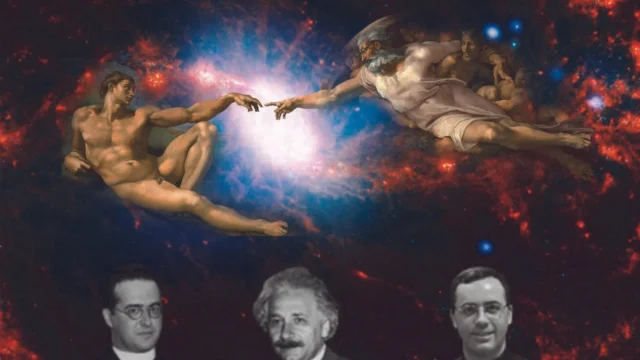
BIG BANG THEORY
Eric Lerner, plasma physicist and author
“The big bang today relies on a growing number of hypothetical entities, things that we have never observed—inflation, dark matter and dark energy are the most prominent examples. Without them, there is a fatal contradiction between the observations made by astronomers and the predictions of the big bang theory.”From an ‘Open Letter to the Scientific Community’ published in New Scientist (2004) and signed by 34 prominent scientists, critiquing the model’s reliance on unverified parameters.
BIG BANG THEORY
Sir Fred Hoyle, astrophysicist and cosmologist
“As a result of all this, the main efforts of investigators have been in papering over holes in the big bang theory, to build up an idea that has become ever more complex and cumbersome.”From ‘The Intelligent Universe’ (1983). Hoyle, who originally coined the term “Big Bang” as a critique, favored a Steady State universe without a singular explosive beginning.
BIG BANG THEORY
Paul Steinhardt, theoretical physicist and Albert Einstein Professor in Science at Princeton University
“The Big Bang theory, as it is usually presented, relies on the inflationary model, which has become so flexible that it is immune to experimental and observational tests… A theory that can predict anything, predicts nothing.”From a 2014 critique in Scientific American. Steinhardt, an original architect of inflationary theory, became its most prominent skeptic, arguing it renders the model unscientific.
BIG BANG THEORY
Sir Roger Penrose, mathematical physicist and Nobel Laureate in Physics
“The Big Bang was not the beginning. There was something before the Big Bang and that something is what we will have in our future… in this crazy theory of mine, that remote future becomes the Big Bang of another aeon.”Stated during a 2020 interview following his Nobel Prize win, explaining his ‘Conformal Cyclic Cosmology’ which replaces a singular Big Bang with infinite cosmological cycles.
BIG BANG THEORY
Halton Arp, astronomer and observational cosmologist
“If quasars are born from active galaxies… then the expanding universe concept is based on a false assumption. The redshift is not a velocity indicator, but a measure of the age of the matter.”From ‘Seeing Red: Redshifts, Cosmology and Academic Science’ (1998), arguing that intrinsic redshift measurements invalidate the core expansion premise of Big Bang cosmology.
BIG BANG THEORY
Hannes Alfvén, plasma physicist and Nobel Laureate in Physics
“The Big Bang is a myth, a wonderful myth maybe, which deserves a place of honor in the columbarium which already contains the Indian myth of a cyclic Universe… the Ptolemaic cosmological myth, and many others.”From ‘Cosmology: Myth or Science?’ (1978). Alfvén rejected Big Bang cosmology for ignoring the role of plasma physics and electromagnetism in shaping the universe.
BIG BANG THEORY
Geoffrey Burbidge, professor of physics and astronomy at UC San Diego
“Big Bang cosmology is probably as widely believed as has been any theory of the universe in the history of Western civilization. It rests, however, on many untested, and in many cases, untestable, assumptions… it has become a bandwagon of thought that reflects faith as much as objective truth.”From his article ‘Why the Big Bang is Wrong’ in Scientific American (1992), challenging the scientific consensus and its resistance to alternative cosmological models.
BIG BANG THEORY
Jayant Narlikar, astrophysicist and emeritus professor at IUCAA
“The standard big bang cosmology… requires a set of parameters fine-tuned to fit the observations. It is reminiscent of the epicycles of Ptolemy. One has to continually add new assumptions to save the theory.”From ‘An Introduction to Cosmology’ (2002), where Narlikar advocates for the Quasi-Steady State Cosmology as a simpler alternative to the increasingly convoluted Big Bang model.
BIG BANG THEORY
Sir John Maddox, theoretical physicist and former editor of Nature
“In all respects save that of convenience, this view of the origin of the universe is thoroughly unsatisfactory. For one thing, the implication is that there was an instant at which time began and that, until that instant, there was no time. This is an idea that is logically difficult to grasp and scientifically objectionable.”From a controversial 1989 editorial in Nature titled ‘Down with the Big Bang’, arguing against the philosophical and scientific implications of a singular cosmic beginning.
BIG BANG THEORY
David Merritt, astrophysicist and professor at Rochester Institute of Technology
“The standard cosmological model is a classic example of a degenerating research program. Rather than making predictions that are subsequently verified, it is constantly adjusted to accommodate new data, often by postulating unobservable entities like dark matter and dark energy.”From a 2017 paper applying philosopher Imre Lakatos’s criteria for scientific progress to cosmology, arguing the Big Bang model survives primarily through ad hoc modifications.
BIG BANG THEORY
Sir Fred Hoyle, astrophysicist and cosmologist
“The idea that all matter was created in one fell swoop at a finite time in the past seems to me an unnecessary and perhaps indefensible extrapolation.”From public lectures and debates (1957) arguing for the steady-state alternative and questioning the philosophical and physical implications of a temporal cosmic beginning.
BIG BANG THEORY
Hermann Bondi, mathematical physicist & co-creator of Steady State cosmology
“It is a major philosophical leap to go from the observed expansion to the conclusion that the universe began in a singular event.”Reflecting on cosmological assumptions (1970s) and emphasizing the conceptual risk of inferring an absolute beginning purely from expanding spacetime.
BIG BANG THEORY
Sir Roger Penrose, mathematical physicist and Nobel Laureate in Physics
“The singularity at t = 0 is not a physical event but a breakdown of our theories.”Highlighting the limits of general relativity (1965–1980) and warning that mathematical infinities signal incomplete physics rather than an absolute physical origin.
BIG BANG THEORY
William H. McCrea, theoretical physicist and astronomer
“What is most important is that we must beware of conflating mathematical extrapolation with physical reality.”Stated during cosmological discussions (1980s), warning that mathematical back-projection does not necessarily describe the physical history of the universe.
BIG BANG THEORY
Yakov Zeldovich, theoretical physicist and cosmologist
“The cosmological constant could be resurrected to avoid the need for a singular origin.”Demonstrating (1990) how modified field equations or non-zero cosmological constants offer mathematical paths around an absolute initial singularity.
BIG BANG THEORY
Geoffrey Burbidge, professor of physics and astrophysics
“I would not say the Big Bang is proven; there remain reasonable alternative interpretations of the evidence.”From interviews and scientific panels (1996), maintaining that cosmic microwave background and nucleosynthesis observations permit non-standard interpretations.
BIG BANG THEORY
Jayant Narlikar, astrophysicist & emeritus professor at IUCAA
“The cosmic microwave background could have explanations other than a single hot origin — one should not regard the standard story as the only interpretation.”Co-authored with Fred Hoyle across various publications (1960s–1990s), presenting the Quasi-Steady State mechanisms for thermalizing starlight into microwave radiation.
BIG BANG THEORY
Thomas Gold, astrophysicist & former professor of astronomy at Cornell University
“The idea that time itself came into existence at the Big Bang seems to mix physics with metaphysics; caution is required.”From essays and interviews (1980s) critiquing the overextension of physical models into metaphysical assertions regarding the genesis of time.
BIG BANG THEORY
Arno Penzias, radio astronomer and Nobel Laureate in Physics
“We must not mistake an attractive, successful model for the unique truth; the Big Bang remains a model open to revision.”From retrospectives and scientific interviews (2000s), reminding researchers that cosmological frameworks remain provisional despite empirical successes.