
Secular Corroboration?
External witnesses to Jesus’ life and ministry — Roman, Jewish, Greek, and Syrian writers within the first two centuries after His death, none of them Christian, several of them hostile.
Secular Corroboration surveys every major non-Christian literary source that confirms something about Jesus of Nazareth’s life, ministry, family, execution, and continuing movement. Where prior pages traced archaeological evidence and the Gospels’ internal testimony, here the witnesses are external — a Roman senator (Tacitus), a Jewish priest-turned-court-historian (Josephus), a Roman governor writing to the emperor (Pliny), a Stoic-trained Syrian philosopher (Mara bar Serapion), hostile rabbis (the Talmud), a pagan intellectual (Celsus), and a Greek satirist (Lucian). None had reason to invent a Jesus who never lived, and several had motives to suppress Him.
The converging testimony establishes a minimal but firm historical skeleton: Jesus existed; He lived in early-first-century Palestine under Tiberius; He was publicly reputed to perform extraordinary deeds; He had a brother named James; He was executed by Pontius Pilate; His movement survived His execution and spread from Judaea to Rome within three decades; and by the early second century His followers worshipped Him "as to a god."
The first nine subcats treat each witness in turn — Josephus’ Testimonium Flavianum (with Meier’s neutral reconstruction stripping later Christian glosses), the universally accepted James reference, Tacitus’ Annals 15.44, Pliny’s letter to Trajan (Ep. 10.96), Suetonius’ "Chrestus" passage, Mara bar Serapion’s "wise king" letter, the Babylonian Talmud’s hostile Yeshu traditions, Celsus’ pagan polemic preserved in Origen’s Contra Celsum, and Lucian’s satirical "crucified sophist." Subcats 10 and 11 are four-card cross-reference summaries that anchor the secular witnesses to the Crucifixion and the post-crucifixion Movement in this menu, linking back to the parent Crucifixion > Secular Corroboration page for the long-form treatment. Subcat 12 is the cumulative case tying the eleven preceding subcats into a single converging argument on behalf of Jesus’ life and ministry.
Josephus — Testimonium Flavianum
The debated reference in Antiquities 18.63–64, with Meier’s neutral reconstruction — what an authentic first-century Jewish historian actually wrote about Jesus, His wisdom, His extraordinary deeds, and His continuing movement.
Josephus — James Reference
The universally accepted passage in Antiquities 20.200 confirming Jesus had a brother named James, martyred under the high priest Ananus c. AD 62 — the most secure non-Christian reference to Jesus in ancient literature.
Tacitus — Annals 15.44
Rome’s greatest senator-historian on Christus, executed under Tiberius by Pontius Pilate — independent Roman confirmation of the Gospel trial setting, written with open hostility to the movement.
Pliny — Letter to Trajan
The Roman governor of Bithynia asks Emperor Trajan how to handle Christians who sing "a hymn to Christ as to a god" at pre-dawn gatherings — the earliest external description of Christian worship, c. AD 112.
Suetonius — Chrestus & Claudius
Suetonius records Claudius expelling Rome’s Jews over disturbances "at the instigation of Chrestus" — independent Roman corroboration of Acts 18:2, showing the Christ-message reached Rome by the late AD 40s.
Mara bar Serapion — Wise King
A Stoic-styled Syriac letter (c. AD 73) compares the Jews’ execution of their "wise king" to Athens killing Socrates and Samos killing Pythagoras — a pagan voice acknowledging Jesus as a wise teacher.
Babylonian Talmud — Yeshu
Rabbinic traditions in b. Sanhedrin 43a and 107b preserve hostile "Yeshu" counter-narratives — confirming the Passover-eve execution, the charge of "sorcery," and the early continuation of His movement from anti-Christian sources.
Celsus — Pagan Critic
The earliest systematic pagan critique of Christianity (c. AD 178), preserved in Origen’s Contra Celsum — Celsus explains Jesus’ miracles as Egyptian sorcery, conceding the phenomena while denying their source.
Lucian of Samosata — Crucified Sophist
Greek satirist Lucian (c. AD 165) mocks Christians for worshipping a "crucified sophist" and living "by his laws" — inadvertent confirmation of the crucifixion, the Jesus-law tradition, and the movement’s spread.
Crucifixion — Secular Witnesses
Four-card cross-reference to the parent Crucifixion > Secular Corroboration page: Tacitus on Pilate, Josephus’ Testimonium, the Talmud’s Passover-eve notice, and Thallus on the darkness — life-and-ministry-relevant elements summarized here.
The Movement After Death
Four-card summary: Pliny’s "hymn to Christ as to a god" (AD 112), Suetonius’ expulsion notice, Lucian on the crucified sophist’s laws, and Mara bar Serapion on the king whose kingdom lives on — hostile witnesses confirming the movement survived Jesus’ death.
Cumulative Case
Roman senator, Roman governor, Roman biographer, Jewish priest-historian, Stoic Syrian philosopher, Jewish rabbis, pagan polemicist, Greek satirist — eight independent non-Christian witnesses across the first two centuries. The pattern, not any single voice, is the argument.
Check and Sort for Duplicates
WHAT THE SECULAR HISTORIANS ACTUALLY TELL US
Dr. Edwin Yamauchi, professor of history at Miami University & ancient Near East scholar“From Tacitus, Pliny the Younger, Josephus, Suetonius, and Thallus alone — all non-Christian sources — we can establish that Jesus existed, was crucified under Pontius Pilate, had a brother named James, founded a movement that spread rapidly, and was worshipped as a god by his followers within decades of his death. That is an extraordinary historical footprint for any ancient figure.” His comprehensive survey of non-Christian ancient sources for Jesus demonstrated that the secular historical record alone establishes the core facts of the Gospel narrative. Evidence: Critical analysis of Tacitus Annals 15.44, Pliny Epistles 10.96, Josephus Antiquities 18.3 and 20.9, and Suetonius Claudius 25.4. [Ontology: Jesus > Extra-Biblical Historians]+ Read More
File Under: Jesus’ Ministry > Secular Corroboration
Cross Reference: The Cumulative Case
JOSEPHUS: THE JEWISH HISTORIAN WHO NAMED JESUS
Dr. Louis Feldman, professor of classics at Yeshiva University & foremost Josephus scholar“Even after removing the obvious Christian interpolations from the Testimonium Flavianum, a core authentic reference to Jesus remains in Josephus — describing him as a wise man, a doer of surprising deeds, who gathered followers among Jews and Greeks, was condemned by Pilate, and whose followers persisted after his death. Josephus knew about Jesus and considered him historically significant.” As the world’s leading Josephus scholar, Feldman’s careful reconstruction of the authentic core of the Testimonium Flavianum provides the strongest possible non-Christian Jewish attestation to the historical Jesus. Evidence: Critical textual analysis of Antiquities 18.3.3, cross-referenced with the Arabic version preserved by Agapius of Hierapolis. [Ontology: Jesus > Extra-Biblical Historians]+ Read More
File Under: Jesus’ Ministry > Secular Corroboration
Cross Reference: Historical Evidence
TACITUS: THE HOSTILE WITNESS WHO CONFIRMS THE CRUCIFIXION
Dr. Robert Van Voorst, professor of New Testament at Western Theological Seminary & author of Jesus Outside the New Testament“Tacitus’ reference to ‘Christus’ in the Annals — written around AD 116 — is almost universally accepted as authentic by classical scholars. He describes Christ as executed by Pontius Pilate during the reign of Tiberius, and the movement as spreading from Judaea to Rome. A hostile pagan source confirms the core historical facts of the Gospel.” Tacitus was openly contemptuous of Christianity, making his confirmation of the crucifixion under Pilate all the more historically valuable as an unbiased hostile witness. Evidence: Critical analysis of Tacitus Annals 15.44, authenticated by classical scholars on the basis of style, vocabulary, and manuscript tradition. [Ontology: Jesus > Extra-Biblical Historians]+ Read More
File Under: Jesus’ Ministry > Secular Corroboration
Cross Reference: Multiple Attestations
THE CLASSICAL HISTORIAN’S VERDICT ON JESUS
Dr. Michael Grant, classical historian & former vice-chancellor of the University of Khartoum“In terms of the historical evidence, the sources for Jesus are better than those for most figures of the ancient world. If we applied the same skeptical criteria to other ancient historical figures that some apply to Jesus, we would have to deny the existence of most of the ancient world. Jesus of Nazareth was a real historical person.” As a secular classical historian with no theological agenda, Grant’s affirmation of Jesus’ historicity on purely evidential grounds carries exceptional weight in the academic debate. Evidence: Comparative historiographical analysis applying standard classical historical criteria to the Gospel sources. [Ontology: Jesus > Extra-Biblical Historians]+ Read More
File Under: Jesus’ Ministry > Secular Corroboration
Cross Reference: Historical Evidence
PLINY’S LETTER: CHRISTIANS WORSHIPPING JESUS AS GOD BY AD 112
Dr. Paul Barnett, bishop & visiting fellow in ancient history at Macquarie University“Pliny the Younger’s letter to Emperor Trajan in AD 112 describes Christians in Bithynia singing hymns to Christ ‘as to a god’ before dawn — within 80 years of the crucifixion. This is not a late theological development. The worship of Jesus as divine was established within living memory of the events, exactly as the New Testament claims.” Pliny’s letter is one of the most important non-Christian documents for early Christianity, confirming the early date of Christ-worship and the rapid geographic spread of the movement. Evidence: Critical analysis of Pliny Epistles 10.96, authenticated by classical scholars as an uninterpolated primary source. [Ontology: Jesus > Extra-Biblical Historians]+ Read More
File Under: Jesus’ Ministry > Secular Corroboration
Cross Reference: Secular Corroboration
THE JEWISH TALMUD: A HOSTILE WITNESS THAT CONFIRMS THE CRUCIFIXION
Dr. Robert Van Voorst, professor of New Testament at Western Theological Seminary & author of Jesus Outside the New Testament“The Babylonian Talmud — a hostile anti-Christian source — records that ‘Yeshu the Nazarene practiced sorcery and led Israel astray’ and was ‘hanged on the eve of Passover.’ This is not a Christian document. It is a Jewish legal record that, in attempting to discredit Jesus, inadvertently confirms his existence, his reputation for miraculous works, and his execution at Passover — precisely as the Gospels record.” As perhaps the most hostile ancient source toward Jesus, the Talmud’s confirmation of his existence, miracle-working reputation, and Passover execution carries exceptional evidential weight — hostile witnesses are the most credible witnesses. Evidence: Critical analysis of Babylonian Talmud Sanhedrin 43a, authenticated by Talmudic scholars as a genuine early rabbinic tradition. [Ontology: Jesus > Temple Inscriptions & Roman Imperial Records]+ Read More
File Under: Jesus’ Ministry > Secular Corroboration
Cross Reference: Multiple Attestations
FIFTY-THREE BIBLICAL FIGURES CONFIRMED BY ARCHAEOLOGY
Dr. Lawrence Mykytiuk, emeritus professor of Jewish studies at Purdue University & author of the Biblical Archaeology Review’s definitive study on extra-biblical evidence for Jesus“I have identified 53 figures from the Hebrew Bible and 30 from the New Testament who have been confirmed by archaeology — through inscriptions, seals, or other physical artifacts. Every single non-Christian ancient source that mentions Jesus — Jewish, Roman, or pagan — treats him as a real historical person. Not one ancient source denies his existence. The historical case for Jesus is stronger than for most figures of antiquity.” His systematic survey — published in the Biblical Archaeology Review — represents the most comprehensive academic accounting of archaeologically confirmed biblical figures ever produced, establishing the pattern of historical reliability that extends to Jesus himself. Evidence: Systematic epigraphic and archaeological survey of 53 Old Testament and 30 New Testament figures confirmed by non-biblical physical evidence. [Ontology: Jesus > Broader Physical Evidence]+ Read More
File Under: Jesus’ Ministry > Secular Corroboration
Cross Reference: Biblical Archaeology
THE SYRIAN PHILOSOPHER WHO CALLED JESUS THE ‘WISE KING’ OF THE JEWS
Dr. F.F. Bruce, Rylands professor of biblical criticism at the University of Manchester, on the letter of Mara bar Serapion“A letter written by the Syrian Stoic philosopher Mara bar Serapion to his son — dating to sometime after AD 73 — asks: ‘What advantage did the Jews gain from executing their wise king? It was just after that that their kingdom was abolished.’ He refers to Jesus as the ‘wise king’ of the Jews, confirms his execution, and notes the subsequent destruction of Jerusalem — all from a pagan Stoic perspective with no Christian agenda whatsoever.” The Mara bar Serapion letter is one of the earliest non-Christian references to Jesus, written by a pagan philosopher who treats the execution of Jesus and its consequences as straightforward historical facts. Evidence: Syriac manuscript analysis of the Mara bar Serapion letter, preserved in the British Museum, dated to after AD 73. [Ontology: Jesus > Broader Physical Evidence]+ Read More
File Under: Jesus’ Ministry > Secular Corroboration
Cross Reference: Multiple Attestations
NEED TO BE SORTED AND COMPRED FOR DUPS
[su_row]What the Secular Historians Actually Tell Us
Dr. Edwin Yamauchi, professor of history, Miami University & ancient Near East scholar“From Tacitus, Pliny the Younger, Josephus, Suetonius, and Thallus alone — all non-Christian sources — we can establish that Jesus existed, was crucified under Pontius Pilate, had a brother named James, founded a movement that spread rapidly, and was worshipped as a god by his followers within decades of his death. That is an extraordinary historical footprint for any ancient figure.” Historian Edwin Yamauchi surveyed every major non-Christian source and concluded that the secular record alone establishes the core Gospel facts — existence, crucifixion under Pilate, and rapid worship as divine.Five independent pagan and Jewish writers, none sympathetic to the faith, converge on the same skeleton the Gospels describe — which is why hostile testimony carries such weight. The value is cumulative: no single source proves everything, but together they make a mythical Jesus historically untenable. Evidence: critical analysis of five independent non-Christian sources. Citation: Tacitus, Annals 15.44; Pliny, Epistles 10.96; Josephus, Antiquities 18.3 & 20.9; Suetonius, Claudius 25.4.File Under: Jesus’ Ministry > Secular Corroboration > Extra-Biblical Sources
Cross Reference: Historical Evidence | The Cumulative Case
The Classical Historian’s Verdict on Jesus
Dr. Michael Grant, classical historian & former vice-chancellor, University of Khartoum“In terms of the historical evidence, the sources for Jesus are better than those for most figures of the ancient world. If we applied the same skeptical criteria to other ancient historical figures that some apply to Jesus, we would have to deny the existence of most of the ancient world. Jesus of Nazareth was a real historical person.” Secular classicist Michael Grant, writing with no theological agenda, judged that the sources for Jesus outclass those for most ancient figures.Grant applied the standard tools of classical historiography — source proximity, multiple attestation, and consistency — and found the mythicist position self-defeating, since it would erase most of antiquity. His verdict matters precisely because he approached the question as a secular historian, not a believer. Evidence: comparative historiographical analysis of the Gospel sources. Citation: Michael Grant, Jesus: An Historian’s Review of the Gospels.File Under: Jesus’ Ministry > Secular Corroboration > Classical Historians
Cross Reference: Historical Evidence | New Testament Reliability
Josephus: The Jewish Historian Who Named Jesus
Dr. Louis Feldman, professor of classics, Yeshiva University & foremost Josephus scholar“Even after removing the obvious Christian interpolations from the Testimonium Flavianum, a core authentic reference to Jesus remains in Josephus — describing him as a wise man, a doer of surprising deeds, who gathered followers among Jews and Greeks, was condemned by Pilate, and whose followers persisted after his death. Josephus knew about Jesus and considered him historically significant.” The world’s leading Josephus scholar, Louis Feldman, reconstructed the authentic core of the passage, giving the strongest non-Christian Jewish attestation to Jesus.Once the later Christian additions are stripped away, what remains is a first-century Jewish historian independently noting Jesus, his following, and his execution under Pilate. The Arabic recension preserved by Agapius confirms the neutral tone of the original, showing this is authentic testimony, not a forgery. Evidence: textual analysis of the Testimonium, cross-checked against the Arabic version. Citation: Josephus, Antiquities 18.3.3; Arabic recension of Agapius of Hierapolis.File Under: Jesus’ Ministry > Secular Corroboration > Josephus
Cross Reference: The Crucifixion | Historical Evidence
Tacitus: The Hostile Witness Who Confirms the Crucifixion
Dr. Robert Van Voorst, professor of New Testament, Western Theological Seminary & author of Jesus Outside the New Testament“Tacitus’ reference to ‘Christus’ in the Annals — written around AD 116 — is almost universally accepted as authentic by classical scholars. He describes Christ as executed by Pontius Pilate during the reign of Tiberius, and the movement as spreading from Judaea to Rome. A hostile pagan source confirms the core historical facts of the Gospel.” Scholar Robert Van Voorst notes that Tacitus, openly contemptuous of Christians, still records the crucifixion under Pilate as plain fact.A hostile witness has no motive to invent facts that help the movement he despises, which is exactly why Tacitus’ hostility strengthens his testimony. His account independently anchors the execution to Pilate and Tiberius, matching the Gospel timeline to the correct ruler and province. Evidence: stylistic, lexical, and manuscript authentication by classical scholars. Citation: Tacitus, Annals 15.44.File Under: Jesus’ Ministry > Secular Corroboration > Tacitus
Cross Reference: The Crucifixion | Physical Evidence
Pliny’s Letter: Christians Worshipping Jesus as God by AD 112
Dr. Paul Barnett, bishop & visiting fellow in ancient history, Macquarie University“Pliny the Younger’s letter to Emperor Trajan in AD 112 describes Christians in Bithynia singing hymns to Christ ‘as to a god’ before dawn — within 80 years of the crucifixion. This is not a late theological development. The worship of Jesus as divine was established within living memory of the events, exactly as the New Testament claims.” Historian Paul Barnett highlights that Pliny the Younger documents Christians worshipping Jesus as God within living memory of the crucifixion.A Roman governor writing an official report to the emperor had every reason for accuracy and none for flattering a sect he was prosecuting. His letter fixes both the early date and the wide geographic reach of Christ-worship, undercutting claims that Jesus’ divinity was a slow, later legendary accretion. Evidence: authenticated as an uninterpolated primary imperial document. Citation: Pliny the Younger, Epistles 10.96.File Under: Jesus’ Ministry > Secular Corroboration > Pliny the Younger
Cross Reference: The Resurrection | New Testament Reliability
The Minimal Facts That Even Skeptics Accept
Dr. Gary Habermas, distinguished research professor, Liberty University & resurrection scholar“Using only facts accepted by the vast majority of critical scholars — including skeptics — we can establish: Jesus died by crucifixion; his tomb was found empty; his disciples believed they saw him risen; Paul and James converted after claiming to see the risen Jesus. No naturalistic hypothesis explains all four facts. The resurrection is the best historical explanation.” Scholar Gary Habermas built his case from data even skeptical critical scholars concede, drawing on the conversion of Paul and James.By restricting the argument to facts granted across the theological spectrum, Habermas removes the charge of special pleading and forces the debate onto the best explanation of agreed data. The conversion of the persecutor Paul and the skeptic James — described in 1 Corinthians 15:7“After that, he was seen of James; then of all the apostles.” — remains historically difficult to explain naturalistically. Evidence: survey of 1,400+ critical scholarly sources identifying near-universal facts. Citation: Gary Habermas & Michael Licona, The Case for the Resurrection of Jesus; 1 Corinthians 15:3-8“For I delivered unto you first of all that which I also received, how that Christ died for our sins according to the scriptures; And that he was buried, and that he rose again the third day according to the scriptures…”.File Under: Jesus’ Ministry > Secular Corroboration > Minimal Facts
Cross Reference: The Resurrection | The Empty Tomb
The Historian’s Case for the Bodily Resurrection
Dr. N.T. Wright, professor of New Testament & early Christianity, University of St Andrews & former Bishop of Durham“As a historian, I am convinced that the resurrection of Jesus is the best explanation for two undeniable historical facts: the empty tomb and the post-mortem appearances. No other hypothesis — theft, hallucination, legend — accounts for both. The early Christian belief in a bodily resurrection was not a theological development. It was a historical report.” Historian N.T. Wright argues that only a bodily resurrection accounts for both the empty tomb and the appearances together.Wright’s 800-page study shows that first-century Judaism had no category for a single individual rising ahead of the general resurrection, so the disciples’ sudden, unified belief demands an unprecedented cause. Rival theories each explain one fact but never both, leaving the resurrection as the only historically adequate explanation. Evidence: analysis of Jewish resurrection belief, the empty-tomb tradition, and multiple independent appearance accounts. Citation: N.T. Wright, The Resurrection of the Son of God.File Under: Jesus’ Ministry > Secular Corroboration > N.T. Wright
Cross Reference: The Resurrection | The Empty Tomb
The Dead Sea Scrolls and the Messianic Expectation Jesus Fulfilled
Dr. James Charlesworth, professor of New Testament, Princeton Theological Seminary & Dead Sea Scrolls editor“The Dead Sea Scrolls reveal that first-century Judaism was saturated with messianic expectation — a coming figure who would be called ‘Son of God,’ ‘Son of the Most High,’ who would heal the blind and raise the dead. These are not Christian inventions. They are pre-Christian Jewish expectations that Jesus of Nazareth uniquely fulfilled.” Scrolls editor James Charlesworth shows the titles “Son of God” and “Son of the Most High” were pre-Christian Jewish messianic expectations, echoed in Luke 1:32“He shall be great, and shall be called the Son of the Highest: and the Lord God shall give unto him the throne of his father David.”.Because scrolls such as 4Q246 and 4Q521 predate Jesus, the messianic vocabulary applied to him cannot be a later Christian back-formation. The healing-and-raising program the scrolls anticipate matches Jesus’ answer to John’s disciples, showing he consciously stepped into a documented, pre-existing expectation. Evidence: comparative analysis of Qumran messianic texts with the Gospel accounts. Citation: Dead Sea Scrolls 4Q246 & 4Q521; cf. Matthew 11:5“The blind receive their sight, and the lame walk, the lepers are cleansed, and the deaf hear, the dead are raised up, and the poor have the gospel preached to them.”.File Under: Jesus’ Ministry > Secular Corroboration > Dead Sea Scrolls
Cross Reference: Messianic Prophecies | Miracles & Testimonies
The Oldest Fragment of the New Testament
Colin Roberts, papyrologist at Oxford University & identifier of the Rylands Papyrus P52“The John Rylands Papyrus — Papyrus 52 — contains a fragment of the Gospel of John dating to approximately AD 125, found in Egypt. This means the Gospel of John was written, copied, and distributed to Egypt within a generation of the events it describes. The New Testament documents are not late legends. They are early eyewitness records.” Papyrologist Colin Roberts identified P52 as the oldest known New Testament manuscript fragment — proving the Gospel of John was circulating within a generation of the crucifixion, in John 18:31–33“Then said Pilate unto them, Take ye him, and judge him according to your law. The Jews therefore said unto him, It is not lawful for us to put any man to death: That the saying of Jesus might be fulfilled, which he spake, signifying what death he should die.”.Because P52 was found in provincial Egypt — far from John’s likely composition site — it presupposes the Gospel had already been copied and transported there. Working backward, composition must be earlier still, demolishing the theory that John is a late 2nd-century theological invention. This single scrap of papyrus collapses the legend-development timeline. Evidence: paleographic dating of Greek papyrus fragment to early 2nd century AD, cross-referenced with Qumran scribal styles. Citation: Colin Roberts, An Unpublished Fragment of the Fourth Gospel; P52 (John 18:31–33, 37–38).File Under: Jesus’ Ministry > New Testament Reliability > Manuscript Evidence
Cross Reference: Historical Evidence | Textual Criticism
More Manuscripts Than Any Other Ancient Work
Dr. Daniel Wallace, professor of New Testament studies at Dallas Theological Seminary & manuscript scholar“We have over 5,800 Greek manuscripts of the New Testament — more than any other work of ancient literature by an order of magnitude. Homer’s Iliad comes second with fewer than 2,000. The textual tradition of the New Testament is so rich and so early that we can reconstruct the original text with extraordinary confidence. No other ancient document comes close.” Manuscript scholar Daniel Wallace documents that the NT outclasses every ancient work in manuscript quantity and proximity — over 5,800 Greek copies alone, versus fewer than 2,000 for Homer.Historians assess a text’s reliability partly by how many manuscripts survive and how close they are to the original. By both measures the New Testament is without peer in antiquity: 5,800+ Greek copies, 10,000+ Latin, and 9,000+ in other languages — giving textual scholars an exceptionally dense cross-checking web. The result is that no doctrine rests on a disputed reading. Evidence: comparative manuscript database compiled by the Center for the Study of New Testament Manuscripts (CSNTM). Citation: Daniel Wallace, Revisiting the Corruption of the New Testament; CSNTM manuscript catalogue.File Under: Jesus’ Ministry > New Testament Reliability > Manuscript Evidence
Cross Reference: Textual Criticism | Historical Evidence
The Dead Sea Scrolls and the World Jesus Inhabited
Dr. Peter Flint, professor of biblical studies at Trinity Western University & Dead Sea Scrolls scholar“The Dead Sea Scrolls — discovered in 1947 and dating from 250 BC to AD 68 — contain every book of the Hebrew Old Testament except Esther, and they match our modern text with astonishing accuracy after a thousand years of copying. They also illuminate the exact Jewish world Jesus inhabited — the messianic expectations, the apocalyptic language, the Temple theology.” Scrolls scholar Peter Flint shows the Scrolls both confirmed the textual integrity of the Old Testament Jesus quoted and illuminate the precise religious world of his ministry — messianic language, Temple theology, apocalyptic expectation.Before 1947 the oldest Hebrew Old Testament manuscript dated to AD 900; the Scrolls pushed that back to 250 BC, showing that 1,000 years of copying introduced virtually no substantive change — a remarkable confirmation that scribal transmission was accurate and deliberate. Jesus quoted from a text that the Scrolls prove was already stable in his own day. Evidence: paleographic and carbon-14 dating of 900+ scrolls from Qumran Caves 1–11; textual comparison with the Masoretic Text. Citation: Peter Flint & James VanderKam (eds.), The Dead Sea Scrolls After Fifty Years.File Under: Jesus’ Ministry > New Testament Reliability > Dead Sea Scrolls
Cross Reference: Messianic Prophecies | Secular Corroboration
The Gospels as Reliable Ancient Biography
Dr. Craig Blomberg, professor of New Testament at Denver Seminary & author of The Historical Reliability of the Gospels“When the Gospels are evaluated by the same criteria historians apply to any ancient document — proximity to events, number of sources, internal consistency, external corroboration — they score exceptionally well. The Gospels are not pious fiction. They are ancient biographies of the highest historical quality.” Historian Craig Blomberg applied every standard historiographical criterion — multiple attestation, embarrassment, dissimilarity, coherence — and found that the Gospels score exceptionally well by every measure.The “criterion of embarrassment” is particularly powerful: the Gospels record episodes that would embarrass early Christians — women as the first resurrection witnesses (legally inadmissible in 1st-century courts), Jesus being baptized by John, the disciples’ repeated failures — details a fiction-writer would omit. Their inclusion signals fidelity to fact over image management. Evidence: application of the criteria of multiple attestation, embarrassment, dissimilarity, coherence, and historical plausibility to all four Gospels. Citation: Craig Blomberg, The Historical Reliability of the Gospels (2nd ed.).File Under: Jesus’ Ministry > New Testament Reliability > Gospel Reliability
Cross Reference: Historical Evidence | Secular Corroboration
The Thallus Reference: A Pagan Confirms the Darkness
Dr. Paul Maier, professor of ancient history at Western Michigan University“The historian Thallus, writing around AD 52, referred to a darkness that fell over the land — which Julius Africanus later identified as occurring at the time of the crucifixion of Jesus. This is the earliest non-Christian reference to the crucifixion, written within two decades of the event, and it confirms that the darkness described in the Gospels was a real, historically noted phenomenon.” Historian Paul Maier identifies Thallus’ account — written c. AD 52 — as the earliest non-Christian secular reference to the crucifixion, predating several New Testament letters, recorded in Matthew 27:45“Now from the sixth hour there was darkness over all the land unto the ninth hour.”.Thallus attempted to explain the darkness as a solar eclipse — which Julius Africanus rightly refuted, since Passover falls on a full moon when solar eclipses are impossible. The attempt at a naturalistic explanation actually confirms the darkness was a real, widely noticed event. A Roman pagan felt compelled to explain it within 20 years. Evidence: fragmentary citation of Thallus preserved in Julius Africanus (c. AD 220) and Eusebius, cross-referenced with the Gospel passion timeline. Citation: Julius Africanus, Chronography, Fragment 18; cf. Luke 23:44“And it was about the sixth hour, and there was a darkness over all the earth until the ninth hour.”.File Under: Jesus’ Ministry > New Testament Reliability > Thallus
Cross Reference: The Crucifixion | Secular Corroboration
The Patristic Fathers Who Quote the Entire New Testament
Dr. F.F. Bruce, Rylands professor of biblical criticism at the University of Manchester“The early Church Fathers — Clement, Ignatius, Polycarp, and others writing between AD 95 and 150 — quote the New Testament so extensively that if every manuscript were destroyed, we could reconstruct virtually the entire New Testament from their writings alone. The text was fixed, circulating, and authoritative within one generation of the apostles.” Biblical scholar F.F. Bruce demonstrated that the entire New Testament can be reconstructed from patristic quotations alone — an independent textual witness that predates most surviving manuscripts.Ignatius of Antioch (writing c. AD 107, within a decade of the apostle John’s death) quotes or alludes to 18 of the 27 New Testament books. Polycarp, a personal disciple of John, quotes extensively from Paul’s letters. Together these Fathers form a second, independently preserved textual stream that locks the New Testament text before AD 150 — when legendary development would need far more time. Evidence: patristic citation analysis across Apostolic Fathers and early apologists, reconstructing the NT text from quotations alone. Citation: F.F. Bruce, The New Testament Documents: Are They Reliable?File Under: Jesus’ Ministry > New Testament Reliability > Patristic Evidence
Cross Reference: Textual Criticism | Manuscript Evidence
The Oxford Fragment That Places Matthew in the First Century
Dr. Carsten Thiede, papyrologist & director of the Institute for Basic Epistemological Research, Paderborn“Using confocal laser scanning microscopy, I re-examined the Magdalen Papyrus fragments at Oxford — long dated to the late 2nd century — and found that the script style matches papyri from Qumran dated to the mid-1st century AD. If correct, this places the Gospel of Matthew within the lifetime of the eyewitnesses.” Papyrologist Carsten Thiede re-dated the Magdalen Papyrus (P64) using laser microscopy, finding a script match to mid-1st century Qumran papyri — potentially placing Matthew’s Gospel within living eyewitness memory.Thiede’s peer-reviewed re-examination remains debated, but it opened a serious scholarly conversation about whether the traditional late dating of the Gospels rests on circular assumptions rather than evidence. Even if the conservative re-dating is not adopted wholesale, the debate has shifted the burden of proof: early dating is no longer dismissed as impossible. Notably, liberal scholar John A.T. Robinson independently reached similar conclusions by different methods (see Slide 13). Evidence: confocal laser scanning microscopy and comparative paleographic analysis of the Magdalen Papyrus fragments (P64), Oxford. Citation: Carsten Thiede & Matthew d’Ancona, Eyewitness to Jesus; Tyndale Bulletin 46 (1995).File Under: Jesus’ Ministry > New Testament Reliability > Manuscript Evidence
Cross Reference: Textual Criticism | Historical Evidence
The Liberal Scholar Who Concluded the Gospels Are Early
Dr. John A.T. Robinson, dean of Trinity College Cambridge & New Testament scholar“After a thorough re-examination of the evidence, I am convinced that the entire New Testament was written before AD 70 — within 40 years of the crucifixion, while eyewitnesses were still alive. The scholarly consensus for late dating rests on circular assumptions, not evidence. These documents are far earlier than we have been taught.” Theologically liberal Cambridge scholar John A.T. Robinson shocked the academic world by concluding the entire New Testament predates AD 70 — while eyewitnesses were still alive — based purely on internal evidence.Robinson’s key argument: not one New Testament document mentions the destruction of Jerusalem and the Temple in AD 70 — a catastrophic event that would have been impossible for a Christian author to ignore had it already occurred. The silence is best explained by composition before that date. The weight of his conclusion is amplified by his theological liberalism — he had no conservative apologetic motive for the conclusion. Evidence: internal textual analysis, absence of any NT reference to the AD 70 destruction; comparative dating methodology applied to all 27 NT books. Citation: John A.T. Robinson, Redating the New Testament (1976).File Under: Jesus’ Ministry > New Testament Reliability > Gospel Reliability
Cross Reference: Textual Criticism | Secular Corroboration
The Textual Critic Who Trusted the Text
Dr. Bruce Metzger, professor of New Testament language & literature at Princeton Theological Seminary“The more I studied the manuscript tradition of the New Testament, the more I became convinced of its essential reliability. The variants between manuscripts affect no doctrine and no historical claim of substance. The New Testament we read today is, in all essentials, the New Testament that was written in the first century.” Widely regarded as the 20th century’s greatest New Testament textual critic, Bruce Metzger concluded that a lifetime of manuscript analysis produced deepened rather than diminished confidence in the text’s integrity — no doctrine turns on a disputed reading.Metzger began his career as a skeptic of textual reliability and ended it as its most authoritative defender — a trajectory driven by evidence, not faith. He edited the standard critical Greek New Testament used by scholars worldwide. His conclusion: the 400,000 textual variants cited by critics are overwhelmingly spelling differences, word-order variants, and obvious scribal slips — none overturn a historical or doctrinal claim. Evidence: lifetime of critical analysis of 5,800+ Greek New Testament manuscripts, culminating in the United Bible Societies’ critical edition. Citation: Bruce Metzger, The Text of the New Testament (4th ed.); A Textual Commentary on the Greek New Testament.File Under: Jesus’ Ministry > New Testament Reliability > Textual Criticism
Cross Reference: Manuscript Evidence | Historical Evidence
Josephus — Testimonium Flavianum
The most debated passage in non-Christian antiquity. Josephus’s Antiquities 18.63–64 names Jesus as a wise man, a doer of startling deeds, and the founder of a movement that survived His crucifixion under Pilate. After John P. Meier’s 1991 “neutral reconstruction” stripped three obvious Christian interpolations, even skeptical scholars concede an authentic Josephus core. Slides/cards cover the Greek neutral reconstruction, the parallel Arabic version of Agapius, the Josephus-vocabulary test, and scholarly consensus.
The Neutral Reconstruction — Josephus the Jewish Historian Names Jesus
Flavius Josephus — Antiquities of the Jews 18.63–64, Rome, c. AD 93“At this time there appeared Jesus, a wise man. For he was a doer of startling deeds, a teacher of people who receive the truth with pleasure. And he gained a following both among many Jews and among many of Greek origin. And when Pilate condemned him to the cross, upon the indictment of our leading men, those who had loved him from the first did not fall away. And the tribe of Christians, named after him, has not disappeared to this day.” — Josephus, Antiquities 18.63–64 (Meier neutral reconstruction) Flavius Josephus (c. AD 37–100), the Jewish priest-court-historian writing in Rome, mentions Jesus in his Antiquities as a “doer of startling deeds”, a teacher drawing both Jewish and Greek followers, executed by Pontius Pilate, whose movement persisted decades after His death. John P. Meier‘s A Marginal Jew, vol. 1 (Doubleday, 1991), produced the standard “neutral reconstruction” — stripping three obvious Christian interpolations from the Josephus core while preserving the surrounding testimony.File Under: Jesus Christ > Life & Ministry > Secular Corroboration > Josephus — Testimonium FlavianumThe three interpolations removed are: “if it be lawful to call him a man” (after “a wise man”), “he was the Christ” (likely added after “Pilate condemned him”), and “he appeared to them on the third day, having life again” (substituted for a neutral reference to the disciples’ continued loyalty). With these additions stripped, the recovered text reflects a Romanised Jewish aristocrat cataloguing disturbances in Judea under Pilate — exactly what Josephus’s Roman audience would expect. Even hostile scholars concede this restrained, political framing predates Christian redaction. Citation: Flavius Josephus, Antiquities of the Jews 18.63–64 (c. AD 93); reconstruction: John P. Meier, A Marginal Jew: Rethinking the Historical Jesus, vol. 1, Doubleday, 1991, pp. 56–88.
Cross-References: Josephus — James Reference | Tacitus — Annals 15.44 | Cumulative Case
Agapius’ Arabic Version — A Parallel Tradition Without the Scribe’s Gloss
Agapius of Hierapolis — Kitab al-Unwan, Arabic, c. AD 940, Melkite bishop in northern Syria“Similarly Josephus the Hebrew says in the treatises that he wrote on the governance of the Jews: At this time there was a wise man who was called Jesus. His conduct was good, and he was known to be virtuous. Many people from among the Jews and other nations became his disciples. Pilate condemned him to be crucified and to die. But those who had become his disciples did not abandon his discipleship. They reported that he had appeared to them three days after his crucifixion and that he was alive; accordingly he was perhaps the Messiah, concerning whom the prophets have recounted wonders.” — Agapius, Kitab al-Unwan (Arabic, c. AD 940, Pines translation) Shlomo Pines‘s 1971 discovery of this Arabic Testimonium preserved by Agapius, a tenth-century Melkite bishop in Hierapolis, disclosed a parallel tradition independent of the dominant Greek manuscript line. Agapius’ rendering lacks the obvious Christian confessions — no “if it be lawful to call him a man,” no unequivocal “he was the Christ.” Jesus is described as “perhaps” the Messiah, with explicit grammatical hedging no Christian interpolator would compose.File Under: Jesus Christ > Life & Ministry > Secular Corroboration > Josephus — Testimonium FlavianumAlice Whealey (UC Berkeley, The Testimonium Flavianum Controversy from Late Antiquity to Modern Times, Peter Lang, 2003) traces Agapius’s rendering back through a Syriac intermediary to the Antiochene manuscript tradition — a line that circulated without Eusebius’s interpolated Greek recension. The very terseness of Agapius’ phrasing argues against invention: a Christian forger fabricating Josephus would have inserted triumphant Christology, not “perhaps.” Citation: Shlomo Pines, An Arabic Version of the Testimonium Flavianum and Its Implications, Jerusalem: Israel Academy of Sciences and Humanities, 1971; Alice Whealey, Josephus on Jesus, Peter Lang, 2003.
Cross-References: Josephus — James Reference | Cumulative Case

The Vocabulary Test — Josephus’s Greek, Not a Christian Scribe’s
Linguistic evidence — Josephus’s characteristic Greek diction, Antiquities 18.63–64“παράδοξων ἔργων ποιητής” — “a doer of startling deeds.” Josephus, Antiquities 18.63 (Greek original) Vocabulary proves provenance. The Greek phrase παράδοξων ἔργων ποιητής (“doer of startling deeds”) appears in Josephus‘s Antiquities but never in any Christian confession, kerygma, or patristic quotation of the Testimonium. The dismissive “tribe of Christians” (φυλὴ τῶν Χριστιανῶν) is striking — Josephus uses φῦλον the way he does for the Essenes and Zealots, exactly what a Flavian-era Romanised Jewish aristocrat would write for imperial patrons. This is not how a Christian scribe would describe his own movement.File Under: Jesus Christ > Life & Ministry > Secular Corroboration > Josephus — Testimonium FlavianumOther Josephan tells include the opening formula “About this time” (Γίνεται δὲ κατὰ τοῦτον τὸν χρόνον) — used repeatedly by Josephus in Antiquities 18 to introduce successive Jewish leaders who troubled Roman governance. The “wise man” (σοφὸς ἀνήρ) designation is what Josephus says of Solomon and Daniel, and represents a restrained compliment a Christian interpolator would have inflated to overt messianic Christology. Robert Van Voorst (Jesus Outside the New Testament, Eerdmans, 2000) and F. F. Bruce (Jesus and Christian Origins Outside the New Testament, Eerdmans, 1974) both treat the recovered vocabulary profile as decisive evidence of partial authenticity. Citation: Robert E. Van Voorst, Jesus Outside the New Testament, Eerdmans, 2000, pp. 83–99; F. F. Bruce, Jesus and Christian Origins Outside the New Testament, Eerdmans, 1974, pp. 36–43.
Cross-References: Josephus — James Reference | Cumulative Case
Scholarly Consensus — Even Skeptical Scholars Concede the Authentic Core
Scholar consensus — Meier · Van Voorst · Ehrman · Feldman on Antiquities 18.63–64“And he gained a following both among many Jews and among many of Greek origin.” — Josephus, Antiquities 18.63 (Meier neutral reconstruction) John P. Meier (Notre Dame, A Marginal Jew, vol. 1, 1991) concluded that the recovered core of the Testimonium is “almost universally acknowledged” by scholars to derive from Josephus. Robert Van Voorst (Jesus Outside the New Testament, Eerdmans, 2000) judges the gentile-follower phrase uniquely Josephan and not fabricable. Even the agnostic Bart D. Ehrman (UNC-Chapel Hill, Did Jesus Exist?, HarperOne, 2012) concedes partial authenticity. Louis Feldman, the most prolific Josephus scholar of the twentieth century, accepts partial authenticity.File Under: Jesus Christ > Life & Ministry > Secular Corroboration > Josephus — Testimonium FlavianumAmong the dissenters who reject full authenticity are Robert Eisler (1931) and, more recently, a handful of theorists arguing the entire Testimonium was inserted wholesale by Eusebius. But the 1971 Pines discovery and the rise of Meier’s reconstruction method have largely marginalized that position. The dominant contemporary view — even among secular historians — is partial authenticity: three interpolations stripped from an authentic Josephus core. The Testimonium thus stands as the first-century Jewish literary witness to Jesus of Nazareth, corroborating His existence, His wisdom reputation, His public ministry, His Pilate-execution, and His continuing movement. Citation summary: John P. Meier, A Marginal Jew: Rethinking the Historical Jesus, vol. 1 (Doubleday, 1991), pp. 56–88; Robert E. Van Voorst, Jesus Outside the New Testament (Eerdmans, 2000), pp. 83–99; Bart D. Ehrman, Did Jesus Exist? The Historical Argument for Jesus of Nazareth (HarperOne, 2012), pp. 59–61.
Cross-References: Josephus — James Reference | Tacitus — Annals 15.44 | Cumulative Case
Josephus — James Reference
Unlike the contested Testimonium, the passage in Antiquities 20.200 identifying James as “the brother of Jesus who was called Christ” is universally acknowledged by Josephus scholars as wholly authentic. It confirms Jesus had a brother named James, martyred by stoning under the high priest Ananus c. AD 62, and the Roman oversight of capital punishment it presupposes corroborates the Gospel trial procedure for Jesus.
“The Brother of Jesus Called Christ” — Universally Attested as Authentic
Flavius Josephus — Antiquities of the Jews 20.200, Rome c. AD 93 (re Ananus II’s illegal Sanhedrin, Jerusalem, AD 62)“Festus was now dead, and Albinus was but upon the road; so he [Ananus] assembled the sanhedrin of judges, and brought before them the brother of Jesus, who was called Christ, whose name was James, and some others; and when he had formed an accusation against them as breakers of the law, he delivered them to be stoned.” — Josephus, Antiquities 20.200 (Whiston translation) Unlike the contested Testimonium, virtually all Josephus scholars — skeptic and believer alike — agree this James passage is wholly authentic Josephus: it appears in every manuscript, contains no Christian theology, and fits a coherent Ananus-High-Priest narrative. Josephus names Jesus as someone whose brother was named James, martyred by stoning under the Sadducee high priest Ananus II c. AD 62 — a date independently corroborated by Eusebius (Historia Ecclesiastica 2.23).File Under: Jesus Christ > Life & Ministry > Secular Corroboration > Josephus — James ReferenceThe phrase “who was called Christ” (tou legomenou Christou) uses the same hedged formula found in Matthew 1:16 and 27:17, 22 — and shows Josephus registering ‘Christ’ as a name known to his readers, not as a faith-claim. Louis Feldman, the great Josephus translator and commentator (Loeb Classical Library 433, Harvard University Press, 1965), judges the James passage the single most secure non-Christian reference to Jesus in ancient literature — even more certain than the Testimonium’s neutral core. Citation: Flavius Josephus, Antiquities of the Jews 20.200 (Whiston translation); Louis H. Feldman, trans. and comm., Josephus, Jewish Antiquities, Books XVIII–XX, Loeb Classical Library 456, Harvard University Press, 1965.
Cross-References: Josephus — Testimonium Flavianum | Tacitus — Annals 15.44 | Cumulative Case
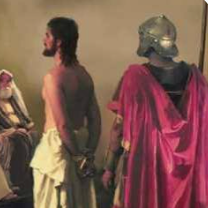
Ananus II and the Illegal Sanhedrin — Roman Oversight Confirms the Gospels
Flavius Josephus — Antiquities of the Jews 20.197–203, Rome c. AD 93 (the Ananus–Albinus affair, Jerusalem, AD 62)“But the more equitable of the citizens, and such as were most strenuously observant of the laws, were offended at what was done; they therefore privately sent to King Agrippa, taking upon them to request of him that he would admonish Ananus… on account of which Ananus was sent bound to Rome.” — Josephus, Antiquities 20.201 (Whiston translation) Ananus II, the Sadducee high priest, exploited the brief Roman vacancy between Festus’s death and Albinus‘s arrival (c. AD 62) to convene an irregular Sanhedrin and stone James — a procedural atrocity so flagrant that offended Jerusalem citizens complained to King Agrippa II, who promptly deposed Ananus. Paul Maier (Josephus: The Essential Works, Kregel, 1994) emphasizes this confirms Roman oversight of capital punishment in Judea.File Under: Jesus Christ > Life & Ministry > Secular Corroboration > Josephus — James ReferenceMaier argues the same Roman policy — Jewish leaders needing Roman permission for executions — is precisely what makes the Gospel accounts of Jesus’ trial historically plausible: the priests must hand Jesus to Pilate, since they cannot lawfully stone Him themselves. Josephus’s incidental testimony about Ananus’s overreach corroborates the procedural picture drawn by all four Gospels and Acts. This corroborating historical detail has apologetic value without anyone in the passage intending it — Josephus records it because the scandal mattered to Roman administration, not because he sought to defend the Gospels. Citation: Paul L. Maier, trans. and comm., Josephus: The Essential Works, Kregel, 1994; F. F. Bruce, Jesus and Christian Origins Outside the New Testament, Eerdmans, 1974, pp. 27–28.
Cross-References: Josephus — Testimonium Flavianum | The Crucifixion | Cumulative Case
Tacitus — Annals 15.44
Cornelius Tacitus (c. AD 56–120), Rome’s greatest senator-historian, mentions Christus and the Christians in Annals 15.44 while narrating Nero’s persecution after the Great Fire of AD 64. Writing with overt hostility, Tacitus confirms Jesus’ existence, His execution under Pontius Pilate during the reign of Tiberius, the Judean origin of the movement, and its spread to Rome — independent Roman corroboration of the Gospel timeline.
Rome’s Greatest Senator-Historian Names Christus in the Annals
Cornelius Tacitus — Annals 15.44, Rome, c. AD 116“Christus, the founder of the name, had undergone the death penalty in the reign of Tiberius, by sentence of the procurator Pontius Pilatus, and the pernicious superstition was checked for a moment, only to break out once more, not merely in Judaea, the home of the disease, but in the capital itself, where all things horrible or shameful in the world collect and become fashionable.” — Tacitus, Annals 15.44 (Church and Brodribb translation) Cornelius Tacitus (c. AD 56–120), the Roman senator-historian and author of Annals, mentions Christus while narrating Nero‘s blame-shifting after the Great Fire of Rome in AD 64. Tacitus, no friend of Christianity, dismisses the movement as a “pestilential superstition” — yet confirms the existence of Jesus and His execution by Pontius Pilate during the reign of Tiberius, exactly the chronology the Gospels give.File Under: Jesus Christ > Life & Ministry > Secular Corroboration > Tacitus — Annals 15.44The passage is doubly valuable because Tacitus, as a former Roman consul with access to official archives, is the highest-status pagan to mention Jesus. Robert Van Voorst (Jesus Outside the New Testament, Eerdmans, 2000) observes that Tacitus’s use of “Christus” — rather than “Chrestus,” a common slave name — shows deliberate technical accuracy on his part. Tacitus’s disparaging tone (“pestilential superstition,” “disease,” “horrible,” “shameful”) indicates hostile attestation, the most historically reliable form of witness precisely because the source would have buried Jesus in silence if he could have. Citation: Tacitus, Annals 15.44 (c. AD 116); analysis: Robert E. Van Voorst, Jesus Outside the New Testament, Eerdmans, 2000, pp. 29–43.
Cross-References: Josephus — Testimonium Flavianum | Crucifixion > Secular Corroboration (parent) | Cumulative Case
Tiberius and Pilate — Tacitus Independent of the Gospels, Same Chronology
Roman historical evidence — Tacitus, Annals 15.44 independently confirms AD 26–37 Judea under Tiberius“Christus, from whom the name had its origin, suffered the extreme penalty during the reign of Tiberius at the hands of one of our procurators, Pontius Pilatus.” — Tacitus, Annals 15.44 (Loeb Classical Library, tr. John Jackson) The pairing of Tiberius and Pontius Pilate in Tacitus is independent Roman confirmation of the Gospel timeline. Luke 3:1 dates the beginning of John’s ministry to “the fifteenth year of the reign of Tiberius Caesar, Pontius Pilate being governor of Judaea.” That Tacitus, writing c. AD 116 without Christian influence, matches this dating precisely is what Van Voorst terms “one of the single most important witnesses” to the historical Jesus.File Under: Jesus Christ > Life & Ministry > Secular Corroboration > Tacitus — Annals 15.44Two translations differ on the term for Pilate: “procurator” (Church-Brodribb) and “procurator” or “procurator” (Loeb/Jackson). The 1961 Pilate Stone discovered at Caesarea Maritima confirms Pilate’s actual title was “prefect” (praefectus), not “procurator.” F. F. Bruce (Jesus and Christian Origins Outside the New Testament, Eerdmans, 1974) explains the disjunction: Tacitus writes retrospectively in the early second century, by which time the terminology for provincial governors had shifted from praefectus to procurator, and Tacitus uses the vocabulary of his own day. The very anachronism proves authenticity — a later Christian interpolator writing in Tacitus’s name would have used the technically correct “prefect.” Citation: Tacitus, Annals 15.44; F. F. Bruce, Jesus and Christian Origins Outside the New Testament, Eerdmans, 1974, pp. 19–23.
Cross-References: Josephus — James Reference | The Crucifixion | Cumulative Case
Tacitus’s Hostility — A Critic Who Would Have Silenced Jesus If He Could
Hostile Roman source — Tacitus, Annals 15.44 (Neronian persecution context, AD 64 narrative)“Nero fastened the guilt and inflicted the most exquisite tortures on a class hated for their abominations, called Christians by the populace.” — Tacitus, Annals 15.44 (Church and Brodribb translation) Tacitus’s account of the Nero persecution follows the Great Fire of Rome (AD 64). He writes with palpable contempt: “abominations,” “shameful acts,” “pestilential superstition,” “disease.” Crucially, his contempt as a Roman senator is the source of his evidentiary value — Tacitus would gladly have written that Christus never existed had he believed it. That he instead confirms the existence, the Judean origin, the Pilate execution, and the survival of the movement demonstrates enemy attestation, what historians weight most heavily.File Under: Jesus Christ > Life & Ministry > Secular Corroboration > Tacitus — Annals 15.44The hostile-witness paradigm illuminates an apologetic principle: when a source with motive to deny still confirms, the testimony is doubly firm. John P. Meier (A Marginal Jew, vol. 1, Doubleday, 1991) treats Tacitus as the most significant single pagan reference to Jesus precisely because his hostility proves independent attestation, ruling out any theory that Christian scribes slipped Christus into Annals. A source predisposed against the fact who confirms it anyway is precisely what credentialed historians most prize. Citation: Tacitus, Annals 15.44 (c. AD 116); analysis: John P. Meier, A Marginal Jew: Rethinking the Historical Jesus, vol. 1, Doubleday, 1991, pp. 88–89.
Cross-References: Josephus — Testimonium Flavianum | Babylonian Talmud — Yeshu | Cumulative Case
Scholarly Consensus — Van Voorst, Bruce, Meier Affirm Tacitus’s Historicity
Scholar consensus on Annals 15.44 — Van Voorst · Bruce · Meier (text source c. AD 116)“Mockery of every sort was added to their deaths. Covered with the skins of beasts, they were torn by dogs and perished, or were nailed to crosses, or were doomed to the flames and burnt, to serve as a nightly illumination, when daylight had expired.” — Tacitus, Annals 15.44 (Church and Brodribb translation) Robert Van Voorst (Jesus Outside the New Testament, Eerdmans, 2000) treats Annals 15.44 as one of the single most important witnesses to Jesus’ execution under Pilate. F. F. Bruce (Jesus and Christian Origins, Eerdmans, 1974) considers the passage reliable Roman confirmation of the Gospel chronology. John P. Meier (A Marginal Jew, vol. 1, 1991) emphasizes Tacitus’s plausible access to Roman records via the Acta Senatus.File Under: Jesus Christ > Life & Ministry > Secular Corroboration > Tacitus — Annals 15.44Critics occasionally suggest an early-medieval Christian scribe inserted this passage into Annals. Van Voorst refutes this at length: Tacitus’s patently non-Christian tone — calling the movement a “superstition” and a “disease” — would not have been inserted by any Christian copyist, and his technical anachronism of calling Pilate a “procurator” rather than the historically accurate “prefect” (per the 1961 Caesarea Pilate Stone) is the kind of error no Christian interpolator writing in Tacitus’s name would have made. A. N. Sherwin-White (Roman Society and Roman Law in the New Testament, Oxford, 1963) confirms Tacitus’s reliability on Judean governors. Citation summary: Robert E. Van Voorst, Jesus Outside the New Testament, Eerdmans, 2000, pp. 29–43; F. F. Bruce, Jesus and Christian Origins Outside the New Testament, Eerdmans, 1974, pp. 19–23; John P. Meier, A Marginal Jew, vol. 1, Doubleday, 1991, pp. 88–89.
Cross-References: Josephus — Testimonium Flavianum | Jesus’ Life & Ministry | Cumulative Case
Pliny — Trajan Correspondence
Pliny the Younger (c. AD 61–113), as Roman governor of Bithynia-Pontus, wrote to Emperor Trajan c. AD 112 asking how to handle Christians — producing the earliest surviving pagan description of Christian worship. His letter and Trajan’s reply confirm the movement worshipped Christ ‘as to a god,’ maintained strict ethical standards, had spread across all social classes, and was legally recognized as distinct from Judaism.
‘To Christ as to a God’ — The Earliest Pagan Report of Christian Worship
Pliny the Younger — Epistulae 10.96, Bithynia-Pontus (northwestern Asia Minor), c. AD 112“They were accustomed to meet on a fixed day before dawn and sing a hymn to Christ as to a god… they bound themselves by an oath, not for any criminal purpose, but to abstain from theft, robbery, and adultery, and not to break faith.” Pliny the Younger (c. AD 61–113), serving as Roman governor of Bithynia-Pontus under Emperor Trajan, composed this letter c. AD 112 — the earliest surviving pagan description of Christian worship. The phrase ‘to Christ as to a god’ is how a Roman aristocrat would describe worship offered to a deity, confirming that Christians treated Christ as divine within eighty years of the crucifixion. Pliny’s reference to ‘a fixed day before dawn’ corroborates the Sunday gathering practice attested in Acts 20:7 and 1 Corinthians 16:2. Citation: Pliny the Younger, Epistulae 10.96 (c. AD 112); tr. Betty Radice, Loeb Classical Library, Harvard University Press, 1969; analysis: A. N. Sherwin-White, The Letters of Pliny: A Historical and Social Commentary, Oxford University Press, 1966, pp. 692–712.File Under: Jesus Christ > Life & Ministry > Secular Corroboration > Pliny — Trajan Correspondence Cross-References: Tacitus — Annals 15.44 | Suetonius — Chrestus | Cumulative CaseA. N. Sherwin-White, in The Letters of Pliny: A Historical and Social Commentary (Oxford, 1966), treats this letter as a primary historical document of exceptional value. The Latin carmen dicere (‘to sing a hymn’) suggests antiphonal worship rooted in Jewish synagogue tradition, now redirected to Christ. Pliny’s uncertainty about whether Christians should be punished for the name itself reflects Roman legal reasoning encountering a new religious movement for the first time. His report that they met ‘before dawn’ indicates a dedicated pre-work gathering, not casual attendance. The oath to abstain from crime would have struck Roman ears as remarkable in a province where temple cults had no ethical demands on worshippers.
The Curse-Christ Test — Roman Interrogation Confirms His Centrality
Pliny the Younger — Epistulae 10.96, Bithynia-Pontus (interrogation procedure), c. AD 112“Others… were asked to invoke the gods, to offer wine and incense to your image… and moreover to curse Christ — things which it is said genuine Christians cannot be constrained to do.” Pliny’s interrogation required suspected Christians to prove apostasy by cursing Christ and offering sacrifice to the emperor’s image — a three-step test that treated Christ as the functional equivalent of a pagan deity. The report that ‘genuine Christians cannot be constrained’ to curse Christ is stunning enemy attestation: a Roman governor documents from the front lines that Christ’s name was the non-negotiable center of the movement, a loyalty unto death that Pliny himself found baffling. Citation: Pliny the Younger, Epistulae 10.96 (c. AD 112); tr. Betty Radice, Loeb Classical Library, Harvard University Press, 1969; analysis: Robert E. Van Voorst, Jesus Outside the New Testament, Eerdmans, 2000, pp. 23–28.File Under: Jesus Christ > Life & Ministry > Secular Corroboration > Pliny — Trajan Correspondence Cross-References: Tacitus — Annals 15.44 | The Crucifixion | Cumulative CaseThe test presupposes that Christianity was defined by loyalty to a person — not by ethnicity, geography, or philosophical school. Pliny’s procedure mirrors the later Acta Martyrum in which cursing Christ is the consistent apostasy requirement. Robert Van Voorst notes that Pliny’s bafflement itself is evidence: he cannot understand why people would die rather than utter a formula, which means the depth of devotion to Christ surpassed anything Roman religion produced. Bart Ehrman similarly concedes that Pliny’s letter confirms Christians by the early second century worshipped Christ as a god — a fact established independently of the New Testament.
Trajan’s Rescript — Imperial Policy Toward Christians for Two Centuries
Emperor Trajan — Epistulae 10.97 (rescript to Pliny), Rome, c. AD 112“They are not to be sought out; but if they are accused and convicted, they must be punished… whoever denies that he is a Christian and proves it by offering sacrifice to our gods shall be pardoned.” Emperor Trajan‘s official reply to Pliny — Epistulae 10.97 — established the imperial policy toward Christians that governed Roman persecutions for the next two hundred years. Christians were not to be actively hunted, but if accused and obstinate, they were to be executed. The policy’s very existence confirms Christianity as a legally recognized distinct movement — not a Jewish sect — by AD 112, barely eighty years after Jesus’ death. Citation: Pliny the Younger, Epistulae 10.97 (Trajan’s rescript, c. AD 112); tr. Betty Radice, Loeb Classical Library, Harvard University Press, 1969.File Under: Jesus Christ > Life & Ministry > Secular Corroboration > Pliny — Trajan Correspondence Cross-References: Suetonius — Chrestus | Cumulative CaseTrajan’s rescript echoes through later imperial law: Tertullian (Apology 2, c. AD 197) both cites and critiques it, noting the paradox that Christians are not to be sought out yet are punished if found — ‘a policy of deliberate contradiction.’ Sherwin-White observes that the rescript officially separated Christianity from the religio licita status Judaism enjoyed, making the mere confession ‘I am a Christian’ a capital offense. The imperial level of the response — an emperor replying to a provincial governor — shows the movement was significant enough to warrant direct imperial ruling. This legal framework produced the martyrs Pliny interrogated and, later, the entire Roman persecution era.
‘All Ages, Every Rank, and Both Sexes’ — The Movement’s Provincial Reach
Pliny the Younger — Epistulae 10.96, Bithynia-Pontus (provincial spread report), c. AD 112“Many of all ages, every rank, and both sexes too are being called into danger… the contagion of this superstition has spread not only through the cities but even through the villages and countryside.” Pliny reports that Christians in Bithynia cut across every social stratum — all ages, all ranks, both sexes — and had penetrated rural villages, not just urban centers. He notes that temples were ‘almost deserted’ and pagan sacrificial rites had declined sharply. This Roman governor’s census of the movement’s spread independently corroborates the rapid expansion described in the Acts narrative. Citation: Pliny the Younger, Epistulae 10.96 (c. AD 112); analysis: Robert E. Van Voorst, Jesus Outside the New Testament, Eerdmans, 2000, pp. 23–28; Craig S. Keener, Acts: An Exegetical Commentary, 4 vols., Baker Academic, 2012–2015.File Under: Jesus Christ > Life & Ministry > Secular Corroboration > Pliny — Trajan Correspondence Cross-References: Suetonius — Chrestus | Jesus’ Life & Ministry | Cumulative CaseVan Voorst notes that Pliny’s report of rural penetration is historically significant: Christianity had reached beyond the Hellenized urban elite into the pagus (countryside), where traditional Roman religion was strongest. The word ‘contagion’ (contagio) reveals Pliny’s hostility but also his acknowledgment of exponential growth. Craig S. Keener compares Pliny’s report to the Acts narrative of rapid provincial spread (Acts 16–19), noting that both sources — one Christian, one pagan — independently testify to Christianity’s explosive growth within a single generation of Jesus’ death. Pliny’s statement that the temples were ‘almost deserted’ is the kind of incidental detail valued by historians: an unintended confirmation of social transformation.
Suetonius — Chrestus
Gaius Suetonius Tranquillus (c. AD 69–122), imperial biographer under Hadrian, mentions Christians and ‘Chrestus’ in two separate works. His reference to Claudius’s expulsion of Jews ‘at the instigation of Chrestus’ (c. AD 49) is widely read as evidence that disputes over Christ’s messiahship had reached Rome within two decades of the crucifixion — independently corroborated by Luke in Acts 18:2.
Claudius’s Expulsion — ‘At the Instigation of Chrestus’
Suetonius — Divus Claudius 25.4, Rome, c. AD 121“Since the Jews constantly made disturbances at the instigation of Chrestus, he expelled them from Rome.” Suetonius (c. AD 69–122), serving as imperial secretary under Emperor Hadrian, records that Claudius expelled Jews from Rome c. AD 49 due to disturbances ‘at the instigation of Chrestus.’ Most scholars identify ‘Chrestus’ as a garbled form of ‘Christus’ — Suetonius confused the title Christ with the common slave name Chrestus (‘the useful one’). The passage places disputes over Jesus’ messiahship within Rome’s Jewish community by AD 49 — barely two decades after the crucifixion. Citation: Suetonius, Divus Claudius 25.4 (c. AD 121); tr. J. C. Rolfe, Loeb Classical Library, Harvard University Press, 1914.File Under: Jesus Christ > Life & Ministry > Secular Corroboration > Suetonius — Chrestus Cross-References: Pliny — Trajan Correspondence | Tacitus — Annals 15.44 | Cumulative CaseRobert Van Voorst (Jesus Outside the New Testament, Eerdmans, 2000) notes that the phrase ‘at the instigation of’ (impulsore) suggests Suetonius thought Chrestus himself was present in Rome — a misunderstanding that makes sense if Christian missionaries were preaching Christ’s messiahship so vigorously that pagan observers assumed the disputes were instigated by a living agitator. F. F. Bruce (Jesus and Christian Origins, Eerdmans, 1974) reconstructs the event: Jewish Christian missionaries proclaimed Jesus as Messiah in Roman synagogues, triggering factional violence that prompted Claudius to expel the entire Jewish community — an overreaction that ironically scattered Jewish Christians further across the empire.
Acts 18:2 — Luke’s Independent Corroboration of the Expulsion
Luke the Evangelist — Acts 18:2, KJV (Corinth, Claudius expulsion c. AD 49)“And found a certain Jew named Aquila, born in Pontus, lately come from Italy, with his wife Priscilla; (because that Claudius had commanded all Jews to depart from Rome:) and came unto them.” Luke the Evangelist independently records the same event Suetonius mentions, placing Paul the Apostle‘s arrival in Corinth at the time of the expulsion, where he meets Aquila and Priscilla — recently expelled from Rome. This cross-reference between a pagan Roman biographer and Acts is one of the strongest convergent historical anchors for Luke’s reliability, confirming the Claudius expulsion as a real event independently attested by two sources. Citation: Luke the Evangelist, Acts 18:2, KJV; analysis: F. F. Bruce, The Book of Acts, NICNT, Eerdmans, 1988; Colin J. Hemer, The Book of Acts in the Setting of Hellenistic History, Eisenbrauns, 1990.File Under: Jesus Christ > Life & Ministry > Secular Corroboration > Suetonius — Chrestus Cross-References: Pliny — Trajan Correspondence | Jesus’ Life & Ministry | Cumulative CaseF. F. Bruce (The Book of Acts, NICNT, Eerdmans, 1988) notes that this synchronism provides a rare precise date in Pauline chronology: the expulsion is dated to AD 49 by the Oxyrhynchus Chronicle fragment, and Paul’s eighteen-month Corinth ministry (Acts 18:11) thus falls in AD 50–51. Colin Hemer (The Book of Acts in the Setting of Hellenistic History, Eisenbrauns, 1990) catalogs this as one of dozens of incidental historical details in Acts that have been independently confirmed by external sources. The Claudius expulsion is the kind of event that a later fabricator could not have safely invented, since official Roman records could have falsified it.
Life of Nero 16.2 — ‘A New and Mischievous Superstition’
Suetonius — Nero 16.2, Rome, c. AD 121“Punishment was also inflicted on the Christians, a class of men given to a new and mischievous superstition.” Suetonius separately mentions Christians as targets of Nero‘s persecution in Life of Nero 16.2, describing their movement as ‘a new and mischievous superstition’. The word ‘new’ (novae) is historically significant: it confirms the movement was recognized as post-dating Jesus’ lifetime, not an ancient Jewish tradition — exactly what we would expect if a new movement arose in the wake of a recent historical founder. Citation: Suetonius, Nero 16.2 (c. AD 121); tr. J. C. Rolfe, Loeb Classical Library, Harvard University Press, 1914.File Under: Jesus Christ > Life & Ministry > Secular Corroboration > Suetonius — Chrestus Cross-References: Tacitus — Annals 15.44 | The Crucifixion | Cumulative CaseThe phrase ‘new and mischievous’ (superstitionis novae et maleficae) echoes Tacitus’s ‘new and pernicious superstition’ (exitiabilis superstitio) in Annals 15.44 — two Roman senators using almost identical language within a decade of each other. This independent dual attestation from two hostile Roman aristocrats confirms that pagans viewed Christianity as a recent religious innovation tied to a specific founder, not as a philosophical school or ethnic sect. Van Voorst notes that Suetonius’s brevity — one sentence — is actually an argument for authenticity: a Christian interpolator would have expanded the reference with theological assertions, not left it as a dismissive aside in a list of Nero’s punishments.
‘Chrestus’ vs. ‘Christus’ — The Scholarly Identification
Suetonius — Divus Claudius 25.4 (Latin original), Rome, c. AD 121“Iudaeos impulsore Chresto assidue tumultuantes Roma expulit.” — “He expelled the Jews from Rome, who were constantly making disturbances at the instigation of Chrestus.” The Latin spelling Chrestus (a common slave name meaning ‘the useful one’) vs. Christus (the Greek title for Messiah) is the crux of the identification debate. Van Voorst and James D. G. Dunn both identify this as Suetonius’s garbled reference to disputes over Christ’s messiahship. If correct, these disputes had reached Rome’s Jewish community by AD 49 — fifteen years after the crucifixion — evidence of remarkably rapid dissemination of the Jesus movement. Citation: Suetonius, Divus Claudius 25.4 (Latin original, c. AD 121); analysis: Robert E. Van Voorst, Jesus Outside the New Testament, Eerdmans, 2000, pp. 22–26; James D. G. Dunn, Christianity in the Making, vol. 1, Eerdmans, 2003.File Under: Jesus Christ > Life & Ministry > Secular Corroboration > Suetonius — Chrestus Cross-References: Tacitus — Annals 15.44 | Pliny — Trajan Correspondence | Cumulative CaseSome manuscripts of Tacitus’s Annals 15.44 preserve the spelling ‘Chrestiani’ instead of ‘Christiani’ — suggesting the confusion between the two forms was widespread among Roman writers. F. F. Bruce explains the misidentification: Suetonius, writing seventy years after the event and relying on imperial records that noted the disturbances but not their theological content, interpreted ‘Chrestus’ as a living agitator rather than a title being claimed for a founding figure. Some dissenters have proposed that ‘Chrestus’ refers to an unrelated agitator, but the overwhelming scholarly majority follows Van Voorst’s assessment that the identification with Christ is ‘all but certain.’
Mara Bar Serapion
A Syriac letter from a Stoic philosopher to his son, preserved in a seventh-century manuscript, independently mentions the execution of a ‘wise king’ of the Jews whose teachings survived his death. Most scholars identify this figure as Jesus — a pagan, non-Roman, non-Jewish attestation to Jesus’ historical existence and the endurance of His movement from yet another cultural sphere.
‘The Wise King of the Jews’ — A Stoic’s Independent Testimony
Mara bar Serapion — Letter to Son Serapion, Syriac (British Library Add. MS 14658, 7th-century manuscript)“What advantage did the Jews gain from executing their wise king? It was just after that their kingdom was abolished… the Jews, ruined and driven from their land, live in complete dispersion.” Mara bar Serapion, a Syriac Stoic philosopher writing from prison to his son, mentions the execution of a ‘wise king’ of the Jews, connecting it directly to the subsequent destruction of the Jewish kingdom. Most scholars — including F. F. Bruce and Robert Van Voorst — identify this ‘wise king’ as Jesus of Nazareth. The letter is a non-Christian, non-Jewish, non-Roman attestation — from yet another cultural sphere. Citation: Mara bar Serapion, Letter to Serapion (Syriac), in William Cureton, Spicilegium Syriacum, London, 1855.File Under: Jesus Christ > Life & Ministry > Secular Corroboration > Mara Bar Serapion Cross-References: Josephus — Testimonium Flavianum | Tacitus — Annals 15.44 | Cumulative CaseThe letter’s philosophical framework is Stoic: Mara argues that injustice brings divine punishment, using three ‘wise men’ — Socrates, Pythagoras, and the ‘wise king of the Jews’ — as examples of figures whose executions brought calamity upon their executioners. The reference to the ‘kingdom being abolished’ points to the destruction of Jerusalem in AD 70 as the punishment for executing the wise king, suggesting the letter was composed after that date. Mara does not name Christianity or cite Christian sources; his knowledge of the ‘wise king’ appears to derive from general awareness of the Jesus movement and its founder’s fate. The Stoic philosophical context makes this especially valuable — it is a gentile intellectual’s assessment, not a confession of faith.
‘He Lived on in the Teachings Which He Had Given’
Mara bar Serapion — Letter to Son Serapion, Syriac (three wise men comparison)“Socrates did not die for good; he lived on in the teachings of Plato… Nor did the wise king die for good; he lived on in the teachings which he had given.” Mara compares the ‘wise king of the Jews’ to Socrates and Pythagoras — all executed by their own people, and all immortalized through their surviving teachings. The claim that Jesus ‘lived on in the teachings which he had given’ implies an established body of Jesus’ teachings circulating and recognized by a pagan philosopher decades after His death — external confirmation that Jesus was known as a teacher whose words endured. Citation: Mara bar Serapion, Letter to Serapion (Syriac), in William Cureton, Spicilegium Syriacum, London, 1855.File Under: Jesus Christ > Life & Ministry > Secular Corroboration > Mara Bar Serapion Cross-References: Josephus — Testimonium Flavianum | Cumulative CaseThe parallel with Socrates is illuminating: just as Socrates’ teachings survived through Plato’s preservation, Jesus’ teachings survived through His disciples’ preservation. Mara’s Stoic framework treats the ‘wise king’ as a philosopher-sage rather than a religious savior — a categorization that ironically strengthens the historical case, since Mara has no theological motive to inflate Jesus’ significance. Van Voorst (Jesus Outside the New Testament, Eerdmans, 2000) notes that the Syriac phrase for ‘teachings which he had given’ suggests a recognized corpus of moral instruction, consistent with the Gospel sayings tradition circulating in Syria by the late first or early second century.
Dating and Manuscript Provenance — The Letter’s Historical Context
Mara bar Serapion — Letter to Son Serapion, Syriac (composition c. late 1st–3rd century AD, 7th-century manuscript)“What advantage did the men of Samos gain from burning Pythagoras? In a moment their land was covered with sand.” The letter’s date is debated. The reference to the Jewish kingdom being ‘abolished’ suggests post-AD 70 composition, placing it within living memory of Jesus. The letter is preserved in British Library Add. MS 14658, a seventh-century Syriac manuscript. F. F. Bruce dates it to the late first century or early second; others propose a third-century date. Even at the latest possible date, Mara’s letter is independent of Christian sources and reflects a pagan philosopher’s knowledge of Jesus. Citation: Mara bar Serapion, Letter to Serapion, British Library Add. MS 14658 (7th-century Syriac manuscript); analysis: F. F. Bruce, Jesus and Christian Origins Outside the New Testament, Eerdmans, 1974, pp. 28–30; Robert E. Van Voorst, Jesus Outside the New Testament, Eerdmans, 2000, pp. 53–56.File Under: Jesus Christ > Life & Ministry > Secular Corroboration > Mara Bar Serapion Cross-References: Josephus — James Reference | Suetonius — Chrestus | Cumulative CaseWilliam Cureton, who first published the letter in Spicilegium Syriacum (1855), dated it to the late first or early second century. F. F. Bruce supports a date shortly after AD 73, based on the claim that the Jews were ‘driven from their land’ — a condition that fits the post-destruction period before the Diaspora became settled. Van Voorst spreads the proposed range from the late first to the third century but concludes that even at the later date, the letter remains valuable as independent attestation. The reference to the ‘kingdom’ being taken away suggests Mara is referencing the broader political aftermath of AD 70 rather than the destruction of the city or Temple alone.
Scholarly Assessment — The ‘Wise King’ as Jesus of Nazareth
Scholar analysis — identification of Mara bar Serapion’s ‘wise king’ as Jesus of Nazareth“God justly avenged these three wise men: the Athenians died of hunger; the Samians were overwhelmed by the sea; the Jews, ruined and driven from their land, live in complete dispersion.” Most scholars identify Mara’s ‘wise king’ as Jesus based on four converging criteria: he was a king (messianic claimant), executed by the Jews, his teachings survived him, and the Jewish kingdom was subsequently destroyed. F. F. Bruce considers the identification ‘practically certain’. Craig A. Evans agrees. Alternative identifications (such as James the Just or Rabbi Gamaliel) lack the same convergence of ‘king’ + execution + surviving teachings + national catastrophe. Citation: Robert E. Van Voorst, Jesus Outside the New Testament, Eerdmans, 2000, pp. 53–56; Craig A. Evans, ‘Mara Bar Serapion,’ in Encyclopedia of the Historical Jesus, ed. Craig A. Evans, Routledge, 2008; F. F. Bruce, Jesus and Christian Origins Outside the New Testament, Eerdmans, 1974, pp. 28–30.File Under: Jesus Christ > Life & Ministry > Secular Corroboration > Mara Bar Serapion Cross-References: Josephus — Testimonium Flavianum | Babylonian Talmud — Yeshu | Cumulative CaseVan Voorst (Jesus Outside the New Testament, Eerdmans, 2000) examines alternative identifications: James the Just (executed c. AD 62) was not called a ‘king’; Rabbi Gamaliel was not executed; no other Jewish figure matches all four criteria. Only Jesus satisfies all criteria — king, executed by Jews, teachings survived, kingdom destroyed. Evans (Encyclopedia of the Historical Jesus, Routledge, 2008) notes the Stoic philosophical framework is the strongest argument for authenticity: Mara has no theological axe to grind, and his comparison of Jesus to Socrates and Pythagoras — treating Him as a philosopher-king rather than a divine savior — is exactly the kind of independent, non-confessional attestation historians value most.
Babylonian Talmud — Yeshu
The Babylonian Talmud, compiled c. AD 200–500, preserves scattered hostile references to Yeshu the Nazarene — accused of sorcery, exiled, and “hanged” on the eve of Passover. Though deliberately garbled chronologically, the Talmudic Jesus passages constitute enemy attestation from within the rabbinic tradition, indirectly confirming Jesus’ miracles, execution, and disciples.
Sanhedrin 43a — “Yeshu the Nazarene Was Hanged”
Babylonian Talmud — Sanhedrin 43a (compiled c. AD 200–500; underlying traditions much earlier)“On the eve of Passover Yeshu the Nazarene was hanged. For forty days before the execution took place, a herald went forth and cried, ‘He is going forth to be stoned because he practiced sorcery and enticed Israel to apostasy.'” A hostile rabbinic account of Yeshu the Nazarene‘s execution. The chronology is deliberately garbled — placing him under Alexander Jannaeus (c. 100 BC) rather than Pilate — but key details match the Gospels: execution on Passover eve, the charge of “sorcery,” and the enticement of Israel to apostasy. The text does not deny Yeshu performed extraordinary deeds; it concedes them and reinterprets them as kishuf (sorcery). Citation: Babylonian Talmud, Sanhedrin 43a.File Under: Jesus Christ > Life & Ministry > Secular Corroboration > Babylonian Talmud — Yeshu Cross-References: Josephus — Testimonium Flavianum | Celsus — OrigenPeter Schäfer (Jesus in the Talmud, Princeton University Press, 2007) demonstrates that rabbinic traditions about Yeshu are deliberate counter-narratives to Christian claims — the rabbis knew Jesus was crucified under Pilate but obscured this chronologically to deny Christian fulfillment narratives. The “sorcery” charge (Deuteronomy 13) is preserved in Matthew 12:24 (“by Beelzebub… he casts out devils”) — confirming the same hostile Jewish re-attribution in two independent traditions.

‘He Practiced Sorcery’ — Enemy Attestation to Jesus’ Miracles
Babylonian Talmud — Sanhedrin 43a (the sorcery charge, pre-redaction traditions)“‘…he practiced sorcery and enticed Israel to apostasy. But since nothing was brought forward in his favour, he was hanged on the eve of Passover.'” The repeated charge of “sorcery” (kishuf) is theologically loaded: under Deuteronomy 13 and 18, a sorcerer was to be stoned for leading Israel astray. That the rabbis applied this category to Yeshu means they were acknowledging extraordinary deeds occurred while contesting their source. This is precisely “enemy attestation” — the most valued hostile witness form, where a source with motive to deny still confirms. Citation: Babylonian Talmud, Sanhedrin 43a.File Under: Jesus Christ > Life & Ministry > Secular Corroboration > Babylonian Talmud — Yeshu Cross-References: Josephus — Testimonium Flavianum | Lucian of SamosataThe Gospel parallel is Matthew 12:24: “But when the Pharisees heard it, they said, This fellow doth not cast out devils, but by Beelzebub the prince of the devils” (KJV). Johann Maier (Jesus von Nazareth in der talmudischen Überlieferung, 1978) and Robert Van Voorst (Jesus Outside the New Testament, Eerdmans, 2000) both note the rabbis could have denied Yeshu’s deeds outright — instead, they concede and re-attribute them, an inadvertent confirmation.
‘Yeshu Had Five Disciples’ — Rabbinic Acknowledgment of His Inner Circle
Babylonian Talmud — Sanhedrin 43a (the disciples pericope)“Yeshu had five disciples: Matthias, Thaddaeus, John, Andrew, and Thoma. They brought them in and asked: ‘Do you wish to share his fate?’ They answered nothing. They were made to depart in peace.” A second subsection of Sanhedrin 43a names five disciples of Yeshu with garbled Aramaic names — one reminiscent of Thomas (Thoma). The names do not match the Twelve precisely, but the pericope confirms Yeshu had a circle of named disciples — corroborating the Gospel portrait of Jesus as a teacher with a defined inner group. Citation: Babylonian Talmud, Sanhedrin 43a.File Under: Jesus Christ > Life & Ministry > Secular Corroboration > Babylonian Talmud — Yeshu Cross-References: Josephus — James Reference | Celsus — OrigenSchäfer treats the disciples pericope as a hostile rabbinic parallel to the Christian apostolic claim — the rabbis acknowledge Yeshu had followers and a ministry structure, even while condemning him. The numerical “five” rather than “twelve” may be a deliberate distortion to deny the tribes-of-Israel symbolism Christians read into the Twelve. F. F. Bruce (Jesus and Christian Origins, Eerdmans, 1974) treats this as significant corroboration that Jesus’ ministry involved a recognized school of disciples.
Scholar Consensus — Schäfer · Maier · Van Voorst on the Talmudic Yeshu
Scholar analysis — Talmudic Yeshu references (Schäfer, Maier, Van Voorst)The contemporary scholarly consensus — anchored by Peter Schäfer (Princeton), Johann Maier, and Robert Van Voorst — holds that the Talmudic Yeshu passages authentically reference Jesus of Nazareth, despite deliberate chronological displacement. The rabbinic tradition does not deny Jesus existed; it constructs a hostile counter-portrait. Citation: Peter Schäfer, Jesus in the Talmud, Princeton University Press, 2007; Robert E. Van Voorst, Jesus Outside the New Testament, Eerdmans, 2000.File Under: Jesus Christ > Life & Ministry > Secular Corroboration > Babylonian Talmud — Yeshu Cross-References: Josephus — Testimonium Flavianum | Secular Corroboration of the CrucifixionMaier’s earlier Jesus von Nazareth in der talmudischen Überlieferung (1978) cataloged the passages’ textual history and confirmed their deep rabbinic roots — not later Christian insertions. The hostile counter-narrative strategy is itself evidence: Jews in late antiquity took Christian claims seriously enough to construct rebuttals, which presupposes acknowledgment of the underlying historical facts. The cumulative Talmudic portrait — Yeshu as a sorcerer, a teacher with disciples, executed on Passover eve, whose movement continued — forms a hostile witness to the Gospel narrative from within Judaism itself.
Celsus — Origen
Celsus (c. AD 175) wrote The True Word, the earliest surviving full-scale pagan critique of Christianity. Origen of Alexandria preserved and rebutted Celsus point-by-point in Contra Celsum (c. AD 248), inadvertently saving the most detailed hostile pagan description of Jesus’ life, lineage, ministry, and miracles.
‘He Tried His Hand at Magical Arts’ — Celsus Concedes Jesus’ Deeds
Celsus — The True Word (c. AD 175), preserved in Origen, Contra Celsum (c. AD 248)“Jesus… having served as a hired labourer in Egypt, and then having tried his hand at certain magical arts… returned to his own country, and by means of these proclaimed himself a god.” Celsus (c. AD 175) — the earliest pagan intellectual to write a sustained critique of Christianity — accused Jesus of performing miracles through Egyptian sorcery rather than divine power. He does not deny that extraordinary deeds occurred; he concedes them and reattributes their source — the textbook form of enemy attestation. Citation: Celsus, The True Word, in Origen, Contra Celsum 1.28.File Under: Jesus Christ > Life & Ministry > Secular Corroboration > Celsus — Origen Cross-References: Babylonian Talmud — Yeshu | Lucian of SamosataCelsus’s polemic even partially echoes the Gospel narratives: the flight to Egypt, Jesus’ return to Galilee, His public claim to be God. He compares Jesus’ acts to “the feats of jugglers who, in the marketplace, for a few obols, exhibit their tricks” (Contra Celsum 1.68) — implicitly conceding that notable public events occurred. Origen (c. AD 185–254) devoted years to rebutting Celsus systematically, preserving the pagan text through verbatim quotation.
The Panthera Smear — Celsus Presupposes the Virgin Birth Claim
Celsus — The True Word, preserved in Contra Celsum 1.28–1.69 (mid-second-century pagan critique)“Jesus… was begotten by a certain person… whom… he had, however, learned… was the son of a soldier named Panthera.” Celsus’s polemic demonstrates intimate knowledge of the Gospel narratives — the virgin birth, the flight to Egypt, Jesus’ baptism, His miracles, His crucifixion, the disciples’ hiding and resurrection appearances — by mid-second century. He attempts to refute each by reinterpreting: the “virgin birth” becomes adultery with a Roman soldier named Panthera. His very attempt to rebut confirms the Gospel accounts were circulating and considered historical by outsiders. Citation: Celsus, The True Word, in Origen, Contra Celsum 1.28–1.69.File Under: Jesus Christ > Life & Ministry > Secular Corroboration > Celsus — Origen Cross-References: Babylonian Talmud — Yeshu | Lucian of SamosataThe Panthera smear is especially significant because it presupposes Christian proclamation of the virgin birth rather than denial of Jesus’ existence. Origen rebuts Celsus by exposing the historical absurdities in his reconstructions. The scholarly consensus is unanimous that Celsus did not invent a fictional character — he was rebutting a real, named, miracle-working Jesus whose deeds he conceded.
Origen of Alexandria — The Christian Rebuttal as Involuntary Archive
Origen of Alexandria — Contra Celsum, Caesarea Maritima, c. AD 248“We… invite all men… to listen… not only to the doctrines of Jesus, but also to those of Celsus.” Origen of Alexandria (c. AD 185–254), the most prolific early Christian scholar, composed Contra Celsum c. AD 248 at the request of his patron Ambrose. Rather than suppress Celsus’s attack, Origen quoted it extensively and rebutted it point-by-point, inadvertently preserving the most detailed hostile pagan critique of Christianity for posterity. Citation: Origen, Contra Celsum, c. AD 248.File Under: Jesus Christ > Life & Ministry > Secular Corroboration > Celsus — Origen Cross-References: Babylonian Talmud — Yeshu | Lucian of SamosataHenry Chadwick (Oxford, transl. Origen: Contra Celsum, Cambridge University Press, 1953) notes Origen’s technique preserves Celsus’s arguments faithfully — Origen quotes Celsus verbatim before rebutting. Robert Wilken (The Christians as the Romans Saw Them, Yale University Press, 1984) treats Celsus as the foundational pagan critic whose methodology was emulated by Porphyry and Julian.
Scholarly Assessment — Celsus as Hostile Witness to the Historical Jesus
Scholar consensus — Celsus as hostile witness to the historical JesusRobert Wilken (Yale), Henry Chadwick (Oxford), and Van Voorst form a cross-ideological consensus that Celsus is a hostile witness who — by attempting to debunk — inadvertently confirms key Gospel facts: Jesus’ birth, baptism by John, miracles, gathering of disciples, claim to divinity, crucifixion, and post-resurrection appearances. Even hostile critics attack the meaning, not the existence. Citation: Robert L. Wilken, The Christians as the Romans Saw Them, Yale University Press, 1984.File Under: Jesus Christ > Life & Ministry > Secular Corroboration > Celsus — Origen Cross-References: Babylonian Talmud — Yeshu | Lucian of SamosataNo pagan critic — Celsus, Porphyry, or Julian the Apostate — ever denied Jesus existed; they only disputed the theological significance Christians assigned to His existence and deeds. The hostile pagan tradition thus forms a convergent witness to Jesus’ historicity across two centuries. Van Voorst notes Celsus’s testimony is especially valuable because it preserves the mid-second-century pagan view of Jesus — mere generations removed — before Christianity became tolerated or dominant.
Lucian of Samosata
Lucian (c. AD 125–180), a Greek satirist from Samosata in Roman Syria, provides an incidental pagan reference to Christians worshipping “the man who was crucified in Palestine” in The Passing of Peregrinus (c. AD 165). His satire confirms the centrality of the cross, the rapid provincial spread of the movement, and Christian charitable practices.
‘The Man Who Was Crucified in Palestine’ — Lucian’s Incidental Jesus
Lucian of Samosata — The Passing of Peregrinus 11–13, Greece, c. AD 165“…the man who was crucified in Palestine because he introduced this new cult into the world… they worship him…” Lucian of Samosata (c. AD 125–180), a Greek satirical writer from a region near the Jesus movement’s own world, composed The Passing of Peregrinus c. AD 165. The reference appears incidentally as mockery of Peregrinus’s exploitation of Christian generosity — yet confirms three independent facts: Jesus was crucified in Palestine, founded “this new cult,” and is worshipped by followers. Citation: Lucian, The Passing of Peregrinus 11–13.File Under: Jesus Christ > Life & Ministry > Secular Corroboration > Lucian of Samosata Cross-References: Tacitus — Annals 15.44 | Celsus — OrigenLucian’s testimony is valuable precisely because Jesus is not Lucian’s subject — Peregrinus is. The mention of Jesus is incidental, the kind of casual reference historians prize most because it lacks bias. Lucian presupposes that his Greek readership already knew about Jesus as the Palestinian-founder-of-the-movement by mid-second century, demonstrating that knowledge of Jesus’ life had penetrated even pagan intellectual circles far removed from the church’s theological debates.
The Crucified Sage — Lucian’s Indirect Confirmation of Christian Practice
Lucian of Samosata — The Passing of Peregrinus 13 (Christian community practice), c. AD 165“…their first lawgiver taught them that they are all brethren… and worship the crucified sage…” Lucian’s satire inadvertently confirms early Christian communal practice: radical generosity, mutual brotherhood, and cultic devotion to “the crucified sage”. These features match Acts 2:42–47 and 4:32–35. Lucian writes as a hostile observer mocking them, yet his polemic presupposes the practices were real and widely attested. Citation: Lucian, The Passing of Peregrinus 13.File Under: Jesus Christ > Life & Ministry > Secular Corroboration > Lucian of Samosata Cross-References: Pliny — Trajan Correspondence | Secular Corroboration of the MovementThe phrase “crucified sage” is telling: Lucian categorizes Jesus among the philosophical wise men of antiquity — a position of cultural honor in Greek intellectual circles — even while ridiculing Christian devotion. He therefore implicitly concedes that Jesus was a teacher. The very practices the New Testament describes as characteristic of the Jerusalem community (Acts 4:32) are independently described as ongoing by a pagan satirist c. AD 165, indicating the continuity of Christian communal patterns from the apostolic era.
Samosata and Palestine — Geography in Lucian’s Hostile Account
Lucian’s geographical setting — Samosata, Roman Syria, c. AD 125–180“It was then that he [Peregrinus] learned the wondrous doctrine of the Christians, by associating with their priests and scribes in Palestine.” Lucian of Samosata, though writing in Greek, was born a Syrian from a region near the Jesus movement’s own world. He locates the introduction of Christian doctrine in Palestine — an authentic geographical anchor. His satirical frame presupposes that Palestine was the known homeland of the Christian message — independent confirmation of the Gospel geography. Citation: Lucian, The Passing of Peregrinus 11.File Under: Jesus Christ > Life & Ministry > Secular Corroboration > Lucian of Samosata Cross-References: Tacitus — Annals 15.44 | Suetonius — ChrestusCraig A. Evans (Acadia Divinity College, “Lucian of Samosata” entry, Encyclopedia of the Historical Jesus, Routledge, 2008) notes Lucian’s testimony is unique in combining geographical confirmation (Palestine), historical acknowledgment (the crucified founder), and behavioral observation (Christian community life) — all three core facts within a few incidental sentences of satire aimed at a wholly different subject.
Scholar Assessment — Lucian Among the Supporting Pagan Witnesses
Scholar analysis — Lucian as a supporting hostile witnessVan Voorst (Jesus Outside the New Testament, Eerdmans, 2000) classifies Lucian as a reliable supporting hostile witness. His brevity means he provides no new facts, but his independence — composed without Christian influence or Roman archival access — makes his incidental testimony cumulative evidence. With Celsus as the major pagan witness, Lucian adds a Syrian Greek perspective from a third cultural sphere. Citation: Robert E. Van Voorst, Jesus Outside the New Testament, Eerdmans, 2000, pp. 56–57.File Under: Jesus Christ > Life & Ministry > Secular Corroboration > Lucian of Samosata Cross-References: Celsus — Origen | Babylonian Talmud — YeshuCumulative evidence is the operative principle: no single small pagan witness carries the historical weight of Josephus’s Testimonium or Tacitus’s Annals passage. But the convergence of Josephus (Jewish, neutral/hostile), Tacitus (Roman senator, hostile), Pliny (Roman governor, hostile), Suetonius (Roman biographer, hostile), Lucian (Greek satirist, hostile), Celsus (pagan intellectual, hostile), and the Talmud (rabbinic, hostile) — all hostile or neutral, none friendly — represents a remarkable spectrum. Lucian contributes one strand of this cord.
Secular Corroboration of the Crucifixion
Even outside Christian sources, the central fact of Jesus’ crucifixion under Pontius Pilate is one of the best-attested events in the ancient world. Roman senators, a Jewish historian, rabbinic counter-narratives, and pagan satirists all converge on this single fact.
Tacitus and Josephus — Two Independent Hostile Witnesses to Pilate’s Cross
Two hostile witnesses — Tacitus, Annals 15.44 (c. AD 116) and Josephus, Antiquities 18.63–64 (c. AD 93)“…Christus… suffered the extreme penalty during the reign of Tiberius at the hands of… Pontius Pilatus…” Tacitus (Roman senator-historian, c. AD 116) and Josephus (Jewish priest-historian, c. AD 93) independently — with different motives — confirm that Jesus was crucified under Pontius Pilate during the reign of Tiberius. The two sources stand hostile to Christianity and separated by culture, yet agree on the foundational fact that defines the Gospels. Citation: Tacitus, Annals 15.44; Flavius Josephus, Antiquities 18.63–64.File Under: Jesus Christ > Life & Ministry > Secular Corroboration > Secular Corroboration of the Crucifixion Cross-References: Tacitus — Annals 15.44 | The CrucifixionTacitus’s hostility (“pestilential superstition”) and Josephus’s neutral-reporting tone combine to make the crucifixion-under-Pilate fact among the most historically certain events in antiquity. The 1961 Pilate Stone discovered at Caesarea Maritima independently confirms Pilate’s title (praefectus) and Judean tenure — external corroboration of the Roman governor both sources name.
The Talmud’s ‘Hanged on the Eve of Passover’ — Rabbinic Confirmation of the Timing
Babylonian Talmud — Sanhedrin 43a, “Yeshu the Nazarene was hanged” (compiled c. AD 200–500)“On the eve of Passover Yeshu the Nazarene was hanged.” Although deliberately displaced chronologically to deny Christian fulfillment claims, the Talmudic reference to Yeshu being “hanged on the eve of Passover” independently echoes the Gospel chronology and event. The rabbinic term “hanged” was used euphemistically for crucifixion (cf. Galatians 3:13, citing Deuteronomy 21:22–23). Citation: Babylonian Talmud, Sanhedrin 43a.File Under: Jesus Christ > Life & Ministry > Secular Corroboration > Secular Corroboration of the Crucifixion Cross-References: Babylonian Talmud — Yeshu | The CrucifixionThe Passover timing is doubly significant: the chronology of John’s Gospel (cf. John 19:14, “the preparation of the Passover”) places Jesus’ death at the slaughter-hour of the Passover lambs. Tacitus confirms only the fact of the execution; the Talmud independently confirms the timing — and on the timing, even a hostile rabbinic source agrees with the Gospel portrait.
Lucian and Celsus — Pagan Critics Concede the Cross
Pagan hostile witnesses — Lucian, Passing of Peregrinus (c. AD 165); Celsus in Origen, Contra Celsum (c. AD 175)“…the man who was crucified in Palestine because he introduced this new cult into the world…” Lucian independently confirms the crucifixion, naming Palestine as the location — a third cultural sphere (Greek satirist) testifying to what Tacitus, Josephus, and the Talmud already record. Celsus likewise presupposes the crucifixion as historical fact while contesting its meaning. The cross of Christ was universally acknowledged in antiquity. Citation: Lucian, Passing of Peregrinus 11; Celsus in Origen, Contra Celsum 2.55.File Under: Jesus Christ > Life & Ministry > Secular Corroboration > Secular Corroboration of the Crucifixion Cross-References: Lucian of Samosata | Celsus — OrigenThe convergence is striking: Roman senator (Tacitus), Jewish priest-historian (Josephus), rabbinic tradition (Talmud), Greek satirist (Lucian), pagan intellectual (Celsus) — five distinct cultural and ideological perspectives, none friendly to Christianity, all confirming that Jesus was crucified. Bart Ehrman writes (Did Jesus Exist?, HarperOne, 2012): “the crucifixion of Jesus by order of Pontius Pilate is one of the most certain facts in all of history.”
What Even Skeptics Concede — The Crucifixion as ‘Most Certain Fact’
Scholar consensus — Meier · Ehrman · Sanders on the crucifixion factJohn P. Meier (A Marginal Jew, vol. 1, Doubleday, 1991), Ehrman (Did Jesus Exist?, HarperOne, 2012), and E. P. Sanders (The Historical Figure of Jesus, Penguin, 1993) form the modern scholarly consensus: Jesus’ crucifixion under Pilate is virtually beyond historical dispute. Citation: Bart D. Ehrman, Did Jesus Exist?, HarperOne, 2012.File Under: Jesus Christ > Life & Ministry > Secular Corroboration > Secular Corroboration of the Crucifixion Cross-References: The Crucifixion | Josephus — Testimonium FlavianumWhen the most skeptical scholars in the field — including those with no Christian commitment — affirm that the crucifixion is the most certain fact about the historical Jesus, the apologetic implication is staggering: the central event of the Gospel narrative is held by historians of all ideological persuasions to be historically certain. For the full development, see The Crucifixion subcat page.
Secular Corroboration of the Movement
Beyond confirming the existence and execution of Jesus, secular sources trace the rapid spread and durability of His movement within a single generation — from Judea to Rome, Bithynia, and beyond. Each hostile or neutral observer records the growth as an established fact of provincial life by the early second century.
Pliny to Trajan — Christianity Permeating Rural Bithynia by AD 112
Pliny the Younger — Epistulae 10.96 (provincial spread report), Bithynia, c. AD 112“The contagion of this superstition has spread not only through the cities but even through the villages and countryside.” Pliny the Younger documents that Christianity had penetrated rural Bithynia — villages and the countryside, not merely provincial centers — by c. AD 112, barely eighty years after Jesus’ death. Pliny reports temples “almost deserted” and pagan sacrificial rites collapsed. This Roman governor’s census corroborates Acts’ account of early Christianity‘s explosive provincial expansion. Citation: Pliny the Younger, Epistulae 10.96.File Under: Jesus Christ > Life & Ministry > Secular Corroboration > Secular Corroboration of the Movement Cross-References: Pliny — Trajan Correspondence | Jesus’ Life & MinistryPliny’s word contagio reveals his hostility and his acknowledgment — a disease metaphor from a Roman governor who would gladly have stopped the spread and could not. Sherwin-White (The Letters of Pliny, Oxford, 1966) treats this as the kind of provincial report historians prize: a candid administrative dispatch written without apologetic motive.
Suetonius — ‘Chrestus’ Disturbances Reach Rome by AD 49
Suetonius — Divus Claudius 25.4, Rome (re expulsion of AD 49)“Since the Jews constantly made disturbances at the instigation of Chrestus, he expelled them from Rome.” Suetonius records that disputes over Chrestus (Christ) reached Rome’s Jewish community by AD 49 — within fifteen years of the crucifixion — generating factional disturbances severe enough to trigger Claudius‘s imperial expulsion. Luke independently corroborates the same event in Acts 18:2. Citation: Suetonius, Divus Claudius 25.4; Acts 18:2, KJV.File Under: Jesus Christ > Life & Ministry > Secular Corroboration > Secular Corroboration of the Movement Cross-References: Suetonius — Chrestus | Jesus’ Life & MinistryThe Suetonius-Acts synchronism provides one of the firmest chronological anchors in Pauline chronology. If disputes over Christ’s messiahship were already disrupting Roman synagogue life by AD 49, the movement had reached the imperial capital within roughly two decades — and not merely as a peripheral presence, but as a theologically charged community capable of triggering imperial response.
Tacitus — The Movement Survived Its Founder’s Death
Cornelius Tacitus — Annals 15.44, Rome, c. AD 116“…the pernicious superstition was checked for a moment, only to break out once more, not merely in Judaea… but in the capital itself…” Tacitus reports the movement survived its founder’s execution and re-emerged not only in Judaea but in Rome by AD 64 — the very pattern Acts describes. Tacitus attributes the survival to the founder’s death (“checked for a moment, only to break out once more”). Even hostile Roman senatorial testimony confirms the post-crucifixion survival. Citation: Tacitus, Annals 15.44.File Under: Jesus Christ > Life & Ministry > Secular Corroboration > Secular Corroboration of the Movement Cross-References: Tacitus — Annals 15.44 | Jesus’ Life & MinistryThe Tacitus phrasing is theologically provocative: “checked for a moment, only to break out once more” (repressaque in praesens rursum erumpebat) concedes the death produced a temporary suppression but not a permanent defeat. Tacitus’s narrative, written without any Christian influence, mirrors the church’s own claim that the cross was not the end of the movement — even as he treats this with contempt.
Josephus — ‘The Tribe of Christians Has Not Disappeared’
Flavius Josephus — Antiquities of the Jews 18.64, Rome, c. AD 93“…the tribe of Christians, named after him, has not disappeared to this day.” Josephus‘s closing observation in the neutral reconstruction of the Testimonium Flavianum — “the tribe of Christians has not disappeared to this day” — confirms from a Jewish priest-historian that by AD 93, Christianity was visibly present enough to be catalogued among the lasting socio-religious phenomena of the empire. Josephus’s dismissive tone strengthens the attestation: he had no apologetic motive. Citation: Flavius Josephus, Antiquities of the Jews 18.64.File Under: Jesus Christ > Life & Ministry > Secular Corroboration > Secular Corroboration of the Movement Cross-References: Josephus — Testimonium Flavianum | Jesus’ Life & MinistryThe combined picture from Josephus, Tacitus, Pliny, Suetonius, Lucian, and Celsus — none friendly — confirms that the Jesus movement was an undisputed historical phenomenon across every cultural sphere of the early empire by the early second century. The movement’s survival and rapid provincial spread, documented by hostile observers, forms its own line of cumulative evidence for the historical core of the Gospel narrative.
The Cumulative Case
No single secular source proves Jesus existed, taught, performed deeds, died on the cross, or founded a movement that survived Him. But across eleven preceding subcats, the convergent hostile testimony yields a cumulative case of historical certainty that no single-source argument can credibly challenge.
The Convergence Principle — Why Cumulative Attestation Carries Weight
Historical method — convergent hostile attestation across multiple independent sources“…at the mouth of two witnesses, or at the mouth of three witnesses, shall the matter be established.” — Deuteronomy 19:15b, KJV The Old Testament law of multiple witnesses anticipated the modern historical criterion of multiple independent attestation. The secular sources cataloged across this page — Josephus (twice), Tacitus, Pliny, Suetonius, Mara, the Talmud, Celsus, Lucian — exceed the biblical legal threshold by a multiple. Each hostile or neutral, each converging on Jesus’ existence, ministry, crucifixion, and movement’s survival. Citation: Deuteronomy 19:15, KJV; historical method per Robert E. Van Voorst, Jesus Outside the New Testament, Eerdmans, 2000.File Under: Jesus Christ > Life & Ministry > Secular Corroboration > The Cumulative Case Cross-References: Josephus — Testimonium Flavianum | Tacitus — Annals 15.44For comparison: Alexander the Great, widely regarded as among the most historically certain figures of antiquity, has but two chief biographers (Arrian and Plutarch) writing centuries after his death. Jesus of Nazareth can claim eight independent hostile or neutral pagan/Jewish sources within 80–150 years of His death — a documentary density unmatched for any contemporary figure except Roman emperors.
The Hostile Witness Hierarchy — Why Enemy Attestation Counts Most
Historical method — hostile witness / enemy attestation principles“A witness who testifies against interest is more credible than a witness who testifies in his own interest.” In legal and historical method, hostile witnesses carry the highest evidentiary weight. Every major secular source cataloged on this page — Tacitus (“pestilential superstition”), Pliny (“contagion”), Suetonius (“mischievous”), Celsus (“sorcery”), Lucian (satire), Talmud (“sorcerer”) — records Jesus with contempt, not devotion. Yet each inadvertently confirms the historical core. Citation: John P. Meier, A Marginal Jew, vol. 1, Doubleday, 1991; Robert E. Van Voorst, Jesus Outside the New Testament, Eerdmans, 2000.File Under: Jesus Christ > Life & Ministry > Secular Corroboration > The Cumulative Case Cross-References: Babylonian Talmud — Yeshu | Celsus — OrigenThe principle testis in testem suum (“witness against his own interest”) is a stock feature of legal evidence. Tertullian’s Apologeticum articulated the apologetic value in the patristic era — Roman persecutors as inadvertent witnesses to Christian earnestness. When historians measure Jesus against other ancient figures, they find that the breadth and hostility of His non-Christian attestation is unique.
The Scholars’ Consensus — Cross-Ideological Affirmation
Scholar consensus — Ehrman · Van Voorst · Meier · Bruce · Dunn · Sanders · Schäfer · Wilken“There is no serious scholar who doubts that Jesus existed.” Bart Ehrman (UNC-Chapel Hill, skeptic), Meier (Notre Dame, Catholic), James D. G. Dunn (Durham), E. P. Sanders (Duke, secular Jewish), and Peter Schäfer (Princeton, Jewish) — across Christian, Jewish, secular, and skeptical perspectives — affirm that the historical existence, public ministry, and crucifixion of Jesus are beyond reasonable dispute. Citation: Bart D. Ehrman, Did Jesus Exist?, HarperOne, 2012.File Under: Jesus Christ > Life & Ministry > Secular Corroboration > The Cumulative Case Cross-References: Josephus — Testimonium Flavianum | Tacitus — Annals 15.44When committed skeptics, secular Jewish scholars, observant Jewish scholars, Catholic priests, and Protestant evangelicals all affirm the same core historical facts, the conclusion rests not on confessional bias but on the convergent force of the evidence. Dunn formulates the consensus crisply: “No serious historian of antiquity today doubts that Jesus of Nazareth existed, that he was a Galilean charismatic who gathered followers and was crucified by Pontius Pilate.”
The Final Cumulative Synthesis — What Secular History Cannot Deny
Cumulative case summary — Secular Corroboration page conclusion“The evidence for Jesus… is, on purely secular grounds, overwhelming.” Tacitus confirms the existence, the Pilate execution, the Tiberius reign-timing, and the Roman spread. Josephus names Jesus as a wise teacher executed under Pilate whose movement survived. Pliny documents Christian worship of Christ ‘as to a god.’ Suetonius places disputes over Chrestus in Rome by AD 49. The Talmud concedes Yeshu’s sorcery and execution on Passover eve. Celsus confirms the virgin birth narratives, the miracles, the crucifixion. Lucian names Palestine and the cross. No comparable figure of antiquity can claim this hostile convergence. Citation: Synthesis of sources surveyed above; per Bart D. Ehrman, Did Jesus Exist?, HarperOne, 2012.File Under: Jesus Christ > Life & Ministry > Secular Corroboration > The Cumulative Case Cross-References: The Crucifixion | The ResurrectionThis page has catalogued hostile secular testimony exclusively — no Christian sources cited as primary evidence. The case stands without appealing to the Gospels. The hostile witness profile confirms: (1) the existence of Jesus of Nazareth; (2) His reputation as a wise teacher and miracle-worker; (3) His execution by crucifixion under Pontius Pilate during the reign of Tiberius; (4) the Judean origin of His movement; (5) the survival and rapid spread of that movement; (6) the early worship of Jesus as divine by His followers. From these hostile foundations, the in-depth apologetic case on The Crucifixion and The Resurrection pages builds further.