Now even science is proving the necessity for a Supreme God
Physical Crucifixion
Physical Evidence
Archaeology and science meet the historical record
Is there tangible proof for the crucifixion of Jesus? This section evaluates the evidence through archaeology, forensic science, and independent historical records. By mapping clinical data—from discovered iron nails to the writings of Roman and Jewish historians—we test the material and historical probability of the Gospel accounts. Explore the categories below to examine the facts for yourself.
It is important to keep in mind that scrolls, ossuaries, inscriptions, tablets, nails, coins, documents – and references to items like titulus – are in fact physical evidence, with cross-over also as artifacts, relics, historical sources, archaeological sites
(PUT Tool tips on each to draw a distinction like between an artifact, relic, etc). In reviewing what is mostly indirect evidence (except arguably for The Shroud) that builds a cumulative case.
Isaiah 53 scrolls Photo by: Jeremy Bishop via UnsplashAncient Wonders
(The Great Isaiah Scroll (designated 1QIsaᵃ); Psalm 22 ( The Naḥal Ḥever Psalms Scroll (designated 5/6HevPs or 5/6Hev 4 Psa), Exodus 12 Passover Lamb (2QExodusᵃ (2Q2) or 4QExodusᶜ (4Q13)), Zechariah 10 and 11 (Qumran, The 4QMinor Prophetsᵍ (designated 4Q82); Protoevangelium (Genesis 3:15) from Qumran 4QGenesisᵍ (designated 4Q7) or 4QGenesis-Exodusᵃ (designated 4Q1) . Fulfilled Biblical prophecies related to Old Testament verses regarding the Suffering Servant. –part of Cum Case?
Archaeology of Caiaphas’ courtyard, the Praetorium, the topography of Golgotha. Documents and gospel passages on betrayal, entrance on donkey?, last supper, arrest, trial – does the saga of golden gate, betrayal prediction, last, etc. require it’s own anchor page
Execution protocols, iron nail specifications, and the legal release of bodies for burial. Mechanics of Roman patibulum and stipes, forensic (move), nailng vs rope-binding techniques
The 1968 Yehohanan heel bone, the Pilate Stone, and the personal ring of the Governor. Gabriel’s Revelation; Nazreth Inscription; nails (bones – keep for medical and forensic?)
The Nazareth Inscription and Roman measures taken to prevent the removal of bodies.MOVE: Grave Prevention
divide up into Roman Law or merge with Jewish Burial
Independent corroborating accounts from Tacitus, Josephus, and Lucian confirming the execution of Jesus.MOVE: Historical Corroboration and Secular Sources
Expert synthesis of the combined physical evidence for the crucifixion event.
Prposed other subcats: Archaeology (Physical arch & material evidence; Historical Sources (Extrabiblical and Textual documenetary sources); Historical Method (Historiographical and analytical theories); Early Christian Texts (Inernal Canonical and early Chrsitian sources); EXISTING Medical & Forensics (medical and pathological analysis); Sociological Impact (Sociological and Historcal Impact); ROMAN LAW (this maybe should be absorbed under ‘Historic; and/or ‘Sociaological Impact'(Comparative Ancient Legal Frameworks Penological); Early Art & Symbols (iconographic and artifactual epigrahy); Manuscript Tradition (textual criticism and manuscript tradition – absorb into early texts or Historical Method); COUNTER THEORY REFUTATION (Alternative Theories)
ISAIAH 53 — A PRE-CHRISTIAN SUFFERING-SERVANT TEXT APPLIED TO JESUS
Isaiah 53:5, KJV; Great Isaiah Scroll, c. 125 BC
“But he was wounded for our transgressions, he was bruised for our iniquities: the chastisement of our peace was upon him; and with his stripes we are healed.” — Isaiah 53:5 (KJV)
Isaiah 52:13–53:12Michelangelo, The Prophet Isaiah, 1509 AD, Sistine Chapel, Vatican City.Isaiah 52:13–53:12 (KJV) “He is despised and rejected of men; a man of sorrows” and “he was wounded for our transgressions.” Christians read the servant’s rejection, suffering, death, and vindication as a prophetic pattern fulfilled in Jesus; other interpretations identify the servant differently. is a Hebrew servant poem preserved in the Great Isaiah ScrollDennis G. Jarvis, Isaiah Scroll at the Shrine of the Book, 2016 AD, Israel Museum, Jerusalem.Great Isaiah Scroll (1QIsaᵃ) A nearly complete Hebrew copy of Isaiah discovered near Qumran in 1947 AD. The card thumbnail separately shows a focused, high-resolution photograph of Isaiah 53 instead of compressing the entire 7.34-meter scroll., copied near QumranPeter van der Sluijs, Qumran Cave, 2012 AD, Qumran, West Bank, near the Dead Sea.Qumran An archaeological site and cave complex northwest of the Dead Sea where the first scrolls, including 1QIsaᵃ, were found in 1947 AD. The manuscripts preserve Jewish texts from the centuries surrounding Jesus’ lifetime. about 125 BC. Its date establishes that the passage existed before Christianity. The poem describes an innocent servant who suffers, bears others’ wrongdoing, dies, and is associated with both the wicked and the rich in burial.
New Testament writers explicitly connected that profile to Jesus: Acts 8:32–35El Greco, Saint Luke Painting the Virgin, c. 1560–1567 AD, Benaki Museum, Athens, Greece.Acts 8:32–35 (KJV) After quoting Isaiah’s servant “led as a sheep to the slaughter,” Acts says Philip “began at the same scripture, and preached unto him Jesus.” This is an explicit early Christian interpretation of Isaiah 53. applies Isaiah’s slaughtered servant to him, while the Passion traditionsPassion traditions The Gospel accounts of Jesus’ arrest, trials, scourging, crucifixion, death, and burial. Here the phrase refers specifically to reported correspondences with Isaiah’s suffering servant, not to independent proof that every correspondence was predictive. describe rejection, execution, and burial in the tomb of wealthy JosephJames Tissot, Joseph of Arimathaea, 1886–1894 AD, Brooklyn Museum, New York City, United States.Joseph of Arimathea A wealthy Jewish council member whom Matthew’s Gospel identifies as the owner of the new rock-cut tomb in which Jesus was placed. Christians have long read this burial detail alongside Isaiah 53:9.. The manuscript secures the text’s pre-Christian existence; the claimed fulfillment rests on the New Testament’s interpretation and reported correspondences.
What the Manuscript Establishes
The Great Isaiah Scroll contains the entire book of Isaiah, including the servant poem, and is generally dated to about 125 BC. It therefore rules out the claim that Christians first composed Isaiah 53 after Jesus’ death. It establishes textual priority, not the identity of the servant or the truth of a later fulfillment claim.
The Hebrew adjective mĕḥōlālMĕḥōlāl A form from the Hebrew root ḥ-l-l. In Isaiah 53:5 it can be rendered “wounded” or “pierced,” but the word does not specify nails, a spear, or a Roman execution technique. can legitimately be translated “wounded” or “pierced,” but it is not technical terminology for crucifixion. Likewise, “stripes” describes injury or welts; it does not independently identify a Roman flagrumAnonymous engraver after Anthony Rich, Flagrum, 1849 AD, in Illustrated Companion to the Latin Dictionary and Greek Lexicon.Flagrum A Roman scourging implement with multiple lashes. The image is a 19th-century scholarly reconstruction, not an excavated whip from Jesus’ execution. Isaiah’s word “stripes” does not identify this specific implement..
Why Christians Connect the Passage to the Passion
The connection is not based on a single English word. The New Testament repeatedly applies the servant song to Jesus: Luke 22:37El Greco, Saint Luke, 1610 AD, Hispanic Society of America, New York City, United States.Luke 22:37 (KJV) Jesus says, “this that is written must yet be accomplished in me, And he was reckoned among the transgressors,” expressly invoking Isaiah 53:12 before his arrest. cites Isaiah 53:12; Acts 8:32–35 applies Isaiah 53:7–8 to Jesus; and 1 Peter 2:22–25Peter Paul Rubens, The Apostle Saint Peter, 1610–1612 AD, Museo Nacional del Prado, Madrid, Spain.1 Peter 2:22–25 (KJV) “Who did no sin” and “by whose stripes ye were healed.” The passage reuses Isaiah 53’s language to interpret Jesus’ innocent suffering and sin-bearing death. echoes the servant’s innocence, wounds, and bearing of sins. Matthew 27:57–60Caravaggio, The Inspiration of Saint Matthew, 1602 AD, Contarelli Chapel, San Luigi dei Francesi, Rome, Italy.Matthew 27:57–60 (KJV) “There came a rich man of Arimathaea, named Joseph” who placed Jesus “in his own new tomb.” Christians connect this reported rich man’s burial with Isaiah 53:9. also supplied Christians with a narrative correspondence to Isaiah 53:9James Tissot or follower, Isaiah, c. 1896–1902 AD, Jewish Museum, New York City, United States.Isaiah 53:9 (KJV) “And he made his grave with the wicked, and with the rich in his death.” The Hebrew line is difficult, and its relationship to Jesus’ burial is a Christian interpretation rather than an archaeological identification..
Interpretive Limits
Isaiah 52:13–53:12 does not name Jesus, describe a cross, or specify Roman nails. Jewish interpreters commonly understand the servant collectively as Israel, while scholars also debate individual, prophetic, royal, and representative readings. The defensible historical claim is therefore narrower than the original card asserted: a demonstrably pre-Christian text supplied a suffering-and-vindication pattern that the earliest Christian authors expressly used to interpret Jesus’ death.
Evidence – Great Isaiah Scroll (1QIsaᵃ), c. 125 BC; Isaiah 52:13–53:12; explicit New Testament applications in Luke 22:37, Acts 8:32–35, and 1 Peter 2:22–25; burial correspondence in Matthew 27:57–60.
Conclusion – The Great Isaiah Scroll proves that the suffering-servant text predates Christianity. The text’s convergence with the Passion narratives is historically important evidence for early Christian interpretation, but identifying the servant with Jesus remains an exegetical and theological conclusion rather than a result established by the manuscript alone.
Criticisms – Joseph Blenkinsopp and many Jewish interpreters situate the servant within Isaiah’s exilic contextExilic context The setting of Isaiah 40–55 against Judah’s Babylonian exile and anticipated restoration in the 6th century BC. This setting supports readings in which the servant represents Israel, a faithful remnant, or a representative individual rather than an exclusively later Christian referent. and resist treating individual phrases as predictions of Roman crucifixion. The servant’s identity and Isaiah 53:9’s difficult grammar remain disputed; these objections limit claims of one-to-one forensic prediction without erasing the passage’s pre-Christian date or its explicit New Testament reception.
Citation – Holy Bible, King James Version, Isaiah 52:13–53:12; Luke 22:37; Acts 8:32–35; 1 Peter 2:22–25; Matthew 27:57–60. Eugene Ulrich and Peter W. Flint, eds., Qumran Cave 1. II: The Isaiah Scrolls, Discoveries in the Judaean Desert XXXII (Clarendon Press, 2010). Joseph Blenkinsopp, Isaiah 40–55, Anchor Bible 19A (Doubleday, 2002). Adele Berlin and Marc Zvi Brettler, eds., The Jewish Study Bible, 2nd ed. (Oxford University Press, 2014).
MICHAEL RYDELNIK — MESSIANIC PREDICTIONS AS EVIDENCE FOR JESUS
Michael Rydelnik, Jewish Studies professor, Moody Bible Institute
“God used messianic predictions to lead me to faith in the Messiah Jesus and to have confidence in the inspiration of Scripture. We need to reclaim messianic prophecy as one of the great evidences that Jesus is the Messiah and that His word is true.”
Dr. Michael Rydelnik, emeritus professor of Jewish Studies, Moody Bible Institute, published this conclusion in a 2019 essay for readers evaluating Christian claims, explaining why he reads the Hebrew BibleThe Great Isaiah Scroll (1QIsaᵃ), second century BC; Shrine of the Book, Israel Museum, Jerusalem. Photograph: Google Arts & Culture / Israel Museum, via Wikimedia Commons.Hebrew Bible The Jewish Scriptures—Torah, Prophets, and Writings—called the Old Testament by Christians. Pre-Christian manuscripts establish that key passages existed before the Gospel accounts. as intentionally messianic. His cumulative case joins Psalm 22Peter Paul Rubens, King David Playing the Harp, 1626–1628; Städel Museum, Frankfurt, via Wikimedia Commons.Psalm 22:1, 7–8, 16–18 (KJV) Traditionally attributed to David, the lament includes: “My God, my God, why hast thou forsaken me?”; mockers say, “let him deliver him”; and the sufferer says, “they pierced my hands and my feet” and “cast lots upon my vesture.” Matthew 27 and John 19 apply these motifs to Jesus., Isaiah 52:13–53:12Michelangelo, The Prophet Isaiah, 1509; Sistine Chapel ceiling, Vatican City. Photograph by Jörg Bittner Unna, via Wikimedia Commons.Isaiah 52:13–53:12 (KJV) The servant is rejected, wounded, killed, assigned a grave “with the wicked, and with the rich in his death,” and afterward vindicated. Isaiah 53:5 says, “he was wounded for our transgressions.” Christians read this as a Passion profile; Jewish and critical interpretations differ over the servant’s identity., Zechariah 12:10Michelangelo, The Prophet Zechariah, 1509; Sistine Chapel ceiling, Vatican City, via Wikimedia Commons.Zechariah 12:10 (KJV) “They shall look upon me whom they have pierced, and they shall mourn for him.” John 19:37 quotes this passage after the spear thrust, interpreting it as fulfilled in Jesus., and Daniel 9:24–27Michelangelo, The Prophet Daniel, 1511–1512; Sistine Chapel ceiling, Vatican City, via Wikimedia Commons.Daniel 9:24–27 (KJV) Daniel 9:26 says, “shall Messiah be cut off, but not for himself.” Rydelnik reads the passage messianically; many historical-critical scholars instead associate its anointed figure with the high priest Onias III, killed in 171 BC.: rejection, violent suffering, piercing imagery, death, burial, and vindication appear in texts transmitted before the Gospel era.
The New Testament applies this network to Jesus’ crucifixion. Rydelnik’s claim is cumulative and theological—not that any one verse is a clinical report, but that the converging Hebrew texts form an antecedent messianic profile fulfilled in Jesus.
Rydelnik’s Interpretive Claim
In The Messianic Hope, Rydelnik argues that the final form of the Hebrew Bible was intended by its human authors to be read messianically. His 2019 essay rejects the idea that New Testament writers merely lifted unrelated verses from their original settings; he maintains that the prophets knew they were predicting a future Messiah, even though they did not know his identity or time of arrival.
Rydelnik grounds that position in 1 Peter 1:10–12Peter Paul Rubens, Saint Peter, seventeenth century, via Wikimedia Commons.1 Peter 1:10–12 (KJV) The prophets “searched diligently” concerning salvation and “the sufferings of Christ, and the glory that should follow.” Rydelnik argues that they lacked the Messiah’s time and identity, not awareness of the messianic subject. and Luke 24:25–27, 44–46Giorgio Vasari, Saint Luke Painting the Virgin, 1565; Santissima Annunziata, Florence, via Wikimedia Commons.Luke 24:25–27, 44–46 (KJV) Jesus explains “in all the scriptures the things concerning himself” and says that “Christ” was to “suffer, and to rise from the dead the third day.” For Rydelnik, this authorizes a whole-Bible messianic reading.. The “fingerprint” is therefore a convergence of distinct textual features, not a probability calculation or modern forensic test.
Crucifixion-Related Convergence
Matthew 27:35, 39–43Guido Reni, Saint Matthew and the Angel, seventeenth century; Vatican Pinacoteca, Vatican City, via Wikimedia Commons.Matthew 27:35, 39–43 (KJV) The soldiers “parted his garments, casting lots,” while passersby mock Jesus and say, “He trusted in God; let him deliver him now.” The narrative echoes Psalm 22:7–8, 18. and John 19:23–24, 34–37Hans Burgkmair the Elder, John the Evangelist on Patmos, 1518; Alte Pinakothek, Munich, via Wikimedia Commons.John 19:23–24, 34–37 (KJV) John records divided garments, lots cast for the coat, and a spear thrust, then cites Scripture: “They shall look on him whom they pierced.” The passages explicitly connect Jesus’ death with Psalm 22 and Zechariah 12:10. make the Gospel authors’ claimed correspondences explicit. Isaiah 53 adds rejection, suffering for others, death, and an anomalous association with both the wicked and the rich in burial. Daniel 9:26 contributes the death of an “anointed one,” although its referent and chronology are disputed.
The pre-Christian Great Isaiah Scroll and Greek Septuagint are important controls: they demonstrate that the core texts were in circulation before Jesus’ crucifixion. They establish textual priority, however, not by themselves the Christian identification of the servant or anointed figure.
Textual and Interpretive Limits
Psalm 22:16 is a genuine textual difficulty. The medieval Masoretic consonants are commonly read “like a lion [at] my hands and my feet,” while the Septuagint reads “they dug/pierced,” and an early Nahal Hever witness is often reconstructed with a verb. The responsible argument acknowledges the variant rather than treating “pierced” as uncontested Hebrew.
Isaiah 53 does not name crucifixion or Jesus, and its “servant” has been read as Israel collectively, a prophetic individual, or a future messianic figure. Daniel 9 is apocalyptic chronology rather than a description of execution mechanics. “Forensic-grade profile” is therefore an explanatory analogy for cumulative correspondence—not a neutral scholarly classification.
Evidence – Rydelnik explicitly presents messianic prediction as evidence for Jesus and argues that the Hebrew Bible’s final form contains direct messianic prophecy. Psalm 22, Isaiah 52:13–53:12, Zechariah 12:10, and Daniel 9:24–27 supply distinct suffering, piercing, death, burial, and vindication motifs later applied to Jesus by New Testament writers. Pre-Christian manuscript witnesses establish that key texts preceded the Gospel era.
Conclusion – Rydelnik’s case is strongest as a cumulative canonical argument: multiple earlier Hebrew passages create a recognizable suffering-and-vindication profile that the New Testament deliberately identifies with Jesus’ crucifixion and resurrection. Manuscript dating excludes Christian invention of Isaiah 53, but fulfillment remains a reasoned theological inference rather than an archaeological demonstration.
Criticisms – Historical-critical scholars dispute direct prediction. Joseph Blenkinsopp treats Isaiah’s servant within the exilic literary setting, while John J. Collins identifies Daniel 9’s cut-off anointed figure with Onias III. Jewish interpretation has often understood Isaiah’s servant corporately as Israel. Psalm 22:16 also has a consequential Hebrew textual variant. A further literary criticism is that Gospel writers’ knowledge of Scripture may have shaped how they narrated the Passion, so correspondence alone does not prove independent event-by-event confirmation.
Citation – Michael Rydelnik, Is the Old Testament a Messianic Book?, September 28, 2019, https://www.michaelrydelnik.org/blog/is-the-old-testament-a-messianic-book (quotebody, verbatim); Michael Rydelnik, The Messianic Hope: Is the Hebrew Bible Really Messianic? (Nashville: B&H Academic, 2010); Michael Rydelnik and Edwin Blum, eds., The Moody Handbook of Messianic Prophecy (Chicago: Moody Publishers, 2019); Joseph Blenkinsopp, Isaiah 40–55, Anchor Bible 19A (New York: Doubleday, 2002); John J. Collins, Daniel, Hermeneia (Minneapolis: Fortress Press, 1993); Holy Bible, KJV, Psalm 22; Isaiah 52:13–53:12; Zechariah 12:10; Daniel 9:24–27; Matthew 27:35–43; John 19:23–37; Luke 24:25–27, 44–46; 1 Peter 1:10–12.
PETER STONER — THE MATHEMATICAL IMPOSSIBILITY OF CHANCE
Professor Peter W. Stoner, Mathematician, Science Speaks, 1958
“The chance that any man might have lived down to the present time and fulfilled all eight prophecies is 1 in 10 to the 17th power… one in one hundred quadrillion.”
Peter W. Stoner, the late Chairman of Mathematics and Astronomy at Pasadena City College, analyzes who fulfills the Messiah’s forensic profile, what statistical laws govern these occurrences, where geographical predictions anchor the claim, when the window of fulfillment closed, and why accidental convergence is mathematically impossible.
Stoner applied the principle of probabilityThe 8 Prophecies Stoner selected eight independent variables Jesus had no control over: birth in Bethlehem, a precursor (John the Baptist), entry on a donkey, betrayal by a friend, sold for 30 silver coins, silence before judges, piercing of hands/feet, and burial with the rich. to eight specific prophecies. To visualize the odds of 10 to the 17th power, he proposed covering the state of Texas two feet deep in silver dollars; the odds of a blindfolded man picking the “marked” coin on the first try are the same as one man fulfilling these eight points by chance.
When expanding the scope to 48 prophecies1 in 10 to the 157th The probability of one man fulfilling 48 prophecies is 1 in 10 to the 157th power. For comparison, there are only 10 to the 80th power atoms in the observable universe., the result becomes a mathematical certainty of divine intent. Stoner’s data was reviewed and verified by the American Scientific Affiliation, establishing that the physical trauma of the crucifixion was not a historical accident, but a pre-calculated signature.
The Science of Forensic Identification
Stoner emphasizes that many of these prophetic variables—specifically the manner of execution (piercing) and the price of betrayal (30 pieces of silver)—were outside of the subject’s human control.
In probability theory, the “independence of variables” means that each fulfilled detail multiplies the difficulty of the next. The convergence of these specific physical details in Jesus of Nazareth moves the Passion narrative from a religious assertion to a mathematically verifiable certainty.
Evidence – Science Speaks (Moody Press, 1963); Micah 5:2; Zechariah 11:12; Psalm 22:16; Isaiah 53:9; American Scientific Affiliation Audit by H. Harold Hartzler.
Conclusion – The mathematical precision of the crucifixion prophecies serves as a “divine signature” that can be verified through the same laws of probability used in modern forensics.
Criticisms – Skeptics argue that Jesus purposely manipulated his life to fit prophecies. Stoner counters that factors like birth location, his ancestor’s lineage, and the specific mode of execution (piercing) were outside the control of the victim.
Citation – Peter W. Stoner, Science Speaks: Scientific Proof of the Bible (Moody, 1958).
Dr. Michael Rydelnik, Professor of Jewish Studies, Moody Bible Institute
“The Hebrew Bible contains a ‘prophetic fingerprint’ so detailed it can only fit one person in history—Jesus of Nazareth.”
Michael Rydelnik, a leading professor of Jewish Studies, investigates who the Suffering Servant represents in Jewish antiquity, what physical trauma the text demands, where the Great Isaiah Scroll establishes manuscript authority, when these predictions were historically fixed, and why they serve as a pre-recorded witness statement.
Rydelnik relies on the Great Isaiah ScrollProphetic Antiquity Found among the Dead Sea Scrolls and dated to c. 125 BC, this physical scroll proves the descriptions of the Messiah’s piercing and death were fixed in the Hebrew text long before the Roman era in Judea. to prove that the descriptions of the Messiah’s piercing were not Christian interpolations. He highlights Isaiah 53:5 as a primary physical marker where the Hebrew word mĕhollāl (pierced) specifically denotes a through-and-through puncture of the flesh.
By cross-referencing this with the pierced hands and feetPsalm 22:16 Analysis Fragments found at Nahal Hever (5/6HevPs) confirm the reading ‘ka’aru’ (they pierced) rather than the masoretic ‘ka’ari’ (like a lion), dating the ‘piercing’ terminology back to at least the late 1st century. of Psalm 22, Rydelnik establishes that the Old Testament provided a “composite sketch” of the crucifixion that matches the Gospel accounts in every forensic detail, from the scourging to the specific burial with the rich.
The Manuscript Chain of Custody
Dr. Rydelnik emphasizes that the Dead Sea Scrolls provide the ultimate “Chain of Custody” for these prophecies. We possess physical copies of Isaiah and the Psalms that predated the life of Jesus, ensuring that the “prophetic fingerprint” was a public record before the event ever occurred.
This linguistic evidence, combined with archaeological discoveries like the Yehohanan heel bone, provides a cumulative case that the physical trauma Jesus endured was precisely what the ancient Hebrew scriptures mandated for the Messiah.
Evidence – Great Isaiah Scroll (1QIsaᵃ); Nahal Hever Psalms Fragment; Psalm 22:16; Isaiah 53:9; John 19:34-37; Hebrew linguistic analysis of ‘Meholal’.
Conclusion – The Messianic blueprint is a forensic reality that allows for the identification of Jesus as the Messiah through his unique and predicted physical suffering.
Criticisms – Critical scholars often argue that Psalm 22 should read “like a lion” (ka’ari). Rydelnik points to the Nahal Hever fragments which clearly contain the ‘vav’ ending (ka’aru), confirming ‘pierced’ is the original and intended reading.
Citation – Michael Rydelnik, The Messianic Hope: Is the Old Testament Really Messianic? (B&H Academic, 2010).
CRAIG A. EVANS — SUFFERING AS MESSIANIC FULFILLMENT
Craig A. Evans, The Gospel According to Isaiah 53, 2012, p. 170
“The suffering and death of Jesus do not prove that he was not the Messiah, they in fact prove it, for they fulfilled the Scriptures, including the Scripture that spoke of the Suffering Servant Messiah.”
Dr. Craig A. Evans, a scholar of Christian origins, reached this conclusion in a 2012 study of Isaiah 53 in the New Testament lettersGreat Isaiah Scroll, Isaiah 53 detail, second century BC; Shrine of the Book, Israel Museum, Jerusalem, via Wikimedia Commons.Isaiah 53 and the New Testament Evans traces quotations and echoes of Isaiah’s servant poem in Peter, Paul, Hebrews, and John. The pre-Christian scroll establishes the passage’s antiquity; its identification with Jesus is the New Testament authors’ interpretation.. Writing for a scholarly collection edited by Darrell L. Bock and Mitch Glaser, Evans asked why Jesus’ humiliating Roman execution did not invalidate the claim that he was Messiah.
His evidence is literary and historical; early Christians read the crucifixion through the older Suffering ServantMichelangelo, The Prophet Isaiah, 1509; Sistine Chapel ceiling, Vatican City, via Wikimedia Commons.Suffering Servant In Isaiah 52:13–53:12, an unnamed servant is rejected, suffers for others, dies, and is afterward vindicated. Christian interpretation identifies him with Jesus; Jewish and historical-critical readings include Israel collectively and figures within Isaiah’s exilic setting. pattern: rejection, vicarious suffering, death, and vindication. For Evans, the cross becomes messianic evidence only within that scriptural framework — a theological inference from textual convergence, not physical proof by itself.
The Textual Network Evans Examines
Evans does not argue from a single verbal resemblance. He maps Isaiah 53 through several independent New Testament corpora. 1 Peter 2:22–25El Greco, Saint Peter, circa 1610–1614; Monasterio de El Escorial, Spain, via Wikimedia Commons.1 Peter 2:22–25 (KJV) Jesus “did no sin”; “by whose stripes ye were healed”; and he “bare our sins in his own body on the tree.” These phrases closely reuse Isaiah 53:5, 9, and 12. applies the servant’s innocence, wounds, and sin-bearing to Jesus. Acts 8:32–35Rembrandt van Rijn, The Baptism of the Eunuch, 1626; Museum Catharijneconvent, Utrecht, via Wikimedia Commons.Acts 8:32–35 (KJV) The Ethiopian reads, “He was led as a sheep to the slaughter.” Asked whom Isaiah describes, Philip “began at the same scripture, and preached unto him Jesus.” makes the identification explicit.
John 12:37–41El Greco, Saint John the Evangelist, circa 1605; Museo del Prado, Madrid, via Wikimedia Commons.John 12:37–41 (KJV) John quotes Isaiah 53:1—“Lord, who hath believed our report?”—to explain unbelief despite Jesus’ signs. The Gospel thus associates both rejection and glory with Isaiah’s vision., Romans 10:16, and Hebrews’ sacrifice-and-exaltation themes broaden the network. The convergence demonstrates a widespread early Christian interpretation rather than a lone proof-text.
What the Evidence Can Establish
The Great Isaiah Scroll shows that Isaiah’s suffering-servant text existed before Jesus. The New Testament documents show that first-century Christians repeatedly used it to interpret his death. Those facts establish textual priority and early reception; they do not independently prove supernatural prediction or that every detail was written solely about crucifixion.
Evidence – The pre-Christian Great Isaiah Scroll preserves Isaiah 52:13–53:12. Acts, 1 Peter, Romans, John, and Hebrews independently quote or echo its rejection, innocence, suffering, sin-bearing, death, and vindication language in relation to Jesus.
Conclusion – Evans argues that Jesus’ suffering is compatible with messiahship because it matches the scriptural servant pattern. Historically, the evidence securely establishes that this interpretation arose within the earliest Christian movement; its status as fulfilled prophecy remains a theological judgment.
Criticisms – Many Jewish interpreters understand the servant corporately as Israel, while historical-critical scholars often locate the poem within the Babylonian-exilic setting. Critics also observe that Gospel writers knew Isaiah and may have shaped their Passion narratives in scriptural language, limiting the independence of some correspondences.
Citation – Craig A. Evans, “Isaiah 53 in the Letters of Peter, Paul, Hebrews, and John,” in Darrell L. Bock and Mitch Glaser, eds., The Gospel According to Isaiah 53: Encountering the Suffering Servant in Jewish and Christian Theology (Grand Rapids: Kregel Academic, 2012), 145–170, quotation at 170; Great Isaiah Scroll, 1QIsaᵃ, col. XLIV; Holy Bible, KJV, Acts 8:32–35; John 12:37–41; Romans 10:16; 1 Peter 2:22–25.
J. ALEC MOTYER — THE SERVANT AS SUBSTITUTE FOR HIS PEOPLE
J. Alec Motyer, “The Suffering Servant and Conquering King,” 2011
“It was given to him to realize that ultimately only a person can be the substitute for a people. He called that person the Servant of the Lord; we call him Jesus.”
Dr. John Alexander “Alec” Motyer, an Old Testament scholar and former Trinity College Bristol principal, wrote this conclusion in a 2011 essay tracing Isaiah’s messianic portraits. He asked what the servant’s suffering accomplishes—not merely how it resembles crucifixion. The question concerns Isaiah’s ancient sacrificial language and its later Christian application.
Motyer reads Isaiah 53:4–6, 10–12Great Isaiah Scroll, Isaiah 53 detail, second century BC; Shrine of the Book, Israel Museum, Jerusalem, via Wikimedia Commons.Isaiah 53:4–6, 10–12 (KJV) The servant is “wounded for our transgressions”; “the LORD hath laid on him the iniquity of us all”; his soul becomes “an offering for sin”; and he “bare the sin of many.” as a single argument: an innocent individual willingly bears others’ guilt, dies, and is vindicated. He connects that pattern to Israel’s atoning sacrificesJames Tissot, The Scapegoat, circa 1896–1902; Brooklyn Museum, New York, via Wikimedia Commons.Atoning sacrifices Leviticus presents sacrifices through which impurity or guilt is dealt with before God. Isaiah 53 transforms that cultic vocabulary into a human servant who becomes an “offering for sin.” and to Jesus’ self-application of Isaiah. The claimed prophetic fingerprint is therefore purpose as well as pain: suffering that bears sin for others.
From Sacrifice to a Human Servant
Motyer’s argument turns on Isaiah’s deliberate sacrificial vocabulary. In Isaiah 53:10Michelangelo, The Prophet Isaiah, 1509; Sistine Chapel ceiling, Vatican City, via Wikimedia Commons.Isaiah 53:10 (KJV) “When thou shalt make his soul an offering for sin, he shall see his seed, he shall prolong his days.” The Hebrew asham is the term used for a guilt or reparation offering., the servant’s life becomes an asham, a guilt offering. Yet the servant is also declared innocent and acts voluntarily. Motyer therefore sees the poem’s logic as personal substitution rather than punishment of the servant for his own wrongdoing.
This reading is connected directly to Jesus in Luke 22:37Giorgio Vasari, Saint Luke Painting the Virgin, 1565; Santissima Annunziata, Florence, via Wikimedia Commons.Luke 22:37 (KJV) Jesus says, “this that is written must yet be accomplished in me, And he was reckoned among the transgressors,” quoting Isaiah 53:12 immediately before his arrest.. The Gospel does not merely borrow imagery after the crucifixion; it portrays Jesus applying the servant text to his approaching death.
Prediction, Pattern, and Fulfillment
Motyer describes prophecy as organic development: later fulfillment matures what earlier revelation contained “in embryo.” His argument is broader than a checklist of wounds. Isaiah’s king, servant, and anointed conqueror portraits converge in one messianic figure whose suffering precedes glory.
The Great Isaiah Scroll confirms that the servant poem was transmitted before Christianity. It cannot decide the servant’s identity, but it rules out the claim that Christians composed Isaiah 53 after Jesus to resemble the Passion.
Evidence – Isaiah 53 repeatedly distinguishes the servant from the “we” whose sicknesses, transgressions, and iniquities he bears; calls him innocent; describes his death; names his life an asham; and anticipates subsequent vindication. Luke 22:37 records Jesus applying Isaiah 53:12 to himself before his arrest.
Conclusion – Motyer argues that Isaiah moves Israel’s sacrificial logic into the person of the servant. The correspondence with Jesus concerns the interpreted purpose of his death—not simply scourging, piercing, or burial details.
Criticisms – The identity of Isaiah’s servant remains contested. Corporate-Israel readings emphasize that “servant” names Israel elsewhere in Isaiah; other scholars propose a prophet, an idealized remnant, or an unidentified exilic figure. Critics also distinguish what Isaiah meant in its historical setting from the later christological interpretation supplied by Luke and other New Testament writers.
Citation – J. Alec Motyer, “The Suffering Servant and Conquering King,” The Gospel Coalition, April 13, 2011 (quotebody, verbatim); J. Alec Motyer, The Prophecy of Isaiah: An Introduction and Commentary (Downers Grove: InterVarsity Press, 1993), especially Isaiah 52:13–53:12; Great Isaiah Scroll, 1QIsaᵃ, col. XLIV; Holy Bible, KJV, Isaiah 53:4–12; Luke 22:37.
ISAIAH 50:6 — THE SERVANT STRUCK, SHAMED, AND SPAT UPON
Isaiah 50:6, KJV; Great Isaiah Scroll, c. 125 BC
“I gave my back to the smiters, and my cheeks to them that plucked off the hair: I hid not my face from shame and spitting.” — Isaiah 50:6 (KJV)
The speaker in Isaiah 50:6Unknown illustrator, Isaiah Writing on a Scroll, The New Illustrated Holy Bible, 19th century AD.Isaiah 50:6 (KJV) “I gave my back to the smiters … I hid not my face from shame and spitting.” The verse belongs to the third of Isaiah’s so-called Servant Songs. accepts blows, humiliation, beard-plucking, and spitting without retreat. Within the poem, the servant suffers because he remains obedient to God and trusts that he will ultimately be vindicated rather than disgraced. The Hebrew poem existed centuries before the Passion narratives; the nearly complete Great Isaiah ScrollReese Jacobson, Donald W. Parry Examining the Great Isaiah Scroll, 2005 AD, Dead Sea Scrolls vault, Israel Museum, Jerusalem.Great Isaiah Scroll A 7.34-meter Hebrew manuscript from Qumran Cave 1 containing all sixty-six chapters of Isaiah. Its pre-Christian date establishes the antiquity of the passage, not a particular fulfillment. preserves Isaiah in a manuscript dated approximately 125 BC.
Matthew 26:67 and 27:26, 30Caravaggio, Saint Matthew and the Angel, 1602 AD, destroyed in 1945; surviving photograph.Matthew 26:67; 27:26, 30 (KJV) “Then did they spit in his face, and buffeted him”; Pilate “scourged Jesus,” and the soldiers “spit upon him.” Matthew does not explicitly quote Isaiah 50:6 here, but the actions correspond. reports that Jesus was struck, spat upon, and scourged in Jerusalem under Roman authority. The correspondence concerns a distinctive cluster of physical abuse, although Matthew does not explicitly call Isaiah 50:6 fulfilled.
The third Servant Song
Isaiah 50:4–9 portrays an obedient servant who listens to God, suffers public degradation, and nevertheless expects vindication. “Smiters” translates a Hebrew participle for those striking or beating; the passage specifies the back, cheeks, beard, face, shame, and spittle. Its imagery is concrete bodily mistreatment rather than a general reference to sorrow.
The Passion accounts independently narrate comparable acts at different stages: Jewish guards or bystanders strike and spit upon Jesus, while Pilate orders Roman scourging. The relationship is interpretive: early Christians read the servant through Jesus’s suffering, but the Gospel writers do not attach an explicit Isaiah 50 fulfillment formula to these particular actions.
What the manuscript establishes
The Great Isaiah Scroll was discovered in Qumran Cave 1Jennifer Zilm, Qumran Cave 1, 2013 AD, West Bank near the Dead Sea.Qumran Cave 1 The cave in which Bedouin discoverers found the first Dead Sea Scrolls in 1947 AD, including the Great Isaiah Scroll. in 1947 AD. Its approximately 125 BC date securely places the Book of Isaiah’s wording before Christianity. That physical manuscript prevents the suffering language from being dismissed as a Christian composition, but antiquity of the text does not itself prove messianic prediction or fulfillment.
Evidence – Isaiah 50:6 describes beating, beard-plucking, shame, and spitting; the pre-Christian Great Isaiah Scroll preserves the Book of Isaiah; Matthew 26:67 and 27:26, 30 report striking, spitting, and scourging of Jesus.
Conclusion – Isaiah 50:6 supplies a pre-Christian literary profile of an obedient servant enduring a distinctive combination of bodily abuse that closely resembles elements of the Gospel Passion accounts. It is meaningful contextual evidence, not independent physical proof that each reported act occurred.
Criticisms – Critical interpreters dispute the servant’s identity and often read Isaiah 50 first within Israel’s exilic setting. The New Testament never explicitly labels the mistreatment scenes a fulfillment of Isaiah 50:6, so the correspondence may reflect later Christian interpretation or scriptural shaping of the narratives.
Citation – Holy Bible, King James Version, Isaiah 50:4–9; Matthew 26:67; 27:26–30. Israel Museum, “The Great Isaiah Scroll (1QIsaᵃ),” c. 125 BC, Qumran Cave 1, accession HU 95.57/27.
ZECHARIAH 12:10 — MOURNING FOR THE ONE WHO WAS PIERCED
Zechariah 12:10 and John 19:34–37, KJV
“And I will pour upon the house of David, and upon the inhabitants of Jerusalem, the spirit of grace and of supplications: and they shall look upon me whom they have pierced, and they shall mourn for him, as one mourneth for his only son, and shall be in bitterness for him, as one that is in bitterness for his firstborn.” — Zechariah 12:10 (KJV)
Zechariah 12:10Michelangelo Buonarroti, Zechariah, 1509 AD, fresco, Sistine Chapel, Vatican City; detail.Zechariah 12:10 (KJV) “They shall look upon me whom they have pierced, and they shall mourn for him.” The surrounding oracle concerns Jerusalem’s deliverance and subsequent communal mourning., written within a post-exilic prophetic book centuries before Jesus, describes Jerusalem mourning a pierced figure. The surrounding oracle moves from the city’s threatened destruction and deliverance to grief resembling mourning for an only child or firstborn son. A Hebrew copy from Qumran, 4Q80Unknown ancient scribe, Greek Minor Prophets Scroll (8HevXIIgr), c. 50 BC–50 AD, Israel Antiquities Authority. The displayed columns contain Zechariah 8:18–9:7, illustrating the book’s early transmission rather than verse 12:10 itself.4Q80 A Hebrew Twelve-Prophets manuscript from Qumran Cave 4, dated approximately 75–50 BC. Its surviving Zechariah 12:7–12 portion includes the pierced-one wording., dated approximately 75–50 BC, preserves this portion of chapter 12.
After a Roman soldier pierces Jesus’s side, John 19:34–37El Greco, Saint John the Evangelist, c. 1600 AD, Museo del Greco, Toledo, Spain.John 19:34–37 (KJV) “One of the soldiers with a spear pierced his side,” followed by: “They shall look on him whom they pierced.” John explicitly presents the event as corresponding to Scripture. explicitly applies Zechariah’s language to the crucifixion. The connection appears within the New Testament’s own interpretation, not only in modern apologetics. Its evidentiary value is cumulative: a pre-Christian piercing text and John’s claimed eyewitness testimony converge, while the original identity of Zechariah’s pierced figure remains debated.
The Hebrew text and John’s application
The Hebrew verb dāqarDāqar A Hebrew verb meaning to pierce or thrust through, normally describing a lethal or severe penetration. The issue in Zechariah 12:10 is principally the identity and pronouns of the pierced figure, not whether the Hebrew verb denotes piercing. means “pierce” or “thrust through.” Zechariah shifts from “me whom they have pierced” to mourning “for him,” producing a difficult passage whose speaker and victim have been interpreted in several ways. John 19:37 renders the line “They shall look on him whom they pierced” and places it immediately after the spear wound.
The correspondence is unusually direct because John himself identifies the scriptural connection. Yet this remains the evangelist’s theological-historical interpretation of the event; the pre-Christian manuscript proves that the wording was not invented after the crucifixion, while it cannot independently verify John’s spear account.
An important textual qualification
The ancient SeptuagintSeptuagint The ancient Greek translation of Jewish Scripture, produced over several centuries before and around the beginning of the Christian era. At Zechariah 12:10 its surviving Greek wording differs markedly from the Hebrew “pierced” reading, referring instead to insulting or triumphing over the speaker. differs markedly at this point, using wording commonly translated as “because they danced triumphantly over” or “insulted” me. The Hebrew 4Q80 manuscript, however, supplies pre-Christian support for the Hebrew piercing reading. The antiquity of “pierced” is strong; its original referent remains contested.
Evidence – Zechariah 12:10 in the Hebrew textual tradition; 4Q80, a Hebrew manuscript dated approximately 75–50 BC preserving Zechariah 12:7–12; John 19:34–37, which narrates the spear wound and explicitly invokes the pierced-one text.
Conclusion – Zechariah 12:10 supplies a securely pre-Christian piercing-and-mourning text that John explicitly connects to Jesus’s crucifixion. It strengthens the cumulative biblical case but does not independently establish the historical spear wound or settle the prophecy’s original referent.
Criticisms – Jewish and critical interpreters identify the pierced figure variously as an individual victim, a representative leader, or people killed in Jerusalem’s conflict rather than the Messiah. The Septuagint’s divergent wording and John’s change from “me” to “him” require disclosure when presenting the Christian interpretation.
Citation – Holy Bible, King James Version, Zechariah 12:10; John 19:34–37. Eugene Ulrich, ed., The Biblical Qumran Scrolls: Transcriptions and Textual Variants (Brill, 2010), 4Q80/4QXIIe. Mark J. Boda, The Book of Zechariah (Eerdmans, 2016), pp. 712–721.
This section examines the ius gladiiius gladii
The “right of the sword”—the supreme legal authority held by Roman provincial governors like Pilate to order capital punishment. and the specific protocols governing execution. We analyze the physical mechanics of the flagrumflagrum
The Roman scourge used in the verberatio (flogging). It featured multiple leather thongs weighted with lead or bone to maximize tissue trauma. used in scourging, the metallurgical properties of iron nails, and the Roman discretionary laws that allowed for the release of bodies to family or petitioners for burial.
EXECUTION PROTOCOL — THE CAPRICE & SADISM OF THE ROMAN CROSS
Martin Hengel, Crucifixion, 1977, p. 25
“Crucifixion was a punishment in which the caprice and sadism of the executioners were given full rein.”
Martin Hengel published this sentence in his 1977 monograph Crucifixion in the Ancient World and the Folly of the Message of the Cross. As a Tübingen professor of New Testament and early Judaism, he assembled Greek, Roman, Jewish, and Christian testimony concerning the cross.
Hengel showed that Roman crucifixion was a flexible penal practice rather than one mechanically fixed procedure. Roman writers treated it as the summum suppliciumSummum supplicium
Latin for “supreme punishment,” a description used for the severest Roman penalties. Crucifixion was especially associated with enslaved people, rebels, and noncitizens, although practice varied by period and jurisdiction., a deliberately degrading public death. Executioners retained wide practical latitude over posture, attachment, duration, and additional abuse.
The Greek term staurosStauros
The New Testament Greek term commonly translated “cross.” Its usage could refer to an upright stake or, in Roman execution contexts, to a compound apparatus involving an upright and crossbeam. belongs to a broader family of suspension punishments. Mark’s restrained report—Mark 15:24Mark 15:24 (KJV)
“And when they had crucified him, they parted his garments, casting lots upon them, what every man should take.”—does not describe every procedural detail. The brief wording presupposes a familiar punishment whose cruelty ancient readers did not need explained.
Variation in the surviving sources
Seneca’s Consolation to MarciaSeneca’s Consolation to Marcia
The first-century Roman philosopher describes crosses made in different ways, with victims attached in differing postures. Hengel cites the passage as evidence that Roman crucifixion varied substantially. describes crosses made in different ways. Josephus’s Jewish WarJosephus’s Jewish War
The first-century historian reports mass crucifixions during the Roman siege of Jerusalem and says soldiers varied the victims’ positions. reports that soldiers crucified prisoners in different positions during the siege of AD 70.
Hengel’s argument is that the Roman crucifixion protocol was not a set proceduresTacitus’s AnnalsTacitus’s AnnalsAnnals 15.44 recounts Nero’s punishment of Christians after the fire of Rome in AD 64. It documents Roman spectacle and cruelty, though not a uniform crucifixion procedure. records punishments intensified for spectacle under Nero. Together these witnesses support Hengel’s central point: Roman execution practice permitted deliberate variation, humiliation, and cruelty beyond the basic act of suspension.
What the quotation establishes
Hengel’s sentence is a modern scholarly synthesis, not an ancient regulation stating that every executioner possessed unlimited legal discretion. The evidence establishes substantial variation in recorded Roman practice; it does not reconstruct every physical detail of Jesus’ execution.
The Gospel accounts independently name scourging, carrying the cross, attachment, a charge placard, mockery, divided clothing, and public death. Hengel’s synthesis provides historical context for their compressed language without turning every cruelty reported elsewhere into an event in Jesus’ case.
Evidence – Hengel’s survey and the cited passages in Seneca, Josephus, and Tacitus document varied Roman suspension practices, public humiliation, and discretionary cruelty.
Conclusion – Roman crucifixion was a variable form of state terror, making the Gospels’ terse “crucified him” wording historically intelligible without supplying a complete procedural reconstruction.
Criticism – Hengel’s formulation is a synthesis of diverse literary examples rather than proof that every Roman crucifixion used the same abuses or that every executioner exercised identical authority.
Citation – Martin Hengel, Crucifixion in the Ancient World and the Folly of the Message of the Cross, trans. John Bowden (Philadelphia: Fortress Press, 1977), p. 25; Seneca, Consolation to Marcia 20.3; Josephus, Jewish War 5.449–451; Tacitus, Annals 15.44.
TITULUS & ROMAN JURISDICTION — THE PUBLIC CHARGE AGAINST JESUS
Roman provincial procedure under Pontius Pilate, approximately 30 AD
Roman evidence supports displaying an offender’s accusation publicly; all four Gospels preserve a charge identifying Jesus as “King of the Jews,” while John alone reports that Pilate had it written in three languages.
In Roman-governed JudaeaPalestine in the Time of Jesus, historical map; Wikimedia Commons.Judaea A Roman province governed by prefects from Caesarea Maritima. Jerusalem became especially sensitive during pilgrimage festivals, when large crowds gathered., Pontius PilateNikolai Ge, What Is Truth? Christ and Pilate, 1890; State Tretyakov Gallery, Moscow.Pontius Pilate Roman prefect of Judaea from approximately 26–36 AD. His provincial authority included trying and executing noncitizens; the Gospels place Jesus’s sentence under that authority. possessed capital jurisdiction over noncitizens. A titulusCommando76, diagram of the Titulus Crucis relic, 2020, based on Giacomo Bosio’s 1610 engraving; Wikimedia Commons.Titulus Latin for a title or written notice. Roman sources attest placards announcing a punishment’s cause; attachment above a crucified person is specifically reported in the Gospels. made the alleged offense visible as punishment and warning. The accusation “King of the Jews” expresses the political charge for which Rome could execute Jesus.
The Synoptic Gospels preserve the charge; John 19:19–20Domenichino, Saint John the Evangelist, approximately 1624–1629; National Gallery, London.John 19:19–20 (KJV) “And Pilate wrote a title, and put it on the cross.” John adds that it was written “in Hebrew, and Greek, and Latin,” so local residents and imperial personnel could read it. supplies the writer, location, wording, and languages. The placard and royal accusation fit Roman public deterrence; the three-language detail remains Johannine testimony, not an independently recovered inscription.
Roman Procedure and the Gospel Detail
Roman provincial justice under Pilate was flexible rather than a single, modern-style code. The prefect’s ius gladiiIllustration of Roman fasces, the emblem of a magistrate’s coercive authority; Wikimedia Commons.Ius gladii Latin for “right of the sword”: authority to impose capital punishment. Modern scholarship cautions against treating every provincial hearing as governed by a single uniform procedural code. enabled capital judgment over provincial noncitizens. Suetonius describes a condemned slave preceded by a placard giving the reason for punishment, confirming the broader Roman publicity practice.
Classicist Joseph Geiger observed that John uses titlos, a Greek form of the Latin term applied to a criminal’s placard. Geiger considers that terminology evidence favoring John’s historical knowledge, while acknowledging that a local-language version would have depended upon a governor’s broad discretion. This supports plausibility; it does not independently prove the exact wording or three-language format.
Evidence – Matthew 27:37, Mark 15:26, Luke 23:38, and John 19:19–20 independently preserve the royal accusation; Suetonius, Caligula 32.2, attests a Roman punishment placard; Geiger identifies John’s titlos as the relevant Latin-derived term.
Conclusion – The charge board and “King of the Jews” accusation cohere with Roman jurisdiction and public deterrence. The evidence supports the Gospel framework, although only John reports Pilate’s authorship and the complete trilingual form.
Criticisms – Geiger found no clear parallel for an official Roman document using all three of John’s languages. The trilingual detail is therefore plausible under Pilate’s discretion but cannot be described as standard Roman practice or as independently verified.
Citation – Joseph Geiger, “Titulus Crucis,” Scripta Classica Israelica 15 (1996), pp. 202–207; Adrian Nicholas Sherwin-White, Roman Society and Roman Law in the New Testament (Clarendon Press, 1963); Suetonius, Caligula 32.2; Holy Bible, KJV, Matthew 27:37; Mark 15:26; Luke 23:38; John 19:19–20.
TITULUS CRUCIS — A MEDIEVAL RELIC OF THE GOSPEL INSCRIPTION
Francesco Bella and Carlo Azzi, radiocarbon analysis, 2002
Radiocarbon analysis places the walnut wood known as the Titulus Crucis between 980 and 1146 AD; it cannot be the original placard from Jesus’s first-century crucifixion.
The inscribed fragment is kept at the Basilica of Santa Croce in GerusalemmeBasilica of Santa Croce in Gerusalemme, Rome, Italy; Wikimedia Commons.Santa Croce in Gerusalemme A Roman basilica associated with Passion relics. “In Gerusalemme” means “in Jerusalem,” reflecting the church’s symbolic connection with the Holy Land. in Rome. It surfaced from a sealed box there in 1492 ADCommando76, reconstruction diagram, 2020, based on Giacomo Bosio’s 1610 engraving; Wikimedia Commons.1492 AD rediscovery The earliest secure notice of the Roman object concerns its discovery inside the basilica that year. Claims carrying it continuously back to Helena lack an unbroken documentary chain., and its damaged lines imitate the trilingual inscriptionDiagram of the relic’s damaged Semitic line and retrograde Greek and Latin lines; Wikimedia Commons.Trilingual inscription The first, Semitic line is mostly lost; the Greek and Latin survive in right-to-left, or retrograde, writing. That is not boustrophedon, which alternates direction line by line. in John 19:19–20Domenichino, Saint John the Evangelist, approximately 1624–1629; National Gallery, London.John 19:19–20 (KJV) “JESUS OF NAZARETH THE KING OF THE JEWS.” John says the title was written “in Hebrew, and Greek, and Latin.”.
In 2002, Francesco Bella and Carlo Azzi tested the wood in Rome. Their peer-reviewed result excludes a first-century origin at 95% confidence. The object therefore documents medieval reception of the Gospel title—not the execution itself.
What the Testing Establishes
The laboratory obtained a conventional radiocarbon age of 1020 ± 30 years BP. Calibration produced ranges of 996–1023 AD at one standard deviation and 980–1146 AD at two standard deviations. That range overlaps the tenure of Cardinal Gherardo Caccianemici—later Pope Lucius II—whose seal was reportedly associated with the reliquary discovered in 1492 AD.
The lettering does not rescue first-century authenticity. The Greek and Latin lines run right-to-left; epigraphers have noted linguistic and script problems, while the surviving Semitic traces are too damaged for a secure reading. The suggestion that this is a medieval copy of a lost original is possible in the abstract but cannot be demonstrated from the artifact.
Evidence – The walnut fragment, its 1492 AD documentary appearance, its damaged Semitic and retrograde Greek and Latin lines, and Bella and Azzi’s accelerator-mass-spectrometry radiocarbon measurement.
Conclusion – The Rome Titulus Crucis is a medieval relic modeled on the Gospel inscription. It is valuable evidence for medieval Passion devotion and the transmission of John’s wording, but it is not physical evidence from Jesus’s cross.
Criticisms – Supporters have proposed that the board copies an authentic earlier placard, but no original, copying record, or continuous provenance establishes that relationship. Radiocarbon dating directly contradicts identification of this wood as the first-century object.
Citation – Francesco Bella and Carlo Azzi, “14C Dating of the ‘Titulus Crucis,’” Radiocarbon 44, no. 3 (2002), pp. 685–689, doi:10.1017/S0033822200032136; Joseph Geiger, “Titulus Crucis,” Scripta Classica Israelica 15 (1996), pp. 202–207; Holy Bible, KJV, John 19:19–20.
PAPYRUS 90 — AN EARLY COPY OF JOHN’S PASSION NARRATIVE
P⁹⁰ (P. Oxy. 3523), Egypt Exploration Society collection, Oxford
Papyrus 90 preserves portions of John 18:36–19:7 on both sides of a papyrus codex leaf, materially attesting the circulation of John’s trial-and-Passion text in Roman Egypt during the second century AD.
The fragment came from OxyrhynchusLocator map of Oxyrhynchus, modern el-Bahnasa, Egypt; Wikimedia Commons.Oxyrhynchus A Greek-speaking city in Middle Egypt, about 160 kilometers south-southwest of Cairo. Excavations begun by Bernard Pyne Grenfell and Arthur Surridge Hunt yielded hundreds of thousands of papyrus fragments. and is held in Oxford’s Art, Archaeology and Ancient World LibraryPapyri from Oxyrhynchus, 113 AD; University of Pennsylvania Museum, Philadelphia.Oxford collection The Egypt Exploration Society owns the collection, which is housed at Oxford. The library formerly called the Sackler Library was renamed the Art, Archaeology and Ancient World Library in 2023.. Handwriting comparison assigns P⁹⁰ to the later second century AD.
Written on both sides, it came from a codexPapyrus Oxyrhynchus 551, second century AD; Princeton University Library.Codex A book made from leaves written on both sides and bound along one edge, unlike a scroll. P⁹⁰’s recto and verso preserve consecutive passages, identifying it as part of a codex., not a scroll. Its surviving words include Jesus before Pilate and the accusation that he made himself “the Son of God” in John 19:7Domenichino, Saint John the Evangelist, approximately 1624–1629; National Gallery, London.John 19:7 (KJV) “We have a law, and by our law he ought to die, because he made himself the Son of God.” P⁹⁰ preserves part of the Greek wording of this verse.. It proves early Egyptian transmission of this text, although one small fragment cannot by itself prove every Passion detail or complete textual uniformity.
What P⁹⁰ Preserves
The recto contains parts of John 18:36–19:1 and the verso parts of John 19:2–7. Its wording belongs to the early textual tradition commonly associated with the Alexandrian form of John, but its limited size makes sweeping classification unsafe. The secure finding is an early Greek witness to the trial before Pilate.
Palaeography compares undated handwriting with dated documentary hands; it produces ranges, not an exact year. Pasquale Orsini and Willy Clarysse’s reassessment favors the later second century AD. P⁹⁰ therefore does not establish an “early second-century” date with precision, and “within roughly a century” should not be stated as certainty.
Evidence – P⁹⁰ is a papyrus codex fragment containing John 18:36–19:7 in Greek, catalogued as P. Oxy. L 3523 and assigned palaeographically to the second century AD.
Conclusion – P⁹⁰ materially demonstrates that John’s Passion narrative circulated in Roman Egypt during the second century AD. It supports early geographic transmission, not independent confirmation that each narrated event occurred.
Criticisms – Palaeographic dating is approximate, and this fragment has no archaeological context precise enough to produce a calendar year. Its small amount of text cannot establish complete textual stability across the Gospel of John.
Citation – R. A. Coles, W. E. H. Cockle, and others, The Oxyrhynchus Papyri, vol. 50 (Egypt Exploration Society, 1983), P. Oxy. 3523; Pasquale Orsini and Willy Clarysse, “Early New Testament Manuscripts and Their Dates,” Ephemerides Theologicae Lovanienses 88 (2012), pp. 443–474; Holy Bible, KJV, John 18:36–19:7.
ROMAN EXECUTION DETAIL — FOUR SOLDIERS AND A CENTURION
John 19:23–34; Mark 15:39, 44–45 — Gospel execution accounts
John’s division of Jesus’s clothing implies four soldiers, while Mark explicitly places a centurion at the cross and reports that Pilate consulted him before releasing Jesus’s body.
John 19:23–24Master of Zweder van Culemborg, Crucifixion illumination from a Book of Hours, approximately 1420–1430; National Library of the Netherlands, The Hague.John 19:23–24 (KJV) “[They] made four parts, to every soldier a part.” The soldiers then cast lots for the seamless coat, which John links to Psalm 22:18. supplies the number indirectly: four shares, “to every soldier a part.” It does not call them a quaternioMaster of the Die, The Conversion of the Centurion, approximately 1532–1535; Metropolitan Museum of Art, New York.Quaternio Latin for a group of four. Acts 12:4 describes four four-soldier watches guarding Peter, but no surviving Roman rule proves that every crucifixion squad was a fixed quaternio. or establish a universal staffing rule. Mark 15:44–45Andrea Mantegna, Saint Mark the Evangelist, approximately 1448; Städel Museum, Frankfurt.Mark 15:44–45 (KJV) Pilate “called unto him the centurion” and, “when he knew it of the centurion, he gave the body to Joseph.” The passage explicitly makes the officer Pilate’s source for confirmation of death. identifies who certified death to Pilate and why: Joseph requested the body unusually soon.
John separately reports leg-breaking and the spear woundUnknown illuminator, The Crucifixion: Longinus Pierces Christ’s Side, Vaux Passional, approximately 1503; National Library of Wales, Aberystwyth.John 19:31–34 (KJV) The soldiers “brake the legs of the first, and of the other,” but found Jesus dead; “one of the soldiers with a spear pierced his side.” John does not name that soldier or call the wound a formal Roman certification ritual. before Sabbath removal. Together the accounts depict supervision, accelerated removal, and confirmation of death, but they do not prove that the spear thrust or a four-man crew followed a standardized empire-wide manual.
What the Narratives Actually Establish
The officer in Mark is a centurionJames Tissot, The Centurion, 1886–1894; Brooklyn Museum, New York.Centurion A Roman officer conventionally associated with command of a century. Mark places one at the cross and makes his report decisive when Pilate authorizes release of the body.; John calls the other participants soldiers. Reading the accounts together is historically reasonable, but the authors emphasize different details. Mark directly attests official confirmation before release; John directly attests four clothing shares, broken legs, and a pierced side.
John connects the undivided garment and casting of lots to Psalm 22:18Gerard van Honthorst, King David Playing the Harp, 1622; Centraal Museum, Utrecht.Psalm 22:18 (KJV) “They part my garments among them, and cast lots upon my vesture.” John presents the soldiers’ actions as fulfillment of this scripture. and the unbroken bones to Exodus 12:46 and Psalm 34:20Exodus 12:46; Psalm 34:20 (KJV) Concerning the Passover lamb: “neither shall ye break a bone thereof.” Psalm 34 adds: “He keepeth all his bones: not one of them is broken.” John 19:36 applies this scriptural pattern to Jesus.. These theological connections do not erase the procedural details, but physical evidence such as Yehohanan’s heel nail establishes Roman nailing—not the exact size or actions of Jesus’s guard.
Evidence – John 19:23–24 implies four soldiers through four garment shares; John 19:31–34 records leg-breaking and a spear wound; Mark 15:44–45 explicitly records Pilate consulting the centurion before releasing the body.
Conclusion – The Gospels present a coherent chain of custody from execution detail to Roman confirmation and authorized release. They support military supervision but not a universal four-soldier crucifixion regulation.
Criticisms – No cited Roman regulation establishes a fixed quaternio for crucifixions, and Acts 12:4 concerns prison watches rather than execution crews. Medical explanations of why leg-breaking hastened death remain debated; John itself states the actions without supplying a physiological mechanism.
Citation – Holy Bible, KJV, John 19:23–36; Mark 15:39, 44–45; Acts 12:4; Psalm 22:18; Psalm 34:20; Exodus 12:46; Martin Hengel, Crucifixion in the Ancient World and the Folly of the Message of the Cross (Fortress Press, 1977).
“And Pilate wrote a title, and put it on the cross. And the writing was, JESUS OF NAZARETH THE KING OF THE JEWS. This title then read many of the Jews: for the place where Jesus was crucified was nigh to the city: and it was written in Hebrew, and Greek, and Latin. Then said the chief priests of the Jews to Pilate, Write not, The King of the Jews; but that he said, I am King of the Jews. Pilate answered, What I have written I have written.”
John 19:19–22Domenichino, Saint John the Evangelist, 1624–1629 AD; later artistic representation, private collection.John 19:19–22 (KJV) “And Pilate wrote a title, and put it on the cross.” John alone specifies its three languages and the dispute over its wording; all four canonical Gospels report a charge identifying Jesus as King of the Jews. places the notice at GolgothaJean-Léon Gérôme, Jerusalem (Consummatum est), 1867 AD, Musée d’Orsay, Paris, France; later artistic rendering.Golgotha The execution place outside or near Jerusalem’s walls; its precise location remains debated. John says the site was “nigh to the city,” explaining the notice’s public readership., near Jerusalem, during the governorship of Pontius PilateNikolai Ge, What Is Truth? Christ and Pilate, 1890 AD, State Tretyakov Gallery, Moscow, Russia; later artistic rendering.Pontius Pilate Roman prefect of Judaea about 26–36 AD.
A public charge identifying a claimant as “King of the Jews” would frame the execution politically under Roman authority., about 30 AD. The titulusTitulus Latin for a notice or inscription. In crucifixion accounts it denotes the displayed charge, although the Gospels themselves use the Greek word titlos.
No placard from Jesus’s execution survives. stated the political accusation, while the chief priests contested its phrasing.
John says it appeared in “Hebrew, Greek, and Latin,” languages suited respectively to local Jewish, wider eastern Mediterranean, and Roman official audiences. The Greek term translated “Hebrew” can also denote AramaicAramaic A Northwest Semitic language widely spoken among Jews in first-century Judaea.
John’s Greek Hebraisti can mean Hebrew or, more broadly, the Jewish language then commonly expressed in Aramaic.. The charge appears in all four Gospels, but the trilingual wording and exchange with Pilate occur only in John; the setting is historically plausible, not independently verified.
Text, Languages, and Administrative Setting
The Johannine accountJohannine account A scholarly label for material in the Gospel according to John. Here it refers specifically to John’s version of the Passion narrative, not to proof that its traditional author personally witnessed every reported detail. uses titlos, a Greek borrowing from Latin that fits a Roman administrative setting. Its three-language detail is understandable in multilingual Judaea, yet surviving evidence does not establish that trilingual execution notices were a fixed empire-wide rule.
Plausibility should therefore be distinguished from direct corroboration.
The four Gospels preserve variants of the same core accusation in Matthew 27:37, Mark 15:26, and Luke 23:38Synoptic titulus texts (KJV) Matthew: “THIS IS JESUS THE KING OF THE JEWS.” Mark: “THE KING OF THE JEWS.” Luke: “THIS IS THE KING OF THE JEWS.” These are compact variants of the same accusation; only John narrates the dispute over its wording.: Jesus was publicly designated “King of the Jews.” John adds that the chief priestsGerard van Honthorst, Christ before the High Priest, about 1617 AD, National Gallery, London, United Kingdom; later artistic rendering.Chief priests Jerusalem’s senior priestly leadership. In John’s narrative they object not to Jesus’s name but to wording that could read as Rome’s declaration rather than Jesus’s alleged claim. asked Pilate to revise it; that exchange gives the scene literary and theological force as well as an administrative function.
Evidence – John 19:19–22 supplies the trilingual notice and dispute; Matthew 27:37, Mark 15:26, and Luke 23:38 independently preserve variant forms of the central charge within the Gospel tradition.
Conclusion – The passage coheres with a Roman public accusation in multilingual Judaea and preserves a charge shared by all four Gospels; it does not independently authenticate the later Titulus Crucis relic or prove that every reported dialogue is verbatim.
Criticisms – No first-century execution placard or external record verifies this particular notice. Classicist Joseph Geiger argues that the trilingual detail is plausible but cannot presently be demonstrated as standard Roman practice.
Citation – Holy Bible, King James Version, John 19:19–22; Matthew 27:37; Mark 15:26; Luke 23:38. Joseph Geiger, “Titulus Crucis,” Scripta Classica Israelica 15 (1996), pp. 202–207.
TACITUS, ANNALS 15.44: CHRISTUS EXECUTED UNDER PILATE
Publius Cornelius Tacitus, Annals 15.44, Church and Brodribb translation
“Christus… suffered the extreme penalty during the reign of Tiberius at the hands of one of our procurators, Pontius Pilatus.”
Annals 15.44Tacitus’s text in Codex Laurentianus Mediceus 68.2, folio 38 recto, copied in the 11th century AD; Biblioteca Medicea Laurenziana, Florence, Italy.Annals 15.44 Tacitus’s account of Nero’s punishment of Christians after Rome’s fire in 64 AD. The passage survives in the second Medicean manuscript; “recto” means the front side of a manuscript leaf. was written about 116 AD by Publius Cornelius TacitusJulien, Tacitus, from an Antique Bust, 1915 AD; posthumous drawing, Bibliothèque nationale de France source.Publius Cornelius Tacitus Roman senator, consul, and historian, born about 56 AD. His hostile description of Christianity is not Christian testimony, although it does not reveal where he obtained his information., while recounting how NeroNero Roman emperor from 54 to 68 AD. Tacitus says Nero blamed Christians after the great fire of Rome in 64 AD; historians debate Nero’s responsibility for the fire, not that the fire occurred. punished Christians after the great fire of RomeGreat fire of Rome A destructive urban fire beginning in July 64 AD during Nero’s reign. Tacitus introduces Christus’s execution to explain the origin of the group Nero targeted..
Looking back roughly eight decades, he located Christus’s execution during Tiberius’s reignTiberius’s reign Tiberius ruled the Roman Empire from 14 to 37 AD. This chronology overlaps Pontius Pilate’s prefecture of Judaea, about 26–36 AD. and under Pontius PilatusNikolai Ge, What Is Truth? Christ and Pilate, 1890 AD, State Tretyakov Gallery, Moscow, Russia; later artistic rendering.Pontius Pilatus Roman prefect of Judaea about 26–36 AD. Tacitus calls him a procurator, a title common for later provincial governors; the Caesarea inscription gives Pilate’s contemporary title as prefect. in Judaea.
The passage establishes that a leading Roman historian knew Christians derived their name from a Christus executed under Pilate, providing non-Christian attestation in Roman historiography. Its contemptuous language shows Tacitus was not endorsing Christian belief; it does not, by itself, disclose whether he consulted records, public knowledge, or Christian reports.
Text, Office, and Historical Weight
The quotation uses the 1876 Church and Brodribb translation. Tacitus’s “extreme penalty” is generally understood here as execution, and the surrounding sentence identifies the founder, time, and responsible governor. The passage does not describe the method in anatomical detail; its value is chronological and administrative convergence with the Passion tradition.
The surviving witness is the second Medicean manuscriptSecond Medicean manuscript Codex Laurentianus Mediceus 68.2, an 11th-century AD copy preserving Tacitus’s Annals 11–16. A late surviving copy is not the date of composition; textual scholars assess it through manuscript transmission, language, and context.. On folio 38 rectoRecto The front face of a manuscript leaf; the reverse is the verso. The Christian passage appears on folio 38r of the Medicean manuscript., the word for Christians shows a scribal correction often discussed in textual studies. The passage’s authenticity is broadly accepted, while Tacitus’s immediate source remains debated.
Evidence – Tacitus, Annals 15.44, links Christus’s execution to Tiberius and Pontius Pilate; the Pilate Stone independently identifies Pontius Pilate as prefect of Judaea.
Conclusion – Tacitus provides important non-Christian Roman testimony that Christus was executed under Pilate and that the movement had reached Rome by 64 AD. He does not independently document the Gospel trial dialogue, titulus, wounds, burial, or resurrection.
Criticisms – Tacitus wrote decades after the event, names no source, and uses “procurator” rather than Pilate’s inscription-attested title “prefect.” Scholars therefore debate the passage’s informational independence even though its authenticity is widely accepted.
Citation – Publius Cornelius Tacitus, Annals 15.44, trans. Alfred John Church and William Jackson Brodribb (1876); Codex Laurentianus Mediceus 68.2, fol. 38r. Antonio Frova, ed., L’iscrizione di Ponzio Pilato a Cesarea (1963).
Archaeological discovery provides tangible links to the individuals and methods of the crucifixion. Central to this evidence is the Yehohanan calcaneusYehohanan calcaneus
The 1968 discovery of a first-century heel bone pierced by a 11.5cm iron nail, proving that Roman victims were indeed nailed through the bone., which offers osteological proof of Roman techniques. We also examine epigraphyepigraphy
The study of inscriptions. Artifacts like the Pilate Stone confirm the historical title and existence of the Prefect mentioned in the Gospels. that confirms the existence of high-ranking officials involved in the trial and sentencing.
THE ALEXAMENOS GRAFFITO — ROMAN MOCKERY OF A CRUCIFIED GOD
Parco archeologico del Colosseo, Palatine Museum catalog, Severan period
A plaster-wall graffito from imperial Rome portrays a human figure affixed to a cross with a donkey’s head while another figure raises an arm toward it; its Greek caption identifies the worshipper as Alexamenos.
Discovered in 1857 inside the Paedagogium on the PalatineJean-Pol Grandmont, Ruins of the Domus Augustana, 2013; Palatine Hill, Rome. Wikimedia Commons.Paedagogium on the Palatine A building attached to the imperial palace, commonly interpreted as a training residence for enslaved imperial personnel. The graffito was cut into wall plaster there, placing it in a Roman institutional—not church—setting., the approximately 36-by-32-centimeter image is now held by the Palatine MuseumJensens, Museo Palatino, 2007; Palatine Hill, Rome. Wikimedia Commons.Palatine Museum Rome’s archaeological museum for material recovered from the imperial Palatine complex; it preserves the original plaster fragment.. The official catalog places it in the Severan periodSeveran Tondo, anonymous artist, approximately 200 AD; Antikensammlung, Altes Museum, Berlin. Wikimedia Commons.Severan period The Roman imperial era beginning with Septimius Severus in 193 AD. The graffito is generally placed in the late second or early third century AD, although an exact year cannot be established.. Its caption, Alexamenos sebete theonScewing after Rodolfo Lanciani, Tracing of the Alexamenos Graffito, 2010/1898; public-domain reconstruction, Wikimedia Commons.Alexamenos sebete theon Irregular popular Greek conventionally understood as “Alexamenos worships [his] god.” The spelling and grammar are nonstandard, so translations vary slightly., probably ridicules a Christian named Alexamenos. A Roman outsider associated Christian worship with a crucified figure—material evidence for the public visibility and social shame of that belief by approximately 200 AD.
What the Image Shows
The crucified figure is seen from behind, wears a short sleeveless tunic, and has an animal-like head; to the left, a smaller man raises one arm. The official museum description cautiously calls the subject a human-like figure “affixed to a cross” and says the scene was probably intended to mock a Christian.
The animal head draws upon the ancient donkey-worship accusationAndré Thevet, Tertullian, 1584; allegorical engraving, Wikimedia Commons.Donkey-worship accusation Some Greco-Roman polemicists accused Jews—and later Christians—of worshipping a donkey-headed deity. Quintus Septimius Florens Tertullian discussed the insult in Apologeticum 16 near the end of the second century AD. directed first against Jews and subsequently against Christians. The insult therefore combines two Roman stigmas: worship of an allegedly absurd deity and reverence for someone subjected to a slave’s degrading execution.
Relation to the Gospel Crucifixion
The graffito does not identify the condemned figure by the written name “Jesus,” nor does it independently reconstruct the execution of approximately 30 AD. Its importance is later and narrower: hostile Roman visual evidence links Christian worship, divinity, and crucifixion. That cultural combination corresponds to Paul’s description of “Christ crucified” as a scandal in 1 Corinthians 1:23Probably Valentin de Boulogne, Saint Paul Writing His Epistles, approximately 1618–1620; Museum of Fine Arts, Houston. Wikimedia Commons.1 Corinthians 1:23 (KJV) Paul contrasts Christian preaching with prevailing expectations: “But we preach Christ crucified, unto the Jews a stumblingblock, and unto the Greeks foolishness.” The graffito visually illustrates the ridicule described by the verse..
Evidence – Original inscribed plaster fragment discovered in 1857 in the Palatine Paedagogium; a cruciform execution scene; an accompanying Greek reference to Alexamenos worshipping a god; official archaeological dating to the late second or early third century AD.
Conclusion – The graffito is early material evidence that at least one Roman observer understood a Christian’s god as crucified and made that belief the object of ridicule. It corroborates early public knowledge of Christian devotion to the crucified Christ, but it is not an eyewitness record of Jesus’s execution.
Criticisms – The exact date is not fixed; the figure is not named Jesus; the gesture and animal head admit interpretive debate; and Il Tze Soon has recently argued that Christian self-parody deserves consideration alongside the dominant hostile-mockery interpretation. These limitations weaken claims that it is definitively the earliest surviving image of Jesus, but not its status as an ancient crucifixion image associated with Alexamenos and worship.
Citations – Parco archeologico del Colosseo, “Scratched Graffito with Blasphemous Crucifix,” Palatine Museum collection catalog; Felicity Harley-McGowan, “The Alexamenos Graffito,” in The Routledge Handbook of Early Christian Art, ed. Robin M. Jensen and Mark D. Ellison (Routledge, 2018), pp. 95–113; Il Tze Soon, “The Alexamenos Graffito as Christian Self-Parody,” New Testament Studies 71 (2025).
JOHN GRANGER COOK — VISUAL EVIDENCE OF ROMAN CRUCIFIXION
John Granger Cook, “Envisioning Crucifixion,” Novum Testamentum 50.3 (2008)
“The Palatine graffito of a crucified man with an ass’s head, a graffito that uses crucifixion as an obscenity, and the remnant of a crucified man’s foot transfixed by a nail provide visual imagery of ancient Roman practice.”
John Granger Cook, a historian of early Christianity and Roman execution, published this assessment in the peer-reviewed journal Novum TestamentumJustin Benttinen, Alexamenos Graffito, High-Contrast Edition, photograph made 2023 and edited 2025; Palatine Museum, Rome. Wikimedia Commons, CC BY-SA 4.0.Novum Testamentum An international scholarly journal devoted to New Testament and early-Christian research. Cook’s article appeared in volume 50, issue 3, in 2008.. He compared the Palatine image with Roman inscriptions and the nail-pierced heel of YehohananGary Todd, Nail and Heel Bone: Evidence of Crucifixion, 2018; Israel Museum, Jerusalem. Wikimedia Commons, CC0.Yehohanan A first-century AD Jerusalem man whose right heel bone retained an iron nail. The discovery supplies rare osteological evidence of Roman crucifixion, although its original full-body reconstruction was corrected in 1985. to recover how crucifixion appeared in Roman material culture. His point is cumulative: independent images, inscriptions, and skeletal remains illuminate the same punishment. The graffito specifically shows that Christian worship of a crucified figure had become recognizable—and mockable—in imperial Rome.
Cook’s Comparative Method
Cook does not treat the crude drawing as a photographic record. He reads it beside literary, legal, epigraphic, and osteological evidence from the Roman Mediterranean. That method matters because Roman execution practice varied; no single image establishes every detail of the cross, fastening method, posture, or cause of death.
The word obscenityOutline of the Alexamenos Graffito, anonymous digital tracing, 2007; after the Palatine original. Wikimedia Commons.Obscenity Cook uses the term for another graffito that invokes crucifixion as an abusive expression. Together with the Alexamenos caricature, it demonstrates the degrading associations the punishment carried in Roman speech and imagery. in the quotation refers to a separate graffito invoking crucifixion as abuse, not to the Alexamenos inscription itself. Cook’s third item—the heel transfixed by a nail—is archaeological evidence from Judea. The quotation deliberately joins three different classes of material evidence rather than making the Alexamenos drawing bear the entire argument.
What It Adds to the Jesus Question
The image was created generations after Jesus and cannot verify a detail unique to the Gospel Passion narratives. It does, however, preserve hostile reception evidence: someone in imperial Rome believed that Alexamenos worshipped a crucified divine figure. This is consistent with the early Christian proclamation summarized in Philippians 2:8Caravaggio, Conversion on the Way to Damascus, approximately 1600–1601; Cerasi Chapel, Basilica of Santa Maria del Popolo, Rome. Wikimedia Commons.Philippians 2:8 (KJV) The passage places crucifixion at the center of Christ’s humiliation: “he humbled himself, and became obedient unto death, even the death of the cross.” and helps explain why ancient writers called the message shameful or foolish.
Evidence – Cook’s comparison integrates the Palatine graffito, a separate Roman graffito using crucifixion as abuse, Latin execution inscriptions, and the nail-pierced heel from Giv’at HaMivtar. The quoted sentence is reproduced verbatim from the published abstract.
Conclusion – Cook treats the Alexamenos graffito as one component of a converging material record of Roman crucifixion. For the history of Christianity, its distinctive contribution is evidence that devotion to a crucified figure was publicly recognizable in Rome by approximately 200 AD.
Criticisms – Material comparison establishes knowledge of crucifixion but cannot prove that every depicted feature reproduces Jesus’s execution. The Alexamenos figure’s identity, gesture, animal head, precise date, and satirical purpose remain partly interpretive; recent scholarship has reopened whether the drawing necessarily came from a non-Christian mocker.
Citations – John Granger Cook, “Envisioning Crucifixion: Light from Several Inscriptions and the Palatine Graffito,” Novum Testamentum 50, no. 3 (2008), pp. 262–285, DOI: 10.1163/156853608X262918; John Granger Cook, Crucifixion in the Mediterranean World, 2nd ed. (Mohr Siebeck, 2018); Parco archeologico del Colosseo, “Scratched Graffito with Blasphemous Crucifix.”
Ada Yardeni and Binyamin Elitzur, first scholarly publication, 2007
“It was written in the first person, perhaps by someone named Gabriel (‘I Gabriel’, line 77), so I have named the text ‘Gabriel’s Vision.’”
Ada Yardeni, working with Binyamin Elitzur, introduced the inscription of what is best-known as ‘Gabriel’s Revelation’Hazon Gabriel
Hebrew for “Vision of Gabriel.” Gabriel is the interpreting angel named in Daniel 8–9 and the messenger in Luke 1. The artwork is a later representation, not an image from the stone’s period. to scholarship in 2007 after examining photographs supplied by its private owner. The object—also called Hazon GabrielHazon Gabriel
Hebrew for “Vision of Gabriel.” Gabriel is the interpreting angel named in Daniel 8–9 and the messenger in Luke 1. The artwork is a later representation, not an image from the stone’s period. or the Jeselsohn Stone—is a roughly one-meter-high limestone tablet carrying 87 fragmentary lines in two columns.
Archangel Gabriel with Virgin Mary; Lychakiv Cemetery in Lviv, Ukraine
Unlike an engraved monument, its Hebrew letters were written in ink across ruled lines. The script, vocabulary, and literary parallels led Yardeni and other specialists to date the writing approximately to the late first century BC or early first century AD.
The secure contribution is a Jewish revelatory text near Christianity’s emergence. It does not name Jesus, describe his crucifixion, or securely announce a dying messiah’s resurrection.
What the artifact physically preserves
The surviving text is painted on a smoothed, pale limestone surface rather than cut into it. Its two-column arrangement, ruled guide lines, square Hebrew letter forms, and apocalyptic vocabulary invite comparison with contemporary manuscripts from the Judaean Desert. A repeated passage suggests that a scribe may have copied from another text rather than composing directly on the stone.
PaleographyPaleography
Dating and studying handwriting through changing letter forms. The Gabriel Stone’s script resembles late Second Temple Hebrew hands, but handwriting alone cannot supply an exact year or prove provenance. supports a date around the turn of the era, not the original card’s overly precise “first century BC” label. Ink on stone is unusual but not intrinsically impossible; the text imitates the visual organization of a scroll.
Reported origin and scientific examination
The stone is unprovenancedUnprovenanced
Not recovered in a documented archaeological excavation. Its findspot, ownership history, and original setting cannot be independently reconstructed from field records.. According to the antiquities-market history, it surfaced around 2000 after being found in Jordan near the eastern shore of the Dead SeaDead Sea
The salt lake between modern Israel, the West Bank, and Jordan. The reported find area lies east of its Lisan Peninsula, but no controlled excavation documents the stone’s discovery., passed through dealers, and was purchased by collector David Jeselsohn.
Yuval Goren examined the limestone surface, coatings, and attached sediment. He reported no evidence of modern surface treatment and found the sediment compatible with terrain east of the Lisan Peninsula. The analysis supports compatibility, not a demonstrated excavation history: naturally formed coatings can strengthen an antiquity argument, but geology cannot identify who wrote the text or when the ink was applied with calendar precision.
Its legitimate historical significance
The text invokes Gabriel, divine conflict, deliverance, David, Ephraim, blood, and repeated three-day language within a fragmentary apocalypticApocalyptic literature
Revelatory writing in which an angelic or heavenly speaker discloses divine judgment, conflict, and future deliverance through symbolic language. discourse. It therefore belongs to the diverse Jewish expectation surrounding redemption during the late Second Temple periodLate Second Temple period
The final centuries before the Jerusalem Temple’s destruction in AD 70, when Jewish groups expressed varied hopes concerning restoration, judgment, angels, resurrection, and messianic agents..
That setting is relevant to early Christianity because it shows that “three days,” angelic revelation, eschatological conflict, and divine vindication were intelligible Jewish themes before or near the first Christian generation. It supplies context, not a source for the Gospels. No evidence demonstrates that Jesus or his followers knew this particular text.
Evidence – The limestone tablet preserves 87 fragmentary lines of inked Hebrew in two ruled columns. Paleography and language place the writing approximately in the late first century BC or early first century AD; surface and sediment analysis found no modern treatment and reported compatibility with an origin east of the Dead Sea.
Conclusion – If ancient, Gabriel’s Revelation is material evidence for Jewish apocalyptic and redemptive language around Christianity’s emergence. It documents a shared historical thought-world, but does not itself mention Jesus or securely prove a pre-Christian belief in one messiah who dies and rises after three days.
Clarifications – “Gabriel Jesus inscription” is a popular association, not the artifact’s name or content: the text is called Gabriel’s Revelation, Hazon Gabriel, or the Jeselsohn Stone. Its reported Dead Sea origin is not an excavated provenance, and much of the inscription is damaged.
Criticism – Årstein Justnes and other specialists have raised substantive authenticity and provenance objections concerning the handwriting, language, content, and antiquities-market history. Most discussion treats the object as plausibly ancient, but its unprovenanced status requires continuing caution.
Citation – Ada Yardeni and Binyamin Elitzur, “A First-Century BCE Prophetic Text Written on a Stone: First Publication,” Cathedra 123 (2007): 155–166; Ada Yardeni, “A New Dead Sea Scroll in Stone?” Biblical Archaeology Review 34.1 (2008): 60–65, quotation p. 60; Yuval Goren, “Micromorphologic Examination of the ‘Gabriel Revelation’ Stone,” Israel Exploration Journal 58.2 (2008): 220–229; Årstein Justnes, “Gabriel’s Revelation (Hazon Gabriel)—a Modern Forgery?” Teologisk Tidsskrift 4.2 (2015): 120–133.
ISRAEL KNOHL — THE DISPUTED “IN THREE DAYS, LIVE” READING
Israel Knohl, “By Three Days, Live,” The Journal of Religion, 2008
“By three days, live, I Gabriel command you, prince of princes, the dung of the rocky crevices.”
Israel Knohl, professor of Hebrew Bible at the Hebrew University of Jerusalem, published this reconstruction of lines 80–81 in 2008. He read a badly faded word after “by/in three days” as ḥayeh, “live”Ḥayeh
A proposed Hebrew imperative meaning “live!” Knohl supplied an unusual spelling and interpreted it as a command to return to life. Several letters are too damaged for that reading to be certain. and understood Gabriel as commanding a slain messianic figure to return to life.
Known as ‘Gabriel’s Revelation’ – the ink on stone inscription has created much controversy as to its actual meaning and intent.
The proposal was historically important because it would place a three-day resurrection expectation before or near the time of Jesus. But Ronald Hendel proposed reading the damaged letters as ha-’ot, “the sign,” and Knohl later acknowledged that “the sign” is more probable. The visible words “in three days” are significant; “live” is not secure. The stone therefore cannot responsibly be presented as proof that Christianity borrowed Jesus’ resurrection from an earlier dying-and-rising messiah story.
Why Knohl connected the text with a slain leader
Knohl joined the proposed “live” command with fragmentary references to Ephraim, blood, a “prince of princes,” and a three-day interval. He associated the historical setting with Simon of PeraeaSimon of Peraea
A former slave of Herod the Great who claimed kingship during unrest after Herod’s death in 4 BC. Josephus reports that the Roman commander Gratus defeated and beheaded him; the stone never securely names Simon., a royal claimant killed during the disturbances following Herod the Great’s death in 4 BC, and with later traditions about a suffering Messiah son of JosephMessiah son of Joseph
A later Jewish tradition about an Ephraimite or Josephite messianic figure who fights and may die before final redemption. Whether that developed form existed before Christianity is disputed..
Each step depends on joining damaged and separated phrases. The inscription does not clearly say “messiah,” securely name Simon, narrate a death, and then plainly command that same person to rise. Knohl’s reconstruction is a creative historical synthesis, not a continuous readable sentence preserved on the stone.
Hendel’s alternative reading
Ronald Hendel observed that the uncertain word could be read ha-’ot, “the sign,” producing approximately: “In three days, the sign … I, Gabriel …” The noun “sign” also appears elsewhere in the inscription and requires fewer claims about an anomalous spelling. Subsequent discussion has generally preferred this reading, although the broken syntax prevents complete certainty.
“The sign” removes an explicit resurrection command. Three-day language remains part of the text’s expectation of divine action, but line 80 no longer supplies a clear statement that a messianic individual will return bodily from death.
Earlier scriptural three-day patterns
A three-day timetable did not begin with this stone. Hosea 6:2Hosea 6:2 (KJV)
“After two days will he revive us: in the third day he will raise us up, and we shall live in his sight.” The passage speaks corporately of Israel’s restoration; later readers could apply its imagery more broadly. uses revival and raising “in the third day” for Israel, while Jonah’s three days supply another biblical pattern. Luke 24:46Luke 24:46 (KJV)
“Thus it is written, and thus it behoved Christ to suffer, and to rise from the dead the third day.” Luke interprets Jesus’ suffering and resurrection through Israel’s Scriptures; it does not cite Gabriel’s Revelation. and 1 Corinthians 15:41 Corinthians 15:4 (KJV)
“And that he was buried, and that he rose again the third day according to the scriptures.” Paul supplies early Christian testimony to a scripturally interpreted third-day resurrection, without identifying one single source text. show Christians interpreting Jesus’ resurrection through Scripture.
Gabriel’s Revelation belongs within that wider Jewish symbolic vocabulary. It may illuminate the environment in which third-day vindication could be understood, but dependence cannot be established and the disputed word cannot bear the original card’s sweeping conclusion.
Evidence – Line 80 securely begins with language meaning approximately “in/by three days.” Knohl reconstructed the following damaged word as the imperative “live,” while Hendel read “the sign,” a word paralleled elsewhere in the inscription. Knohl later stated that “the sign” is more probable.
Conclusion – The inscription provides credible evidence that three-day divine intervention belonged to late Second Temple Jewish apocalyptic language. It does not securely attest a pre-Christian messiah commanded to rise bodily after three days, much less demonstrate literary dependence by the Gospel writers.
Clarifications – The quotebody reproduces Knohl’s published reconstruction, not an uncontested translation. Brackets and lacunae are essential to responsible presentation. Simon of Peraea and Messiah son of Joseph are proposed interpretive backgrounds, not names plainly preserved in a continuous resurrection narrative.
Criticism – Hendel’s “the sign” reading has stronger contextual support and removes the explicit resurrection command. John J. Collins, Matthias Henze, Moshe Bar-Asher, and other specialists have also cautioned that the fragmentary wording cannot sustain Knohl’s full dying-and-rising-messiah reconstruction.
Citation – Israel Knohl, “By Three Days, Live: Messiahs, Resurrection, and Ascent to Heaven in Hazon Gabriel,” The Journal of Religion 88.2 (2008): 147–158, quotation pp. 155–156; Ronald Hendel, “The Messiah Son of Joseph,” Biblical Archaeology Review 34.5 (2008); Israel Knohl, “The Apocalyptic and Messianic Dimensions of the Gabriel Revelation in Their Historical Context,” in Matthias Henze, ed., Hazon Gabriel: New Readings of the Gabriel Revelation (Atlanta: Society of Biblical Literature, 2011), 39–59, especially p. 43 n. 12; John J. Collins, “Gabriel’s Revelation,” in Apocalypse, Prophecy, and Pseudepigraphy (Grand Rapids: Eerdmans, 2015), 126–141.
CAIAPHAS-TOMB NAILS — WHAT THE EXCAVATION REPORT RECORDS
Zvi Greenhut, “The ‘Caiaphas’ Tomb,” ‘Atiqot 21 (1992)
“It is possible that these nails were used to inscribe the ossuaries after the bones had been deposited in them…”
Zvi Greenhut, the Israel Antiquities Authority archaeologist who excavated the North Talpiot burial caveEman, Tombs of Zechariah and the Benei Hezir Family, photograph, 2005 AD, Mount of Olives, Jerusalem; comparative rock-cut tomb architecture, not the Caiaphas cave.North Talpiot burial cave A rock-cut family tomb exposed during construction in Jerusalem’s Peace Forest in November 1990. Four burial niches contained twelve limestone ossuaries; several had already been disturbed. in 1990, reported one iron nail inside Ossuary 1 and another in kokh IVIan Scott, Jewish Tomb at Dominus Flevit, photograph, 2009 AD, Mount of Olives, Jerusalem; comparative first-century kokhim tomb.Kokh Hebrew archaeological term for a narrow burial shaft cut into a tomb wall; plural kokhim. The second nail lay in the fourth niche, near Ossuaries 5 and 6.. The cave’s ornate inscribed box identifies “Joseph son of Caiaphas,” plausibly connecting the tomb with the high-priestly family.
Greenhut did not identify either nail as a crucifixion implement. He suggested they could have scratched inscriptions after bone collection. The secure archaeological fact is two nails in the tomb—not their use. Their dimensions, photographs, and identifying records were not published sufficiently to match them securely to nails later examined at Tel Aviv University.
The Tomb, Ossuaries, and Nails
The identification rests principally on two Aramaic inscriptions—“Yehosef bar Qayafa” and “Yehosef bar Qafa”Israel Museum display drawing, Inscriptions on the Ossuary of Joseph Caiaphas, first-century artifact documentation, Jerusalem, Israel.“Yehosef bar Qayafa / Qafa” Aramaic forms translated “Joseph son of Caiaphas.” Scholars generally regard the uncommon name, date, and elite context as a strong identification of the priestly family, although an ossuary inscription cannot prove every Gospel episode involving Caiaphas.—on the most elaborate ossuary. The nails were separate small finds; the published context does not place either in the inscribed Caiaphas ossuary itself. One nail was in Ossuary 1, not the ornate Ossuary 6.
John 11:49–50Gerard van Honthorst, Christ before the High Priest, about 1617 AD, National Gallery, London, United Kingdom; later artistic interpretation.John 11:49–50 (KJV) “Caiaphas, being the high priest that same year, said unto them… it is expedient for us, that one man should die for the people.” The passage identifies Caiaphas’s role in John’s narrative; it does not identify either excavated nail. supplies the Christian textual relevance, but no excavated object links these nails to Jesus. Nails occur in Jewish tombs for practical purposes, including securing ossuary lids and scratching inscriptions, while ancient literary sources also associate execution nails with amuletic beliefs.
Evidence – Greenhut’s controlled 1990 excavation documented two iron nails: one inside Ossuary 1 and one in kokh IV. The tomb contained twelve ossuaries, including the ornate box inscribed “Joseph son of Caiaphas.”
Conclusion – The excavation securely establishes that two nails were present in the probable Caiaphas family tomb. It does not establish that they were crucifixion nails, belonged to Caiaphas personally, or were connected with Jesus.
Criticisms – Greenhut’s inscription-tool suggestion is possible rather than demonstrated. Levi Yizhaq Rahmani and Joseph E. Zias emphasize that nails also served as ossuary-sealing hardware, so burial context alone cannot determine function.
Citation – Zvi Greenhut, “The ‘Caiaphas’ Tomb in North Talpiyot, Jerusalem,” ‘Atiqot 21 (1992), pp. 63–71, especially p. 68; Zvi Greenhut, “Burial Cave of the Caiaphas Family,” Biblical Archaeology Review 18.5 (1992), pp. 28–36, 76.
UNPROVENANCED NAILS — THE 2020 CRUCIFIXION CLAIM AND ITS LIMITS
Israel Hershkovitz, nail custodian; Aryeh E. Shimron et al., 2020 study
Two nails kept in an unmarked Tel Aviv University box were petrochemically compared with Caiaphas-tomb material; their provenance and crucifixion use remain disputed.
Israel Hershkovitz, a Tel Aviv University biological anthropologist, safeguarded two corroded nails received in an unmarked box; he did not lead the published 2020 analysis. Geologist Aryeh E. Shimron and colleagues compared deposits on those unprovenanced nailsUnprovenanced nails Objects lacking a documented archaeological chain of custody. Their box carried no find number or origin record, so laboratory similarity cannot by itself prove that they are Greenhut’s missing tomb nails. with sediment and bone-degradation material sampled from four tomb ossuaries.
The authors reported shared chemical and physical features, accreted cedar fragments, and possible bone microstructures, concluding that the nails probably came from the tomb and had probably been used in a crucifixion. Those are the study’s interpretations—not established provenience. The Israel Antiquities Authority disputed the identification, while critics note the nails are only 6–7 cm long and may instead have sealed ossuary lids.
What the Laboratory Study Tested
The team used SEM-EDXSEM-EDX Scanning electron microscopy paired with energy-dispersive X-ray spectroscopy. It images surface microstructures and measures elemental composition; it can compare accretions but cannot reconstruct a missing chain of custody., X-ray diffractionX-ray diffraction (XRD) A method for identifying crystalline minerals from their diffraction patterns. Here it characterized corrosion and mineral deposits on the nails and in tomb samples., and stable-isotope measurements. They reported comparable calcite flowstoneDeror Avi, Caiaphas Ossuary, photograph, 2011 AD, Israel Museum, Jerusalem, Israel.Calcite flowstone Calcium-carbonate crust deposited by mineral-bearing water. Similar crusts may support a shared burial environment, but they are not a unique fingerprint unless alternative Jerusalem limestone contexts are excluded., iron-corrosion phases, biological residues, and cedar-wood fragments. They interpreted microscopic structures as degraded bone and the bent tips as compatible with fastening a body to wood. Compatibility is not the same as proof of use.
Provenance and Identification
The tested nails arrived from the collection associated with the late anatomist Nicu Haas. One box was labeled; the box holding the pair was not. Journalist Simcha Jacobovici proposed that they were Greenhut’s missing nails. The 2020 paper argued that material similarities support this identification, but there is no excavation photograph, inventory number, or uninterrupted transfer record with which to verify it.
Even if the pair came from the probable Caiaphas family tomb and was used in a crucifixion, no analysis can identify the crucified individual as Jesus. The established Yehohanan heel nail remains the direct osteological comparison because it was recovered embedded in human bone during controlled excavation.
Evidence – Shimron, Deutsch, Schoch, and Gutkin reported mineral, chemical, wood, and possible bone similarities between the two laboratory nails and samples from four Caiaphas-tomb ossuaries.
Conclusion – The 2020 results present a testable circumstantial case that the laboratory nails may have come from the tomb and may have contacted bone and wood. Missing provenance prevents secure identification, and nothing ties them specifically to Jesus.
Criticisms – Archaeologist Gabriel Barkay stated that no evidence established the tomb origin, bone residue, or a connection to Jesus. Joseph E. Zias, citing Rahmani’s ossuary catalogue, argued that their short length and limestone residue better fit iron rivets used to seal ossuary lids.
Citation – Aryeh E. Shimron, Yoetz Deutsch, Werner H. Schoch, and Vitaly Gutkin, “Petrochemistry of Sediment and Organic Materials Sampled from Ossuaries and Two Nails from the Tomb of the Family of the High Priest Caiaphas, Jerusalem,” Archaeological Discovery 8 (2020), pp. 260–287, DOI 10.4236/ad.2020.83015; Joseph E. Zias, “Nails in Jewish Tombs,” The Bible and Interpretation (2011).
Pilate Stone — limestone Caesarea block; housed at the Israel Museum
“A 60×90 cm limestone block excavated at Caesarea Maritima … bears a fragmentary Latin inscription identifying Pontius Pilate as Prefect of Judaea.”
Antonio Frova, the archaeologist who led the 1961 excavation in Caesarea MaritimaCaesarea Maritima The Roman provincial capital of Judaea. The block is currently housed in the Israel Museum in Jerusalem., recovered this primary example of epigraphyepigraphy
The study of ancient inscriptions. This block is the only excavated artifact naming Pontius Pilate as an active Roman official..The inscription explicitly names him as [PO]NTIUS PILATUS [PRAEFECTUS IUD]AE, confirming his role as PraefectusPraefectus
The official Latin title for the governor of Judaea (AD 6–41). The find confirms the Gospel title for Pilate and corrects later anachronistic records.. Because the findspot matches the known Roman administrative seat, the stone anchors the trial setting in verifiable history. It provides an archaeological link between the Gospel narrative and the Roman government.
The Tiberieum Context
The block was originally part of a structure dedicated to Emperor TiberiusEmperor Tiberius The second Roman emperor (AD 14–37). Pilate served as his prefect in Judaea during the period of the crucifixion.. Its discovery repurposed as a theater step proves it was a genuine local monument. The artifact validates the Lucan chronology of Luke 3:1Luke 3:1 (KJV)
“Now in the fifteenth year of the reign of Tiberius Caesar, Pontius Pilate being governor of Judaea…”.
The use of Praefectus instead of “procurator” reflects the specific vocabulary of the early empire. This accuracy suggests the Gospel sources were drawing on contemporary knowledge. History and archaeology align on his title.
Evidence – A limestone block bearing a 1st-century Latin inscription excavated in the Caesarea theater in 1961.
Conclusion – The Pilate Stone provides archaeological proof of Pontius Pilate’s historical existence and his office as prefect of Judaea.
Clarifications – The stone does not mention Jesus; it validates the administrative framework in which the trial occurred.
Criticisms – Historically, some critics suggested Pilate was a literary creation; this 1961 discovery rendered that position untenable. However, historians like TacitusTacitus Publius Cornelius Tacitus (AD 56–120), a Roman historian who used the later title “procurator” for Pilate, whereas this stone proves “prefect” was the title used during the actual events. had used the wrong title, which caused early scholarly confusion.
Citation – Antonio Frova, “Iscrizione di Ponzio Pilato a Cesarea,” Rendiconti dell’Istituto Lombardo 95 (1961), pp. 419–34.
YEHOHANAN’S HEEL NAIL — PHYSICAL EVIDENCE OF ROMAN AFFIXION
Joseph Zias and Eliezer Sekeles, Israel Exploration Journal, 1985, p. 24
“The physical evidence for this in the present case is limited to the right calcaneum (heel bone), which is pierced by a rusty nail that is bent at the pointed end.”
Joseph Zias and Eliezer Sekeles wrote this in their 1985 re-examination of remains excavated by Vassilios Tzaferis in 1968. Construction exposed a rock-cut family tomb at Giv’at ha-MivtarGiv’at ha-Mivtar
A neighborhood northeast of Jerusalem’s Old City where a first-century Jewish burial complex was exposed during construction in 1968., northeast of Jerusalem’s Old City.One limestone bone box, inscribed with a form of “Yehohanan son of Hagakol,” held the heel of an adult man. An approximately 11.5-centimeter iron nail passed laterally through his right calcaneusCalcaneus
The heel bone. Yehohanan’s surviving right calcaneus was pierced from the side by the iron nail.; a small olive-wood plaque lay between the nail head and bone, and the bent point prevented normal removal. The find directly confirms heel nailing in Roman Judea, but it neither identifies Jesus nor establishes one universal crucifixion posture.
The tomb, inscription, and burial custom
Tzaferis excavated the burial cave under controlled archaeological conditions after its accidental exposure. The tomb and its limestone ossuariesOssuaries
Small stone boxes used in late Second Temple-period Jewish secondary burial. After a body decomposed, relatives gathered the bones and placed them in an ossuary within the family tomb. belong to the late Second Temple funerary world. Epigrapher Joseph Naveh published the cave’s inscriptions separately; the patronymic following Yehohanan’s name is difficult and has received several readings.
The heel was preserved because the nail’s point had bent, probably after striking resistant wood. The family buried the retained nail with the bone rather than removing it destructively. The olive wood securely identified in the assemblage was the small plaque beneath the nail head; fragments at the point were too slight to identify, so the find does not establish the species of the upright.
What the 1985 reappraisal corrected
Nicu Haas initially reconstructed one long nail passing through both heels and reported possible forearm-nail trauma. Zias and Sekeles measured the surviving nail at about 11.5 centimeters, determined that only the right heel was pierced, and found no secure traumatic lesion in the arm bones. One laterally pierced right heel is the defensible finding; the position of the left foot and the manner of attaching the arms cannot be recovered from the surviving skeleton.
The reappraisal therefore strengthened the artifact’s evidentiary value by separating observation from reconstruction. It demonstrates that a man in first-century Roman JudeaRoman Judea
The Roman-governed region centered on Jerusalem in the first century AD. Yehohanan’s burial belongs to this historical and geographic setting. was judicially affixed through the heel, while leaving the complete apparatus and posture unresolved.
Why the evidence is rare
Roman literary sources describe crucifixion frequently, but skeletal confirmation is scarce because nails could be removed and most victims did not receive ossuary burial. Yehohanan was long described as the world’s only direct skeletal example. That wording is now outdated: a Roman-period skeleton excavated at Fenstanton, England, also retained an iron nail through a heel bone.
Yehohanan remains the clearest published case from Judaea and the find most directly relevant to Jerusalem’s first-century execution environment. It corroborates a method available to Roman executioners, not every procedural detail in the Gospel narratives.
Evidence – A controlled 1968 excavation recovered an inscribed ossuary containing an adult male’s right calcaneus pierced laterally by an approximately 11.5-centimeter iron nail, with an olive-wood plaque beneath the nail head and the nail point bent.
Conclusion – The find supplies direct archaeological evidence that heel nailing was used in first-century Roman Judea. It establishes a local execution practice compatible with the Gospel setting, but does not identify Yehohanan with Jesus or prove a single standard posture.
Clarifications – “Yehohanan son of Hagakol” is a conventional rendering of a difficult inscription. Only the right heel’s attachment is osteologically secure; the arms, left foot, cross shape, and terminal cause of death remain unknown. Fenstanton means this is no longer the only nailed skeleton known worldwide.
Criticism – Haas’s influential 1970 reconstruction overread damaged remains, including the nail length, a supposed second heel fragment, and possible forearm trauma. The peer-reviewed 1985 reappraisal corrected those claims while retaining the central conclusion that the right heel had been nailed.
Citation – Vassilios Tzaferis, “Jewish Tombs at and near Giv’at ha-Mivtar, Jerusalem,” Israel Exploration Journal 20 (1970): 18–32; Joseph Naveh, “The Ossuary Inscriptions from Giv’at ha-Mivtar,” Israel Exploration Journal 20 (1970): 33–37; Nicu Haas, “Anthropological Observations on the Skeletal Remains from Giv’at ha-Mivtar,” Israel Exploration Journal 20 (1970): 38–59; Joseph Zias and Eliezer Sekeles, “The Crucified Man from Giv’at ha-Mivtar: A Reappraisal,” Israel Exploration Journal 35.1 (1985): 22–27, quotation p. 24; David Ingham and Corinne Duhig, “Crucifixion in the Fens: Life and Death in Roman Fenstanton,” British Archaeology 182 (2022): 18–29.
Modern clinical studies provide a pathophysiological reconstruction of the crucifixion. This section explores the onset of hypovolemic shockhypovolemic shock
Severe blood and fluid loss (from scourging) that causes the heart to fail. This explains Jesus’ rapid death and his inability to carry the cross., the mechanics of suspension, and the “blood and water” phenomenon resulting from pericardial effusionpericardial effusion
A buildup of clear fluid around the heart sac due to extreme physical trauma, which explains the “water” observed when the spear was used. following the spear wound.
Medical & Forensic
Jerusalem’s landscape is filled with first-century rock-cut tombs that confirm the Gospel’s architectural descriptions. We analyze the presence of arcosoliaarcosolia
An arched burial niche common in elite tombs, where a body could be laid flat on a stone bench rather than placed into a narrow shaft. and the engineering of the rolling stonerolling stone
A large circular stone set in a track to seal a tomb entrance, found in several wealthy burial sites in Jerusalem from the Herodian period. mechanism used to seal elite burial chambers.
MODERN MEDICAL READING — JAMA ON JESUS’ DEATH BEFORE REMOVAL
William Edwards, JAMA medical reconstruction, 1986
“Modern medical interpretation of the historical evidence indicates that Jesus was dead when taken down from the cross.”
William D. Edwards, a Mayo Clinic pathologist, Wesley J. Gabel, a United Methodist minister, and Floyd E. Hosmer, a medical illustrator, published this interdisciplinary reconstruction in JAMAJAMA The peer-reviewed journal of the American Medical Association. “On the Physical Death of Jesus Christ” appeared on 21 March 1986 as a historical-medical reconstruction, not an autopsy or experimental study. on 21 March 1986. They examined what modern medicine could infer from ancient accounts of Jesus’ execution.
The authors compared Roman crucifixion evidence, anatomy, and the Yehohanan heel with the Gospel reports of scourging in Mark 15:15Mark 15:15 (KJV) “And so Pilate, willing to content the people, released Barabbas unto them, and delivered Jesus, when he had scourged him, to be crucified.” The passage reports pre-crucifixion scourging but does not quantify the wounds or blood loss. and Simon’s compelled assistance in Mark 15:21Mark 15:21 (KJV) “And they compel one Simon a Cyrenian, who passed by, coming out of the country, the father of Alexander and Rufus, to bear his cross.” Edwards interpreted this as evidence of severe weakness, although the verse supplies no clinical diagnosis.. These details support severe trauma without measuring blood loss or proving one cause of death.
More decisively, Mark 15:44–45Mark 15:44–45 (KJV) “And Pilate marvelled if he were already dead: and calling unto him the centurion, he asked him whether he had been any while dead. And when he knew it of the centurion, he gave the body to Joseph.” Pilate obtains confirmation from the supervising officer before releasing the body. describes official confirmation before burial, while John 19:31–34John 19:31–34 (KJV) The soldiers find Jesus already dead, refrain from breaking his legs, and then pierce his side. The sequence supports death verification but does not establish the exact physiological mechanism or source of the reported “blood and water.” places the soldiers’ determination of death before the spear wound. The reported sequence makes natural survival medically implausible, although the precise terminal physiology remains disputed.
The spear wound and its limits
Edwards and his coauthors proposed that a spear entering the right side of the chest could have passed through the right lung, pericardiumPericardium The double-walled sac surrounding the heart. The proposed wound path is anatomically possible, but John does not identify the entry point, angle, depth, or organs penetrated., and heart. Such a wound could cause or ensure death.
John’s “blood and water” has been interpreted as pleural fluid, pericardial fluid, serum, or simply the witnessed appearance of different fluids. No body, wound tract, or sample survives. Therefore, the precise fluid source cannot be diagnosed retrospectively.
The stronger point is chronological: John says the soldiers considered Jesus dead before the wound. The spear supplied an additional action that would make subsequent natural recovery still less plausible.
Official confirmation before burial
Mark assigns the decision to release the body to Pontius PilatePontius Pilate Roman prefect of Judaea from approximately 26–36 AD. Mark reports that Pilate questioned whether Jesus had died so quickly and consulted the supervising centurion before releasing the body.. Pilate first questions the centurionCenturion A Roman military officer. In Mark, the centurion responsible for supervising the execution confirms Jesus’ death before Pilate authorizes release of the body. and then authorizes Joseph of ArimatheaJoseph of Arimathea A council member identified by all four Gospels as the person who requested Jesus’ body and arranged its burial. Mark connects the release directly with the centurion’s confirmation. to receive it.
John independently describes soldiers refraining from breaking Jesus’ legs because they find him dead. Both accounts place verification before removal and burial.
What the reconstruction can establish
The article plausibly identifies cumulative trauma from scourging, blood loss, pain, dehydration, forced movement, suspension, and the side wound. Together, these conditions make meaningful recovery without treatment extremely improbable.
It cannot determine Jesus’ blood pressure, measured blood loss, heart rhythm, respiratory values, nail placement, cross geometry, or exact terminal sequence. Its proposed hypovolemic shockHypovolemic shock Circulatory failure caused by a critical loss of blood or other body fluid. Scourging and dehydration could contribute to it, but the degree of hypovolemia in Jesus cannot be measured from the surviving texts. and exhaustion asphyxia remain retrospective interpretations.
Later reviews dispute whether respiratory failure was primary. That criticism limits the proposed mechanism without making survival through the reported execution sequence credible.
Evidence – Edwards, Gabel, and Hosmer integrated Gospel reports of scourging, severe weakness, crucifixion, the soldiers’ determination of death, official confirmation, and a penetrating side wound with comparative Roman evidence and anatomical reasoning.
Conclusion – The cumulative trauma, soldiers’ determination, centurion’s confirmation, and subsequent spear wound make survival medically implausible. The evidence supports death before removal more strongly than any one precise physiological reconstruction.
Clarifications – The article is a retrospective historical-medical reconstruction, not an autopsy. Its proposed blood loss, respiratory mechanics, wrist placement, wound path, and explanation of “blood and water” cannot be independently measured or verified.
Criticism – Later medical reviews dispute the article’s confidence concerning exhaustion asphyxia and emphasize that literary descriptions cannot establish an exclusive cause of death.
Citation – William D. Edwards, Wesley J. Gabel, and Floyd E. Hosmer, “On the Physical Death of Jesus Christ,” JAMA 255, no. 11 (1986): 1455–1463, doi:10.1001/jama.1986.03370110077025; Matthew W. Maslen and Piers D. Mitchell, “Medical Theories on the Cause of Death in Crucifixion,” Journal of the Royal Society of Medicine 99, no. 4 (2006): 185–188; Mark 15:15, 15:21, 15:44–45 and John 19:31–34 (KJV).
FORENSIC LIMITS — WHY CRUCIFIXION HAS NO SINGLE PROVEN CAUSE OF DEATH
Matthew Maslen, crucifixion medical review, 2006
“Our conclusion is that, at present, there is insufficient evidence to safely state exactly how people did die from crucifixion in Roman times.”
Matthew W. Maslen and Piers D. Mitchell published this peer-reviewed review in the Journal of the Royal Society of MedicineJournal of the Royal Society of Medicine A peer-reviewed British medical journal. The review appeared in April 2006 and examined more than forty publications proposing medical explanations for death during crucifixion. in April 2006. Working from Cambridge’s Department of Archaeology, they investigated whether historical, medical, archaeological, and experimental evidence identifies one cause of crucifixion death.
They evaluated more than forty publications proposing shock, dehydration, respiratory failure, cardiac rupture, heart failure, pulmonary embolism, arrhythmia, or interacting processes. Their conclusion does not question whether crucifixion killed; it means no single terminal mechanism can presently be proved.
For Jesus, Mark 15:15Mark 15:15 (KJV) “And so Pilate, willing to content the people, released Barabbas unto them, and delivered Jesus, when he had scourged him, to be crucified.” Scourging could produce trauma and blood loss, but the verse gives no clinical measurements. reports scourging, while Mark 15:44–45Mark 15:44–45 (KJV) Pilate questions whether Jesus has died, consults the supervising centurion, and releases the body only after receiving confirmation. The passage supports verification of death without identifying its physiology. records confirmation before burial. John 19:31–34John 19:31–34 (KJV) The soldiers find Jesus already dead, refrain from breaking his legs, and then pierce his side. The sequence supports recognition of death but does not distinguish among shock, cardiac failure, respiratory impairment, or another mechanism. adds the soldiers’ assessment and side wound.
These sources support Jesus’ death and its recognition, but they do not constitute an ancient clinical autopsy. The exact pathway remains uncertain because no body, measurements, or complete execution configuration survives.
Competing medical explanations
Maslen and Mitchell reviewed theories published from the nineteenth century through the early twenty-first century. Proposed mechanisms included hypovolemic shockHypovolemic shock Critical circulatory failure caused by severe blood or fluid loss. Scourging and dehydration could contribute to it, but no measurements survive from Jesus or another complete ancient crucifixion case., traumatic shock, dehydration, respiratory impairment, cardiac rupture, heart failure, pulmonary embolism, metabolic disturbance, and fatal arrhythmiaFatal arrhythmia A terminal disruption of the heart’s electrical rhythm. Trauma, shock, electrolyte imbalance, and oxygen deprivation can provoke arrhythmia, but an ancient narrative cannot preserve the electrocardiographic evidence required for diagnosis..
Some authors selected one dominant mechanism. Others proposed that blood loss, dehydration, pain, exposure, suspension, and traumatic injury progressively destabilized several systems. The same limited evidence has produced competing diagnoses.
The review accordingly distinguishes medical plausibility from historical demonstration. A mechanism can be possible without being proven in an individual victim.
Limits of suspension experiments
Modern experiments have suspended healthy volunteers using straps, harnesses, and supports while monitoring breathing, circulation, discomfort, or consciousness. Ethical experiments cannot reproduce scourging, nailing, untreated wounds, extreme pain, dehydration, exposure, prolonged suspension, and execution until death.
Results also change with arm angle, foot support, restraint, duration, and participant health. Therefore, no modern experiment reproduces a complete Roman crucifixion.
Positional asphyxiaPositional asphyxia Respiratory impairment caused when body position restricts effective ventilation. It remains a possible contributor, but its importance depends on posture, restraints, support, injuries, exhaustion, and the victim’s ability to move. may describe one contributor without establishing suffocation as the universal cause.
Outcome versus mechanism
Maslen and Mitchell did not argue that crucifixion victims ordinarily survived. Their conclusion separates confidence in the fatal outcome from confidence in the biological sequence producing it.
A scourged and suspended victim could deteriorate through mutually reinforcing processes. Blood loss and dehydration could impair circulation; trauma could intensify metabolic stress; respiratory difficulty could reduce oxygen delivery; and cardiac instability could become terminal.
Uncertainty about mechanism does not imply uncertainty about death. It requires writers to identify shock, respiratory impairment, and cardiac disturbance as plausible contributors rather than verified autopsy findings.
Evidence – Maslen and Mitchell reviewed more than forty medical publications proposing cardiovascular, respiratory, metabolic, traumatic, and combined causes of crucifixion death. Variation in Roman methods and the absence of clinical observations prevent identification of one universal mechanism.
Conclusion – Roman crucifixion imposed several interacting and potentially fatal stresses whose relative importance varied with the victim, injuries, posture, method, duration, and environment. For Jesus, the sources establish reported death and verification more strongly than one exact medical diagnosis.
Clarifications – The review questions confidence in specific physiological explanations, not the capacity of Roman crucifixion to kill or the historical occurrence of Jesus’ execution.
Criticism – The review is constrained by the sparse evidence it evaluates and predates later suspension research. Subsequent studies continue to debate suffocation and alternative mechanisms without establishing one exclusive cause.
Citation – Matthew W. Maslen and Piers D. Mitchell, “Medical Theories on the Cause of Death in Crucifixion,” Journal of the Royal Society of Medicine 99, no. 4 (2006): 185–188, doi:10.1258/jrsm.99.4.185, PMID 16574970; Thomas W. McGovern, David A. Kaminskas, and Eustace S. Fernandes, “Did Jesus Die by Suffocation? An Appraisal of the Evidence,” The Linacre Quarterly 90, no. 1 (2023): 64–79, doi:10.1177/00243639221116217; Mark 15:15, 15:44–45 and John 19:31–34 (KJV).
YEHOHANAN’S PIERCED HEEL — PHYSICAL EVIDENCE OF ROMAN CRUCIFIXION
Joe Zias and Eliezer Sekeles, anthropologists
“The direct physical evidence here is also limited to one right calcaneum pierced by an 11.5 cm iron nail with traces of wood at both ends.”
Joe Zias and Eliezer Sekeles published this corrective assessment in 1985 after re-examining the skeletal material excavated by Vassilios Tzaferis in 1968 at Giv‘at ha-MivtarGiv‘at ha-Mivtar
A neighborhood north of Jerusalem’s Old City where construction exposed a Jewish rock-cut tomb complex in 1968. This photograph shows the modern neighborhood, not the excavated tomb., north of Jerusalem.The excavated ossuaryOssuary
A limestone box used for the secondary burial of bones after the body had decomposed. Ossuary burial was practiced among many Judean Jews from approximately the first century BC through the first century AD. carried an inscription conventionally rendered “Yehohanan son of Hagakol.”
Its contents included one right calcaneusCalcaneus
The heel bone. In Yehohanan’s case, an iron nail passed laterally through the right calcaneus. transfixed by a bent iron nail approximately 11.5 centimeters long.
A thin olive-wood plaque remained between the nail head and heel. Minute wood traces survived at the bent tip but could not be identified by species. The assemblage supplies direct bone-level evidence of Roman nailing in first-century Judea.
What survived in the tomb
The burial cave was discovered accidentally during construction and then investigated archaeologically. Its architecture, ossuaries, inscriptions and associated material place the complex within the late Second Temple period, before Jerusalem’s destruction in 70 AD.
The nail passed from the outer toward the inner surface of one right calcaneus. Its tip was bent, probably after encountering resistant material such as a knot or another nail in the wooden upright.
Removing the bent nail would have damaged the heel further. The family therefore appears to have placed the heel, nail and attached wooden plaque together in the ossuary. The bent nail explains the evidence’s exceptional preservation.
Iron nails were reusable, and many crucifixion victims did not receive formal burial. Even when buried, fastening through soft tissue could leave no diagnostic skeletal lesion. These factors help explain why archaeological examples remain rare.
The 1985 correction of Haas’s reconstruction
Nico Haas initially reported a nail approximately 17–18 centimeters long and reconstructed both heels as pierced by a single nail. He also interpreted a mark on a forearm as evidence of nailing and leg fractures as deliberate crurifragiumCrurifragium
Latin for breaking the legs. Roman executioners could use leg-breaking to hasten death, but Zias and Sekeles concluded that Yehohanan’s supposed fractures occurred after death..
Zias and Sekeles measured the nail at approximately 11.5 centimeters—too short to traverse two heel bones, the wooden plaque and the upright.
They found no persuasive nail wound in the forearm and identified the supposed leg fractures as post-mortem damage.
Accordingly, Haas’s detailed two-heel reconstruction cannot be retained. The surviving evidence does not establish the cross’s shape, the position of the left foot, the placement of the arms or Yehohanan’s complete posture.
What the evidence establishes
The right heel, nail and wooden plaque establish that a person in Roman Judea was physically fastened to wooden execution equipment by a nail driven through the calcaneus. It confirms that nailing formed part of the Roman crucifixion repertoire in the appropriate region and period.
John 20:25John 20:25 (KJV)
“Except I shall see in his hands the print of the nails… I will not believe.” The verse describes nail wounds in Jesus’ hands. Yehohanan independently demonstrates heel nailing but cannot determine where Jesus was nailed. refers to “the print of the nails” in Jesus’ hands.
Yehohanan does not prove that Gospel account, identify Jesus’ fastening position or demonstrate that every Roman crucifixion used nails.
The appropriate conclusion is narrower: Roman executioners in first-century Judea did nail crucifixion victims, and the archaeological practice belongs to the same historical environment described by the Passion narratives.
The Fenstanton comparison
The excavation of Fenstanton Skeleton 4926Fenstanton Skeleton 4926
A man buried in Roman Britain during approximately the third or fourth century AD with an iron nail passing horizontally through his right calcaneus. The find is another persuasive nail-and-heel case from the Roman world. in Cambridgeshire in 2017 means Yehohanan should no longer be described as the world’s only nail-pierced Roman-period skeleton.
Its narrower distinction remains important: Yehohanan is the secure first-century Judean example and the only presently established nail-through-heel discovery from the region and century in which Jesus was crucified.
Evidence – One right calcaneus pierced laterally by an approximately 11.5-centimeter iron nail; an olive-wood plaque between the nail head and bone; minute unidentified wood traces at the bent tip; controlled excavation of a late Second Temple Jewish tomb; and an inscribed ossuary conventionally associated with Yehohanan.
Conclusion – The Giv‘at ha-Mivtar remains provide direct archaeological evidence that Roman crucifixion in first-century Judea could include nailing through a heel. They do not determine the victim’s complete posture, cross shape, arm attachment or physiological cause of death.
Clarifications – The evidence consists of one pierced right calcaneus, not two heels. The identified olive wood belonged to the plaque beneath the nail head; the minute fragments at the nail tip could not be identified securely. Fenstanton supplies another persuasive Roman-period nail-and-heel case.
Criticism – Haas’s 1970 reconstruction of two superimposed heels, nailed forearms and deliberately broken legs was undermined by the 1985 reappraisal. This limits reconstruction of Yehohanan’s posture but does not overturn the identification of a heel pierced during crucifixion.
Citation – Vassilios Tzaferis, “Jewish Tombs at and near Giv‘at ha-Mivtar, Jerusalem,” Israel Exploration Journal 20, 1970, pp. 18–32; Joseph Naveh, “The Ossuary Inscriptions from Giv‘at ha-Mivtar,” Israel Exploration Journal 20, 1970, pp. 33–37; Nico Haas, “Anthropological Observations on the Skeletal Remains from Giv‘at ha-Mivtar,” Israel Exploration Journal 20, 1970, pp. 38–59; Joe Zias and Eliezer Sekeles, “The Crucified Man from Giv‘at ha-Mivtar: A Reappraisal,” Israel Exploration Journal 35, 1985, pp. 22–27; David Ingham and Corinne Duhig, “Crucifixion in the Fens: Life and Death in Roman Fenstanton,” British Archaeology 180, 2021.
MEDICAL PHYSIOLOGY — AN INFLUENTIAL BUT DISPUTED DEATH MODEL
William D. Edwards, MD; Wesley J. Gabel; and Floyd E. Hosmer , 1986
“Accordingly, death resulted primarily from hypovolemic shock and exhaustion asphyxia.”
William D. Edwards, Wesley J. Gabel and Floyd E. Hosmer reached this conclusion in a 1986 JAMA article. Edwards was a Mayo Clinic pathologist, Gabel a Methodist minister and Hosmer a Mayo medical illustrator.
The authors interpreted the Gospel Passion accounts alongside Roman execution literature, anatomical reasoning and archaeological evidence.
They proposed that severe scourging produced blood loss and hypovolemic shockHypovolemic shock
Circulatory failure caused by an inadequate volume of blood or fluid. Reduced venous return lowers cardiac output and can deprive organs of oxygen. before crucifixion.
Suspension was then said to interfere progressively with respiration until exhaustion prevented adequate ventilation. The paper made hypovolemia and exhaustion-asphyxia a widely cited combined model, but subsequent medical reviews have not established it as the universal mechanism of death in crucifixion.
The Edwards-Gabel-Hosmer reconstruction
The authors reconstructed a sequence beginning with emotional stress, fasting and Roman scourging. They argued that blood and fluid loss could create hypovolemia before crucifixion, while pain, exposure and muscular exertion intensified physiological deterioration.
They then proposed that suspension with the arms extended impaired expiration. The victim would repeatedly push upward against the nailed feet to breathe and speak until pain, cramps and exhaustion made that movement impossible.
Exhaustion asphyxiaExhaustion asphyxia
The paper’s proposed process in which suspension impairs breathing and muscular exhaustion eventually prevents adequate ventilation. Its role in crucifixion remains medically disputed. was therefore presented as operating alongside circulatory shock. In this reconstruction, blood loss weakened circulation while suspension impaired respiration.
What Yehohanan can establish
Yehohanan’s pierced heel confirms that a Roman crucifixion victim in Judea could be fastened by a nail through the calcaneus. It does not preserve lungs, circulation, soft-tissue injuries or a medically determined cause of death.
Consequently, the pierced heel cannot validate an asphyxia mechanism. It supports one component of execution technique while leaving suspension angle, arm position, duration and terminal physiology unknown.
The Gospel accounts likewise supply narrative observations rather than an autopsy. They describe scourging, crucifixion, thirst, speech, death and a spear wound but do not provide the physiological measurements required to isolate one terminal mechanism.
Why the asphyxia model remains disputed
Experimental suspension studies rely on living volunteers, safety supports and limited exposure. They cannot reproduce scourging, shock, dehydration, traumatic pain, fear, environmental exposure or prolonged suspension. Their postures also may not reproduce the varied attachment methods used by Roman executioners.
Some experiments produced substantial respiratory discomfort without the inevitable progressive suffocation required by a strict asphyxia theory. Medical writers have proposed interacting causes including hemorrhage, dehydration, shock, respiratory compromise, arrhythmia, traumatic injury and cardiac arrest.
No single physiological mechanism fits every Roman crucifixion. Cross form, posture, previous trauma, fastening method, exposure, duration and executioner intervention could change how an individual victim died.
Applying the model to Jesus
Mark 15:44Mark 15:44 (KJV)
“And Pilate marvelled if he were already dead.” Pilate’s surprise suggests that Jesus died sooner than expected, but the passage does not identify the physiological mechanism. reports that Pilate was surprised Jesus had already died. That detail is compatible with severe pre-crucifixion trauma or individual physiological vulnerability but cannot distinguish shock from respiratory, cardiac or multifactorial explanations.
John 19:34John 19:34 (KJV)
“But one of the soldiers with a spear pierced his side, and forthwith came there out blood and water.” Medical proposals include pleural, pericardial or post-mortem fluid separation, but the wording cannot establish one anatomical source. describes “blood and water” after the spear thrust. Edwards and colleagues considered this compatible with pleural and pericardial fluid, but the text cannot identify a specific fluid compartment or determine whether the spear caused or confirmed death.
The defensible conclusion is narrower than the original card claimed: scourging, blood loss, suspension and trauma provide a medically plausible combination capable of producing death. The exact terminal sequence remains a historical medical hypothesis rather than a forensic diagnosis.
Evidence – Edwards, Gabel and Hosmer integrated Gospel descriptions, Roman execution practices, anatomical reasoning and archaeological evidence into a combined hypovolemic-shock and exhaustion-asphyxia hypothesis. The model identifies medically plausible interacting stresses rather than a directly observed cause of death.
Conclusion – Severe blood loss, dehydration, traumatic stress, exposure and respiratory compromise could operate together during crucifixion. The 1986 reconstruction remains influential, but existing evidence does not establish it as the universal mechanism of Roman crucifixion or a certain diagnosis for Jesus.
Clarifications – Positional asphyxia and exhaustion asphyxia should not be treated as demonstrated certainties. Yehohanan confirms heel nailing but supplies no direct evidence about respiration. The Johannine blood-and-water report does not uniquely identify pleural or pericardial fluid.
Criticism – Medical and historical reviews criticize crucifixion-death reconstructions for relying on incomplete literary descriptions, uncertain body positions, non-comparable suspension experiments and assumptions about attachment. The most established criticism is that no single cause of death can be assigned to every crucifixion victim.
Citation – William D. Edwards, Wesley J. Gabel and Floyd E. Hosmer, “On the Physical Death of Jesus Christ,” JAMA 255, no. 11, March 21, 1986, pp. 1455–1463, doi:10.1001/jama.1986.03370110077025; Matthew W. Maslen and Piers D. Mitchell, “Medical Theories on the Cause of Death in Crucifixion,” Journal of the Royal Society of Medicine 99, 2006, pp. 185–188; Thomas W. McGovern, “Did Jesus Die by Suffocation? An Appraisal of the Evidence,” Linacre Quarterly 90, 2023, pp. 64–79; Mark 15:44; John 19:34.
Frederick Thomas Zugibe, forensic pathologist and author, 1995
“This area is equally as sturdy as either Destot’s Space or the radial area indicated above and would emerge at the site depicted on the Shroud.”
Frederick Thomas Zugibe, longtime chief medical examiner of Rockland County, New York, made this statement in his 1995 paper “Pierre Barbet Revisited,” later developing the argument in his 2005 forensic study of crucifixion. He was describing the upper palm—not its soft center—as a possible entrance point for a crucifixion nail.
Zugibe proposed that a nail driven obliquely through the thenar furrowThenar furrow The crease bordering the muscular prominence at the base of the thumb. Zugibe placed his proposed entry point in the upper palm along this furrow, not in the palm’s weaker center. could follow a protected anatomical corridor between the index-finger metacarpal and adjacent wrist bones. He called this corridor the “Z area”Z area Zugibe’s name for a proposed passage formed by the second metacarpal, capitate, and trapezoid bones. It is his anatomical reconstruction, not a universally adopted anatomical term.. His reconstruction made upper-palm suspension anatomically plausible without requiring the nail to pass through the palm’s center.
This hypothesis provides context for John 20:25John 20:25 Thomas says that he must see “the print of the nails” in Jesus’ hands. The passage attests multiple nail wounds but does not identify their exact anatomical path., but it does not prove where Roman executioners normally placed hand nails or independently authenticate the Shroud. It is a testable forensic interpretation of one possible nail trajectory, not direct archaeological evidence of Jesus’ crucifixion.
The proposed nail path
Zugibe distinguished the weak center of the palm from its stronger upper portion. He proposed driving the nail through the thenar furrow several centimeters above the wrist, angled approximately ten to fifteen degrees toward the wrist and slightly toward the thumb.
According to his reconstruction, the nail would enter a space bounded by the second metacarpal, capitate, and trapezoid. It could then emerge on the back of the hand near the radial, or thumb, side of the wrist. Zugibe therefore treated “palm” and “wrist” placement as parts of a continuous oblique trajectory rather than necessarily competing locations.
What Zugibe actually tested
Zugibe reported demonstrating the proposed trajectory in a human-anatomy dissection laboratory. He also described a forensic case in which a blade entered through the thenar furrow, followed the proposed corridor, and exited near the back of the wrist without producing a radiographically visible fracture.
His living volunteers were safely supported with leather gauntlets and monitored during experimental suspension. Those experiments evaluated breathing, circulation, pain, posture, and the older theory that a crucified person had to push upward to exhale. The volunteers were not nailed, and those suspension experiments did not directly test nail placement.
Relationship to Pierre Barbet’s theory
Pierre Barbet’s Destot-space theoryDestot’s space A gap among carpal bones on the little-finger side of the wrist. Pierre Barbet argued that crucifixion nails passed through this area because the center of the palm could not support a suspended body. placed the nail on the ulnar, or little-finger, side of the wrist. Zugibe objected that this location did not correspond to the radial-side wound image he perceived on the Shroud and argued that Barbet’s proposed median-nerve injury was anatomically misplaced.
Zugibe nevertheless acknowledged that a radial-wrist entrance could not be excluded. His preference for the upper palm depended partly upon accepting the Shroud’s visible mark as anatomically meaningful.
Evidence – Zugibe’s anatomical-dissection observations, his reported forensic case involving a thenar-furrow wound, and his comparison of possible nail paths with the dorsal hand-wound image visible on the Shroud of Turin.
Conclusion – Zugibe presented a biomechanically plausible route by which a nail entering the upper palm could traverse the hand toward the radial wrist without necessarily fracturing a bone. This supports upper-palm nailing as a possibility but does not establish it as the standard Roman method or the historical path used in Jesus’ crucifixion.
Criticism – The reconstruction depends partly on interpreting the Shroud’s image as a genuine anatomical record. Neither Zugibe’s dissection observations nor his unrelated forensic wound reproduces the forces, nail dimensions, wood support, movement, and duration of an actual Roman crucifixion. Specialists therefore continue to debate upper-palm, radial-wrist, and other possible nail trajectories.
Clarifications – Zugibe’s volunteer suspension studies investigated respiratory and physiological responses; they did not involve nailing volunteers or directly measure the ability of living palm tissue to sustain prolonged crucifixion loads.
Citation – Frederick Thomas Zugibe, “Pierre Barbet Revisited,” Sindon, new series, no. 8, December 1995; Frederick Thomas Zugibe, The Crucifixion of Jesus: A Forensic Inquiry (New York: M. Evans & Company, 2005).
GARY R. HABERMAS — THE CUMULATIVE MEDICAL AND HISTORICAL CASE
Gary R. Habermas, medical-literature survey, 2021
“First, there appear to be twice as many asphyxiation and asphyxiation-dominant views as all the other medical options combined. Second, two other strong postmortem arguments have been developed (the Roman chest wound plus Strauss’ argument), both of which clearly argue for a sure death even when an exact cause is only probably known.”
Gary R. Habermas, Jonathan Kopel, and Benjamin C. F. Shaw published this survey in Baylor University Medical Center Proceedings in 2021. Working in theology, medicine, and historical analysis, they compared decades of professional opinions about Jesus’ death by crucifixion.
Their survey found that respiratory-dominant explanations outnumbered other proposed mechanisms, although asphyxiationAsphyxiation Dangerous oxygen deprivation caused by impaired breathing. Suspension posture may have contributed to respiratory distress, but modern reviewers dispute whether asphyxiation was necessary, primary, or universal in Roman crucifixion., shock, blood loss, cardiac disturbance, and suspension trauma remain competing or interacting hypotheses. The exact physiological mechanism remains less certain than death itself.
Independent archaeological context comes from Yehohanan’s pierced heelYehohanan’s pierced heel A right calcaneus excavated in 1968 from a first-century tomb at Giv’at ha-Mivtar. Its embedded 11.5-centimeter iron nail directly establishes that at least one Roman crucifixion victim in Judaea was affixed through the heel.. It confirms heel nailing in first-century Judaea, consistent with the nail wounds presupposed in John 20:25John 20:25 (KJV) “Except I shall see in his hands the print of the nails, and put my finger into the print of the nails… I will not believe.” The verse attests the Gospel tradition of nailing but does not specify the anatomical entry points or cross configuration., without proving Jesus’ exact nail placement.
Finally, John 19:33–35John 19:33–35 (KJV) “But when they came to Jesus, and saw that he was dead already, they brake not his legs: But one of the soldiers with a spear pierced his side… And he that saw it bare record.” John places the soldiers’ determination of death before the spear wound and expressly presents the report as eyewitness testimony. reports that soldiers found Jesus dead before piercing his side. The heel nail, medically plausible trauma, and reported Roman verification are different evidence types, but together they support the Gospel account’s realistic execution setting.
What the 2021 survey examined
Habermas, Kopel, and Shaw reviewed medical and specialist explanations including asphyxiation, hypovolemic shock, cardiac rupture, pulmonary embolism, suspension trauma, coagulopathy, syncope, and a fatal penetrating wound. They concluded that asphyxiation or asphyxiation-dominant explanations had become the most numerous position in the literature they surveyed.
That numerical predominance is not equivalent to experimental proof or universal medical consensus. Roman crucifixion varied in posture, attachment, preceding injury, duration, and physical support. Different victims could die through different interacting mechanisms.
The archaeological control supplied by Yehohanan
The heel recovered at Giv’at ha-Mivtar is direct osteological evidence rather than a medical reconstruction. Its iron nail and associated wood demonstrate that a person in first-century Judaea had been affixed through the right calcaneusCalcaneus The heel bone. Yehohanan’s right calcaneus retained an iron nail, supplying direct evidence for heel nailing without establishing the position of his arms or the precise arrangement used for Jesus..
The find does not identify Jesus and cannot reconstruct his cross. Its contribution is narrower: it establishes that nailing was not merely a later artistic invention and that the Gospel references to crucifixion nails fit an attested Roman-period practice in Judaea.
The spear wound and Roman death verification
The authors compared John’s side wound with a passage attributed to the Roman educator QuintilianQuintilian A first-century AD Roman teacher of rhetoric. A passage in the collection known as the Major Declamations describes crucified bodies being struck or pierced before release for burial. The declamation’s precise authorship is disputed, so it should be treated as Roman rhetorical evidence rather than an eyewitness account of Jesus.. Major Declamations 6.9 describes bodies being struck or pierced before relatives were permitted to receive them.
This is not an independent account of Jesus’ spear wound, and the declamation’s authorship is uncertain. It nevertheless shows that piercing a crucified body before release was intelligible in Roman literature.
John reports that the soldiers first found Jesus dead and then inflicted the wound. Mark adds that Pilate consulted the centurion before releasing the body. Together, the passages portray observation, physical verification, and official confirmation rather than an unattended assumption of death.
David Friedrich Strauss and the survival hypothesis
David Friedrich StraussDavid Friedrich Strauss A nineteenth-century German theologian and critic of traditional Christian claims. Strauss argued that a severely injured survivor requiring prolonged care could not plausibly have produced the disciples’ conviction that Jesus had conquered death. did not defend traditional Christian orthodoxy. Nevertheless, he argued that a person who escaped crucifixion barely alive, required medical treatment, and remained physically broken could not naturally have inspired belief that he had triumphed over death.
Strauss’s argument is historical and psychological rather than archaeological or clinical. Habermas and his coauthors combine it with the Roman side wound to argue that uncertainty over the precise cause of death does not make survival a persuasive explanation.
Evidence – The cumulative case combines distinct evidence levels: Yehohanan’s heel provides direct archaeological evidence of Roman-period nailing in Judaea; medical literature identifies several plausible fatal processes; John reports a side wound after soldiers determined that Jesus was dead; Mark reports official confirmation before release of the body; Roman literature provides a comparative practice of piercing bodies before burial release.
Conclusion – No single item proves every detail of Jesus’ crucifixion, and the exact cause of death remains debated. Together, however, the archaeological, literary, procedural, and medical evidence supports the Gospel narratives’ central depiction of a genuinely fatal Roman crucifixion rather than an execution survived through ordinary natural recovery.
Criticism – Habermas, Kopel, and Shaw’s claim of an emerging asphyxiation consensus has been challenged by medical reviewers who regard crucifixion death as multifactorial and victim-specific. The Quintilianic declamation is comparative Roman evidence, not independent testimony about Jesus, and the Yehohanan remains cannot establish Jesus’ exact posture or nail placement.
Clarifications – The physical heel evidence, Gospel reports, Roman literary comparison, modern physiological models, and Strauss’s survival argument are different forms of evidence. Their convergence may strengthen historical plausibility, but they should not be presented as if every element were direct archaeological evidence from Jesus.
Citation – Gary R. Habermas, Jonathan Kopel, and Benjamin C. F. Shaw, “Medical Views on the Death by Crucifixion of Jesus Christ,” Baylor University Medical Center Proceedings 34, no. 6 (2021): 748–752, quotation p. 751, doi:10.1080/08998280.2021.1951096; Joseph Zias and Eliezer Sekeles, “The Crucified Man from Giv’at ha-Mivtar: A Reappraisal,” Israel Exploration Journal 35, no. 1 (1985): 22–27; Pseudo-Quintilian, Major Declamations 6.9; David Friedrich Strauss, A New Life of Jesus, 2nd ed. (London: Williams and Norgate, 1879); Mark 15:44–45, John 19:33–35, and John 20:25 (KJV).
Pierre Barbet, French surgeon and crucifixion researcher, 1953
Pierre Barbet interpreted John’s report of blood and water as anatomically compatible with a lance entering Jesus’ right chest after death; the proposed wound path and fluid sources remain medical hypotheses.
Pierre Barbet (1883–1961), chief surgeon at Saint Joseph’s Hospital in Paris, presented this reconstruction in the English edition of A Doctor at Calvary in 1953. Drawing on surgical anatomy and his interpretation of the Shroud of Turin, he proposed what a right-sided Roman lance thrustRoman lance thrust John identifies the weapon only with the Greek word longchē, meaning a lance or spear. The text does not specify its dimensions, angle, depth, or the soldier’s exact target. might have penetrated.
The immediate textual setting is John 19:33–35John 19:33–35 (KJV) “But when they came to Jesus, and saw that he was dead already, they brake not his legs: But one of the soldiers with a spear pierced his side, and forthwith came there out blood and water.”
The passage places the soldiers’ observation of death before the spear thrust. It reports the outflow but does not offer a modern clinical diagnosis.: soldiers found Jesus dead before one pierced his side. Barbet reasoned that blood could have come from a heart chamber and clear fluid from the pleural or pericardial spacesPleural and pericardial spaces The pleural spaces surround the lungs; the pericardial space lies between layers surrounding the heart. Either may contain fluid, but the Gospel’s wording cannot identify which compartment supplied the reported “water.”. The text reports death before the spear thrust, making the wound a post-observation act rather than John’s stated cause of death.
Barbet’s proposal matters because it tests whether the reported outflow is physiologically conceivable. It supplies an anatomically possible explanation, not physiological proof: without a body, autopsy, wound dimensions, or measured fluid, medicine cannot determine the lance’s precise course or uniquely identify the liquids.
What Barbet reconstructed
Barbet envisioned a thrust through the right side of the chest that entered the thoracic cavity and reached the heart. His reconstruction was influenced by the position and appearance of the side wound and blood flow he perceived on the Shroud of Turin. It is a retrospective anatomical reconstruction, not a finding from Jesus’ remains.
The proposal is sometimes summarized too confidently as a demonstrated passage into the right atrium. John’s account supplies neither the side of the body nor the angle of penetration, and the Shroud’s authenticity and medical interpretation remain disputed.
What “blood and water” can mean medically
Modern discussions have proposed several sources: blood from the heart or major vessels, ordinary or increased pericardial fluid, pleural fluid surrounding a lung, or separation within blood after death. Each scenario requires assumptions about trauma, elapsed time, posture, fluid volume, and the wound tract. No single fluid source follows necessarily from the words “blood and water.”
The observation and its evidentiary limit
John 19:33 states that the soldiers saw Jesus was already dead; verse 34 then describes the piercing. Accordingly, the narrative uses the spear episode within a sequence of death verification. The reported outflow may be medically compatible with thoracic penetration, but compatibility cannot establish the exact pathology or convert the narrative into an autopsy report.
Evidence – John 19:33–35 reports that soldiers observed Jesus to be dead before a spear pierced his side and that blood and water followed. Barbet compared that literary description and the Shroud’s side-wound image with thoracic anatomy.
Conclusion – Barbet offered a medically possible right-chest trajectory and possible sources for blood and clear fluid. His reconstruction supports physiological compatibility with the Gospel report but does not prove a unique wound path, fluid source, or cause of death.
Criticism – Later physicians, including Frederick Thomas Zugibe, disputed the amount and source of fluid required by Barbet’s pericardial explanation and proposed pleural fluid instead. Medical reviewers also caution that the available literary and image evidence cannot discriminate confidently among competing mechanisms.
Clarifications – The Vienna Holy Lance is a medieval relic and cannot identify the weapon used in Jesus’ crucifixion. Barbet’s broader conclusions also depend partly on accepting the Shroud as a medically reliable image.
Citation – Pierre Barbet, A Doctor at Calvary: The Passion of Our Lord Jesus Christ as Described by a Surgeon, translated by the Earl of Wicklow (New York: P. J. Kenedy & Sons, 1953), especially the discussion of the wound in the heart; John 19:33–35 (KJV); Matthew W. Maslen and Piers D. Mitchell, “Medical Theories on the Cause of Death in Crucifixion,” Journal of the Royal Society of Medicine 99, no. 4 (2006): 185–188, doi:10.1177/014107680609900416.
Matthew W. Maslen, medical-literature review coauthor, 2006
“Our conclusion is that, at present, there is insufficient evidence to safely state exactly how people did die from crucifixion in Roman times.”
Matthew W. Maslen and Piers D. Mitchell published this conclusion in the peer-reviewed Journal of the Royal Society of Medicine in April 2006. Working in Cambridge, England, they asked whether modern physicians could identify a single physiological cause of death for Roman crucifixion generally or for Jesus specifically.
Their review examined more than forty medical publications on crucifixion, then compared their claims with historical writing, archaeology, artwork, graffiti, and humane re-enactment studiesRe-enactment studies Modern experiments in which safely supported volunteers approximate selected crucifixion postures while researchers monitor breathing and circulation. They cannot reproduce scourging, nailing, prolonged exposure, blood loss, or execution and therefore test only limited variables.. The authors emphasized the scarce physical record, especially the nail-pierced heel from the Giv’at ha-Mivtar tombGiv’at ha-Mivtar tomb A Jewish rock-cut tomb excavated north of Jerusalem in 1968 and dated to the first century AD. An ossuary held the right heel bone of Yehohanan with an iron nail still passing through it. The find demonstrates nailing in one crucifixion but does not reveal the victim’s cause of death.. That specimen demonstrates nailing in one case but preserves no soft tissue from which to diagnose death.
The Gospel tradition provides observations rather than clinical measurements. Mark 15:44–45Mark 15:44–45 (KJV) “And Pilate marvelled if he were already dead: and calling unto him the centurion, he asked him whether he had been any while dead. And when he knew it of the centurion, he gave the body to Joseph.”
The passage records official confirmation of death before release of the body, but it does not specify a physiological mechanism. records a centurion’s confirmation of death, not an anatomical diagnosis. Maslen and Mitchell therefore argued that the evidence cannot identify one universal mechanism. Their conclusion limits retrospective precision; it does not dispute that crucifixion was lethal or that Jesus died by crucifixion.
Why the proposed causes multiply
The reviewed literature proposed cardiovascular, respiratory, metabolic, neurological, and psychological mechanisms, frequently in combinations. Maslen and Mitchell argued that numerous incompatible diagnoses signal an inadequate evidence base when each appears plausible but cannot be tested against direct clinical data.
Roman crucifixion was not a uniform laboratory procedure. Victims could be tied or nailed in different positions, subjected to different prior injuries, and left suspended for different periods. Those variables could produce different terminal pathways even when the judicial cause of death was crucifixion.
What the archaeological record establishes
The authors criticized medical discussions that ignored archaeology. The Giv’at ha-Mivtar heel provides direct osteological evidence of nailing, while ancient texts and images document variation in execution practice. None preserves the soft-tissue data needed for diagnosis, such as blood volume, lung condition, heart rhythm, or measured respiratory function at death.
The review’s continuing value
Maslen and Mitchell did not conclude that medical analysis is useless. They concluded that reconstructions should be stated as hypotheses proportioned to their sources. The article’s central methodological point is that medical plausibility can test whether a scenario is possible, but plausibility alone cannot select one cause of death from multiple compatible mechanisms.
Evidence – Maslen and Mitchell reviewed more than forty physician-authored publications and compared them with archaeological, historical, artistic, and experimental evidence. They found that most proposed mechanisms were not adequately supported by the available data.
Conclusion – The evidence available in 2006 did not safely identify exactly how Roman crucifixion victims died, and different victims likely died through different physiological pathways depending on posture, trauma, duration, and individual condition.
Criticism – A later peer-reviewed survey by Gary R. Habermas, Jonathan Kopel, and Benjamin C. F. Shaw reported a growing preference among medical writers for asphyxiation or asphyxiation-dominant explanations of Jesus’ death. That survey identifies a literature trend, however, rather than supplying the missing body, autopsy, or first-century clinical measurements emphasized by Maslen and Mitchell.
Clarifications – The article questions confidence in a precise physiological mechanism; it does not challenge the historical fact of Roman crucifixion, the evidence that Romans sometimes used nails, or the Gospel claim that Jesus died while crucified.
Citation – Matthew W. Maslen and Piers D. Mitchell, “Medical Theories on the Cause of Death in Crucifixion,” Journal of the Royal Society of Medicine 99, no. 4 (2006): 185–188, doi:10.1177/014107680609900416; Gary R. Habermas, Jonathan Kopel, and Benjamin C. F. Shaw, “Medical Views on the Death by Crucifixion of Jesus Christ,” Baylor University Medical Center Proceedings 34, no. 6 (2021): 748–752, doi:10.1080/08998280.2021.1951096.
The burial of an executed convict was governed by a strict intersection of Roman authority and Jewish lawJewish law
Specifically the Mishnah and Torah requirements for prompt burial before sundown, ensuring that the land was not “defiled” by a body left hanging.. Here we investigate the role of the SanhedrinSanhedrin
The Jewish high council that maintained protocols for the burial of those executed under their religious jurisdiction, often requiring separate, dishonorable burial sites. in managing the remains of the condemned and the historical consistency of Joseph of Arimathea’s petition.
Jewish Burial Conflict
This subcat examines the collision between Roman cadaver-exposure policy and the Jewish mandate of same-day burial — the legal-religious tension that explains the urgency and political improviso of the Gospel burial account. Cards survey Josephus and Philo on Roman discretionary burial release during festivals, the Yehohanan ossuary evidence that a crucified victim was indeed taken down and given family-tomb interment in Givat ha-Mivtar, the Akeldama Potter’s Field purchase, and the Deuteronomy 21:22-23 hanging-corpus impurity law. Together these cards establish that the Joseph of Arimathea request to Pilate is consistent with documented Roman-Jewish provincial practice — anchoring Jesus’s burial within the cumulative evidentiary case for the parent Crucifixion category.
__________________________
JOHN GRANGER COOK — ROMAN LAW PERMITTED BODY RELEASE
John Granger Cook, historian, Crucifixion in the Mediterranean World, 2014
“Roman law was flexible regarding the burial of the executed… in the case of Judaea, the custom was to grant bodies to relatives or petitioners for burial before sundown.”
John Granger Cook, a professor of Religion at LaGrange College and leading historian of ancient judicial execution, analyzes who held legal authority over execution victims, what statutory mechanisms existed under Roman governance, where provincial law adapted to regional populations, when magistrates exercised leniency, and why political stability took precedence over total post-mortem desecration.
Cook cites the legal code in the DigestaAnonymous, Digest of Justinian, sixth-century AD fragment.The Digesta (Book 48.24.1) Compiled under Emperor Justinian I (c. 533 AD) preserving Ulpian’s 3rd-century jurisprudence. It states: “The bodies of those who are punished are not to be refused to their relatives,” establishing the formal legal framework for discretionary release. alongside the historical records of Philo of AlexandriaAndré Thevet, Philo Judaeus, 1584 AD engraving; National Library of France, Paris.Philo of Alexandria (c. 20 BC – 50 AD) In In Flaccum 10.83, Philo records that Roman prefects routinely surrendered crucified bodies to families before major Jewish holy days so the sacred seasonal observances would not be polluted. to demonstrate that Pontius Pilate operated well within Roman legal norms when yielding to petitions.
This administrative reality corroborates the narrative in Matthew 27:58Rembrandt van Rijn, Saint Matthew and the Angel, 1661 AD; Louvre Museum, Paris, France.Matthew 27:58 (KJV) “He went to Pilate, and begged the body of Jesus. Then Pilate commanded the body to be delivered.” Matthew accurately reflects the Roman governor’s imperial power of ius gladii (discretionary release). and parallel accounts in Mark 15:43-45Mark 15:43–45 detail the formal verification of death before body surrender.Mark 15:43–45 Joseph of Arimathea requested the body, prompting Pilate to confirm Jesus’ death with the centurion before granting the corpse—directly following Roman procedural law., establishing that releasing executed prisoners to prevent local civil unrest was standard imperial policy in 1st-century Judaea.
The Legal Mechanism of Release
Cook emphasizes that the Roman ius gladii (power of the sword) granted provincial governors absolute discretion over capital sentencing and body disposition. In Jerusalem—a politically volatile province during high pilgrimage festivals—governors prioritized riot suppression over unrelenting public exposure. Discretion served Roman imperial self-interest.
First-century administrative records confirm that Pilate’s compliance with Jewish burial sensitivities during Passover aligned directly with Roman provincial security strategies outlined by ancient jurists.
Evidence – Digest 48.24.1 (Ulpian); Philo, In Flaccum 10.83; Josephus, Jewish War 4.317; Deuteronomy 21:22-23Deuteronomy 21:22–23 “His body shall not remain all night upon the tree, but thou shalt in any wise bury him that day.” The Torah mandate driving Jewish public pressure on Roman authorities.; Matthew 27:58; Mark 15:43–45.
Conclusion – Roman statutory jurisprudence and provincial governance in 1st-century Judaea explicitly permitted releasing executed corpses for burial, validating the historical plausibility of Joseph of Arimathea’s petition to Pilate.
Criticisms – Skeptical scholars argue that those convicted of maiestas (treason against the state) were denied burial as a rule. Cook demonstrates that Roman law made no strict prohibition against buried treason victims, leaving final authorization entirely to the governor’s discretion.
Citation – John Granger Cook, Crucifixion in the Mediterranean World (Mohr Siebeck, 2014), 384–391; A.N. Sherwin-White, Roman Society and Roman Law in the New Testament (Oxford, 1963).
BYRON R. McCANE — JEWISH CUSTOM DEMANDED PROMPT BURIAL
Byron R. McCane, archaeologist and historian, Roll Back the Stone, 2003
“The Jewish requirement for burial before sunset was absolute… leaving a body exposed would have been an intolerable defilement of the Holy City during Passover.”
Byron R. McCane, an archaeologist and specialist in ancient Mediterranean mortuary practices, breaks down who conducted criminal interments, what religious imperatives mandated quick action, where body pollution posed ceremonial danger to Jerusalem, when sunset deadlines forced rapid execution protocol, and why Jewish leaders negotiated immediate body removal before the Sabbath.
McCane highlights the collision between Roman punitive terror and Jewish ritual law, citing legal codes in Mishnah Sanhedrin 6:5Jewish Scribes, Mishnah Kaufmann Manuscript, 10th-century AD copy; National Library of Hungary.Mishnah Sanhedrin 6:5–6 Codified Rabbinic oral law (c. 200 AD) mandating that executed criminals be interred on the day of death in designated court-controlled burial plots (kverim she-lanu) rather than family tombs. alongside Deuteronomy 21:22-23Deuteronomy 21:22–23 Torah law strictly forbidding unburied exposed corpses overnight to protect the Promised Land from ritual uncleanness. to contextualize the timeline.
McCane demonstrates that Jewish burial customSecond Temple era Jewish rock-cut family tomb chamber, Jerusalem.Second Temple Burial Architecture Rock-cut multi-chambered tombs with kokhim (loculi shafts) used throughout 1st-century Judea for immediate primary burial prior to secondary ossuary collection.demanded same-day burial to avoid national ritual pollution. This obligation is documented in John 19:31John 19:31 “The Jews therefore, because it was the preparation… besought Pilate that their legs might be broken, and that they might be taken away.” Confirms Jewish leaders petitioned Pilate to accelerate death before sunset., where authorities urged Pilate to expedite death so bodies could be removed. McCane proves Jesus’ hurried “burial of shame” represented a standard legal compromise between Jewish purification laws and Roman execution authority.
Shame and the Criminal’s Grave
McCane highlights that initial execution burial was a dishonorable obligation, not an immediate family tribute. Sanhedrin jurisdiction mandated holding criminal corpses in public graves until flesh decomposed. Initial interment fulfilled legal duty while preserving punitive dishonor.
Utilizing Joseph of Arimathea’s nearby rock-cut tomb served as an emergency measure within the brief timeframe remaining before sunset and the commencement of the Sabbath.
Evidence – Deuteronomy 21:23; Mishnah Sanhedrin 6:5–6; Josephus, Against Apion 2.211; archaeological surveys of 1st-century Jerusalem bench tombs and trench graves; John 19:31–42.
Conclusion – The Jewish obligation for immediate same-day burial is a thoroughly corroborated historical fact that directly accounts for the rapid burial chronology preserved across all four Gospel accounts.
Criticisms – Skeptics, though lacking direct textual counter-evidence, often minimize the urgency of legal purity laws. McCane counters using the Yehohanan archaeological findYehohanan Ossuary Find (1968) Giv’at HaMivtar discovery of a 1st-century Jewish heel bone pierced by an iron crucifixion nail, proving Roman authorization for proper Jewish burial of crucified victims. as empirical proof that crucified Judeans received traditional Jewish burial in Jerusalem.
Citation – Byron R. McCane, Roll Back the Stone: Death and Burial in the World of Jesus (Trinity Press, 2003), 89–108.
TEMPLE SCROLL — PRE-70 LAW REQUIRED SAME-DAY BURIAL
Temple Scroll 11Q19 64:6–13; Qumran Cave 11
Temple Scroll 11Q19 physically preserves a pre-70 Jewish legal interpretation requiring an executed person suspended on a tree to be removed and buried that same day.
That physical manuscript matters because it predates both the Gospels and the Mishnah: removal before nightfall was not a rule invented by later Christians. The duty protected the land from defilement and made prompt disposal of an exposed corpse a religious obligation, not merely a family preference. It supplies an independent Jewish legal setting for the hurried removal and burial reported in the Passion narratives, without proving any individual Gospel event by itself.
What the manuscript adds
Column 64:6–13 reworks the Torah rule by describing execution through suspension on wood and then repeating the prohibition against leaving the body overnight. A partly parallel fragment, 4Q524 14:1–6, preserves the same legal development. Together, the manuscripts place execution, removal, and same-day burial inside the Jewish legal conversation before the destruction of Jerusalem in AD 70.
The Temple Scroll is not a record of Jesus’s burial, and its law cannot show that Pilate complied on a particular Friday. Its value is narrower and firmer: a dated Jewish manuscript independently confirms the legal urgency presupposed by the Gospel burial accounts.
Evidence – Temple Scroll 11Q19 64:6–13 and parallel 4Q524 14:1–6; Deuteronomy 21:22–23; Mark 15:42–46; John 19:31, 38–42; Galatians 3:13.
Conclusion – A physical, pre-70 Jewish legal manuscript confirms that an executed person suspended on wood was to be removed and buried the same day. This materially strengthens the historical setting of the Gospels’ before-sundown burial, while stopping short of proving Jesus’s individual burial.
Criticisms – Scholars dispute whether the Temple Scroll describes crucifixion in the Roman sense, hanging alive, or another form of suspension. Its author and relationship to the Qumran community also remain debated, so the rule should not be treated as proof of universal Jewish practice or automatic Roman compliance.
Citation – Yigael Yadin, The Temple Scroll, vol. 1 (Israel Exploration Society, 1983), col. 64:6–13; Lawrence H. Schiffman and Andrew D. Gross, eds., The Temple Scroll: 11Q19, 11Q20, 11Q21, 4Q524, 5Q21 with 4Q365a (Brill, 2021); Ananda Geyser-Fouché, “Crucifixion at Qumran,” HTS Teologiese Studies/Theological Studies 70.1 (2014); Israel Museum, Dead Sea Scrolls Digital Project, “The Temple Scroll.”
JODI MAGNESS — GOSPEL BURIAL DETAILS FIT JERUSALEM ARCHAEOLOGY
Jodi Magness, archaeologist, “Has the Tomb of Jesus Been Discovered?” 2007
“The Gospel accounts provide an accurate description of Joseph of Arimathea burying Jesus’ body in a loculus in his family’s rock-cut tomb.”
Jodi Magness, a University of North Carolina archaeologist specializing in ancient Judaism, made this assessment in 2007 while evaluating claims about the Talpiot “Jesus family tomb.” She compared the Gospels with excavated burial architecture around first-century Jerusalem.
Magness explains that rock-cut tombs were multigenerational family installations affordable mainly to Jerusalem’s upper classes. This fits the Gospel identification of Joseph as wealthy and explains why Jesus’s poorer Galilean family would not ordinarily possess such a tomb in Jerusalem. The timing in Mark 15:42–46Andrea Mantegna, Saint Mark the Evangelist, approximately 1448 AD; Städel Museum, Frankfurt, Germany.Mark 15:42–46 (KJV) “It was the preparation, that is, the day before the sabbath”; Joseph “craved the body of Jesus,” wrapped it in linen, and placed it in a rock-hewn sepulchre. supplies the reason for the exception: digging a trench grave before sundown was impractical.
John 19:38–42Anthony van Dyck, Saint John the Evangelist, approximately 1618–1620 AD; Museum of Fine Arts, Budapest, Hungary.John 19:38–42 (KJV) Joseph and Nicodemus wrapped Jesus with spices “as the manner of the Jews is to bury” and used a nearby new tomb “because of the Jews’ preparation day.” independently emphasizes a nearby new tomb and the preparation-day deadline. These details form a coherent chain: Roman permission, Jewish prompt-burial concerns, elite access, linen preparation, a loculus, and a sealed rock-cut tomb. The convergence establishes contextual credibility, not direct identification of the site.
Magness’s own limitation
Magness allows that Jesus’s followers or relatives could theoretically have moved the body to a trench grave after the Sabbath because leaving a non-relative in a family tomb would be unusual. That proposal is not reported by the Gospels and is not supported by direct archaeological evidence; it is her possible natural explanation for the empty loculus.
Evidence – First-century Jerusalem rock-cut family tombs, loculi, ossuaries, and shroud burial practices; Mark 15:42–46; Matthew 27:57–60; Luke 23:50–56; John 19:38–42; Jewish before-Sabbath burial urgency.
Conclusion – Magness concludes that the Gospel description of Joseph placing Jesus in a loculus within his family’s rock-cut tomb accurately reflects the archaeology and burial customs of first-century Jerusalem. This supports the narratives’ historical setting without identifying a surviving tomb or adjudicating the resurrection.
Criticisms – John Dominic Crossan and Byron R. McCane have argued for exposure or a less honorable burial, while Magness herself cautions that the Gospel accounts may not be complete historical transcripts. Archaeology establishes plausibility and contextual accuracy; it cannot verify the tomb’s owner, occupant, or later emptiness.
Citation – Jodi Magness, “Has the Tomb of Jesus Been Discovered?” Society of Biblical Literature Forum, 2007; Jodi Magness, “What Did Jesus’ Tomb Look Like?” Biblical Archaeology Review 32.1 (2006), 38–49, 70; Byron R. McCane, Roll Back the Stone: Death and Burial in the World of Jesus (Trinity Press International, 2003).
BURIAL OF CRUCIFIED VICTIMS — ROMAN DISCRETION AND JEWISH DEMAND
Craig A. Evans, New Testament scholar, 2012
Roman authorities could release an executed person’s body for burial when permission was requested, while Jewish law and custom pressed for burial before nightfall.
Craig A. Evans argues that the Gospel account of
Joseph of ArimatheaJoseph of Arimathea A respected member of the Jewish council whom all four Gospels associate with Jesus’ burial. John 19:38 says Joseph “besought Pilate that he might take away the body of Jesus: and Pilate gave him leave.” The quotation is verbatim KJV; the explanation supplies historical context.
requesting Jesus’ body is historically compatible with evidence from Roman law, Jewish practice, and archaeology. In Jerusalem under
Pontius PilatePontius Pilate Roman prefect of Judaea from approximately 26–36 AD. As the official who authorized Jesus’ execution, Pilate also possessed the authority to release or withhold the body. John 19:38 reports that Joseph “besought Pilate that he might take away the body of Jesus: and Pilate gave him leave.” The quoted words are from the KJV; the remaining text supplies historical context.,
such release required official approval rather than occurring automatically.
The Roman jurists Ulpian and PaulusUlpian and Paulus Influential Roman legal writers of the late second and early third centuries AD. Their rulings were preserved in Justinian’s Digest. Digest 48.24 records that bodies of punished persons could be given to those requesting burial, although authorities could refuse in exceptional cases. later preserved rules allowing bodies of executed persons to be surrendered when burial was requested, although permission could be withheld in serious cases.
Philo of AlexandriaPhilo of Alexandria A first-century Jewish philosopher, biblical interpreter, and civic representative who lived in Alexandria from approximately 20 BC to 50 AD. His account supplies evidence about Roman provincial discretion, but its Egyptian setting must not be treated as direct documentation of Pilate’s administration in Judaea.
likewise reports that crucified persons were sometimes released before an imperial festival, while
Aulus Avilius FlaccusAulus Avilius Flaccus Roman prefect of Egypt from approximately 32–38 AD, also rendered “Avillius” in some sources. No reliable contemporary portrait is known, so the image shows the Roman archaeological setting of Alexandria, the city he governed. Philo condemns Flaccus for refusing customary festival leniency and ordering Jewish prisoners crucified during the Alexandrian violence of 38 AD.
notoriously withheld that leniency in
AlexandriaAlexandria A major Mediterranean port and center of Greek-speaking Jewish life in northern Egypt. The violence described by Philo occurred there in 38 AD, not in Jerusalem, making his account comparative evidence about Roman provincial practice rather than direct evidence about Pilate..
Archaeology supplies a Judean example: the
Yehohanan ossuaryYehohanan Ossuary A first-century Jerusalem bone box held the remains of a crucified man whose right heel retained an approximately 11.5-centimeter iron nail. The find proves that at least one crucified person received Jewish secondary burial.
demonstrates that a crucified person could receive burial in a Jerusalem tomb. Together, these sources establish historical plausibility—not proof of every Gospel detail.
Roman Permission Was Discretionary
In Flaccum 83–84In Flaccum 83–84 Philo’s Greek account of the persecution of Alexandrian Jews under Flaccus. In C. D. Yonge’s English translation, Philo writes: “I have known instances before now of men who had been crucified when this festival and holiday was at hand, being taken down and given up to their relations, in order to receive the honours of sepulture.” Section 84 contrasts this precedent with Flaccus’s decision to crucify living prisoners during the festival.
concerns
Roman EgyptRoman Egypt Egypt became a Roman province in 30 BC and was governed by an equestrian prefect appointed by the emperor. Alexandria was its capital. The image is a late first-century portrait from Roman Egypt. Because Flaccus governed Egypt rather than Judaea, Philo’s evidence demonstrates Roman administrative precedent, not a binding rule applied identically in every province.,
not Judaea. Philo recalled occasions when crucified persons were taken down and given to relatives as an imperial festival approached. His complaint was that Flaccus departed from that precedent during the anti-Jewish violence in Alexandria in 38 AD.
The passage therefore shows that festival clemency and release for burial were possible within Roman provincial government; it does not prove that governors routinely released every crucified person. The later Roman legal material is similarly conditional: Ulpian says bodies should not be refused to relatives but records that burial followed a request and grant of permission, while Paulus says the bodies should be given to persons requesting them for burial.
Jewish Practice in Judaea
Philo and the Roman jurists establish administrative possibility.
Jewish War 4.317Jewish War 4.317 Josephus contrasts the Idumeans’ abandonment of bodies during the Jewish revolt with normal Jewish concern for burial. William Whiston’s English translation reads: “The Jews used to take so much care of the burial of men, that they took down those that were condemned and crucified, and buried them before the going down of the sun.” The passage is first-century evidence for Jewish pre-sunset burial practice.
supplies the closer Jewish context, reporting that Jews were so attentive to burial that they took down condemned and crucified persons before sunset.
The archaeological case from
Giv’at HaMivtarGiv’at HaMivtar A neighborhood north of Jerusalem’s Old City where construction work exposed a first-century Jewish tomb complex in 1968. Archaeologist Vassilios Tzaferis excavated an ossuary containing the nail-pierced heel of Yehohanan, demonstrating that a crucified man received Jewish burial.,
excavated in 1968, confirms that a crucified man entered a Jerusalem burial system. Neither Yehohanan nor the legal texts independently proves that Jesus received Joseph’s tomb, but they answer the claim that burial of a crucified person was inherently incompatible with Roman or Jewish practice.
Limits of the Argument
Roman discretionary permission explains why the Gospel narratives portray
Joseph approaching PilateJoseph Approaching Pilate The request was necessary because Roman authority controlled the body of an executed prisoner. Mark 15:43 says Joseph “went in boldly unto Pilate, and craved the body of Jesus.” The quoted words are verbatim KJV; the remaining explanation supplies the legal and narrative context.
rather than simply taking the body.
Mark 15:43–45Mark 15:43–45 (KJV) Joseph “went in boldly unto Pilate, and craved the body of Jesus.” Pilate then “called unto him the centurion” and, after learning that Jesus was dead, “gave the body to Joseph.” The quoted phrases are verbatim KJV. The passage portrays both official verification of death and gubernatorial authorization before release of the body.
adds that Pilate first confirmed Jesus’ death through the centurion before granting the corpse.
Evidence – Roman burial permission in Digest 48.24.1 and 48.24.3; festival precedent and its violation in Philo, In Flaccum 83–84; Jewish pre-sunset burial practice in Josephus, Jewish War 4.317; and the excavated remains of Yehohanan from Giv’at HaMivtar.
Conclusion – Roman officials possessed discretion to release executed bodies, Jewish practice strongly favored burial before sunset, and archaeology confirms that at least one crucified man received Jerusalem tomb burial. These points make the Gospel request to Pilate historically plausible without independently proving every element of the narrative.
Criticisms – John Dominic Crossan argues that Roman exposure and scavenging, rather than private-tomb burial, was the more likely fate of Jesus’ body. Bart D. Ehrman likewise questions whether Rome would have released a person executed for claiming royal authority and whether Joseph of Arimathea is historically secure. These are substantial objections to the specific Gospel burial narrative, but they do not erase the legal evidence for discretionary release or the archaeological fact that Yehohanan received tomb burial.
Clarifications – Philo’s incident occurred in Alexandria, Egypt, rather than Jerusalem. The Roman legal texts survive in Justinian’s sixth-century compilation but preserve writings attributed to earlier Roman jurists. Yehohanan establishes the possibility of crucifixion burial, not the identity or treatment of Jesus.
Citation – Craig A. Evans, Jesus and His World: The Archaeological Evidence (Westminster John Knox Press, 2012); Philo of Alexandria, In Flaccum 83–84, trans. C. D. Yonge; Josephus, Jewish War 4.317, trans. William Whiston; Digest 48.24.1 and 48.24.3; Vassilios Tzaferis, “Jewish Tombs at and near Giv’at ha-Mivtar,” Israel Exploration Journal 20 (1970), pp. 18–32; Joe Zias and Eliezer Sekeles, “The Crucified Man from Giv’at ha-Mivtar: A Reappraisal,” Israel Exploration Journal 35 (1985), pp. 22–27; John Granger Cook, “Crucifixion and Burial,” New Testament Studies 57 (2011), pp. 193–213.
“His body shall not remain all night upon the tree, but thou shalt in any wise bury him that day; (for he that is hanged is accursed of God;) that thy land be not defiled, which the LORD thy God giveth thee for an inheritance.” — Deuteronomy 21:23 (KJV)
Deuteronomy required an executed person displayed on a tree to be buried the same day so that the land would not be defiled. The command concerns the dishonor and land-defilement caused by leaving the body exposed overnight; it should not be reduced to the separate Jewish laws governing impurity acquired through physical contact with a corpse.
The later
Mishnaic prescriptionMishnaic Prescription The Mishnah, compiled around 200 AD from earlier rabbinic traditions, interprets Deuteronomy as prohibiting an executed body from remaining exposed overnight. Mishnah Sanhedrin 6 also describes separate court burial grounds and later collection of the bones by relatives.
applied the Torah command to judicial executions.
Josephus’s reportFlavius Josephus A first-century AD Jewish priest, military commander, and historian who wrote under Roman patronage. In Jewish War 4.317 he says Jews were so careful about burial that they took down and buried condemned and crucified persons before sunset.
similarly records that Jews took down even crucified offenders before sunset.
This legal background illuminates the urgency in
Mark 15:42Mark 15:42 (KJV) “And now when the even was come, because it was the preparation, that is, the day before the sabbath.” Mark identifies the approaching Sabbath as the immediate deadline for Joseph’s burial request; the explanatory sentence is contextual rather than part of the quotation.,
John 19:31John 19:31 (KJV) “The Jews therefore, because it was the preparation, that the bodies should not remain upon the cross on the sabbath day … besought Pilate that their legs might be broken, and that they might be taken away.” John explicitly connects removal of the bodies with the approaching Sabbath.,
and
John 19:42John 19:42 (KJV) “There laid they Jesus therefore because of the Jews’ preparation day; for the sepulchre was nigh at hand.” John presents the nearby tomb as important because burial had to be completed promptly..
The Gospel urgency corresponds to a documented Jewish concern about leaving an executed body exposed overnight.
From Torah Command to Burial Practice
Deuteronomy 21:22–23 originally addresses a person executed and then displayed on a tree. Its command is explicit: the body must be buried that day.
Jewish War 4.317Jewish War 4.317 William Whiston’s English translation reads: “The Jews used to take so much care of the burial of men, that they took down those that were condemned and crucified, and buried them before the going down of the sun.” Josephus wrote in the first century AD, making this evidence closer to Jesus’ period than the Mishnah’s final compilation.
applies the same pre-sunset concern to people condemned and crucified, providing first-century evidence closer to the period of Jesus than the final written form of the Mishnah.
Mishnah Sanhedrin 6Mishnah Sanhedrin 6 A rabbinic discussion of judicial execution and burial. It prohibits leaving the executed person hanging overnight, describes burial in court-designated grounds, and permits relatives to gather the bones after decomposition for reburial.
develops the rule for executions administered by a Jewish court. Its description of separate court burial grounds should not automatically be imposed upon a person crucified by Roman authority, but its same-day-burial requirement preserves the legal force attributed to Deuteronomy.
Preparation Day and Removal from the Cross
Mark calls the day “the preparation,” meaning the day before the Sabbath. John adds that the coming Sabbath was a “high day” and says the authorities asked Pontius PilatePontius Pilate Roman prefect of Judaea from approximately 26–36 AD. John portrays the Jewish authorities requesting that Pilate accelerate removal of the bodies, while Joseph separately requests custody of Jesus’ body for burial.
to have the victims’ legs broken and their bodies removed.
CrurifragiumCrurifragium A Latin term for the breaking of a person’s legs. John 19:31–33 reports that the soldiers broke the legs of the two men crucified with Jesus but did not break Jesus’ legs because they found him already dead.
could hasten death or ensure that a condemned person could no longer support himself. John 19:33 states that Jesus’ legs were not broken because the soldiers judged that he was already dead.
The Synoptic Gospels and John frame the Passover chronology differently, so the evidence should not be compressed into the unsupported statement that all four Gospels place the Passover meal at the same point on Friday evening. What they share is an approaching Sabbath and a compressed burial timetable.
Burial Without Exoneration
Jewish burial law did not declare an executed person innocent. Mishnah Sanhedrin’s separate burial grounds demonstrate that punishment and burial could coexist: the condemned could receive prompt interment without immediately entering an ancestral family tomb. Roman permission, Jewish law, and available burial arrangements therefore operated as distinct questions.
Evidence – Deuteronomy 21:22–23 requires same-day burial; Josephus, Jewish War 4.317, reports Jewish pre-sunset burial of crucified offenders; Mishnah Sanhedrin 6 preserves later rabbinic application of the prohibition; Mark 15:42 and John 19:31, 38, and 42 describe the approaching Sabbath, requests to Pilate, and prompt burial.
Conclusion – The Gospel narratives’ concern with removing and burying Jesus before the Sabbath fits the Torah’s same-day-burial command and first-century Jewish concern about leaving crucified bodies exposed after sunset.
Criticisms – Byron R. McCane argues that the shame attached to Roman execution makes a dishonorable or temporary burial more likely than immediate placement in an honored ancestral tomb. Bart D. Ehrman cautions that the Mishnah’s later rules for Jewish-court executions cannot simply be transferred to a Roman crucifixion. These objections limit what the legal texts can prove; they do not negate the earlier testimony of Josephus or Deuteronomy’s same-day deadline.
Clarifications – Deuteronomy 21:23 speaks of defiling the land by leaving a displayed body overnight. It is related to, but not identical with, the separate purity rules concerning contact with a corpse. Same-day burial also does not establish that every crucified person received an honorable private-tomb burial.
Citation – Holy Bible, KJV, Deuteronomy 21:22–23; Mark 15:42–46; John 19:31–42; Josephus, Jewish War 4.317, trans. William Whiston; Mishnah Sanhedrin 6:4–6.
SABBATH URGENCY — JOHN 19:31–42 AND THE FEAST-DAY DEADLINE
Gospel of John 19:31–42, King James Version
“The Jews therefore, because it was the preparation, that the bodies should not remain upon the cross on the sabbath day, (for that sabbath day was an high day,) besought Pilate that their legs might be broken, and that they might be taken away.” — John 19:31 (KJV)
The Gospel of JohnPapyrus 66 — unknown Christian scribe, approximately 200 AD. Bodmer Library, Cologny, Switzerland.Gospel of John The fourth canonical Gospel. John 19 places Jesus’ death and burial on the day of preparation and repeatedly emphasizes the approaching Sabbath. Papyrus 66 is an early surviving manuscript of much of John, although the pictured page is not John 19. locates this request in Jerusalem on the day of preparationShabbat candles — photograph by Gilabrand, 2011. Wikimedia Commons.Day of Preparation The day on which work and food preparation were completed before the weekly Sabbath began at sundown. Mark 15:42 calls it “the preparation, that is, the day before the sabbath” (KJV)., probably a Friday during Passover observance, when the approaching Sabbath imposed a firm sunset deadline. John calls that Sabbath a “high day”Open Torah scroll — traditional handwritten Hebrew biblical text. Wikimedia Commons.High Day John’s Greek calls the Sabbath “great,” indicating heightened festival importance. Because John’s Passover chronology is debated, the phrase should not be converted without qualification into the more specific claim that this was certainly 15 Nisan., linking the weekly rest day with the festival season.
The request went to Pontius PilateEcce Homo — Antonio Ciseri, 1871–1891. Gallery of Modern Art, Palazzo Pitti, Florence, Italy.Pontius Pilate Roman prefect of Judaea approximately 26–36 AD. John portrays the Jewish authorities asking him, as the official controlling the execution, to order leg-breaking and removal of the bodies. because Roman authority controlled the condemned and their remains. The requested crurifragiumBones of the lower leg — illustration from Henry Gray, Anatomy of the Human Body, 1918 edition.Crurifragium A modern scholarly label derived from Latin for breaking the legs. John 19:32–33 says the soldiers broke the legs of the two men beside Jesus, but not Jesus’ legs because he was already dead. The text does not specify one exclusive physiological mechanism. would bring the executions to an end so the bodies could be removed. John makes the approaching Sabbath the explicit deadline, cohering with Deuteronomy’s prohibition against leaving an executed body exposed overnight without proving every later burial detail.
John then reports that the soldiers broke the legs of the two other condemned men but found Jesus already dead. Joseph of Arimathea subsequently obtained Pilate’s permission, and Jesus was prepared with spices and placed in a nearby new tomb because time was short. The passage therefore explains who acted, under whose authority, and why the burial location’s proximity mattered.
The Legal and Narrative Sequence
The underlying scriptural rule appears in Deuteronomy 21:22–23Deuteronomy 21 — page from a historic Hebrew Bible manuscript. Wikimedia Commons.Deuteronomy 21:22–23 (KJV) “His body shall not remain all night upon the tree, but thou shalt in any wise bury him that day.” The command concerns a person executed and displayed on a tree; later Jewish sources applied its same-day concern to crucified persons.: an executed person displayed on a tree was to be buried that day rather than remain overnight. John 19:31 supplies the immediate request; verses 32–33 distinguish the two men whose legs were broken from Jesus, whom the soldiers found already dead.
John 19:34 then says that one of the soldiers pierced Jesus’ sideThe Lance — Peter Paul Rubens, 1620. Royal Museum of Fine Arts Antwerp, Belgium.John 19:34 (KJV) “But one of the soldiers with a spear pierced his side, and forthwith came there out blood and water.” John does not identify this soldier as a centurion or formally call the thrust a Roman death-verification procedure.. Only afterward does Joseph of ArimatheaJoseph of Arimathea Seeks Pilate to Beg Permission to Remove the Body of Jesus — James Tissot, c. 1886–1894. Brooklyn Museum, Brooklyn, USA.Joseph of Arimathea A Jewish council member whom John identifies as a secret disciple. John 19:38 says he “besought Pilate that he might take away the body of Jesus: and Pilate gave him leave” (KJV). request custody, joined by Nicodemus, prepare the body, and use a nearby new tomb. The sequence separates removal, authorization, preparation, and interment rather than treating burial as automatic.
What the Calendar Can and Cannot Establish
Mark 15:42 also identifies the burial day as the preparation before the Sabbath. John adds festival significance, but the Synoptics and John frame Passover chronology differently. It is therefore safer to say that the Sabbath fell within the Passover festival setting than to insist, without qualification, that John’s “high day” proves a universally agreed date of 15 Nisan.
Mishnah Sanhedrin 6:5–6Kaufmann Manuscript of the Mishnah — unknown scribe, approximately twelfth century. Library of the Hungarian Academy of Sciences, Budapest, Hungary.Mishnah Sanhedrin 6:5–6 Compiled around 200 AD, this later rabbinic discussion prohibits leaving an executed body hanging overnight and describes court burial grounds. It illuminates later Jewish interpretation but cannot be transferred without qualification to Roman execution procedure approximately 170 years earlier. confirms the continuing importance of same-day removal in later rabbinic law. It is corroborative evidence for interpretation, not a contemporary administrative record of Jesus’ burial. The legal convergence supports urgency, not historical certainty about every narrative feature.
Evidence – John 19:31–42 explicitly connects removal with the preparation day and approaching Sabbath; Deuteronomy 21:22–23 commands same-day burial; Mark 15:42 independently identifies the day before the Sabbath; Josephus, Jewish War 4.317, reports Jewish concern for burying crucified persons before sunset.
Conclusion – John’s compressed sequence of leg-breaking, removal, authorization, preparation, and nearby burial is intelligible within documented Jewish concern for same-day burial and an approaching Sabbath. These convergences support the narrative’s historical setting but do not independently verify each event.
Criticisms – Bart D. Ehrman questions whether a Roman governor would release the body of a person executed on a royal or sedition-related charge, while John Dominic Crossan argues that exposure or dishonorable disposal better reflects common Roman practice. The later Mishnah also cannot function as a direct record of first-century Roman procedure.
Clarifications – John names “one of the soldiers,” not a centurion, as the person who pierced Jesus’ side. “High day” indicates a Sabbath of special festival importance, but the precise relationship between the Johannine and Synoptic Passover chronologies remains disputed.
Citation – Holy Bible, KJV, Deuteronomy 21:22–23; Mark 15:42–47; John 19:31–42; Flavius Josephus, Jewish War 4.317, trans. William Whiston; Mishnah Sanhedrin 6:5–6; Raymond E. Brown, The Death of the Messiah, vol. 2 (Doubleday, 1994), pp. 1173–1277.
ROMAN EXPOSURE POLICY — STATE TERROR VS. BURIAL DENIAL
Domitius Ulpianus, Digest 48.24.1, approximately 200 AD
“The bodies of those who are capitally punished are not to be refused to their relatives.” — Ulpian, Digest 48.24.1, trans. S. P. Scott
The Roman jurist Domitius UlpianusDomice Vlpian, Ivrisconsvlte — imagined portrait engraved for André Thevet’s Les vrais pourtraits, 1584. British Museum, London, United Kingdom.Domitius Ulpianus An influential Roman jurist active in the early third century AD. His writings survive chiefly through excerpts incorporated into Justinian’s sixth-century Digest, so they illuminate Roman legal principles but postdate Jesus’ execution. states a presumption favoring release, then qualifies it: burial ordinarily followed a request and official permission, and could be refused particularly in cases of high treasonHigh Treason Scott translates the Roman category maiestas as “high treason.” It covered offenses against the Roman people, emperor, or state. The charge “King of the Jews” gave Jesus’ case an unmistakably political dimension, although the Gospels still portray Pilate authorizing release.. The rule preserved in the DigestEmperor Justinian and His Attendants — unknown Byzantine mosaicists, approximately 547 AD. Basilica of San Vitale, Ravenna, Italy.Digest 48.24 A title in Emperor Justinian’s compilation of classical Roman jurisprudence, completed in 533 AD. It preserves excerpts attributed to Ulpian and Paulus concerning requests for the bodies of punished persons. therefore documents discretion—not an automatic right to burial.
Martin Hengel, a German historian of ancient Judaism and Christianity, showed in Crucifixion (1977) that Roman crucifixion was also public degradation and political intimidation. Victims could remain exposed, especially during war, revolt, or exemplary repression. The most famous mass display followed Spartacus’s revoltVia Appia Antica, Rome — photograph by Berit Wallenberg, 1932. Swedish National Heritage Board, Stockholm, Sweden.Spartacus’s Revolt A major uprising of enslaved people in Italy from 73–71 BC. Appian reports that Marcus Licinius Crassus crucified approximately 6,000 captured rebels along the Appian Way between Capua and Rome in 71 BC., when Appian reports approximately 6,000 prisoners crucified along the Appian WayVia Appia Antica basalt paving — photograph by Nicholas Hartmann, 2019. Rome, Italy.Appian Way A major Roman road running southeast from Rome toward Capua and later Brundisium. Appian places Crassus’s mass crucifixions along the road from Capua to Rome as a conspicuous warning. in 71 BC. Exposure and permitted burial were competing Roman possibilities; status, charge, timing, local pressure, and gubernatorial choice mattered.
There was no single outcome everywhere: governors weighed exemplary punishment, the prisoner’s charge, petitions from relatives, local burial expectations, and immediate political conditions. The governing pattern was discretionary rather than uniform.
Exposure as Punishment and Warning
Roman crucifixion could extend humiliation beyond death. Literary sources describe bodies remaining on crosses and vulnerable to birds or animals, while mass crucifixions transformed roads and siege lines into warnings. Vasily Vereshchagin’s later painting A Crucifixion in the Time of the RomansA Crucifixion in the Time of the Romans — Vasily Vereshchagin, 1887. Brooklyn Museum, Brooklyn, USA.A Crucifixion in the Time of the Romans Vereshchagin’s nineteenth-century historical reconstruction is not archaeological evidence, but its large public setting visually conveys crucifixion’s exemplary and theatrical function. visualizes that public dimension. Prolonged display magnified punishment into political communication.
That evidence prevents the opposite overstatement that Roman officials normally released every crucified body. Jesus’ titulus, “King of the Jews,” framed his execution politically; it cannot simply be reclassified as an ordinary non-sedition case to make burial easier.
Documented Exceptions and Their Limits
Philo of AlexandriaPhilo of Alexandria — imagined portrait by André Thevet, 1584. Published in Les vrais pourtraits et vies des hommes illustres.Philo of Alexandria A first-century AD Jewish philosopher and civic leader. In In Flaccum 83–84 he recalls earlier festival occasions when crucified persons were taken down and returned to relatives, then condemns Flaccus for crucifying living prisoners during an imperial celebration. does not record Flaccus granting burial. In In Flaccum 83–84, he invokes earlier festival clemency precisely to contrast it with Flaccus’s cruelty in Alexandria in 38 AD.
Flavius JosephusFlavius Josephus — romanticized portrait by an unknown engraver, published in an 1817 edition of William Whiston’s translation.Flavius Josephus A first-century AD Jewish historian writing under Roman patronage. Jewish War 4.317 contrasts the Idumeans’ refusal of burial with Jewish care to take down and bury condemned and crucified persons before sunset. likewise does not describe petitioners obtaining burial from Titus in Jewish War 4.317. He states a Jewish burial norm while condemning the Idumeans’ impiety. In Life 420–421, a different episode, Josephus asks Titus to take down three crucified acquaintances; one survives after treatment. These sources establish exceptions without making them universal.
Application to the Gospel Burial
The Gospels’ insistence that Joseph requested the body from Pilate fits a system in which the governor retained control. Ulpian’s treason exception makes the issue harder rather than easier, because Jesus’ public charge was political. The narrative’s plausibility therefore rests on claimed gubernatorial discretion together with Jewish pressure for burial—not on a Roman rule requiring Pilate to grant the request.
Evidence – Digest 48.24.1 and 48.24.3 preserve conditional release for burial and possible refusal in treason cases; Philo, In Flaccum 83–84, attests festival precedents; Josephus, Jewish War 4.317, describes Jewish pre-sunset burial concern; Appian, Civil Wars 1.120, reports the mass crucifixion following Spartacus’s revolt.
Conclusion – Roman practice included both prolonged exposure and authorized release. The evidence supports a discretionary spectrum rather than either an absolute burial prohibition or an automatic right to receive a crucified body.
Criticisms – John Dominic Crossan argues that exposure and scavenging better fit Rome’s degrading treatment of crucified rebels, while Bart D. Ehrman emphasizes the political nature of Jesus’ charge and doubts that Pilate would have released the body. Their criticism directly challenges the specific Gospel exception, although it does not negate evidence that exceptions existed.
Clarifications – Digest 48.24 preserves later juristic material and is not a case file from Pilate’s administration. Philo describes a prior custom but condemns Flaccus’s contrary conduct. Josephus’s request to Titus occurs in Life 420–421, not Jewish War 4.317.
Citation – Digest of Justinian 48.24.1, 48.24.3, trans. S. P. Scott; Philo of Alexandria, In Flaccum 83–84, trans. F. H. Colson; Flavius Josephus, Jewish War 4.317 and Life 420–421; Appian, Civil Wars 1.120; Martin Hengel, Crucifixion in the Ancient World and the Folly of the Message of the Cross, trans. John Bowden (Fortress Press, 1977); John Granger Cook, “Crucifixion and Burial,” New Testament Studies 57 (2011), pp. 193–213.
JOSEPH OF ARIMATHEA — COUNCIL MEMBER AND BURIAL AGENT
Gospel of Mark 15:43–46, King James Version
“Joseph of Arimathaea, an honourable counsellor… went in boldly unto Pilate, and craved the body of Jesus.… And he bought fine linen, and took him down, and wrapped him in the linen, and laid him in a sepulchre which was hewn out of a rock.” — Mark 15:43, 46 (KJV)
Joseph of ArimatheaSimon Bening, Joseph of Arimathea Before Pilate, approximately 1525–1530 AD; J. Paul Getty Museum, Los Angeles, United States.Joseph of Arimathea A named figure in all four canonical Gospels who assumes responsibility for Jesus’s burial. Mark and Luke call him a council member; Matthew calls him rich; John calls him a secret disciple. acted in Jerusalem late on Preparation Day, after Jesus’s Roman execution. Mark 15:43–46Joseph of Arimathea Before Pilate, Sweet Media biblical illustration, twenty-first century AD.Mark 15:43–46 (KJV) “Joseph of Arimathaea, an honourable counsellor… went in boldly unto Pilate, and craved the body of Jesus.” Pilate first confirmed the death through the centurion, then released the body. identifies him as a respected council member awaiting God’s kingdom; Matthew supplies the wealth, while John calls him a secret disciple. He approached Pontius PilateAntonio Ciseri, Ecce Homo, 1871 AD; Gallery of Modern Art, Palazzo Pitti, Florence, Italy.Pontius Pilate Roman prefect of Judaea from approximately 26–36 AD. A crucified person’s body remained under Roman authority, so Joseph required the governor’s permission. because Rome controlled the corpse. The approaching Sabbath explains why removal and burial had to be completed quickly. Before sundown, he obtained Jesus’s body, wrapped it in linen, and placed it in a rock-cut tombTamarah, Second Temple-period Jerusalem ossuaries, photographed 2012 AD; Israel Museum, Jerusalem, Israel.Rock-cut family tomb A burial chamber hewn into Jerusalem’s limestone and generally associated with families able to afford its construction. The Gospels name no architectural subtype such as an arcosolium.. The named petitioner, Roman authorization, hurried timing, linen, and tomb form create a historically coherent burial sequence, although archaeology cannot identify Joseph’s particular tomb.
Agreement and Differences Among the Gospels
All four canonical Gospels name Joseph and connect him with the burial, but they do not describe him identically. Matthew 27:57–60Antonio Ciseri, The Transport of Christ to the Sepulchre, nineteenth century AD; Santa Maria del Sasso, Morcote, Switzerland.Matthew 27:57–60 (KJV) “There came a rich man of Arimathaea, named Joseph, who also himself was Jesus’ disciple.… And laid it in his own new tomb, which he had hewn out in the rock.” calls him rich and says the tomb was his; Luke 23:50–53Luke 23:50–53 (KJV) “There was a man named Joseph, a counsellor; and he was a good man, and a just… [who] had not consented to the counsel and deed of them.” says he had not consented to the council’s action; John 19:38–42John 19:38–42 (KJV) “Joseph of Arimathaea, being a disciple of Jesus, but secretly for fear of the Jews, besought Pilate that he might take away the body of Jesus.” John adds Nicodemus and burial spices. calls him a secret disciple. The stable core is Joseph’s name, his request to Pilate, and his responsibility for the tomb burial.
What Archaeology Can Establish
Archaeologist Jodi Magness argues that a wealthy Jerusalemite’s rock-cut family tomb and prompt burial before the Sabbath fit known late Second Temple practice. Archaeology cannot verify Joseph’s identity, locate ArimatheaArimathea The place-name is preserved in the Gospels, but its modern identification remains disputed. Proposed equations with Ramathaim or Rentis are hypotheses, not established facts., or demonstrate that the tomb used a disk-shaped rolling stone; most surviving Jerusalem tomb entrances used other blocking-stone forms.
Evidence – Mark 15:43–46, Matthew 27:57–60, Luke 23:50–53, and John 19:38–42 converge on Joseph’s burial role; elite rock-cut family tombs are archaeologically documented around first-century Jerusalem; Roman authorization explains the approach to Pilate.
Conclusion – The Gospel burial sequence is compatible with Roman custody and wealthy Jerusalem burial practice. It supports historical plausibility, but the surviving archaeology does not independently prove Joseph’s identity or identify Jesus’s tomb.
Criticisms – John Dominic Crossan and Bart D. Ehrman argue that Roman crucifixion commonly involved denied burial or exposure and question the narrative’s historicity. Their objection is significant, but Roman literary and juristic evidence also records discretionary release of bodies, so denial was not universal.
Citation – Holy Bible, King James Version, Mark 15:43–46; Matthew 27:57–60; Luke 23:50–53; John 19:38–42. Jodi Magness, “What Did Jesus’ Tomb Look Like?” Biblical Archaeology Review 32, no. 1 (2006), pp. 38–49; expanded in Stone and Dung, Oil and Spit (Eerdmans, 2011), pp. 170–172.
MISHNAH PRESCRIPTION — EXECUTED BODIES AND COURT BURIAL GROUNDS
Mishnah Sanhedrin 6:5–6, trans. Herbert Danby, 1933
“They did not bury him in the burial-place of his fathers, but two burial-places were prepared by the court.” — Mishnah Sanhedrin 6:5, trans. Herbert Danby
The Mishnah Sanhedrin 6:5–6Kaufmann Manuscript of the Mishnah, unknown scribe, approximately twelfth century AD; Library of the Hungarian Academy of Sciences, Budapest, Hungary.Mishnah Sanhedrin 6:5–6 Danby translates: “They did not bury him in the burial-place of his fathers, but two burial-places were prepared by the court.” After decomposition, “they gathered together the bones and buried them in their own place.”, edited in Roman Palestine around 200 AD, describes people executed by a Jewish court: the court placed them in designated burial grounds, separating categories of punishment. After decomposition, relatives gathered the bones for secondary burialLimestone ossuary of “Simon, builder of the Temple,” first century AD; Israel Museum, Jerusalem, Israel.Secondary burial After a body decomposed, relatives collected the bones and placed them in an ossuary or another family resting place. The Mishnah states the sequence but does not specify an exact one-year interval here. in the family place. The rule’s purpose was to honor the same-day burial command while withholding immediate ancestral burial from the condemned. It illuminates later rabbinic legal memory, but it governs Jewish-court executions—not automatically Roman crucifixions. Because its compilation postdates Jesus by roughly 170 years, it supplies comparative context rather than direct proof of the procedure followed in 30 AD.
Torah Basis and Legal Scope
The rule develops the command in Deuteronomy 21:22–23Lawrie Cate, Open Torah Scroll, photographed 2009 AD.Deuteronomy 21:22–23 (KJV) “His body shall not remain all night upon the tree, but thou shalt in any wise bury him that day.” The passage concerns an executed offender exposed on a tree and became central to Jewish same-day burial reasoning.: an exposed body must not remain overnight. The Mishnah’s two court burial grounds were distinguished by execution category; later transfer of the bones restored them to the family’s burial place. The text does not say that a council member could waive the rule for an elite prisoner.
Relationship to the Gospel Burial
Jesus was executed by Roman authority, whereas this tractate regulates executions imposed by a Jewish court. Accordingly, it is unsafe to infer either that Joseph violated the Mishnah or that he received a special Sanhedrin exemption. Joseph of ArimatheaJames Tissot, Joseph of Arimathea, approximately 1886–1894 AD; Brooklyn Museum, New York, United States.Joseph of Arimathea The Gospels’ named burial agent. Mark and Luke describe him as a council member, but no ancient source says the council granted him an exemption from a court-cemetery rule. instead sought permission from the Roman prefect. The Mishnah corroborates the importance of prompt burial in Jewish law while also exposing a real limit to direct comparison.
Evidence – Mishnah Sanhedrin 6:5–6 prescribes court burial grounds and later collection of the bones; Deuteronomy 21:22–23 supplies the same-day burial principle; the Gospel accounts describe Roman execution and permission from Pilate.
Conclusion – The Mishnah is strong evidence for a Jewish legal concern with prompt burial and post-execution treatment, but it neither proves a special exemption for Joseph nor directly governs a crucifixion ordered by Rome.
Criticisms – Historians caution against projecting a text edited around 200 AD unchanged into Jerusalem of approximately 30 AD. Scholars also disagree over how much of Mishnah Sanhedrin’s idealized capital procedure reflects actual Second Temple institutions, especially under Roman control.
Citation – Herbert Danby, trans., The Mishnah (Oxford University Press, 1933), Sanhedrin 6:5–6, pp. 391–392; Holy Bible, King James Version, Deuteronomy 21:22–23. Jodi Magness, Stone and Dung, Oil and Spit (Eerdmans, 2011), pp. 170–172.
Matthew 27:7–8, King James Version; Akeldama burial archaeology
“And they took counsel, and bought with them the potter’s field, to bury strangers in. Wherefore that field was called, The field of blood, unto this day.” — Matthew 27:7–8 (KJV)
Matthew 27:7–8Caravaggio, The Calling of Saint Matthew, approximately 1599–1600 AD; Contarelli Chapel, Church of San Luigi dei Francesi, Rome, Italy. Later artistic representation.Matthew 27:7–8 (KJV) “And they took counsel, and bought with them the potter’s field, to bury strangers in.” Matthew connects the field’s purchase with the chief priests and Judas’s returned payment. says Jerusalem’s chief priests used Judas’s returned silverRembrandt van Rijn, Judas Repentant, Returning the Pieces of Silver, 1629 AD; private collection, England. Later artistic representation.Judas’s returned silver Matthew 27:3–6 reports that Judas returned thirty pieces of silver. The priests judged it unlawful to place “the price of blood” in the Temple treasury and used it to buy the field. to purchase a potter’s field for burying foreigners after Jesus’s condemnation. The Gospel does not locate it, but later Christian tradition identifies AkeldamaSeetheholyland.net, burial cave at Akeldama, photographed 2012 AD; Monastery of Saint Onuphrius, Jerusalem.Akeldama From Aramaic ḥaqel demā, “field of blood.” The traditional site lies south of Jerusalem near the meeting of the Hinnom and Kidron valleys, but its identification developed after the New Testament period. south of Jerusalem. In 1989, Gideon Avni and Zvi Greenhut excavated elaborate burial caves there, used from the late Second Temple period into later centuries. Inscriptions suggest some families came from outside Judaea. The finds confirm a contemporary burial landscape, not Matthew’s transaction: they do not prove that priests purchased this property, nor that the excavated tombs were reserved for indigent “strangers.”
Two New Testament Explanations
Acts 1:18–19El Greco, Saint Luke the Evangelist, approximately 1602–1605 AD; Toledo Cathedral, Toledo, Spain. Later artistic representation.Acts 1:18–19 (KJV) “This man purchased a field with the reward of iniquity… [and] it was known unto all the dwellers at Jerusalem… Aceldama, that is to say, The field of blood.” Acts associates the name with Judas’s violent death. also names Akeldama, but its wording differs from Matthew: Judas is said to acquire the field with his reward, and the “Field of Blood” is associated with his death. The shared place-name is early literary evidence; the differing explanations prevent simplistic harmonization.
What the Excavations Establish
The Israel Antiquities Authority’s 1989 excavation documented three richly constructed rock-cut tombs with kokhim and arcosoliaJoe Freeman, Hinnom Valley with Ancient Burial Vaults, photographed 2005 AD; Jerusalem.Kokhim and arcosolia Kokhim are narrow burial shafts cut into tomb walls; arcosolia are arched recesses above burial benches or troughs. Both occur in elite Jerusalem tomb architecture., ossuaries, a sarcophagus, pottery, glass, coins, jewelry, and Greek and Aramaic inscriptions. Tal Ilan’s epigraphic study identified connections with immigrant Jewish families, including people linked to Apamea in Syria. That is not equivalent to a cemetery for unknown or non-Jewish foreigners.
Prophetic Language in Matthew
Matthew 27:9–10 combines wording and themes principally associated with Zechariah 11:12–13Michelangelo Buonarroti, The Prophet Zechariah, approximately 1509 AD; Sistine Chapel, Vatican City. Later artistic representation.Zechariah 11:12–13 (KJV) “So they weighed for my price thirty pieces of silver.… Cast it unto the potter: a goodly price that I was prised at of them.” Matthew interprets the returned silver and potter’s field through prophetic language., while attributing the fulfillment formula to Jeremiah. This is a literary-theological connection, not archaeological identification of a parcel of land.
Evidence – Matthew 27:3–10 and Acts 1:18–19 independently associate a “Field of Blood” with Judas; the Avni-Greenhut excavations demonstrate substantial late Second Temple-period burial activity at the traditional Akeldama area; Greek and Aramaic inscriptions attest families with diaspora connections.
Conclusion – Akeldama archaeology confirms the area’s ancient funerary setting, making the narrative’s burial geography plausible. It does not establish the priestly purchase, the precise New Testament field, or a dedicated cemetery for indigent foreigners.
Criticisms – W. D. Davies, Dale C. Allison Jr., and Raymond E. Brown emphasize the literary and geographical uncertainties: Matthew and Acts explain the field differently, the traditional southern identification is later, and the excavated ornate tombs better fit prosperous Jerusalem or diaspora families than a paupers’ cemetery.
Citation – Holy Bible, King James Version, Matthew 27:3–10; Acts 1:18–19; Zechariah 11:12–13. Gideon Avni and Zvi Greenhut, The Akeldama Tombs: Three Burial Caves in the Kidron Valley, Jerusalem, IAA Reports 1 (Israel Antiquities Authority, 1996); Tal Ilan, “The Ossuary and Sarcophagus Inscriptions,” pp. 57–72. W. D. Davies and Dale C. Allison Jr., A Critical and Exegetical Commentary on the Gospel According to Saint Matthew, vol. 3 (T&T Clark, 1997), pp. 568–578; Raymond E. Brown, The Death of the Messiah, vol. 1 (Doubleday, 1994), pp. 643–660.
JOSEPHUS’S INTERVENTION — TITUS RELEASES THREE CRUCIFIED MEN
Flavius Josephus, Life 420–421, trans. William Whiston
“So he immediately commanded them to be taken down, and to have the greatest care taken of them, in order to their recovery.” — Flavius Josephus, Life 421, trans. William Whiston
Flavius JosephusUnknown artist, romanticized woodcut portrait of Flavius Josephus, published by 1817 AD in an edition of William Whiston’s translation. Posthumous representation.Flavius Josephus Jerusalem-born Jewish priest, commander, and historian, approximately 37–100 AD. After surrendering during the Jewish revolt, he received Flavian patronage and later wrote histories of Judaea and the war. says that during the Roman siege of JerusalemNicolas Poussin, The Conquest of Jerusalem by Emperor Titus, 1638 AD; Kunsthistorisches Museum, Vienna, Austria. Later historical representation.Roman siege of Jerusalem In 70 AD, Titus’s forces encircled and captured Jerusalem during the First Jewish Revolt. Josephus served the Romans as an interpreter and intermediary after his earlier surrender. in 70 AD he recognized three acquaintances among many crucified captives. He tearfully informed TitusLawrence Alma-Tadema, The Triumph of Titus: The Flavians, 1885 AD; Walters Art Museum, Baltimore, United States. Later historical representation.Titus Roman commander who captured Jerusalem in 70 AD and emperor from 79–81 AD. His exceptional order here followed a personal appeal from Josephus., who ordered all three removed and medically treated; two died, while one survived. Josephus composed this defense of his conduct in Rome near the end of the first century AD. The episode concerns attempted rescue—not burial or routine policy. Yet it directly demonstrates a Roman commander granting a named Jewish intermediary’s request. That limited administrative parallel helps make Joseph of Arimathea’s approach to Pilate conceivable, without proving that the Gospel episode occurred.
What Josephus Actually Reports
In Life 420–421Unknown engraver, Flavius Josephus, published in William Whiston’s Works of Flavius Josephus, 1854 AD. Posthumous representation.Life 420–421 Whiston translates: “I saw many captives crucified, and remembered three of them as my former acquaintance.… [Titus] immediately commanded them to be taken down.” Modern editions often number this episode Life 420–421; older references sometimes call it section 75 or 76., Josephus was returning from Tekoa when he saw the captives. Titus ordered their removal “in order to their recovery,” followed by medical care. The original card’s claim that Titus ordered the men “taken away and buried” was not Josephus’s wording and has therefore been removed.
A Separate Statement About Burial
Josephus gives the relevant burial testimony elsewhere. In Jewish War 4.317Unknown engraver, title-page ornament from The Whole Genuine and Complete Works of Flavius Josephus, eighteenth century AD.Jewish War 4.317 Whiston translates that Jews “took down those that were condemned and crucified, and buried them before the going down of the sun.” The sentence states Jewish burial concern; it does not narrate Roman soldiers granting a petition., written in the late 70s AD, he contrasts the Idumaeans’ refusal to bury the slain with Jewish care to remove even crucified offenders before sunset. Together the passages attest Jewish burial urgency and exceptional Roman intervention, but they describe separate events.
The Gospel Comparison
Mark 15:43–45Andrea Mantegna, Saint Mark the Evangelist, approximately 1448 AD; Städel Museum, Frankfurt, Germany. Later artistic representation.Mark 15:43–45 (KJV) “Joseph of Arimathaea, an honourable counsellor… went in boldly unto Pilate, and craved the body of Jesus.” After confirming death through the centurion, Pilate “gave the body to Joseph.” similarly portrays a prominent Jewish petitioner approaching a Roman authority. The analogy concerns discretionary access, not identical circumstances: Josephus sought emergency rescue during wartime, while Joseph requested a confirmed corpse for burial under an earlier prefect.
Evidence – Josephus, Life 420–421, reports Titus ordering three crucified men taken down for medical treatment after Josephus’s personal appeal; Jewish War 4.317 separately reports Jewish concern to bury crucified offenders before sunset; Mark 15:43–45 describes Joseph’s request to Pilate.
Conclusion – Josephus supplies a genuine precedent for discretionary Roman intervention after a Jewish intermediary’s personal request. Combined with his separate testimony about prompt Jewish burial, it supports the administrative plausibility—but not independent verification—of the Gospel burial request.
Criticisms – The analogy is limited. Titus acted for Josephus, a favored wartime intermediary, to rescue living acquaintances; Pilate’s temperament, the peacetime setting, and a request for a corpse were different. Scholars including John Dominic Crossan and Bart D. Ehrman therefore dispute whether such evidence establishes Jesus’s particular burial, even while acknowledging Josephus’s text.
Citation – Flavius Josephus, Life 420–421 and The Jewish War 4.317, trans. William Whiston; see also H. St. J. Thackeray, trans., Josephus: The Life; Against Apion, Loeb Classical Library 186 (Harvard University Press, 1926). Holy Bible, King James Version, Mark 15:43–45.
Aramaic inscription on the Caiaphas ossuary; published by Ronny Reich, 1992
“Joseph son of Caiaphas.”
The short Aramaic inscriptionAramaic inscription
Incised as Yehosef bar Qafa, the text identifies Joseph by the Caiaphas family name. Another side of the same box carries a variant spelling of Caiaphas. appears on the most ornate ossuaryOssuary
A limestone bone box used in many Jerusalem-area Jewish burials from roughly the late first century BC through the first century AD. After decomposition, bones were gathered for secondary burial inside the box. recovered from a sealed burial cave in 1990. The excavated box names Joseph and Caiaphas, the same combination preserved for the high priest in JosephusFlavius Josephus
First-century Jewish historian whose Jewish Antiquities 18.35 and 18.95 identifies “Joseph, who was called Caiaphas” as the high priest appointed by Valerius Gratus and later removed by Vitellius. and the passion narratives.Zvi Greenhut directed the Israel Antiquities Authority salvage excavation after earthmoving machinery opened the tomb in the Peace Forest in southeastern Jerusalem. Twelve ossuaries were documented, six already disturbed. Controlled excavation securely fixes the archaeological context, although the inscription alone cannot prove that the approximately sixty-year-old male inside was the New Testament high priestNew Testament high priest
Joseph Caiaphas held the Jerusalem high priesthood during the governorship of Pontius Pilate. The Gospels place him in the proceedings that preceded Jesus’ transfer to the Roman governor; the ossuary identification remains probable rather than certain..
The decorated box and its inscriptions
The ossuary’s façade carries paired six-petaled rosettes within concentric circles, compass-cut borders, and an elaborately worked central motif. Its craftsmanship distinguishes it from the plainer boxes in the same tomb and is compatible with an affluent Jerusalem priestly household.
Ronny Reich documented inscriptions on two boxes from the tomb. The ornate ossuary carries Yehosef bar QafaYehosef bar Qafa
The Aramaic wording means “Joseph son of Qafa,” identifying Joseph through the Caiaphas family name. A second inscription on the same ossuary uses a variant spelling of Caiaphas. and another Caiaphas spelling, while a second ossuary also preserves the family name. Multiple inscriptions locate a Caiaphas family tomb, not an isolated modern reading of one ambiguous scratch.
The historical convergence
Jewish Antiquities 18Jewish Antiquities 18
Josephus reports that Valerius Gratus appointed “Joseph, who was called Caiaphas” and that Vitellius later removed him from the high priesthood. The wording supplies the same Joseph–Caiaphas name combination found archaeologically. independently identifies the high priest as Joseph called CaiaphasJoseph called Caiaphas
Josephus uses this identifying formula for the high priest appointed by Valerius Gratus. The Joseph–Caiaphas combination is important because the ornate ossuary carries corresponding Aramaic forms, though the match does not conclusively identify the bones.. John 18:13–14John 18:13–14 (KJV)
“And led him away to Annas first; for he was father in law to Caiaphas, which was the high priest that same year. Now Caiaphas was he, which gave counsel to the Jews, that it was expedient that one man should die for the people.” places Caiaphas within the high-priestly hearing that preceded Jesus’ delivery to Pilate.
The ossuary therefore corroborates the name, period, social setting, and funerary world of the Caiaphas family. It does not contain Jesus’ name, describe the hearing, or convert the probable identification into certainty. The artifact anchors a named passion figure while preserving the proper limit of archaeological inference.
The remains and the identification limit
The ornate box held commingled remains of six people: two infants, a young child, an adolescent, an adult woman, and a male about sixty years old. That profile is consistent with a reused family ossuary, but it prevents assignment of the box to only one individual.
Because Joseph and Caiaphas were both attested names, some scholars stop at “Caiaphas family tomb.” The unusual name combination, ornate box, elite Jerusalem context, and appropriate date make association with the high priest plausible; none by itself identifies the surviving bones conclusively.
Evidence – A controlled 1990 excavation recovered an ornate first-century ossuary bearing the Joseph–Caiaphas name combination from a twelve-ossuary family tomb; Josephus independently calls the high priest Joseph Caiaphas.
Conclusion – The find securely attests a Jerusalem Caiaphas family and probably identifies the ossuary associated with the high priest’s household, materially corroborating a named figure and social setting in the passion narratives.
Criticism – The inscription does not state that its Joseph was the high priest, the ossuary held six individuals, and neither the approximately sixty-year-old male nor any other remains can be identified conclusively. Many specialists therefore regard “Caiaphas family tomb” as more secure than “the high priest’s bones.”
Citation – Zvi Greenhut, “Burial Cave of the Caiaphas Family,” Biblical Archaeology Review 18, no. 5 (1992), pp. 28–36, 76; Ronny Reich, “Caiaphas Name Inscribed on Bone Boxes,” Biblical Archaeology Review 18, no. 5 (1992), pp. 38–44, 76; Joseph Zias, “Human Skeletal Remains from the ‘Caiaphas’ Tomb,” ‘Atiqot 21 (1992), pp. 78–80.
MIRIAM OSSUARY — THE CAIAPHAS PRIESTLY FAMILY INSCRIPTION
Aramaic inscription on the Miriam ossuary; published by Boaz Zissu and Yuval Goren, 2011
“Miriam daughter of Yeshua son of Caiaphas, priests of Maʿaziah from Beth ʾImri.”
A decorated limestone ossuary acquired by the Israel Antiquities Authority preserves a four-generation genealogy and priestly affiliation. Boaz Zissu and Yuval Goren published the inscription in 2011, identifying its script as a formal type used on Jerusalem-area ossuaries in the late Second Temple periodSecond Temple period
The era from the rebuilding of the Jerusalem Temple in the late sixth century BC until its Roman destruction in AD 70. Most decorated Jewish limestone ossuaries belong to the final century of this period and the decades immediately following it..The name CaiaphasCaiaphas
Joseph Caiaphas was high priest during Pilate’s governorship and is named in the Gospel passion accounts. The ossuary inscription refers to a Caiaphas ancestor within a priestly family; it does not say that Miriam was the high priest’s granddaughter. links Miriam’s ancestry to the priestly family independently attested in the excavated Jerusalem tomb. The reference to MaʿaziahMaʿaziah
The twenty-fourth priestly course in the biblical rotation of Temple service. This inscription is important because it supplies rare epigraphic evidence connecting the Caiaphas family with that priestly division. adds information absent from the Gospels and Josephus. The artifact supplies genealogy and priestly affiliation, strengthening the conclusion that Caiaphas was a historical Jerusalem priestly family rather than a name created for the passion story.
What the inscription contributes
The text names Miriam, her father Yeshua, her grandfather Caiaphas, the priestly course of Maʿaziah, and Beth ʾImri. That density is exceptional: it combines a woman’s identity, paternal genealogy, professional lineage, and a family or geographical designation on one funerary object.
The formula does not equate the named grandfather automatically with Joseph Caiaphas the high priest. It does, however, document a Caiaphas priestly lineage in the correct cultural horizon and complements the Joseph–Caiaphas inscriptions recovered under controlled conditions in Jerusalem. Two ossuary finds attest the same priestly family through different genealogical formulas.
Date, manufacture, and authenticity testing
Palaeography dates the formal inscription to the late first century BC or first century AD. Zissu and Goren judged the more carelessly executed decoration and reportedly associated oil lamps compatible with a Judaean workshop and a possible production date around AD 70–135.
Because the object was not recovered archaeologically, the researchers tested the stone and the patina coatingPatina coating
A naturally accumulated surface layer formed through prolonged contact with soil, moisture, minerals, and microorganisms. Zissu and Goren examined patina on the stone and within the carved letters because continuity across those surfaces bears on whether the inscription is ancient. on the inscription. They concluded that the long-term patination was extremely difficult to reproduce artificially and that the inscription is authentic beyond reasonable doubt. Authentication of the carving does not reconstruct the lost tomb context.
The provenance limitation
The Israel Antiquities Authority acquired the ossuary after it reportedly came from a looted cave in the Elah ValleyElah Valley
A broad valley southwest of Jerusalem in the Judaean Shephelah. The reported origin cannot be independently reconstructed because the ossuary did not come from a controlled excavation.. Its precise findspot, original tomb assemblage, and association with the two lamps therefore depend on reports rather than excavation records.
This makes the Miriam ossuary a strong epigraphic artifactStrong epigraphic artifact
The inscription preserves a multi-generation genealogy, a priestly family name, and the Maʿaziah course. Its epigraphic value is substantial, but the missing controlled find context limits claims about its original tomb and associated objects. but a weaker archaeological context than the 1990 Peace Forest tomb. The responsible cumulative case uses the two finds differently: one secures context; the other expands the Caiaphas family’s genealogy and priestly affiliation.
Evidence – An authenticated Aramaic inscription names Miriam, Yeshua, Caiaphas, the priestly course of Maʿaziah, and Beth ʾImri; palaeography and patina analysis support its antiquity.
Conclusion – The Miriam ossuary independently attests a Caiaphas priestly family and adds a rare priestly-course affiliation, complementing the controlled Peace Forest discovery without proving Miriam’s exact relationship to the high priest.
Criticism – The ossuary lacks a controlled excavation provenance: its reported Elah Valley origin, original tomb, and association with two oil lamps cannot be independently verified. The authenticated inscription establishes a Caiaphas priestly family, but not Miriam’s exact relationship to Joseph Caiaphas.
Citation – Boaz Zissu and Yuval Goren, “The Ossuary of ‘Miriam Daughter of Yeshua Son of Caiaphas, Priests [of] Maʿaziah from Beth ʾImri,’” Israel Exploration Journal 61, no. 1 (2011), pp. 74–95.
DUP? SCHOLARLY ASSESSMENT — THE ALEXANDER OSSUARY AND MARK 15:21 – DUP?
Craig A. Evans, New Testament scholar and historical-Jesus researcher
“We may actually have the ossuary of the Alexander, son of Simon, the man mentioned in Mark’s Gospel.”Craig A. Evans treats a 1941 Jerusalem tomb find as a serious possible link to the family named in The Gospel of Mark. The find belongs to the late Second Temple periodLate Second Temple period
The final centuries before the destruction of Jerusalem’s Temple in AD 70. This is the same broad historical setting in which Jesus lived and in which limestone ossuary burial became common among some Jewish families around Jerusalem. and includes an ossuaryOssuary
A limestone bone box used in some Jewish burials around Jerusalem. After a body decomposed in a tomb, the bones could be gathered into an ossuary; inscriptions sometimes preserved names and family relationships, making these boxes valuable for reconstructing first-century social history. bearing forms of the names Alexander and Simon. Another inscription on the lid contains the debated designation QRNYTQRNYT
A word written in Semitic script on the ossuary lid. Some scholars connect it with Cyrene or “Cyrenian.” If that reading is correct, the inscription would join the names Alexander and Simon with the same North African place-name given in Mark 15:21.. Evans therefore regards the combination as a very interesting constellation of names rather than a one-name coincidence.The Gospel of Mark identifies Simon of CyreneSimon of Cyrene
The man whom Mark, Matthew, and Luke say Roman soldiers compelled to carry Jesus’ cross. Mark adds the unusually specific detail that Simon was the father of Alexander and Rufus, which becomes important when an archaeological inscription places Alexander and Simon together. as “the father of Alexander and Rufus” in Mark 15:21“And they compel one Simon a Cyrenian, the father of Alexander and Rufus, to bear his cross.”. The inscription reproduces Alexander and Simon together, while the possible Cyrene designation supplies another point of correspondence.
CyreneCyrene
An important Greek and Roman city in present-day Libya with a substantial Jewish population in antiquity. Mark’s description of Simon as a Cyrenian means that a genuine Cyrene connection on the ossuary would make the archaeological match more specific. was a major North African city with an established Jewish population. The tomb itself was found in the Kidron ValleyKidron Valley
A valley immediately east of Jerusalem’s Old City and west of the Mount of Olives. Numerous ancient Jewish tombs occur in this burial zone, placing the find in an authentic first-century Jerusalem funerary setting., adding the correct broad period, burial custom, and geographic setting to the name pattern.
How strong is the identification?
Evans uses cautious language because the case is epigraphicEpigraphic evidence
Evidence derived from inscriptions. Here the argument depends on how the Greek and Semitic letters are read, how the names relate grammatically, and whether QRNYT really denotes Cyrene. and cumulative. The first-century date, Jerusalem tomb context, names Alexander and Simon, and possible Cyrene designation all matter together. Evans argues for possibility rather than certainty.
Other scholars who take the match seriously
Pieter W. van der Horst has written that there is at least a good chance that the ossuary belonged to the son of the man who carried Jesus’ cross. Martin Hengel also treated the identification as a serious possibility. Their interest reflects the same principle: multiple details converge in one burial context rather than relying on a single common name.
Why Alexander and Rufus may have been named
Richard Bauckham argues that Mark’s reference to Alexander and Rufus may reflect people known personally or by reputation among early Christians. That proposal is tied to his wider eyewitness-memory argumentEyewitness-memory argument
Bauckham argues that some named individuals in the Gospels function as links to people remembered within early Christian communities. In this case, naming Simon’s sons may indicate that readers could connect the crucifixion tradition with people associated with Simon’s family.. Mark’s naming detail may preserve eyewitness memory because “Simon of Cyrene” already identifies the man without needing to name his sons.
What the archaeological match contributes
The tomb places Alexander and Simon together in the correct broad period and Jerusalem setting, with a possible Cyrene connection. Archaeology matches Mark’s unusually specific name pattern without requiring the stronger claim that the identification is certain.
Evidence – Alexander, Simon, and possible Cyrene converge archaeologically in a first-century Jerusalem tomb, closely paralleling Mark 15:21’s unusually specific naming of Simon of Cyrene as Alexander’s father.
Conclusion – The identification is plausible but not proven; its strength comes from the convergence of names, period, location, burial context, and the possible Cyrene designation.
Clarifications – Alexander and Simon were both used names in antiquity, and the reading of QRNYT as a reference to Cyrene is debated. The value of the find is cumulative rather than conclusive.
Citation – Craig A. Evans, Jesus and the Ossuaries (Baylor University Press, 2003), pp. 95–96; Craig A. Evans, “Excavating Caiaphas, Pilate, and Simon of Cyrene: Assessing the Literary and Archaeological Evidence,” in Jesus and Archaeology, ed. James H. Charlesworth (Eerdmans, 2006), pp. 323–340; Richard Bauckham, Jesus and the Eyewitnesses, 2nd ed. (Eerdmans, 2017).
ZISSU & GOREN — THE CAIAPHAS FAMILY ACROSS TWO OSSUARY INSCRIPTIONS
Boaz Zissu and Yuval Goren, Israel Exploration Journal 61 (2011), pp. 74–95
“The prime importance of the inscription lies in the reference to the ancestry of the deceased — Miriam daughter of Yeshua — to the Caiaphas family, indicating the connection to the family of the Maʿaziah course of priests of Beth ʾImri.”
Boaz Zissu and Yuval Goren reached this conclusion in 2011 after studying the Miriam ossuaryOssuary of Miriam Daughter of Yeshua Son of Caiaphas, late first century BC or first century AD; acquired by the Israel Antiquities Authority. Photograph reproduced for identification.Miriam ossuary A decorated limestone bone box bearing a formal Aramaic inscription that names Miriam, her father Yeshua, the Caiaphas family, the priestly course of Maʿaziah, and Beth ʾImri. Its reported findspot was not archaeologically observed., reportedly obtained from looters and attributed to the Elah ValleyIan Scott, Elah Valley from Tel Socho, 2015; Israel. Wikimedia Commons, CC BY-SA 2.0.Elah Valley A valley southwest of Jerusalem. Antiquities dealers reportedly associated the Miriam box with a looted burial cave in this region, but no archaeologist witnessed its removal.. Its lineage complements the securely excavated “Joseph son of Caiaphas” ossuaryDeror Avi, Ossuary Attributed to Joseph Caiaphas, photograph 2012; first-century AD artifact, Israel Museum, Jerusalem. Wikimedia Commons, CC BY-SA 3.0.“Joseph son of Caiaphas” ossuary The most ornate box in a tomb opened during construction in 1990. Two inscriptions give variants conventionally read as “Joseph son of Caiaphas.” Its controlled tomb context makes it evidentially stronger than the Miriam box. discovered south of Jerusalem in 1990. Together, the inscriptions document a first-century Caiaphas priestly family; they do not prove that either box held the Gospel high priest or directly document Jesus’s crucifixion.
Two Finds with Different Evidentiary Strengths
The Joseph ossuary came from a controlled Israel Antiquities Authority salvage excavation directed by Zvi Greenhut after construction machinery opened a rock-cut tomb in the Peace ForestDeror Avi, Joseph Caiaphas Ossuary, Inscribed Side, photograph 2012; Israel Museum, Jerusalem. Wikimedia Commons.Peace Forest tomb A late Second Temple-period burial cave discovered in November 1990 south of Jerusalem’s Old City. Twelve ossuaries were recorded; several bore inscriptions, including two with forms of the Caiaphas name.. The ornate box bears the forms Yehosef bar Qayafa and Yehosef bar QafaDrawing of the Joseph Caiaphas Ossuary Inscriptions, Israel Museum display; photographed by Deror Avi in 2012. Wikimedia Commons.Yehosef bar Qayafa / Yehosef bar Qafa Aramaic forms usually translated “Joseph son of Caiaphas.” Ronny Reich proposed that Caiaphas functioned as a family designation or nickname; the spelling variants occur on the same box.. It contained the commingled remains of six people, including an older man, so the bones cannot be assigned to the high priest merely from age.
The Miriam box was not recovered in a controlled excavation. Zissu and Goren nevertheless judged its script consistent with formal late Second Temple-period ossuary inscriptions and investigated its physical surface. Its wording supplies information absent from the Joseph box: a connection between the Caiaphas family, a priestly division, and Beth ʾImri. Authenticity of an inscription and certainty of provenance are separate questions.
Maʿaziah and Beth ʾImri
The inscription associates the family with the priestly course of MaʿaziahJames Jacques Joseph Tissot, The Costume of the High Priest, approximately 1896–1902; The Jewish Museum, New York. Wikimedia Commons.Priestly course of Maʿaziah One of twenty-four rotating priestly divisions named in 1 Chronicles. These groups organized Temple service. The inscription is significant because it connects the Caiaphas name to an identifiable priestly lineage.. 1 Chronicles 24:181 Chronicles 24:18 (KJV) The list concludes: “The three and twentieth to Delaiah, the four and twentieth to Maaziah.” The verse establishes Maaziah as the twenty-fourth priestly course; it does not independently identify the Caiaphas family as members. names Maaziah as the twenty-fourth division. Zissu and Goren considered whether Beth ʾImriDavidbena, Valley of Elah Landscape, 2014; Israel. Wikimedia Commons.Beth ʾImri The phrase may identify a place of origin or a priestly ancestral house. Its precise location and grammatical relationship to Maʿaziah remain debated, so it should not be mapped with certainty. was a geographical settlement or the name of a priestly ancestral house.
Connection to Caiaphas and the Passion Narratives
The first-century historian Flavius JosephusFlavius Josephus, traditional woodcut portrait published with William Whiston’s translation; Wikimedia Commons.Flavius Josephus A first-century Jewish historian. Antiquities 18.35 identifies the high priest as “Joseph, who was called Caiaphas,” providing a literary parallel to the Joseph-and-Caiaphas name combination on the ossuary. identifies the high priest as “Joseph, who was called Caiaphas.” The Gospels place Caiaphas within the decision-making that led to Jesus’s transfer to Roman authority. John 11:49–53Gerard van Honthorst, Christ before the High Priest, approximately 1617; National Gallery, London. Wikimedia Commons.John 11:49–53 (KJV) Caiaphas, “being the high priest that same year,” argues that “it is expedient for us, that one man should die for the people.” John then says the council plotted Jesus’s death. The ossuaries corroborate the family’s historical setting, not John’s theological interpretation. records Caiaphas’s political rationale, while Matthew 26:57–68Giotto di Bondone, Christ before Caiaphas, approximately 1303–1305; Scrovegni Chapel, Padua. Wikimedia Commons.Matthew 26:57–68 (KJV) “They that had laid hold on Jesus led him away to Caiaphas the high priest.” The passage narrates questioning before Caiaphas and the council before Jesus is delivered to Pilate. situates Jesus’s hearing at his residence.
The two inscriptions therefore supply material corroboration for the Caiaphas name, period, priestly status, and family setting. They do not mention Jesus, a trial, or crucifixion, and they cannot by themselves establish that the ornate Joseph box belonged to the specific high priest described by Josephus and the Gospels.
Evidence – The excavated Peace Forest tomb and its two Caiaphas inscriptions; the ornate ossuary’s “Yehosef bar Qayafa/Qafa” readings; the Miriam inscription naming Yeshua, Caiaphas, Maʿaziah, and Beth ʾImri; formal first-century script; Josephus’s independent identification of the high priest as Joseph called Caiaphas.
Conclusion – Zissu and Goren’s reading makes the Miriam inscription important evidence for a first-century Caiaphas priestly lineage. Read alongside the excavated Joseph ossuary, it strengthens the historical setting surrounding the high-priestly family named in the Passion narratives, while stopping short of proving that either deceased individual was the New Testament high priest.
Criticisms – The Miriam ossuary is unprovenanced because it surfaced through the antiquities market, preventing verification of its tomb, associated objects, and reported Elah Valley origin. The reading of Beth ʾImri remains debated. For the Joseph ossuary, scholars dispute whether the inscription securely identifies the famous high priest rather than another Joseph in the Caiaphas family; the commingled bones cannot resolve that identification.
Citations – Boaz Zissu and Yuval Goren, “The Ossuary of ‘Miriam Daughter of Yeshua Son of Caiaphas, Priests [of] Maʿaziah from Beth ʾImri,’” Israel Exploration Journal 61 (2011), pp. 74–95; Zvi Greenhut, “The ‘Caiaphas’ Tomb in North Talpiyot, Jerusalem,” ʿAtiqot 21 (1992), pp. 63–71; Ronny Reich, “Caiaphas Name Inscribed on Bone Boxes,” Biblical Archaeology Review 18, no. 5 (1992), pp. 38–44, 76; Flavius Josephus, Antiquities 18.35 and 18.95; John 11:49–53 and Matthew 26:57–68 (KJV).
As the most studied artifact in history, the Shroud provides a high-resolution forensic map of a crucifixion victim. We explore the photographic negativephotographic negative
The 1898 discovery that the Shroud’s image behaves like a photographic negative, revealing anatomical details of scourging and piercing that are nearly invisible to the naked eye. properties of the linen and the ongoing scientific debate regarding radiocarbon datingradiocarbon dating
The 1988 test that suggested a medieval date for the Shroud, which has since been challenged due to samples taken from repaired edges and potential carbon-monoxide contamination.. These cards separate measurable features of the Shroud of Turin and Sudarium of Oviedo from interpretations that remain disputed. Forensic wound readings, STURP’s image tests, radiocarbon dating, textile comparisons, botanical claims, and blood chemistry are presented together so the strengths and limitations of each line of evidence remain visible.
THE SHROUD OF TURIN — FORENSIC & SCIENTIFIC RE-EVALUATION
Jeremiah Johnston & Raymond Rogers, forensic & chemical analysis, 2005
“To believe this is a medieval hoax, you have to believe a 14th-century artist understood UV radiation, 3D topographic mapping, Roman trauma mechanics, and Jerusalem botany.”
Jeremiah Johnston, a New Testament historian, and Raymond Rogers, a physical chemist from Los Alamos, argue that the material properties of the cloth refute a medieval origin. Rogers, a lead member of the 1978 STURPSTURP
The Shroud of Turin Research Project. A multi-disciplinary team of 33 scientists who performed 120 hours of non-destructive testing on the cloth in 1978. team, used micro-chemical testing to prove the body image contains no pigments, dyes, or binders.
The forensics of the photographic negativephotographic negative
The property discovered in 1898 where the image appears in natural detail only when light-values are reversed, a feature unachievable by medieval artists. revealed blood marks that match first-century execution practices. Forensic testing identified serum separationserum separation
The natural process where clear fluid separates from clotted blood. The Shroud shows this around the spear wound, mirroring the “blood and water” described in the Gospels. in the wound, corroborating accurate physical trauma mechanics. By analyzing the 16th-century repairs, Rogers demonstrated that the 1988 C-14 date was based on a non-representative sample.
Scientific Parameters of the Image
Chemical analysis indicates the image is restricted to a 0.2-micron surface layer on the flax fibers. The results match the effects of a high-intensity burst of radiation, a phenomenon unachievable with medieval technology.
The nail entry points are located in Destot’s spaceDestot’s space
A small space in the wrist (carpus). Modern forensics proves this point can support body weight, unlike the palm placement common in medieval art. of the wrist. Additionally, the presence of pollen from JerusalemJerusalem
Botanical analysis identified pollen from plants native specifically to the Jerusalem region trapped in the Shroud’s fibers. supports a Middle Eastern origin for the linen.
Evidence – Spectroscopic and chemical data gathered by STURP and the peer-reviewed research of Raymond Rogers on the C-14 sample heterogeneity.
Conclusion – Multiple streams of physical data refute the medieval forgery hypothesis and support the Shroud as a 1st-century Judaean burial cloth.
Clarifications – Science can establish the material properties and age of the cloth but cannot theologicaly identify the specific individual wrapped within it.
Criticisms – Skeptics such as Joe Nickell argue that the 1988 C-14 date remains the most reliable evidence and suggest that the image could be the result of a subtle artistic technique yet to be replicated.
Citation – Raymond N. Rogers, “Studies on the Radiocarbon Sample from the Shroud of Turin,” Thermochimica Acta 425 (2005), pp. 189–194.
Mark Guscin, historian and linguist, The Oviedo Cloth, 1998
“The bloodstains on the Sudarium and the Shroud match so perfectly… they must have covered the same head at different stages of the burial.”
Mark Guscin, a researcher of ancient textiles, specializes in the SudariumSudarium
A small sweat-cloth (84 x 53 cm) used to cover the head of the deceased. Jewish law required such a cloth for victims of violent death to preserve the blood. of Oviedo. This artifact, housed in OviedoOviedo
A city in northern Spain. Its cathedral houses the Sudarium in a sacred chest (Cámara Santa), with a documented history in Spain stretching back to the 7th century., Spain, shows no image but contains blood patterns identical to those on the ShroudShroud
The Shroud of Turin. Comparison with the Sudarium shows 70 points of congruence in the bloodstains on the back of the head and 50 on the face..Guscin’s forensic mapping established 70 points of congruence between the two cloths.
Because the bloodstains match so perfectly, including the unique patterns of the crown of thorns and the pulmonary fluid from the nose, the artifacts had the motive and opportunity to be joined during the 1st-century burial of the same man. This “multiple attestation” of physical artifacts from two different continents provides a powerful forensic cross-check, anchoring the Shroud’s trauma in an independent archaeological record.
Congruence of Trauma
Forensic analysis shows the blood on the Sudarium was deposited while the victim was upright (on the cross) and later when moved. The stains align with the Shroud’s head wounds in position, geometry, and type (AB blood). The cloths corroborate the same execution event.
Unlike the Shroud, the Sudarium has a known history that predates the medieval era by centuries, providing a “chronological anchor” for the Shroud’s authenticity.
Evidence – Polarized light overlay and forensic mapping of the bloodstains on the Sudarium of Oviedo compared to the Shroud of Turin.
Conclusion – Mark Guscin concludes that both cloths covered the same head, confirming the forensic accuracy of the Shroud’s blood patterns via an independent artifact.
Clarifications – The Sudarium contains no body image; its value lies exclusively in its blood patterns and documented historical provenance.
Criticisms – Charles Freeman and other historians argue that medieval “relic-matching” was a common industry and suggest that similarities could be the result of intentional medieval fabrication to create a matching set.
Citation – Mark Guscin, The Oviedo Cloth (Lutterworth Press, 1998).
Frederick T. Zugibe, MD, PhD, forensic pathologist and former chief medical examiner
“First of all, it can’t be Destot’s space because it’s on the wrong side of the wrist.”Frederick T. Zugibe made this anatomical objection in “Pierre Barbet Revisited,” his experimental critique of Barbet’s wrist-nailing theory. Zugibe conducted crucifixion reconstructions with living volunteers supported in cross-like suspension apparatuses and published extensively on crucifixion physiology and the Shroud of TurinShroud of Turin A linen cloth bearing front-and-back images of a crucified man, preserved in Turin. Its documented history is secure from the mid-14th century; its earlier provenance and identification with Jesus remain disputed. The 1988 radiocarbon tests dated the sampled linen to the medieval period, while authenticity advocates have challenged whether that sample represented the whole cloth.
His work is important partly because it corrects a common attribution: Zugibe rejected nailing through Destot’s spaceDestot’s space
A carpal interval on the ulnar, or little-finger, side of the wrist, bounded by the hamate, capitate, triquetrum and lunate. Pierre Barbet proposed it as the nail route; Zugibe objected that its position does not match the radial-side exit wound he perceived on the Shroud and that the median nerve does not run through this space. as the Shroud’s nail path. He argued instead that the visible wound is on the radial side of the wrist and proposed either a radial-wrist trajectory or an entry through the upper palm angled toward the wrist.
Zugibe also disputed the older claim that a nail through Destot’s space severed the median nerveMedian nerve
A major nerve supplying sensation and movement to much of the hand. It travels toward the thumb-side of the wrist rather than through Destot’s space, which is why Zugibe argued that Barbet’s proposed nail path could not explain the Shroud’s hidden thumb by median-nerve injury.. The median nerve does not traverse Destot’s space, making the older “triggered thumb” explanation anatomically problematic.
Palm-versus-wrist biomechanics
Zugibe agreed with earlier experiments that a nail placed through the center of the palm is poorly positioned to support a suspended body. But he did not conclude that Destot’s space was therefore the correct route. His reconstruction allowed an upper-palm entry angled toward the wrist or a radial-side wrist route, both intended to account for the exit location visible on the Shroud.
Center-palm placement is biomechanically problematic, but that does not establish one unique nail path. The archaeological discovery of the crucified man Yehohanan demonstrates Roman use of nails in crucifixion, yet no preserved hand or wrist from that find determines Jesus’ upper-limb nail trajectory.
Scourge-pattern interpretation
The Shroud contains numerous marks that investigators have interpreted as scourge wounds. Claims that their geometry proves exactly two scourgers or a single standardized Roman flagrum configuration are reconstructions, not independently measured historical facts. The safer evidentiary point is that the marks have been interpreted as scourging injuries, while the Shroud’s authenticity remains contested.
Lance wound and the Gospel account
The Shroud bears a side mark interpreted by proponents as a chest wound. The Gospel of John reports that Jesus was already dead when a soldier pierced his side in John 19:33–34“But when they came to Jesus, and saw that he was dead already, they brake not his legs: But one of the soldiers with a spear pierced his side, and forthwith came there out blood and water.”.
The visual correspondence is relevant to Shroud interpretation, but the image alone cannot establish wound timing or prove a particular pleural/pericardial mechanism.
Evidence – Zugibe experimentally challenged the Destot-space nail theory and proposed alternative radial-wrist or upper-palm trajectories compatible with the wound position he identified on the Shroud .
Conclusion – Wrist-region nailing remains anatomically plausible, but Zugibe’s work does not support the supplied claim that Destot’s space was the only biomechanically stable route; he explicitly argued against it.
Citation – Frederick T. Zugibe, The Crucifixion of Jesus: A Forensic Inquiry (M. Evans & Company, 2005); Frederick T. Zugibe, “Pierre Barbet Revisited,” Shroud of Turin Website, 1995, section “Hypothesis One.”
The quotation requires a major later qualification: Danin reported that expert palynologicalPalynology
The microscopic study of pollen and spores. For provenance claims, identification at genus or species level can be crucial; broad pollen types may occur across large regions and therefore provide much weaker geographic evidence. re-examination could not identify the Frei pollen grains to species level, and he said earlier conclusions based on those pollen identifications should be suspended. A later peer-reviewed Archaeometry study proposed that the abundant pollen was more likely Helichrysum than Gundelia.
Accordingly, the pollen evidence does not securely localize Jerusalem. The plant-image claims are likewise contested because the alleged images are faint and depend heavily on image interpretation.
The original Gundelia claim
Danin’s published argument treated Gundelia tournefortii as one of several indicator plants and connected the proposed assemblage with the Near East and spring flowering. But Gundelia grows beyond the Jerusalem region; high-quality botanical records document it elsewhere in Israel and across parts of the Middle East.
Why the pollen identification changed
The pollen had been collected by Max Frei-Sulzer on adhesive tapes in the 1970s. Danin later reported that specialist Thomas Litt could not make reliable species-level identifications from the material and that previous palynological conclusions should be suspended. Species-level pollen identification was not reproducible from the examined Frei material.
Plant images versus pollen grains
Danin continued to regard faint plant-like forms in Shroud photographs as meaningful even after his confidence in the pollen evidence declined. These are separate claims: pollen is microscopic physical material, whereas the alleged floral images are visual interpretations of low-contrast cloth imagery. Later digital-image analysis has also challenged whether recognizable flower images can be reliably extracted.
Botanical provenance remains suggestive but disputed. It should not be described as a non-transferable fingerprint or as something a medieval origin could not explain.
Evidence – Danin and Baruch originally reported a Near-Eastern spring assemblage from pollen and proposed plant images, including Gundelia, Zygophyllum, and Cistus.
Conclusion – Later re-examination substantially weakens the pollen claim; species-level identification and a uniquely Jerusalem provenance cannot presently be treated as established.
Citation – Avinoam Danin, quoted in “Shroud of Turin Passes Test,” CBS News, August 3, 1999; Avinoam Danin and Uri Baruch, “Flora of the Shroud of Turin,” XVI International Botanical Congress, Abstract 4188 (1999); Avinoam Danin, Botany of the Shroud (Danin Publishing, 2010), p. 68; Marzia Boi, “Pollen on the Shroud of Turin: The Probable Trace Left by Anointing and Embalming,” Archaeometry 59, no. 2 (2017), pp. 316–330, DOI 10.1111/arcm.12269.
=== DUPLICATE SLIDE — REPURPOSE OR MERGE WITH ABOVE? =======
SHROUD OF TURIN — FORENSIC WOUND CORRELATION
Frederick T. Zugibe, forensic pathologist and former Rockland County chief medical examiner
“The hand wound image on the Shroud is indeed on the radial (thumb) side of the wrist.”
Frederick T. ZugibeFrederick T. Zugibe (1928–2013)
An American forensic pathologist who studied crucifixion physiology and challenged Pierre Barbet’s proposed nail path through Destot’s space. made this observation in his 1995 paper “Pierre Barbet Revisited.” He was describing the visible exit-area stain on the Shroud of TurinShroud of Turin
A linen cloth bearing faint front-and-back images of a wounded man. Its first undisputed historical appearance is in fourteenth-century France; 1988 radiocarbon tests dated the sampled linen to AD 1260–1390., not proving where a nail entered the hand.Zugibe rejected Destot’s spaceDestot’s space
A gap among wrist bones proposed by Pierre Barbet as a crucifixion nail route. Zugibe argued that it did not match the radial-side stain.. He instead proposed entry through the upper palm’s thenar furrowThenar furrow
The crease bordering the muscular pad at the base of the thumb. Zugibe argued that an angled nail could enter here and emerge near the radial wrist.. The image localizes a stain, not a unique nail path.
Scourge-like marks
The cloth shows numerous paired or dumbbell-shaped marks that researchers compare with injuries from a Roman flagrumFlagrum
A Roman whip fitted with multiple thongs; some reconstructions use weighted tips capable of producing paired injuries. The cloth’s marks are interpretations, not recovered instruments.. Their distribution is compatible with repeated whipping, but cannot identify the implement, number of assailants, or date.
The marks resemble a scourged body; resemblance is not independent proof of Roman manufacture.
The hand-wound dispute
Pierre BarbetPierre Barbet (1884–1961)
A French surgeon whose cadaver experiments popularized wrist nailing through Destot’s space. Zugibe disputed both the anatomy and its fit with the stain. argued for a wrist route; Zugibe argued for upper-palm entry and radial-wrist exit. The cloth records a surface stain, not a three-dimensional wound channel.
Zugibe did not endorse simple center-palm nailing, and his work does not prove that only wrist nailing could support a body.
The side stain
The large side stain has been compared with a lance wound and John 19:34John 19:34
The Gospel passage stating that a soldier pierced Jesus’ side and “blood and water” came out. It does not identify a specific anatomical fluid or authenticate the cloth.. A paler margin has been described as serum, but the image cannot establish wound timing or distinguish among possible fluids.
The medical comparison remains suggestive, not diagnostic.
Evidence: The cloth depicts a radial-side hand or wrist stain, paired scourge-like marks, and a large side stain. Zugibe offered one possible upper-palm-to-wrist nail trajectory; Heller and Adler reported blood in sampled stain areas.
Conclusion: The imagery is broadly compatible with a scourged and crucified person, but it cannot determine the cloth’s age, identify the victim, or establish one exclusive nail route.
Clarifications: Zugibe rejected Barbet’s Destot-space theory and proposed upper-palm entry, not direct wrist entry. Claims that ordinary palm tissue necessarily tears under body weight oversimplify his position.
Citation: Frederick T. Zugibe, “Pierre Barbet Revisited,” Sindon, n.s., no. 8 (December 1995); Zugibe, The Crucifixion of Jesus: A Forensic Inquiry (M. Evans, 2005); J. H. Heller and A. D. Adler, “Blood on the Shroud of Turin,” Applied Optics 19, no. 16 (1980): 2742–2744, doi:10.1364/AO.19.002742.
BOTANICAL PROVENANCE CLAIMS — POLLEN AND PLANT IMAGES
Avinoam Danin, Hebrew University botanist; later reassessment of the Frei pollen tapes
“We cannot currently use the pollen to define any geographical indication.”
Avinoam DaninAvinoam Danin (1939–2015)
An Israeli botanist at the Hebrew University of Jerusalem who first supported, then substantially qualified, Shroud botanical-provenance claims. gave this later assessment after pollen specialist Thomas Litt re-examined material collected by Max Frei-SulzerMax Frei-Sulzer (1913–1983)
A Swiss criminologist who pressed adhesive tapes onto the Shroud in 1973 and 1978. His collection and taxonomic identifications were later criticized..Litt reported that wax and adhesive obscured diagnostic structures and considered the examined grains unlikely to be Gundelia tournefortiiGundelia tournefortii
A thorny plant native across parts of the eastern Mediterranean and western Asia. Its presence would not uniquely identify Jerusalem.. The later specialist review withdrew geographic certainty.
The original provenance argument
Danin and Uri Baruch proposed that pollen and faint plant-like forms were compatible with spring flora from the Near EastNear East
A historical term referring here to the eastern Mediterranean and adjacent western Asia.. They emphasized combinations including Gundelia, Zygophyllum, and Cistus.
The proposal depended on species-level identifications and interpreting faint photographic patterns as flowers.
Why pollen identification changed
PalynologyPalynology
The scientific study of pollen and spores. Geographic inference requires securely identified grains, documented sampling, reference collections, and contamination controls. often cannot distinguish related plants without unobscured surface features. Litt found those features covered, and Danin said earlier pollen conclusions should be suspended pending new sampling.
Species-level identification was not independently reproduced.
Plant-image interpretation
Danin continued to regard some enhanced photographs as showing plant forms. Because the forms are faint and partial, critics identify a risk of pareidoliaPareidolia
The tendency to perceive meaningful forms in ambiguous patterns. Independent, blinded identification helps test reproducibility..
Neither pollen nor floral images securely fixes Jerusalem, Passover, or a first-century date.
Evidence: Frei collected adhesive-tape particles in 1973 and 1978. Danin and Baruch initially proposed a Near-Eastern assemblage, but Litt’s later microscopy could not sustain reliable genus- or species-level identifications.
Conclusion: The botanical material generated a testable Near-Eastern provenance hypothesis, but present samples and image interpretations do not establish geographic origin or date.
Clarifications:Gundelia tournefortii is not unique to Jerusalem. Flowering season cannot date when pollen reached a cloth handled over centuries.
Citation: Avinoam Danin and Uri Baruch, “Flora of the Shroud of Turin,” XVI International Botanical Congress, abstract 4188 (1999); Danin, Botany of the Shroud (2010), 68; Emanuela Marinelli, “The Question of Pollen Grains on the Shroud of Turin and the Sudarium of Oviedo” (2015), quoting Thomas Litt and Danin; Marzia Boi, “Pollen on the Shroud of Turin,” Archaeometry 59, no. 2 (2017): 316–330.
Shroud of Turin Research Project, five-day examination in Turin, October 1978
“We can conclude for now that the Shroud image is that of a real human form of a scourged, crucified man.”
This sentence comes from the 1981 concluding statement of the Shroud of Turin Research ProjectSTURP
A largely American group of scientists and engineers granted direct access to the cloth for about five days in October 1978., after analysis of data collected in TurinTurin
A city in Piedmont, northern Italy. The Shroud has been kept there since 1578 and is now housed in the Cathedral of Saint John the Baptist..The statement said the image was “not the product of an artist,” while calling its formation an “ongoing mystery.” Schwalbe and Rogers more narrowly reported no evidence that the visible image resulted from pigment. STURP excluded a conventional painted image in its samples, not every possible human process.
What the team tested
STURP used visible, ultraviolet, and infrared photography; X-radiography and X-ray fluorescence; reflectance spectroscopy; thermography; and adhesive-tape sampling. These addressed image chemistry, distribution, possible pigments, and stain composition.
The program was extensive but non-destructive, which also limited direct sampling.
Image chemistry and superficiality
Team publications attributed the yellow image to chemical change in linen microfibrils, including oxidation, dehydration, and conjugation of cellulose. Later work debates whether color lies on fibers or a thin impurity layer.
No fixed 200-nanometer depth was established by STURP, and “not painted” does not establish a miraculous or first-century origin.
Blood and image data
John Heller and Alan Adler reported blood in sampled stain areas. Later AB-type claims are less secure and require modern confirmation.
VP-8 image analysisVP-8 image analysis
An analog system that converts brightness into apparent relief. The result is not a unique authentication test and depends on processing. produced relief-like displays from spatial brightness variation. That property is unusual, but not proof of bodily radiation.
Evidence: STURP’s instruments and samples found no evidence that the visible image was made with conventional pigment, paint, dye, or binder. Heller and Adler reported blood in stain areas, and brightness distribution can generate relief-like displays.
Conclusion: STURP established important physical characteristics and rejected a straightforward painted-image explanation, but did not determine the cloth’s date, identify the man, or solve image formation.
Clarifications: The 1988 radiocarbon result—AD 1260–1390 for the sampled linen—postdates STURP and remains the principal direct dating result. Independent replication remains important.
Citation: L. A. Schwalbe and R. N. Rogers, “Physics and Chemistry of the Shroud of Turin,” Analytica Chimica Acta 135 (1982): 3–49; E. J. Jumper et al., “A Comprehensive Examination,” Archaeological Chemistry III (1984): 447–476; Heller and Adler, “Blood on the Shroud,” Applied Optics 19 (1980): 2742–2744; STURP, “A Summary of STURP’s Conclusions” (1981).
Mark Guscin, historian and linguist; The Oviedo Cloth, 1998
“The only possible conclusion … is that the sudarium covered the same face as the Turin Shroud.”
Mark GuscinMark Guscin
A British historian, linguist, and author of The Oviedo Cloth (1998). His work presents the case advanced by Spanish Centre for Sindonology investigators. wrote this as his interpretation of claimed stain correspondences, not a consensus conclusion of independent forensic science.The SudariumSudarium
Latin for a sweat cloth or face cloth. John 20:7 mentions a separate head cloth but does not identify the Oviedo relic. is an approximately 84-by-53-centimeter stained linen kept in the Cámara SantaCámara Santa
The medieval “Holy Chamber” within Oviedo Cathedral in Asturias, northern Spain, where the cloth is kept. of Oviedo CathedralOviedo Cathedral
The Cathedral of San Salvador in Asturias, Spain—not Toledo, Ohio. Secure local documentation is medieval; earlier movements rest substantially on tradition.. The relic is real; its identification remains disputed.
The separate face cloth in John
John 20:6–7John 20:6–7
The passage distinguishes linen burial cloths from a separate soudarion that had been around Jesus’ head. It does not establish the identity or age of the Oviedo relic. describes a separate Greek soudarionSoudarion (σουδάριον)
A Greek loanword from Latin sudarium, meaning sweat cloth, handkerchief, or face cloth.. John 11:44 uses the same word for Lazarus’s face cloth.
The Gospel supplies context, not artifact provenance.
The route to Oviedo
Tradition traces the cloth from Jerusalem through North Africa to ToledoToledo, Spain
An ancient city south of Madrid—not Toledo, Ohio. Tradition says relics moved north after the Muslim conquest began in AD 711., then north as Muslim armiesMuslim armies
Forces involved in the early eighth-century Islamic conquest of most of Visigothic Iberia. The setting is historical; the relic’s exact route comes from later tradition. advanced. Its association with the Asturian kingdomKingdom of Asturias
A Christian polity in northern Iberia established in the early eighth century. Oviedo became its royal center. is medieval.
The pre-Oviedo chain is not continuously documented.
Stain comparison and dating
The repeated “70 front and 50 rear” count came from Alan Whanger’sPolarized Image Overlay TechniquePolarized Image Overlay Technique
A visual superimposition method. Its “points of coincidence” are not equivalent to a blinded biometric or blood-pattern statistical match., not a broadly replicated forensic protocol. Reported AB typing also rests on older indirect tests.
A reported radiocarbon result near AD 700 conflicts with first-century origin, though proponents allege contamination. No independent test establishes that both cloths covered one person.
Evidence: A stained linen called the Sudarium is preserved at Oviedo; medieval documentation places it there by 1075. Guscin and associated investigators report stain similarities, while Whanger counted visual correspondences using overlays.
Conclusion: The cloth is historically important and relevant to John’s separate face cloth, but current provenance, dating, blood typing, and overlay evidence do not demonstrate that it covered Jesus or the same person depicted on the Shroud.
Clarifications: The quoted conclusion is Guscin’s. The numerical correspondence count is method-dependent and lacks broad independent validation. The Commons image is uploader-identified as the Sudarium, not scientific documentation.
Citation: Mark Guscin, The Oviedo Cloth (Lutterworth Press, 1998), 32; Janice Bennett, Sacred Blood, Sacred Image (Ignatius Press, 2001); quotation reproduced from Guscin’s discussion of Alan Whanger’s overlay comparison.
1988 RADIOCARBON DATING — THE SAMPLE-LOCATION CONTROVERSY
Raymond N. Rogers, Thermochimica Acta study and press statement, 2005 AD
“The radiocarbon sample has completely different chemical properties than the main part of the Shroud relic.”
Raymond N. Rogers, the former chemistry lead for the Shroud of Turin Research Project, made this claim in 2005 AD after examining fibers attributed to the area cut for the 1988 AD dating. That earlier test used accelerator mass spectrometryAccelerator mass spectrometry (AMS)
A radiocarbon method that counts carbon isotopes directly, allowing laboratories to date milligram-size textile samples rather than destroying a much larger piece. at laboratories in Arizona, Oxford, and Zürich. Their coordinated report dated the tested linen to 1260–1390 AD at at least 95 percent confidence and concluded that it was medieval.
The strip was removed on April 21, 1988 AD from one site on the main cloth, immediately above a sample removed in 1973 AD. The published protocol states that it was away from visible patches and charred areas. Rogers nevertheless reported chemical differences between fibers associated with that corner and fibers from elsewhere on the cloth, arguing that the dated material was not representative.
2026 Peer-Reviewed Exam
A 2026 AD peer-reviewed textile examination of two surviving Arizona fragments found flax, the same 3:1 herringbone-twill structure as the main cloth, no cotton, no significant surface contamination, and no signs of repair in the examined pieces. The medieval radiocarbon result therefore remains the only direct, authorized age measurement of Shroud linen, while the single-site design leaves a legitimate question about how well one corner represents the whole cloth.
What was actually sampled
The 1988 AD protocol divided one strip among three laboratories rather than sampling several areas. Textile specialists Franco Testore and Gabriel Vial approved the location, and the original report explicitly describes it as part of the main cloth away from patches and charred material.
One sampling location limits spatial representativeness, but it is incorrect to say that the laboratories knowingly dated one of the visible fire patches.
The 1532 AD fire and the Poor Clare repairs
The 1532 AD Chambéry Fire1532 AD Chambéry Fire
A fire in the Sainte-Chapelle at Chambéry heated the folded Shroud inside its silver reliquary. Molten silver and firefighting water left repeated scorch, burn-hole, and water-mark patterns. damaged the folded cloth. From 1532–1534 AD, Poor Clare nunsPoor Clares
Members of a cloistered Franciscan order founded in the thirteenth century. Nuns at Chambéry sewed triangular patches over the burn holes and attached a reinforcing backing cloth known as the Holland cloth. covered the burn holes and added a backing cloth. Those repairs matter to the Shroud’s conservation history, but the 1988 AD strip was not cut from a visible Poor Clare patch or a charred zone.
Rogers’s chemical argument
Rogers reported a yellow-brown coating, dye-related material, cotton, and different behavior in a vanillin testVanillin test
A chemical test used by Rogers as an indirect indicator of flax aging. Vanillin is released as lignin in plant fibers degrades, but its survival also depends strongly on heat and storage history.. His phrase vanillin lignin-degradationVanillin and lignin degradation
Lignin is a structural plant polymer found in small amounts in flax. As lignin changes with age and heat, measurable vanillin can decline. This is not a direct calendar-dating method, and its rate is environmentally sensitive. refers to that proposed chemical-aging proxy, not to a second radiocarbon date.
Rogers inferred a dyed rewoven area, but Marco Bella, Luigi Garlaschelli, and Roberto Samperi later concluded that the cited mass-spectrometry evidence did not establish an invisible mend. The 2026 AD microscopy likewise reported no signs of repair in the two surviving fragments it examined, while cautioning that those fragments were small and may not represent every portion distributed in 1988 AD.
What a stronger retest would require
A defensible new campaign would use multiple documented locations, independent chain-of-custody records, and spectroscopic pre-screeningSpectroscopic pre-screening
Examining each proposed fiber with light-based analytical methods before dating it, so coatings, dyes, cotton, conservation materials, or chemically unusual regions can be identified and documented. before radiocarbon preparation. A new multi-location protocol should test both cloth uniformity and age, rather than assuming either in advance.
The Holy SeeThe Holy See and the Shroud
The pope is the Shroud’s owner, while the archbishop of Turin serves as its pontifical custodian. The cloth is conserved at Turin Cathedral; invasive sampling requires ecclesiastical authorization. has not authorized another destructive radiocarbon campaign, so no later test has superseded the 1989 AD Nature result.
Evidence – The Arizona, Oxford, and Zürich laboratories dated subdivisions of one Shroud strip to 1260–1390 AD at at least 95 percent confidence. Rogers reported chemical anomalies in material associated with the sampling corner. Freer-Waters and Jull’s 2026 AD microscopy found the two surviving Arizona fragments consistent with the main flax textile, with no cotton, significant contamination, or repair detected in those fragments.
Conclusion – The authorized radiocarbon result supports a medieval date for the tested linen. The single-site design supports calls for transparent multi-location retesting, but current evidence does not establish that the dated fragments were a Poor Clare patch or an invisible medieval reweave.
Clarifications – Rogers’s vanillin method was an environmentally sensitive chemical-aging argument, not radiocarbon dating. The 2026 AD study examined only two surviving Arizona fragments and did not redetermine their age.
Criticisms – Established technical criticism runs in both directions: the 1988 AD test sampled only one region and later statistical work reported heterogeneity among measurements; conversely, textile and chemical critiques have not confirmed Rogers’s invisible-mending interpretation, and the latest direct microscopy found no repair in the fragments available for study.
Citation – P. E. Damon et al., “Radiocarbon Dating of the Shroud of Turin,” Nature 337 (1989 AD): 611–615, DOI 10.1038/337611a0; Raymond N. Rogers, “Studies on the Radiocarbon Sample from the Shroud of Turin,” Thermochimica Acta 425 (2005 AD): 189–194, DOI 10.1016/j.tca.2004.09.029; Marco Bella, Luigi Garlaschelli, and Roberto Samperi, “There Is No Mass Spectrometry Evidence That the C14 Sample from the Shroud of Turin Comes from a ‘Medieval Invisible Mending,’” Thermochimica Acta 617 (2015 AD): 169–171, DOI 10.1016/j.tca.2015.08.002; Rachel A. Freer-Waters and A. J. Timothy Jull, “Analysis of Textile Fragments from the 1988 Radiocarbon Samples of the Turin Shroud,” npj Heritage Science 14 (2026 AD): 263, DOI 10.1038/s40494-026-02530-7; Rogers press statement quoted by the Shroud of Turin Education and Research Association, January 2005 AD.
3D IMAGE PROPERTIES — VP-8 BRIGHTNESS-TO-RELIEF ANALYSIS
Pete Schumacher, VP-8 engineer, recalling the 1976 AD test
“I can’t tell you why it comes out 3D.”
Pete Schumacher, a product engineer who installed and serviced the VP-8 image analyzerVP-8 image analyzer
A 1970s analog video-processing instrument that converts brightness levels into vertical displacement on an isometric display. It was used for applications including topographic and medical-image interpretation; it was not a NASA device., recalled the result of a 1976 AD demonstration in Colorado Springs for Air Force Academy researchers John P. Jackson and Eric J. Jumper. The device did not discover literal depth hidden inside the cloth. It mapped tonal brightness as apparent height, and the Shroud photograph produced a recognizable relief-like human form.Jackson, Jumper, and William R. Ercoline later tested the relationship more formally.
Their 1984 AD Applied Optics paper reported that shading in the frontal image could be described by one global mapping function related to distance between a body-shaped surface and a naturally draping cloth. In that restricted experimental sense, the image encodes three-dimensional distanceEncodes three-dimensional distance
The darker or lighter image intensity changes systematically with modeled cloth-to-body separation, allowing a brightness-to-height processor to form relief.
This is a correlation in the image data, not proof that the cloth touched a body, recorded radiation, or came from a particular century.. In the demonstration, the VP-8 produced a coherent human-body relief with correctly graded distances; conventional portrait photographs typically produced less coherent facial relief under the same brightness-to-height conversion.
What the VP-8 actually does
The VP-8 assigns display height to image brightness: depending on the selected polarity, lighter pixels become higher and darker pixels lower. Ordinary photographs usually mix depth with shadows, surface color, and illumination, so brightness-to-height conversion often distorts faces.
The Shroud image’s gradual tonal change gives a more coherent relief because intensity correlates unusually well with apparent cloth-to-body spacing. The analyzer visualizes that correlation; it does not independently identify the process that created it.
The sequence of the research
In 1976 AD, Jackson and Jumper were already investigating the Shroud image when Schumacher installed a VP-8 at Jumper’s home and helped operate it. The result encouraged further research and helped motivate the project that became STURP. Giovanni Tamburelli and Pietro Sozzi later performed separate digital image processing in Turin in 1978 AD.
Tamburelli should not be credited with the 1976 AD VP-8 demonstration; his Turin work was independent computer enhancement, not the originating VP-8 test.
What the 1984 AD experiment established
Jackson, Jumper, and Ercoline compared image intensity with a body model beneath a naturally draped cloth. They reported that a single mapping function could relate intensity to modeled separation across the frontal image.
Any proposed process must reproduce the image’s superficiality, tonal gradation, and the measured intensity-distance relationship together. That combination is a meaningful constraint on hypotheses, but it does not by itself establish the cloth’s age, the identity of the depicted man, or a supernatural image mechanism.
Why the strongest uniqueness claim needs qualification
Processed paintings, bas-relief-derived images, and purpose-built grayscale images can also generate recognizable brightness relief. Results depend upon source photography, contrast, polarity, filtering, and display settings. Accordingly, the broad statement that no identified medieval-artist hypothesis can account for any relief effect goes beyond what the VP-8 experiment alone demonstrates.
The narrower supported finding is that the Shroud image displays an unusually systematic intensity-to-apparent-distance correlation and produced a more anatomically coherent relief than the ordinary photographs used for comparison.
Evidence – A VP-8 demonstration in Colorado Springs in 1976 AD converted Shroud-image brightness into a recognizable relief-like body display. Jackson, Jumper, and Ercoline’s peer-reviewed 1984 AD model found that frontal-image shading was consistent with a single mapping function related to distance from a body-shaped surface under a naturally draping cloth.
Conclusion – The image contains a technically significant intensity-to-relief correlation that proposed formation mechanisms must explain. It is distinct from the neighboring STURP chemistry card because it addresses spatial tone mapping, not pigments, blood, or image composition.
Clarifications – The VP-8 was an analog brightness-mapping instrument, not a NASA authentication device. A relief display does not itself prove bodily contact, radiation, first-century origin, or identification with Jesus.
Criticisms – The credible technical criticism is that brightness-to-height conversion is not unique to the Shroud: selected paintings, bas-relief images, and deliberately encoded grayscale images can produce coherent relief. The evidential question is therefore the quality and global consistency of the correlation, not the mere appearance of any three-dimensional display.
Citation – John P. Jackson, Eric J. Jumper, and William R. Ercoline, “Correlation of Image Intensity on the Turin Shroud with the 3-D Structure of a Human Body Shape,” Applied Optics 23.14 (1984 AD): 2244, DOI 10.1364/AO.23.002244; Shroud of Turin Research Project, “A Summary of STURP’s Conclusions,” 1981 AD; Diocese of Orange, “One Man’s Journey with the Shroud,” OC Catholic, March 25, 2026 AD, source of Schumacher’s verbatim quotation and the verified Schumacher and VP-8 photographs.
========= REVISE, FACT CHECK, NORMALIZE EXTRA HEIGHT IMGS, DON”T CHANGE EXISTING WORKING IMGS, ADD MORE PARAGRAPH using
add more tooltips after quotebody for context and to answer the 5ws and give full context of the quotebody and the rest of the card, also make sure not duplicate of live pages =====
HERRINGBONE TWILL WEAVE — WHAT TEXTILE PARALLELS ACTUALLY SHOW
Joe Nickell, Inquest on the Shroud of Turin, revised edition, 1987 AD
“The weave of the cloth of Turin is a three-to-one twill, striped in the herringbone pattern.”
Joe Nickell used this technically accurate description in his 1987 AD investigation of the Shroud. The cloth is flax linen woven as a 3:1 chevron twill3:1 chevron twill
Each weft thread passes over three warp threads and under one, producing diagonal ribs. Reversing the diagonal at regular intervals creates the repeating V-shaped chevron commonly called herringbone.: the weft passes over three warp threads and under one, while periodic reversals form V-shaped bands.
The weave describes how and with what the cloth was manufactured; it does not identify who made it, where it was woven, or when. Roman-period archaeology shows that twill technology twill technology existed in antiquity, but surviving Judaean textiles are overwhelmingly plain weave and usually S-spun.
No exact first-century Judaean linen parallel is established. The weave is therefore compatible with ancient textile knowledge in a broad sense, yet it is not a first-century provenance marker.
What the structure tells us
A warpWarp and weft
Warp threads run lengthwise under tension on a loom; the weft passes across them. Their crossing sequence determines whether cloth is plain weave, twill, chevron, or another structure. is the lengthwise set of threads held under tension; the weftWeft
The crosswise thread carried over and under the warp. In a 3:1 twill, its repeating path produces a strong diagonal surface pattern. crosses it. In the Shroud’s 3:1 structure, one thread system predominates on each face, and the diagonal reverses to create chevrons.
The weave establishes manufacturing complexity, not geographic origin. A skilled workshop and a loom capable of controlling four thread groups were required, but a pattern’s technical possibility is not the same as an excavated match.
Masada and the Roman-period comparison
Excavations directed by Yigael Yadin at MasadaMasada
A Herodian fortress beside the Dead Sea occupied by Jewish rebels until the Roman siege of 73–74 AD. Its dry environment preserved a major corpus of Roman-period textiles. in the 1960s recovered textiles preserved by the arid Judaean Desert. The corpus demonstrates Roman-period twill weaving, chiefly in wool, alongside linen and other structures.
Yigael YadinYigael Yadin
An Israeli archaeologist who directed Masada’s large-scale excavations from 1963–1965 AD. Textile specialists, rather than Yadin’s popular account alone, provide the relevant weave classifications.’s site therefore shows that twill was not technologically impossible in the first century AD. It does not supply a 3:1 chevron-twill linen matching the Shroud in material, spin, weave, and density. Masada demonstrates capability, not an exact textile parallel.
The Jerusalem burial-cloth comparison
Orit Shamir and colleagues published a rare first-century AD burial textile from a sealed tomb at Akeldama in Jerusalem. The preserved shroud was wool, apparently Z-spun, and simply woven; local Roman-period linens were generally S-spun plain weave.
That securely excavated cloth differs materially from the Turin textile. It does not prove every burial shroud used the same fabric, but it prevents an unsupported claim that the Turin weave was customary for first-century Judaean burials.
The Gospel descriptions of burial linen
Mark 15:46Mark 15:46
“And he bought fine linen, and took him down, and wrapped him in the linen, and laid him in a sepulchre which was hewn out of a rock.” The passage identifies Joseph of Arimathea, a purchased linen shroud, and a rock-cut tomb—but gives no weave specification. says that Joseph of ArimatheaJoseph of Arimathea
A respected council member who, according to all four canonical Gospels, obtained Jesus’ body from Pilate and provided the burial place. Mark says he purchased linen for the burial. bought linen, wrapped the body, and placed it in a rock-cut tomb. John 19:40John 19:40
“Then took they the body of Jesus, and wound it in linen clothes with the spices, as the manner of the Jews is to bury.” John supplies Jewish-burial context but uses the plural “linen clothes” and does not describe their weave. adds linen cloths and spices “as the manner of the Jews is to bury.”
These texts make costly burial linen historically relevant, especially because the burial was reportedly arranged before the Sabbath. They do not specify 3:1 twill, herringbone bands, yarn spin, loom type, dimensions, or a surviving image-bearing cloth. The Gospel fit is contextual rather than identificatory.
The loom experiment and its limits
Antoinette Merete Olsen attempted a 3:1 chevron setup on a reconstructed warp-weighted loomWarp-weighted loom
A vertical loom whose hanging warp threads are tensioned by stone or clay weights. It was widespread in antiquity and differs from a horizontal treadle loom operated with foot-controlled shafts. in 2020 AD. Her wool test produced an imbalanced double weave rather than the Shroud’s single weave, leading her to infer a treadle loom.
This reviewed experimental-archaeology result is relevant but not a universal proof about every ancient loom configuration. It strengthens the need to explain production technology while leaving date and place to independent evidence.
Evidence – The Shroud is flax linen woven in a 3:1 chevron twill with Z-spun yarns. Roman-period sites preserve twills, chiefly in wool, while published Judaean linens are predominantly S-spun plain weave. No excavated first-century Judaean linen yet matches the Shroud across fiber, spin, weave, and density.
Conclusion – The textile is sophisticated and unusual, and ancient weavers knew twill structures. Its construction is neither chronologically impossible for antiquity nor archaeological proof of a first-century Judaean origin.
Clarifications – “Herringbone” describes the visual chevron reversal; 3:1 describes the thread-crossing ratio. Neither term dates the cloth. Mark 15:46 and John 19:40 establish burial-linen context without specifying a weave.
Criticisms – The principal established criticism is the absence of an exact first-century Judaean linen parallel. Olsen’s loom experiment also raises a production-history question, although one reconstruction cannot establish that every possible ancient loom or workshop was incapable of the weave.
Citation – Joe Nickell, Inquest on the Shroud of Turin, revised ed. (1987 AD), p. 35; Avigail Sheffer and Hero Granger-Taylor, Masada IV: The Yigael Yadin Excavations 1963–1965, Final Reports—Textiles (1994 AD); Orit Shamir, “A Burial Textile from the First Century AD in Jerusalem Compared to Roman Textiles in the Land of Israel and the Turin Shroud,” SHS Web of Conferences 15 (2015 AD): 00010, DOI 10.1051/shsconf/20151500010; Antoinette Merete Olsen, “The Shroud of Turin and the Extra Sheds of Warping Threads,” EXARC Journal 2020/4 (2020 AD); Mark 15:46 KJV; John 19:40 KJV.
BLOOD CHEMISTRY — IDENTIFICATION, TYPING, AND FORENSIC LIMITS
John H. Heller and Alan D. Adler, “Blood on the Shroud of Turin,” Applied Optics, 1980 AD
“By spectroscopic and chemical tests (conversion of heme to a porphyrin), we have identified the presence of blood in the alleged blood areas of the Shroud of Turin.”
John H. Heller and Alan D. Adler published this verbatim conclusion in Applied Optics in 1980 AD. They tested particles and fibers lifted from reddish areas during the 1978 AD STURP examinationSTURP examination
The Shroud of Turin Research Project conducted approximately five days of non-destructive testing in Turin in October 1978 AD. Adhesive tapes collected microscopic surface material for later laboratory analysis., using absorption spectroscopy and microchemical reactions that converted heme to a porphyrinHeme and porphyrin
Heme is the iron-containing component of hemoglobin. Converting it chemically to a fluorescent porphyrin provides evidence for a heme-derived substance, though interpretation still depends on sample integrity and controls..
Their work directly opposed microscopist Walter McCrone, who interpreted red particles as iron oxide and vermilion in a protein binder and reported no blood. Heller and Adler’s blood identification is the card’s central finding; later assertions about human origin, group AB, exceptional bilirubin, or exact wound timing require separate evidential steps.
Blood identification is stronger than blood typing, and neither result can identify the individual whose material is present.
What Heller and Adler tested
STURP’s adhesive tapes carried only microscopic surface particles, not a modern liquid-blood sample. Heller and Adler used spectroscopy, chemical conversion of heme to fluorescent porphyrin, protein tests, and microscopy to evaluate material from reddish stain regions.
They reported heme-related porphyrin and additional blood-associated constituents. Multiple chemical observations supported blood constituents, but the tiny, aged, repeatedly handled samples limited contamination control and later replication.
The Takayama and Teichmann tests
The Takayama crystal testTakayama crystal test
A presumptive forensic test in which heme can form characteristic pink pyridine hemochromogen crystals. Positive results support the presence of blood pigment but are not an individualizing DNA test. and Teichmann crystal testTeichmann crystal test
A classical microcrystal procedure that produces brown hemin crystals from blood pigment under suitable conditions. Like other historical presumptive tests, it identifies chemical behavior rather than a person or wound. are classical heme tests discussed in the Shroud literature. Their importance lies in convergence with spectroscopy, not in treating any one color or crystal reaction as conclusive by itself.
Modern forensic work would seek independently collected samples, substrate controls, immunological confirmation, proteomics, and carefully authenticated DNA—opportunities unavailable from the 1978 AD tape particles alone.
Why the AB claim is less secure
Researchers later reported reactions interpreted as AB blood groupAB blood group
In fresh blood, both A and B carbohydrate antigens appear on red cells. On ancient or contaminated material, environmental carbohydrates, microbial products, degraded antigens, and non-specific antibody binding can complicate typing.. Blood-group antigens are carbohydrate structures that can degrade, cross-react, or be mimicked by microorganisms and plant material.
Immunologist Kelly P. Kearse notes that Adler himself expressed serious reservations about relying on AB typing for Shroud stains. AB should be presented as reported, not confirmed without blinded modern replication on authenticated samples.
Bilirubin and severe-trauma claims
Adler associated the stain chemistry and fluorescence with elevated bilirubinBilirubin
A yellow breakdown product formed when the body processes heme. Severe trauma and hemolysis can elevate it, but detecting or estimating it in centuries-old cloth is analytically difficult and is not a unique diagnosis of scourging or crucifixion., proposing that hemolysis after severe trauma could help explain the reddish appearance.
Experimental work has not shown that high bilirubin reliably preserves a bright-red bloodstain on linen. Aging, light exposure, conservation history, substrate chemistry, and contamination provide alternative influences. The trauma interpretation is compatible with the depicted wounds but does not reconstruct one unique physiological sequence.
Serum halos and the lance-wound comparison
Ultraviolet imaging and stain examination have been interpreted as showing lighter serum-like margins around some darker stains. A serum haloSerum halo
A lighter margin formed when liquid components migrate farther through a porous material than cellular or clotted material. It may indicate component separation but does not, by itself, identify wound location, pleural fluid, or whether blood flowed before or after death. can arise as liquid fractions spread differently through cloth.
John 19:34John 19:34
“But one of the soldiers with a spear pierced his side, and forthwith came there out blood and water.” The passage supplies the religious and historical comparison for a side wound; chemistry cannot label a cloth halo as John’s “water.” records that a soldier pierced Jesus’ side and that “blood and water” emerged. The Shroud comparison is relevant because a large side stain is depicted, but the text and stain cannot authenticate each other without independent dating and physiological evidence.
The established opposing interpretation
Walter McCrone, an accomplished microscopist, identified iron oxide, vermilion, and a collagen medium on tape samples and concluded that the image and blood areas were artist’s materials. Heller, Adler, and other STURP investigators accepted that iron oxide occurred but argued that its purity, distribution, and quantity could not account for the body image; they interpreted the reddish areas as blood-associated material.
This is a real analytical dispute, not fringe skepticism. The strongest responsible wording is that Heller and Adler published peer-reviewed chemical evidence for blood, while McCrone’s pigment interpretation and the absence of fresh, independently sampled material remain established criticisms.
Evidence – Heller and Adler reported spectroscopic and microchemical evidence for heme-derived porphyrin and other blood-associated constituents in reddish stain samples collected in 1978 AD. Their peer-reviewed conclusion identifies blood in the sampled areas. Later claims concerning human specificity, AB type, bilirubin concentration, and post-mortem serum separation rest on less definitive tests.
Conclusion – The chemical case for blood-associated material is stronger than a simple color comparison and directly challenges a purely vermilion explanation. It does not identify Jesus, independently date the cloth, prove group AB, or reconstruct a unique crucifixion physiology.
Clarifications – Heme tests are not DNA identification. Serum-like margins do not independently establish pleural or pericardial fluid. John 19:34 provides narrative context for the side stain but is not a laboratory result.
Criticisms – McCrone’s published pigment interpretation remains the principal established chemical counterposition. Modern reviewers also question ancient AB typing, bilirubin-based color explanations, contamination control, and the inability to repeat the analyses with newly collected, independently authenticated samples.
Citation – John H. Heller and Alan D. Adler, “Blood on the Shroud of Turin,” Applied Optics 19.16 (1980 AD): 2742–2744, DOI 10.1364/AO.19.002742; John H. Heller and Alan D. Adler, “A Chemical Investigation of the Shroud of Turin,” Canadian Society of Forensic Science Journal 14.3 (1981 AD): 81–103, DOI 10.1080/00085030.1981.10756882; Walter C. McCrone, “Red Ochre and Vermilion on Shroud Tapes,” Microscope 28 (1980 AD): 115–128; Kelly P. Kearse, “The Aggrandizement of Scientific Data in the Media: The Shroud of Turin Blood Marks as a Case Example,” Forensic Science International: Reports 12 (2025 AD): 100430, DOI 10.1016/j.fsir.2025.100430; Kelly P. Kearse, “The Reddish Color of Bloodstains on the Shroud of Turin: Investigation of Two Hypotheses,” Journal of Historical Archaeology & Anthropological Sciences 5 (2020 AD), DOI 10.15406/jhaas.2020.05.00223; John 19:34 KJV.
SEDILE — LITERARY EVIDENCE FOR BODY SUPPORT ON THE CROSS
Irenaeus, Against Heresies 2.24.4, c. 180 AD
“The very form of the cross, too, has five extremities … one in the middle, on which [last] the person rests.”
Irenaeus of LyonsIrenaeus of Lyons
2nd-century Christian bishop and author (c. 130–c. 202 AD). Against Heresies 2.24.4 describes a middle point of the cross on which the crucified person rests. wrote Against Heresies around 180 AD, more than a century after Jesus’ death but still within early Christian antiquity. His “middle” projection is one of the clearest ancient references to a body-support feature later called a sedileSedile
A projecting support associated with some ancient descriptions of crucifixion. No complete Roman execution cross survives to establish a standard size, shape, or frequency..
Justin MartyrJustin Martyr
2nd-century Christian philosopher and apologist (c. 100–165 AD). Dialogue with Trypho 91 contains a related description of a central projection on the cross. supplies a related description. The texts support a support-point, not a standardized seat, and they cannot establish that Jesus’ individual cross had one or how such a feature affected breathing.
Its value is therefore contextual rather than anatomical proof: the passage helps explain how ancient readers could imagine a projecting body support while leaving its shape, comfort, placement, and use in any specific execution unknown.
Ancient Literary Evidence
Irenaeus describes a cross with a central projection, and Justin Martyr gives a related description in the 2nd century AD. These sources are later than the Gospel period, but they are early enough to show that a projecting body support belonged to ancient Christian understanding of crucifixion rather than appearing only in medieval art.
The Latin label sedile is a modern scholarly convenience for discussing that support. The textual evidence is stronger than any attempt to specify its exact size, shape, or frequency.
Mechanical and Medical Limits
No complete Roman execution cross survives with a sedile in place. That means modern diagrams necessarily add assumptions about joinery, victim posture, weight distribution, and respiratory effect.
The best conclusion is therefore limited: a body-support projection is anciently attested and consistent with some crucifixion reconstructions. It should not be presented as universal, as archaeologically recovered hardware, or as a proven component of Jesus’ individual cross.
Evidence – Irenaeus and Justin describe a central projecting element; modern classical scholarship recognizes a sedile or body ledge as part of some crucifixion configurations.
Conclusion – A projecting body support is historically plausible for some Roman crosses but cannot be demonstrated on Jesus’ individual cross.
Clarifications – The sedile is primarily literary evidence; no complete Roman execution cross survives with this component measurable in place.
Citation – Irenaeus, Against HeresiesAgainst Heresies
Irenaeus’s major 2nd-century theological work. Book 2.24.4 contains his description of the cross and central projection. 2.24.4, c. 180 AD; Watson and Lintott, “Crucifixion,” Oxford Classical Dictionary, 2015.
Oxford Classical Dictionary, “Crucifixion,” Watson and Lintott, 2015
The Oxford Classical Dictionary describes the Roman footrest as rarely attested.
A suppedaneumSuppedaneum
Foot support familiar from later Christian crucifixion art. Classical scholarship describes the Roman footrest as rarely attested. is the foot support familiar from many later crucifixes, but its Roman evidence is much weaker than the evidence for heel nailing or a central body support. The Oxford Classical Dictionary describes a footrest as rarely attested, while the much later Gero CrossGero Cross
Monumental crucifix in Cologne Cathedral dating to about 965–970 AD. It is evidence for later Christian representation, not 1st-century Roman execution hardware. in Cologne CathedralCologne Cathedral
Major cathedral in Cologne, Germany, housing the 10th-century Gero Cross. shows how strongly the feature entered Christian art.
That distinction matters: later art documents later tradition, not first-century hardware. YehohananYehohanan
First-century Jewish man from Giv’at ha-Mivtar whose right heel retained an iron nail, providing direct archaeological evidence of crucifixion-related heel fixation. ’s pierced heel demonstrates fixation of the foot or heel but preserves no platform. Heel nailing is better evidenced than a footrest , and John 19:31–33John 19:31–33, KJV
“The Jews therefore, because it was the preparation… besought Pilate that their legs might be broken… But when they came to Jesus, and saw that he was dead already, they brake not his legs:” does not identify a suppedaneum or a specific push-up breathing mechanism.
Later Art Versus Roman Evidence
The footrest seen on many later crucifixes is visually memorable, which can make it seem automatically Roman. The surviving evidence does not justify that assumption. The Oxford Classical Dictionary specifically treats the suppedaneum as rarely attested, while foot or heel fixation by tying or nailing is much better supported.
The Gero Cross is therefore useful as evidence for later Christian iconographyIconography
Study of imagery, symbols, and visual conventions. Later crucifixion art can document reception without automatically preserving first-century hardware., not as a 1st-century archaeological specimen.
Why the Distinction Matters
Yehohanan proves that a heel could be nailed; he does not preserve a foot platform. John 19:31–33 reports leg-breaking but does not identify a footrest or say that victims had to push upward from one to breathe.
Separating those claims prevents a later artistic convention from becoming an assumed part of Roman hardware. Where direct evidence stops, the card should say so plainly.
Evidence – Classical scholarship describes the suppedaneum as rarely attested; later Christian art depicts foot supports, while first-century heel-nailing evidence preserves no foot platform.
Conclusion – A footrest is possible in some crucifixion configurations but should not be presented as standard Roman hardware or a demonstrated feature of Jesus’ cross.
Clarifications – John 19:31–33 records leg-breaking but does not identify a footrest or a push-up breathing cycle.
Citation – Watson and Lintott, “Crucifixion,” Oxford Classical Dictionary, 2015; John 19:31–33.
JUSTIN MARTYR — UPRIGHT, CROSSBAR, AND CENTRAL PROJECTION
Justin Martyr, Dialogue with Trypho 91, c. 160 AD
“The part which is fixed in the centre … also stands out like a horn.”
Justin MartyrJustin Martyr
2nd-century Christian philosopher and apologist (c. 100–165 AD). His writings preserve early descriptions and analogies for cross form. , a 2nd-century Christian philosopher, gives one of the clearest ancient structural descriptions of the cross in Dialogue with TryphoDialogue with Trypho
Justin Martyr’s 2nd-century dialogue. Chapter 91 describes an upright, transverse member, and central projection. 91. He refers to an upright element, a transverse beam, and a central projection. In First ApologyFirst Apology
Justin Martyr’s mid-2nd-century defense of Christianity. Chapter 55 compares cross form with familiar objects including ships, ploughs, tools, and Roman standards. 55 he separately compares cross form with ships, ploughs, tools, the human body with extended arms, and Roman standards.
These passages show that a transverse cross form was culturally recognizable within the Roman world. Justin supports the antiquity of the configuration , but he wrote more than a century after Jesus’ death and therefore cannot serve as an eyewitness reconstruction of Jesus’ individual cross.
Two Different Justin Passages
Dialogue with Trypho 91 and First Apology 55 do related but different work. Dialogue 91 gives structural language about an upright, transverse member, and central projection. First Apology 55 appeals to familiar cross-like forms in ships, ploughs, tools, the extended human body, and Roman standards.
Together they show that a transverse cross shape was intelligible to a 2nd-century audience and that Christians were already describing it in concrete physical terms.
Chronological Value and Limit
Justin wrote roughly a century after Jesus’ execution, so he is not an eyewitness to the crucifixion. His testimony is nevertheless early enough to matter in the history of cross form and Christian memory.
The strongest use is therefore historical rather than archaeological: Justin documents an ancient structural conception of the cross, but cannot establish the exact timber arrangement used in one execution under Pontius PilatePontius Pilate
Roman prefect of Judea from 26–36 AD. The Pilate Stone independently confirms his name and prefectural title..
Evidence – Dialogue with Trypho 91 describes an upright beam, transverse beam, and central projection; First Apology 55 supplies separate cross-shaped analogies.
Conclusion – Justin supports the historical plausibility of a cross with an upright, crossbar, and central projection without establishing one universal Roman design.
Clarifications – The central-projection description belongs to Dialogue with Trypho 91, not First Apology 55; Justin is later than Jesus.
Citation – Justin Martyr, Dialogue with Trypho 91, c. 160 AD; First Apology 55, c. 150s AD.
PUTEOLI GRAFFITO — ROMAN IMAGE OF CROSSBAR SUSPENSION
Puteoli crucifixion graffito, Taberna 5, c. 98–138 AD
The Puteoli graffito depicts a crucified figure with arms extended across a transverse beam.
The PuteoliPuteoli
Major Roman port on the Bay of Naples, modern Pozzuoli. A Roman-period wall graffito from the city preserves rare early crucifixion imagery. graffito comes from ancient Puteoli , modern Pozzuoli near Naples, and is usually dated to the reigns of TrajanEmperor Trajan
Roman emperor from 98–117 AD. His reign forms the earlier part of the date range commonly assigned to the Puteoli graffito. or HadrianEmperor Hadrian
Roman emperor from 117–138 AD. His reign forms the later part of the broad date range assigned to the Puteoli graffito. , about 98–138 AD. Published descriptions show a crucified figure with arms extended across a transverse beam. A nearby Greek name, AlkimillaAlkimilla
Greek name written near the Puteoli crucifixion graffito. It may identify the depicted person, but the association is uncertain. , may identify the figure, although the association is uncertain.The image is later than Jesus and too schematic for precise anatomical reconstruction.
Its clearest contribution is Roman crossbar imagery : it independently shows that suspension on a transverse beam was visually intelligible in the early imperial period without proving specific nail placement, a sedileSedile
Projecting body support associated with some ancient crucifixion descriptions. Ancient literature supports the concept, but no complete Roman execution cross survives with one attached. , or a footrest.
The Roman Setting
Puteoli was a major commercial port on the Bay of Naples. The graffito usually associated with crucifixion comes from a Roman taberna and is commonly dated to the Trajanic-Hadrianic period. Its rough execution is part of its value: this is informal Roman wall imagery, not later church art.
The figure appears suspended with arms extended across a transverse beam. A nearby Greek name, Alkimilla, has been connected with the image, but that identification remains uncertain.
What the Drawing Can and Cannot Show
The graffito is iconographic evidence. It can show that a crossbar configuration was visually recognizable in a Roman setting not far removed chronologically from the Gospel period.
It cannot securely establish precise anatomy, nail placement, a sedile, a suppedaneumSuppedaneum
Foot support familiar from later Christian crucifixion art. Classical scholarship describes the Roman footrest as rarely attested., or the identity of the depicted person. Those details exceed what the surviving lines can bear.
Evidence – The Trajanic-Hadrianic Puteoli graffitoPuteoli Graffito
Roman-period wall graffito from ancient Puteoli depicting a crucified figure with arms extended across a transverse beam. depicts a crucified figure with arms extended on a crossbar; a nearby Greek name may identify the figure.
Conclusion – Puteoli provides rare early Roman-period iconographic evidence for crossbar suspension while remaining too late and schematic to reconstruct Jesus’ individual cross.
Clarifications – The exact identity and meaning of the image are uncertain, and it should not be used as secure proof of a sedile, footrest, or nail placement.
Citation – Margherita Guarducci, “Iscrizioni greche e latine in una taberna a Pozzuoli,” 1971; John Granger Cook, 2014, 203–204.
PLAUTUS — THE PATIBULUM IN ROMAN PUNISHMENT VOCABULARY
Plautus, Miles Gloriosus 359–360; Cook translation
“I believe that you will soon go out the gate … with hands spread out on the patibulum which you will have.”
PlautusPlautus
Roman comic playwright (c. 254–184 BC). Miles Gloriosus 359–360 threatens a man with going outside the gate with hands spread on a patibulum, centuries before Christianity. wrote Miles Gloriosus in the Roman Republic, roughly two centuries before the Gospel period. The joke works because the punishment is already intelligible to his audience: the condemned man goes outside the city with his hands spread on a patibulumPatibulum
Latin punishment term for a transverse penal timber or crossbeam. In Plautus’s scene it is associated with outstretched hands and movement outside the gate..The source predates Christianity by centuries, so this vocabulary is not derived from Christian Passion imagery. It supports a Roman tradition of transverse-timber punishment and public carrying while leaving the beam’s exact size, weight, joinery, and later attachment to an upright uncertain.
That distinction matters for the Gospel comparison: Plautus directly supports the existence of a carried transverse punishment timber, while later reconstruction is still required to explain how that timber was raised or joined at the execution site.
Why Plautus Matters
Plautus wrote more than two centuries before the Gospel period. That chronology is important because his punishment vocabulary cannot be a Christian invention created to explain Jesus’ cross-bearing. In Miles Gloriosus, the threat of carrying a patibulum publicly before attachment to a cross assumes that the audience understands the humiliating punishment.
Comedy exaggerates, but a joke only works when its social reference is recognizable.
What the Text Establishes
Plautus supports the antiquity of the patibulum as a carried penal timber associated with public punishment. He does not provide construction specifications, a universal sequence, or the weight of the beam.
The passage therefore strengthens the historical plausibility of crossbeam-bearing while leaving the engineering details open.
Evidence – Plautus preserves pre-Christian Latin penal language connecting the patibulum with public carrying and subsequent attachment to a cross.
Conclusion – Crossbeam-bearing was part of Roman punishment vocabulary centuries before Jesus and is a historically plausible element of crucifixion procedure.
Clarifications – Comic literature reflects recognizable practice but is not a procedural statute and should not be generalized into an identical method for every victim.
Citation – Plautus, Miles Gloriosus 359–360; John Granger Cook, Crucifixion in the Mediterranean World, 2014.
NAILS, ROPES & MIXED AFFIXION — NO SINGLE ROMAN METHOD
Oxford Classical Dictionary, “Crucifixion,” 2015
Roman victims could be fastened with nails, cords, or combinations of both.
Roman crucifixion did not require one universal attachment method. Classical sources allow nails, cords, or combinations of both, while archaeology preserves the methods most likely to survive: metal striking bone. YehohananYehohanan
First-century Jewish man from Giv’at ha-Mivtar whose right heel retained an iron nail, providing direct archaeological evidence of crucifixion-related heel fixation. and FenstantonFenstanton
Roman roadside settlement in Cambridgeshire, England, where a 2017 excavation recovered a man with an iron nail through the right heel. directly document heel nailing in individual cases, yet ropes normally decay and nails passing only through soft tissueSoft Tissue
Skin, muscle, fascia, blood vessels, and other non-bony tissue. A nail that passes only through soft tissue may leave no diagnostic skeletal trace. may leave no skeletal lesion.Removed iron can also disappear entirely from the record. Nailing is directly attested without being universal . The best reconstruction therefore treats each limb separately: heel fixation may be known while arm attachment remains uncertain, and the surviving sample cannot establish the percentage of victims nailed, tied, or treated with mixed methods.
Why the Archaeology Is Selective
Nails survive archaeologically only under unusually favorable conditions. Iron may be removed and reused; nails can pass through soft tissue without touching bone; rope disappears; exposed bodies may not enter protected burials. A retained nail through bone is therefore a preservation exception, not the expected outcome of every crucifixion.
This selection effect explains why literary sources describing nails and cords are broader than the skeletal record.
What Mixed Methods Mean
The Oxford Classical Dictionary allows both nails and cords in Roman fastening. That makes mixed methods historically reasonable and warns against assuming that every limb was treated identically.
A heel can preserve direct evidence of nailing while the arms leave no diagnostic skeletal trace. The absence of an arm lesion therefore cannot by itself distinguish tying from soft-tissue nailing.
Evidence – Classical sources attest fastening by nails and cords; Yehohanan and Fenstanton directly document heel penetration by iron nails.
Conclusion – Roman crucifixion could use nails, ropes, or mixed attachment, and archaeology demonstrates particular fixation points rather than one mandatory method.
Clarifications – Absence of bone trauma is not proof that a limb was never nailed, because nails may pass through soft tissue and be removed.
Citation – Watson and Lintott, “Crucifixion,” Oxford Classical Dictionary, 2015; Zias and Sekeles, 1985; Ingham and Duhig, 2022.
I see crosses there, not just of one kind but made in many different ways … others stretch out their arms on the gibbet.
Seneca the YoungerSeneca the Younger
Roman Stoic philosopher, senator, and writer (c. 4 BC–65 AD). His testimony is valuable because it comes from 1st-century Roman culture rather than Christian tradition. wrote this around 40 AD in Consolatio ad Marciam, only several years after the commonly proposed date of Jesus’ crucifixion. He assumes that Roman audiences already knew crosses could differ in shape and victim position.The final clause—arms stretched on the “gibbet”—is especially relevant to a transverse timber or patibulumPatibulum
Latin punishment term for a crossbeam or related penal timber. Roman sources associate it with outstretched arms and, in some contexts, public carrying.. The quotation documents Roman cross-form variation while independently supporting crossbar suspension. It does not identify the precise cross geometry, nail placement, or supports used in Jesus’ individual execution. This makes the quote particularly useful beside archaeology: it defines the range of Roman possibilities into which surviving nail and bone evidence must be placed.
Why This Quotation Matters
The passage is useful because it is neither Christian apologetic nor a later medieval description. Seneca writes from inside Roman elite culture and treats multiple crucifixion configurations as familiar enough to require no explanation. That makes the quotation evidence for the range of real Roman practice rather than evidence derived from Gospel imagery.
It also cautions against assuming that one reconstruction must represent every crucifixion. A common penal category could include different timber arrangements, fastening methods, and orientations.
What It Adds to the Physical Evidence
Archaeology supplies direct evidence for individual details—such as heel nailing—while Seneca supplies the larger Roman framework in which such physical remains belong. The literary and archaeological lines reinforce one another without becoming interchangeable.
His reference to extended arms is compatible with crossbar suspension, but it cannot tell us whether Jesus’ arms were nailed, tied, or attached by a mixed method. That boundary is essential when using Roman literary evidence to interpret physical remains.
Evidence – Seneca’s 1st-century Roman testimony explicitly describes multiple cross configurations and extended-arm suspension.
Conclusion – Independent Roman literary evidence shows that crucifixion form and posture could vary while still including transverse suspension.
Clarifications – The passage documents Roman possibilities, not Jesus’ exact cross dimensions, fastening points, or posture.
Citation – Seneca, De Consolatione ad Marciam 20.3; Matthew W. Maslen and Piers D. Mitchell, “Medical theories on the cause of death in crucifixion,” Journal of the Royal Society of Medicine 99.4 (2006): 185–188.
JUSTIN MARTYR — AN EARLY TWO-BEAM CROSS DESCRIPTION
Justin Martyr, Dialogue with Trypho 91, c. 155 AD
For the one beam is placed upright … when the other beam is fitted on to it.
Justin MartyrJustin Martyr
2nd-century Christian philosopher and apologist (c. 100–165 AD). His writings preserve some of the earliest Christian descriptions of cross form. wrote Dialogue with Trypho in the mid-2nd century AD and described a cross as an upright beam joined by another beam. Elsewhere in the same passage he also refers to a central projection on which crucified persons were suspended.This is early evidence for a composite cross, not merely a much later artistic convention. Because Justin wrote more than a century after Jesus, however, the passage cannot establish Jesus’ exact hardware. Its value is historical: a recognizable upright-plus-crossbeam configuration was already being explicitly described in early Christian antiquity. The passage therefore contributes historical form evidence rather than physical proof, helping distinguish an early documented configuration from assumptions imported from much later devotional art.
An Early Description of Cross Structure
Justin’s language distinguishes an upright element from a second beam fitted onto it. That matters because later Christian art is often treated as though it created the familiar cross form from imagination. Justin shows that the basic two-beam configuration was described much earlier.
The same chapter mentions a central projecting part. That feature is often compared with a sedileSedile
Projecting body support mentioned or inferred in some ancient crucifixion descriptions. No complete Roman execution cross survives to establish its standard form or frequency., but the text does not provide dimensions, engineering details, or frequency of use.
How Far the Evidence Reaches
Justin is a later literary witness rather than direct physical evidence. He therefore belongs beside, not above, archaeological remains such as Yehohanan and Fenstanton. His description strengthens the historical plausibility of a transverse cross form while leaving Jesus-specific details unresolved.
The quotation is especially useful when paired with Seneca: Seneca documents Roman variation in the 1st century, while Justin shows that an upright-and-crossbeam configuration was explicitly recognizable in the 2nd century.
Evidence – Justin explicitly distinguishes an upright beam from another beam fitted to it and also describes a central projecting element.
Conclusion – The passage shows that a composite transverse cross form was explicitly described in 2nd-century Christian antiquity.
Clarifications – Justin is a later literary witness and cannot establish the precise cross hardware used in Jesus’ execution.
Citation – Justin Martyr, Dialogue with Trypho 91, c. 155 AD, in Ante-Nicene Fathers, vol. 1.
Tertullian, early Christian author; Ad Nationes on cross form
“an entire cross is attributed to us, with its transverse beam, of course, and its projecting seat.”
TertullianTertullian
Early Christian author from Roman North Africa, active around 197–220 AD. His Latin works are valuable for how Christians in the Roman world described cross form. wrote Ad Nationes around 197 AD while answering pagan criticism of Christians. His wording is unusually structural: an “entire cross” includes both a transverse beam and a projecting seat.The passage preserves an early technical description rather than a medieval artistic convention. It strengthens the Methods & The Cross section by showing that multiple-piece cross construction and a body-support projection were explicitly discussed in Roman antiquity. Because Tertullian wrote long after Jesus, his description establishes an ancient configuration, not the exact hardware used in Jesus’ execution. It also gives independent context for why later physical finds should be compared with more than one plausible Roman cross configuration.
Why This Voice Matters
Tertullian wrote in Latin for readers who already knew Roman social and punishment vocabulary. His argument assumes that the cross’s recognizable form can be described in ordinary structural terms.
How It Advances the Evidence
The quotation is especially valuable beside archaeology because it explains a feature that bone cannot preserve: timber arrangement. The projecting seatProjecting Seat
A central support described by some ancient authors and commonly compared with the sedile. Its exact Roman form and frequency remain uncertain. is literary evidence, while nail-pierced skeletal remains are physical evidence. Together they define historically plausible components without proving one standardized execution device.
Evidence – Late-2nd-century literary testimony explicitly describes a cross with a transverse beam and projecting seat.
Conclusion – The familiar multi-element cross form is ancient, although Tertullian cannot reconstruct Jesus’ individual cross.
Clarifications – This is literary evidence from about 197 AD, not a surviving Roman cross and not eyewitness testimony to Jesus’ execution.
Citation – Tertullian, Ad Nationes 1.12, c. 197 AD.
Plutarch, Greek biographer; Moralia on condemned cross-bearing
“every criminal who goes to execution must carry his own cross on his back”
PlutarchPlutarch
Greek biographer, essayist, and priest of Apollo at Delphi (c. 45–125 AD). His Moralia preserves an important analogy involving a condemned criminal carrying a stauros. uses this image in On the Delays of Divine Vengeance, written after 81 AD. The point is moral, but the analogy only works if his audience recognizes condemned people carrying an execution instrument.That makes the passage independent cross-bearing context close to the Roman imperial period. Modern scholars debate exactly what Greek stauros denotes here, so the quote should not be forced into a complete-cross reconstruction. Its importance is narrower: public carriage of a penal suspension device was culturally intelligible outside Christian narrative. That makes Plutarch especially useful beside Roman Latin sources because the practice appears as ordinary cultural knowledge rather than Christian explanation.
Why This Voice Matters
Plutarch was a prolific Greek writer deeply acquainted with Roman imperial society. His statement occurs as an analogy, not a procedural manual, which makes the incidental assumption behind it especially interesting.
How It Advances the Evidence
Recent source analysis notes that the passage probably refers to capital punishment and may reflect Roman cross-bearing, while still warning that the precise object cannot be identified with certainty. This complements Latin patibulumPatibulum
Latin term used for a transverse penal timber. Several Latin punishment texts connect it with carrying or outstretched arms. evidence without pretending the Greek term specifies identical hardware.
Evidence – A non-Christian imperial-era author treats a condemned person carrying a cross/suspension instrument as a recognizable image.
Conclusion – Plutarch supports the historical plausibility of penal cross-bearing before execution.
Clarifications – The passage is metaphorical and does not prove that every condemned person carried the same object or that it was a complete cross.
Citation – Plutarch, Moralia: On the Delays of Divine Vengeance 554a, after 81 AD.
Sir William Smith, classical lexicographer; Dictionary of Greek and Roman Antiquities
“The third, and most common sort, was made of two pieces of wood crossed, so as to make four right angles.”
Sir William Smith edited one of the Victorian era’s most influential reference works on Greek and Roman antiquity. In the 1875 entry “Crux,” the dictionary classifies several cross forms and identifies the four-armed, two-piece form as the most common.
Smith represents an important older scholarly synthesis: long before modern medical reconstructions or recent crucifixion archaeology, classicists were assembling Latin and Greek textual evidence into a historical typology. His statement is not new physical evidence, and later scholarship has rightly emphasized greater Roman variation. It nevertheless shows that the transverse two-timber reconstruction has deep roots in classical-source study rather than modern devotional art alone.
Why This Voice Matters
Smith’s dictionary drew on classical authors, antiquarian scholarship, and earlier studies of Roman punishment. It became a standard English-language reference for generations of classicists and historians.
How It Advances the Evidence
Its value today is historiographical. Modern scholars can test Smith’s typology against a larger corpus of texts and archaeological finds. Where newer evidence emphasizes variation, Smith’s synthesis still documents why the two-piece transverse cross became the dominant historical reconstruction.
Evidence – A major 19th-century classical reference work synthesized ancient evidence and identified a two-piece transverse form as the common type.
Conclusion – The standard transverse cross reconstruction has a long classical-scholarly pedigree, while modern evidence still requires allowance for variation.
Clarifications – Smith is an older secondary source. His classification should be checked against modern philology and archaeology rather than treated as the final word.
Citation – William Smith, ed., A Dictionary of Greek and Roman Antiquities, 1875, s.v. “Crux.”
John Granger Cook, religion professor; Crucifixion in the Mediterranean World
“the individual to be crucified never carried a crux … but only the patibulum”
John Granger Cook, Professor of Religion at LaGrange College, built Crucifixion in the Mediterranean World from Greek and Latin texts, inscriptions, material evidence, and reception history. His 2014 summary argues that classical Latin sources distinguish carrying a patibulum from carrying the whole crux.
Cook’s work directly sharpens cross-bearing reconstruction. It explains why Gospel language about Jesus carrying the cross can be historically compatible with a transverse timber rather than requiring a full assembled cross on his shoulders. The conclusion is philological and historical, not archaeological proof of Jesus’ individual load, and later scholars continue to debate particular source readings. Cook’s standing in the debate comes from testing that claim across a large corpus rather than from one isolated proof-text.
Why This Voice Matters
Cook’s monograph is one of the largest modern collections of literary and material evidence for crucifixion across the Mediterranean world. Its importance lies in comparing terminology across genres rather than relying on a single Gospel passage or later image.
How It Advances the Evidence
His distinction between crux and patibulumPatibulum
A Latin penal term commonly associated with a transverse beam or horizontal punishment timber. places cross-bearing inside Roman vocabulary. It also limits reconstruction: source language can support a carried crossbeam without telling us its exact dimensions, species of wood, or weight.
Evidence – Cook’s philological survey argues that classical Latin cross-bearing texts concern the patibulum rather than an assembled crux.
Conclusion – A carried crossbeam is strongly compatible with Roman punishment vocabulary and Gospel cross-bearing traditions.
Clarifications – Cook’s interpretation is influential but not uncontested; individual Latin passages still require source-by-source analysis.
Citation – John Granger Cook, Crucifixion in the Mediterranean World (Mohr Siebeck, 2014); Cook, “Crucifixion in the Ancient Mediterranean World,” 2014.
Gunnar Samuelsson, New Testament scholar; author of Crucifixion in Antiquity
“The major problem is that there was no general method of crucifixion in the ancient world”
Gunnar Samuelsson made terminology itself the center of his doctoral study Crucifixion in Antiquity. Surveying Greek, Latin, Hebrew, and Aramaic material, he argues that ancient suspension punishments cannot be reduced to one universally fixed crucifixion technique.
That caution strongly supports the section’s evidence hierarchy. Yehohanan, Fenstanton, Seneca, Plautus, and early images can each document particular methods or configurations without proving that every Roman execution followed them. Samuelsson is deliberately skeptical about over-specific reconstructions, and some scholars think he pushes lexical ambiguity too far. Even so, his warning is methodologically valuable: physical evidence should constrain reconstruction rather than be forced into a standard diagram.
Why This Voice Matters
Samuelsson’s work became widely discussed because it challenged assumptions hidden inside translations of ancient suspension terminology. He asks what each word demonstrably means in its own context before assigning a modern cross shape.
How It Advances the Evidence
For the Physical Evidence page, that approach protects against overgeneralization. A nail-pierced heel establishes heel nailing in that victim; a patibulum text establishes a carried penal timber in that source. Convergence may support a historically plausible reconstruction, but no single specimen or word supplies every missing detail.
Evidence – A modern source-critical survey emphasizes the diversity and lexical ambiguity of ancient suspension punishments.
Conclusion – The strongest reconstruction uses multiple independent evidence lines while preserving variation.
Clarifications – Samuelsson’s conclusions are debated, particularly where other scholars see stronger crucifixion-specific contexts.
Citation – Gunnar Samuelsson, Crucifixion in Antiquity, 2nd ed. (Mohr Siebeck, 2013).
RUBEN VAN WINGERDEN — REASSESSING CROSS-BEARING SOURCES
Ruben van Wingerden, New Testament researcher; specialist in ancient cross-bearing texts
“a crux was never carried, and a patibulum could be the object that was carried”
Ruben van Wingerden revisited the non-Christian Latin and Greek cross-bearing passages in peer-reviewed New Testament Studies articles. Rather than assuming every traditional citation proves the same thing, he evaluates Plautus, the Lex Puteolana, Plutarch, and other texts individually.
His conclusion refines rather than discards cross-bearing evidence: Latin sources support a carried patibulum, while the assembled crux is not what the condemned is shown carrying. That distinction makes the historical comparison with the Gospel procession more precise. It still cannot determine Jesus’ beam weight, exact route, or whether a particular upright was permanently installed at the execution site. His reassessment therefore helps separate a defensible historical core from picturesque details that the ancient texts themselves never actually supply.
Why This Voice Matters
Van Wingerden’s work is important because it directly engages both Cook’s stronger cross-bearing case and Samuelsson’s skepticism. The result is a source-by-source middle position rather than a blanket acceptance or rejection of traditional reconstructions.
How It Advances the Evidence
His analysis connects literary evidence to construction logic: a carried patibulumPatibulum
Horizontal penal timber or crossbeam in important Latin punishment texts. can later be attached to an upright element. The texts support that sequence as a Roman possibility without requiring that every execution used an identical assembly procedure.
Evidence – A recent philological reassessment finds meaningful Latin evidence for a carried patibulum while rejecting a carried assembled crux.
Conclusion – Crossbeam-bearing remains historically well supported when the terminology is handled carefully.
Clarifications – The precise interpretation of several individual ancient passages remains debated.
Citation – Ruben van Wingerden, “Carrying a patibulum: A Reassessment of Non-Christian Latin Sources,” New Testament Studies 66 (2020).
==== END METHODS ======
====== START SECURING THE GRAVE ==============
Securing the Grave
Roman authorities took specific legal and physical measures to prevent the removal of bodies from high-profile graves. We examine the Nazareth InscriptionNazareth Inscription
An imperial decree from the mid-first century prescribing the death penalty for those who move bodies from tombs or violate the sanctity of a grave. and the historical reality of the custodiacustodia
A Roman military guard unit assigned to secure prisoners or execution sites, reflecting the state’s interest in maintaining the permanence of the death sentence. guard units assigned to burial sites.
==== END SECURING GRAVE =========
==== START ART V REALITY ========
Art vs. Reality
Centuries of Western art have created popular misconceptions about the physical nature of the cross. This section identifies anachronismsanachronisms
Historical errors in art, such as portraying Jesus on a high cross (which would be inefficient) or using Renaissance-style clothing for Roman soldiers. in historical paintings and focuses on the engineering of the sedilesedile
A small wooden peg or “seat” often attached to the cross to support the victim’s weight, prolonging the agony by preventing rapid death from exhaustion..
SENECA — ROMAN CROSS-FORM AND SUSPENSION VARIATION
Seneca, Consolatio ad Marciam 20.3, c. 40 AD
“I see crosses there, not just of one kind but made in many different ways …”
Seneca the YoungerSeneca the Younger
Roman Stoic philosopher, senator, and writer (c. 4 BC–65 AD). His crucifixion references are important because they come from 1st-century Roman literary culture rather than Christian tradition. , a Roman StoicStoicism
Greco-Roman philosophical school emphasizing reason, virtue, self-command, and endurance. Seneca was one of its most influential Roman writers. statesman writing around 40 AD, describes crosses made in different ways and victims whose arms were spread on a patibulumPatibulum
Latin punishment term for a crossbeam or related penal timber. Roman sources connect it with public carrying and transverse suspension. . His evidence comes from Roman literary culture only several years after the commonly proposed 30 or 33 AD crucifixion dates.That proximity matters because the passage is independent of Christian Passion tradition. It shows how Roman execution could vary in construction and body position while still using a transverse punishment timber. The strongest conclusion is variation plus crossbar suspension : Seneca documents a real Roman configuration, not the exact dimensions or geometry of Jesus’ individual cross.
Roman Context
Seneca wrote within the Julio-ClaudianJulio-Claudian Dynasty
The first Roman imperial dynasty, from Augustus through Nero (27 BC–68 AD). Seneca lived and wrote within this political world. imperial world in which crucifixion was a familiar degrading penalty for slaves, non-citizens, rebels, and others of low status. His language is valuable because it is not trying to explain the Gospel narratives. The passage instead assumes that different cross forms and victim positions were recognizable to a Roman audience.
The reference to arms spread on a patibulum belongs beside later archaeological and visual evidence, but it should not be turned into a universal blueprint. Roman punishment could preserve a common logic—public suspension, humiliation, and prolonged death—while allowing considerable variation in fastening and body position.
Limits of the Source
Seneca does not identify a standard cross height, timber dimensions, nail placement, sedileSedile
Projecting body support associated with some ancient crucifixion descriptions. Ancient literature supports the concept, but no complete Roman execution cross survives with one attached., or footrest. Nor does his literary description identify the configuration used for Jesus. Its evidentiary value is narrower and stronger: it documents cross-form variation and transverse suspension language inside 1st-century Roman culture.
That distinction keeps the card historically useful. Literary evidence establishes what Romans could do and recognize; archaeological remains are needed for direct physical evidence of how an individual victim was actually fastened.
Evidence – Seneca’s Consolatio ad MarciamConsolatio ad Marciam
Seneca’s Consolation to Marcia, usually dated around 40 AD. Section 20.3 describes varied crosses and arms extended on a patibulum. 20.3 describes differently constructed crosses and victims with arms extended on a patibulum.
Conclusion – Seneca provides first-century Roman evidence for variation in crucifixion posture and apparatus, including crossbar suspension.
Clarifications – The passage was written after, not before, the commonly proposed date of Jesus’ crucifixion and does not establish Jesus’ exact cross shape.
Citation – Seneca, Consolatio ad Marciam 20.3, c. 40 AD; John Granger Cook, Crucifixion in the Mediterranean World, 2014.
CHAPMAN — RECONSTRUCTING THE CROSS WITHOUT OVERREACH
David W. Chapman, Ancient Jewish and Christian Perceptions of Crucifixion, 2008
Crucifixion is reconstructed most responsibly by combining literary, archaeological, and visual evidence rather than forcing every case into one diagram.
David W. Chapman synthesized Jewish, Roman, literary, archaeological, and visual evidence in his 2008 study of crucifixion. The method is valuable because each evidence type answers a different question: SenecaSeneca the Younger
Roman Stoic philosopher, senator, and writer (c. 4 BC–65 AD). His crucifixion references are important because they come from 1st-century Roman literary culture rather than Christian tradition. documents variation, YehohananYehohanan
First-century Jewish man from Giv’at ha-Mivtar whose right heel retained an iron nail, providing direct archaeological evidence of crucifixion-related heel fixation. provides direct heel-nailing evidence from first-century JudeaJudea
Roman-ruled territory centered on Jerusalem in the first century AD. Its provincial setting is essential to the archaeology and administration surrounding crucifixion., and the later Alexamenos graffitoAlexamenos Graffito
Roman mocking graffito from the Palatine complex, generally dated to the late 2nd or early 3rd century AD. It preserves an early image of a crucified figure on a crossbar. preserves Roman crossbar imagery.Used together, these sources define a range of historically documented possibilities rather than one universal diagram. Physical evidence should anchor the reconstruction , while later images and literary testimony supply context. The result is compatibility with Gospel crucifixion details without claiming that archaeology reconstructs every attachment point or timber. Chapman’s comparison is useful precisely because it keeps later interpretation subordinate to earlier evidence.
How the Evidence Types Work Together
Modern reconstruction is strongest when it ranks evidence instead of flattening everything into one picture. Direct bone-and-nail evidence can establish an individual method of fixation. Ancient literary texts can document Roman terminology and variation. Graffiti and other images can preserve how cross forms were pictured. Later Christian art can show reception but cannot automatically be projected backward into the 1st century.
David W. Chapman is especially useful here because his research compares Jewish and Graeco-Roman evidence rather than treating one source type as self-sufficient.
What a Responsible Reconstruction Can Say
A responsible synthesis can say that crossbeam suspension, nailing, tying, heel fixation, and executioner variation are all historically documented. It can also say when evidence is weak—for example, a universal suppedaneumSuppedaneum
Foot support familiar from later Christian crucifixion art. Classical scholarship describes the Roman footrest as rarely attested. or one mandatory physiological mechanism.
What it cannot do is convert compatibility into identification. Even a configuration that fits the Gospels and Roman practice remains a reconstruction unless physical evidence ties that exact arrangement to Jesus.
Conclusion – The cumulative evidence supports several historically attested crucifixion components but not one universal cross design or exact anatomical reconstruction for Jesus.
Clarifications – Modern syntheses should lead readers back to primary and archaeological evidence rather than replace it.
Citation – David W. Chapman, Ancient Jewish and Christian Perceptions of Crucifixion, 2008; Zias and Sekeles, 1985.
SEDILE — LITERARY EVIDENCE FOR BODY SUPPORT ON THE CROSS
Irenaeus, Against Heresies 2.24.4, c. 180 AD
“The structure of the cross has five extremities, two in length, two in breadth, and one in the middle, on which the person rests.”
Irenaeus of Lyons, writing in the second century, provides early literary evidence for a structural projectionprojection
A central ledge or seat (sedile) that supported the body’s weight, preventing rapid death from exhaustion but prolonging the victim’s agony.. He describes the cross as having five extremities, including a central point where the crucified person was suspended.Modern engineering analysis identifies this feature as a sedilesedile
Latin for “seat.” A wooden peg or block attached to the upright of the cross. It was not a mercy but a device to prolong the punishment by supporting the victim’s weight.. By analyzing the structure of the crossstructure of the cross
While artistic depictions vary, ancient literary sources suggest a multi-part construction including an upright (stipes) and a crossbar (patibulum). through ancient texts, we can separate historical reality from medieval artistic tradition. Body support was a known Roman feature; it allowed the victim to rest their weight, thereby extending the duration of the execution and the visibility of the state’s power.
Engineering Longevity
The addition of a sedile contradicts the popular notion that Romans sought to kill quickly. Instead, by providing a “rest,” they ensured the victim would not immediately succumb to respiratory failure. The sedile prolonged the death process.
Literary Consistency
Irenaeus’ description of the “middle” extremity aligns with other early writers like Justin Martyr. This suggests that the three-part upright (upright, crossbar, and seat) was a recognizable form in the Roman world. Early testimony anchors the sedile’s use.
Evidence – Irenaeus, Against Heresies 2.24.4, describes five extremities of the cross, explicitly including a central projection for body support.
Conclusion – A projecting body support (sedile) is a historically attested feature of Roman crucifixion that served to prolong the victim’s life and suffering.
Clarifications – While attested in literature, no archaeological specimen of a sedile has survived, making its exact dimensions a matter of historical reconstruction.
Criticisms – Some scholars, like **Gunnar Samuelsson**, argue that early Christian writers like Irenaeus may have been using symbolic language rather than technical descriptions, though the majority of historians accept the sedile as a Roman reality.
Citation – Irenaeus, Against Heresies 2.24.4, c. 180 AD.
“The suppedaneum is rarely attested in Roman crucifixion… it became a feature of later Christian art.”
The Oxford Classical Dictionary clarifies that the suppedaneumsuppedaneum
A foot-support or ledge familiar in medieval and Renaissance art but absent from early Roman archaeological and literary records. (footrest) is a largely post-Roman addition to the cross imagery. While it appears in iconic works like the Gero CrossGero Cross
The oldest large-scale crucifix in Western Europe (c. 965 AD), located in Cologne Cathedral. It features a prominent footrest which is an artistic rather than historical detail., it is rarely attested in Roman crucifixion evidence.In contrast to the sedilesedile
The central “seat” peg that actually appears in early literary descriptions (Irenaeus/Justin) and graffiti, making it historically more probable than a footrest., which is better supported by early writers, the footrest may be an artistic invention to explain how a body could remain on a cross without tearing. This creates a conflict between later Christian art and the archaeological reality of the first century, where the feet were typically nailed directly through the heel or to the sides of the upright beam.
Artistic Anachronism
The footrest likely entered Christian imagery as a way to provide dignity to the crucified figure. However, the earliest archaeological evidence (the Yehohanan heel) shows no such hardware. Art obscures the brutal reality of fixation.
Fixation Mechanics
Instead of a platform, Romans used direct nailing through the calcaneus or tying the feet. The “push up” required for breathing was done against the nails themselves, not a comfortable ledge. Nails, not ledges, provided the leverage.
Evidence – Classical historians and archaeologists point to the absence of the suppedaneum in early Roman sources compared to its ubiquity in medieval art.
Conclusion – The footrest is an artistic convention of later centuries and was not a standard component of first-century Roman crucifixion hardware.
Clarifications – This does not mean a footrest was *never* used, but that it lacks the literary and archaeological weight of the sedile or the stipes.
Criticisms – Some traditionalists argue that the crurifragium (leg-breaking) implies a footrest was present to push against, but forensic pathologists note that the legs can be pushed against a nail through the heels just as effectively.
Citation – George Ronald Watson and Andrew Lintott, “Crucifixion,” Oxford Classical Dictionary, 2015.
JUSTIN MARTYR — CROSS FORM AND THE CENTRAL PROJECTION
Justin Martyr, Dialogue with Trypho 91, c. 160 AD
“The part which is fixed in the centre… also stands out like a horn, on which are suspended those who are crucified.”
Justin Martyr, writing in the middle of the second century, provides a technical description of the cross formcross form
The “t” or “†” shape of the Roman cross, which Justin explicitly describes as having a central projection to support the body.. He notes that the central part stands out like a horn, which is the earliest analogy for the central projectioncentral projection
The sedile (seat). Justin’s description confirms this was a recognizable structural element of Roman crosses during his lifetime. used to support the victim’s weight.In his Dialogue with Trypho, Justin describes the hardware as an uprightupright
The “stipes”—the vertical post of the cross that was often permanently fixed in the ground at the execution site. and a transversetransverse
The “patibulum”—the horizontal crossbar that the victim was often forced to carry to the site of execution. beam. His testimony is crucial for correcting artistic depictions that omit the seat-peg. By identifying the “horn” in the centre, Justin anchors the engineering of the cross in the material reality of the Roman world, showing that crucified victims were suspended on a multi-part apparatus rather than a simple two-beam cross.
The Three-Part Apparatus
Justin’s description of the “horn” (sedile) is one of the few ancient literary sources that explains how the body was physically held up. Without this projection, the victim would have died too quickly from suffocation. The “horn” was a functional death-prolonger.
Visual Familiarity
Writing for a Roman and Jewish audience, Justin assumes they know what a cross looks like. His analogies to ships and ploughs in First Apology 55 confirm that the transverse form was common. The crossbar was a standard Roman sight.
Evidence – Justin Martyr, Dialogue with Trypho 91, provides a structural description of the upright, the transverse beam, and the central horn-like projection.
Conclusion – Early literary testimony from Justin confirm that Roman crosses typically featured a central support to maintain the victim’s suspension.
Clarifications – Justin is writing nearly 130 years after Jesus; while he reflects Roman practice, he is not an eyewitness to the specific crucifixion of Jesus.
Criticisms – Some modern scholars suggest Justin’s “horn” analogy was purely symbolic (referring to a rhinoceros horn in the Psalms), but technical historians point out that symbolic analogies in the 2nd century usually rested on real, visible objects.
Citation – Justin Martyr, Dialogue with Trypho 91, c. 160 AD.
PUTEOLI GRAFFITO — ROMAN IMAGE OF CROSSBAR SUSPENSION
Puteoli crucifixion graffito, Taberna 5, c. 98–138 AD
“The Puteoli graffito depicts a crucified figure with arms extended across a transverse beam.”
The Puteoli graffitoPuteoli graffito
A rare second-century sketch found on a tavern wall in Pozzuoli, Italy. It depicts a victim on a cross, providing a rare visual check against artistic tradition. provides rare Roman-period visual evidence for execution hardware. Dated to the reigns of TrajanTrajan
Roman Emperor (98–117 AD) under whose reign the Roman Empire reached its greatest territorial extent. or HadrianHadrian
Roman Emperor (117–138 AD). The graffito dates to this era, showing that the crossbar form was the standard visual representation of crucifixion., the image depicts a victim with their arms extended across a crossbar.This sketch confirms that crossbar suspension was the standard method depicted by Romans themselves. By correcting the medieval “Y-shaped” or single-pole artistic myths, the graffito anchors the transverse beamtransverse beam
The horizontal patibulum. The Puteoli sketch clearly shows the victim’s arms nailed or tied to this cross-piece. in the material culture of the Roman world. It demonstrates that the Gospel description of a “cross” (stauros) being carried and used for suspension matches the visual reality recognized by Roman citizens in the second century.
Visual Realism
The Puteoli sketch is not a piece of high art; it is a “snapshot” from a tavern wall. This makes it more valuable as it reflects how the common person in the Roman Empire visualized a crucifixion. The crossbar was the default visual form.
Identifying the Victim
Scratched near the figure is the name “Alkimilla,” which may identify the person. Whether a real execution or a curse, the mechanical details (arms spread, upright post) are consistent with early literary descriptions. Iconography confirms the literature.
Evidence – Archaeological discovery of a 2nd-century graffito in Puteoli depicting a crucified figure on a transverse crossbar.
Conclusion – The Puteoli graffito provides early visual confirmation that Roman crucifixion used a transverse beam for arm suspension.
Clarifications – The drawing is schematic and does not provide enough detail to determine nail placement or the presence of a footrest.
Criticisms – Some scholars argue the Puteoli image is too crude to be used for technical reconstruction. However, historians note that its “t-shape” matches the descriptions of Tacitus and Seneca, providing cumulative weight.
Citation – Margherita Guarducci, “Iscrizioni greche e latine in una taberna a Pozzuoli,” 1971.
======= #### END ART V REALITY #### =======
====== START ANCIENT COINS ==========
Ancient Coins
Excavated coinage provides a secure chronological anchor for the crucifixion period. We analyze the prutahprutah
A low-denomination bronze coin. Coins minted specifically by Pontius Pilate between 29–31 AD have been found throughout Judaea, confirming his administrative timeline. coins minted under Pilate and the “widow’s mites” that serve as archaeological markers for daily life and temple economy during the first century.
====== END ANCIENT COINS ============
====== START TRIAL LOCATIONS =========
The Trial Locations
Archaeology has identified the specific stones where the trial of Jesus took place. This section covers the discovery of the LithostratosLithostratos
The “Stone Pavement” (Gabbatha) where Pilate sat on the judgment seat. Large Herodian flagstones found near the Antonia Fortress match this description. pavement and the remains of the PraetoriumPraetorium
The governor’s official residence. Archaeological excavations at Herod’s Palace have revealed the platform and judgment seat where Pilate likely presided over the public trial..
====== END TRIAL LOCATIONS ========
Golgotha & Landscape
The execution site was chosen for maximum visibility and public impact. We analyze the topographytopography
The study of the landscape. Golgotha was a prominent rocky outcrop outside the city walls, located near a high-traffic thoroughfare to ensure public shame. of the Jerusalem quarry and the archaeological evidence for the Church of the Holy SepulchreChurch of the Holy Sepulchre
The site traditionally identified as Calvary. Archaeological soundings confirm it was an active quarry and burial zone during the early first century. as the historical site.
==== START GOLGOTHA AND TOPOGRAPHY ========
Historical Records
Physical evidence finds its context in the writings of ancient historians who recorded the execution of Jesus from non-Christian perspectives. This section examines the multiple attestationmultiple attestation
A historical criterion used to determine the reliability of an event. When independent Roman, Jewish, and Greek sources all record the same event, historical certainty is significantly increased. provided by the Roman senator TacitusTacitus
Publius Cornelius Tacitus (c. 56–120 AD). His “Annals” provide a secular Roman confirmation of the execution of “Christus” under the procurator Pontius Pilate. and the Jewish historian JosephusJosephus
Flavius Josephus (c. 37–100 AD). His “Antiquities of the Jews” records Jesus’ life and his condemnation to the cross by Pilate, reflecting late first-century Jewish awareness of the event..
We also analyze the writings of the Greek satirist Lucian of SamosataLucian of Samosata
A 2nd-century Greek writer who mocked Christians for worshipping their “crucified sophist.” His mockery serves as a hostile but independent confirmation of the historical cross. and the Rabbinic traditionsRabbinic traditions
References in the Babylonian Talmud (Sanhedrin 43a) to “Yeshu” being hanged on the eve of Passover, reflecting a Jewish legal memory of the execution. found in the Talmud. By combining these secular and sacred accounts, we establish that the crucifixion was not a later religious fabrication, but a recorded fact of the Roman administration in Judaea.
——-
Together, these cards do not turn ancient texts into physical artifacts or make archaeology prove every detail of the Passion narratives. Their value is convergence: independent categories of evidence repeatedly intersect around a Roman execution, Pontius Pilate, first-century Judea, and a historical Jesus whose crucifixion became known to both Christian and non-Christian writers.
JOSEPHUS — JESUS CONDEMNED TO THE CROSS UNDER PILATE
Flavius Josephus, first-century Jewish historian preserving a debated notice of Jesus under Pilate
“And when Pilate, at the suggestion of the principal men amongst us, had condemned him to the cross…”
Flavius JosephusFlavius Josephus
A Jewish priest, military commander, and historian born in Jerusalem around AD 37. He wrote Jewish Antiquities around AD 93–94. includes a notice about Jesus in Jewish Antiquities 18.63–64Jewish Antiquities 18.63–64
The passage commonly called the Testimonium Flavianum. The surviving text describes Jesus and says Pilate condemned him to the cross, but some wording is disputed because it sounds unusually Christian.. In the traditional text, Josephus says that Pontius Pilate, following accusations by leading men, condemned Jesus to the cross.The passage is called the Testimonium FlavianumTestimonium Flavianum
Latin for “Flavian Testimony,” the conventional name for Josephus’s notice about Jesus. Scholars have debated its wording because the surviving form contains statements difficult to attribute to a non-Christian Jewish author.. Scholars therefore distinguish the received textReceived text
The wording transmitted through surviving manuscripts, which may preserve ancient material alongside changes introduced during centuries of copying. from a possible Josephan coreJosephan core
The portion scholars judge may derive from Josephus himself after probable Christian additions or alterations are removed. Proposed reconstructions differ.. T. C. Schmidt’s 2025 Oxford reassessment specifically defends the wording that Pilate condemned Jesus to the cross as Josephan.
Why the disputed wording matters
The manuscript traditionManuscript tradition
The chain of handwritten copies through which an ancient work survives. Josephus’s works were copied for centuries, often by Christians, making textual analysis especially important here. contains phrases many scholars regard as later Christian alteration. The debate concerns wording as well as authenticity, so the entire received paragraph should not be treated as unquestionably Josephus’s original wording.
A 2025 Oxford reassessment retains the cross
T. C. Schmidt‘s 2025 Oxford University Press study Josephus and Jesus: New Evidence for the One Called Christ argues for Josephus’s authorship of the Testimonium Flavianum and specifically defends the wording that Pilate condemned Jesus to the cross. Schmidt retains Pilate and the cross as Josephan.
How Josephus compares with the Gospels
The Gospel of Matthew records in Matthew 27:26“Then released he Barabbas unto them: and when he had scourged Jesus, he delivered him to be crucified.” that Pilate delivered Jesus for crucifixion. Josephus’s much shorter notice preserves the same central coordinates: Jesus, leading accusers, Pilate, and the cross.
Josephus also knew of Jesus’ family
Elsewhere, in Antiquities 20.200Jewish Antiquities 20.200
In a separate account concerning the high priest Ananus, Josephus refers to “the brother of Jesus, who was called Christ, whose name was James.”, Josephus refers to James as the brother of Jesus who was called Christ. Josephus places Jesus within first-century Jewish history outside the Gospel narratives.
Evidence – Josephus’s Jesus tradition places Pilate and crucifixion together, and Schmidt’s 2025 analysis specifically argues that the Pilate-and-cross wording is authentic Josephus.
Conclusion – A Jewish historical tradition corroborates the execution framework of the Gospels: Jesus was condemned under Pontius Pilate and executed on a cross.
Clarifications – The surviving Testimonium Flavianum has a long scholarly dispute, and proposed reconstructions differ. Schmidt’s 2025 study argues for substantial authenticity, but that recent case should not be presented as universal scholarly consensus.
Citation – Josephus, Jewish Antiquities 18.63–64 and 20.200; T. C. Schmidt, Josephus and Jesus: New Evidence for the One Called Christ (Oxford University Press, 2025); D. S. Wallace-Hadrill, “Eusebius of Caesarea and the Testimonium Flavianum,” Journal of Ecclesiastical History 25.4 (1974): 353–362.
File Under – Evidence for Jesus Christ > The Crucifixion > Physical Evidence > Historical Corroboration > Josephus on Jesus and Pilate
LUCIAN OF SAMOSATA — CHRISTIANS AND THE CRUCIFIED TEACHER
Lucian of Samosata, second-century Greek satirist
“…the man who was crucified in Palestine because he introduced this new cult into the world.”Lucian of SamosataLucian of Samosata
A second-century Greek-speaking satirist from Roman Syria. Lucian was not a Christian writer and frequently mocked religious credulity, philosophers, and social pretension. refers to Christians in The Passing of PeregrinusThe Passing of Peregrinus
A satirical work in which Lucian ridicules Peregrinus and describes his earlier association with Christians. Jesus appears incidentally within a work whose main subject is Peregrinus.. Lucian says Christians worship a man who had been crucified in Palestine and live according to his laws. An outsider associates Christianity with a crucified founder.
Lucian also mocks Christians for worshipping the “crucified sophist”“Crucified sophist”
Lucian’s derisive phrase presents the Christian founder as a crucified teacher. The Alexamenos graffito shown here is a different ancient mockery illustrating how devotion to a crucified figure could be ridiculed in the Roman world..
Why Lucian matters
Lucian is later than Tacitus and Josephus, so his testimony carries less weight for reconstructing the event itself. Its value is different: a pagan satirist knows the crucified-founder tradition as a defining feature of Christianity.
The reference is incidental
Lucian’s subject is Peregrinus. Jesus appears only while Lucian explains why Christians had once supported him. That incidental setting makes the passage useful evidence for what an educated non-Christian writer understood about Christianity in the second century.
What Lucian does not establish
Lucian does not name Pontius Pilate, date the execution, or demonstrate that he consulted official Roman records. His statement may ultimately reflect information circulating about Christians rather than independent archival investigation.
What the passage contributes
Alongside Tacitus and Josephus, Lucian shows that crucifixion remained central to outside descriptions of Christianity rather than appearing only inside Christian scripture.
Evidence – Lucian identifies Christianity with a crucified founder and does so while mocking rather than defending the movement.
Conclusion – Second-century pagan testimony preserves the crucifixion tradition as a publicly recognizable feature of Christianity.
Clarifications – Lucian wrote more than a century after Jesus’ death and does not identify an independent documentary source for the crucifixion. His testimony is corroborative of the established tradition, but weaker than Tacitus for the historical event itself.
Citation – Lucian of Samosata, The Passing of Peregrinus 11–13, trans. A. M. Harmon, Lucian, Loeb Classical Library.
File Under – Evidence for Jesus Christ > The Crucifixion > Physical Evidence > Historical Corroboration > Lucian and the Crucified Teacher
“On Passover Eve they hung the corpse of Jesus the Nazarene after they killed him by way of stoning.”A passage in Sanhedrin 43aSanhedrin 43a
A passage in the Babylonian Talmud discussing execution procedure. In its transmitted form it says that Jesus the Nazarene was killed and his corpse hung on Passover Eve. preserves a hostile rabbinic tradition about Jesus’ death. The text associates the execution with Passover EvePassover Eve
The period immediately preceding Passover. The Gospel Passion narratives also place Jesus’ death in close connection with Passover, although their precise festival chronology differs.. The tradition links Jesus’ death with Passover.
The text says Jesus was stoned and then “hung”“Hung”
Here the corpse is described as being hung after stoning, following a Jewish legal framework rather than the Gospel account of Roman crucifixion. The wording must not simply be converted into “crucified.”, which differs from the Roman execution described by the Gospels.
A late source preserving earlier traditions
The Babylonian Talmud reached its final form centuries after the first century. Individual traditions may be older, but assigning a first-century date to this passage is difficult. The source is late and must be weighted accordingly.
Agreement and disagreement with the Gospels
The passage agrees that Jesus was executed and connects his death with Passover, but it describes Jewish stoning followed by hanging rather than Roman crucifixion under Pilate.
Why a hostile tradition can still matter
The passage is polemical rather than Christian. It does not deny that Jesus was executed; instead it supplies a very different explanation and legal framing. Hostile memory preserves execution rather than survival.
The correct evidentiary weight
This is best treated as later rabbinic corroboration that traditions of Jesus’ execution near Passover circulated outside Christian literature—not as proof of the precise mechanics or legal process described in the Gospels.
Evidence – Rabbinic tradition remembers Jesus’ execution near Passover, while presenting the event through a distinctly different Jewish legal narrative.
Conclusion – A hostile tradition preserves Jesus’ death rather than survival, but its late date and divergent execution details limit its historical weight.
Clarifications – Sanhedrin 43a is late and says Jesus was stoned and then hung. It should not be represented as an independent first-century report of Roman crucifixion. Its narrower value is the preservation of an execution tradition associated with Passover.
Citation – Babylonian Talmud, Sanhedrin 43a:20–21; modern translation and text as presented by Sefaria.
File Under – Evidence for Jesus Christ > The Crucifixion > Physical Evidence > Historical Corroboration > Rabbinic Execution Tradition
SCHOLARLY ASSESSMENT — THE ALEXANDER OSSUARY AND MARK 15:21 – DUP – REONCILE with FIRST INSTANCE
Craig A. Evans, New Testament scholar and historical-Jesus researcher
“We may actually have the ossuary of the Alexander, son of Simon, the man mentioned in Mark’s Gospel.”Craig A. Evans regards the 1941 Jerusalem tomb find as a serious possible link to the family named in The Gospel of Mark. The case rests on several details appearing together: a first-century ossuaryOssuary
A limestone bone box used in some Jewish burials around Jerusalem during the late Second Temple period. After a body decomposed, the bones could be gathered into an ossuary, and inscriptions sometimes preserved personal names and family relationships. bears the names Alexander and Simon, while another inscription on the lid contains the debated designation QRNYTQRNYT
A Semitic-script designation on the ossuary lid. Some scholars connect it with Cyrene or “Cyrenian.” If that reading is correct, it would link Alexander and Simon with the same North African place-name preserved in Mark 15:21.. Evans describes the combination as a very interesting constellation of names and argues that it may identify the Alexander mentioned by Mark.
The Gospel of Mark gives an unusually specific identification in Mark 15:21“And they compel one Simon a Cyrenian, the father of Alexander and Rufus, to bear his cross.”: Simon of Cyrene is named not only by place of origin but also as the father of Alexander and Rufus. The inscription reproduces Alexander and Simon together, and the possible Cyrene reading adds another point of correspondence.
CyreneCyrene
An important Greek and Roman city in present-day Libya with a substantial Jewish population in antiquity. Mark specifically identifies Simon as a Cyrenian, so a genuine Cyrene connection on the ossuary would make the name correspondence more significant. had a well-established Jewish population, and the tomb was found in the Kidron ValleyKidron Valley
A valley immediately east of Jerusalem’s Old City and west of the Mount of Olives. Numerous ancient Jewish tombs occur in this burial zone, placing the ossuary in an authentic first-century Jerusalem funerary setting.. Together, the period, burial custom, place, names, and possible Cyrene designation create a historically meaningful convergence.
How strong is the identification?
Evans does not claim certainty. His wording—“may actually have”—reflects the evidence accurately. The case is epigraphicEpigraphic evidence
Evidence derived from inscriptions. Here the argument depends on how the Greek and Semitic letters are read, how the names relate to one another, and whether QRNYT really refers to Cyrene. and cumulative: Alexander, Simon, the possible Cyrene designation, a first-century date, and a Jerusalem tomb context. Evans argues for possibility rather than certainty.
Other scholars who take the match seriously
Pieter W. van der Horst has written that there is at least a good chance that the ossuary belonged to the son of the man who carried Jesus’ cross. Martin Hengel also treated the identification as a serious possibility. Their interest reflects the same point: multiple details converge in one burial context, making the find more notable than a simple match of one common name.
Why Alexander and Rufus may have been named
Richard Bauckham argues that Mark’s reference to Alexander and Rufus assumes that readers knew them personally or by reputation. He proposes that the sons may have preserved their father’s eyewitness testimony within the early Christian movement. Mark’s naming detail may preserve eyewitness memory because the sons are unnecessary for identifying Simon—“of Cyrene” already does that.
What the archaeological match contributes
The ossuary provides a first-century Jerusalem setting in which the names Alexander and Simon appear together, alongside a possible Cyrene designation. Archaeology matches Mark’s unusually specific name pattern in the correct period and geographic world.
Evidence – Alexander, Simon, and possible Cyrene converge archaeologically in a first-century Jerusalem tomb, closely paralleling Mark 15:21’s unusually specific naming of Simon of Cyrene as Alexander’s father.
Conclusion – The identification is plausible but not proven; its strength comes from the convergence of names, period, location, burial context, and the possible Cyrene designation.
Clarifications – Alexander and Simon were both used names in antiquity, and the reading of QRNYT as a reference to Cyrene is debated. The value of the find is therefore cumulative rather than conclusive.
Citation – Craig A. Evans, Jesus and the Ossuaries (Baylor University Press, 2003), pp. 95–96; Craig A. Evans, “Excavating Caiaphas, Pilate, and Simon of Cyrene: Assessing the Literary and Archaeological Evidence,” in Jesus and Archaeology, ed. James H. Charlesworth (Eerdmans, 2006), pp. 323–340; Richard Bauckham, Jesus and the Eyewitnesses, 2nd ed. (Eerdmans, 2017).
MULTIPLE ATTESTATION — THE CRUCIFIXION AS HISTORICAL BEDROCK
John Dominic Crossan and Bart D. Ehrman, critical historical-Jesus scholars
“That he was crucified is as sure as anything historical can ever be.”John Dominic Crossan, a scholar who questions the historicity of many traditional Gospel details, nevertheless regards Jesus’ crucifixion as exceptionally secure history. His assessment matters because it does not depend on accepting all of the Gospel narratives as historical. The case rests in part on multiple attestationMultiple attestation
A historical method that gives greater weight to an event when it is reported in more than one source or stream of tradition, especially when those sources are partly independent. Agreement does not prove every detail, but convergence makes simple invention less likely.: early Christian sources attest the execution, while non-Christian writers later connect Christ with Roman punishment under Pontius Pilate.
Bart D. Ehrman likewise describes Jesus’ crucifixion under Pilate as one of the most certain facts historians can recover about his life. Roman crucifixion under Pilate is historically secure across a wide range of scholarship, including scholars who do not accept Christian supernatural claims.
The archaeological setting also fits the Gospel framework. The Pilate StonePilate Stone
A first-century Latin dedicatory inscription discovered at Caesarea Maritima in 1961. It names Pontius Pilate and preserves his title as prefect of Judaea, independently confirming the Roman official placed by the Gospels in authority during Jesus’ execution. independently confirms Pontius Pilate as prefect of Judaea. The inscription does not mention Jesus, but it confirms the official, title, place, and administrative setting described by the Passion narratives.
Tacitus and Roman confirmation
The Roman historian TacitusTacitus
A Roman senator and historian writing in the early second century. In Annals 15.44, while explaining Nero’s persecution of Christians, he places Christus’s punishment during Tiberius’s reign under Pontius Pilate., writing in Annals 15.44Annals 15.44
Tacitus’s account of Nero’s persecution of Christians after the Great Fire of Rome. Because Tacitus is openly hostile toward Christians, the passage is important as a non-Christian Roman witness connecting the movement’s founder with punishment under Pilate., reports that Christus suffered the “extreme penalty” during the reign of Tiberius under Pontius Pilate. Tacitus independently links Christus with Pilate’s punishment, providing a Roman literary witness outside the New Testament.
Josephus and the execution of Jesus
The Jewish historian Flavius JosephusFlavius Josephus
A first-century Jewish historian who wrote Jewish Antiquities around AD 93–94. The surviving passage about Jesus appears to contain later Christian wording, but many scholars judge that it preserves an authentic core mentioning Jesus and his condemnation under Pilate. preserves a passage in Antiquities 18.63–64Jewish Antiquities 18.63–64
The passage commonly called the Testimonium Flavianum. Its transmitted wording contains phrases widely regarded as later Christian additions, but many historians accept that Josephus originally referred to Jesus and his execution under Pilate.. Josephus and Tacitus converge on Roman execution, adding non-Christian testimony to the early Christian sources.
The Gospel charge: “King of the Jews”
All four canonical Gospels connect Jesus’ execution with the title “King of the Jews.” The Gospel of Mark gives the accusation in Mark 15:26“And the superscription of his accusation was written over, THE KING OF THE JEWS.”. A posted execution charge is sometimes called a titulusTitulus
A Latin term for an inscription, label, or notice. In crucifixion discussions it refers to the written statement of the condemned person’s charge. “King of the Jews” would frame Jesus as a royal claimant and therefore as a potential political challenge to Roman authority..
Bart D. Ehrman argues that this accusation has strong historical plausibility because it fits the Roman political setting of crucifixion. The political charge coheres with Roman crucifixion: a claim to kingship could be understood as a challenge to imperial authority.
Why historians regard the crucifixion as secure
The basic event appears across early Christian traditions and is echoed by non-Christian historical sources, while archaeology independently confirms Pilate’s real office and setting. Jesus’ execution by crucifixion is historical bedrock even though historians continue to debate many details of the trial, sayings, burial, and later theological claims.
Evidence – Christian and non-Christian sources converge on crucifixion, while the Pilate Stone independently confirms the Roman prefect named in the Passion narratives.
Conclusion – Jesus’ crucifixion under Pilate is historical bedrock across a very broad spectrum of historical-Jesus scholarship.
Clarifications – The Pilate Stone confirms Pilate and his title, not Jesus directly; the Josephus passage contains later textual alteration, although many historians accept an authentic core referring to Jesus and his execution.
Citation – John Dominic Crossan, Jesus: A Revolutionary Biography (HarperSanFrancisco, 1994); Bart D. Ehrman, Did Jesus Exist? (HarperOne, 2012); Tacitus, Annals 15.44; Josephus, Jewish Antiquities 18.63–64.
JOHN DOMINIC CROSSAN — CRUCIFIXION AS HISTORICAL CERTAINTY
John Dominic Crossan, historical-Jesus scholar
“That he was crucified is as sure as anything historical can ever be.”John Dominic CrossanJohn Dominic Crossan
A major historical-Jesus scholar whose reconstruction differs sharply from traditional Christian claims on many points. That makes his unusually strong judgment about the crucifixion especially useful for showing how widely the event itself is accepted. separates what he calls the historical passionHistorical passion
Crossan distinguishes the underlying events historians try to reconstruct from later literary development of the Passion narratives. His certainty claim concerns the basic crucifixion, not every scene or saying. from later narrative development. A highly critical scholar accepts crucifixion as bedrock.
Crossan explicitly points to convergence among Christian sources and the non-Christian notices of Tacitus and JosephusTacitus and Josephus
Two major non-Christian authors used in discussions of Jesus’ execution. Tacitus places Christus’s punishment under Pilate; Josephus’s Jesus passage, despite textual alteration, preserves a tradition of condemnation under Pilate..
Why Crossan is useful here
Crossan is not being cited as an authority whose opinion settles the question. His value is methodological: a scholar willing to reject or reinterpret many Gospel details still judges the crucifixion extraordinarily secure.
The cumulative reasoning
Crossan points to Christian writings, Josephus, and Tacitus. Different source streams converge on the same execution despite major differences in purpose and perspective.
What consensus does not mean
Historical agreement about crucifixion does not automatically establish every saying, trial scene, burial detail, miracle claim, or theological interpretation.
Why this belongs in Historical Corroboration
The card summarizes how historians evaluate the combined evidence after the primary-source cards have been considered individually. Scholarly judgment reflects the cumulative source pattern.
Evidence – Crossan regards Jesus’ crucifixion as exceptionally certain despite rejecting or revising many other traditional elements of the Gospel narratives.
Conclusion – Critical scholarship can affirm the event without affirming theology, demonstrating how firmly crucifixion sits within historical-Jesus research.
Clarifications – Crossan’s judgment is a scholarly assessment, not an additional ancient source. Its evidentiary value lies in showing how a critical historian weighs the converging ancient evidence.
Citation – John Dominic Crossan, Jesus: A Revolutionary Biography (HarperSanFrancisco, 1994).
File Under – Evidence for Jesus Christ > The Crucifixion > Physical Evidence > Historical Corroboration > Crossan on Historical Certainty
BART D. EHRMAN — CRUCIFIXION UNDER PILATE WITH VIRTUAL CERTAINTY
Bart D. Ehrman, New Testament historian
“There are a few things we can say with virtual certainty about Jesus.”Bart D. EhrmanBart D. Ehrman
A historian of early Christianity and New Testament scholar at the University of North Carolina at Chapel Hill, known for critical work on early Christian sources and textual history. includes among those virtually certain facts that Jesus went to Jerusalem and was crucified by Pontius Pilate. He describes the crucifixion as the best-attested event of Jesus’ life.
The Roman setting is independently anchored by the Pilate StonePilate Stone
A first-century Latin inscription discovered at Caesarea Maritima. It names Pontius Pilate and preserves his title as prefect of Judaea, independently confirming the Roman official central to the Gospel execution setting.. Ehrman also argues that the accusation “King of the Jews”“King of the Jews”
The political title attached to Jesus in all four Gospel Passion narratives. Ehrman argues that it makes historical sense as the sort of royal claim Roman authorities could regard as a challenge to imperial rule. helps explain why Rome would execute Jesus. The charge supplies a plausible Roman motive.
What Ehrman calls virtually certain
Ehrman’s argument is deliberately limited. He does not treat every Passion detail as equally secure. The core he emphasizes is that Jesus was a Jewish preacher, went to Jerusalem, and was crucified by Pilate.
Why Roman responsibility matters
Crucifixion was a Roman punishment in this setting. Ehrman stresses that it was Romans who killed Jesus. Roman execution fits the political charge against Jesus.
The charge and the historical setting
The accusation “King of the Jews” appears across the Passion traditions and is politically intelligible under Roman rule. Ehrman argues that this helps explain why Jesus was subjected to Roman crucifixion.
A broad scholarly pattern
Recent scholarship continues to describe Roman execution under Pilate as a point of nearly universal agreement even while debating trial details, chronology, burial, and responsibility. Consensus is strongest around the basic execution event.
Evidence – Ehrman treats crucifixion under Pilate as virtually certain and argues that the “King of the Jews” accusation supplies a historically plausible Roman political charge.
Conclusion – Roman execution under Pilate is historical bedrock even within strongly critical New Testament scholarship.
Clarifications – Modern scholarly consensus is not independent ancient testimony. It results from historians weighing the surviving sources, their dates, relationships, biases, and fit with Roman historical context.
Citation – Bart D. Ehrman, historical-Jesus discussions of crucifixion under Pilate and the “King of the Jews” charge; Nathanael J. Andrade, Killing the Messiah: The Trial and Crucifixion of Jesus of Nazareth (Oxford University Press, 2025).
File Under – Evidence for Jesus Christ > The Crucifixion > Physical Evidence > Historical Corroboration > Ehrman on Crucifixion Under Pilate
===== END HISTORIC ==========
===== START THE FINAL VERDICT ============
THE MAGDALA STONE — A FIRST-CENTURY GALILEAN SYNAGOGUE
Dina Avshalom-Gorni and Arfan Najar, Israel Antiquities Authority excavation at Migdal, 2009–2013
A decorated limestone block recovered in situ from the Magdala synagogue preserves a seven-branched menorah and Temple-related imagery from first-century Jewish Galilee.Dina Avshalom-Gorni and Arfan Najar directed the Israel Antiquities Authority excavation that uncovered the stone in 2009 at
MagdalaMagdala
An Early Roman Jewish settlement on the northwestern shore of the Sea of Galilee, identified with ancient Migdal Nunia or Taricheae.
Christian tradition associates the town with Mary Magdalene, although the stone itself contains no reference to her or to Jesus. , on the northwestern shore of the Sea of Galilee. The four-footed stone stood within the synagogue’s reading room and was decorated in relief on five sides.
The excavators identified a seven-branched menorahMenorah
The seven-branched lampstand used in the Jerusalem Temple. The Magdala relief is among the earliest representations of the Temple menorah found in a Jewish synagogue context. flanked by amphorae and columns. Other reliefs have been interpreted as architectural and ritual imagery associated with the Second TempleSecond Temple
The Jerusalem sanctuary remained the center of Jewish sacrificial worship until Roman forces destroyed it in 70 AD.. The imagery links a Galilean synagogue to Jerusalem’s Temple while that Temple still stood.
The archaeological context is unusually important. A coin dated 43 AD was recovered from the foundation of the reading-room mosaic; other coins and ceramics place the synagogue within the first century AD. The result is secure material evidence for Jesus-era Galilean synagogue life, although it is not evidence of a particular visit by Jesus.
What the excavation established
The synagogue occupied part of Magdala’s Early Roman settlement. Its reading room contained stone benches, basalt columns, colored frescoes and a mosaic foundation. The decorated stone was discovered on the floor level in this controlled archaeological setting rather than appearing through the antiquities market.
Its in-situ context sharply strengthens its evidentiary value. Unlike an unprovenanced artifact, the stone can be interpreted alongside the building’s architecture, coins, ceramics and destruction history. The excavation report dates the relevant settlement stratum principally from about 50 AD through the end of the first century AD.
What the carved imagery means
The menorah, amphorae, columns, rosette, arches and other reliefs have generated several interpretations. Avshalom-Gorni and Najar proposed that the stone represented the Jerusalem Temple and functioned as a prayer table. Other scholars have suggested a base for a Torah-reading installation or a symbolic visualization of the Temple and its innermost spaces.
The precise function remains debated, but the Temple orientation of the imagery is broadly recognized. The relief demonstrates that Galilean Jews expressed attachment to Jerusalem’s sanctuary through synagogue art before or near the Temple’s destruction in 70 AD.
Relationship to Jesus and Mary Magdalene
The Gospels repeatedly place Jesus in Galilean synagogues, including the programmatic scene in Luke 4:16–21Luke 4:16–21
Jesus enters the synagogue at Nazareth, reads from Isaiah and applies the passage to his ministry. The passage establishes the synagogue as an important setting for his public teaching; it does not state that he entered the Magdala synagogue.. The excavated building therefore illuminates the kind of communal religious environment presupposed by those accounts.
Mary MagdaleneMary Magdalene
A prominent follower of Jesus named in Luke 8:2–3 and in all four Gospel resurrection narratives. “Magdalene” is commonly understood as identifying her with Magdala, but the Magdala Stone neither names her nor proves that she attended this synagogue. is introduced among the women supporting Jesus in Luke 8:2–3Luke 8:2–3
Mary called Magdalene, Joanna, Susanna and other women are described as accompanying Jesus and supporting the movement from their resources. The passage supplies literary context for Mary but makes no reference to the stone.. Her likely geographic connection makes the discovery historically evocative, but geographic association is not personal identification.
Limits of the evidence
The stone contains no inscription naming Jesus, Mary Magdalene, the disciples or the Crucifixion. There is no surviving record that Jesus taught at this particular synagogue. Its relevance is therefore contextual and cumulative: it verifies an early synagogue and Temple-centered Jewish culture in the Galilean setting of the Gospel ministry.
Evidence – Controlled Israel Antiquities Authority excavation; decorated limestone stone recovered within the synagogue reading room; coin dated 43 AD beneath the mosaic foundation; first-century ceramics and coins; menorah, amphorae, columns and additional relief decoration.
Conclusion – The Magdala Stone materially corroborates the first-century Galilean synagogue and Temple-centered religious environment presupposed by the Gospels. It does not independently attest Jesus, Mary Magdalene or the Crucifixion.
Clarifications – “Magdalene” is commonly understood geographically, but neither Mary Magdalene’s presence in the synagogue nor Jesus’ use of it has been archaeologically demonstrated.
Criticisms – Scholars disagree about the stone’s exact function and the interpretation of several reliefs. Proposals include a prayer table, the base of a Torah-reading installation and a symbolic representation of the Jerusalem Temple. This disagreement limits detailed reconstruction but does not challenge the stone’s excavated context or first-century synagogue association.
Citation – Dina Avshalom-Gorni and Arfan Najar, “Migdal: Preliminary Report,” Hadashot Arkheologiyot—Excavations and Surveys in Israel 125, Israel Antiquities Authority, 2013; Mordechai Aviam, “The Decorated Stone from the Synagogue at Migdal: A Holistic Interpretation and a Glimpse into the Life of Galilean Jews at the Time of Jesus,” Novum Testamentum 55, no. 3, 2013, pp. 205–220; Luke 4:16–21; Luke 8:2–3.
THE EXCAVATORS — A SYMBOLIC REPRESENTATION OF THE TEMPLE
Dina Avshalom-Gorni and Arfan Najar, “Migdal: Preliminary Report,” Israel Antiquities Authority, 2013
“It seems that the stone represents the Second Temple and it was used as a prayer table.”Dina Avshalom-Gorni and Arfan Najar, the archaeologists who directed the Israel Antiquities Authority excavation, published this assessment in their 2013 preliminary report. Their interpretation arose from where the artifact was found—in the reading room of a first-century synagogue—and from what was carved across five of its surfaces.
The front relief depicts a seven-branched menorah on a square structure, flanked by amphorae and columns. Because these forms evoke objects and architecture associated with the Jerusalem sanctuary, the excavators concluded that the stone brought Temple symbolism into a Galilean synagogue.
The statement is an interpretation rather than an inscriptional claim. No label on the stone identifies it as a prayer table, and no text explains its imagery. Nevertheless, the combination of archaeological context and repeated cultic symbols makes a Temple connection substantially stronger than claims connecting the artifact directly to Jesus or the Crucifixion.
A Temple represented outside Jerusalem
The quotation’s significance lies in its date and location. A Jewish community in Galilee employed imagery of Jerusalem’s sanctuary while the Second Temple still stood or within the generation of its destruction. The stone therefore documents a living relationship between synagogue and Temple, rather than a much later artistic reconstruction.
The carved menorah is especially important because it appears in a synagogue context and predates or closely approaches 70 AD. The artist’s triangular menorah base differs from the two-tiered base later shown on the Arch of Titus, illustrating why the Magdala relief is treated as an independent early witness.
Why scholars continue debating it
Mordechai Aviam proposed that the stone supported a Torah-reading table and interpreted its decoration as a visual journey into the Temple. Rina Talgam likewise reads its program as an architectural and symbolic rendering of sacred space. Other specialists dispute particular identifications, including the supposed showbread, altar, veil and chariot imagery.
Interpretive disagreement concerns function and individual symbols, not whether the object is a genuine first-century archaeological discovery. Calling it a “prayer table” should therefore remain attributed to the excavators rather than presented as settled fact.
Its proper evidentiary weight
The stone strengthens the historical background of the Gospel narratives by showing that elaborate synagogue life and Jerusalem-oriented symbolism existed in Galilee. It can reasonably accompany evidence for the world in which Jesus’ ministry occurred.
It cannot be used as physical proof of the Crucifixion. It bears no cross, execution scene, Christian inscription or personal name. Its contribution to the Crucifixion page is contextual evidence within the cumulative case, not direct evidence of the event itself.
Evidence – The excavators’ interpretation rests on the stone’s controlled synagogue context and its menorah, amphorae, columns and related reliefs, which collectively evoke the Jerusalem Temple and its worship.
Conclusion – Avshalom-Gorni and Najar’s Temple-and-prayer-table interpretation is credible and archaeologically grounded, although the stone’s precise function remains unresolved. Its relevance to Jesus is historical context; its relevance to the Crucifixion is indirect.
Criticisms – The prayer-table identification is not universally accepted. Aviam proposed that the block supported a separate Torah-reading installation, while other scholars have offered different readings of the altar, arches, rosette and wheel-like motifs. No surviving inscription settles the question.
Citation – Dina Avshalom-Gorni and Arfan Najar, “Migdal: Preliminary Report,” Hadashot Arkheologiyot—Excavations and Surveys in Israel 125, Israel Antiquities Authority, August 6, 2013: “It seems that the stone represents the Second Temple and it was used as a prayer table”; Mordechai Aviam, “The Decorated Stone from the Synagogue at Migdal,” Novum Testamentum 55, no. 3, 2013, pp. 205–220.
When individual archaeological finds and medical data are combined, they create a compelling cumulative casecumulative case
An argument based on the convergence of many independent lines of evidence. When archaeology, law, and medicine all align, the historical probability reaches a “final verdict.” for the crucifixion. This synthesis relies on the minimal factsminimal facts
A historical-critical framework that focuses only on facts so well-attested that virtually all scholars, regardless of their religious beliefs, accept them as true. agreed upon by global scholarship to confirm the material reality of Jesus’ execution.
FILL THIS IN
MULTIPLE ATTESTATION — THE CRUCIFIXION AS HISTORICAL BEDROCK
John Dominic Crossan, New Testament scholar and historian of early Christianity
“That he was crucified is as sure as anything historical can ever be.”John Dominic Crossan, whose reconstructions of Jesus differ sharply from traditional Christian belief on many points, nevertheless treats the crucifixion as exceptionally secure history. His conclusion draws on multiple attestationMultiple attestation
A historical method that gives greater weight to an event when it appears in more than one source or stream of tradition, especially where the witnesses are not simply copying one another. For the crucifixion, Christian and non-Christian evidence converges on the same basic event.: early Christian writings attest the execution, while Roman and Jewish historical sources also connect Jesus with punishment under Pontius PilateHistorical-Jesus researchHistorical-Jesus research
The academic study of what can be established about Jesus using historical methods, ancient texts, archaeology, social history, and source criticism. Scholars in this field often disagree strongly about theology while still agreeing on certain core events.includes scholars across a wide theological spectrum. Bart D. Ehrman, for example, likewise treats Jesus’ execution under Pilate as one of the most certain facts of his life. Roman crucifixion under Pilate is historically secure even among scholars who reject Christian supernatural claims.
The archaeological setting is independently anchored by the Pilate StonePilate Stone
A first-century Latin dedicatory inscription discovered at Caesarea Maritima in 1961. It names Pontius Pilate and preserves his title as prefect of Judaea, independently confirming the Roman official placed by the Gospels in authority during Jesus’ execution.. The inscription confirms Pontius PilatePontius Pilate
Roman prefect of Judaea under Emperor Tiberius. His existence, office, and title are independently attested by the Caesarea inscription, giving the Gospel trial setting a securely documented Roman official. and his prefectural office, strengthening the historical framework in which the Passion narratives place the crucifixion.
Tacitus and Roman confirmation
The Roman historian TacitusTacitus
A Roman senator and historian writing in the early second century. His account of Nero’s persecution of Christians is important because it is openly unsympathetic toward Christians yet still connects Christus with punishment under Pilate., writing in Annals 15.44Annals 15.44
A passage in Tacitus’s history describing Emperor Nero’s persecution of Christians after the Great Fire of Rome. Tacitus states that Christus, from whom the movement took its name, suffered the “extreme penalty” during Tiberius’s reign under Pontius Pilate., places the punishment of Christus during the reign of TiberiusTiberius
Roman emperor from AD 14 to 37. The Gospel chronology places Jesus’ public ministry and execution within his reign, so Tacitus’s dating fits the same imperial timeframe. under Pilate. Tacitus independently links Christus with Pilate’s punishment, providing a Roman literary witness outside the New Testament.
Josephus and the execution of Jesus
The Jewish historian Flavius JosephusFlavius Josephus
A first-century Jewish historian who wrote Jewish Antiquities around AD 93–94. His works are among the most important non-Christian literary sources for first-century Judaea. preserves a notice about Jesus in Antiquities 18.63–64Jewish Antiquities 18.63–64
The passage commonly called the Testimonium Flavianum. Its surviving wording contains phrases many scholars regard as later Christian additions, but a broad scholarly position holds that Josephus originally referred to Jesus and his condemnation under Pilate.. The transmitted text has a complicated history, but many scholars accept an authentic core that associates Jesus with condemnation under Pilate. Josephus and Tacitus converge on Roman execution alongside the early Christian sources.
The Gospel charge: “King of the Jews”
All four canonical Gospels connect Jesus’ execution with the title “King of the Jews.” The Gospel of Mark gives the charge in Mark 15:26“And the superscription of his accusation was written over, THE KING OF THE JEWS.”. A posted execution charge is often described with the Latin term titulusTitulus
A Latin term for an inscription, label, or notice. In crucifixion discussions it refers to the written statement of the condemned person’s accusation. “King of the Jews” would frame Jesus as a royal claimant and therefore as a possible political challenge to Roman authority..
Bart D. Ehrman argues that this accusation has strong historical plausibility because it fits the Roman political setting. A royal claimantRoyal claimant
Someone understood to be claiming kingship or royal authority. In Roman-controlled Judaea, a claim to be “King of the Jews” could be interpreted politically because Rome determined who exercised legitimate rule. could be seen as challenging imperial authorityImperial authority
The governing power of the Roman emperor and the officials acting in his name. This matters because crucifixion was a Roman execution, so the accusation placed over Jesus’ cross is historically significant when it carries a political meaning Rome would recognize.. The political charge coheres with Roman crucifixion.
Why historians regard the crucifixion as secure
The basic event appears across early Christian traditions and is echoed by non-Christian historical sources, while archaeology independently confirms Pilate’s real office and setting. Jesus’ execution by crucifixion is historical bedrock even though historians continue to debate many details of the trial, sayings, burial, and later theological claims.
Evidence – Christian and non-Christian sources converge on crucifixion, while the Pilate Stone independently confirms the Roman prefect named in the Passion narratives.
Conclusion – Jesus’ crucifixion under Pilate is historical bedrock across a very broad spectrum of historical-Jesus scholarship.
Clarifications – The Pilate Stone confirms Pilate and his title rather than Jesus directly; the Josephus passage has a complex textual history, although many historians accept an authentic core referring to Jesus and his execution.
Citation – John Dominic Crossan, Jesus: A Revolutionary Biography (HarperSanFrancisco, 1994); Bart D. Ehrman, Did Jesus Exist? (HarperOne, 2012); Tacitus, Annals 15.44; Josephus, Jewish Antiquities 18.63–64.
====== END THE FINAL VERDICT =============
======= START BONES AND NAILS ===========
Bones & Nails
The strongest physical evidence for Roman crucifixion comes from human remains. The best-known case is Yehohanan from first-century Jerusalem, whose right calcaneus retained an iron nail. The 2017 Fenstanton excavation in Roman Britain added another nail-pierced right heel, while Gavello and other proposed cases show why osteological diagnosis must remain cautious.
This section separates secure nail-and-bone evidence from possible lesions and shows why crucifixion remains are inherently rare.
A first-century Jewish tomb in Jerusalem produced a heel bone still transfixed by an iron nail.
In 1968, archaeologist Vassilios Tzaferis excavated Jewish rock-cut tombsRock-Cut Tombs
Burial chambers excavated into bedrock. Such family tombs were common around Jerusalem during the late Second Temple period. exposed by construction at Giv’at ha-MivtarGiv’at ha-Mivtar
Northern Jerusalem neighborhood where 1968 excavations uncovered first-century Jewish tombs, including the burial associated with Yehohanan. in northern Jerusalem . One burial contained the remains of a man commonly called YehohananYehohanan
First-century Jewish man from Giv’at ha-Mivtar whose right heel retained an iron nail, providing direct archaeological evidence of crucifixion-related heel fixation. , whose right calcaneusCalcaneus
The large heel bone. A retained iron nail through the calcaneus provides unusually direct archaeological evidence of fixation. still held an iron nail. The controlled tomb context is crucial: bone, nail, burial architecture, and associated ossuaryOssuary
Limestone bone box used in many Jewish secondary burials around Jerusalem during the late Second Temple period. evidence could be studied together rather than reconstructed from an unprovenanced object.The find directly documents heel nailing in first-century Judea . It also shows that at least one crucified Judean received formal Jewish burial, while saying nothing by itself about Jesus’ exact posture, cross geometry, or burial circumstances. This context matters because the card separates what the surviving evidence directly establishes from later reconstruction.
Excavation and Burial Context
The Giv’at ha-Mivtar tomb was discovered during construction and excavated in 1968 under Vassilios Tzaferis. Its importance lies in context: the nail-pierced heel was not an isolated museum object but part of a first-century Jewish burial assemblage that included rock-cut tomb architecture and ossuary use.
That context anchors the individual chronologically and culturally within Roman-period Judea.
Two Direct Archaeological Contributions
First, the heel and nail document a real case of crucifixion-related fixation. Second, the formal tomb burial shows that at least one crucified Judean was buried rather than left exposed indefinitely.
Neither finding identifies Jesus. The value of the discovery is that it establishes what actually happened to another crucified person in the same broad regional and chronological world.
Evidence – A controlled first-century Jerusalem tomb excavation recovered an ossuary-associated male whose right calcaneus retained an iron nail consistent with crucifixion.
Conclusion – Giv’at ha-Mivtar provides direct evidence for heel nailing in Roman JudeaJudea
Roman-ruled territory centered on Jerusalem in the first century AD. Its provincial setting is essential to the archaeology and administration surrounding crucifixion. and for formal burial of at least one crucified Judean.
Clarifications – The find does not establish the precise circumstances of Jesus’ burial, his exact cross shape, or a universal Roman burial policy.
Citation – Vassilios Tzaferis, “Jewish Tombs at and near Giv’at ha-Mivtar,” Israel Exploration Journal 20 (1970); Zias and Sekeles, 1985.
YEHOHANAN — WHAT THE NAIL-PIERCED HEEL ACTUALLY PROVES
Zias and Sekeles, “The Crucified Man…,” 1985
Zias and Sekeles found the surviving nail to be about 11.5 centimeters long, penetrating the right calcaneus—not both heels.
The 1985 reappraisal by Joseph Zias and Eliezer Sekeles revisited YehohananYehohanan
First-century Jewish man whose right heel retained an iron nail. His remains provide direct archaeological evidence for heel fixation during crucifixion.’s remains from Giv’at ha-MivtarGiv’at ha-Mivtar
Northern Jerusalem neighborhood where the 1968 burial cave containing Yehohanan was discovered. The location provides the archaeological setting for the find. and corrected the earlier reconstruction by Nicu Haas. The surviving iron nail measured about 11.5 centimeters and passed through the right calcaneusCalcaneus
The heel bone. The surviving nail penetrated Yehohanan’s right calcaneus; it was not long enough to pass through both heels..That evidence rules out the old both-heels reconstruction. The reappraisal also found no convincing traumatic forearm perforation, so arm attachment, complete posture, foot orientation, and any sedile or footrest remain unresolved.
The revised reconstruction matters because it shows how direct osteological evidence can narrow historical claims: the heel fixation is secure, while details not preserved in bone must remain hypotheses rather than inherited features of an older drawing.
Why the Reappraisal Changed the Picture
Nicu Haas published an influential reconstruction in 1970, but Joseph Zias and Eliezer Sekeles reexamined the remains in 1985 and corrected major details. The surviving nail was about 11.5 centimeters long and penetrated the right calcaneus. That length makes the famous one-nail-through-both-heels reconstruction anatomically untenable.
The reappraisal also rejected the supposed traumatic forearm lesion as unconvincing.
The Secure Minimum
The secure osteological conclusion is one right heel pierced by an iron nail. The evidence does not tell us whether the arms were tied or nailed through soft tissueSoft Tissue
Skin, muscle, fascia, blood vessels, and other non-bony tissue. A nail that passes only through soft tissue may leave no diagnostic skeletal trace., the exact orientation of the feet, the height of the cross, or whether a sedile or footrest was present.
This narrower conclusion is not weaker; it is stronger because it follows what the surviving remains actually demonstrate.
Evidence – An approximately 11.5-centimeter iron nail penetrated Yehohanan’s right calcaneus; the 1985 reappraisal rejected the older both-heels reconstruction and found no convincing forearm nail trauma.
Conclusion – Yehohanan securely demonstrates heel nailing in one first-century Judean crucifixion while leaving much of the victim’s full posture unknown.
Clarifications – Popular diagrams based on Haas’s 1970 reconstruction are outdated; the 1985 reappraisal is the proper baseline.
Citation – Joseph Zias and Eliezer Sekeles, “The Crucified Man from Giv’at ha-Mivtar: A Reappraisal,” Israel Exploration Journal 35 (1985), 22–27.
David Ingham and Corinne Duhig, Fenstanton excavation, 2022
A 5-centimeter iron nail passed horizontally through the right heel of a Roman-period man in Britain.
At FenstantonFenstanton
Roman roadside settlement in Cambridgeshire, England, where a 2017 excavation recovered a man with an iron nail through the right heel. in CambridgeshireCambridgeshire
County in eastern England containing Fenstanton, the site of a Roman-period nail-pierced heel burial. , archaeologists excavated Skeleton 4926 from a Roman-period cemetery in 2017. The man, about 25–35 years old, had a 5-centimeter iron nail passing horizontally through his right calcaneumCalcaneus
The large heel bone. A retained iron nail through the calcaneus provides unusually direct archaeological evidence of fixation. . Radiocarbon datingRadiocarbon Dating
Scientific method measuring carbon-14 in once-living material. Results provide probability ranges rather than a single exact calendar year. placed the burial broadly between 130 and 360 AD. The find matters because it supplies an independent nail-through-heel case far from JudeaJudea
Roman-ruled territory centered on Jerusalem in the first century AD. Its provincial setting is essential to the archaeology and administration surrounding crucifixion. and shows that a suspected crucifixion victim could receive formal cemetery burial.Fenstanton broadens the archaeological evidence for heel nailing . It does not prove one empire-wide posture, and its later date means it corroborates Roman practice rather than Jesus’ individual execution. The cemetery context also shows that crucifixion and formal burial were not mutually exclusive in Roman practice.
The 2017 Fenstanton Find
Excavators working at Fenstanton in Cambridgeshire recovered Skeleton 4926 from a Roman cemetery in 2017. Laboratory cleaning revealed a 5-centimeter iron nail driven horizontally through the right calcaneum. The man was about 25–35 years old, and radiocarbon dating placed his death between 130 and 360 AD.
Twelve additional nails around the body may relate to a wooden board or bierBier
A platform or board used to carry or support a body. Some nails found around the Fenstanton burial may relate to a wooden bier rather than the execution itself. rather than the execution itself.
Why Fenstanton Matters
Fenstanton provides an independent heel-nailing case far from Judea and later in date. That geographic separation strengthens the conclusion that calcaneal nailing was a real Roman technique rather than a one-off interpretation of YehohananYehohanan
First-century Jewish man from Giv’at ha-Mivtar whose right heel retained an iron nail, providing direct archaeological evidence of crucifixion-related heel fixation..
It still does not establish a standardized empire-wide posture. It documents one individual case and broadens the archaeological range of known Roman crucifixion practice.
Evidence – Skeleton 4926 had a 5-centimeter iron nail passing horizontally through the right calcaneum; radiocarbon dating places the man between 130 and 360 AD.
Conclusion – Fenstanton provides powerful independent Roman-era evidence for heel nailing and formal burial after crucifixion or a closely related punitive fixation.
Clarifications – Researchers describe crucifixion as the most plausible explanation; the case is later and geographically distant from Jesus and does not prove identical posture.
Citation – David Ingham and Corinne Duhig, “Crucifixion in the Fens,” British Archaeology 182 (2022); University of Cambridge, 2021.
GAVELLO — A POSSIBLE CRUCIFIXION LESION WITHOUT THE NAIL
Gualdi-Russo et al., Archaeological and Anthropological Sciences, 2019
A Roman-period skeleton from northern Italy has a heel lesion compatible with nailing, but preservation prevents certainty.
A Roman-period burial at La Larda near GavelloGavello
Area in northern Italy near the La Larda burial where a Roman-period heel lesion was interpreted as compatible with possible crucifixion. in northern Italy produced a right-heel lesion that researchers judged compatible with crucifixion. Unlike YehohananYehohanan
First-century Jewish man from Giv’at ha-Mivtar whose right heel retained an iron nail, providing direct archaeological evidence of crucifixion-related heel fixation. and FenstantonFenstanton
Roman roadside settlement in Cambridgeshire, England, where a 2017 excavation recovered a man with an iron nail through the right heel. , however, no nail remained in the bone and preservation was poor. That difference matters because an isolated lesion must be distinguished from disease, postmortemPostmortem
Damage occurring after death. Archaeologists must distinguish it from trauma sustained during execution. damage, roots, excavation injury, and other trauma.The investigators therefore described crucifixion as possible rather than certain. Gavello illustrates the boundary between evidence and diagnosis : it may add another case to the pattern of heel trauma, but it should not be counted at the same confidence level as specimens retaining the iron implement.
Why Gavello Is More Tentative
The La Larda burial near Gavello preserves a heel lesion interpreted as compatible with crucifixion, but no nail remained in the bone and preservation was poor. That makes diagnosis more difficult than in Yehohanan or Fenstanton.
Researchers must consider alternative causes of bone damage, including trauma unrelated to execution and postmortem change.
How to Use an Ambiguous Case
Gavello is valuable precisely because it shows how evidentiary grades should work. A possible crucifixion lesion belongs in the comparative record, but it should not be described with the same certainty as a retained nail physically passing through a heel.
Keeping that distinction visible makes the stronger cases more persuasive rather than less.
Evidence – A Roman-period skeleton from Gavello has a right-calcanealCalcaneus
The large heel bone. A retained iron nail through the calcaneus provides unusually direct archaeological evidence of fixation. lesion that investigators judged potentially compatible with crucifixion.
Conclusion – Gavello is a plausible but unconfirmed crucifixion case and is most useful for illustrating diagnostic uncertainty.
Clarifications – Poor preservation and the absence of a surviving nail prevent a definitive diagnosis; the study itself remains cautious.
Citation – Emanuela Gualdi-Russo et al., “A multidisciplinary study of calcaneal trauma in Roman Italy: a possible case of crucifixion?” Archaeological and Anthropological Sciences 11 (2019).
2024 REVIEW — FIVE PROPOSED CRUCIFIXION VICTIMS COMPARED
Scott Stripling and Jonathan Moore, Jahrbuch für Antike und Christentum, 2024
A 2024 comparative study evaluates five proposed crucifixion victims rather than treating one skeleton as the entire archaeological record.
In 2024, Scott Stripling and Jonathan Moore published a comparative study of five proposed archaeological crucifixion victims, including three from Roman JudeaJudea
Roman-ruled territory centered on Jerusalem in the first century AD. Its provincial setting is essential to the archaeology and administration surrounding crucifixion.. The review brings newer finds into a discussion long dominated by YehohananYehohanan
First-century Jewish man from Giv’at ha-Mivtar whose right heel retained an iron nail, providing direct archaeological evidence of crucifixion-related heel fixation. and reports three cases involving calcanealCalcaneus
The large heel bone. A retained iron nail through the calcaneus provides unusually direct archaeological evidence of fixation. nailing. Its importance is not merely the larger number: the cases differ in preservation and diagnostic strength.A retained nail through bone is not equivalent to an ambiguous lesion. The emerging record favors diversity rather than one standardized posture . The old claim that archaeology has only one possible crucifixion victim is no longer adequate, but neither should every proposed case be treated as equally secure.
A Broader Comparative Record
The 2024 study by Scott Stripling and Jonathan E. Moore compares five proposed archaeological crucifixion victims across the Mediterranean world, three associated with Roman Judea. The authors emphasize diversity and note multiple cases involving calcaneal nailing.
The usefulness of the review is comparative: it forces researchers to ask which features recur and which claims depend on one damaged specimen.
Confidence Is Not Equal Across Cases
The five proposed cases do not all preserve the same level of evidence. A retained nail in anatomical position is stronger than an isolated lesion or a reconstruction that depends heavily on missing bone.
The review therefore expands the record without eliminating the need for case-by-case diagnosis. It supports variation, not a single universal Roman crucifixion template.
Evidence – A 2024 interdisciplinary review compares five proposed crucifixion victims, three from Roman Judea, and reports three cases involving calcaneal nailing.
Conclusion – The expanded record strengthens evidence that heel fixation occurred in multiple Roman settings while underscoring variable methods and variable diagnostic confidence.
Clarifications – The five proposed cases should not be presented as five equally secure crucifixions.
Citation – Scott Stripling and Jonathan Moore, “Roman Crucifixion,” Jahrbuch für Antike und Christentum, 2024.
DIAGNOSTIC LIMITS — WHEN A HOLE IN A HEEL IS NOT ENOUGH
Comparative osteoarchaeological method, 1985–2024
Crucifixion can be archaeologically obvious when nail, bone, and context survive together—and ambiguous when they do not.
OsteoarchaeologyOsteoarchaeology
Scientific study of human skeletal remains from archaeological contexts, combining anatomy, trauma, pathology, and burial evidence. can identify crucifixion confidently only when anatomy, trauma, associated objects, and burial context converge. A nail still penetrating a heel is unusually persuasive; a hole or damaged surface by itself is much less so. Researchers must distinguish perimortemPerimortem
Trauma occurring around the time of death, before bone has fully lost its living mechanical properties. injury from disease, root action, excavation damage, weathering, and postmortemPostmortem
Damage occurring after death. Archaeologists must distinguish it from trauma sustained during execution. breakage.They also face a preservation bias because ropes disappear and soft-tissue nailing may never mark bone. The entire archaeological context determines evidentiary strength . That standard explains why YehohananYehohanan
First-century Jewish man from Giv’at ha-Mivtar whose right heel retained an iron nail, providing direct archaeological evidence of crucifixion-related heel fixation. and FenstantonFenstanton
Roman roadside settlement in Cambridgeshire, England, where a 2017 excavation recovered a man with an iron nail through the right heel. carry greater weight than more ambiguous candidates and why an uncertain case can still be useful without being promoted to proof.
How Osteoarchaeologists Diagnose Trauma
Osteoarchaeology evaluates lesion shape, anatomical location, fracture behavior, healing, associated artifacts, burial position, and the effects of later disturbance. Perimortem damage behaves differently from many postmortem breaks, but poor preservation can blur that distinction.
A nail retained through bone is unusually informative because implement and injury survive together.
Why Negative Evidence Is Weak
The absence of a skeletal lesion does not prove that a victim was not nailed. A nail can traverse soft tissueSoft Tissue
Skin, muscle, fascia, blood vessels, and other non-bony tissue. A nail that passes only through soft tissue may leave no diagnostic skeletal trace. without contacting bone, and ropes leave no durable skeletal mark. Iron can also be removed after death.
For crucifixion, archaeology is therefore much better at confirming certain positive cases than at ruling out methods that leave little or no bone damage.
Evidence – Crucifixion diagnosis is strongest when penetrating trauma, associated metal, anatomy, and burial context converge; isolated lesions require greater caution.
Conclusion – Secure and possible cases should be distinguished rather than combined into one undifferentiated count.
Clarifications – The rarity of diagnostic skeletal lesions does not imply crucifixion itself was rare, because many attachment methods leave no bone trace.
Citation – Zias and Sekeles, 1985; Gualdi-Russo et al., 2019; Ingham and Duhig, 2022; Stripling and Moore, 2024.
WHY SO FEW REMAINS? — THE ARCHAEOLOGICAL SURVIVAL PROBLEM
Archaeological synthesis of Roman crucifixion remains
Thousands could be crucified while almost none leave a skeleton that archaeology can diagnose two millennia later.
Crucifixion can be historically common yet archaeologically rare because most executions leave no diagnostic skeletal signature. Ropes decay, nails may pass only through soft tissueSoft Tissue
Skin, muscle, fascia, blood vessels, and other non-bony tissue. A nail that passes only through soft tissue may leave no diagnostic skeletal trace. , reusable iron may be removed, exposed bodies may never enter protected graves, and later disturbance can separate bones from execution hardware.Even a nail that strikes bone has to remain there long enough for archaeologists to recover the relationship. Survival requires an unusually favorable chain of preservation . The few diagnosable skeletons therefore tell us more about burial and taphonomyTaphonomy
Study of what happens to remains after death, including decay, burial, weathering, roots, disturbance, and excavation damage. than about how often Rome used crucifixion, which is independently well documented in ancient literary sources.
The Preservation Bottleneck
For a crucifixion victim to become archaeologically diagnostic, several uncommon conditions must align: burial rather than prolonged exposure, survival of the skeleton, a fastening method that reaches bone, retention of the metal, and an undisturbed context that preserves the relationship between them.
Failure at any stage can erase the physical signature.
Rarity Does Not Measure Frequency
Ancient literary sources document crucifixion on a scale far larger than the handful of diagnosable skeletons. The mismatch is expected because the archaeological record is filtered by taphonomy and burial practice.
The small skeletal sample should therefore not be used to infer that crucifixion itself was rare.
Evidence – Crucifixion may leave no bone injury, no surviving cord, no retained nail, and no recoverable burial; secure cases require an unusually favorable preservation chain.
Conclusion – The scarcity of crucifixion skeletons is expected from taphonomy and execution practice and does not contradict abundant literary evidence for the punishment.
Clarifications – Preserved cases are exceptional and should not automatically be treated as representative of all Roman crucifixion techniques.
Citation – Zias and Sekeles, 1985; Ingham and Duhig, 2022; Watson and Lintott, 2015.
Two widely separated Roman-era burials preserve iron nails passing through the right heel.
YehohananYehohanan
First-century Jewish man from Giv’at ha-Mivtar whose right heel retained an iron nail, providing direct archaeological evidence of crucifixion-related heel fixation. in first-century JudeaJudea
Roman-ruled territory centered on Jerusalem in the first century AD. Its provincial setting is essential to the archaeology and administration surrounding crucifixion. and Skeleton 4926 at FenstantonFenstanton
Roman roadside settlement in Cambridgeshire, England, where a 2017 excavation recovered a man with an iron nail through the right heel. in Roman Britain are separated by place and date, yet both preserve an iron nail through the right heel region. That independent parallel makes heel fixation more than an idiosyncratic interpretation of one damaged skeleton.At the same time, the cases do not duplicate one another in every anatomical detail, which argues against forcing them into a single posture. Repeated heel nailing establishes a real Roman technique . For the Gospel question, the evidence supports the historical plausibility of nail-based foot fixation but cannot determine Jesus’ precise foot orientation, arm attachment, or the presence of a foot support.
What Repetition Adds
Yehohanan and Fenstanton are separated by centuries and geography, yet both preserve iron nails through the right heel region. Independent repetition matters because it reduces the chance that heel nailing is merely a mistaken interpretation of one damaged bone.
The cases also show that crucified individuals could enter formal burial contexts.
What Repetition Still Does Not Prove
The two cases do not reproduce an identical posture, hardware set, or execution sequence. Repeated calcanealCalcaneus
The large heel bone. A retained iron nail through the calcaneus provides unusually direct archaeological evidence of fixation. nailing therefore documents a method, not a universal standard.
For Jesus, this evidence supports the historical plausibility of nail-based foot fixation while leaving his exact foot orientation and other attachment details unresolved.
Evidence – Yehohanan and Fenstanton independently preserve right-heel penetration by iron nails in Roman-period crucifixion contexts.
Conclusion – Heel nailing was a real Roman crucifixion technique used in more than one province, strengthening the historical plausibility of nail-based foot fixation.
Clarifications – The two cases do not establish a universal body posture or prove Jesus’ precise nail placement.
Citation – Zias and Sekeles, 1985; Ingham and Duhig, 2022; John 20:25John 20:25, KJV
“Except I shall see in his hands the print of the nails… I will not believe.”.
Vassilios Tzaferis, biblical archaeologist; excavator of Giv’at ha-Mivtar
“The most dramatic evidence that this young man was crucified was the nail which penetrated his heel bones.”
Vassilios Tzaferis directed the 1968 excavation at Giv’at ha-Mivtar and later wrote a widely read Biblical Archaeology Review account of the discovery. His statement captures why the burial changed crucifixion archaeology: an iron nail remained directly associated with a human heel.
The specimen converted literary practice into recoverable physical evidence. Tzaferis relied on Nicu Haas’s first reconstruction, however, including details later corrected by Joseph Zias and Eliezer Sekeles. The secure point survives those corrections: the right heel was pierced by a nail. His role as the excavator makes the quote especially important for discovery history, while later osteological reanalysis controls the anatomical reconstruction.
Why This Voice Matters
Tzaferis excavated the tomb context rather than encountering an isolated artifact. That provenance linked the skeletal remains, burial chamber, ossuary context, and nail within a datable first-century Judean burial assemblage.
How It Advances the Evidence
His 1985 popular archaeological account helped make the find widely known. The later correction of Haas’s posture does not erase the discovery; it demonstrates why excavation evidence and anatomical interpretation must be kept distinct.
Evidence – The excavator emphasizes the retained heel nail as the decisive material indicator of crucifixion.
Conclusion – Giv’at ha-Mivtar provides direct archaeological evidence for nail-based heel fixation in first-century Judea.
Clarifications – Tzaferis’s article repeats parts of Haas’s superseded both-heels/forearm reconstruction; the 1985 Zias–Sekeles reappraisal controls those details.
NICU HAAS — THE FIRST RECONSTRUCTION, AND ITS LIMITS
Nicu Haas, Hebrew University anatomist; first osteological study of Yehohanan
“The feet were joined almost parallel, both transfixed by the same nail at the heels”
Nicu Haas, an anatomist and anthropologist at Hebrew University, published the first detailed osteological reconstruction of the Giv’at ha-Mivtar crucifixion remains in 1970. His vivid model—one nail through both heels and traumatic evidence in the forearms—shaped books and illustrations for years.
Today the quote is important because it was corrected. Zias and Sekeles reexamined the surviving material in 1985 and found the nail only about 11.5 cm long, penetrating the right calcaneus, with no convincing forearm nail trauma. Haas therefore illustrates both the power and danger of reconstruction: physical evidence can be direct while the pose inferred from it can still be wrong.
Why This Voice Matters
Haas worked under time pressure before the bones were reburied, and his publication attempted to reconstruct the entire posture from fragmentary remains. That ambitious interpretation became far more famous than the narrower physical facts.
How It Advances the Evidence
The later reappraisal is a methodological lesson for this section. The correct response to revision is not to discard the artifact but to separate secure observation from inference: nail, right heel, and crucifixion remain strong; both heels, arm nailing, and complete posture do not.
Evidence – Haas’s early anatomical study documented the crucifixion remains but proposed a posture later shown to exceed the surviving evidence.
Conclusion – The history of Yehohanan demonstrates why direct physical evidence must be distinguished from anatomical reconstruction.
Clarifications – This quotation is intentionally presented as a superseded interpretation, not the current reconstruction.
Citation – Nicu Haas, “Anthropological Observations on the Skeletal Remains from Giv’at ha-Mivtar,” Israel Exploration Journal 20 (1970): 38–59.
Emanuela Gualdi-Russo, anthropology professor; lead author of the Gavello study
“Here we suggest crucifixion as a possible cause of the lesion”
Emanuela Gualdi-Russo, Professor of Anthropology at the University of Ferrara, led the multidisciplinary study of a Roman-period skeleton found near Gavello in northern Italy. Her wording is deliberately cautious: the heel lesion may reflect crucifixion, but preservation prevents a secure diagnosis.
That caution makes the case scientifically useful. Unlike Yehohanan and Fenstanton, Gavello retains no nail traversing the bone; researchers had to evaluate trauma, taphonomy, genetics, and competing causes. The study therefore advances the Bones & Nails section by defining a lower-confidence category of evidence. A possible crucifixion lesion can broaden comparison without being counted as equivalent to a retained nail-in-heel specimen.
Why This Voice Matters
Gualdi-Russo and colleagues combined biological anthropology, taphonomic assessment, and genetic analysis rather than diagnosing crucifixion from a hole alone. Their paper repeatedly notes the poor condition of the skeletal surfaces.
How It Advances the Evidence
The case shows why taphonomyTaphonomy
Study of processes affecting remains after death, including decay, roots, burial disturbance, weathering, and excavation damage. is central to crucifixion archaeology. Similar-looking damage can have different causes; diagnostic strength depends on context and preservation.
Evidence – The Gavello team identified a heel lesion compatible with crucifixion but explicitly labeled the interpretation possible rather than proven.
Conclusion – Gavello is a useful comparative candidate, not a secure nail-in-bone case.
Clarifications – Poor preservation and other skeletal damage prevent the lesion from carrying the same evidentiary weight as Yehohanan or Fenstanton.
Citation – Emanuela Gualdi-Russo et al., “A multidisciplinary study of calcaneal trauma in Roman Italy: a possible case of crucifixion?” Archaeological and Anthropological Sciences 11 (2019): 1783–1791.
David Ingham, archaeological manager; led the Fenstanton excavation
“The Fenstanton man was found with an iron nail in his right heel bone, the calcaneum”
David Ingham, an Archaeological Manager with Albion Archaeology, led the excavation that uncovered Skeleton 4926 at Fenstanton in 2017. His description identifies the key observation before interpretation: an iron nail remained in the man’s right heel bone.
That nail-bone relationship is the evidentiary center of the case. The burial dates broadly to 130–360 AD and lies far from Judea, providing an independent Roman-world parallel to Yehohanan. Ingham’s role matters because his team recovered the skeleton in a controlled cemetery excavation rather than from an antiquities market or undocumented collection. Fenstanton does not reconstruct Jesus’ posture, but it confirms heel nailing as an actual Roman practice.
Why This Voice Matters
The wider Fenstanton excavation exposed several cemeteries around a previously unknown Roman settlement. Skeleton 4926 was buried formally, with other iron nails nearby and possible evidence of a wooden bier.
How It Advances the Evidence
The case advances two physical-evidence questions at once: Roman crucifixion could involve heel nailing, and a crucified person could subsequently receive formal burial. Neither point establishes how frequently either practice occurred.
Evidence – A controlled Roman-period cemetery excavation preserved a 5 cm iron nail passing horizontally through a man’s right calcaneum.
Conclusion – Fenstanton independently confirms that heel nailing occurred in Roman crucifixion beyond Judea.
Clarifications – The burial is later than Jesus and cannot define a universal Roman posture or prove Jesus’ precise fixation.
Citation – David Ingham quoted in reporting on the Albion Archaeology Fenstanton excavation; University of Cambridge, 2021.
SCOTT STRIPLING — THE ARCHAEOLOGICAL RECORD NOW HAS MULTIPLE CASES
Scott Stripling, archaeologist; coauthor of the 2024 five-case crucifixion review
“The archaeological record confirms the piercing of crucifixion victims’ extremities”
Scott Stripling, an archaeologist and coauthor with Jonathan E. Moore of a 2024 comparative review, places Yehohanan within a larger set of proposed crucifixion remains. Their article argues that the archaeological record now includes multiple cases relevant to nail placement and body position.
The importance is comparative rather than numerical. Secure nail-in-bone specimens can be separated from weaker lesions, and differing cases make a single universal posture less plausible. The authors sometimes draw stronger Jesus-specific conclusions than archaeology alone can sustain, so this card uses their narrower contribution: physical remains illuminate real Roman fixation methods. They do not independently prove where nails entered Jesus’ body.
Why This Voice Matters
Stripling and Moore compare five proposed crucifixion cases rather than treating Yehohanan in isolation. That wider comparative frame is useful because diagnostic quality varies markedly among the cases.
How It Advances the Evidence
For this page, the review’s strongest contribution is methodological: multiple specimens can reveal a spectrum of Roman practices. The physical record can support nail-based fixation without turning every proposed lesion into equal-quality evidence.
Evidence – A recent comparative review synthesizes several proposed crucifixion skeletons and emphasizes archaeological evidence for pierced extremities.
Conclusion – The physical record is broader than a single famous skeleton and points toward varied Roman fixation practices.
Clarifications – Not all proposed cases are equally secure, and archaeological parallels do not establish Jesus’ exact nail trajectory.
Citation – Scott Stripling and Jonathan E. Moore, “Crucifixion in the Archaeological Record,” Jahrbuch für Antike und Christentum 67 (2024).
IS THIS A DUP? CRAIG A. EVANS — CRUCIFIXION REMAINS AND JEWISH BURIAL
Craig A. Evans, historical-Jesus scholar; author on Jesus-era archaeology and burial
“many people who were crucified were probably buried, according to Jewish customs”
Craig A. Evans, a historical-Jesus scholar who has written extensively on archaeology and the material culture of Jesus’ world, uses the combined evidence of Roman law, Philo, Josephus, and crucifixion burials to challenge an absolute “no burial” rule.
The skeletal record makes that argument materially testable. Yehohanan was placed in a Jewish tomb, while the later Fenstanton victim entered a formal Roman-period cemetery. Those cases do not prove that most crucified people were buried, but they demonstrate that burial after crucifixion could occur. Evans’s significance here is synthetic: he connects bones and tomb context to the historical question of whether a crucified Jesus could plausibly have been buried.
Why This Voice Matters
Evans’s work moves beyond the nail itself to the archaeological setting in which crucifixion remains survive. Formal burial is the reason these skeletons entered an environment where archaeologists could recover them.
How It Advances the Evidence
That preservation bias matters to both history and archaeology. Bodies left exposed or disposed of informally are far less likely to become diagnosable crucifixion burials. Known burials therefore demonstrate possibility, not frequency.
Evidence – Crucifixion skeletons recovered from formal burials provide direct examples showing that execution and burial were not mutually exclusive.
Conclusion – Archaeology supports the historical possibility of burial after crucifixion in at least some Roman contexts.
Clarifications – Evans’s statement that many were probably buried is a scholarly synthesis; the small archaeological sample cannot establish a percentage.
Citation – Craig A. Evans, interview on Jesus and the Remains of His Day, Bible Gateway, 2016.
the direct physical evidence here is also limited to one right calcaneum … pierced by an 11.5 cm. iron nail
Joseph Zias and Eliezer Sekeles published their reappraisal in 1985 after reexamining the surviving remains, photographs, casts, and radiographs from Giv’at ha-MivtarGiv’at ha-Mivtar
Northern Jerusalem neighborhood where the 1968 burial cave containing Yehohanan was discovered. The tomb context anchors the find archaeologically. . Their wording deliberately separates abundant literary descriptions from the much rarer direct skeletal evidence.The decisive specimen is the right calcaneumCalcaneum
The heel bone. In Yehohanan’s case, an iron nail passed laterally through the right calcaneum and remained embedded. pierced by an 11.5 cm iron nail. This is direct osteological evidence of crucifixion, not a reconstruction from art. The reappraisal also corrected the earlier claim that one nail pierced both heels. That methodological restraint is itself important: the physical evidence can establish heel nailing securely while leaving unsupported features of the victim’s complete posture outside the claim.
Why the Reappraisal Is So Important
The original 1970 reconstruction by Nicu Haas became visually influential, but Zias and Sekeles showed that several anatomical assumptions were unsustainable. The surviving nail was about 11.5 cm long, not 17–18 cm, and there was insufficient room for both heels plus the proposed wooden plaque to have been penetrated by the same nail.
They also rejected the supposed forearm nail trauma as unconvincing because similar non-traumatic scratches occur on ancient bone. That correction narrows the evidence while making the secure portion stronger.
What the Bone Actually Establishes
The nail entered the lateral side of the right heel and passed toward the medial side. Wood traces survived in association with the nail. The specimen therefore documents at least one real Roman-period case in which a victim’s heel was fixed with an iron nail.
It cannot establish Jesus’ foot orientation, arm attachment, cross height, or complete posture. Its contribution to the Jesus question is comparative: it demonstrates that nail-based heel fixation was physically practiced in the same broad Roman-Judean world in which the Gospel crucifixion is set.
Evidence – The 1985 reappraisal identifies a right heel bone pierced by an 11.5 cm iron nail as the secure direct physical evidence.
Conclusion – Yehohanan provides unusually direct archaeological evidence that heel nailing was used in Roman-period crucifixion.
Clarifications – The same study rejects several details of the earlier reconstruction; it does not prove Jesus’ precise nail placement or posture.
Citation – Joseph Zias and Eliezer Sekeles, “The Crucified Man from Giv’at ha-Mivtar: A Reappraisal,” Israel Exploration Journal 35.1 (1985): 22–27.
The lucky combination of good preservation and the nail being left in the bone has allowed me to examine this almost unique example.
Corinne Duhig, the osteoarchaeologist who examined the Fenstanton skeleton, emphasized why this 2017 discovery is so valuable: the nail remained physically associated with the right heel bone. The man was buried in a Roman-period cemetery at FenstantonFenstanton
Roman roadside settlement in Cambridgeshire, England, where Skeleton 4926 was excavated from a formal cemetery. in Cambridgeshire and dated broadly to 130–360 AD.The retained 5 cm nail passed horizontally through the right calcaneumCalcaneum
Heel bone. Skeleton 4926 retained an iron nail passing horizontally through the right calcaneum, creating a rare diagnostic association.. The association turns an execution hypothesis into unusually strong physical evidence. Fenstanton is later than Jesus, but it independently confirms that heel nailing occurred elsewhere in the Roman world. The discovery also explains why crucifixion is archaeologically elusive: without the nail retained in bone, this execution might have looked like an ordinary Roman-period burial.
A Second Secure Nail-in-Heel Case
Fenstanton matters because the archaeological discussion of crucifixion was long dominated by the single Giv’at ha-Mivtar specimen. Skeleton 4926 provides an independent case from Roman Britain, far from Judea, with the iron nail still traversing the right heel.
The burial was also ordinary enough to show that crucifixion did not always prevent formal interment. That observation is relevant to debates over whether executed persons could sometimes be reclaimed and buried.
Why Preservation Changes the Evidence
Crucifixion is difficult to diagnose osteologically. Ropes decay; nails can be removed; nails passing only through soft tissue may leave no bone lesion; and bodies may not enter protected graves. Duhig’s quotation highlights why the Fenstanton case survived where thousands of others may not have.
Its evidentiary role is therefore both specific and methodological: it documents another real heel-nailing case and helps explain the archaeological rarity of crucifixion remains. It supports Roman practice, not Jesus’ precise nail placement.
Evidence – Fenstanton preserves a Roman-period skeleton with a 5 cm iron nail passing horizontally through the right calcaneum.
Conclusion – The nail-in-bone relationship provides independent physical evidence that heel nailing occurred beyond Judea in the Roman world.
Clarifications – The burial dates later than Jesus and cannot determine Jesus’ precise execution configuration.
Citation – Corinne Duhig quoted by Albion Archaeology/Fenstanton, 10 December 2021; University of Cambridge, “Evidence of a Roman crucifixion found in Cambridgeshire,” 2021.
Roman crucifixion was a public punishment system rather than a single mechanical recipe. Ancient sources describe scourging, procession, the patibulum, fastening by cords or nails, displayed charges, executioner discretion, prolonged exposure, and sometimes crurifragium.
This section rebuilds the old Execution Protocol material around what can actually be documented. It distinguishes Roman custom from legal certainty and historical reconstruction from modern medical models.
EXECUTIONER DISCRETION — VARIATION AS PART OF THE PUNISHMENT
Josephus, Jewish War 5.451, c. 75 AD
“The soldiers out of rage and hatred amused themselves by nailing their prisoners in different postures.”
JosephusFlavius Josephus
Jewish priest, commander, and historian (37–c. 100 AD). In Jewish War 5.451 he describes Roman soldiers varying the posture of crucified prisoners during the 70 AD siege. wrote Jewish War after the 66–73 AD revolt and described Roman mass crucifixions outside Jerusalem during the 70 AD siege. His wording is unusually specific: soldiers varied the posture of prisoners rather than following one rigid configuration.SenecaSeneca the Younger
Roman Stoic philosopher and statesman (c. 4 BC–65 AD). Around 40 AD he likewise describes crosses made in different ways and victims with extended arms. independently describes differently arranged crosses and victim positions decades earlier. Together the sources document executioner discretion in distinct Roman settings. That does not prove every provincial execution followed siege practice, but it makes one mandatory reconstruction of Jesus’ posture historically unwarranted under PilatePontius Pilate
Roman prefect of Judea from 26–36 AD. Later Christian art supplies imaginative portraits of Pilate; the Pilate Stone, separately, provides the direct epigraphic evidence for his office.’s administration.
In other words, the literary evidence explains why differing nail positions, supports, cross shapes, and body orientations should be evaluated as documented Roman possibilities rather than forced into one universal execution blueprint.
Two Ancient Witnesses to Variation
Seneca writes of crosses made in different ways and victims positioned differently. Josephus, describing the siege of 70 AD, says Roman soldiers fastened captives to crosses in varied ways. The circumstances differ, but both sources resist the idea of one rigid mechanical procedure.
Variation itself could intensify humiliation and terror.
How Far the Comparison Can Go
Josephus is describing wartime mass execution, not a normal provincial sentencing under Pilate. His account therefore demonstrates Roman capacity and executioner latitude rather than the exact procedure used in Jesus’ case.
Seneca supplies a broader cultural parallel. Together they support variability while leaving individual configurations to other evidence.
Evidence – Seneca describes multiple cross configurations; Josephus reports soldiers nailing prisoners in different positions during the siege of Jerusalem.
Conclusion – Roman crucifixion allowed substantial variation in body position and execution technique, making one universal reconstruction historically unlikely.
Clarifications – Josephus’s 70 AD siege account is wartime evidence and not a direct record of Pilate’s procedure decades earlier.
Citation – Seneca, Consolatio ad MarciamConsolatio ad Marciam
Seneca’s Consolation to Marcia, usually dated around 40 AD. Section 20.3 describes varied crosses and arms extended on a patibulum. 20.3; Josephus, Jewish WarThe Jewish War
Josephus’s account of the Jewish revolt against Rome and the destruction of Jerusalem in 70 AD. Book 5 describes mass crucifixion during the siege. 5.449–451; Martin Hengel, 1977.
FLOGGING — A COMMON PRELUDE, NOT A MEASURABLE AUTOPSY
Oxford Classical Dictionary, “Crucifixion,” 2015
Classical summaries place flagellation before crucifixion, but the severity in any individual case cannot be measured from texts alone.
Roman sources and classical reference works place flagellationFlagellation
Severe whipping used in Roman punishment. It could weaken and humiliate a condemned person before crucifixion, but intensity varied. among the common preliminaries to crucifixion, and the Gospel accounts place Jesus’ scourging before execution. That procedural agreement is historically meaningful, but ancient narratives do not provide a clinical wound inventory.Modern medicine can explain what severe whipping may cause—pain, blood loss, shock, and weakness—but it cannot recover Jesus’ exact number of blows, wound depths, blood volume, or blood pressure. The procedure is better attested than the physiology . Medical models should therefore use scourging as a plausible contributor to later collapse without presenting reconstructed measurements as if they came from an ancient autopsy.
Procedure Before Physiology
Classical summaries place flagellation before crucifixion, and the Gospel Passion narrativesGospel Passion Narratives
The crucifixion accounts in Matthew, Mark, Luke, and John. Historical analysis distinguishes what they report from what archaeology independently establishes. place scourging before Jesus is led to execution. That agreement supports the procedural setting.
Severity, however, varied. Ancient sources do not give a clinical count of wounds or quantify blood loss.
What Medicine Can Add
Modern medicine can describe plausible consequences of severe flogging: pain, bleeding, fluid loss, weakness, and shock. Those effects can inform a model of crucifixion death, but they remain retrospective estimates when applied to Jesus.
The historical claim—scourging before crucifixion—is firmer than any reconstructed blood volume or shock stage.
Evidence – Classical reference works and the Gospel narratives place flagellation before crucifixion; severe flogging is medically capable of causing major trauma and blood loss.
Conclusion – Pre-crucifixion flogging is historically plausible and well attested as Roman practice, but Jesus’ exact wounds and blood loss cannot be quantified.
Clarifications – Specific lash counts, wound depths, and shock estimates are reconstructions unless explicitly supported by an ancient source.
Citation – Watson and Lintott, “Crucifixion,” 2015; Mark 15:15Mark 15:15, KJV
“And so Pilate, willing to content the people, released Barabbas unto them, and delivered Jesus, when he had scourged him, to be crucified.”; John 19:1John 19:1, KJV
“Then Pilate therefore took Jesus, and scourged him.”; Edwards, Gabel, and Hosmer, JAMAJAMA
Journal of the American Medical Association. The 1986 Edwards-Gabel-Hosmer article became an influential modern medical reconstruction of crucifixion. 255 (1986).
####### BEGINNING OF EXECUTION PROTOCOL ###########
CROSS-BEARING — WHAT THE CONDEMNED LIKELY CARRIED
Plautus and Oxford Classical Dictionary on the carried crossbeam
Roman sources strongly support a carried crossbeam, while claims about the permanent upright require more caution.
Roman punishment vocabulary strongly supports public carrying of a patibulumPatibulum
Latin punishment term for a crossbeam or related penal timber. Roman sources connect it with public carrying and transverse suspension. or crossbeam. PlautusPlautus
Roman comic playwright (c. 254–184 BC). His plays preserve pre-Christian punishment vocabulary involving the patibulum. uses the term centuries before Jesus, and later classical summaries connect the condemned person with carrying a transverse timber to the execution site. The Gospel accountsGospel Passion Narratives
The crucifixion accounts in Matthew, Mark, Luke, and John. Historical analysis distinguishes what they report from what archaeology independently establishes. are compatible with that practice: John 19:17John 19:17, KJV
“And he bearing his cross went forth into a place called the place of a skull, which is called in the Hebrew Golgotha:” says Jesus bore his cross, while the Synoptic GospelsSynoptic Gospels
Matthew, Mark, and Luke, called Synoptic because they share substantial narrative structure and wording. describe Simon of CyreneSimon of Cyrene
Man identified in the Synoptic Gospels as being compelled to carry Jesus’ cross during the procession to execution. being compelled to carry it.A carried crossbeam is historically well supported . What is less certain is the common modern assumption that every upright stipesStipes
Upright element in many reconstructions of a Roman cross. Evidence does not establish that every upright was permanently fixed and repeatedly reused. was permanently fixed and repeatedly reused. Crossbeam-bearing and permanent-post reuse are separate claims and should not be treated as the same evidence.
The Carried Timber
Plautus provides pre-Christian evidence for carrying a patibulum in a punishment setting, and the Oxford Classical Dictionary describes the condemned carrying a crossbeam to the place of execution. This makes a carried transverse timber historically well supported.
The Gospel traditions fit that background while preserving different narrative details about who carried it.
The Upright Is a Separate Question
Modern reconstructions often assume that the upright stipes was permanently fixed at the execution site and reused. That may have occurred, but it is not established by every cross-bearing text.
The evidence for carrying a crossbeam should therefore not be made to prove a specific system of permanent posts, beam weights, or joinery.
Evidence – Plautus and later classical summaries support public carrying of a patibulum or crossbeam as part of Roman crucifixion practice.
Conclusion – A carried crossbeam is historically well supported and compatible with the Gospel procession narratives.
Clarifications – The evidence does not establish that every victim carried only the crossbeam or that every upright was permanently fixed and reused.
Citation – Plautus, Miles GloriosusMiles Gloriosus
Comedy by Plautus. Lines 359–360 contain a punishment threat involving public carrying of a patibulum before attachment to a cross. 359–360; Watson and Lintott, 2015; John 19:17; Mark 15:21Mark 15:21, KJV
“And they compel one Simon a Cyrenian… to bear his cross.”.
All four canonical Gospels report a written accusation displayed with Jesus; each preserves “King of the Jews” as the core charge.
The four canonical GospelsCanonical Gospels
Matthew, Mark, Luke, and John. All four Passion accounts report a written accusation displayed with Jesus’ crucifixion. preserve a displayed accusation with the same political core: Jesus is presented as “King of the Jews.” Mark 15:26 gives the compact form, while Matthew, Luke, and John expand the wording. In Roman public punishment, a titulusTitulus
A written notice identifying the accusation or offense associated with a condemned person. In the Gospel accounts it makes the alleged rival kingship visible to spectators. made the accusation legible to spectators.The wording fits Pontius Pilate’s jurisdiction: a kingship claim could be framed as a challenge to Roman authority. Pontius PilatePontius Pilate
Roman prefect of Judea from 26–36 AD. Artistic portraits are later reconstructions; the separate Pilate Stone confirms his historical office. is independently anchored by the Pilate StonePilate Stone
Inscribed limestone found at Caesarea in 1961 naming Pontius Pilate and identifying him as prefect of Judea. It does not mention Jesus., but that artifact does not prove the Gospel inscription itself.
The evidentiary layers should remain separate: the Gospels preserve the charge tradition, Roman practice explains why a public accusation fits execution procedure, and archaeology independently establishes Pilate’s office and provincial authority.
The Shared Gospel Core
Matthew, Mark, Luke, and John differ in the full wording they give the inscription, but all preserve the same core political accusation: Jesus is identified as king of the Jews. That convergence is more important historically than forcing the four wordings into one reconstructed placard.
A public charge makes sense within Roman deterrent punishment because spectators were meant to understand why the condemned person was being executed.
Roman Authority and the Pilate Stone
The Pilate Stone independently confirms Pontius Pilate as prefect of JudeaJudea
Roman-ruled territory centered on Jerusalem in the first century AD. Its provincial setting is essential to the archaeology and administration surrounding crucifixion. in the relevant administrative period. It does not mention Jesus or the crucifixion.
Its value to this card is contextual: it anchors the Roman official under whose authority the Gospel traditions place the titulus, while the wording of the charge remains literary evidence from the Passion narrativesGospel Passion Narratives
The crucifixion accounts in Matthew, Mark, Luke, and John. Historical analysis distinguishes what they report from what archaeology independently establishes..
Evidence – All four Gospels report a written accusation associated with Jesus’ crucifixion, with “King of the Jews” as the shared core wording; public charge display fits Roman deterrent practice.
Conclusion – A displayed accusation is historically plausible and multiply attested in the Passion tradition, but its exact wording and legal mechanism should not be overstated.
Clarifications – The medieval Titulus Crucis relic is a separate later artifact and should not be used as first-century physical evidence.
Citation – Mark 15:26Mark 15:26, KJV
“And the superscription of his accusation was written over, THE KING OF THE JEWS.”; Matthew 27:37Matthew 27:37, KJV
“And set up over his head his accusation written, THIS IS JESUS THE KING OF THE JEWS.”; Luke 23:38Luke 23:38, KJV
“And a superscription also was written over him in letters of Greek, and Latin, and Hebrew, THIS IS THE KING OF THE JEWS.”; John 19:19–22John 19:19–22, KJV
Pilate wrote a title placed on the cross: “JESUS OF NAZARETH THE KING OF THE JEWS.” John adds that it was written in Hebrew, Greek, and Latin.; A. N. Sherwin-White, Roman Society and Roman Law in the New Testament, 1963.
Ancient evidence supports leg-breaking as a way to hasten death, but not one settled physiological explanation.
CrurifragiumCrurifragium
Deliberate breaking of the legs to hasten death. Ancient evidence supports the practice while its exact physiological pathway remains debated. —deliberate breaking of the legs—appears in John 19:31–33John 19:31–33, KJV
“The Jews therefore, because it was the preparation… besought Pilate that their legs might be broken… But when they came to Jesus, and saw that he was dead already, they brake not his legs:” , where the legs of the two other crucified men are broken while Jesus’ are not because he is already dead. Classical discussions also recognize leg-breaking as a way to hasten death.Severe fractures could shorten survival through pain, bleeding, shock, and loss of lower-limb support, but the relative contribution of each mechanism depends on posture and prior trauma. The practice is better attested than one physiological explanation . John does not mention a footrest and does not say leg-breaking worked specifically by preventing a victim from pushing upward to breathe.
Leg-Breaking in the Narrative
John 19:31–33 says that the legs of the two other crucified men were broken while Jesus’ were not because he was already dead. Classical summaries also recognize breaking the legs as a way to hasten death.
The practice is therefore historically intelligible without requiring a single mechanical explanation.
Physiological Caution
Fracturing the lower limbs could worsen pain, bleeding, shock, mobility, and the ability to support body weight. Exactly which effect dominated would depend on posture and prior injury.
John does not mention a suppedaneumSuppedaneum
Foot support familiar from later Christian crucifixion art. Classical scholarship describes the Roman footrest as rarely attested. and does not explain crurifragium as a specific anti-breathing maneuver. That popular mechanism remains a modern interpretation.
Evidence – John 19:31–33 records leg-breaking of two crucified men, and classical summaries recognize breaking the legs as a way to hasten death.
Conclusion – Crurifragium is historically credible as an execution-accelerating measure, but its effect should not be reduced to one universally demonstrated respiratory mechanism.
Clarifications – The Gospel text does not mention a footrest or say leg-breaking worked specifically by preventing upward pushing.
Citation – John 19:31–33; Watson and Lintott, 2015; Zias and Sekeles, 1985.
HOW CRUCIFIXION KILLED — A MULTIFACTORIAL MEDICAL DEBATE
Medical literature on crucifixion, 1986–2023
No single cause of death can be medically demonstrated for Jesus from ancient texts; multiple lethal pathways are plausible.
Modern physicians have proposed several interacting mechanisms for death in crucifixion: traumatic and hypovolemic shockHypovolemic Shock
Life-threatening circulatory collapse caused by critically reduced blood or fluid volume. It is one proposed contributor to crucifixion death. , exhaustion, respiratory compromise, dehydration, arrhythmiaArrhythmia
Abnormal heart rhythm. Severe shock, electrolyte disturbance, hypoxia, or extreme physiological stress can provoke dangerous arrhythmias. , acidosisAcidosis
Abnormal increase in body acidity, potentially produced by shock, poor oxygen delivery, and severe metabolic stress. , and cardiac events. The influential 1986 JAMAJAMA
Journal of the American Medical Association. The 1986 Edwards-Gabel-Hosmer article became an influential modern medical reconstruction of crucifixion. article emphasized hypovolemic shock plus exhaustion asphyxiaExhaustion Asphyxia
Term used in the 1986 JAMA reconstruction for progressive respiratory failure associated with exhaustion during suspension. The model remains debated. , while later medical discussions have challenged suffocation as a universal mechanism. The uncertainty is expected because Roman posture and attachment varied and no clinical measurements survive.The most defensible model is multifactorial physiological collapse . Medical reconstruction can test whether proposed mechanisms are plausible, but it cannot function as an autopsy or demonstrate one exact cause of Jesus’ death from the ancient narratives alone. The historical evidence establishes crucifixion; medicine evaluates plausible pathways by which the punishment could become fatal.
Why One Cause Is Difficult to Isolate
Crucifixion combined trauma, prolonged suspension, dehydration, exposure, pain, and sometimes prior flogging. Different victims could therefore reach death through different combinations of circulatory, respiratory, metabolicMetabolic Stress
Physiological disruption of cellular energy and acid-base balance. Severe shock and oxygen deprivation can contribute to metabolic failure., and cardiac failure.
Variation in posture and fastening further complicates any universal mechanism.
What Medical Models Are For
A medical model can ask whether hypovolemic shock, respiratory compromise, arrhythmia, acidosis, or other mechanisms are physiologically plausible. It cannot recover missing vital signs or laboratory values from antiquity.
The safest conclusion is a multifactorial lethal process rather than a single demonstrated cause for every crucified person.
Evidence – Medical literature proposes several interacting causes of death; the 1986 JAMA paper emphasized hypovolemic shock and exhaustion asphyxia, while later analyses dispute universal suffocation.
Conclusion – Crucifixion death is best presented as a multifactorial physiological process whose exact mechanism in Jesus cannot be medically demonstrated from ancient sources.
Clarifications – Retrospective medical analysis is not an autopsy and depends on assumptions about posture, wounds, duration, and source specificity.
Citation – Edwards, Gabel, and Hosmer, JAMA 255 (1986): 1455–1463; “Medical theories on the cause of death in crucifixion,” JRSM 99 (2006); “Did Jesus Die by Suffocation?” 2023.
JAMA 1986 — INFLUENTIAL MEDICAL RECONSTRUCTION, NOT AUTOPSY
Edwards, Gabel and Hosmer, JAMA 255, 1986
“Death resulted primarily from hypovolemic shock and exhaustion asphyxia.”
In 1986, physicians William D. Edwards , Wesley J. Gabel , and Floyd E. Hosmer published an influential JAMAJAMA
Journal of the American Medical Association. The 1986 Edwards-Gabel-Hosmer article became an influential modern medical reconstruction of crucifixion. reconstruction of Jesus’ death. They combined Gospel narratives, Roman historical evidence, anatomy, and the then-known YehohananYehohanan
First-century Jewish man from Giv’at ha-Mivtar whose right heel retained an iron nail, providing direct archaeological evidence of crucifixion-related heel fixation. remains to argue for hypovolemic shockHypovolemic Shock
Life-threatening circulatory collapse caused by critically reduced blood or fluid volume. It is one proposed contributor to crucifixion death. and exhaustion asphyxiaExhaustion Asphyxia
Term used in the 1986 JAMA reconstruction for progressive respiratory failure associated with exhaustion during suspension. The model remains debated. . The paper shaped decades of popular medical discussion, but contemporary JAMA correspondence challenged the certainty of several assumptions about posture, wounds, and respiratory mechanics.It remains an important model rather than an autopsy . Its value is greatest when compared with competing medical hypotheses and when its reconstructed inputs are clearly distinguished from directly observed ancient evidence. Its continuing value lies in making specific physiological claims testable against later medical and archaeological criticism.
The 1986 JAMA Reconstruction
William D. Edwards, Wesley J. Gabel, and Floyd E. Hosmer published their reconstruction in JAMA 255(11), 1455–1463. The article proposed hypovolemic shock and exhaustion asphyxia and became highly influential in popular medical discussions of the Passion.
Its strength is that it states a detailed physiological model that can be examined and criticized.
Why It Must Be Read as a Model
JAMA published a substantial group of critical letters two months later. Critics objected that historical assumptions and unverifiable details were sometimes stated with too much certainty.
That does not make the paper useless. It means its medical conclusions must be separated from the ancient evidence on which its reconstruction depends.
Evidence – The 1986 JAMA paper proposed hypovolemic shock and exhaustion asphyxia; contemporary correspondence challenged the certainty of its historical and medical assumptions.
Conclusion – The JAMA model is a major modern interpretation of crucifixion physiology but does not scientifically settle the cause of Jesus’ death.
Clarifications – The paper is retrospective and source-dependent; its anatomical and physiological sequence should not be presented as directly observed clinical data.
Citation – William D. Edwards, Wesley J. Gabel, and Floyd E. Hosmer, “On the Physical Death of Jesus Christ,” JAMA 255 (1986): 1455–1463; JAMA 255 no. 20 correspondence, 1986.
PUBLIC EXECUTION — SOLDIERS, SPECTACLE, AND DETERRENCE
Josephus, Jewish War 5.449–451; Roman punishment studies
Crucifixion worked by making punishment visible: the condemned body, accusation, route, and execution site became a warning.
Roman crucifixion worked as public intimidation as well as execution. JosephusFlavius Josephus
Jewish priest, commander, and historian (37–c. 100 AD). Jewish War is a major ancient source for the 70 AD siege and Roman mass crucifixions. describes prisoners crucified before Jerusalem ’s walls during the 70 AD siege so that the spectacle would affect those watching from inside. Procession, stripping, a visible charge, soldiers, and prolonged suspension all served the same political logic: the condemned body became a warning about Roman power.Execution personnel also had practical latitude over fastening and treatment. The audience was part of the punishment’s purpose . The Gospel Passion’s public procession, soldiers, mockery, displayed accusation, and visible execution fit this wider Roman deterrent setting, although siege-era mass crucifixion should not be treated as a procedural template for every provincial case.
Execution as Communication
Josephus’s siege narrative makes the public logic of crucifixion unusually clear: bodies displayed before the city walls were meant to be seen by others. Roman punishment could therefore communicate state power through location, visibility, humiliation, and duration.
The condemned person became part of the message.
Why the Gospel Setting Fits
The Gospel Passion narrativesGospel Passion Narratives
The crucifixion accounts in Matthew, Mark, Luke, and John. Historical analysis distinguishes what they report from what archaeology independently establishes. include procession, soldiers, a visible accusation, mockery, spectators, and an execution site accessible to passersby. Those details fit the broader deterrent logic of Roman crucifixion.
Josephus’s wartime mass crucifixions are not a procedural template for Jesus’ case, but they illuminate why visibility and spectacle mattered to the punishment.
Evidence – Roman literary evidence portrays crucifixion as a deliberately public, degrading punishment carried out by personnel with latitude over treatment and posture.
Conclusion – The public and military features of the Gospel Passion fit the well-attested deterrent logic of Roman crucifixion.
Clarifications – Siege-era mass crucifixions are an extreme context and should not be treated as a procedural template for every provincial execution.
Citation – Josephus, Jewish WarThe Jewish War
Josephus’s account of the Jewish revolt against Rome and the destruction of Jerusalem in 70 AD. Book 5 describes mass crucifixion during the siege. 5.449–451; Martin Hengel, Crucifixion in the Ancient World and the Folly of the Message of the Cross, 1977.
Cicero, Roman statesman and orator; prosecution of Verres
“to crucify him is—what? There is no fitting word that can possibly describe so horrible a deed.”
CiceroMarcus Tullius Cicero
Roman statesman, advocate, and orator (106–43 BC). His prosecution speeches against Verres preserve elite Roman attitudes toward crucifixion. delivered Against Verres in 70 BC while denouncing the illegal crucifixion of a Roman citizen. His outrage depends on crucifixion’s established social meaning: it was not simply a method of killing but a punishment associated with extreme degradation.The quote supplies pre-Christian Roman context for why crucifixion carried such force as a public sentence. It helps explain the political and humiliating setting into which Jesus’ execution belongs. Cicero does not describe Jesus or a specific crucifixion mechanism; his evidence concerns Roman attitudes, status, and the punitive meaning of the cross. That social meaning is essential context for interpreting the physical brutality preserved by nails, skeletal trauma, and later medical reconstruction.
Why This Voice Matters
Cicero’s argument is powerful precisely because he assumes his Roman audience shares his revulsion. A citizen’s exposure to crucifixion becomes evidence of Verres’s abuse of provincial power.
How It Advances the Evidence
For Roman Execution, the passage explains why public humiliation, legal status, and spectacle matter alongside nails and wounds. The physical violence cannot be separated from the sentence’s political and social message.
Evidence – A major pre-Christian Roman orator describes crucifixion as an especially horrifying and degrading punishment.
Conclusion – Jesus’ crucifixion belongs to a Roman penal world in which the cross carried exceptional stigma and public meaning.
Clarifications – Cicero is describing the wrongful crucifixion of a Roman citizen, not giving a procedural account of Jesus’ execution.
Pseudo-Quintilian, Roman declamation tradition; Declamation 274 on deterrence
“the most frequented roads are chosen, where the greatest number of people can look and be seized by fear”
The Roman rhetorical tradition preserved under the name Pseudo-Quintilian explains why crucifixions were placed where spectators could see them. The passage makes deterrence explicit: location was chosen to maximize visibility and fear rather than merely to dispose of a condemned body.
This directly explains the spectacle dimension of execution. Public procession, a visible accusation, soldiers, mockery, and suspension all fit a punishment designed to communicate Roman power. The text is not securely authored by the historical Quintilian, so attribution must remain “Pseudo-Quintilian.” It also describes a general penal rationale, not the exact site or crowd at Jesus’ crucifixion. The quotation therefore explains not only where executions could occur, but why visibility itself formed part of the Roman punishment.
Why This Voice Matters
The declamation belongs to the Roman rhetorical school tradition and is later than the Republic-era evidence from Cicero. Its value lies in the rationale it assigns to execution placement: exemplary punishment works through spectatorship.
How It Advances the Evidence
That rationale helps interpret physical and topographical evidence together. A crucifixion site near traffic or outside a populated center is not incidental if public warning is part of the penalty’s purpose.
Evidence – A Roman declamatory source explicitly connects crucifixion location with maximum visibility and deterrent fear.
Conclusion – Public spectatorship was integral to the logic of Roman crucifixion, not merely a byproduct.
Clarifications – The work is traditionally associated with Quintilian but is not securely his; it is cited here as Pseudo-Quintilian.
FREDERIC FARRAR — A VICTORIAN HISTORY OF THE CRUCIFIXION
Frederic W. Farrar, historian-cleric; author of The Life of Christ
“Utterly brutal and revolting as was the punishment of crucifixion”
Frederic W. Farrar, a classical scholar, Anglican cleric, and later Dean of Canterbury, published the enormously popular The Life of Christ in 1874. His description of crucifixion helped shape English-language historical imagination long before modern forensic articles and recent archaeological discoveries.
Farrar’s importance is historical synthesis, not new physical proof. He gathered classical punishment practices, Jewish context, Gospel narrative, and 19th-century scholarship into a detailed Passion account read by generations. Some physiological and procedural assumptions in older reconstructions require modern correction, but his emphasis on the brutality and social degradation of crucifixion remains consistent with ancient Roman testimony. The card therefore marks an influential stage in the history of interpretation.
Why This Voice Matters
Farrar wrote before Yehohanan was discovered and before modern osteoarchaeology existed. His work shows what historians could reconstruct from texts alone and how strongly those reconstructions influenced later popular accounts.
How It Advances the Evidence
Comparing Farrar with newer physical evidence reveals both continuity and correction. Archaeology confirms that nailing was real, but it also warns against inherited assumptions about posture, foot placement, or a single physiological sequence.
Evidence – A major 19th-century historical life of Jesus presents crucifixion as an exceptionally brutal Roman punishment.
Conclusion – Older historical synthesis correctly recognized the severity and stigma of crucifixion even where modern archaeology revises mechanical details.
Clarifications – Farrar is a Victorian secondary source; his medical and procedural details should not override later archaeological or medical evidence.
Citation – Frederic W. Farrar, The Life of Christ (1874), chapter on the Crucifixion.
MARTIN HENGEL — THE SCANDAL OF A CRUCIFIED MESSIAH
Martin Hengel, historian of early Christianity; author of Crucifixion
“A crucified messiah, son of God or God, must have seemed a contradiction in terms”
Martin Hengel, a German historian of early Judaism and Christianity, made ancient crucifixion sources accessible to a broad scholarly audience in his influential 1977 book Crucifixion. His famous formulation captures the social problem the punishment created for the earliest Christian proclamation.
Hengel advances the evidence argument through historical context: crucifixion was so shameful that proclaiming a crucified Messiah was not an obviously advantageous invention within Greco-Roman culture. His book assembles literary evidence for slaves, rebels, humiliation, public exposure, and execution cruelty. That argument supports the historical seriousness of the crucifixion tradition, but it remains historical interpretation rather than physical evidence for a particular nail, wound, or cross.
Why This Voice Matters
Hengel’s short monograph became a standard entry point because it ranged widely through Greek and Roman sources that many New Testament readers had not encountered. The book emphasizes the status degradation attached to crucifixion.
How It Advances the Evidence
That social history helps interpret physical evidence correctly. A heel nail is not merely hardware; it belongs to a punishment designed to dishonor the victim publicly. Material remains and literary stigma illuminate different parts of the same Roman institution.
Evidence – Hengel’s historical synthesis demonstrates the profound stigma attached to crucifixion in ancient Mediterranean society.
Conclusion – The shamefulness of crucifixion helps explain why Jesus’ Roman execution was historically and theologically difficult for early Christians rather than culturally convenient.
Clarifications – The argument concerns historical plausibility and social context, not a direct archaeological identification of Jesus’ execution.
Citation – Martin Hengel, Crucifixion in the Ancient World and the Folly of the Message of the Cross (Fortress Press, 1977).
Bart D. Ehrman, historian of early Christianity; author of Jesus: Apocalyptic Prophet
“Their idea was to make violent criminals suffer violent deaths, to make public offenders die in the public eye”
Bart D. Ehrman, James A. Gray Distinguished Professor of Religious Studies at UNC, writes for both academic and popular audiences about the historical Jesus and early Christianity. In Jesus: Apocalyptic Prophet of the New Millennium, he contrasts modern concealed executions with Roman punishment designed for public suffering and humiliation.
The quotation connects procedure with purpose. Cross-bearing, stripping, soldiers, accusation, prolonged suspension, and a visible execution site make better historical sense when deterrence is understood as part of the punishment. Ehrman is synthesizing ancient Roman evidence rather than reporting a newly discovered artifact, so his authority supplies interpretation. Physical remains and inscriptions must independently establish their own claims.
Why This Voice Matters
Ehrman’s popular historical writing is significant because it translates Roman social history into the logic of the Gospel execution scene without depending on a devotional reconstruction.
How It Advances the Evidence
The deterrent framework also explains why execution details that seem gratuitously humiliating can be historically coherent. Public punishment communicates power through the condemned body, which is why spectacle belongs alongside nails and wounds in reconstructing Roman execution.
Evidence – A modern historian synthesizes Roman punishment evidence as deliberately public, violent, humiliating, and exemplary.
Conclusion – The public features of the Passion are historically compatible with the deterrent logic of Roman crucifixion.
Clarifications – Ehrman’s statement is modern historical synthesis, not direct physical evidence and not proof of every Gospel scene detail.
Citation – Bart D. Ehrman, Jesus: Apocalyptic Prophet of the New Millennium (Oxford University Press, 1999).
PAULA FREDRIKSEN — WHY THE CROSS DEMANDS A ROMAN EXPLANATION
Paula Fredriksen, historian; author of Jesus of Nazareth, King of the Jews
“However, Jesus’ cross is the stumbling block for all these reconstructions.”
Paula Fredriksen, historian of ancient Christianity and author of Jesus of Nazareth, King of the Jews, uses the specifically Roman form of Jesus’ death as a constraint on historical reconstruction. Her point is that theories centered only on religious controversy still have to explain why Roman authorities chose crucifixion.
The execution method itself becomes historical evidence. Crucifixion was a Roman public punishment with political and deterrent dimensions; a simpler private killing would communicate something different. Fredriksen therefore advances the Roman Execution section by asking what the sentence reveals about the authorities’ perception of Jesus. Her argument does not identify a particular cross shape or nail trajectory, but it makes the Roman mode of death historically consequential.
Why This Voice Matters
Fredriksen’s book reconstructs Jesus within Jewish history while taking Pilate’s role and Roman execution seriously. She uses the cross as a test that competing historical portraits must be able to explain.
How It Advances the Evidence
That approach complements physical evidence. Archaeology can document crucifixion techniques and Roman administration; historical analysis asks why this punishment was selected. The two questions converge without becoming the same kind of evidence.
Evidence – A major modern historian treats Jesus’ specifically Roman crucifixion as a constraint on historical explanations of his death.
Conclusion – Any adequate reconstruction must explain not only that Jesus died, but why Roman authority executed him by crucifixion.
Clarifications – Fredriksen’s inference concerns historical causation and political meaning, not direct archaeological proof of the execution mechanics.
Citation – Paula Fredriksen, Jesus of Nazareth, King of the Jews (Knopf, 1999).
nailed those they caught, one after one way, and another after another to the crosses, by way of jest.
Flavius JosephusFlavius Josephus
Jewish priest, commander, and historian (37–c. 100 AD). Jewish War is a principal ancient source for the Roman siege of Jerusalem in 70 AD. describes this during the Roman siege of Jerusalem in 70 AD, when prisoners were crucified in large numbers outside the city. The phrase “one after one way, and another after another” makes executioner variation explicit rather than inferred.Josephus documents Roman latitude in crucifixion technique: soldiers could alter how captives were fastened and positioned. His wartime setting was more brutal and chaotic than an ordinary provincial execution, so it cannot reconstruct Pilate’s procedure directly. It does, however, show why physical evidence from different victims should not be forced into one universal Roman posture. The quotation therefore provides the procedural context needed to interpret differing archaeological fixation patterns as compatible variations within Roman crucifixion rather than contradictions.
Execution as Public Terror
Josephus places these crucifixions before the city walls during the siege. The bodies were therefore part of a visible campaign of intimidation, not merely a concealed method of killing. His account also describes prior whipping and torture in the same context.
The soldiers’ freedom to vary posture fits the broader Roman objective of humiliation and deterrence. The victim’s body itself became part of the public warning.
Using Siege Evidence Carefully
The quotation is strong evidence for what Roman soldiers could do, but the context matters. Titus’s siege operations in 70 AD were not identical to the prefectural administration of Pontius PilatePontius Pilate
Roman prefect of Judea from 26–36 AD. Later art supplies imaginative portraits; the Pilate Stone independently confirms his historical office. roughly four decades earlier.
For the physical-evidence page, Josephus supplies a critical interpretive rule: different nail trajectories, body positions, or support arrangements found archaeologically need not conflict with one another. Variation is itself documented Roman evidence.
Evidence – Josephus describes Roman soldiers deliberately varying the way prisoners were attached to crosses during the 70 AD siege.
Conclusion – Roman execution practice could include substantial discretion in posture and fastening, reinforcing the need for non-uniform reconstructions.
Clarifications – This is wartime mass-execution evidence under Titus, not a direct account of Pilate’s execution procedure.
Citation – Flavius Josephus, Jewish War 5.451, Whiston translation; compare Maslen and Mitchell, JRSM 99.4 (2006): 185–188.
Modern medical interpretation of the historical evidence indicates that Jesus was dead when taken down from the cross.
In 1986, physicians William D. Edwards, Wesley J. Gabel, and Floyd E. Hosmer published an influential retrospective reconstruction in JAMA. Their conclusion that Jesus was dead when removed from the cross was based on a synthesis of Gospel narratives, Roman history, anatomy, and the crucifixion evidence then available.
The quotation addresses the physical reality of death, but the study is not an autopsy. Its proposed mechanisms—especially hypovolemic shockHypovolemic Shock
Life-threatening circulatory collapse caused by critically reduced blood or fluid volume. It is one proposed contributor to crucifixion death. and exhaustion asphyxia—remain medically debated. The card therefore uses the statement as an expert historical-medical judgment, not as direct archaeological proof. Its strongest contribution is cumulative rather than anatomical certainty: the study argues that the documented execution sequence is medically compatible with genuine death before removal.
What the JAMA Study Attempted
The authors reconstructed a sequence of scourging, cross-bearing, nailing, suspension, and final spear injury from historical and Gospel material. They argued that severe blood loss and respiratory impairment interacted during the execution.
The paper became one of the most cited modern medical discussions of crucifixion because it translated ancient narrative into anatomical and physiological questions.
Why the Conclusion Needs Limits
Later physicians and historians criticized parts of the reconstruction for assuming uncertain details about posture, wounds, and breathing mechanics. A 2006 review in the Journal of the Royal Society of Medicine concluded that the published medical literature supports multiple possible mechanisms rather than one securely demonstrated cause of death.
That does not make the JAMA quotation useless. It shows how modern medicine assesses the cumulative execution narrative. The strongest formulation is that crucifixion was fully capable of causing death through severe, interacting physiological stresses; the exact mechanism in Jesus’ individual case cannot be measured retrospectively.
Evidence – The 1986 JAMA study synthesized historical texts, anatomy, and then-known archaeological evidence into a retrospective medical reconstruction.
Conclusion – The authors judged the execution evidence physiologically sufficient for death, while later scholarship disputes the certainty of specific mechanisms.
Clarifications – The paper is an influential medical reconstruction, not an autopsy; proposed mechanisms such as exhaustion asphyxia remain debated.
Citation – William D. Edwards, Wesley J. Gabel, and Floyd E. Hosmer, “On the Physical Death of Jesus Christ,” JAMA 255.11 (1986): 1455–1463, doi:10.1001/jama.1986.03370110077025.
Eusebius of Caesarea, Constantinian site account, c. 337 AD
“They brought a quantity of earth from a distance with much labor, and covered the entire spot.”
Eusebius of CaesareaEusebius of Caesarea
Bishop, historian, and contemporary of Constantine whose Life of Constantine describes the fourth-century recovery and construction at the traditional tomb site. says a “sacred cave” had been concealed beneath imported earth and paving. His Life of ConstantineLife of Constantine
A fourth-century imperial biography written after Constantine’s death; it is early testimony to the Constantinian project but explicitly Christian in interpretation. records the sequence leading to the Church of the Holy SepulchreChurch of the Holy Sepulchre
The fourth-century church complex enclosing the traditional locations of Golgotha and Jesus’ tomb in a former quarry and burial landscape..The account offers a physical sequence archaeology can test: quarry, tomb, fill, Roman platform, and church. Eusebius preserves an early location tradition, but his identification is later literary testimony. ConstantineConstantine
Roman emperor who authorized the church project in the 320s AD after the site was cleared.’s builders exposing a cave cannot by itself prove that the tomb belonged to Jesus.The later church’s architecture and the surviving rock cannot simply be projected backward without stratigraphic control. Eusebius is most valuable where his description intersects with independently observed construction layers. His testimony strengthens continuity of place while leaving first-century personal identification unresolved.
What the Fourth-Century Account Describes
Eusebius reports clearing a Roman sanctuary and fill before builders exposed rock associated with the tomb. His narrative is important because it predates the completed church and links memory, demolition, and construction. The account records a recoverable building sequence.
Tradition and Archaeology
Excavated quarry surfaces, tombs, and later Roman construction can be compared with that sequence. Agreement supports continuity of place, not the identity of the occupant. Eusebius writes as a Christian bishop praising Constantine, and his theological confidence is not archaeological demonstration. Early testimony and material strata remain distinct evidence streams.
Evidence – Eusebius records a fourth-century recovery tradition involving fill, paving, and a concealed rock-cut cave.
Conclusion – His account preserves an early literary claim of continuity at the Church of the Holy Sepulchre site.
Clarifications – Eusebius interprets the feature as Jesus’ tomb; the account is not an archaeological identification by inscription.
Citation – Eusebius, Life of Constantine 3.26, in Nicene and Post-Nicene Fathers, Series II, vol. 1.
Old Path – Evidence for Jesus Christ > The Crucifixion > Physical Evidence > Search for Golgotha > Eusebius Describes the Buried Sacred Cave
DAN BAHAT WEIGHS THE CHURCH OF THE HOLY SEPULCHRE CLAIM
Dan Bahat, Jerusalem archaeologist, Church of the Holy Sepulchre assessment, 2016
“We may not be absolutely certain … but we certainly have no other site that can lay a claim nearly as weighty.”
Dan Bahat, former Jerusalem district archaeologist, ranks the Church of the Holy Sepulchre
Church of the Holy Sepulchre
The traditional crucifixion-and-burial complex. Its location in a disused quarry with first-century tombs gives the site substantial historical weight. by cumulative fit rather than certainty. His judgment draws together quarry archaeology, tombs, early memory, and the site’s development before the Constantinian church.No competing site carries comparable cumulative weight, yet Bahat carefully says “not absolutely certain.”
No inscription names Jesus, and the first-century wall line is reconstructed rather than fully exposed. His statement is therefore a modern archaeological assessment, not new physical evidence. It explains why the traditional location remains the strongest working identification while preserving the difference between historical probability and demonstrated identity. The conclusion is strongest when expressed as a ranked historical judgment.
Why Bahat Ranks the Traditional Site First
Bahat’s assessment rests on constraints that converge at one location: a disused quarry, first-century funerary use, plausible extramural placement, and a location tradition known before Constantine’s church. Multiple independent constraints strengthen the candidate.
Why the Wording Remains Qualified
The wall line is incompletely recovered, the original tomb was heavily altered, and no inscription identifies Jesus. Bahat therefore ranks historical claims instead of declaring proof. Comparative weight is not absolute certainty. The statement also explains why visually attractive later alternatives cannot compete unless they satisfy the same chronological and archaeological tests.
Evidence – Bahat evaluates the traditional site against the cumulative archaeological and historical constraints.
Conclusion – He regards the Church of the Holy Sepulchre as the strongest candidate without claiming absolute certainty.
Clarifications – The quotation is an expert assessment, not a new excavation result or inscribed identification.
Citation – Dan Bahat, quoted in Kristin Romey, “Unsealing of Christ’s Reputed Tomb Turns Up New Revelations,” National Geographic, October 31, 2016.
Old Path – Evidence for Jesus Christ > The Crucifixion > Physical Evidence > Search for Golgotha > Dan Bahat Weighs the Church of the Holy Sepulchre Claim
STASOLLA REPORTS CULTIVATION AT THE TRADITIONAL SITE
Need Image
Francesca Romana Stasolla, Church of the Holy Sepulchre excavation director, 2025
“There was certainly the presence of cultivation on the site prior to the reign of the Emperor Hadrian. That’s an archaeological fact.”
Francesca Romana Stasolla, director of current work inside the Church of the Holy SepulchreChurch of the Holy Sepulchre
The traditional Golgotha-and-tomb complex, built over a former quarry later used for burials and cultivation. precinct, reports pre-Hadrianic cultivationpre-Hadrianic cultivation
Cultivation soil and botanical traces dating before Hadrian’s second-century rebuilding; the evidence concerns land use, not the identity of a tomb. as an excavated fact. The finding predates Emperor HadrianEmperor Hadrian
Roman emperor from 117–138 AD. Roman redevelopment preceded Constantine’s church and helps establish the site’s stratigraphic sequence. and therefore belongs to the landscape before Roman monumental redevelopment.
Cultivation strengthens the ancient garden context described near the burial place. The result complements the disused quarry and nearby rock-cut tombs, but it does not identify Golgotha or prove that a particular tomb held Jesus. Botanical and soil evidence establish land use; the historical identification still depends on location, chronology, funerary archaeology, and transmitted memory together. The reported plant remains also require full publication before detailed botanical conclusions are fixed.
What the New Excavation Adds
Soil analysis and botanical remains indicate cultivation before Hadrianic construction. This adds a materially observed land-use phase between quarry abandonment and later monumental building. The excavated sequence includes ancient cultivated ground, making the Gospel’s garden setting archaeologically coherent.
Limits of Botanical Context
Cultivation could occur across many extramural plots and does not identify one execution place or tomb. Dating, stratigraphy, and association with surrounding rock-cut burials matter more than the presence of plants alone. Garden evidence supports contextual compatibility here, while the site’s identification remains cumulative and historically argued.
Evidence – Current excavation reports cultivation at the site before Hadrianic construction.
Conclusion – The finding strengthens the traditional site’s compatibility with an ancient garden-and-tomb landscape.
Clarifications – Cultivation is contextual evidence; it does not identify Jesus’ tomb or the exact crucifixion point.
Citation – Francesca Romana Stasolla, quoted in “Olive tree and grape traces found at traditional site of crucifixion,” The Times, April 18, 2025.
Old Path – Evidence for Jesus Christ > The Crucifixion > Physical Evidence > Search for Golgotha > Stasolla Reports Cultivation at the Traditional Site
MARTIN BIDDLE COMPARES THE TOMB WITH JERUSALEM PRACTICE
Need Image
Martin Biddle, archaeologist, The Tomb of Christ, 1999
“The kind of tomb suggested by the Gospel accounts is consistent with what is now known of contemporary practice in the Jerusalem area.”
Martin Biddle, the archaeologist who led modern architectural study of the AediculeAedicule
The shrine enclosing the surviving remains of the traditional tomb within the Church of the Holy Sepulchre; repeated rebuilding has altered its visible form. at the Church of the Holy SepulchreChurch of the Holy Sepulchre
The church contains the traditional Golgotha and tomb locations within an ancient quarry-and-burial landscape. compares Gospel details with first-century Jerusalem burial practice.His elements—a rock-cut tombrock-cut tomb
A burial chamber cut into Jerusalem limestone. Shared architectural features establish period plausibility, not an occupant’s identity., low entrance, movable stone, and raised burial couch—fit known local forms. The described tomb is archaeologically plausible, but common typology cannot identify one individual burial. Extensive later alteration also limits reconstruction of the original chamber. Biddle’s conclusion supports consistency between text and funerary archaeology while leaving authenticity to the broader topographic and historical case. The original entrance and burial surface must therefore be reconstructed cautiously from surviving fabric and earlier records.
The Architectural Comparison
Biddle’s study used survey, earlier excavation records, and architectural analysis to reconstruct the rock preserved beneath later masonry. Gospel features fit the known repertoire of Jerusalem burial chambers. The tomb form supports first-century plausibility.
Why Typology Cannot Name an Occupant
Rock-cut chambers, benches, and blocking stones were not unique to Jesus. Centuries of destruction and rebuilding further limit reconstruction of the original monument. Shared form is not personal identification. Biddle’s contribution is therefore methodological: he shows that the textual description belongs to a credible local funerary environment without claiming that architecture alone proves authenticity.
Evidence – Known Jerusalem tomb architecture matches the general form implied by the Gospel burial accounts.
Conclusion – The Gospel tomb description is archaeologically plausible within first-century Jerusalem practice.
Clarifications – Common tomb features establish consistency, not the identity of an individual tomb or occupant.
Citation – Martin Biddle, The Tomb of Christ (Sutton Publishing, 1999), p. 55.
Old Path – Evidence for Jesus Christ > The Crucifixion > Physical Evidence > Search for Golgotha > Martin Biddle Compares the Tomb with Jerusalem Practice
BURIAL TOMBS
ULPIAN STATES THE RULE AND THE NEED FOR PERMISSION
Need Image
Ulpian, Roman jurist, burial-permission rule in Digest 48.24.1
“The bodies of those who have been punished are only buried when this has been requested and permission granted.”
UlpianUlpian
Domitius Ulpianus was an influential Roman jurist of the early third century AD. No reliable life portrait was located; his rule survives through the later Digest. distinguishes ordinary release from official discretion in Digest 48.24.1Digest 48.24.1
A passage in Justinian’s sixth-century compilation preserving earlier Roman juristic writings on bodies of punished persons and burial permission.. The rule says relatives should not normally be refused, yet a body is buried only after a request and permission; grave political offenses could produce denial. Joseph of ArimatheaJoseph of Arimathea
The Gospel petitioner who asks Pilate for Jesus’ body. The painting is a later devotional representation, not a contemporary portrait.’s petition therefore has a recognizable Roman legal form.
Execution did not automatically prevent burial, but permission was not guaranteed. Because Ulpian wrote later, the text establishes documented Roman legal practice rather than Pilate’s exact ruling in one first-century case.
The legal text also helps separate customary release from an enforceable outcome in every province. Local circumstances, the charge, and the governor’s judgment could alter the result.
Request, Permission, and Exception
Ulpian’s formulation preserves three components: a normal expectation of release, a request by interested parties, and official permission. It also recognizes denial in politically aggravated cases. Roman control over the body remained decisive.
Applying a Later Juristic Text
The rule was written after Pilate and survives in Justinian’s later compilation. It cannot function as the decree issued in Jesus’ case. It does show that release was a documented Roman legal possibility rather than an inherently impossible exception. Legal plausibility does not prove the petition or the tomb described in the Gospels.
Evidence – Roman juristic tradition explicitly allows release of executed bodies after request and official permission.
Conclusion – Burial after crucifixion was legally possible and subject to Roman discretion.
Clarifications – The Digest is not a record of Jesus’ case, and exceptions could apply in politically serious convictions.
Citation – Ulpian, Digest 48.24.1, Duties of Proconsul 9, trans. S. P. Scott (1932).
Old Path – Evidence for Jesus Christ > The Crucifixion > Physical Evidence > Jewish Burial Conflict > Ulpian States the Rule and the Need for Permission
PAULUS ALLOWS RELEASE FOR BURIAL ON REQUEST
Need Image
Julius Paulus, Roman jurist, burial-release rule in Digest 48.24.3
“The bodies of persons who have been punished should be given to whoever requests them for the purpose of burial.”
Julius PaulusJulius Paulus
An influential Roman jurist active around the late second and early third centuries AD. His rulings were later excerpted in Justinian’s Digest. states in Digest 48.24.3Digest 48.24.3
A section of Justinian’s sixth-century legal compilation preserving Paulus’ rule on releasing punished bodies for burial. that a punished person’s body should be given to whoever requests it for burial.The concise rule directly qualifies claims that Roman execution invariably required indefinite exposure or anonymous disposal. It matches the procedural shape of Joseph of ArimatheaJoseph of Arimathea
The Gospel petitioner who asks Pilate to release Jesus’ body. Titian’s painting is a later artistic representation of the burial tradition. approaching the governor.
Roman law permitted requested burial release, but Paulus does not guarantee every request, identify Jesus’ petitioner, or specify a private rock-cut tomb. Other juristic passages preserve exceptions, so the evidence establishes historical possibility within Roman discretion rather than a transcript of Pilate’s decision. Its importance lies in documenting a recognized route from punishment to interment.
The Scope of Paulus’ Rule
Paulus states the release principle more simply than Ulpian: a requester seeking burial should receive the punished person’s body. The wording establishes that execution and burial were not mutually exclusive in Roman legal tradition.
Discretion Still Matters
Other juristic passages preserve exceptions, especially in serious political cases, and provincial practice could vary. The rule does not specify a relative, a council member, or a rock-cut family tomb. The rule validates a historically possible procedure, not the identity of Joseph of Arimathea or the historicity of every narrative detail.
Evidence – A Roman jurist states that an executed person’s body should be released to a requester for burial.
Conclusion – Roman law could accommodate the petition-and-release sequence described in the Gospels.
Clarifications – The rule is general, not a record of Jesus’ burial, and does not specify tomb type or honors.
Citation – Paulus, Digest 48.24.3, Sentences 1, trans. S. P. Scott (1932).
“The Gospel accounts describing Jesus’ removal from the cross and burial are consistent with archaeological evidence and with Jewish law.”
Jodi Magness, a specialist in early Jewish archaeology, compares the Gospel sequence with Jewish burial lawJewish burial law
Jewish legal and customary concern for prompt burial, especially before nightfall and the Sabbath; its application still operated under Roman authority. and excavated Jerusalem tombs. Her wording deliberately separates consistency from proof.Neither Joseph of ArimatheaJoseph of Arimathea
The Gospel petitioner who requests Jesus’ body and provides a tomb. This is a later icon, not a historical portrait. nor Pontius PilatePontius Pilate
Roman prefect of Judaea. The inscription confirms his office but not this individual burial decision. can be identified from tomb architecture. Yet removal, permission, and prompt burial fit known legal and archaeological contexts. The burial account is archaeologically consistent; it is not thereby archaeologically demonstrated. Magness’s distinction matters because common rock-cut forms can test period plausibility while names, motives, and the identity of a specific tomb remain literary claims. Her analysis consequently joins material culture to legal and literary evidence without collapsing their different source values.
Archaeology and Jewish Law
Magness places the Gospel burial within the material world of first-century Jerusalem cemeteries and Jewish concern for prompt interment. Tomb typology can test chronology and social practice. The described sequence fits known evidence.
What Archaeology Cannot Recover
A common architectural form cannot supply the names Joseph, Pilate, or Jesus. Nor can it reconstruct a governor’s unrecorded decision. Magness therefore uses “consistent,” not “proved.” Compatibility is the defensible archaeological conclusion. Literary testimony carries the personal identifications; Roman law and archaeology evaluate whether the reported actions were historically possible and contextually coherent.
Evidence – Magness compares the Gospel burial sequence with excavated Jerusalem tombs and Jewish burial law.
Conclusion – She finds removal from the cross and burial consistent with the relevant evidence.
Clarifications – Consistency does not archaeologically prove Joseph’s identity, Pilate’s permission, or Jesus’ specific tomb.
Old Path – Evidence for Jesus Christ > The Crucifixion > Physical Evidence > Jewish Burial Conflict > Jodi Magness Finds the Burial Account Archaeologically Consistent
BYRON McCANE RETAINS THE SHAME OF A CONVICT’S BURIAL
Need Image
Byron R. McCane, burial historian, Jesus burial study, 1998
“A residue of shame still clings to him as an executed convict.”
Byron R. McCane, a historian of death and burial in Roman Palestine, argues that a new tombnew tomb
An unused rock-cut tomb could separate Jesus from a common criminals’ burial without removing the disgrace attached to Roman execution. does not convert crucifixion into an honorable death.Individual placement could spare Jesus the additional disgrace of a criminals’ tomb while leaving him publicly marked as an executed convict. Roman crucifixionRoman crucifixion
A state punishment designed to kill, expose, and degrade. Burial outcomes varied with local conditions and official permission. and Jewish burial practiceJewish burial practice
Jewish concern for burial could press toward removal before nightfall, while Roman authority retained control over an executed body. therefore need not force an all-or-nothing choice. Private burial can coexist with execution shame. McCane’s interpretation is debated and does not identify the tomb archaeologically; it clarifies the social meaning of the burial scenario. The tomb can therefore alter the manner of disposal without reversing the dishonor imposed by the sentence.
Burial Without Rehabilitation
McCane distinguishes the location of burial from the social meaning of death. A private tomb could prevent placement among criminals while leaving the condemned person’s public disgrace intact. Burial does not erase crucifixion’s stigma.
A Debated Historical Reconstruction
Scholars differ over how shame, family tombs, emergency burial, and Gospel theology interact. McCane’s reading interprets social meaning rather than excavating Jesus’ individual grave. The argument explains a plausible middle position between honorable elite burial and total non-burial, while Roman permission and Jewish burial concerns remain separate supporting evidence.
Evidence – McCane analyzes the Gospel tomb tradition against the social stigma attached to Roman execution.
Conclusion – Individual burial can coexist with the continuing shame of crucifixion.
Clarifications – This is a historical interpretation of burial status, not an archaeological identification of Jesus’ tomb.
Citation – Byron R. McCane, “Where No One Had Yet Been Laid: The Shame of Jesus’ Burial,” in Bruce D. Chilton and Craig A. Evans, eds., Authenticating the Activities of Jesus (Brill, 1998), pp. 431–452.
Old Path – Evidence for Jesus Christ > The Crucifixion > Physical Evidence > Jewish Burial Conflict > Byron McCane Retains the Shame of a Convict’s Burial
******======
JOHN DOMINIC CROSSAN ON HISTORICAL CERTAINTY
John Dominic Crossan, New Testament historian, historical Jesus research, 1994
“That he was crucified is as sure as anything historical can ever be, since both Josephus and Tacitus… agree with the Christian accounts on at least that basic fact.”
John Dominic Crossan, a co-founder of the Jesus Seminar, argues that the execution of Jesus is a baseline historical reality. He relies on the convergence of the Jewish historian JosephusJosephus
Titus Flavius Josephus (37–c. 100 AD), a Romano-Jewish historian whose “Antiquities of the Jews” records Jesus’ execution under Pilate. and the Roman chronicler TacitusTacitus
Publius Cornelius Tacitus (c. 56–120 AD), a Roman senator whose “Annals” mentions the execution of “Christus” by the procurator Pontius Pilate. to verify the basic factbasic fact
In historical-critical methodology, a fact so well-attested across independent sources that it serves as an indisputable foundation for reconstruction. of the crucifixion.Crossan’s analysis uses multiple attestationmultiple attestation
A standard criterion of authenticity; if a story is found in multiple independent sources (Christian, Jewish, and Roman), its historical probability increases significantly. to show that even hostile or indifferent non-Christian writers confirm the event. By anchoring the Christian accountsChristian accounts
The canonical Gospels and Pauline epistles, representing the earliest literary testimony. Shown is the P52 fragment of John. in external secular history, Crossan demonstrates that the crucifixion is as sure as anything historical can be. His synthesis forces a distinction between the historical act of execution and the theological interpretation of it, ensuring the event remains a “fixed point” in first-century studies.
The Secular Anchor
Crossan highlights that Tacitus and Josephus had no reason to validate Christian claims. Their mention of the execution provides a non-biblical framework that supports the physical reality of the event. External attestation creates historical certainty.
Historiographical Necessity
If a historian were to reject the crucifixion, they would logically have to reject almost every other major event of antiquity, as few events enjoy this level of independent, cross-cultural documentation. To doubt the cross is to doubt ancient history itself.
Evidence – Crossan cites early second-century Roman (Tacitus) and late first-century Jewish (Josephus) literary accounts that independently corroborate the New Testament record of execution under Pilate.
Conclusion – He determines that the event of Jesus’ crucifixion is historically certain and serves as a foundational “hard fact” for any reconstruction of the first century.
Criticisms – While the crucifixion is certain, Crossan is criticized by **Craig A. Evans** for his “scavenged body” theory. Evans argues that Crossan’s suggestion that Jesus was eaten by dogs ignores the archaeological evidencearchaeological evidence
The discovery of the Yehohanan bone shows that even crucified convicts could receive proper Jewish burial in family tombs, contradicting the “scavenged body” theory. of the Yehohanan find and documented Jewish burial laws.
Citation – John Dominic Crossan, Jesus: A Revolutionary Biography (HarperOne, 1994), p. 145.
MARTIN HENGEL ANCHORS THE CRUCIFIXION AS A HARD FACT
Martin Hengel, theologian/historian, Roman execution specialist, 1977
“The crucifixion of Jesus is a ‘hard fact’… the fixed point of the historical Jesus, from which all other things must be judged.”
Martin Hengel, whose research into Roman crucifixioncrucifixion
The “mors turpissima” (most shameful death) reserved for rebels and slaves, intended to publicly dehumanize. is the definitive scholarly standard, argues that the event is a hard facthard fact
A historical event so securely grounded in context, legal practice, and early testimony that it cannot be reasonably dismissed.. He identifies it as the fixed pointfixed point
In historical reconstruction, an undisputed event that serves as the benchmark for testing the reliability of all other related data. around which all investigation must revolve.Hengel’s work demonstrates that early Christians had no social motive to invent a crucified leader; in the ancient world, this was a source of supreme shame and follyshame and folly
The 2nd-century Alexamenos Graffito illustrates the mockery Christians faced for following a crucified “Lord,” a concept Romans viewed as utter madness.. By mapping the sociological landscape, he shows why the crucifixion must be judged as the fixed point of Jesus’ life. His synthesis bridges literary tradition with the brutal material reality of the summum suppliciumsummum supplicium
Latin for “the ultimate punishment,” a legal term for crucifixion, emphasizing its role as the most severe and public of Roman penalties..
The Sociology of Execution
Hengel proves that the “scandal of the cross” was so great that the Gospel writers would never have fabricated such a shameful end. The embarrassment factor reinforces the hard fact.
Legal Coherence
The procedural details of Jesus’ execution align perfectly with Roman provincial legal administration. The cross is historically consistent with Roman law.
Evidence – Hengel synthesizes Roman legal codes, Cicero’s orations, and social history regarding the “folly” of the cross in early Greco-Roman perception.
Conclusion – He concludes that the crucifixion is the most secure historical fact about Jesus, serving as the essential anchor for all biography.
Criticisms – **Gunnar Samuelsson** has challenged the linguistic certainty of the “cross” shape, arguing that the Greek term *stauros* was more generic for any suspension device. While Samuelsson does not doubt the execution, he criticizes the “over-interpretation” of the technical physical reconstruction by scholars like Hengel.
Citation – Martin Hengel, Crucifixion in the Ancient World and the Folly of the Message of the Cross (Fortress Press, 1977), p. 11.
Early Cross Images
Graffiti, manuscripts, and ancient images show how crucifixion was pictured and remembered.
Shroud & Relics
Scientific testing separates measurable findings, disputed claims, and later relics from stronger evidence.
The Cumulative Case
What the independent physical evidence supports—and where certainty still ends.


 Photo by: Jeremy Bishop via Unsplash
Ancient Wonders
(The Great Isaiah Scroll (designated 1QIsaᵃ); Psalm 22 ( The Naḥal Ḥever Psalms Scroll (designated 5/6HevPs or 5/6Hev 4 Psa), Exodus 12 Passover Lamb (2QExodusᵃ (2Q2) or 4QExodusᶜ (4Q13)), Zechariah 10 and 11 (Qumran, The 4QMinor Prophetsᵍ (designated 4Q82); Protoevangelium (Genesis 3:15) from Qumran 4QGenesisᵍ (designated 4Q7) or 4QGenesis-Exodusᵃ (designated 4Q1)
. Fulfilled Biblical prophecies related to Old Testament verses regarding the Suffering Servant. –part of Cum Case?
Photo by: Jeremy Bishop via Unsplash
Ancient Wonders
(The Great Isaiah Scroll (designated 1QIsaᵃ); Psalm 22 ( The Naḥal Ḥever Psalms Scroll (designated 5/6HevPs or 5/6Hev 4 Psa), Exodus 12 Passover Lamb (2QExodusᵃ (2Q2) or 4QExodusᶜ (4Q13)), Zechariah 10 and 11 (Qumran, The 4QMinor Prophetsᵍ (designated 4Q82); Protoevangelium (Genesis 3:15) from Qumran 4QGenesisᵍ (designated 4Q7) or 4QGenesis-Exodusᵃ (designated 4Q1)
. Fulfilled Biblical prophecies related to Old Testament verses regarding the Suffering Servant. –part of Cum Case?
 Isaiah 53:5, KJV; Great Isaiah Scroll, c. 125 BC“But he was wounded for our transgressions, he was bruised for our iniquities: the chastisement of our peace was upon him; and with his stripes we are healed.” — Isaiah 53:5 (KJV)Isaiah 52:13–53:12
Michelangelo, The Prophet Isaiah, 1509 AD, Sistine Chapel, Vatican City.Isaiah 52:13–53:12 (KJV)
Dennis G. Jarvis, Isaiah Scroll at the Shrine of the Book, 2016 AD, Israel Museum, Jerusalem.Great Isaiah Scroll (1QIsaᵃ)
Peter van der Sluijs, Qumran Cave, 2012 AD, Qumran, West Bank, near the Dead Sea.Qumran
El Greco, Saint Luke Painting the Virgin, c. 1560–1567 AD, Benaki Museum, Athens, Greece.Acts 8:32–35 (KJV)
James Tissot, Joseph of Arimathaea, 1886–1894 AD, Brooklyn Museum, New York City, United States.Joseph of Arimathea
Anonymous engraver after Anthony Rich, Flagrum, 1849 AD, in Illustrated Companion to the Latin Dictionary and Greek Lexicon.Flagrum
El Greco, Saint Luke, 1610 AD, Hispanic Society of America, New York City, United States.Luke 22:37 (KJV)
Peter Paul Rubens, The Apostle Saint Peter, 1610–1612 AD, Museo Nacional del Prado, Madrid, Spain.1 Peter 2:22–25 (KJV)
Caravaggio, The Inspiration of Saint Matthew, 1602 AD, Contarelli Chapel, San Luigi dei Francesi, Rome, Italy.Matthew 27:57–60 (KJV)
James Tissot or follower, Isaiah, c. 1896–1902 AD, Jewish Museum, New York City, United States.Isaiah 53:9 (KJV)


_-_James_Tissot.jpg)

_-_Saint_Luke_-_A1894_-_Hispanic_Society_of_America.jpg)

.jpg)

 Michael Rydelnik, Jewish Studies professor, Moody Bible Institute“God used messianic predictions to lead me to faith in the Messiah Jesus and to have confidence in the inspiration of Scripture. We need to reclaim messianic prophecy as one of the great evidences that Jesus is the Messiah and that His word is true.”Dr. Michael Rydelnik, emeritus professor of Jewish Studies, Moody Bible Institute, published this conclusion in a 2019 essay for readers evaluating Christian claims, explaining why he reads the Hebrew Bible
The Great Isaiah Scroll (1QIsaᵃ), second century BC; Shrine of the Book, Israel Museum, Jerusalem. Photograph: Google Arts & Culture / Israel Museum, via Wikimedia Commons.Hebrew Bible
Peter Paul Rubens, King David Playing the Harp, 1626–1628; Städel Museum, Frankfurt, via Wikimedia Commons.Psalm 22:1, 7–8, 16–18 (KJV)
Michelangelo, The Prophet Isaiah, 1509; Sistine Chapel ceiling, Vatican City. Photograph by Jörg Bittner Unna, via Wikimedia Commons.Isaiah 52:13–53:12 (KJV)
Michelangelo, The Prophet Zechariah, 1509; Sistine Chapel ceiling, Vatican City, via Wikimedia Commons.Zechariah 12:10 (KJV)
Michelangelo, The Prophet Daniel, 1511–1512; Sistine Chapel ceiling, Vatican City, via Wikimedia Commons.Daniel 9:24–27 (KJV)
Giorgio Vasari, Saint Luke Painting the Virgin, 1565; Santissima Annunziata, Florence, via Wikimedia Commons.Luke 24:25–27, 44–46 (KJV)
Guido Reni, Saint Matthew and the Angel, seventeenth century; Vatican Pinacoteca, Vatican City, via Wikimedia Commons.Matthew 27:35, 39–43 (KJV)
Hans Burgkmair the Elder, John the Evangelist on Patmos, 1518; Alte Pinakothek, Munich, via Wikimedia Commons.John 19:23–24, 34–37 (KJV)


.jpg&w=400) Professor Peter W. Stoner, Mathematician, Science Speaks, 1958“The chance that any man might have lived down to the present time and fulfilled all eight prophecies is 1 in 10 to the 17th power… one in one hundred quadrillion.”Peter W. Stoner, the late Chairman of Mathematics and Astronomy at Pasadena City College, analyzes who fulfills the Messiah’s forensic profile, what statistical laws govern these occurrences, where geographical predictions anchor the claim, when the window of fulfillment closed, and why accidental convergence is mathematically impossible.
Professor Peter W. Stoner, Mathematician, Science Speaks, 1958“The chance that any man might have lived down to the present time and fulfilled all eight prophecies is 1 in 10 to the 17th power… one in one hundred quadrillion.”Peter W. Stoner, the late Chairman of Mathematics and Astronomy at Pasadena City College, analyzes who fulfills the Messiah’s forensic profile, what statistical laws govern these occurrences, where geographical predictions anchor the claim, when the window of fulfillment closed, and why accidental convergence is mathematically impossible.The 8 Prophecies
1 in 10 to the 157th
_-_Column_XLIV_-_Isaiah_52-13_to_53-12.jpg&w=400) Dr. Michael Rydelnik, Professor of Jewish Studies, Moody Bible Institute“The Hebrew Bible contains a ‘prophetic fingerprint’ so detailed it can only fit one person in history—Jesus of Nazareth.”Michael Rydelnik, a leading professor of Jewish Studies, investigates who the Suffering Servant represents in Jewish antiquity, what physical trauma the text demands, where the Great Isaiah Scroll establishes manuscript authority, when these predictions were historically fixed, and why they serve as a pre-recorded witness statement.
Dr. Michael Rydelnik, Professor of Jewish Studies, Moody Bible Institute“The Hebrew Bible contains a ‘prophetic fingerprint’ so detailed it can only fit one person in history—Jesus of Nazareth.”Michael Rydelnik, a leading professor of Jewish Studies, investigates who the Suffering Servant represents in Jewish antiquity, what physical trauma the text demands, where the Great Isaiah Scroll establishes manuscript authority, when these predictions were historically fixed, and why they serve as a pre-recorded witness statement.Prophetic Antiquity
Psalm 22:16 Analysis
El Greco, Saint Peter, circa 1610–1614; Monasterio de El Escorial, Spain, via Wikimedia Commons.1 Peter 2:22–25 (KJV)
Rembrandt van Rijn, The Baptism of the Eunuch, 1626; Museum Catharijneconvent, Utrecht, via Wikimedia Commons.Acts 8:32–35 (KJV)
El Greco, Saint John the Evangelist, circa 1605; Museo del Prado, Madrid, via Wikimedia Commons.John 12:37–41 (KJV)
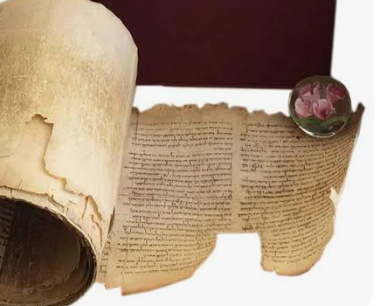



James Tissot, The Scapegoat, circa 1896–1902; Brooklyn Museum, New York, via Wikimedia Commons.Atoning sacrifices
Michelangelo, The Prophet Isaiah, 1509; Sistine Chapel ceiling, Vatican City, via Wikimedia Commons.Isaiah 53:10 (KJV)


Unknown illustrator, Isaiah Writing on a Scroll, The New Illustrated Holy Bible, 19th century AD.Isaiah 50:6 (KJV)
Reese Jacobson, Donald W. Parry Examining the Great Isaiah Scroll, 2005 AD, Dead Sea Scrolls vault, Israel Museum, Jerusalem.Great Isaiah Scroll
Caravaggio, Saint Matthew and the Angel, 1602 AD, destroyed in 1945; surviving photograph.Matthew 26:67; 27:26, 30 (KJV)
Jennifer Zilm, Qumran Cave 1, 2013 AD, West Bank near the Dead Sea.Qumran Cave 1


Michelangelo Buonarroti, Zechariah, 1509 AD, fresco, Sistine Chapel, Vatican City; detail.Zechariah 12:10 (KJV)
Unknown ancient scribe, Greek Minor Prophets Scroll (8HevXIIgr), c. 50 BC–50 AD, Israel Antiquities Authority. The displayed columns contain Zechariah 8:18–9:7, illustrating the book’s early transmission rather than verse 12:10 itself.4Q80
El Greco, Saint John the Evangelist, c. 1600 AD, Museo del Greco, Toledo, Spain.John 19:34–37 (KJV)


 ius gladii
The “right of the sword”—the supreme legal authority held by Roman provincial governors like Pilate to order capital punishment. and the specific protocols governing execution. We analyze the physical mechanics of the flagrum
ius gladii
The “right of the sword”—the supreme legal authority held by Roman provincial governors like Pilate to order capital punishment. and the specific protocols governing execution. We analyze the physical mechanics of the flagrum flagrum
The Roman scourge used in the verberatio (flogging). It featured multiple leather thongs weighted with lead or bone to maximize tissue trauma. used in scourging, the metallurgical properties of iron nails, and the Roman discretionary laws that allowed for the release of bodies to family or petitioners for burial.
flagrum
The Roman scourge used in the verberatio (flogging). It featured multiple leather thongs weighted with lead or bone to maximize tissue trauma. used in scourging, the metallurgical properties of iron nails, and the Roman discretionary laws that allowed for the release of bodies to family or petitioners for burial.
Seneca’s Consolation to Marcia The first-century Roman philosopher describes crosses made in different ways, with victims attached in differing postures. Hengel cites the passage as evidence that Roman crucifixion varied substantially. describes crosses made in different ways. Josephus’s Jewish War
Josephus’s Jewish War The first-century historian reports mass crucifixions during the Roman siege of Jerusalem and says soldiers varied the victims’ positions. reports that soldiers crucified prisoners in different positions during the siege of AD 70.
Tacitus’s Annals Annals 15.44 recounts Nero’s punishment of Christians after the fire of Rome in AD 64. It documents Roman spectacle and cruelty, though not a uniform crucifixion procedure. records punishments intensified for spectacle under Nero. Together these witnesses support Hengel’s central point: Roman execution practice permitted deliberate variation, humiliation, and cruelty beyond the basic act of suspension.

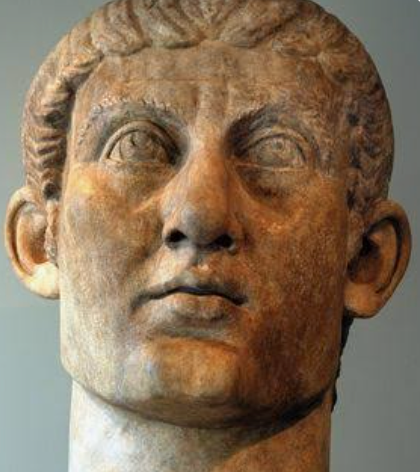 Roman provincial procedure under Pontius Pilate, approximately 30 ADRoman evidence supports displaying an offender’s accusation publicly; all four Gospels preserve a charge identifying Jesus as “King of the Jews,” while John alone reports that Pilate had it written in three languages.In Roman-governed Judaea
Palestine in the Time of Jesus, historical map; Wikimedia Commons.Judaea
Nikolai Ge, What Is Truth? Christ and Pilate, 1890; State Tretyakov Gallery, Moscow.Pontius Pilate
Commando76, diagram of the Titulus Crucis relic, 2020, based on Giacomo Bosio’s 1610 engraving; Wikimedia Commons.Titulus
Domenichino, Saint John the Evangelist, approximately 1624–1629; National Gallery, London.John 19:19–20 (KJV)
Illustration of Roman fasces, the emblem of a magistrate’s coercive authority; Wikimedia Commons.Ius gladii


 Francesco Bella and Carlo Azzi, radiocarbon analysis, 2002Radiocarbon analysis places the walnut wood known as the Titulus Crucis between 980 and 1146 AD; it cannot be the original placard from Jesus’s first-century crucifixion.The inscribed fragment is kept at the Basilica of Santa Croce in Gerusalemme
Basilica of Santa Croce in Gerusalemme, Rome, Italy; Wikimedia Commons.Santa Croce in Gerusalemme

Locator map of Oxyrhynchus, modern el-Bahnasa, Egypt; Wikimedia Commons.Oxyrhynchus
Papyri from Oxyrhynchus, 113 AD; University of Pennsylvania Museum, Philadelphia.Oxford collection
Papyrus Oxyrhynchus 551, second century AD; Princeton University Library.Codex


Master of Zweder van Culemborg, Crucifixion illumination from a Book of Hours, approximately 1420–1430; National Library of the Netherlands, The Hague.John 19:23–24 (KJV)
Master of the Die, The Conversion of the Centurion, approximately 1532–1535; Metropolitan Museum of Art, New York.Quaternio
Andrea Mantegna, Saint Mark the Evangelist, approximately 1448; Städel Museum, Frankfurt.Mark 15:44–45 (KJV)
Unknown illuminator, The Crucifixion: Longinus Pierces Christ’s Side, Vaux Passional, approximately 1503; National Library of Wales, Aberystwyth.John 19:31–34 (KJV)
Gerard van Honthorst, King David Playing the Harp, 1622; Centraal Museum, Utrecht.Psalm 22:18 (KJV)


Jean-Léon Gérôme, Jerusalem (Consummatum est), 1867 AD, Musée d’Orsay, Paris, France; later artistic rendering.Golgotha
Gerard van Honthorst, Christ before the High Priest, about 1617 AD, National Gallery, London, United Kingdom; later artistic rendering.Chief priests


Tacitus’s text in Codex Laurentianus Mediceus 68.2, folio 38 recto, copied in the 11th century AD; Biblioteca Medicea Laurenziana, Florence, Italy.Annals 15.44
Julien, Tacitus, from an Antique Bust, 1915 AD; posthumous drawing, Bibliothèque nationale de France source.Publius Cornelius Tacitus


 Yehohanan calcaneus
The 1968 discovery of a first-century heel bone pierced by a 11.5cm iron nail, proving that Roman victims were indeed nailed through the bone., which offers osteological proof of Roman techniques. We also examine epigraphy
Yehohanan calcaneus
The 1968 discovery of a first-century heel bone pierced by a 11.5cm iron nail, proving that Roman victims were indeed nailed through the bone., which offers osteological proof of Roman techniques. We also examine epigraphy epigraphy
The study of inscriptions. Artifacts like the Pilate Stone confirm the historical title and existence of the Prefect mentioned in the Gospels. that confirms the existence of high-ranking officials involved in the trial and sentencing.
epigraphy
The study of inscriptions. Artifacts like the Pilate Stone confirm the historical title and existence of the Prefect mentioned in the Gospels. that confirms the existence of high-ranking officials involved in the trial and sentencing.Jean-Pol Grandmont, Ruins of the Domus Augustana, 2013; Palatine Hill, Rome. Wikimedia Commons.Paedagogium on the Palatine
Jensens, Museo Palatino, 2007; Palatine Hill, Rome. Wikimedia Commons.Palatine Museum
Severan Tondo, anonymous artist, approximately 200 AD; Antikensammlung, Altes Museum, Berlin. Wikimedia Commons.Severan period
Scewing after Rodolfo Lanciani, Tracing of the Alexamenos Graffito, 2010/1898; public-domain reconstruction, Wikimedia Commons.Alexamenos sebete theon
André Thevet, Tertullian, 1584; allegorical engraving, Wikimedia Commons.Donkey-worship accusation
Probably Valentin de Boulogne, Saint Paul Writing His Epistles, approximately 1618–1620; Museum of Fine Arts, Houston. Wikimedia Commons.1 Corinthians 1:23 (KJV)

.JPG)


Justin Benttinen, Alexamenos Graffito, High-Contrast Edition, photograph made 2023 and edited 2025; Palatine Museum, Rome. Wikimedia Commons, CC BY-SA 4.0.Novum Testamentum
Gary Todd, Nail and Heel Bone: Evidence of Crucifixion, 2018; Israel Museum, Jerusalem. Wikimedia Commons, CC0.Yehohanan
Outline of the Alexamenos Graffito, anonymous digital tracing, 2007; after the Palatine original. Wikimedia Commons.Obscenity
Caravaggio, Conversion on the Way to Damascus, approximately 1600–1601; Cerasi Chapel, Basilica of Santa Maria del Popolo, Rome. Wikimedia Commons.Philippians 2:8 (KJV)


Hazon Gabriel Hebrew for “Vision of Gabriel.” Gabriel is the interpreting angel named in Daniel 8–9 and the messenger in Luke 1. The artwork is a later representation, not an image from the stone’s period. to scholarship in 2007 after examining photographs supplied by its private owner. The object—also called Hazon Gabriel
Hazon Gabriel Hebrew for “Vision of Gabriel.” Gabriel is the interpreting angel named in Daniel 8–9 and the messenger in Luke 1. The artwork is a later representation, not an image from the stone’s period. or the Jeselsohn Stone—is a roughly one-meter-high limestone tablet carrying 87 fragmentary lines in two columns.
Paleography Dating and studying handwriting through changing letter forms. The Gabriel Stone’s script resembles late Second Temple Hebrew hands, but handwriting alone cannot supply an exact year or prove provenance. supports a date around the turn of the era, not the original card’s overly precise “first century BC” label. Ink on stone is unusual but not intrinsically impossible; the text imitates the visual organization of a scroll.
Dead Sea The salt lake between modern Israel, the West Bank, and Jordan. The reported find area lies east of its Lisan Peninsula, but no controlled excavation documents the stone’s discovery., passed through dealers, and was purchased by collector David Jeselsohn. Yuval Goren examined the limestone surface, coatings, and attached sediment. He reported no evidence of modern surface treatment and found the sediment compatible with terrain east of the Lisan Peninsula. The analysis supports compatibility, not a demonstrated excavation history: naturally formed coatings can strengthen an antiquity argument, but geology cannot identify who wrote the text or when the ink was applied with calendar precision.
Late Second Temple period The final centuries before the Jerusalem Temple’s destruction in AD 70, when Jewish groups expressed varied hopes concerning restoration, judgment, angels, resurrection, and messianic agents.. That setting is relevant to early Christianity because it shows that “three days,” angelic revelation, eschatological conflict, and divine vindication were intelligible Jewish themes before or near the first Christian generation. It supplies context, not a source for the Gospels. No evidence demonstrates that Jesus or his followers knew this particular text.


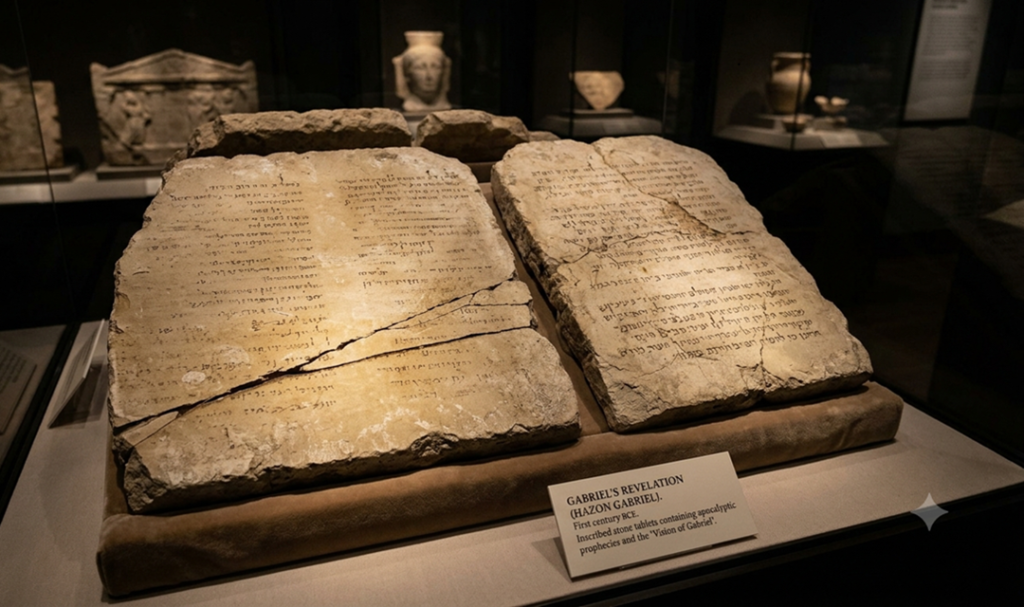
Eman, Tombs of Zechariah and the Benei Hezir Family, photograph, 2005 AD, Mount of Olives, Jerusalem; comparative rock-cut tomb architecture, not the Caiaphas cave.North Talpiot burial cave
Ian Scott, Jewish Tomb at Dominus Flevit, photograph, 2009 AD, Mount of Olives, Jerusalem; comparative first-century kokhim tomb.Kokh
Israel Museum display drawing, Inscriptions on the Ossuary of Joseph Caiaphas, first-century artifact documentation, Jerusalem, Israel.“Yehosef bar Qayafa / Qafa”
Gerard van Honthorst, Christ before the High Priest, about 1617 AD, National Gallery, London, United Kingdom; later artistic interpretation.John 11:49–50 (KJV)


.jpg)

Deror Avi, Caiaphas Ossuary, photograph, 2011 AD, Israel Museum, Jerusalem, Israel.Calcite flowstone


Caesarea Maritima The Roman provincial capital of Judaea. The block is currently housed in the Israel Museum in Jerusalem., recovered this primary example of epigraphyepigraphy The study of ancient inscriptions. This block is the only excavated artifact naming Pontius Pilate as an active Roman official..The inscription explicitly names him as [PO]NTIUS PILATUS [PRAEFECTUS IUD]AE, confirming his role as PraefectusPraefectus The official Latin title for the governor of Judaea (AD 6–41). The find confirms the Gospel title for Pilate and corrects later anachronistic records.. Because the findspot matches the known Roman administrative seat, the stone anchors the trial setting in verifiable history. It provides an archaeological link between the Gospel narrative and the Roman government.
Emperor Tiberius The second Roman emperor (AD 14–37). Pilate served as his prefect in Judaea during the period of the crucifixion.. Its discovery repurposed as a theater step proves it was a genuine local monument. The artifact validates the Lucan chronology of Luke 3:1Luke 3:1 (KJV) “Now in the fifteenth year of the reign of Tiberius Caesar, Pontius Pilate being governor of Judaea…”. The use of Praefectus instead of “procurator” reflects the specific vocabulary of the early empire. This accuracy suggests the Gospel sources were drawing on contemporary knowledge. History and archaeology align on his title.
Tacitus Publius Cornelius Tacitus (AD 56–120), a Roman historian who used the later title “procurator” for Pilate, whereas this stone proves “prefect” was the title used during the actual events. had used the wrong title, which caused early scholarly confusion.

Giv’at ha-Mivtar A neighborhood northeast of Jerusalem’s Old City where a first-century Jewish burial complex was exposed during construction in 1968., northeast of Jerusalem’s Old City.One limestone bone box, inscribed with a form of “Yehohanan son of Hagakol,” held the heel of an adult man. An approximately 11.5-centimeter iron nail passed laterally through his right calcaneus
Calcaneus The heel bone. Yehohanan’s surviving right calcaneus was pierced from the side by the iron nail.; a small olive-wood plaque lay between the nail head and bone, and the bent point prevented normal removal. The find directly confirms heel nailing in Roman Judea, but it neither identifies Jesus nor establishes one universal crucifixion posture.
Ossuaries Small stone boxes used in late Second Temple-period Jewish secondary burial. After a body decomposed, relatives gathered the bones and placed them in an ossuary within the family tomb. belong to the late Second Temple funerary world. Epigrapher Joseph Naveh published the cave’s inscriptions separately; the patronymic following Yehohanan’s name is difficult and has received several readings.
Roman Judea The Roman-governed region centered on Jerusalem in the first century AD. Yehohanan’s burial belongs to this historical and geographic setting. was judicially affixed through the heel, while leaving the complete apparatus and posture unresolved.
 pericardial effusion
A buildup of clear fluid around the heart sac due to extreme physical trauma, which explains the “water” observed when the spear was used. following the spear wound.
pericardial effusion
A buildup of clear fluid around the heart sac due to extreme physical trauma, which explains the “water” observed when the spear was used. following the spear wound.
 arcosolia
An arched burial niche common in elite tombs, where a body could be laid flat on a stone bench rather than placed into a narrow shaft. and the engineering of the rolling stone
arcosolia
An arched burial niche common in elite tombs, where a body could be laid flat on a stone bench rather than placed into a narrow shaft. and the engineering of the rolling stone rolling stone
A large circular stone set in a track to seal a tomb entrance, found in several wealthy burial sites in Jerusalem from the Herodian period. mechanism used to seal elite burial chambers.
rolling stone
A large circular stone set in a track to seal a tomb entrance, found in several wealthy burial sites in Jerusalem from the Herodian period. mechanism used to seal elite burial chambers.Mark 15:21 (KJV)
Pericardium
Pontius Pilate
Joseph of Arimathea
Fatal arrhythmia
Positional asphyxia
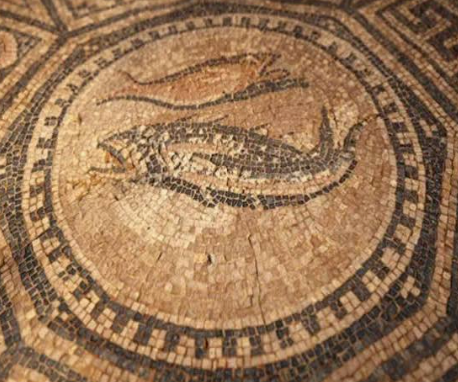
Giv‘at ha-Mivtar A neighborhood north of Jerusalem’s Old City where construction exposed a Jewish rock-cut tomb complex in 1968. This photograph shows the modern neighborhood, not the excavated tomb., north of Jerusalem.The excavated ossuaryOssuary A limestone box used for the secondary burial of bones after the body had decomposed. Ossuary burial was practiced among many Judean Jews from approximately the first century BC through the first century AD. carried an inscription conventionally rendered “Yehohanan son of Hagakol.”
Calcaneus The heel bone. In Yehohanan’s case, an iron nail passed laterally through the right calcaneus. transfixed by a bent iron nail approximately 11.5 centimeters long. A thin olive-wood plaque remained between the nail head and heel. Minute wood traces survived at the bent tip but could not be identified by species. The assemblage supplies direct bone-level evidence of Roman nailing in first-century Judea.
Hypovolemic shock Circulatory failure caused by an inadequate volume of blood or fluid. Reduced venous return lowers cardiac output and can deprive organs of oxygen. before crucifixion. Suspension was then said to interfere progressively with respiration until exhaustion prevented adequate ventilation. The paper made hypovolemia and exhaustion-asphyxia a widely cited combined model, but subsequent medical reviews have not established it as the universal mechanism of death in crucifixion.
Exhaustion asphyxia The paper’s proposed process in which suspension impairs breathing and muscular exhaustion eventually prevents adequate ventilation. Its role in crucifixion remains medically disputed. was therefore presented as operating alongside circulatory shock. In this reconstruction, blood loss weakened circulation while suspension impaired respiration.
John 19:34 (KJV) “But one of the soldiers with a spear pierced his side, and forthwith came there out blood and water.” Medical proposals include pleural, pericardial or post-mortem fluid separation, but the wording cannot establish one anatomical source. describes “blood and water” after the spear thrust. Edwards and colleagues considered this compatible with pleural and pericardial fluid, but the text cannot identify a specific fluid compartment or determine whether the spear caused or confirmed death. The defensible conclusion is narrower than the original card claimed: scourging, blood loss, suspension and trauma provide a medically plausible combination capable of producing death. The exact terminal sequence remains a historical medical hypothesis rather than a forensic diagnosis.
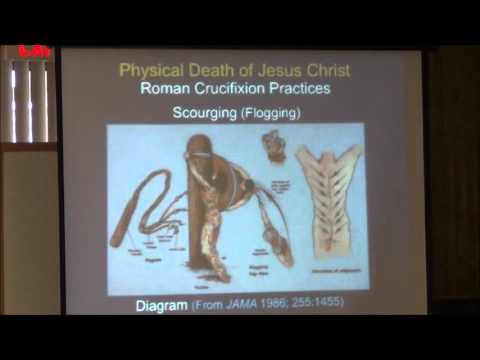
 Frederick Thomas Zugibe, forensic pathologist and author, 1995“This area is equally as sturdy as either Destot’s Space or the radial area indicated above and would emerge at the site depicted on the Shroud.”Frederick Thomas Zugibe, longtime chief medical examiner of Rockland County, New York, made this statement in his 1995 paper “Pierre Barbet Revisited,” later developing the argument in his 2005 forensic study of crucifixion. He was describing the upper palm—not its soft center—as a possible entrance point for a crucifixion nail.
Thenar furrow
Yehohanan’s pierced heel
Calcaneus
David Friedrich Strauss

Pleural and pericardial spaces
Giv’at ha-Mivtar tomb
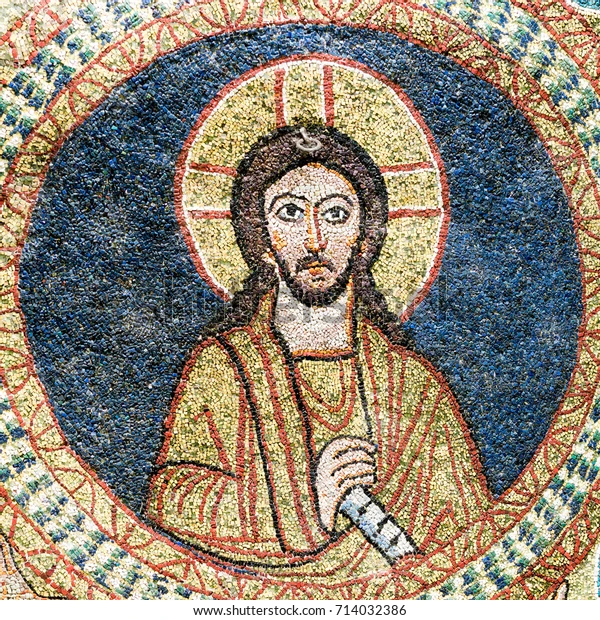
 Jewish law
Specifically the Mishnah and Torah requirements for prompt burial before sundown, ensuring that the land was not “defiled” by a body left hanging.. Here we investigate the role of the SanhedrinSanhedrin
The Jewish high council that maintained protocols for the burial of those executed under their religious jurisdiction, often requiring separate, dishonorable burial sites. in managing the remains of the condemned and the historical consistency of Joseph of Arimathea’s petition.
Jewish law
Specifically the Mishnah and Torah requirements for prompt burial before sundown, ensuring that the land was not “defiled” by a body left hanging.. Here we investigate the role of the SanhedrinSanhedrin
The Jewish high council that maintained protocols for the burial of those executed under their religious jurisdiction, often requiring separate, dishonorable burial sites. in managing the remains of the condemned and the historical consistency of Joseph of Arimathea’s petition. John Granger Cook, historian, Crucifixion in the Mediterranean World, 2014“Roman law was flexible regarding the burial of the executed… in the case of Judaea, the custom was to grant bodies to relatives or petitioners for burial before sundown.”John Granger Cook, a professor of Religion at LaGrange College and leading historian of ancient judicial execution, analyzes who held legal authority over execution victims, what statutory mechanisms existed under Roman governance, where provincial law adapted to regional populations, when magistrates exercised leniency, and why political stability took precedence over total post-mortem desecration.
André Thevet, Philo Judaeus, 1584 AD engraving; National Library of France, Paris.Philo of Alexandria (c. 20 BC – 50 AD)
Rembrandt van Rijn, Saint Matthew and the Angel, 1661 AD; Louvre Museum, Paris, France.Matthew 27:58 (KJV)
 Byron R. McCane, archaeologist and historian, Roll Back the Stone, 2003“The Jewish requirement for burial before sunset was absolute… leaving a body exposed would have been an intolerable defilement of the Holy City during Passover.”Byron R. McCane, an archaeologist and specialist in ancient Mediterranean mortuary practices, breaks down who conducted criminal interments, what religious imperatives mandated quick action, where body pollution posed ceremonial danger to Jerusalem, when sunset deadlines forced rapid execution protocol, and why Jewish leaders negotiated immediate body removal before the Sabbath.
Jewish Scribes, Mishnah Kaufmann Manuscript, 10th-century AD copy; National Library of Hungary.Mishnah Sanhedrin 6:5–6
Second Temple era Jewish rock-cut family tomb chamber, Jerusalem.Second Temple Burial Architecture
Yehohanan Ossuary Find (1968)
 Temple Scroll 11Q19 64:6–13; Qumran Cave 11Temple Scroll 11Q19 physically preserves a pre-70 Jewish legal interpretation requiring an executed person suspended on a tree to be removed and buried that same day.The Temple Scroll
Effi Schweizer, Qumran Cave 11 Entrance, photographed 2008 AD; Qumran, West Bank.Qumran Cave 11
Rembrandt van Rijn, Moses with the Tablets of the Law, 1659 AD; Gemäldegalerie, Berlin, Germany.Deuteronomy 21:22–23 (KJV)
Andrea Mantegna, Saint Mark the Evangelist, approximately 1448 AD; Städel Museum, Frankfurt, Germany.Mark 15:42–46 (KJV)
Anthony van Dyck, Saint John the Evangelist, approximately 1618–1620 AD; Museum of Fine Arts, Budapest, Hungary.John 19:31, 38–42 (KJV)
El Greco and workshop, Saint Paul, approximately 1605 AD; John and Mable Ringling Museum of Art, Sarasota, United States.Galatians 3:13 (KJV)
 Jodi Magness, archaeologist, “Has the Tomb of Jesus Been Discovered?” 2007“The Gospel accounts provide an accurate description of Joseph of Arimathea burying Jesus’ body in a loculus in his family’s rock-cut tomb.”Jodi Magness, a University of North Carolina archaeologist specializing in ancient Judaism, made this assessment in 2007 while evaluating claims about the Talpiot “Jesus family tomb.” She compared the Gospels with excavated burial architecture around first-century Jerusalem.
Jprg1966, Sanhedrin Tombs Burial Chamber, photographed 2023 AD; Jerusalem, Israel.Loculus
Simon Bening, Joseph of Arimathea Before Pilate, approximately 1525–1530 AD; J. Paul Getty Museum, Los Angeles, United States.Joseph of Arimathea
 Craig A. Evans, New Testament scholar, 2012Roman authorities could release an executed person’s body for burial when permission was requested, while Jewish law and custom pressed for burial before nightfall.Craig A. Evans argues that the Gospel account of Joseph of Arimathea
Joseph of Arimathea
Pontius Pilate
Ulpian and Paulus
Philo of Alexandria
Aulus Avilius Flaccus
Alexandria
Yehohanan Ossuary
In Flaccum 83–84
Roman Egypt
Jewish War 4.317
Joseph Approaching Pilate
Mark 15:43–45 (KJV)
 Deuteronomy 21:23; Mishnah Sanhedrin 6“His body shall not remain all night upon the tree, but thou shalt in any wise bury him that day; (for he that is hanged is accursed of God;) that thy land be not defiled, which the LORD thy God giveth thee for an inheritance.” — Deuteronomy 21:23 (KJV)Deuteronomy required an executed person displayed on a tree to be buried the same day so that the land would not be defiled. The command concerns the dishonor and land-defilement caused by leaving the body exposed overnight; it should not be reduced to the separate Jewish laws governing impurity acquired through physical contact with a corpse.
Flavius Josephus
Mark 15:42 (KJV)
John 19:31 (KJV)
John 19:42 (KJV)
Mishnah Sanhedrin 6
Pontius Pilate
Crurifragium
Papyrus 66 — unknown Christian scribe, approximately 200 AD. Bodmer Library, Cologny, Switzerland.Gospel of John
Shabbat candles — photograph by Gilabrand, 2011. Wikimedia Commons.Day of Preparation
Bones of the lower leg — illustration from Henry Gray, Anatomy of the Human Body, 1918 edition.Crurifragium
The Lance — Peter Paul Rubens, 1620. Royal Museum of Fine Arts Antwerp, Belgium.John 19:34 (KJV)
Kaufmann Manuscript of the Mishnah — unknown scribe, approximately twelfth century. Library of the Hungarian Academy of Sciences, Budapest, Hungary.Mishnah Sanhedrin 6:5–6

Domice Vlpian, Ivrisconsvlte — imagined portrait engraved for André Thevet’s Les vrais pourtraits, 1584. British Museum, London, United Kingdom.Domitius Ulpianus
Via Appia Antica, Rome — photograph by Berit Wallenberg, 1932. Swedish National Heritage Board, Stockholm, Sweden.Spartacus’s Revolt
Via Appia Antica basalt paving — photograph by Nicholas Hartmann, 2019. Rome, Italy.Appian Way
A Crucifixion in the Time of the Romans — Vasily Vereshchagin, 1887. Brooklyn Museum, Brooklyn, USA.A Crucifixion in the Time of the Romans

Simon Bening, Joseph of Arimathea Before Pilate, approximately 1525–1530 AD; J. Paul Getty Museum, Los Angeles, United States.Joseph of Arimathea
Joseph of Arimathea Before Pilate, Sweet Media biblical illustration, twenty-first century AD.Mark 15:43–46 (KJV)
Antonio Ciseri, Ecce Homo, 1871 AD; Gallery of Modern Art, Palazzo Pitti, Florence, Italy.Pontius Pilate
Tamarah, Second Temple-period Jerusalem ossuaries, photographed 2012 AD; Israel Museum, Jerusalem, Israel.Rock-cut family tomb
Antonio Ciseri, The Transport of Christ to the Sepulchre, nineteenth century AD; Santa Maria del Sasso, Morcote, Switzerland.Matthew 27:57–60 (KJV)

Kaufmann Manuscript of the Mishnah, unknown scribe, approximately twelfth century AD; Library of the Hungarian Academy of Sciences, Budapest, Hungary.Mishnah Sanhedrin 6:5–6
Limestone ossuary of “Simon, builder of the Temple,” first century AD; Israel Museum, Jerusalem, Israel.Secondary burial
Lawrie Cate, Open Torah Scroll, photographed 2009 AD.Deuteronomy 21:22–23 (KJV)
James Tissot, Joseph of Arimathea, approximately 1886–1894 AD; Brooklyn Museum, New York, United States.Joseph of Arimathea
Caravaggio, The Calling of Saint Matthew, approximately 1599–1600 AD; Contarelli Chapel, Church of San Luigi dei Francesi, Rome, Italy. Later artistic representation.Matthew 27:7–8 (KJV)
Rembrandt van Rijn, Judas Repentant, Returning the Pieces of Silver, 1629 AD; private collection, England. Later artistic representation.Judas’s returned silver
Seetheholyland.net, burial cave at Akeldama, photographed 2012 AD; Monastery of Saint Onuphrius, Jerusalem.Akeldama
El Greco, Saint Luke the Evangelist, approximately 1602–1605 AD; Toledo Cathedral, Toledo, Spain. Later artistic representation.Acts 1:18–19 (KJV)
Joe Freeman, Hinnom Valley with Ancient Burial Vaults, photographed 2005 AD; Jerusalem.Kokhim and arcosolia
Michelangelo Buonarroti, The Prophet Zechariah, approximately 1509 AD; Sistine Chapel, Vatican City. Later artistic representation.Zechariah 11:12–13 (KJV)

Unknown artist, romanticized woodcut portrait of Flavius Josephus, published by 1817 AD in an edition of William Whiston’s translation. Posthumous representation.Flavius Josephus
Nicolas Poussin, The Conquest of Jerusalem by Emperor Titus, 1638 AD; Kunsthistorisches Museum, Vienna, Austria. Later historical representation.Roman siege of Jerusalem
Lawrence Alma-Tadema, The Triumph of Titus: The Flavians, 1885 AD; Walters Art Museum, Baltimore, United States. Later historical representation.Titus
Unknown engraver, Flavius Josephus, published in William Whiston’s Works of Flavius Josephus, 1854 AD. Posthumous representation.Life 420–421
Unknown engraver, title-page ornament from The Whole Genuine and Complete Works of Flavius Josephus, eighteenth century AD.Jewish War 4.317

Ossuary A limestone bone box used in many Jerusalem-area Jewish burials from roughly the late first century BC through the first century AD. After decomposition, bones were gathered for secondary burial inside the box. recovered from a sealed burial cave in 1990. The excavated box names Joseph and Caiaphas, the same combination preserved for the high priest in Josephus
New Testament high priest Joseph Caiaphas held the Jerusalem high priesthood during the governorship of Pontius Pilate. The Gospels place him in the proceedings that preceded Jesus’ transfer to the Roman governor; the ossuary identification remains probable rather than certain..
Yehosef bar Qafa The Aramaic wording means “Joseph son of Qafa,” identifying Joseph through the Caiaphas family name. A second inscription on the same ossuary uses a variant spelling of Caiaphas. and another Caiaphas spelling, while a second ossuary also preserves the family name. Multiple inscriptions locate a Caiaphas family tomb, not an isolated modern reading of one ambiguous scratch.
Joseph called Caiaphas Josephus uses this identifying formula for the high priest appointed by Valerius Gratus. The Joseph–Caiaphas combination is important because the ornate ossuary carries corresponding Aramaic forms, though the match does not conclusively identify the bones.. John 18:13–14John 18:13–14 (KJV) “And led him away to Annas first; for he was father in law to Caiaphas, which was the high priest that same year. Now Caiaphas was he, which gave counsel to the Jews, that it was expedient that one man should die for the people.” places Caiaphas within the high-priestly hearing that preceded Jesus’ delivery to Pilate. The ossuary therefore corroborates the name, period, social setting, and funerary world of the Caiaphas family. It does not contain Jesus’ name, describe the hearing, or convert the probable identification into certainty. The artifact anchors a named passion figure while preserving the proper limit of archaeological inference.

Caiaphas Joseph Caiaphas was high priest during Pilate’s governorship and is named in the Gospel passion accounts. The ossuary inscription refers to a Caiaphas ancestor within a priestly family; it does not say that Miriam was the high priest’s granddaughter. links Miriam’s ancestry to the priestly family independently attested in the excavated Jerusalem tomb. The reference to MaʿaziahMaʿaziah The twenty-fourth priestly course in the biblical rotation of Temple service. This inscription is important because it supplies rare epigraphic evidence connecting the Caiaphas family with that priestly division. adds information absent from the Gospels and Josephus. The artifact supplies genealogy and priestly affiliation, strengthening the conclusion that Caiaphas was a historical Jerusalem priestly family rather than a name created for the passion story.
Elah Valley A broad valley southwest of Jerusalem in the Judaean Shephelah. The reported origin cannot be independently reconstructed because the ossuary did not come from a controlled excavation.. Its precise findspot, original tomb assemblage, and association with the two lamps therefore depend on reports rather than excavation records. This makes the Miriam ossuary a strong epigraphic artifact
Strong epigraphic artifact The inscription preserves a multi-generation genealogy, a priestly family name, and the Maʿaziah course. Its epigraphic value is substantial, but the missing controlled find context limits claims about its original tomb and associated objects. but a weaker archaeological context than the 1990 Peace Forest tomb. The responsible cumulative case uses the two finds differently: one secures context; the other expands the Caiaphas family’s genealogy and priestly affiliation.
Cyrene An important Greek and Roman city in present-day Libya with a substantial Jewish population in antiquity. Mark’s description of Simon as a Cyrenian means that a genuine Cyrene connection on the ossuary would make the archaeological match more specific. was a major North African city with an established Jewish population. The tomb itself was found in the Kidron Valley
Kidron Valley A valley immediately east of Jerusalem’s Old City and west of the Mount of Olives. Numerous ancient Jewish tombs occur in this burial zone, placing the find in an authentic first-century Jerusalem funerary setting., adding the correct broad period, burial custom, and geographic setting to the name pattern.
Ian Scott, Elah Valley from Tel Socho, 2015; Israel. Wikimedia Commons, CC BY-SA 2.0.Elah Valley
Deror Avi, Joseph Caiaphas Ossuary, Inscribed Side, photograph 2012; Israel Museum, Jerusalem. Wikimedia Commons.Peace Forest tomb
James Jacques Joseph Tissot, The Costume of the High Priest, approximately 1896–1902; The Jewish Museum, New York. Wikimedia Commons.Priestly course of Maʿaziah
Davidbena, Valley of Elah Landscape, 2014; Israel. Wikimedia Commons.Beth ʾImri
Gerard van Honthorst, Christ before the High Priest, approximately 1617; National Gallery, London. Wikimedia Commons.John 11:49–53 (KJV)
Giotto di Bondone, Christ before Caiaphas, approximately 1303–1305; Scrovegni Chapel, Padua. Wikimedia Commons.Matthew 26:57–68 (KJV)


 photographic negative
The 1898 discovery that the Shroud’s image behaves like a photographic negative, revealing anatomical details of scourging and piercing that are nearly invisible to the naked eye. properties of the linen and the ongoing scientific debate regarding radiocarbon datingradiocarbon dating
The 1988 test that suggested a medieval date for the Shroud, which has since been challenged due to samples taken from repaired edges and potential carbon-monoxide contamination.. These cards separate measurable features of the Shroud of Turin and Sudarium of Oviedo from interpretations that remain disputed. Forensic wound readings, STURP’s image tests, radiocarbon dating, textile comparisons, botanical claims, and blood chemistry are presented together so the strengths and limitations of each line of evidence remain visible.
photographic negative
The 1898 discovery that the Shroud’s image behaves like a photographic negative, revealing anatomical details of scourging and piercing that are nearly invisible to the naked eye. properties of the linen and the ongoing scientific debate regarding radiocarbon datingradiocarbon dating
The 1988 test that suggested a medieval date for the Shroud, which has since been challenged due to samples taken from repaired edges and potential carbon-monoxide contamination.. These cards separate measurable features of the Shroud of Turin and Sudarium of Oviedo from interpretations that remain disputed. Forensic wound readings, STURP’s image tests, radiocarbon dating, textile comparisons, botanical claims, and blood chemistry are presented together so the strengths and limitations of each line of evidence remain visible.STURP The Shroud of Turin Research Project. A multi-disciplinary team of 33 scientists who performed 120 hours of non-destructive testing on the cloth in 1978. team, used micro-chemical testing to prove the body image contains no pigments, dyes, or binders.
photographic negative The property discovered in 1898 where the image appears in natural detail only when light-values are reversed, a feature unachievable by medieval artists. revealed blood marks that match first-century execution practices. Forensic testing identified serum separationserum separation The natural process where clear fluid separates from clotted blood. The Shroud shows this around the spear wound, mirroring the “blood and water” described in the Gospels. in the wound, corroborating accurate physical trauma mechanics. By analyzing the 16th-century repairs, Rogers demonstrated that the 1988 C-14 date was based on a non-representative sample.
Destot’s space A small space in the wrist (carpus). Modern forensics proves this point can support body weight, unlike the palm placement common in medieval art. of the wrist. Additionally, the presence of pollen from Jerusalem
Jerusalem Botanical analysis identified pollen from plants native specifically to the Jerusalem region trapped in the Shroud’s fibers. supports a Middle Eastern origin for the linen.
Sudarium A small sweat-cloth (84 x 53 cm) used to cover the head of the deceased. Jewish law required such a cloth for victims of violent death to preserve the blood. of Oviedo. This artifact, housed in Oviedo
Oviedo A city in northern Spain. Its cathedral houses the Sudarium in a sacred chest (Cámara Santa), with a documented history in Spain stretching back to the 7th century., Spain, shows no image but contains blood patterns identical to those on the Shroud
Shroud The Shroud of Turin. Comparison with the Sudarium shows 70 points of congruence in the bloodstains on the back of the head and 50 on the face..Guscin’s forensic mapping established 70 points of congruence between the two cloths.

Shroud of Turin A linen cloth bearing front-and-back images of a crucified man, preserved in Turin. Its documented history is secure from the mid-14th century; its earlier provenance and identification with Jesus remain disputed. The 1988 radiocarbon tests dated the sampled linen to the medieval period, while authenticity advocates have challenged whether that sample represented the whole cloth.
Destot’s space A carpal interval on the ulnar, or little-finger, side of the wrist, bounded by the hamate, capitate, triquetrum and lunate. Pierre Barbet proposed it as the nail route; Zugibe objected that its position does not match the radial-side exit wound he perceived on the Shroud and that the median nerve does not run through this space. as the Shroud’s nail path. He argued instead that the visible wound is on the radial side of the wrist and proposed either a radial-wrist trajectory or an entry through the upper palm angled toward the wrist.

Shroud of Turin The linen relic preserved in Turin whose image is traditionally associated with Jesus’ burial. Botanical arguments are one proposed line of provenance evidence, but they must be evaluated separately from the cloth’s disputed radiocarbon date and other authenticity arguments. and faint plant-like images suggested indicator plants including Gundelia tournefortii
Gundelia tournefortii A spiny perennial of parts of the Middle East, including Israel. Danin treated it as an indicator species in his Shroud work; importantly, the plant is not confined to Jerusalem, and later pollen re-examination did not sustain species-level identification from Frei’s tapes., Zygophyllum dumosum, and Cistus creticus.
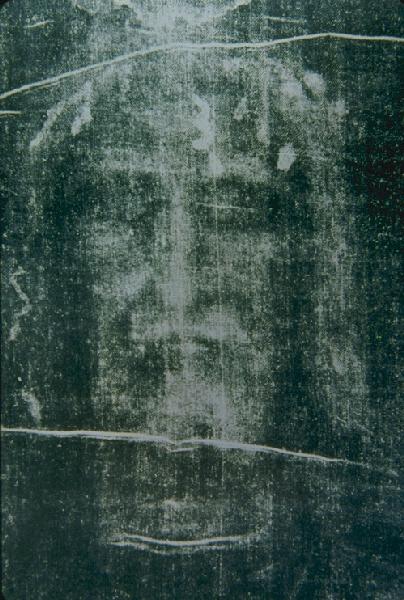


Cámara Santa The medieval “Holy Chamber” within Oviedo Cathedral in Asturias, northern Spain, where the cloth is kept. of Oviedo CathedralOviedo Cathedral The Cathedral of San Salvador in Asturias, Spain—not Toledo, Ohio. Secure local documentation is medieval; earlier movements rest substantially on tradition.. The relic is real; its identification remains disputed.

1532 AD Chambéry Fire A fire in the Sainte-Chapelle at Chambéry heated the folded Shroud inside its silver reliquary. Molten silver and firefighting water left repeated scorch, burn-hole, and water-mark patterns. damaged the folded cloth. From 1532–1534 AD, Poor Clare nunsPoor Clares Members of a cloistered Franciscan order founded in the thirteenth century. Nuns at Chambéry sewed triangular patches over the burn holes and attached a reinforcing backing cloth known as the Holland cloth. covered the burn holes and added a backing cloth. Those repairs matter to the Shroud’s conservation history, but the 1988 AD strip was not cut from a visible Poor Clare patch or a charred zone.
The Holy See and the Shroud The pope is the Shroud’s owner, while the archbishop of Turin serves as its pontifical custodian. The cloth is conserved at Turin Cathedral; invasive sampling requires ecclesiastical authorization. has not authorized another destructive radiocarbon campaign, so no later test has superseded the 1989 AD Nature result.
VP-8 image analyzer A 1970s analog video-processing instrument that converts brightness levels into vertical displacement on an isometric display. It was used for applications including topographic and medical-image interpretation; it was not a NASA device., recalled the result of a 1976 AD demonstration in Colorado Springs for Air Force Academy researchers John P. Jackson and Eric J. Jumper. The device did not discover literal depth hidden inside the cloth. It mapped tonal brightness as apparent height, and the Shroud photograph produced a recognizable relief-like human form.Jackson, Jumper, and William R. Ercoline later tested the relationship more formally.
3:1 chevron twill Each weft thread passes over three warp threads and under one, producing diagonal ribs. Reversing the diagonal at regular intervals creates the repeating V-shaped chevron commonly called herringbone.: the weft passes over three warp threads and under one, while periodic reversals form V-shaped bands.
twill technology existed in antiquity, but surviving Judaean textiles are overwhelmingly plain weave and usually S-spun.
Masada A Herodian fortress beside the Dead Sea occupied by Jewish rebels until the Roman siege of 73–74 AD. Its dry environment preserved a major corpus of Roman-period textiles. in the 1960s recovered textiles preserved by the arid Judaean Desert. The corpus demonstrates Roman-period twill weaving, chiefly in wool, alongside linen and other structures. Yigael Yadin
Yigael Yadin An Israeli archaeologist who directed Masada’s large-scale excavations from 1963–1965 AD. Textile specialists, rather than Yadin’s popular account alone, provide the relevant weave classifications.’s site therefore shows that twill was not technologically impossible in the first century AD. It does not supply a 3:1 chevron-twill linen matching the Shroud in material, spin, weave, and density. Masada demonstrates capability, not an exact textile parallel.
Mark 15:46 “And he bought fine linen, and took him down, and wrapped him in the linen, and laid him in a sepulchre which was hewn out of a rock.” The passage identifies Joseph of Arimathea, a purchased linen shroud, and a rock-cut tomb—but gives no weave specification. says that Joseph of Arimathea
Joseph of Arimathea A respected council member who, according to all four canonical Gospels, obtained Jesus’ body from Pilate and provided the burial place. Mark says he purchased linen for the burial. bought linen, wrapped the body, and placed it in a rock-cut tomb. John 19:40John 19:40 “Then took they the body of Jesus, and wound it in linen clothes with the spices, as the manner of the Jews is to bury.” John supplies Jewish-burial context but uses the plural “linen clothes” and does not describe their weave. adds linen cloths and spices “as the manner of the Jews is to bury.” These texts make costly burial linen historically relevant, especially because the burial was reportedly arranged before the Sabbath. They do not specify 3:1 twill, herringbone bands, yarn spin, loom type, dimensions, or a surviving image-bearing cloth. The Gospel fit is contextual rather than identificatory.
Warp-weighted loom A vertical loom whose hanging warp threads are tensioned by stone or clay weights. It was widespread in antiquity and differs from a horizontal treadle loom operated with foot-controlled shafts. in 2020 AD. Her wool test produced an imbalanced double weave rather than the Shroud’s single weave, leading her to infer a treadle loom. This reviewed experimental-archaeology result is relevant but not a universal proof about every ancient loom configuration. It strengthens the need to explain production technology while leaving date and place to independent evidence.

John 19:34 “But one of the soldiers with a spear pierced his side, and forthwith came there out blood and water.” The passage supplies the religious and historical comparison for a side wound; chemistry cannot label a cloth halo as John’s “water.” records that a soldier pierced Jesus’ side and that “blood and water” emerged. The Shroud comparison is relevant because a large side stain is depicted, but the text and stain cannot authenticate each other without independent dating and physiological evidence.

Irenaeus of Lyons 2nd-century Christian bishop and author (c. 130–c. 202 AD). Against Heresies 2.24.4 describes a middle point of the cross on which the crucified person rests. wrote Against Heresies around 180 AD, more than a century after Jesus’ death but still within early Christian antiquity. His “middle” projection is one of the clearest ancient references to a body-support feature later called a sedile Sedile A projecting support associated with some ancient descriptions of crucifixion. No complete Roman execution cross survives to establish a standard size, shape, or frequency..
Justin Martyr 2nd-century Christian philosopher and apologist (c. 100–165 AD). Dialogue with Trypho 91 contains a related description of a central projection on the cross. supplies a related description. The texts support a support-point, not a standardized seat, and they cannot establish that Jesus’ individual cross had one or how such a feature affected breathing. Its value is therefore contextual rather than anatomical proof: the passage helps explain how ancient readers could imagine a projecting body support while leaving its shape, comfort, placement, and use in any specific execution unknown.


Gero Cross Monumental crucifix in Cologne Cathedral dating to about 965–970 AD. It is evidence for later Christian representation, not 1st-century Roman execution hardware. in Cologne Cathedral
Cologne Cathedral Major cathedral in Cologne, Germany, housing the 10th-century Gero Cross. shows how strongly the feature entered Christian art.


Justin Martyr 2nd-century Christian philosopher and apologist (c. 100–165 AD). His writings preserve early descriptions and analogies for cross form. , a 2nd-century Christian philosopher, gives one of the clearest ancient structural descriptions of the cross in Dialogue with TryphoDialogue with Trypho Justin Martyr’s 2nd-century dialogue. Chapter 91 describes an upright, transverse member, and central projection. 91. He refers to an upright element, a transverse beam, and a central projection. In First ApologyFirst Apology Justin Martyr’s mid-2nd-century defense of Christianity. Chapter 55 compares cross form with familiar objects including ships, ploughs, tools, and Roman standards. 55 he separately compares cross form with ships, ploughs, tools, the human body with extended arms, and Roman standards.


Puteoli Major Roman port on the Bay of Naples, modern Pozzuoli. A Roman-period wall graffito from the city preserves rare early crucifixion imagery. graffito comes from ancient Puteoli , modern Pozzuoli near Naples, and is usually dated to the reigns of Trajan Emperor Trajan Roman emperor from 98–117 AD. His reign forms the earlier part of the date range commonly assigned to the Puteoli graffito. or Hadrian Emperor Hadrian Roman emperor from 117–138 AD. His reign forms the later part of the broad date range assigned to the Puteoli graffito. , about 98–138 AD. Published descriptions show a crucified figure with arms extended across a transverse beam. A nearby Greek name, Alkimilla Alkimilla Greek name written near the Puteoli crucifixion graffito. It may identify the depicted person, but the association is uncertain. , may identify the figure, although the association is uncertain.The image is later than Jesus and too schematic for precise anatomical reconstruction.


Plautus Roman comic playwright (c. 254–184 BC). Miles Gloriosus 359–360 threatens a man with going outside the gate with hands spread on a patibulum, centuries before Christianity. wrote Miles Gloriosus in the Roman Republic, roughly two centuries before the Gospel period. The joke works because the punishment is already intelligible to his audience: the condemned man goes outside the city with his hands spread on a patibulumPatibulum Latin punishment term for a transverse penal timber or crossbeam. In Plautus’s scene it is associated with outstretched hands and movement outside the gate..The source predates Christianity by centuries, so this vocabulary is not derived from Christian Passion imagery. It supports a Roman tradition of transverse-timber punishment and public carrying while leaving the beam’s exact size, weight, joinery, and later attachment to an upright uncertain. That distinction matters for the Gospel comparison: Plautus directly supports the existence of a carried transverse punishment timber, while later reconstruction is still required to explain how that timber was raised or joined at the execution site.
.jpg?width=600)

.jpg?width=600)
Seneca the Younger Roman Stoic philosopher, senator, and writer (c. 4 BC–65 AD). His testimony is valuable because it comes from 1st-century Roman culture rather than Christian tradition. wrote this around 40 AD in Consolatio ad Marciam, only several years after the commonly proposed date of Jesus’ crucifixion. He assumes that Roman audiences already knew crosses could differ in shape and victim position.The final clause—arms stretched on the “gibbet”—is especially relevant to a transverse timber or patibulumPatibulum Latin punishment term for a crossbeam or related penal timber. Roman sources associate it with outstretched arms and, in some contexts, public carrying.. The quotation documents Roman cross-form variation while independently supporting crossbar suspension. It does not identify the precise cross geometry, nail placement, or supports used in Jesus’ individual execution. This makes the quote particularly useful beside archaeology: it defines the range of Roman possibilities into which surviving nail and bone evidence must be placed.


Justin Martyr 2nd-century Christian philosopher and apologist (c. 100–165 AD). His writings preserve some of the earliest Christian descriptions of cross form. wrote Dialogue with Trypho in the mid-2nd century AD and described a cross as an upright beam joined by another beam. Elsewhere in the same passage he also refers to a central projection on which crucified persons were suspended.This is early evidence for a composite cross, not merely a much later artistic convention. Because Justin wrote more than a century after Jesus, however, the passage cannot establish Jesus’ exact hardware. Its value is historical: a recognizable upright-plus-crossbeam configuration was already being explicitly described in early Christian antiquity. The passage therefore contributes historical form evidence rather than physical proof, helping distinguish an early documented configuration from assumptions imported from much later devotional art.


Tertullian Early Christian author from Roman North Africa, active around 197–220 AD. His Latin works are valuable for how Christians in the Roman world described cross form. wrote Ad Nationes around 197 AD while answering pagan criticism of Christians. His wording is unusually structural: an “entire cross” includes both a transverse beam and a projecting seat.The passage preserves an early technical description rather than a medieval artistic convention. It strengthens the Methods & The Cross section by showing that multiple-piece cross construction and a body-support projection were explicitly discussed in Roman antiquity. Because Tertullian wrote long after Jesus, his description establishes an ancient configuration, not the exact hardware used in Jesus’ execution. It also gives independent context for why later physical finds should be compared with more than one plausible Roman cross configuration.


Plutarch Greek biographer, essayist, and priest of Apollo at Delphi (c. 45–125 AD). His Moralia preserves an important analogy involving a condemned criminal carrying a stauros. uses this image in On the Delays of Divine Vengeance, written after 81 AD. The point is moral, but the analogy only works if his audience recognizes condemned people carrying an execution instrument.That makes the passage independent cross-bearing context close to the Roman imperial period. Modern scholars debate exactly what Greek stauros denotes here, so the quote should not be forced into a complete-cross reconstruction. Its importance is narrower: public carriage of a penal suspension device was culturally intelligible outside Christian narrative. That makes Plutarch especially useful beside Roman Latin sources because the practice appears as ordinary cultural knowledge rather than Christian explanation.


 Nazareth Inscription
An imperial decree from the mid-first century prescribing the death penalty for those who move bodies from tombs or violate the sanctity of a grave. and the historical reality of the custodiacustodia
A Roman military guard unit assigned to secure prisoners or execution sites, reflecting the state’s interest in maintaining the permanence of the death sentence. guard units assigned to burial sites.
Nazareth Inscription
An imperial decree from the mid-first century prescribing the death penalty for those who move bodies from tombs or violate the sanctity of a grave. and the historical reality of the custodiacustodia
A Roman military guard unit assigned to secure prisoners or execution sites, reflecting the state’s interest in maintaining the permanence of the death sentence. guard units assigned to burial sites. anachronisms
Historical errors in art, such as portraying Jesus on a high cross (which would be inefficient) or using Renaissance-style clothing for Roman soldiers. in historical paintings and focuses on the engineering of the sedilesedile
A small wooden peg or “seat” often attached to the cross to support the victim’s weight, prolonging the agony by preventing rapid death from exhaustion..
anachronisms
Historical errors in art, such as portraying Jesus on a high cross (which would be inefficient) or using Renaissance-style clothing for Roman soldiers. in historical paintings and focuses on the engineering of the sedilesedile
A small wooden peg or “seat” often attached to the cross to support the victim’s weight, prolonging the agony by preventing rapid death from exhaustion..Consolatio ad Marciam Seneca’s Consolation to Marcia, usually dated around 40 AD. Section 20.3 describes varied crosses and arms extended on a patibulum. 20.3 describes differently constructed crosses and victims with arms extended on a patibulum.


Alexamenos Graffito Roman mocking graffito from the Palatine complex, generally dated to the late 2nd or early 3rd century AD. It preserves an early image of a crucified figure on a crossbar. preserves Roman crossbar imagery.Used together, these sources define a range of historically documented possibilities rather than one universal diagram. Physical evidence should anchor the reconstruction , while later images and literary testimony supply context. The result is compatibility with Gospel crucifixion details without claiming that archaeology reconstructs every attachment point or timber. Chapman’s comparison is useful precisely because it keeps later interpretation subordinate to earlier evidence.


projection A central ledge or seat (sedile) that supported the body’s weight, preventing rapid death from exhaustion but prolonging the victim’s agony.. He describes the cross as having five extremities, including a central point where the crucified person was suspended.Modern engineering analysis identifies this feature as a sedilesedile Latin for “seat.” A wooden peg or block attached to the upright of the cross. It was not a mercy but a device to prolong the punishment by supporting the victim’s weight.. By analyzing the structure of the cross
structure of the cross While artistic depictions vary, ancient literary sources suggest a multi-part construction including an upright (stipes) and a crossbar (patibulum). through ancient texts, we can separate historical reality from medieval artistic tradition. Body support was a known Roman feature; it allowed the victim to rest their weight, thereby extending the duration of the execution and the visibility of the state’s power.

suppedaneum A foot-support or ledge familiar in medieval and Renaissance art but absent from early Roman archaeological and literary records. (footrest) is a largely post-Roman addition to the cross imagery. While it appears in iconic works like the Gero Cross
Gero Cross The oldest large-scale crucifix in Western Europe (c. 965 AD), located in Cologne Cathedral. It features a prominent footrest which is an artistic rather than historical detail., it is rarely attested in Roman crucifixion evidence.In contrast to the sedilesedile The central “seat” peg that actually appears in early literary descriptions (Irenaeus/Justin) and graffiti, making it historically more probable than a footrest., which is better supported by early writers, the footrest may be an artistic invention to explain how a body could remain on a cross without tearing. This creates a conflict between later Christian art and the archaeological reality of the first century, where the feet were typically nailed directly through the heel or to the sides of the upright beam.

cross form The “t” or “†” shape of the Roman cross, which Justin explicitly describes as having a central projection to support the body.. He notes that the central part stands out like a horn, which is the earliest analogy for the central projectioncentral projection The sedile (seat). Justin’s description confirms this was a recognizable structural element of Roman crosses during his lifetime. used to support the victim’s weight.In his Dialogue with Trypho, Justin describes the hardware as an uprightupright The “stipes”—the vertical post of the cross that was often permanently fixed in the ground at the execution site. and a transversetransverse The “patibulum”—the horizontal crossbar that the victim was often forced to carry to the site of execution. beam. His testimony is crucial for correcting artistic depictions that omit the seat-peg. By identifying the “horn” in the centre, Justin anchors the engineering of the cross in the material reality of the Roman world, showing that crucified victims were suspended on a multi-part apparatus rather than a simple two-beam cross.


 prutah
A low-denomination bronze coin. Coins minted specifically by Pontius Pilate between 29–31 AD have been found throughout Judaea, confirming his administrative timeline. coins minted under Pilate and the “widow’s mites” that serve as archaeological markers for daily life and temple economy during the first century.
prutah
A low-denomination bronze coin. Coins minted specifically by Pontius Pilate between 29–31 AD have been found throughout Judaea, confirming his administrative timeline. coins minted under Pilate and the “widow’s mites” that serve as archaeological markers for daily life and temple economy during the first century. Lithostratos
The “Stone Pavement” (Gabbatha) where Pilate sat on the judgment seat. Large Herodian flagstones found near the Antonia Fortress match this description. pavement and the remains of the Praetorium
Lithostratos
The “Stone Pavement” (Gabbatha) where Pilate sat on the judgment seat. Large Herodian flagstones found near the Antonia Fortress match this description. pavement and the remains of the Praetorium Praetorium
The governor’s official residence. Archaeological excavations at Herod’s Palace have revealed the platform and judgment seat where Pilate likely presided over the public trial..
Praetorium
The governor’s official residence. Archaeological excavations at Herod’s Palace have revealed the platform and judgment seat where Pilate likely presided over the public trial.. Church of the Holy Sepulchre
The site traditionally identified as Calvary. Archaeological soundings confirm it was an active quarry and burial zone during the early first century. as the historical site.
Church of the Holy Sepulchre
The site traditionally identified as Calvary. Archaeological soundings confirm it was an active quarry and burial zone during the early first century. as the historical site. Tacitus
Publius Cornelius Tacitus (c. 56–120 AD). His “Annals” provide a secular Roman confirmation of the execution of “Christus” under the procurator Pontius Pilate. and the Jewish historian Josephus
Tacitus
Publius Cornelius Tacitus (c. 56–120 AD). His “Annals” provide a secular Roman confirmation of the execution of “Christus” under the procurator Pontius Pilate. and the Jewish historian Josephus Josephus
Flavius Josephus (c. 37–100 AD). His “Antiquities of the Jews” records Jesus’ life and his condemnation to the cross by Pilate, reflecting late first-century Jewish awareness of the event..
Josephus
Flavius Josephus (c. 37–100 AD). His “Antiquities of the Jews” records Jesus’ life and his condemnation to the cross by Pilate, reflecting late first-century Jewish awareness of the event..Flavius Josephus A Jewish priest, military commander, and historian born in Jerusalem around AD 37. He wrote Jewish Antiquities around AD 93–94. includes a notice about Jesus in Jewish Antiquities 18.63–64
Jewish Antiquities 18.63–64 The passage commonly called the Testimonium Flavianum. The surviving text describes Jesus and says Pilate condemned him to the cross, but some wording is disputed because it sounds unusually Christian.. In the traditional text, Josephus says that Pontius Pilate, following accusations by leading men, condemned Jesus to the cross.The passage is called the Testimonium Flavianum
Testimonium Flavianum Latin for “Flavian Testimony,” the conventional name for Josephus’s notice about Jesus. Scholars have debated its wording because the surviving form contains statements difficult to attribute to a non-Christian Jewish author.. Scholars therefore distinguish the received text
Received text The wording transmitted through surviving manuscripts, which may preserve ancient material alongside changes introduced during centuries of copying. from a possible Josephan core
Josephan core The portion scholars judge may derive from Josephus himself after probable Christian additions or alterations are removed. Proposed reconstructions differ.. T. C. Schmidt’s 2025 Oxford reassessment specifically defends the wording that Pilate condemned Jesus to the cross as Josephan.
Manuscript tradition The chain of handwritten copies through which an ancient work survives. Josephus’s works were copied for centuries, often by Christians, making textual analysis especially important here. contains phrases many scholars regard as later Christian alteration. The debate concerns wording as well as authenticity, so the entire received paragraph should not be treated as unquestionably Josephus’s original wording.
“Then released he Barabbas unto them: and when he had scourged Jesus, he delivered him to be crucified.” that Pilate delivered Jesus for crucifixion. Josephus’s much shorter notice preserves the same central coordinates: Jesus, leading accusers, Pilate, and the cross.
Jewish Antiquities 20.200 In a separate account concerning the high priest Ananus, Josephus refers to “the brother of Jesus, who was called Christ, whose name was James.”, Josephus refers to James as the brother of Jesus who was called Christ. Josephus places Jesus within first-century Jewish history outside the Gospel narratives.

Lucian of Samosata A second-century Greek-speaking satirist from Roman Syria. Lucian was not a Christian writer and frequently mocked religious credulity, philosophers, and social pretension. refers to Christians in The Passing of Peregrinus
The Passing of Peregrinus A satirical work in which Lucian ridicules Peregrinus and describes his earlier association with Christians. Jesus appears incidentally within a work whose main subject is Peregrinus.. Lucian says Christians worship a man who had been crucified in Palestine and live according to his laws. An outsider associates Christianity with a crucified founder. Lucian also mocks Christians for worshipping the “crucified sophist”
“Crucified sophist” Lucian’s derisive phrase presents the Christian founder as a crucified teacher. The Alexamenos graffito shown here is a different ancient mockery illustrating how devotion to a crucified figure could be ridiculed in the Roman world..

Sanhedrin 43a A passage in the Babylonian Talmud discussing execution procedure. In its transmitted form it says that Jesus the Nazarene was killed and his corpse hung on Passover Eve. preserves a hostile rabbinic tradition about Jesus’ death. The text associates the execution with Passover Eve
Passover Eve The period immediately preceding Passover. The Gospel Passion narratives also place Jesus’ death in close connection with Passover, although their precise festival chronology differs.. The tradition links Jesus’ death with Passover. The text says Jesus was stoned and then “hung”
“Hung” Here the corpse is described as being hung after stoning, following a Jewish legal framework rather than the Gospel account of Roman crucifixion. The wording must not simply be converted into “crucified.”, which differs from the Roman execution described by the Gospels.
Pilate Stone A first-century Latin dedicatory inscription discovered at Caesarea Maritima in 1961. It names Pontius Pilate and preserves his title as prefect of Judaea, independently confirming the Roman official placed by the Gospels in authority during Jesus’ execution. independently confirms Pontius Pilate as prefect of Judaea. The inscription does not mention Jesus, but it confirms the official, title, place, and administrative setting described by the Passion narratives.
Tacitus A Roman senator and historian writing in the early second century. In Annals 15.44, while explaining Nero’s persecution of Christians, he places Christus’s punishment during Tiberius’s reign under Pontius Pilate., writing in Annals 15.44Annals 15.44 Tacitus’s account of Nero’s persecution of Christians after the Great Fire of Rome. Because Tacitus is openly hostile toward Christians, the passage is important as a non-Christian Roman witness connecting the movement’s founder with punishment under Pilate., reports that Christus suffered the “extreme penalty” during the reign of Tiberius under Pontius Pilate. Tacitus independently links Christus with Pilate’s punishment, providing a Roman literary witness outside the New Testament.
Flavius Josephus A first-century Jewish historian who wrote Jewish Antiquities around AD 93–94. The surviving passage about Jesus appears to contain later Christian wording, but many scholars judge that it preserves an authentic core mentioning Jesus and his condemnation under Pilate. preserves a passage in Antiquities 18.63–64Jewish Antiquities 18.63–64 The passage commonly called the Testimonium Flavianum. Its transmitted wording contains phrases widely regarded as later Christian additions, but many historians accept that Josephus originally referred to Jesus and his execution under Pilate.. Josephus and Tacitus converge on Roman execution, adding non-Christian testimony to the early Christian sources.

John Dominic Crossan A major historical-Jesus scholar whose reconstruction differs sharply from traditional Christian claims on many points. That makes his unusually strong judgment about the crucifixion especially useful for showing how widely the event itself is accepted. separates what he calls the historical passion
Historical passion Crossan distinguishes the underlying events historians try to reconstruct from later literary development of the Passion narratives. His certainty claim concerns the basic crucifixion, not every scene or saying. from later narrative development. A highly critical scholar accepts crucifixion as bedrock. Crossan explicitly points to convergence among Christian sources and the non-Christian notices of Tacitus and Josephus
Tacitus and Josephus Two major non-Christian authors used in discussions of Jesus’ execution. Tacitus places Christus’s punishment under Pilate; Josephus’s Jesus passage, despite textual alteration, preserves a tradition of condemnation under Pilate..

Bart D. Ehrman A historian of early Christianity and New Testament scholar at the University of North Carolina at Chapel Hill, known for critical work on early Christian sources and textual history. includes among those virtually certain facts that Jesus went to Jerusalem and was crucified by Pontius Pilate. He describes the crucifixion as the best-attested event of Jesus’ life. The Roman setting is independently anchored by the Pilate Stone
Pilate Stone A first-century Latin inscription discovered at Caesarea Maritima. It names Pontius Pilate and preserves his title as prefect of Judaea, independently confirming the Roman official central to the Gospel execution setting.. Ehrman also argues that the accusation “King of the Jews”

Magdala An Early Roman Jewish settlement on the northwestern shore of the Sea of Galilee, identified with ancient Migdal Nunia or Taricheae.
Menorah The seven-branched lampstand used in the Jerusalem Temple. The Magdala relief is among the earliest representations of the Temple menorah found in a Jewish synagogue context. flanked by amphorae and columns. Other reliefs have been interpreted as architectural and ritual imagery associated with the Second Temple
Second Temple The Jerusalem sanctuary remained the center of Jewish sacrificial worship until Roman forces destroyed it in 70 AD.. The imagery links a Galilean synagogue to Jerusalem’s Temple while that Temple still stood.


Pontius Pilate Roman prefect of Judaea under Emperor Tiberius. His existence, office, and title are independently attested by the Caesarea inscription, giving the Gospel trial setting a securely documented Roman official. and his prefectural office, strengthening the historical framework in which the Passion narratives place the crucifixion.
====== END THE FINAL VERDICT ============= ======= START BONES AND NAILS ===========Tiberius Roman emperor from AD 14 to 37. The Gospel chronology places Jesus’ public ministry and execution within his reign, so Tacitus’s dating fits the same imperial timeframe. under Pilate. Tacitus independently links Christus with Pilate’s punishment, providing a Roman literary witness outside the New Testament.
Giv’at ha-Mivtar Northern Jerusalem neighborhood where 1968 excavations uncovered first-century Jewish tombs, including the burial associated with Yehohanan. in northern Jerusalem . One burial contained the remains of a man commonly called YehohananYehohanan First-century Jewish man from Giv’at ha-Mivtar whose right heel retained an iron nail, providing direct archaeological evidence of crucifixion-related heel fixation. , whose right calcaneusCalcaneus The large heel bone. A retained iron nail through the calcaneus provides unusually direct archaeological evidence of fixation. still held an iron nail. The controlled tomb context is crucial: bone, nail, burial architecture, and associated ossuary
Ossuary Limestone bone box used in many Jewish secondary burials around Jerusalem during the late Second Temple period. evidence could be studied together rather than reconstructed from an unprovenanced object.The find directly documents heel nailing in first-century Judea . It also shows that at least one crucified Judean received formal Jewish burial, while saying nothing by itself about Jesus’ exact posture, cross geometry, or burial circumstances. This context matters because the card separates what the surviving evidence directly establishes from later reconstruction.
Yehohanan First-century Jewish man whose right heel retained an iron nail. His remains provide direct archaeological evidence for heel fixation during crucifixion.’s remains from Giv’at ha-Mivtar
Giv’at ha-Mivtar Northern Jerusalem neighborhood where the 1968 burial cave containing Yehohanan was discovered. The location provides the archaeological setting for the find. and corrected the earlier reconstruction by Nicu Haas. The surviving iron nail measured about 11.5 centimeters and passed through the right calcaneus
Calcaneus The heel bone. The surviving nail penetrated Yehohanan’s right calcaneus; it was not long enough to pass through both heels..That evidence rules out the old both-heels reconstruction. The reappraisal also found no convincing traumatic forearm perforation, so arm attachment, complete posture, foot orientation, and any sedile or footrest remain unresolved. The revised reconstruction matters because it shows how direct osteological evidence can narrow historical claims: the heel fixation is secure, while details not preserved in bone must remain hypotheses rather than inherited features of an older drawing.
Cambridgeshire County in eastern England containing Fenstanton, the site of a Roman-period nail-pierced heel burial. , archaeologists excavated Skeleton 4926 from a Roman-period cemetery in 2017. The man, about 25–35 years old, had a 5-centimeter iron nail passing horizontally through his right calcaneum
Calcaneus The large heel bone. A retained iron nail through the calcaneus provides unusually direct archaeological evidence of fixation. . Radiocarbon datingRadiocarbon Dating Scientific method measuring carbon-14 in once-living material. Results provide probability ranges rather than a single exact calendar year. placed the burial broadly between 130 and 360 AD. The find matters because it supplies an independent nail-through-heel case far from JudeaJudea Roman-ruled territory centered on Jerusalem in the first century AD. Its provincial setting is essential to the archaeology and administration surrounding crucifixion. and shows that a suspected crucifixion victim could receive formal cemetery burial.Fenstanton broadens the archaeological evidence for heel nailing . It does not prove one empire-wide posture, and its later date means it corroborates Roman practice rather than Jesus’ individual execution. The cemetery context also shows that crucifixion and formal burial were not mutually exclusive in Roman practice.
Gavello Area in northern Italy near the La Larda burial where a Roman-period heel lesion was interpreted as compatible with possible crucifixion. in northern Italy produced a right-heel lesion that researchers judged compatible with crucifixion. Unlike YehohananYehohanan First-century Jewish man from Giv’at ha-Mivtar whose right heel retained an iron nail, providing direct archaeological evidence of crucifixion-related heel fixation. and FenstantonFenstanton Roman roadside settlement in Cambridgeshire, England, where a 2017 excavation recovered a man with an iron nail through the right heel. , however, no nail remained in the bone and preservation was poor. That difference matters because an isolated lesion must be distinguished from disease, postmortemPostmortem Damage occurring after death. Archaeologists must distinguish it from trauma sustained during execution. damage, roots, excavation injury, and other trauma.The investigators therefore described crucifixion as possible rather than certain. Gavello illustrates the boundary between evidence and diagnosis : it may add another case to the pattern of heel trauma, but it should not be counted at the same confidence level as specimens retaining the iron implement.
Calcaneus The large heel bone. A retained iron nail through the calcaneus provides unusually direct archaeological evidence of fixation. lesion that investigators judged potentially compatible with crucifixion.
Calcaneum The heel bone. In Yehohanan’s case, an iron nail passed laterally through the right calcaneum and remained embedded. pierced by an 11.5 cm iron nail. This is direct osteological evidence of crucifixion, not a reconstruction from art. The reappraisal also corrected the earlier claim that one nail pierced both heels. That methodological restraint is itself important: the physical evidence can establish heel nailing securely while leaving unsupported features of the victim’s complete posture outside the claim.
Flavius Josephus Jewish priest, commander, and historian (37–c. 100 AD). In Jewish War 5.451 he describes Roman soldiers varying the posture of crucified prisoners during the 70 AD siege. wrote Jewish War after the 66–73 AD revolt and described Roman mass crucifixions outside Jerusalem during the 70 AD siege. His wording is unusually specific: soldiers varied the posture of prisoners rather than following one rigid configuration.Seneca
Pontius Pilate Roman prefect of Judea from 26–36 AD. Later Christian art supplies imaginative portraits of Pilate; the Pilate Stone, separately, provides the direct epigraphic evidence for his office.’s administration. In other words, the literary evidence explains why differing nail positions, supports, cross shapes, and body orientations should be evaluated as documented Roman possibilities rather than forced into one universal execution blueprint.
The Jewish War Josephus’s account of the Jewish revolt against Rome and the destruction of Jerusalem in 70 AD. Book 5 describes mass crucifixion during the siege. 5.449–451; Martin Hengel, 1977.
Flagellation Severe whipping used in Roman punishment. It could weaken and humiliate a condemned person before crucifixion, but intensity varied. among the common preliminaries to crucifixion, and the Gospel accounts place Jesus’ scourging before execution. That procedural agreement is historically meaningful, but ancient narratives do not provide a clinical wound inventory.Modern medicine can explain what severe whipping may cause—pain, blood loss, shock, and weakness—but it cannot recover Jesus’ exact number of blows, wound depths, blood volume, or blood pressure. The procedure is better attested than the physiology . Medical models should therefore use scourging as a plausible contributor to later collapse without presenting reconstructed measurements as if they came from an ancient autopsy.
Simon of Cyrene Man identified in the Synoptic Gospels as being compelled to carry Jesus’ cross during the procession to execution. being compelled to carry it.A carried crossbeam is historically well supported . What is less certain is the common modern assumption that every upright stipesStipes Upright element in many reconstructions of a Roman cross. Evidence does not establish that every upright was permanently fixed and repeatedly reused. was permanently fixed and repeatedly reused. Crossbeam-bearing and permanent-post reuse are separate claims and should not be treated as the same evidence.
Titulus A written notice identifying the accusation or offense associated with a condemned person. In the Gospel accounts it makes the alleged rival kingship visible to spectators. made the accusation legible to spectators.The wording fits Pontius Pilate’s jurisdiction: a kingship claim could be framed as a challenge to Roman authority. Pontius Pilate
Pontius Pilate Roman prefect of Judea from 26–36 AD. Artistic portraits are later reconstructions; the separate Pilate Stone confirms his historical office. is independently anchored by the Pilate Stone
Pilate Stone Inscribed limestone found at Caesarea in 1961 naming Pontius Pilate and identifying him as prefect of Judea. It does not mention Jesus., but that artifact does not prove the Gospel inscription itself. The evidentiary layers should remain separate: the Gospels preserve the charge tradition, Roman practice explains why a public accusation fits execution procedure, and archaeology independently establishes Pilate’s office and provincial authority.
Hypovolemic Shock Life-threatening circulatory collapse caused by critically reduced blood or fluid volume. It is one proposed contributor to crucifixion death. , exhaustion, respiratory compromise, dehydration, arrhythmiaArrhythmia Abnormal heart rhythm. Severe shock, electrolyte disturbance, hypoxia, or extreme physiological stress can provoke dangerous arrhythmias. , acidosisAcidosis Abnormal increase in body acidity, potentially produced by shock, poor oxygen delivery, and severe metabolic stress. , and cardiac events. The influential 1986 JAMAJAMA Journal of the American Medical Association. The 1986 Edwards-Gabel-Hosmer article became an influential modern medical reconstruction of crucifixion. article emphasized hypovolemic shock plus exhaustion asphyxiaExhaustion Asphyxia Term used in the 1986 JAMA reconstruction for progressive respiratory failure associated with exhaustion during suspension. The model remains debated. , while later medical discussions have challenged suffocation as a universal mechanism. The uncertainty is expected because Roman posture and attachment varied and no clinical measurements survive.The most defensible model is multifactorial physiological collapse . Medical reconstruction can test whether proposed mechanisms are plausible, but it cannot function as an autopsy or demonstrate one exact cause of Jesus’ death from the ancient narratives alone. The historical evidence establishes crucifixion; medicine evaluates plausible pathways by which the punishment could become fatal.
Flavius Josephus Jewish priest, commander, and historian (37–c. 100 AD). Jewish War is a major ancient source for the 70 AD siege and Roman mass crucifixions. describes prisoners crucified before Jerusalem ’s walls during the 70 AD siege so that the spectacle would affect those watching from inside. Procession, stripping, a visible charge, soldiers, and prolonged suspension all served the same political logic: the condemned body became a warning about Roman power.Execution personnel also had practical latitude over fastening and treatment. The audience was part of the punishment’s purpose . The Gospel Passion’s public procession, soldiers, mockery, displayed accusation, and visible execution fit this wider Roman deterrent setting, although siege-era mass crucifixion should not be treated as a procedural template for every provincial case.
Flavius Josephus Jewish priest, commander, and historian (37–c. 100 AD). Jewish War is a principal ancient source for the Roman siege of Jerusalem in 70 AD. describes this during the Roman siege of Jerusalem in 70 AD, when prisoners were crucified in large numbers outside the city. The phrase “one after one way, and another after another” makes executioner variation explicit rather than inferred.Josephus documents Roman latitude in crucifixion technique: soldiers could alter how captives were fastened and positioned. His wartime setting was more brutal and chaotic than an ordinary provincial execution, so it cannot reconstruct Pilate’s procedure directly. It does, however, show why physical evidence from different victims should not be forced into one universal Roman posture. The quotation therefore provides the procedural context needed to interpret differing archaeological fixation patterns as compatible variations within Roman crucifixion rather than contradictions.
Eusebius of Caesarea Bishop, historian, and contemporary of Constantine whose Life of Constantine describes the fourth-century recovery and construction at the traditional tomb site. says a “sacred cave” had been concealed beneath imported earth and paving. His Life of Constantine
Life of Constantine A fourth-century imperial biography written after Constantine’s death; it is early testimony to the Constantinian project but explicitly Christian in interpretation. records the sequence leading to the Church of the Holy Sepulchre
Church of the Holy Sepulchre The fourth-century church complex enclosing the traditional locations of Golgotha and Jesus’ tomb in a former quarry and burial landscape..The account offers a physical sequence archaeology can test: quarry, tomb, fill, Roman platform, and church. Eusebius preserves an early location tradition, but his identification is later literary testimony. Constantine
Constantine Roman emperor who authorized the church project in the 320s AD after the site was cleared.’s builders exposing a cave cannot by itself prove that the tomb belonged to Jesus.The later church’s architecture and the surviving rock cannot simply be projected backward without stratigraphic control. Eusebius is most valuable where his description intersects with independently observed construction layers. His testimony strengthens continuity of place while leaving first-century personal identification unresolved.
Emperor Hadrian Roman emperor from 117–138 AD. Roman redevelopment preceded Constantine’s church and helps establish the site’s stratigraphic sequence. and therefore belongs to the landscape before Roman monumental redevelopment.
Aedicule The shrine enclosing the surviving remains of the traditional tomb within the Church of the Holy Sepulchre; repeated rebuilding has altered its visible form. at the Church of the Holy Sepulchre
Church of the Holy Sepulchre The church contains the traditional Golgotha and tomb locations within an ancient quarry-and-burial landscape. compares Gospel details with first-century Jerusalem burial practice.His elements—a rock-cut tomb
rock-cut tomb A burial chamber cut into Jerusalem limestone. Shared architectural features establish period plausibility, not an occupant’s identity., low entrance, movable stone, and raised burial couch—fit known local forms. The described tomb is archaeologically plausible, but common typology cannot identify one individual burial. Extensive later alteration also limits reconstruction of the original chamber. Biddle’s conclusion supports consistency between text and funerary archaeology while leaving authenticity to the broader topographic and historical case. The original entrance and burial surface must therefore be reconstructed cautiously from surviving fabric and earlier records.
Ulpian Domitius Ulpianus was an influential Roman jurist of the early third century AD. No reliable life portrait was located; his rule survives through the later Digest. distinguishes ordinary release from official discretion in Digest 48.24.1
Digest 48.24.1 A passage in Justinian’s sixth-century compilation preserving earlier Roman juristic writings on bodies of punished persons and burial permission.. The rule says relatives should not normally be refused, yet a body is buried only after a request and permission; grave political offenses could produce denial. Joseph of Arimathea
Joseph of Arimathea The Gospel petitioner who asks Pilate for Jesus’ body. The painting is a later devotional representation, not a contemporary portrait.’s petition therefore has a recognizable Roman legal form.
Julius Paulus An influential Roman jurist active around the late second and early third centuries AD. His rulings were later excerpted in Justinian’s Digest. states in Digest 48.24.3
Digest 48.24.3 A section of Justinian’s sixth-century legal compilation preserving Paulus’ rule on releasing punished bodies for burial. that a punished person’s body should be given to whoever requests it for burial.The concise rule directly qualifies claims that Roman execution invariably required indefinite exposure or anonymous disposal. It matches the procedural shape of Joseph of Arimathea
Joseph of Arimathea The Gospel petitioner who asks Pilate to release Jesus’ body. Titian’s painting is a later artistic representation of the burial tradition. approaching the governor.
Joseph of Arimathea The Gospel petitioner who requests Jesus’ body and provides a tomb. This is a later icon, not a historical portrait. nor Pontius Pilate
Pontius Pilate Roman prefect of Judaea. The inscription confirms his office but not this individual burial decision. can be identified from tomb architecture. Yet removal, permission, and prompt burial fit known legal and archaeological contexts. The burial account is archaeologically consistent; it is not thereby archaeologically demonstrated. Magness’s distinction matters because common rock-cut forms can test period plausibility while names, motives, and the identity of a specific tomb remain literary claims. Her analysis consequently joins material culture to legal and literary evidence without collapsing their different source values.
Christian accounts The canonical Gospels and Pauline epistles, representing the earliest literary testimony. Shown is the P52 fragment of John. in external secular history, Crossan demonstrates that the crucifixion is as sure as anything historical can be. His synthesis forces a distinction between the historical act of execution and the theological interpretation of it, ensuring the event remains a “fixed point” in first-century studies.
archaeological evidence The discovery of the Yehohanan bone shows that even crucified convicts could receive proper Jewish burial in family tombs, contradicting the “scavenged body” theory. of the Yehohanan find and documented Jewish burial laws.
crucifixion The “mors turpissima” (most shameful death) reserved for rebels and slaves, intended to publicly dehumanize. is the definitive scholarly standard, argues that the event is a hard facthard fact A historical event so securely grounded in context, legal practice, and early testimony that it cannot be reasonably dismissed.. He identifies it as the fixed pointfixed point In historical reconstruction, an undisputed event that serves as the benchmark for testing the reliability of all other related data. around which all investigation must revolve.Hengel’s work demonstrates that early Christians had no social motive to invent a crucified leader; in the ancient world, this was a source of supreme shame and folly


.jpg?width=1000)
.jpg?width=600)


%20-%20calcaneus%20(medial%20view%20detail).jpg?width=600)


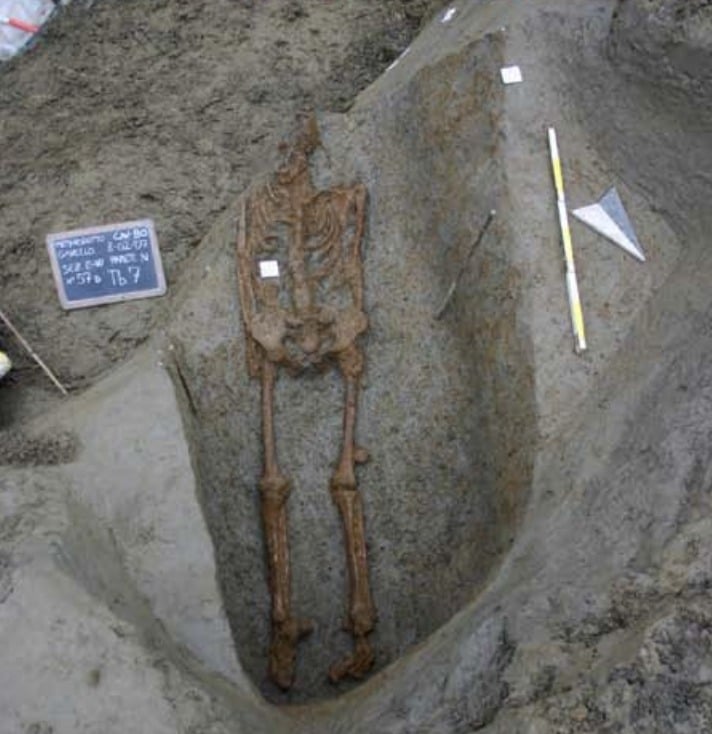
.svg?width=1000)

%20(FindID%20138931).jpg?width=600)

%20-%20calcaneus%20(facies%20articularis%20talaris).jpg?width=600)
%20(FindID%20138925).jpg?width=600)
%20(FindID%20138920).jpg?width=600)



.jpg?width=500)


.jpg?width=600)


.jpg?width=1000)

.png?width=600)


.jpg?width=1000)
.jpg?width=500)
,%20title%20page,%20detail.jpg?width=500)





.jpg?width=220)
.jpg?width=130)
