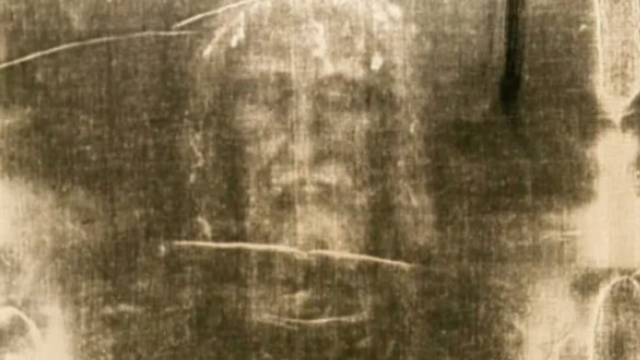
Timeline — Major Events in the History and Study of the Shroud of Turin
Shroud of Turin — Timeline (concise)
A chronological infographic showing key custody milestones, scientific studies, and major discoveries from traditional origin claims to present-day research. Bible passages quoted verbatim where relevant.
Custody / Historical
Scientific / Technical
Controversial / Debate
ca. 1st c.
Traditional claim: burial of Jesus
Believers connect the linen with Gospel accounts of Jesus’ burial. Matthew records: “As evening approached, there came a rich man from Arimathea, named Joseph… Joseph took the body, wrapped it in a clean linen cloth, and placed it in his own new tomb…” (Matthew 27:57–61).6th–9th c.
Early iconography & texts (disputed)
Scholars point to a few early images and texts—such as traditions of the Image of Edessa—as possible antecedents. Direct continuity to the Turin cloth is debated and not established.944 AD
Image of Edessa in Constantinople
Accounts place a revered image (the Mandylion or Image of Edessa) in Constantinople. Some researchers propose a link between this tradition and later Shroud narratives, but documentary gaps leave this speculative.1354–1357
First well-documented European exhibition (Lirey)
Geoffrey de Charny publicly displayed a large linen cloth in Lirey, France—the earliest securely recorded appearance of an image-bearing shroud in Western Europe. Church records from this period mark the start of an authenticated documentary trail.Late 1300s–1500s
Savoy custody; fire damage & repairs (1532)
The House of Savoy became custodians. A 1532 chapel fire produced molten-reliquary damage; visible burn holes were later patched and a backing (Holland cloth) attached—important for later conservation and sampling debates.1578
Transfer to Turin
The relic was moved to Turin, where it would remain the primary public home and focal point for subsequent exhibitions and scientific access.1898
Secondo Pia photograph (negative effect)
Scientific turning point: Amateur photographer Secondo Pia’s glass-plate negatives revealed a clear positive image when inverted—an observation that transformed public and scientific attention and launched modern study.1931–1970s
Photographic studies & growing interest
Professional photographers and scholars produced higher-quality images and catalogs; the cloth became a subject of interdisciplinary curiosity—textile scholars, artists, historians and devotional pilgrims alike studied it.1973–1978
STURP — multidisciplinary examination (1978)
The Shroud of Turin Research Project (STURP) performed comprehensive non-destructive tests—photography, spectroscopy and microscopy—and reported that no conventional pigments fully explain the image; they noted surface-level fiber discoloration and three-dimensional information encoded in image shading.1978
Max Frei palynology sampling
Swiss criminologist Max Frei lifted dust and pollen from fibers. Subsequent analyses (e.g., Avinoam Danin, Uri Baruch) identified pollen and floral markers some researchers say correspond to eastern Mediterranean species blooming in spring—consistent with plants native to areas around Jerusalem.1988
Radiocarbon dating — medieval result
Three labs (Oxford, Zurich, Tucson) dated a sample to about 1260–1390 AD. The result strongly suggested a medieval origin. Critics later raised concerns about contamination, sample selection and whether the sampled area included later repairs.1990s–2000s
Renewed digital and analytical work
High-resolution imaging, spectral analysis, and renewed botanical/palynological study continued. Debates about contamination, image-formation hypotheses, and interpretation of forensic markers remained active.2010s–2020s
Non-destructive imaging & public exhibitions
Multispectral photography and digital projects increased public access to detailed imagery. Controlled public exhibitions continued; conservation practices and digital archiving improved scholarly access without invasive sampling.Present day
Ongoing research & enduring debate
The Shroud remains under ecclesiastical custody in Turin, studied through non-invasive methods. Lines of evidence—textile analysis, pollen studies, forensic interpretation and image-formation models—continue to be discussed; no single consensus has replaced the major contested results such as the 1988 radiocarbon dating.Quick notes: Documented custody begins reliably in the 14th century (Lirey). STURP (1978) and the 1988 radiocarbon tests are the most frequently cited scientific milestones. Palynology and botanical claims (Frei, Danin) are influential but contested due to sampling and interpretation concerns.
- ca. 1st century (traditional claim)
- Claimed origin by some believers: the burial linen used for Jesus of Nazareth after his crucifixion. This is the starting point of the Shroud’s traditional narrative, based on Gospel accounts and later devotional interpretation.
- 6th–9th centuries (early textual/iconic hints — contested)
- A handful of early Christian texts and icons have been proposed by some scholars as indirect references to a holy burial cloth or an image-bearing cloth (examples cited in debates include the Image of Edessa/mandylion traditions). These links are disputed and not universally accepted as direct evidence for the Turin Shroud.
- 944 AD — Reported arrival in Constantinople
- Some historical accounts assert that a cloth known as the “Image of Edessa” (a face-imprint relic) arrived at Constantinople in this period. Proponents sometimes connect the Image of Edessa tradition to later histories of the Shroud; critics note gaps and ambiguities in the chain of custody.
- 1204–1206 — Alleged transfer to the West (controversial)
- During or after the Fourth Crusade (1204), various relics and cloths moved from Constantinople into Western Europe. Some theories propose that an imprinting cloth left Constantinople at this time, though direct documentary evidence linking such transfers to the Turin Shroud is debated.
- 1354–1357 — First securely documented public exhibition in Lirey, France
- The earliest well-documented appearance in Western Europe is at Lirey, a small French town, where a French knight, Geoffrey de Charny, displayed a large linen cloth bearing an image. Surviving church records and legal documents from the mid-14th century confirm the Shroud’s exhibition in Lirey and later custodianship by the de Charny family and, after marriage and inheritance, the House of Savoy.
- Late 1300s–1453 — Savoy custody and exhibitions
- The Shroud passed through the care of the Savoy family, who displayed it periodically. Records show it was kept as a prized relic and exhibited to devotional crowds.
- 1506 — Transfer to Turin (House of Savoy)
- The Shroud was moved to the Savoyard chapel in Chambéry (then Savoy territory). In 1532, a fire in the chapel damaged the reliquary, and molten silver burned holes in the cloth; subsequent restorations stitched patches and created a backing cloth (known as the Holland cloth) that remains associated with conservation history debates.
- 1578 — Move to Turin, Italy
- The Shroud was transferred to Turin, where the House of Savoy established it in their cathedral. Turin becomes the primary long-term home of the cloth and the focal point of later scientific access and public exhibitions.
- 1898 — Secondo Pia photographs the Shroud
- Amateur photographer Secondo Pia took the first photographs of the Shroud during a public exposition. When he developed the glass-plate negatives, he discovered that the faint markings on the cloth produced a detailed positive image in negative form—an observation that sparked modern scientific interest and debate.
- 1931 — Giuseppe Enrie photography and exhibitions
- Professional photographic studies continued; Giuseppe Enrie photographed the Shroud in high detail, providing images further used by investigators.
- 1933–1973 — Periodic conservation and growing scholarly interest
- The Shroud was periodically displayed and preserved under ecclesiastical custodianship; scholarly, artistic, and devotional attention increased, with more scientific questions raised as technology advanced.
- 1973–1978 — Increasing scientific access; formation of STURP
- Interest in hands-on scientific testing grew. In 1978, the Shroud of Turin Research Project (STURP), an international team of scientists (chemists, physicists, microscopists, and forensic specialists), received permission to perform a comprehensive, non-destructive examination. STURP documented many properties of the image (e.g., surface-level discoloration of fibers, absence of conventional pigments) and produced influential technical reports.
- 1978 — Max Frei palynology sampling
- Swiss criminologist Dr. Max Frei took adhesive tape samples of particulates (dust and pollen) from the Shroud. Subsequent palynological analyses identified pollen types and plant particles some researchers argued were consistent with flora from the eastern Mediterranean, including regions near Jerusalem. Frei’s methods, findings, and chain-of-custody have been subjects of debate.
- 1981–1982 — Conservation and restoration work after 1978 exhibition
- Following the 1978 scientific examination and an exhibition, conservation and careful cleaning/restoration steps were implemented, including documentation of repairs and the condition of the cloth.
- 1988 — Radiocarbon dating
- Three independent laboratories (Oxford, Zurich, and Tucson) performed radiocarbon dating on a small sample taken from the Shroud’s edge. The laboratories reported calibrated dates placing the linen’s manufacture in the medieval period (approx. 1260–1390). This result strongly suggested a medieval origin; however, the sampling protocol, potential contamination, and whether the sample derived from a later repair rather than the original cloth have been contested by some researchers.
- 1997 — Re-examination of radiocarbon protocols and criticism
- Several scientists and textile specialists published critiques arguing the 1988 sample might have been taken from a re-woven or patched area, or contaminated by centuries of handling, smoke and microbiological growth. Alternative statistical treatments and hypotheses were presented; the debate remains active though the 1988 result is widely cited.
- 2000s — Continued multi-disciplinary research and digital analysis
- Digital imaging, spectral analysis, and alternative non-destructive methods were applied by various research groups. Scholars revisited STURP data, conservation records, and historical archives. Botanists and palynologists continued to publish work interpreting pollen and floral imagery; questions of sampling contamination and interpretive certainty continued to animate scholarship.
- 2002 — Turin Cathedral conservation and public pilgrimage
- The Shroud was displayed for public veneration in 2000 and later; the Vatican and Turin custodians facilitated public pilgrimages and kept the Shroud under controlled conservation conditions.
- 2009 — Textile and image research publications
- Ongoing peer-reviewed work and books addressed the textile weave, image formation hypotheses (ranging from chemical oxidation, dehydration of fibers, scorch theories, to hypotheses involving radiation or other non-standard mechanisms), and critical reassessments of earlier findings. No single image-formation mechanism universally accepted by the scientific community had emerged.
- 2010s — High-resolution digital projects and public access
- High-resolution photography and multispectral imaging projects made detailed images widely available for scholarship and public viewing, helping forensic analysts, textile experts, and independent researchers to examine micro-features without intrusive sampling.
- 2013 — Public exhibitions continue; custodial and conservation improvements
- The Shroud periodically returned to public exhibition, accompanied by conservation measures and scholarly panels.
- 2020s — Ongoing debate; incremental scientific advances
- New imaging tools, non-destructive chemical analysis, and improved statistical approaches have led to renewed papers and critiques. The Shroud remains a subject of active research, interdisciplinary debate, and considerable public interest. While some lines of evidence (pollen studies, textile analysis, forensic wound interpretation) have been advanced by proponents, questions remain about provenance, sample integrity, and the interpretation of image formation.
- Present day
- The Shroud is kept in Turin under controlled conditions in the Cathedral of Saint John the Baptist (or historic custody arrangements in coordination with ecclesiastical authorities). Research continues through non-invasive methods; the debate over authenticity persists in academic, scientific and faith communities. Public viewings are rare and tightly managed; digital archives and published studies remain the primary means by which researchers and the public study the cloth.
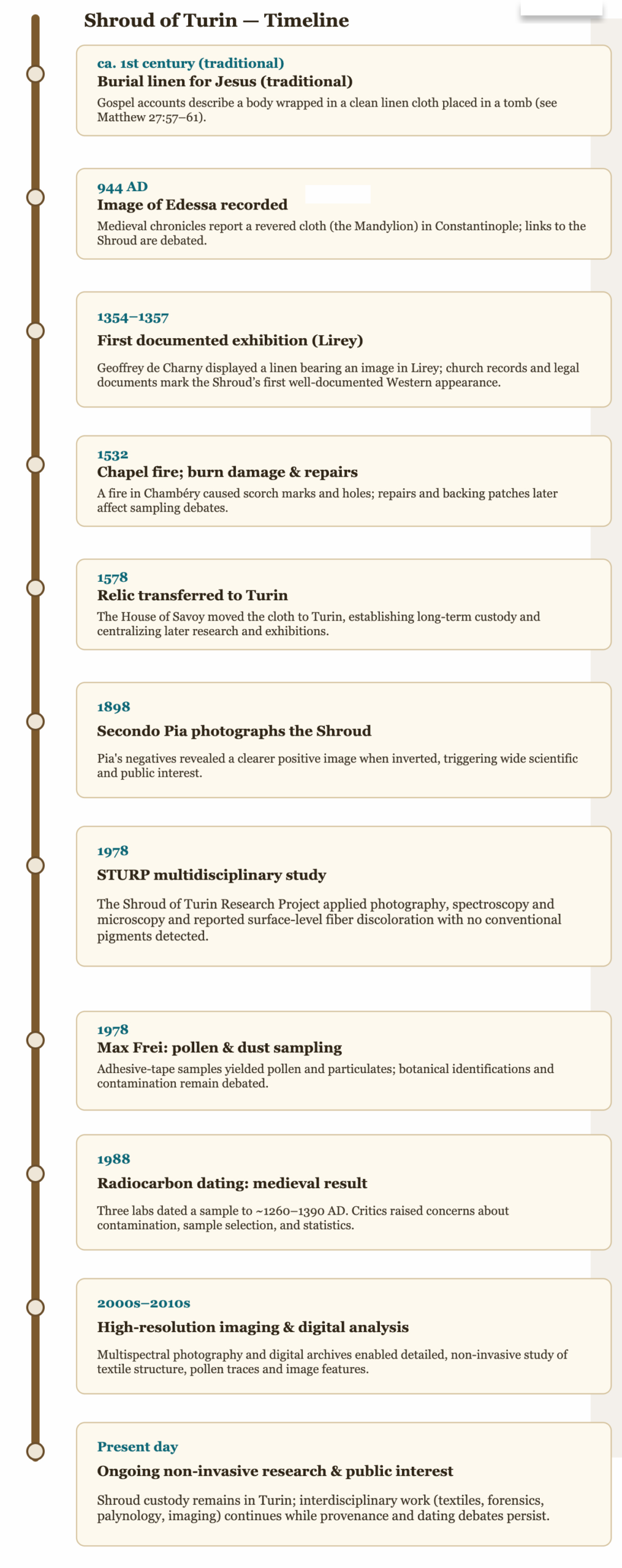 Notes on the timeline and interpretation:
- Documentary continuity before the 14th century is disputed. The mid-14th-century Lirey exhibition is the first securely documented European appearance.
- The 1988 radiocarbon dating is the single most influential laboratory result pointing to a medieval date, but it remains contested by a vocal minority on methodological and contamination grounds.
- Many of the technical studies (STURP, Frei’s palynology, botanical analyses) have been influential but are debated in terms of sampling rigor and interpretive certainty.
- The Shroud’s history blends verifiable archival records (post-1350) with contested earlier traditions (Image of Edessa, Byzantine references). Any reconstruction of the Shroud’s “lifetime” must therefore separate firmly documented custody from hypothesis and devotional tradition.
- Produce a visual timeline (SVG/diagram) summarizing these points.
- Expand any single entry into a fuller narrative with sources and citations.
- Provide a concise “forensic timeline” focusing only on scientific studies and findings.