

The Gospels & the Passion of Jesus
Matthew, Mark, Luke, and John each report Jesus’s arrest at Gethsemane, his trials before Jewish and Roman authorities, his crucifixion under Pontius Pilate, and his burial by Joseph of Arimathea — overlapping yet independent details historians examine for reliability.
This anchor page surveys the four canonical Gospels’ testimony to the closing events of Jesus’s earthly life, organized into five narrative subcategories — Arrest, Trials, Crucifixion, The Burial, and Fulfilled Prophecies — plus a sixth analytical subcategory, Independent Gospel Traditions, examining each Gospel’s unique contribution to the Passion record. The sustained agreement across four independent literary streams — despite differing vocabulary, theology, and audiences — is the strongest internal evidence the Gospels preserve historical events rather than a coordinated invention. The story continues beyond burial in The Resurrection.
Arrest in the Gospels
Judas’s betrayal, the agony in Gethsemane, the kiss that identified Jesus, the Sanhedrin temple-guards seizure, and the disciples’ flight — recorded across Matthew 26, Mark 14, Luke 22, and John 18.
Trials in the Gospels
The Jewish hearing before Caiaphas and the Sanhedrin, Peter’s threefold denial, Pilate’s Roman examination, and Herod Antipas’ sardonic interrogation (Luke alone) — investigated across all four Gospels.
Crucifixion in the Gospels
The crown of thorns, Simon of Cyrene pressed to carry the cross, the multi-language titulus reading “King of the Jews,” the cry of dereliction, the soldiers’ garment-lot — preserved with striking incidental consistency.
The Burial in the Gospels
Joseph of Arimathea, a Sanhedrin member, requests the body from Pilate; the body is laid in a new rock-hewn tomb; the stone is rolled; the Galilean women witness the place — all four Gospels preserve this sequence.
Fulfilled Prophecies
The Evangelists repeatedly flag Passion events as fulfilling Old Testament prophecy: 30 pieces of silver, pierced hands and feet, no broken bone, garments divided, burial with the rich — a key apologetic thread through the narrative.
Independent Gospel Traditions (new)
Each Evangelist contributes material the others omit: John’s Annas hearing; Luke’s “Daughters of Jerusalem”; Mark’s Petrine eyewitness substrate (via Papias); Matthew’s guard-at-the-tomb pericope. Independent parallel detail is the recognized sub-test of authenticity.
Arrest in the Gospels
Judas Iscariot — The Betrayal Foretold at the Last Supper
The Agony in Gethsemane — Jesus’ Prayer of Submission
Luke 22:41–44, KJV — Gethsemane, c. AD 30“And he was withdrawn from them about a stone’s cast, and kneeled down, and prayed, Saying, Father, if thou be willing, remove this cup from me: nevertheless not my will, but thine, be done. And there appeared an angel unto him from heaven, strengthening him. And being in an agony he prayed more earnestly: and his sweat was as it were great drops of blood falling down to the ground.”The Gethsemane agony is recorded in Matthew, Mark, and Luke — the Synoptics — but absent from John. Luke uniquely preserves the “sweat like great drops of blood” detail, recognized by scholars as an early, independent Petrine or eyewitness tradition. The scene meets the criterion of embarrassment: a Messiah pleading to escape crucifixion is exactly what an early church embarrassed by the cross would have omitted, not invented. Citation: Luke the Evangelist, Luke 22:41–44, KJV.File Under: Jesus Christ > Arrest & Crucifixion > The Gospels > Arrest | Cross-References: The Crucifixion | Multiple Attestation
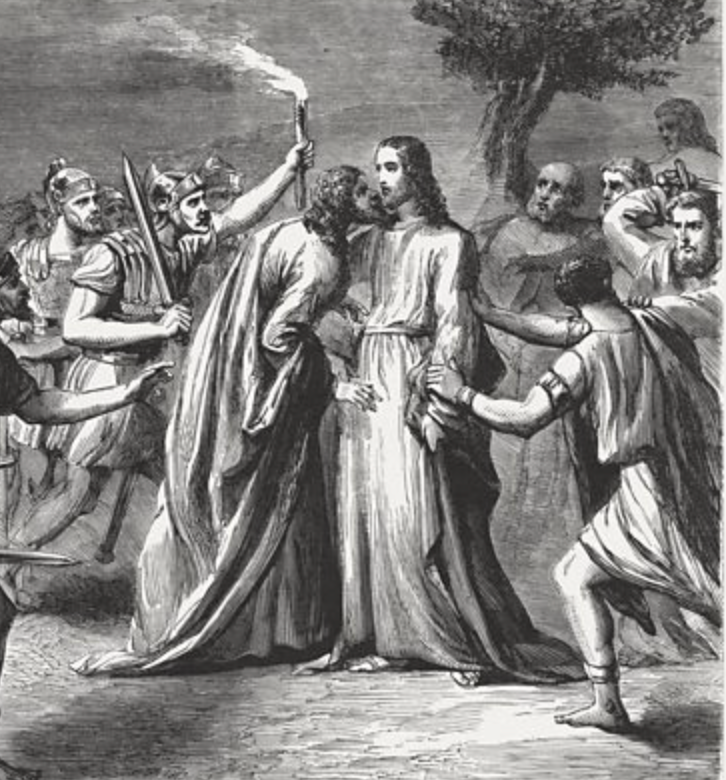
The Kiss of Betrayal — Judas’s Prearranged Signal
Mark 14:43–46, KJV — Garden of Gethsemane“And while he yet spake, lo, Judas, one of the twelve, came, and with him a great multitude with swords and staves, from the chief priests and elders of the people. Now he that betrayed him gave them a sign, saying, Whomsoever I shall kiss, that same is he: hold him fast. And forthwith he came to Jesus, and said, Hail, master; and kissed him.”The kiss of betrayal appears in Matthew 26:48–49, Mark 14:44–45, and Luke 22:47–48 — three independent streams independently naming the same physical signal. A kiss, normally a sign of honor, becomes the instrument of betrayal — a detail no hagiographer invents. The Greek verb for “kissed” in Mark is kataphileō, an intensified form meaning “kissed repeatedly or fervently,” suggesting Judas deliberately overplayed the gesture to convince the officers. Citation: Mark the Evangelist, Mark 14:43–46, KJV.File Under: Jesus Christ > Arrest & Crucifixion > The Gospels > Arrest | Cross-References: The 12 Apostles | The Crucifixion
The Disciples Flee — Mark’s Embarrassing Note
Mark 14:50, KJV — Garden of Gethsemane“And they all forsook him, and fled.”Mark’s stark one-line admission that all Twelve abandoned Jesus is preserved verbatim across Mark 14:50, expanded in Matthew 26:56, and echoed obliquely in John 16:32. A movement glorifying its founders would never have invented their collective cowardice. Mark adds the famously awkward detail of an unnamed young man fleeing naked (Mark 14:51–52) — a parenthetical so obscure scholars suspect it is Mark himself, bearing silent witness. The flight of the apostles is a textbook case of the criterion of embarrassment confirming authentic historical memory. Citation: Mark the Evangelist, Mark 14:50, KJV.File Under: Jesus Christ > Arrest & Crucifixion > The Gospels > Arrest | Cross-References: The 12 Apostles | The Crucifixion
Trials in the Gospels
The Jewish Hearing before Caiaphas and the Sanhedrin
Matthew 26:59–66, KJV — High Priest’s palace, c. AD 30“Now the chief priests, and elders, and all the council, sought false witness against Jesus, to put him to death… Jesus saith unto him, Thou hast said: nevertheless I say unto you, Hereafter shall ye see the Son of man sitting on the right hand of power, and coming in the clouds of heaven.”Matthew, Mark, and Luke all record the nighttime Jewish hearing before Caiaphas the High Priest and the Sanhedrin, focused on Jesus’ messianic and divine claim (the “Son of Man” reference to Daniel 7:13). This self-claim was the legal basis for the Jewish blasphemy charge; it is recorded by hostile sources (the Gospels judging Jesus innocent) and so meets the criterion of enemy attestation. The historicity of the formal Sanhedrin trial remains debated among scholars, but the leadership interrogation is firmly anchored in the synoptic tradition. Citation: Matthew the Apostle, Matthew 26:59–66, KJV.File Under: Jesus Christ > Arrest & Crucifixion > The Gospels > Trials | Cross-References: The Crucifixion | Multiple Attestation
Peter’s Threefold Denial — Foretold and Fulfilled
The Trial before Pontius Pilate — Jesus Even Tones
John 18:33–37, KJV — Praetorium, c. AD 30“Pilate therefore said unto him, Art thou a king then? Jesus answered, Thou sayest that I am a king. To this end was I born, and for this cause came I into the world, that I should bear witness unto the truth. Every one that is of the truth heareth my voice.”All four Gospels name Pontius Pilate as the Roman prefect who examined Jesus and authorized the crucifixion (Matthew 27, Mark 15, Luke 23, John 18–19). The exchange with Jesus over the question of kingship is multiply attested across two of the fours streams (Mark’s tradition and John’s independent account) and independently anchored by the Roman historian Tacitus (Annals 15.44) who records that “Christus suffered the extreme penalty during the reign of Tiberius at the hands of… Pontius Pilate.” Pilate’s role is one of the most firmly anchored facts in the Passion narrative. Citation: John the Apostle, John 18:33–37, KJV.File Under: Jesus Christ > Arrest & Crucifixion > The Gospels > Trials | Cross-References: The Crucifixion | Multiple Attestation
Herod Antipas’ Mockery — A Detail Unique to Luke
Luke 23:6–11, KJV — Herod’s palace, Jerusalem“When Pilate heard of Galilee, he asked whether the man were a Galilaean. And as soon as he knew that he belonged unto Herod’s jurisdiction, he sent him to Herod, who himself also was at Jerusalem at those days. And Herod with his men of war set him at nought, and mocked him, and arrayed him in a gorgeous robe, and sent him again to Pilate.”Luke the Evangelist alone records the episode of Herod Antipas, tetrarch of Galilee, briefly entertaining Jesus in Jerusalem and ridiculing him before sending him back to Pilate. The incidental detail that Pilate transferred a Galilean prisoner to Herod’s jurisdiction matches what historians know about Roman provincial administration, an undesigned coincidence supporting the account’s reliability (cf. HerodAntipas‘s historical attestation in Josephus, Antiquities 18). That Luke alone preserves it suggests an independent Galilean-source strand rather than Gospel copying. Citation: Luke the Evangelist, Luke 23:6–11, KJV.File Under: Jesus Christ > Arrest & Crucifixion > The Gospels > Trials | Cross-References: The Crucifixion | Undesigned Coincidences
Crucifixion in the Gospels
The Crown of Thorns — Mockery of the Kingship Claim
Simon of Cyrene — A Witness Pressed into Service
Mark 15:21, KJV — Road to Golgotha“And they compel one Simon a Cyrenian, who passed by, coming out of the country, the father of Alexander and Rufus, to bear his cross.”Mark, Matthew 27:32, and Luke 23:26 independently record that Roman soldiers conscripted Simon of Cyrene to carry the crossbar when Jesus could no longer bear it. Mark’s puzzling parenthetical — that Simon was “the father of Alexander and Rufus” — names individuals his Roman audience presumably knew (cf. Paul the Apostle‘s greeting to “Rufus” in Romans 16:13), an undesigned coincidence that ties the Gospel record into the wider early-church network. Roman soldiers had legal authority to compel civilian labor for state purposes (cf. Matthew 5:41, “go with him twain”), confirming the historical plausibility of the conscription. Citation: Mark the Evangelist, Mark 15:21, KJV.File Under: Jesus Christ > Arrest & Crucifixion > The Gospels > Crucifixion | Cross-References: The Crucifixion | Undesigned Coincidences
The Titulus — “Jesus of Nazareth, King of the Jews”
John 19:19–20, KJV — Golgotha, c. AD 30“And Pilate wrote a title, and put it on the cross. And the writing was, JESUS OF NAZARETH THE KING OF THE JEWS. This title then read many of the Jews: for the place where Jesus was crucified was nigh to the city: and it was written in Hebrew, and Greek, and Latin.”All four Gospels attest the titulus, the placard announcing the legal charge (Matthew 27:37; Mark 15:26; Luke 23:38; John 19:19) — standard Roman practice at executions. John alone specifies the trilingual posting in Hebrew (Aramaic), Greek, and Latin, the three administrative languages of first-century Palestine. The chief priests’ protest begging Pilate to reword it (“Say, that he said, I am King of the Jews,” John 19:21) and Pilate’s acidic refusal (“What I have written I have written”) is exactly the kind of incidental high-handed detail Roman prefects were known for, and one the early church would not have invented. Citation: John the Apostle, John 19:19–20, KJV.File Under: Jesus Christ > Arrest & Crucifixion > The Gospels > Crucifixion | Cross-References: The Crucifixion | Undesigned Coincidences
The Cry of Dereliction — “My God, My God, Why Hast Thou Forsaken Me?”
Matthew 27:46, KJV — Golgotha, ninth hour“And about the ninth hour Jesus cried with a loud voice, saying, Eli, Eli, lama sabachthani? that is to say, My God, my God, why hast thou forsaken me?”Matthew and Mark preserve Jesus’ Aramaic cry of dereliction, transliterated then translated into Greek — a Semitic substratum pointing to a very early oral tradition. The cry is a quotation of David the Psalmist‘s Psalm 22:1, opening a frame that scholars observe encompasses the whole crucifixion sequence (the piercing, the mocking crowd, the divided garments, the gall/vinegar — all features of that psalm). The Evangelists’ retention of the Aramaic original (rather than smoothing it into Greek) preserves the very sound a dying Galilean rabbi invoked at the hour of death. Citation: Matthew the Apostle, Matthew 27:46, KJV.File Under: Jesus Christ > Arrest & Crucifixion > The Gospels > Crucifixion | Cross-References: Fulfilled Prophecies | Aramaic Traces
THE THALLUS REFERENCE: THE DARKNESS AT THE CRUCIFIXION
Dr. Paul Maier, professor of ancient history at Western Michigan University“The historian Thallus, writing around AD 52, referred to a darkness that fell over the land — which Julius Africanus later identified as occurring at the time of the crucifixion of Jesus. This is the earliest non-Christian reference to the crucifixion, written within two decades of the event, and it confirms that the darkness described in the Gospels was a real, historically noted phenomenon.”Note: The Thallus fragment represents the earliest known secular reference to events surrounding the crucifixion, predating even some of the New Testament letters. Evidence: Fragmentary citation of Thallus preserved in Julius Africanus and Eusebius, dated to approximately AD 52. [Ontology: Jesus > Literary & Textual Fragments]
The Soldiers Cast Lots for the Garments
John 19:23–24, KJV — Golgotha“Then the soldiers, when they had crucified Jesus, took his garments, and made four parts, to every soldier a part; and also his coat: now the coat was without seam, woven from the top throughout. They said therefore among themselves, Let us not rend it, but cast lots for it, whose it shall be: that the scripture might be fulfilled, which saith, They parted my raiment among them, and for my vesture they did cast lots.”All four Gospels independently record the soldiers dividing Jesus’ garments and casting lots for the seamless tunic (Matthew 27:35; Mark 15:24; Luke 23:34; John 19:23–24). John alone notes the tunic was “without seam, woven from the top throughout,” and explicitly flags this as the fulfillment of David the Psalmist‘s Psalm 22:18. The detail matches Roman military custom: the execution squad received the victim’s possessions as a perquisite. John’s detail is an undesigned coincidence showing genuine Roman practice rather than invented theological symbolism. Citation: John the Apostle, John 19:23–24, KJV.File Under: Jesus Christ > Arrest & Crucifixion > The Gospels > Crucifixion | Cross-References: Fulfilled Prophecies | Undesigned Coincidences
The Penitent Thief — A Detail Unique to Luke
Luke 23:39–43, KJV — Golgotha“And one of the malefactors which were hanged railed on him, saying, If thou be Christ, save thyself and us. But the other answering rebuked him, saying, Dost not thou fear God, seeing thou art in the same condemnation?… And he said unto Jesus, Lord, remember me when thou comest into thy kingdom. And Jesus said unto him, Verily I say unto thee, To day shalt thou be with me in paradise.”Luke the Evangelist alone records the exchange with the penitent thief. Matthew 27:44 and Mark 15:32 mention only both criminals mocking Jesus; Luke preserves the later reversal in which one repents and Jesus promises paradise. The tradition shows the criterion of multiple attestations in tension — Luke’s supplementary information does not contradict but enlarges the synoptic core, a recognized hallmark of independent witness. The thief’s language of “kingdom” addresses the same titulus charge (“King of the Jews”) with new radicality. Citation: Luke the Evangelist, Luke 23:39–43, KJV.File Under: Jesus Christ > Arrest & Crucifixion > The Gospels > Crucifixion | Cross-References: The Crucifixion | Multiple Attestation
The Burial in the Gospels
Joseph of Arimathea — A Sanhedrin Member Asks for the Body
John 19:38, KJV — Praetorium, evening of Preparation“And after this Joseph of Arimathea, being a disciple of Jesus, but secretly for fear of the Jews, besought Pilate that he might take away the body of Jesus: and Pilate gave him leave. He came therefore, and took the body of Jesus.”All four Evangelists independently attest that Joseph of Arimathea, a respected Sanhedrin member, requested Jesus’ body from Pilate (Matthew 27:57–58; Mark 15:42–43; Luke 23:50–52; John 19:38). That a member of the very council that condemned Jesus would risk his reputation to provide burial is exactly the kind of awkward detail the early church would not have invented — a criterion of embarrassment footnote. The request to Pilate also matches Roman custom: the body of an executed criminal was normally released to family or interested parties, but only after formal petition. Citation: John the Apostle, John 19:38, KJV.File Under: Jesus Christ > Arrest & Crucifixion > The Gospels > The Burial | Cross-References: The Crucifixion | Criterion of Embarrassment
The New Tomb Cut from Rock — A Rich Man’s Tomb
Matthew 27:59–60, KJV — Garden near Golgotha“And when Joseph had taken the body, he wrapped it in a clean linen cloth, And laid it in his own new tomb, which he had hewn out in the rock: and he rolled a great stone to the door of the sepulchre, and departed.”All four Gospels agree Jesus was buried in a rock-hewn tomb that was new, never used (Matthew 27:60; John 19:41). The detail that Joseph of Arimathea owned the tomb directly fulfills Isaiah the Prophet‘s prophecy that the Suffering Servant would make “his grave with the wicked, and with the rich in his death” (Isaiah 53:9, KJV) — a passage from the eighth-century BC prophet. The archaeological pattern of first-century Jerusalem rock-cut tombs matches the Gospel description exactly, an undesigned coincidence between text and material culture. Citation: Matthew the Apostle, Matthew 27:59–60, KJV.File Under: Jesus Christ > Arrest & Crucifixion > The Gospels > The Burial | Cross-References: Fulfilled Prophecies | The Resurrection
The Great Stone Rolled Across the Door
The Galilean Women Witness the Burial
Luke 23:55–56, KJV — Garden tomb near Golgotha“And the women also, which came with him from Galilee, followed after, and beheld the sepulchre, and how his body was laid. And they returned, and prepared spices and ointments; and rested the sabbath day according to the commandment.”Luke, Matthew 27:61, and Mark 15:47 all name the women — among them Mary Magdalene and “the other Mary” — as eyewitnesses of both the burial and (on Sunday morning) the empty tomb. That female disciples rather than male apostles are the primary witnesses is doubly significant: in Jewish and Roman jurisprudence of the day, female testimony was discounted, yet the Gospels retain the detail, meeting the criterion of embarrassment. The women’s “preparation of spices” is also an undesigned coincidence that explains their Sunday visit. Citation: Luke the Evangelist, Luke 23:55–56, KJV.File Under: Jesus Christ > Arrest & Crucifixion > The Gospels > The Burial | Cross-References: The Resurrection | Criterion of Embarrassment
Fulfilled Prophecies in the Gospels
Thirty Pieces of Silver — The Price of Betrayal Foretold
Matthew 27:9, KJV — citing Zechariah 11:12–13“Then was fulfilled that which was spoken by Jeremy the prophet, saying, And they took the thirty pieces of silver, the price of him that was valued, whom they of the children of Israel did value.”Matthew records that Judas’s betrayal price — thirty pieces of silver — was prefigured by a sixth-century BC prophet (the citation, attributed to “Jeremy” [Jeremiah], appears to combine Zechariah 11:12–13’s numeric detail with Jeremiah 32:6–9’s potter-and-field imagery). The same thirty-shekel figure corresponds exactly to the legal valuation specified in Mosaic law for the price of a slave gored by an ox (Exodus 21:32, KJV) — an undesigned coincidence tying the Gospel’s Passion narrative back into the larger biblical story of the Servant who takes the slave’s wages. Citation: Matthew the Apostle, Matthew 27:9–10, KJV.File Under: Jesus Christ > Arrest & Crucifixion > The Gospels > Fulfilled Prophecies | Cross-References: Fulfilled Prophecies | Old Testament
Pierced Hands and Feet — Psalm 22 and the Crucifixion
Psalm 22:16, KJV — fulfilled in Luke 24:39“For dogs have compassed me: the assembly of the wicked have inclosed me: they pierced my hands and my feet.”A psalm attributed to David the Psalmist (c. 1000 BC) describes the Servant’s hands and feet being pierced, surrounded by mocking onlookers, his garments divided, and gall and vinegar given him to drink — details preserved in the crucifixion narrative across all four Gospels. The crucifixion method (罗马 cross) did not exist in David’s day, making the predictive detail striking. Luke 24:39 records the risen Jesus inviting his disciples to “behold my hands and my feet, that it is I myself,” underscoring the identifiable wound pattern on the воскресшем body. Citation: David the Psalmist, Psalm 22:16, KJV; cf. Luke 24:39, KJV.File Under: Jesus Christ > Arrest & Crucifixion > The Gospels > Fulfilled Prophecies | Cross-References: Fulfilled Prophecies | The Resurrection
No Bone Broken — The Passover Lamb Fulfilled
John 19:33–36, KJV — citing Exodus 12:46“But when they came to Jesus, and saw that he was dead already, they brake not his legs… For these things were done, that the scripture should be fulfilled, A bone of him shall not be broken.”John the Apostle alone records that the Roman soldiers broke the legs of the two thieves (crucifragium, accelerating death for Sabbath eve), but finding Jesus already dead, left his legs intact — explicitly flagging this as fulfillment of the Passover-lamb ordinance in Exodus 12:46 (“nor break any bone of it”). The Apostle Paul elsewhere identifies Jesus as “Christ our passover” (1 Corinthians 5:7, KJV), tying the crucifixion’s typological frame into the earliest creedal layer. John’s incidental detail shows Jesus already dead from the crucifixion itself, supporting the medical-data reading of the heart-piercing flow of “blood and water” that follows (John 19:34). Citation: John the Apostle, John 19:33–36, KJV.File Under: Jesus Christ > Arrest & Crucifixion > The Gospels > Fulfilled Prophecies | Cross-References: Fulfilled Prophecies | The Crucifixion
Buried with the Rich — Isaiah 53:9 Fulfilled in Joseph’s Tomb
Isaiah 53:9, KJV — fulfilled in Matthew 27:57–60“And he made his grave with the wicked, and with the rich in his death; because he had done no violence, neither was any deceit in his mouth.”Isaiah the Prophet (eighth century BC) had written that the Suffering Servant would be assigned a grave “with the wicked” — yet paradoxically also “with the rich in his death.” Matthew 27:57–60 records that Jesus was executed between two thieves (“with the wicked”) yet buried in the new rock-hewn tomb belonging to Joseph of Arimathea, a wealthy Sanhedrin member (“with the rich”). The juxtaposition of execution alongside criminals and burial alongside a rich man unconsciously matches Isaiah’s inspired contrast — a multiple-attestation prophecy fulfillment preserved across the synoptic burial tradition. Citation: Isaiah the Prophet, Isaiah 53:9, KJV; cf. Matthew 27:57–60, KJV.File Under: Jesus Christ > Arrest & Crucifixion > The Gospels > Fulfilled Prophecies | Cross-References: Fulfilled Prophecies | Messianic Prophecies
Independent Gospel Traditions
John’s Passion — Annas’ Hearing Unique to the Fourth Gospel
Mark’s Petrine Substrate — The Eyewitness Footprint per Papias
Mark 14:54, KJV — High Priest’s courtyard“And Peter followed him afar off, even into the palace of the high priest: and he sat with the servants, and warmed himself at the fire.”Early church fathers preserved the testimony of Papias of Hierapolis (c. AD 60–130), Bishop of Hierapolis, that Mark wrote his Gospel “not in order” but as the interpreter of Peter the Apostle, recording accurately (but not in sequence) the events Peter preached. Many scholars see in Mark’s Passion narrative a distinctive Petrine substrate — Peter’s denial story told in vivid first-person-like detail, the unnamed fleeing young man (Mark 14:51), and the fire in the courtyard where Peter warms himself (Mark 14:54) — suggesting the account bears the fingerprint of eyewitness testimony that reaches back into the 30s. Citation: Mark the Evangelist, Mark 14:54, KJV.File Under: Jesus Christ > Arrest & Crucifixion > The Gospels > Independent Traditions | Cross-References: The 12 Apostles | Aramaic Traces
Luke’s Exclusive Witness — The Daughters of Jerusalem
Luke 23:27–31, KJV — Road from Praetorium to Golgotha“And there followed him a great company of people, and of women, which also bewailed and lamented him. But Jesus turning unto them said, Daughters of Jerusalem, weep not for me, but weep for yourselves, and for your children.”Luke the Evangelist alone preserves Jesus’ exchange with the mourning women of Jerusalem on the road to Golgotha — a prophetic address warning of coming judgment on the city (fulfilled in the Roman destruction of Jerusalem in AD 70). The address reflects the mercy of Jesus even on his way to execution and is a distinctively Lukan emphasis on Jesus’ extended care for outsiders and the marginalized. Scholars note that Luke’s gentile-Christian audience wouldn’t have invented Jewish-messianic eschatological addresses of this nature, so the pericope likely preserves an independent Jerusalem-source strand. Citation: Luke the Evangelist, Luke 23:27–31, KJV.File Under: Jesus Christ > Arrest & Crucifixion > The Gospels > Independent Traditions | Cross-References: The Crucifixion | Multiple Attestation
Matthew’s Unique Addendum — The Guard at the Tomb
Matthew 27:62–66, KJV — Day after Preparation“Now the next day, that followed the day of the preparation, the chief priests and Pharisees came together unto Pilate, Saying, Sir, we remember that that deceiver said, while he was yet alive, After three days I will rise again. Command therefore that the sepulchre be made sure until the third day… Pilate said unto them, Ye have a watch: go your way, make it as sure as ye can.”Matthew the Apostle alone records the post-burial dispatch of a Roman-Jewish guard to the tomb in response to the Jewish leadership’s concern about a resurrection ho. The narrative answers (in advance) the “wrong tomb” and “disciples stole the body” counter-explanations argued in modern literature. The incidental detail that the chief priests remembered Jesus’ “after three days” prediction has the form of enemy acknowledgment — a memorable point in the apologetic exchange over the empty tomb. The counter-narrative that developed later (“his disciples came by night, and stole him away,” Matthew 28:13) presupposes an early competing tradition Matthew was answering. Citation: Matthew the Apostle, Matthew 27:62–66, KJV.File Under: Jesus Christ > Arrest & Crucifixion > The Gospels > Independent Traditions | Cross-References: The Resurrection | The Crucifixion