Historians widely agree Jesus’ burial site is The Church of the Holy Sepulchre
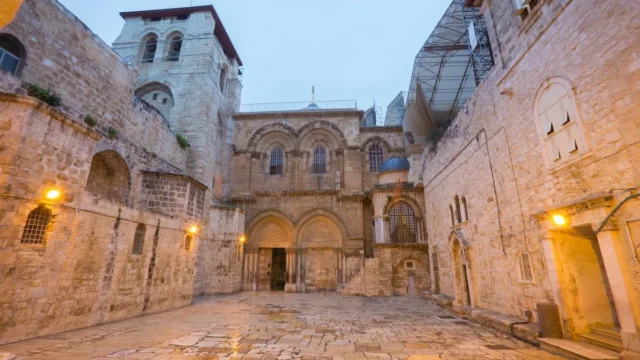
Archaeologists cannot definitively prove that a specific, physical tomb in Jerusalem belonged to Jesus of Nazareth as no direct inscriptions exist to provide absolute verification. However, the Church of the Holy Sepulchre is widely recognized by historians and archaeologists as the most scientifically and historically credible candidate for the location of his burial. [1, 2, 3, 4, 5]
Two main locations in Jerusalem are visited today by millions of pilgrims and tourists seeking the historical site of the tomb: [6, 7, 8, 9, 10]
## 1. [The Church of the Holy Sepulchre](https://www.google.com/search?kgmid=/m/025yg) (The Traditional Site) [11]
This site has an unbroken tradition dating back to the 4th century CE. [8]
* The Location: While it sits inside Jerusalem’s modern city walls, archaeology confirms that during the 1st century, this exact area was an abandoned quarry located outside the city gates, matching biblical accounts. [10, 11]
* The Artifacts: National Geographic researchers analyzing the site revealed that the original limestone burial shelf is encased within a monument called the Edicule. Tests on the mortar dated the structure back to Roman Emperor Constantine’s era (around 326 CE), proving the site’s long-standing historical preservation. [6, 12, 13, 14]
* The Cave: Inside the church, 1st-century Jewish rock-cut tombs still exist right next to the central shrine, proving the area was explicitly used as a graveyard during Jesus’ time. [6, 11]
## 2. [The Garden Tomb](https://www.google.com/search?kgmid=/m/0clp3l) (The Alternative Site)
Discovered in 1867, this alternative spot gained popularity among Protestant Christians in the late 19th century. [8, 15]
* The Appeal: It features a rock-hewn tomb set in a peaceful garden near a rocky hill resembling a skull.
* The Archeology: Most modern archaeologists reject this location because architectural analysis shows the tomb was carved during the Iron Age (8th–7th centuries BCE), meaning it was not a “new tomb” during the 1st century CE as the Gospels describe. [6, 7, 8, 15, 16]
[1] [https://www.reddit.com](https://www.reddit.com/r/DebateAnAtheist/comments/15qh6ig/what_about_jesus_body_and_his_tomb/)
[2] [https://en.wikipedia.org](https://en.wikipedia.org/wiki/Tomb_of_Jesus)
[3] [https://www.waynestiles.com](https://www.waynestiles.com/blog/israel-tour-day-9-the-real-tomb-and-the-garden-tomb/)
[4] [https://en.wikipedia.org](https://en.wikipedia.org/wiki/Talpiot_Tomb)
[5] [https://www.reddit.com](https://www.reddit.com/r/Christianity/comments/1j89m5d/a_possible_location_for_golgotha_where_jesus_was/)
[6] [https://www.youtube.com](https://www.youtube.com/watch?v=_1vEj4F-rm8&vl=en)
[7] [https://www.youtube.com](https://www.youtube.com/shorts/coPOQYnaw88)
[8] [https://www.nelson.edu](https://www.nelson.edu/thoughthub/archaeology/have-archaeologists-found-the-tomb-of-jesus/)
[9] [https://crossroadsbible.net](https://crossroadsbible.net/2019/04/17/where-was-jesus-tomb/)
[10] [https://www.youtube.com](https://www.youtube.com/watch?v=rdmt8Wtfsvo&t=63)
[11] [https://stpaulcenter.com](https://stpaulcenter.com/posts/where-is-jesus-empty-tomb)
[12] [https://www.facebook.com](https://www.facebook.com/NatGeoTV/videos/where-was-jesus-buried-national-geographic/1196233005630277/)
[13] [https://www.smithsonianmag.com](https://www.smithsonianmag.com/smart-news/mortar-found-jesus-tomb-dates-constantine-era-180967345/)
[14] [https://www.facebook.com](https://www.facebook.com/kimbellart/posts/for-centuries-scholars-have-searched-for-evidence-pinpointing-the-exact-location/1355763686582228/)
[15] [https://biblearchaeologyreport.com](https://biblearchaeologyreport.com/2019/04/20/three-tombs-of-jesus-which-is-the-real-one/)
[16] [https://www.youtube.com](https://www.youtube.com/watch?v=JX0Dcy3nlzg&t=785)
tourist israel
The Church of the Holy Sepulchre is one of the most holy and special sites in Christianity. Located in the Christian Quarter of the Old City of Jerusalem, the church is home to two of the holiest sites in Christianity – the site where Jesus was crucified, known as Calvary, and the tomb where Jesus was buried and then resurrected. Today, the tomb is enclosed by a shrine called the Aedicula. The final four Stations of the Cross, or Via Dolorosa, are also located inside the church.