Now even science is proving the necessity for a Supreme God
Historical & Archaeological Evidence
Historical & Physical Evidence
Major scholars & sources cited across this page: John McRay, Archaeology and the New Testament (Baker, 1991); James H. Charlesworth, ed., Jesus and Archaeology (Eerdmans, 2006); Craig S. Keener, The Historical Jesus of the Gospels (Eerdmans, 2009); Richard Bauckham, Jesus and the Eyewitnesses (Eerdmans, 2006); F. F. Bruce, The New Testament Documents (IVP, 1960); E. P. Sanders, The Historical Figure of Jesus (Penguin, 1993); John P. Meier, A Marginal Jew, vols. 1–3 (Doubleday, 1991–2001); Geza Vermes, The Religion of Jesus the Jew (SCM, 1993); Shimon Gibson, The Final Days of Jesus (HarperOne, 2009); Urban C. von Wahlde, “The Pool of Bethesda,” NEAEHL; Joachim Jeremias, Jerusalem in the Time of Jesus (Fortress, 1969); Flavius Josephus, Antiquities 18.63–64 & 20.200; Tacitus, Annals 15.44; Pliny the Younger, Letters 10.96; Suetonius, Claudius 25.
Nine Galilee-to-Jerusalem subcats — the stratigraphy of Jesus’ actual life, not just His Passion
This anchor page gathers the cumulative case from two converging directions: the literary — first-century Jewish and Roman writers (Josephus, Tacitus, Suetonius, Pliny, Lucian, the Talmud) — and the physical — the sites Luke and John described that archaeology has since confirmed: Capernaum’s first-century synagogue and Peter’s house, the Pool of Bethesda with its distinctive five porticoes, the Pool of Siloam uncovered in 2004, and a first-century Nazareth dwelling excavated in 2009. Nine subcats focus on the Galilee-to-Jerusalem theatre of Jesus’ public life; the tenth and eleventh cap at four cards each and link to the parent Crucifixion and Resurrection pages; the twelfth is the Cumulative Case.
These subcats cross-pollinate briefly with the future The Bible > Biblical Archaeology parent page — which will own the OT-side finds (Tel Dan, Khirbet Qeiyafa, the Mesha Stele, Lachish). What stays here is the Jesus/NT side: Capernaum, Bethesda, Siloam, Nazareth, the Magdala synagogue stone, Bethsaida, Sepphoris, the Herodian Temple Mount, first-century Jewish burial customs, the Gallio Inscription, the Pilate Stone, and the Caiaphas Ossuary. Subcats 10 and 11 cap at four summary cards each — anchoring in-page before linking to the full parent Crucifixion and Resurrection pages where the deep dives live.
Methodologically, the case rests on multiple attestation, embarrassment, coherence, and public-site testability — each find is a named, observable venue that anyone in the first century could have falsified. The cumulative pattern, not any single find, carries the argument.
Franciscan excavations exposed a first-century basalt house beneath the Byzantine octagonal church and synagogue foundations matching Mark’s Capernaum teaching venue (Mk 1:21; 2:1–12).
For decades critics called John 5:2’s “five porticoes” fiction — until excavations near the Church of St. Anne uncovered two adjacent pools with a central colonnade wall matching the description.
A 2009 excavation beneath the Sisters of Nazareth convent uncovered a first-century dwelling — countering the lingering critical claim that Nazareth didn’t yet exist in Jesus’ day.
The 2009 Magdala synagogue discovery (with its carved “Magdala Stone”), Bethsaida (et-Tell / el-Araj debate), Chorazin, and Sepphoris situate Jesus’ Galilean ministry in a real first-century regional network.
Herod’s expanded Temple Mount, the Royal Stoa, the southern steps where pilgrims entered, and the Western Wall street — the public stage of Jesus’ Passion-week teaching and Temple-cleansing.
Ossuary second-burial (c. 20 BC–AD 70), acrosolia rock-tombs, linen wrappings and separate face-cloths — material parallels to the Jerusalem burial narratives and the Caiaphas Ossuary (1990).
The 1961 Pilate Inscription at Caesarea confirms the prefect’s title, the Gallio Inscription at Delphi dates Acts 18:12, and the post-70 fiscus Judaicus reform anchors Matthew’s Temple-tax to the pre-70 era.
Josephus (Testimonium Flavianum plus the James reference), Tacitus’s Annals 15.44, Suetonius, Pliny the Younger to Trajan, Lucian, and the Talmud’s hostile Yeshu references — each with the authenticity debate.
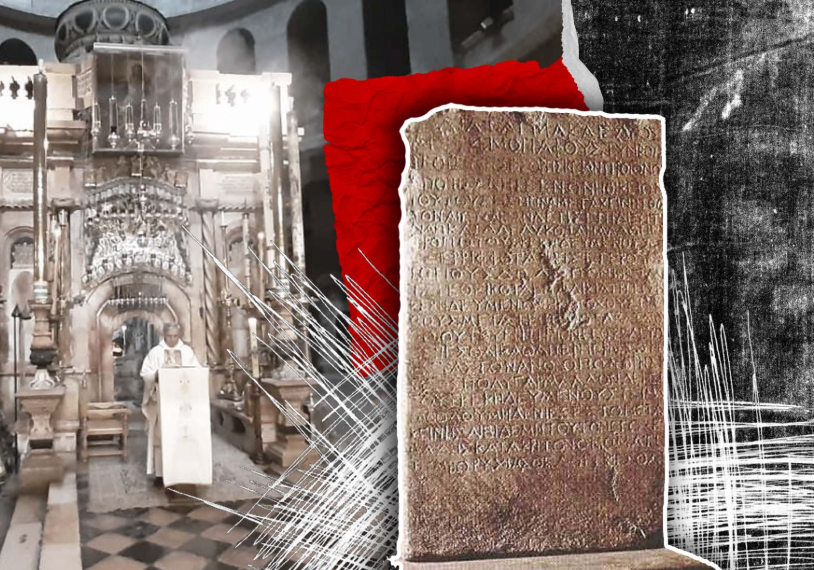
A four-card summary cross-reference: the Pilate Inscription, the Caiaphas Ossuary, the 1968 Yehohanan crucified-heel-bone discovery, and the Holy Sepulchre tomb-site identification.
A four-card summary cross-reference: the Holy Sepulchre Edicule, the Garden Tomb alternative, first-century acrosolia-tomb architecture, and the Roman guard-and-seal custom.
The convergence argument: literary attestation (Josephus, Tacitus, Pliny, the Talmud) plus material confirmation across nine Galilee-to-Jerusalem sites — the cumulative pattern, not any single find, is the argument.
Capernaum Excavations — Peter’s House & Synagogue Foundations
Franciscan excavations at Capernaum (Kfar Nahum) uncovered a first-century basalt house beneath the octagonal Byzantine church — venerated as Peter’s home since at least the mid-second century — and synagogue foundations matching the Gospel’s Capernaum teaching venue. Slides/cards below map the architecture against Mark 2’s roof-lowered paralytic and Mark 1’s synagogue teaching pericope.
Peter’s House — The First-Century Basalt Dwelling
Archaeological evidence — Capernaum, c. 1st c. AD; excavations 1968–present
“And immediately he left the synagogue, and entered into the house of Simon and Andrew, with James and John. But Simon’s wife’s mother lay sick of a fever.” — Mark 1:29–30, KJVVirgilio Corbo and Stanislao Loffreda, the Franciscan archaeologists who led the Capernaum excavations beginning in 1968, uncovered beneath the Byzantine octagonal church a first-century basalt-walled house that had been venerated as Simon Peter’s home by the mid-second century — long before Constantine’s legalization of Christianity. Pre-70 AD protective graffiti using Christian symbology was found on the site’s walls. Once the location became a pilgrimage destination, the domestic space was converted into a public worship venue by the late-second or early-third century, and an octagonal Byzantine martyrium was built around AD 450 directly over the venerated house, beside the white limestone synagogue.
The continuity memory-chain is exceptional: a first-century Galilean house → venerated by believers within 130 years of the events → eventually enclosed by an octagonal martyrium beside the 4th-century limestone synagogue. James H. Charlesworth‘s Jesus and Archaeology (Eerdmans, 2006) treats the Capernaum-Peter’s-house veneration as a strong example of unbroken local-tradition continuity from Jesus’ lifetime into the church era. Richard Bauckham argues the named-house pattern fits his Jesus and the Eyewitnesses (Eerdmans, 2006) thesis: early Christian memory of Jesus’ ministry was anchored to geographically specific, locally remembered sites rather than to invented theological geography. Citation: Virgilio Corbo & Stanislao Loffreda, Capernaum excavation reports (1975–1982); James H. Charlesworth, ed., Jesus and Archaeology, Eerdmans, 2006.
Archaeological evidence — Capernaum synagogue, basalt foundations c. 1st c. AD
“And they went into Capernaum; and straightway on the sabbath day he entered into the synagogue, and taught. And they were astonished at his doctrine.” — Mark 1:21–22, KJVThe visible white limestone synagogue at Capernaum dates to the 4th–5th century AD, but excavations beneath it revealed a basalt foundation dating to the first century AD — the same era when Mark records Jesus teaching there. John McRay in Archaeology and the New Testament (Baker, 1991) treats this basalt lower course as the most likely synagogue floor of Jesus’ day. The site follows the standard Galilean pattern of limestone blocks laid over an earlier basalt predecessor, a construction footprint visible across lower Galilee.
The synagogue sat only a few steps from Peter’s house — exactly as Mark 1:21–29 requires, taking the reader from synagogue to home in a single pericope. Capernaum’s first-century population was probably around 1,000 — a moderate-sized Jewish fishing village on the northwest shore of the Sea of Galilee. James H. Charlesworth notes that the archaeological footprint matches Mark’s narrative choreography: synagogue-teaching, then crossing the street to Peter’s house for the next healing. Citation: John McRay, Archaeology and the New Testament, Baker, 1991.
The Roof-Lowered Paralytic — Mark’s Architectural Detail
Mark 2:1–12, KJV — Capernaum, c. AD 28
“And when they could not come nigh unto him for the press, they uncovered the roof where he was: and when they had broken it up, they let down the bed wherein the sick of the palsy lay.” — Mark 2:4, KJVMark the Evangelist records a vivid architectural detail: friends digging through the Galilean mud-and-thatch roof to lower the paralytic to Jesus. Excavated Capernaum houses confirm the mud-packed reed-and-timber roof construction over basalt walls that Mark’s verb “uncovered” (Greek exoryxantes, “dug out”) presupposes. Luke the Evangelist separately renders the same episode with “tiles” (Lk 5:19), reflecting Luke’s Greco-Roman context rather than direct copying from Mark — a known variation pattern called “undesigned coincidence.”
The architectural fit between Mark’s description and excavated Capernaum houses is a strong argument for authentic local memory rather than Hellenistic literary invention. Craig S. Keener in The Historical Jesus of the Gospels (Eerdmans, 2009) notes that Mark’s “broken-up” roof assumes a soft Galilean construction, while Luke’s “tiles” assumes a Roman-style hard tile roof — two complementary adaptations of a single underlying memory. The variation is exactly what one expects if the recipients come from different regions rather than if one Gospel directly copied the other. Citation: Craig S. Keener, The Historical Jesus of the Gospels, Eerdmans, 2009.
Memory-Chain Continuity — From Jesus to Constantine
Archaeological evidence — Capernaum, c. AD 50–5th century
“And forthwith, when they were come out of the synagogue, they entered into the house of Simon and Andrew, with James and John.” — Mark 1:29, KJVThe Peter’s-house site at Capernaum shows an unusual pattern of continuous Christian veneration across three centuries: (1) mid-1st-century domestic use; (2) late-1st- to early-2nd-century protective plastering over the original walls with Christian-themed graffiti; (3) conversion to a domestic church (domus ecclesiae) in the mid-2nd century; (4) construction of an octagonal Byzantine martyrium around AD 450 directly over the venerated house, beside the white limestone synagogue. The fourth-century pilgrim Egeria visited “the house of the prince of the apostles” at Capernaum, confirming the pre-Byzantine tradition had not yet been displaced by any competing claim.
This unbroken trajectory from Jesus’ lifetime through the early-church era to Constantine is exactly what one would predict if local believers preserved the memory of the specific site. Richard Bauckham in Jesus and the Eyewitnesses (Eerdmans, 2006) treats named-site memory chains like Capernaum’s as key apologetic evidence against the “invented tradition” thesis — the kind of evidence skeptics must explain away rather than ignore. Citation: Richard Bauckham, Jesus and the Eyewitnesses, Eerdmans, 2006; Egeria, Itinerarium Egeriae, c. AD 381–384.
For decades critics called John 5:2’s “five porticoes” a literary fiction — until excavations near the Church of St. Anne in Jerusalem’s Muslim Quarter uncovered two adjacent pools separated by a central wall and surrounded by colonnades, exactly matching the Johannine description. Slides/cards below treat the von Wahlde identification of the southern basin as a Jewish mikveh and the falsification of the “John invented his geography” thesis.
“Five Porticoes” — A Decades-Old Skeptical Prediction Falsified
Archaeological evidence — Jerusalem, 1st c. AD; excavations late 19th–20th c.
“Now there is at Jerusalem by the sheep market a pool, which is called in the Hebrew tongue Bethesda, having five porches.” — John 5:2, KJVFor decades skeptical critics called the Pool of Bethesda‘s “five porticoes” a literary fiction invented by John — the architecture was said to be too unusual to be real. Then late-19th- and 20th-century excavations near the Church of St. Anne in Jerusalem’s Muslim Quarter uncovered two large adjacent pools separated by a central dike wall, with surrounding colonnades. The “five porticoes” architecture is exactly what John described — four porticoes surrounding the outside of the double pool, plus the fifth running across the central dividing wall.
The skeptical thesis (“John invented his Jerusalem geography”) made a falsifiable prediction: the Bethesda site would not exist. Archaeology refuted that prediction. The_pool’s identification was clinched by coins found at the excavation levels dating to the first century AD, before the Roman destruction of Jerusalem in AD 70. By the time John wrote his Gospel, the pool was already a known landmark — and his description is what someone familiar with pre-70 AD Jerusalem would expect. Citation: Urban C. von Wahlde, “The Pool of Bethesda,” in The New Encyclopedia of Archaeological Excavations in the Holy Land; Joachim Jeremias, Jerusalem in the Time of Jesus, Fortress, 1969.
Archaeological evidence — Bethesda southern basin, c. 1st c. AD
“In these lay a great multitude of impotent folk, of blind, halt, withered, waiting for the moving of the water.” — John 5:3, KJVUrban C. von Wahlde‘s analysis identifies the southern basin of Bethesda as a Jewish ritual purification pool (mikveh) — a stepped immersion bath used for ritual purity consistent with John’s framing of sick people waiting for “the moving of the water.” The identification is supported by archaeological parallels with other Jerusalem-area mikva’ot from the Second Temple period, particularly the stepped installations excavated south and west of the Temple Mount.
The mikveh identification matters apologetically: it explains why John’s narrative has a crowd of sick people waiting at the pool — they had come for ritual purification in an era when bodily healing and spiritual purification were closely linked in Jewish piety. James H. Charlesworth in Jesus and Archaeology (Eerdmans, 2006) notes that the Bethesda discovery shows John’s Gospel preserves authentic pre-70 Jerusalem topography that became inaccessible after the destruction. Citation: Urban C. von Wahlde, “The Pool of Bethesda,” NEAEHL; James H. Charlesworth, ed., Jesus and Archaeology, Eerdmans, 2006.
The Paralytic Healed at Bethesda — Archaeological Confirmation
John 5:1–9, KJV — Jerusalem, Pool of Bethesda, c. AD 28
“Jesus saith unto him, Rise, take up thy bed, and walk. And immediately the man was made whole, and took up his bed, and walked: and on the same day was the sabbath.” — John 5:8–9, KJVJohn the Apostle describes the Pool of Bethesda as having “five porches” (5:2) — a detail that for centuries seemedologically impossible until the double-pool-with-central-dike structure was excavated. John’s site-specific narrative includes local Jewish topographical knowledge (“by the sheep market”), the Hebrew name Bethesda, and the architectural oddity of five porticoes rather than the standard four. Together these details demonstrate the Evangelist’s direct acquaintance with pre-70 AD Jerusalem, not late theological invention.
Once Bethesda’s existence was confirmed, the broader skeptical thesis that John‘s Jerusalem geography was fictional collapsed alongside it. Craig S. Keener in The Gospel of John: A Commentary (Hendrickson, 2003) treats the Bethesda discovery as evidence that John’s Jerusalem dimensions reflect authentic pre-destruction memory rather than a later writer’s projection. Citation: Craig S. Keener, The Gospel of John, Hendrickson, 2003.
Bethesda plus Siloam plus Capernaum — John’s Eyewitness Geography
Cumulative argument — Jerusalem + Galilee archaeology, 1st c. AD
“And many other signs truly did Jesus in the presence of his disciples, which are not written in this book: but these are written, that ye might believe that Jesus is the Christ.” — John 20:30–31, KJVA single Gospel — John the Apostle‘s — connects Bethesda, Siloam, Capernaum, Cana, the Sheep Gate, the Temple Mount, and the Pavement (Gabbatha) — and one by one, archaeological discoveries have verified the existence and location of each. Joachim Jeremias in Jerusalem in the Time of Jesus (Fortress, 1969) treats this convergence as one of the strongest cumulative arguments that John’s Gospel preserves eyewitness-era Jerusalem knowledge.
Each discovered site falsifies the late-invention thesis for one more Johannine location. Once a Gospel’s geography is verified at three, four, five independent points, the prior probability that the next named site is also accurate approaches certainty. Bethesda and Siloam alone bring two critical Johannine healing sites into the verified column. James H. Charlesworth concludes that the archaeological footprint of John’s Gospel argues strongly against the late-terminal-date thesis. Citation: Joachim Jeremias, Jerusalem in the Time of Jesus, Fortress, 1969; James H. Charlesworth, ed., Jesus and Archaeology, Eerdmans, 2006.
The Pool of Siloam of John 9:7 — where Jesus sent the man born blind to wash — surfaced in 2004 when workers repairing a sewage pipe in the City of David uncovered an ancient stepped pool. Slides/cards below treat the find, the adjacent Hezekiah’s Tunnel feeding it, and the Siloam Inscription that corroborates the site’s identification.
The 2004 Sewer-Repair Discovery — An Ancient Stepped Pool Surfaces
Archaeological evidence — City of David, Jerusalem; discovered 2004
“And said unto him, Go, wash in the pool of Siloam, (which is by interpretation, Sent.) He went his way therefore, and washed, and came seeing.” — John 9:7, KJVIn 2004, workers repairing a sewage pipe in the City of David uncovered a wide ancient stepped pool that archaeologists soon identified as the Pool of Siloam of John 9:7. Excavations led by Eli Shukron and Ronny Reich exposed a Herodian-era installation with multiple stepped entries designed for ritual immersion — exactly the kind of mikveh-style basin where a blind man would be sent to wash. The find overturned decades of speculation that John had invented the Siloam site.
Prior to 2004 only a smaller Byzantine-era reconstruction of the pool was known, leading some scholars to suggest John was describing a different, later site. The 2004 discovery exposed an earlier first-century pool roughly 50 meters northwest of the Byzantine remains, dating to the Herodian era — the very period of Jesus’ ministry. Shimon Gibson in The Final Days of Jesus (HarperOne, 2009) treats this find as one of the most important Johannine-archaeology discoveries of the past half-century. Citation: Eli Shukron & Ronny Reich, excavation reports (2004–2008); Shimon Gibson, The Final Days of Jesus, HarperOne, 2009.
“And the rest of the acts of Hezekiah, and all his might, and how he made a pool, and a conduit, and brought water into the city, are they not written in the book of the chronicles of the kings of Judah?” — 2 Kings 20:20, KJVThe Siloam pool is fed by Hezekiah’s Tunnel, an underground water channel cut c. 700 BC through 533 meters of solid rock to bring water from the Gihon Spring inside the city walls. The Siloam Inscription — rediscovered in 1880 inside the tunnel — commemorates the moment the two digging teams met in the middle, with a half-cubit overlap attesting to remarkable engineering precision. This same water source supplied the pool where Jesus sent the man born blind.
The continuity from Hezekiah‘s eighth-century-BC conduit through Jesus’ first-century-AD healing at the same site illustrates a 700-year unbroken topographical memory chain. The Siloam site was thus a known landmark before, during, and after Jesus’ lifetime — making John 9’s reference archaeologically testable, not theologically invented. Citation: H. G. M. Williamson, Studies in the Books of Chronicles and the Siloam Inscription; 2 Kings 20:20, KJV.
John 9’s Geography Confirmed — “Wash in the Pool of Siloam”
John 9:1–7, KJV — Jerusalem, Pool of Siloam, c. AD 29
“He answered and said, A man that is called Jesus made clay, and anointed mine eyes, and said unto me, Go to the pool of Siloam, and wash: and I went and washed, and I received sight.” — John 9:11, KJVJohn the Apostle places the seventh sign of his Gospel at a named, geographically precise site — Siloam, fed by the Gihon Spring in the City of David. The 2004 discovery of a first-century stepped pool at exactly that location confirms the topographical anchor of the story: a public ritual-immersion venue ideal for a public healing. No invention is needed for John’s narrative — the place he names is the place archaeology has uncovered. The healed man’s confession, “I went and washed, and I received sight” (Jn 9:11), is a first-person witness testimony preserved in the narrative form.
Siloam’s first-century role as a mikveh-style public immersion pool is especially significant for John 9’s theological grammar: water, light, and ” Sent” (Siloam’s meaning in Hebrew) converge in a single named location. Raymond E. Brown in The Gospel According to John (Doubleday, 1966) treats John 9 as one of the most carefully staged narratives in the Gospel, including named opponents from the Pharisees, parents cross-examined by the authorities, and the man’s escalating christological confession — all anchored to a real Jerusalem site. Citation: Raymond E. Brown, The Gospel According to John I–XII, Anchor Bible, Doubleday, 1966.
The Cumulative-Knowledge Argument — Three Sites, One Gospel
Cumulative argument — Bethesda + Siloam + Capernaum, all in John’s Gospel
“This is again the second miracle that Jesus did when he was come out of Judaea into Galilee.” — John 4:54, KJVThe single Gospel of John the Apostle independently anchors three canonical sites — Bethesda, Siloam, Capernaum — to specific healing narratives. Each has now been excavated and confirmed at or near the expected location. Joachim Jeremias in Jerusalem in the Time of Jesus (Fortress, 1969) treats this three-site convergence as one of the strongest cumulative arguments for John’s eyewitness acquaintance with pre-70 AD Galilee and Jerusalem.
The argument runs as follows: if John correctly identifies three independently excavated sites — Bethesda, Siloam, Capernaum — with their specific architectural oddities (the five porticoes, the stepped immersion pool, the basalt-house-and-synagogue footprint), then the prior probability that his other named locations are also accurate approaches certainty. Urban C. von Wahlde and James H. Charlesworth both treat the Bethesda-Siloam-Capernaum triad as archaeological confirmation sufficient to falsify the late-invention thesis for John’s Gospel. Citation: Joachim Jeremias, Jerusalem in the Time of Jesus, Fortress, 1969.
Dr. Shimon Gibson, archaeologist & fellow, W.F. Albright Institute of Archaeological Research
“In 2004 we excavated the Pool of Siloam — the very pool where Jesus healed the man born blind in John chapter 9. The pool dates precisely to the Second Temple period and was in active use during the time of Jesus. This is not legend. This is a physical location you can stand in today.”Archaeologist Shimon Gibson reports that a Jerusalem sewer repair exposed the monumental stepped pool named in John 9:7“And said unto him, Go, wash in the pool of Siloam, (which is by interpretation, Sent.) He went his way therefore, and washed, and came seeing.”. The healing site is now a datable place you can physically stand in.
Coins in the plaster and pavement fix the pool’s use to exactly the Gospel era, and its scale shows it was a major public immersion pool, not a minor cistern. The find matters because critics long treated John’s Jerusalem geography as late and symbolic; instead the evangelist knew a real, monumental Second Temple landmark. Evidence: stratigraphic dating, Second Temple stepped-pool architecture, and Hasmonean coins.
Citation: Reich & Shukron, Pool of Siloam excavation reports, Israel Antiquities Authority.
Nazareth Archaeology — First-Century Village Confirmed
Excavations in 2009 beneath the Sisters of Nazareth convent uncovered a first-century dwelling — the kind of small Jewish village Jesus grew up in, countering the lingering 19th–20th century critical claim that Nazareth didn’t yet exist in His day. Slides/cards cover the dwelling, the surrounding tombs and oil-press installations, the falsification of the “no first-century Nazareth” thesis, and Nazareth’s proximity to Sepphoris.
The Sisters of Nazareth Convent — A First-Century Dwelling Emerges
Archaeological evidence — Nazareth, dwelling c. 1st c. AD; excavations 2006–2012
“And he came to Nazareth, where he had been brought up: and, as his custom was, he went into the synagogue on the sabbath day, and stood up for to read.” — Luke 4:16, KJVIn 2009, excavations beneath the Sisters of Nazareth convent uncovered a first-century dwelling — the kind of small Jewish home 19th-century critics long claimed could not have existed in Nazareth‘s era. Ken Dark (University of Reading) led the investigation, identifying a 1st-century AD basalt-walled house with domestic installations cut into bedrock. The find sits within a small cluster of similarly dated buildings, confirming Nazareth was a small but real first-century Jewish hamlet, not a post-70 AD invention.
The excavation also uncovered first-century Jewish tombs around the dwelling’s perimeter, an olive-crushing installation, and agricultural terraces — the standard footprint of a small Jewish village of the Late Second Temple period. James H. Charlesworth in Jesus and Archaeology (Eerdmans, 2006) treats the cumulative Nazareth evidence as decisive against the “no first-century Nazareth” thesis advanced by 19th-century skeptics and revived by some 20th-century minimalists. Citation: Ken Dark, “Excavations at the Sisters of Nazareth Convent” excavation reports (2006–2012).
Tombs, Oil-Presses & Terraces — A Second-Temple Village Footprint
Archaeological evidence — Nazareth, c. 1st c. AD tombs & installations
“And he came and dwelt in a city called Nazareth: that it might be fulfilled which was spoken by the prophets, He shall be called a Nazarene.” — Matthew 2:23, KJVThe Sisters of Nazareth excavation uncovered features consistent with a Second-Temple Jewish hamlet: first-century tombs ringed the dwelling’s perimeter, an olive-crushing installation, and agricultural terraces. The tomb pattern is diagnostic — the burials cluster within 50 meters of the dwelling, the layout expected for a Jewish village that respected Mishnaic ritual-purity distance requirements. The olive-press confirms a small agrarian Jewish economy typical of lower Galilee in Jesus’ childhood.
Together these features exhibit the typical footprint of a small Jewish hamlet of the late Second Temple period — the kind of village where a tekton (carpenter-stonemason) household would fit naturally alongside extended-family plots. Ken Dark‘s published findings situate Nazareth on the boundary between the Jezreel Valley trade corridor and the hill-country of lower Galilee. Citation: Ken Dark, “Early Roman-Period Nazareth” reports; James H. Charlesworth, ed., Jesus and Archaeology, Eerdmans, 2006.
Archaeological evidence — Nazareth, refutation of the Renan thesis
“And Nathanael said unto him, Can there any good thing come out of Nazareth? Philip saith unto him, Come and see.” — John 1:46, KJVNineteenth-century skeptics (Ernest Renan and successors) and some later minimalists denied Nazareth‘s existence in Jesus’ day. The 2009-excavated dwelling refuted the persistent “no first-century Nazareth” thesis. Earlier excavations had already revealed Roman-era tombs and Early Roman-period farmhouses, but the Sisters of Nazareth find clinched the case: an intact first-century domestic complex at the heart of the present-day town. John’s “Can there any good thing come out of Nazareth?” (Jn 1:46) presupposes the small-village skepticism the archaeological footprint now confirms.
Ken Dark concluded that the “Nazareth didn’t exist” school was arguing from silence rather than positive evidence — and once positive evidence appeared, the silence collapsed. James H. Charlesworth in Jesus and Archaeology (Eerdmans, 2006) treats the cumulative village evidence — tombs, dwellings, oil-presses, inscriptions — as decisive against the minimalist dating claim. Citation: Ken Dark, excavations reports (2006–2012) at the Sisters of Nazareth convent; James H. Charlesworth, ed., Jesus and Archaeology, Eerdmans, 2006.
Nazareth in the Local Landscape — Sepphoris Proximity
Archaeological evidence — Nazareth–Sepphoris proximity, c. 1st c. AD
“Is not this the carpenter’s son? is not his mother called Mary? and his brethren, James, and Joses, and Simon, and Judas?” — Matthew 13:55, KJVNazareth sat roughly four miles (6 km) southeast of Sepphoris, the Herodian capital of Galilee that Herod Antipas was rebuilding as a major administrative center during Jesus’ youth. The proximity explains how a Galilean tekton household could maintain a small-village residence while positioned within walking distance of a booming regional construction economy. Matt 13:55’s “the carpenter’s son” presupposes a Galilean hill-country agrarian setting with local artisans working the regional trade network.
James Strange argued that Sepphoris’s massive building project would have required a substantial labor force drawn from the surrounding villages — including a short commute from Nazareth. Whether one accepts the specific inference that the young Jesus worked in Sepphoris, the natural labor-market proximity is well established; Sepphoris’s early-first-century expansion made the regional urban economy visible to anyone in nearby hill-country villages. Citation: James F. Strange, “Sepphoris — An Urban Center of Galilee,” in Charlesworth, ed., Jesus and Archaeology, Eerdmans, 2006.
The 2009 Magdala synagogue discovery (with its carved-Torah-ark “Magdala Stone” — pre-70 AD), Bethsaida (et-Tell / el-Araj debate), Chorazin’s basalt synagogue, and Sepphoris’ Herodian Galilee capital just four miles from Nazareth, all situate Jesus’ Galilean ministry in a real first-century regional network. Slides/cards treat each site against the Gospels’ village-set ministry geography.
The Magdala Stone — A Pre-70 Synagogue Discovery (2009)
Archaeological evidence — Magdala, synagogue c. 1st c. AD; discovery 2009
“And it came to pass afterward, that he went throughout every city and village, preaching and shewing the glad tidings of the kingdom of God: and the twelve were with him… Mary called Magdalene, out of whom went seven devils.” — Luke 8:1–2, KJVIn 2009, an excavation at Magdala (Migdal, on the Sea of Galilee’s western shore) led by Marcela Zapata-Meza uncovered a first-century synagogue — one of only seven pre-70 AD synagogue buildings ever excavated in Israel. The central find: the “Magdala Stone,” a carved limestone block depicting a seven-branched Menorah, Torah-ark, and chariot wheels. The relief dates the synagogue to the time of Jesus’ Galilean ministry, when the Gospels record Him visiting numerous local synagogues (Mk 1:39). Magdala was Mary Magdalene‘s hometown.
The Magdala Stone is now considered one of the most important Jewish-art finds of the past half-century — the earliest known depiction of the Temple Menorah in stone, predating the Temple’s destruction by decades.
Its presence in a Galilean synagogue confirms that the synagogue as a place of Torah-reading and teaching was well-developed by Jesus’ lifetime — exactly what the Synoptic Gospels presuppose. Discovered in the first-century synagogue at Magdala, hometown of Mary Magdalene — the stone bears a carved relief of the Temple Menorah, making it the oldest known depiction of the Temple menorah ever found.
It places us directly in the world Jesus and his followers inhabited and worshipped in.” The Magdala synagogue, where Jesus almost certainly taught, and its extraordinary stone carving provide a direct material link to the Temple worship world of the Gospels.
Evidence: First-century synagogue excavation and iconographic analysis of the Magdala Stone menorah relief.Citation: Marcela Zapata-Meza, Magdala excavation reports (2009–present); R. Steven Notley & Mordechai Aviam, The Stone Story of Migdal, Carta, 2019.
Bethsaida — Et-Tell vs. El-Araj and the Apostolic Village
Archaeological evidence — Bethsaida region, c. 1st c. AD
“Now Philip was of Bethsaida, the city of Andrew and Peter.” — John 1:44, KJVMultiple excavations have searched for Bethsaida, the apostolic home of Simon Peter, Andrew, and Philip (John 1:44).
Two candidates dominate: et-Tell (excavations 1988–present, Rami Arav) and el-Araj (Mordechai Aviam and R. Steven Notley, 2014–present). The et-Tell site uncovered a Roman-era residential quarter, while el-Araj in 2022 yielded a Roman-period layer beneath a Byzantine monastery floor. Both finds match a first-century fishing-village profile.
The debate between et-Tell and el-Araj supporters continues — both have produced evidence, and the question of which is the actual Bethsaida of John 1:44 has not been universally settled. The wider significance is that the apostle-connection is now interpretable in concrete terms: at least one first-century fishing village on the lake is documented archaeologically.
Et-Tell sits on a hill slightly inland (prompting arguments that the shoreline has since receded); el-Araj sits directly on the lakeshore.
Citation: R. Steven Notley & Mordechai Aviam, “The Search for Bethsaida,” 2019.
Chorazin — The Basalt Synagogue Above an Earlier Foundation
Archaeological evidence — Chorazin (Korazim), 1st–4th c. AD
“Woe unto thee, Chorazin! woe unto thee, Bethsaida! for if the mighty works, which were done in you, had been done in Tyre and Sidon, they would have repented long ago in sackcloth and ashes.” — Matthew 11:21, KJVChorazin (Korazim), located two miles north of Capernaum, hosts the visible remains of a 3rd–4th-century AD basalt synagogue — but earlier occupation layers beneath push the village back into the first century AD. The basalt construction matches the regional Galilean synagogue-building style seen at Capernaum’s first-century basalt foundation. Jesus’ “Woe unto thee, Chorazin” (Mt 11:21) presupposes a village within walking distance of Capernaum, exactly what the archaeology confirms.
Chorazin’s excavated houses — built in basalt with central courtyards — match the domestic pattern of Galilean villages of the late Second Temple period. Ze’ev Yeivin directed excavations at Korazim (1962–1964 and again in the 1980s), confirming a continuous Jewish-Galilean village tradition across the first four centuries AD. The woe-oracle in Mt 11:21 / Lk 10:13 also names Bethsaida and Capernaum — a triad of lakeshore Galilee villages that has now been archaeologically verified. Citation: Ze’ev Yeivin, “Korazim,” in NEAEHL; John P. Meier, A Marginal Jew, vol. 2, Doubleday, 1994.
Sepphoris — Herod Antipas’s Galilee Capital and the Nazareth Proximity
Archaeological evidence — Sepphoris, c. 4 BC–AD 60s
“And Jesus went about all Galilee, teaching in their synagogues, and preaching the gospel of the kingdom, and healing all manner of sickness and all manner of disease among the people.” — Matthew 4:23, KJVSepphoris — the Herodian capital of Galilee — was extensively rebuilt by Herod Antipas from 4 BC onward. Four miles northwest of Nazareth, Sepphoris would have been within walking distance for Jesus’ household. James Strange and Eric Meyers led major excavations documenting the Roman-era Galilean capital’s footprint. Sepphoris had no Roman garrison resident in Jesus’ lifetime, distinguishing it from a Roman-administered city — which means an active Jewish local culture thrived there across the early first century.
James Strange argued that Sepphoris’s massive building project would have required a substantial labor force drawn from the surrounding villages — including a short commute from Nazareth. Richard Bauckham notes this economic context fits a Galilean tekton household positioned four miles from an active Roman-period regional city. Citation: James F. Strange, “Sepphoris — An Urban Center of Galilee,” in Charlesworth, ed., Jesus and Archaeology, Eerdmans, 2006; Eric M. Meyers, “Sepphoris on the Eve of the Great Revolt,” Israel Exploration Journal.
Shelley Wachsmann, nautical archaeologist & Meadows Professor, Texas A&M University
“The ancient boat we excavated from the mud of the Sea of Galilee in 1986 dates to between 100 BC and AD 70 — precisely the era of Jesus’ ministry. It is the same type of vessel described in the Gospels, large enough to carry thirteen men, and was found in the waters where Jesus calmed the storm and called his fishermen disciples.”Archaeologist Shelley Wachsmann recovered the vessel now called the “Jesus Boat” from Kibbutz Ginosar, matching the craft in the storm-stilling of Mark 4:39“And he arose, and rebuked the wind, and said unto the sea, Peace, be still. And the wind ceased, and there was a great calm.”. It is the exact vessel type the Gospels describe.
Carbon-14 and hull analysis date the boat to the first century BC, and its 27-foot length likely carried a crew of about 13 — a teacher and 12 students. The find is powerful because it is not a text but a physical first-century Galilean fishing boat, the very kind Jesus and his disciples used. Evidence: carbon-14 dating, dendrochronology, and hull-construction analysis.
Citation: Shelley Wachsmann, The Sea of Galilee Boat, Texas A&M University Press.
Dr. Craig Blomberg, professor of New Testament at Denver Seminary & author of The Historical Reliability of the Gospels
“When the Gospels are evaluated by the same criteria historians apply to any ancient document — proximity to events, number of sources, internal consistency, external corroboration — they score exceptionally well. The Gospels are not pious fiction. They are ancient biographies of the highest historical quality.” His comprehensive application of standard historiographical criteria to the Gospel texts produced the most rigorous academic defense of their historical reliability in modern scholarship.
Evidence: Application of standard ancient historiographical criteria including multiple attestation, embarrassment, dissimilarity, and coherence. [Ontology: Jesus > Literary & Textual Fragments]
+ Read More
File Under: Jesus’ Ministry > Historical Evidence
Cross Reference: Secular Corroboration
CAPERNAUM: THE FISHING VILLAGE OF JESUS’ GALILEAN MINISTRY
Father Virgilio Corbo, Franciscan archaeologist & director of major Capernaum excavations
“Excavation at Capernaum has uncovered a first-century fishing village with basalt homes, streets, fishing equipment, a synagogue complex, and one dwelling that became a place of early Christian veneration. The material record fits the Gospels’ portrayal of Capernaum as a central base for Jesus’ Galilean ministry.”Note: Archaeology cannot prove that Jesus stood in a particular room, but it firmly establishes the village, economy, domestic setting, and early Christian memory associated with the Gospel narratives. Evidence: First-century domestic structures, fishing-related material culture, synagogue remains, and later Christian veneration at a domestic structure. [Ontology: Jesus > Physical Evidence > Primary Archaeological Corroboration]
THE EARLIEST CHRISTIAN GRAFFITI: ‘JESUS’ AND ‘PETER’ ON FIRST-CENTURY PLASTER
Father Virgilio Corbo, Franciscan archaeologist & director of the Capernaum excavations
“Beneath the 4th-century octagonal church at Capernaum, we found the plastered walls of a first-century house covered in graffiti — including the names ‘Jesus’ and ‘Peter’ in Greek, Aramaic, Syriac, and Latin, along with crosses and Christian symbols. This house was being used as a place of Christian worship within decades of Jesus’ ministry. It is the earliest known house-church in the world, and it is Peter’s house.”Note: The Capernaum house-church graffiti provides the earliest known physical evidence of Christian worship at a specific named location, directly corroborating the Gospel’s identification of Peter’s house as a center of Jesus’ Galilean ministry. Evidence: Multilingual graffiti analysis on first-century plaster walls, stratigraphic confirmation of early Christian use, and architectural continuity from domestic to sacred use. [Ontology: Jesus > Broader Physical Evidence]
Herod’s expanded Temple Mount, the Royal Stoa, the southern steps where pilgrims entered, and the Western Wall Herodian street — the public stage of Jesus’ Passion-week teaching, Temple-cleansing, and arrest. Slides/cards map the architectural setting against John 7:14; 8:20; 10:23 and the Synoptic Temple-cleansing pericopae, culminating in the AD 70 destruction layer that physically verifies Jesus’ Mt 24:2 oracle.
Herod’s Expanded Temple Mount — A 35-Acre Herodian Platform
Archaeological evidence — Jerusalem, Temple Mount platform c. 20 BC–AD 64
“Then said the Jews, Forty and six years was this temple in building, and wilt thou rear it up in three days?” — John 2:20, KJVHerod the Great’s expansion of the Temple Mount created the largest religious platform in the Roman world — roughly 35 acres (144,000 m²), framed by massive retaining walls still visible today as the Western Wall. Herod the Great began construction c. 20 BC, and the project continued into the reign of Herod Agrippa II, around AD 64. John 2:20’s “forty and six years” reference places Jesus’ Temple-action within the ongoing expansion of the very platform He stood on — confirming the Gospel writers’ acquaintance with first-century Jerusalem.
Mark 13:1 records disciples admiring the Temple’s “manner of stones and what buildings” — the kind of remark one would expect from Galilean visitors encountering Herod’s monumental expansion project for the first time. The retaining walls remain the most ambitious first-century Jewish construction achievement. Citation: Dan Bahat, “The Herodian Temple,” in The Cambridge History of Judaism, vol. 3, 1999; Lee I. Levine, Jerusalem: Portrait of the City in the Second Temple Period, Jewish Publication Society, 2002.
The Royal Stoa — The Largest Building on the Mount
Archaeological evidence — Royal Stoa / Solomon’s Porch, c. AD 60s vs. earlier
“Now about the midst of the feast Jesus went up into the temple, and taught.” — John 7:14, KJVThe southern side of Herod’s Temple Mount was framed by the Royal Stoa — a massive basilica-style structure often called the largest building on the Temple Mount. Josephus describes it as a four-aisled portico with Corinthian columns. John 7:14’s “Jesus went up into the temple and taught” and John 10:23’s “Jesus walked in Solomon’s Porch” place His teaching in the Temple-colonnaded public areas — precisely the architectural venues documented in the excavations of the Temple Mount’s southern perimeter.
Josephus‘ description of the Royal Stoa in Jewish Antiquities 15.412 is corroborated by excavations of its foundation piers and architectural fragments. The Stoa’s location on the Temple’s southern side mirrors the proposed setting for Jesus’ “Solomon’s Porch” teaching — a public colonnade accessible to all pilgrims. Citation: Lee I. Levine, Jerusalem: Portrait of the City in the Second Temple Period, Jewish Publication Society, 2002; Ronny Reich, Excavating the City of David, Israel Exploration Society, 2011.
The Southern Steps & Hulda Gates — The Pilgrim Entry
Archaeological evidence — Jerusalem southern wall, c. 1st c. AD
“And when he was come into the temple, the chief priests and the elders of the people came unto him as he was teaching.” — Matthew 21:23, KJVThe southern wall of the Temple Mount preserves the excavated Hulda Gates — the principal pilgrim entrances during the Second Temple period. Benjamin Mazar‘s southern-wall excavations uncovered the wide monumental stairway rising into the Hulda double gate. Adjacent mikva’ot (ritual immersion baths) dot the southern ascent, vividly matching the New Testament’s frequent references to worshippers “in the temple courts” at festival times. The excavations confirm a pilgrim-entry pathway Jesus Himself would have used.
The Hulda Gates’ position means that during the late Second Temple period, pilgrims entered the Temple Mount through a specific monumental stairway, washed in adjacent mikva’ot, and ascended into the Royal Stoa. The Gospel accounts of Jesus during Sukkoth (Jn 7), Passover (Jn 2:13; 11:55), and His Passion week (Mk 11:15, 27) all presuppose this very sequence. Dan Bahat notes the southern-steps archaeology makes the Temple-action narratives concrete in a way no Hellenistic site-invention could fabricate. Citation: Benjamin Mazar, The Mountain of the Lord, Doubleday, 1975.
The Western Wall Street & the AD 70 Destruction Layer
Archaeological evidence — Jerusalem Western Wall street, destruction AD 70
“And Jesus said unto them, See ye not all these things? verily I say unto you, There shall not be left here one stone upon another, that shall not be thrown down.” — Matthew 24:2, KJVRecent excavations along the Western Wall have uncovered a Herodian street — the first-century stone pavement that ran along the base of the Temple Mount’s western retaining wall. Ronny Reich and Eli Shukron documented toppled Herodian ashlars lying where Roman soldiers cast them down in AD 70. This destruction layer matches Jesus’ “not one stone upon another” oracle of Mt 24:2, given decades before the destruction. The destroyed street is the very path Jesus and His disciples walked during Passion week.
The destruction layer includes not only toppled stones but also ballista stones, burnt arrowheads, and Roman silver coins of AD 70 confirming the historical moment preserved in stratigraphy. The street’s remains visually confront modern visitors with the literal fulfillment of Jesus’ Mk 13:2 / Mt 24:2 oracle — one of the most archaeologically demonstrative convergences of word and stone in the New Testament. Citation: Ronny Reich & Eli Shukron, “The Herodian Street of Jerusalem’s Western Wall,” IEJ; Shimon Gibson, The Final Days of Jesus, HarperOne, 2009.
THE STONE THAT MARKED WHERE THE PRIESTS BLEW THE TRUMPETS
Professor Benjamin Mazar, archaeologist & president of Hebrew University, discoverer of the Trumpeting Stone
“Among the rubble thrown down from the Temple Mount by the Romans in AD 70, we found a three-foot stone block inscribed ‘To the place of trumpeting.’ This is the very parapet from which the priests sounded the shofar to mark the Sabbath — the same Temple complex where Jesus taught daily, overturned the money-changers’ tables, and predicted that not one stone would be left upon another. That prediction was fulfilled in the rubble we excavated.”Note: The Trumpeting Stone, now in the Israel Museum, is one of the most evocative physical artifacts of the Second Temple — the institution at the center of Jesus’ final week and his most dramatic prophetic pronouncement. Evidence: Hebrew inscription analysis and stratigraphic context confirming the stone’s origin in the AD 70 destruction of the Temple Mount. [Ontology: Jesus > Temple Inscriptions & Roman Imperial Records]
Ossuary second-burial (c. 20 BC–AD 70), acrosolia rock-tombs, linen wrappings and separate face-cloths — material parallels to the Jerusalem burial narratives and the Caiaphas Ossuary discovered in 1990. Slides/cards trace the narrow chronological window of ossuary use, the architecture of rock-cut tombs matching the Gospel accounts, and the significance of the Caiaphas and James Ossuary finds.
Ossuary Second-Burial — A Narrow 90-Year Window
Archaeological evidence — Jerusalem ossuaries, c. 20 BC–AD 70
“Then took they the body of Jesus, and wound it in linen clothes with the spices, as the manner of the Jews is to bury.” — John 19:40, KJVThe practice of ossuary second-burial — placing the bones of the deceased in a limestone bone-box after the flesh decomposed — flourished in Jerusalem only from roughly 20 BC to AD 70, the exact period of Jesus’ life and ministry. L. Y. Rahmani, former director of the Israel Antiquities Authority and author of A Catalogue of Jewish Ossuaries (IAA, 1994), documented hundreds of ornate and plain ossuaries from this window. Rachel Hachlili in Jewish Funerary Customs, Practices and Rites (Brill, 2005) notes that every known Jerusalem-area ossuary predates the Roman destruction, making the practice itself a first-century chronological marker.
The significance for the Gospel narratives is direct: John 19:40 describes Jesus’ burial “as the manner of the Jews is to bury,” and the archaeological window for that manner of burial is precisely the era of Jesus’ death. The practice ceased after AD 70 because the Roman destruction depopulated Jerusalem and disrupted the family-tomb infrastructure that sustained second-burial. Citation: L. Y. Rahmani, A Catalogue of Jewish Ossuaries in the Collections of the State of Israel, Israel Antiquities Authority, 1994; Rachel Hachlili, Jewish Funerary Customs, Practices and Rites in the Second Temple Period, Brill, 2005.
Dr. André Lemaire, professor of Hebrew & Aramaic at the Sorbonne & epigrapher
“The limestone ossuary bearing the Aramaic inscription ‘James, son of Joseph, brother of Jesus’ is, in my assessment, authentic. Statistical analysis shows that the combination of these three names in a familial relationship in first-century Jerusalem points to a 1-in-1,000 probability of referring to anyone other than the James, Joseph, and Jesus of the New Testament.”Note: If authentic, the James Ossuary is the first physical artifact ever found that directly names Jesus of Nazareth, providing an epigraphic link to the New Testament family. Evidence: Aramaic paleographic analysis, patina examination, and statistical analysis of first-century Jerusalem name frequency. [Ontology: Jesus > Numismatics & Epigraphy]
+ Read More
File Under: The Bible > Biblical Archaeology
Cross Reference: Ossuary & Nail Remains
Acrosolia Rock-Tombs — The Architecture of the Gospel Burial
Archaeological evidence — Jerusalem, rock-cut tombs c. 1st c. AD
“And laid it in his own new tomb, which he had hewn out in the rock: and he rolled a great stone to the door of the sepulchre, and departed.” — Matthew 27:60, KJVFirst-century Jerusalem rock-tombs typically featured acrosolia — bench-like recesses cut horizontally into the tomb walls — where the deceased was laid on a limestone or basalt slab until the flesh decomposed, after which the bones were collected into an ossuary. James H. Charlesworth in Jesus and Archaeology (Eerdmans, 2006) confirms that Joseph of Arimathea’s “new tomb hewn out in the rock” (Mt 27:60) matches this acrosolia tomb type exactly. The rolling-stone entrance described in the Gospels is also archaeologically standard for wealthy first-century Jerusalem family tombs.
The architectural details are significant: a _kōch_ (singular burial niche) would have been too narrow for the account of John 20:5, where Peter and the beloved disciple must stoop to look inside. An acrosolia tomb, by contrast, has a wider antechamber with bench-recesses visible from the entrance — matching the Gospel choreography precisely. Shimon Gibson in _The Final Days of Jesus_ (HarperOne, 2009) documents multiple examples of this tomb type in the Jerusalem area. Citation: James H. Charlesworth, ed., _Jesus and Archaeology_, Eerdmans, 2006; Shimon Gibson, _The Final Days of Jesus_, HarperOne, 2009.
Linen Wrappings & the Separate Face-Cloth — John 20:6–7
Archaeological & textual evidence — John 20:6–7, KJV; first-century Jewish burial practice
“Then cometh Simon Peter following him, and went into the sepulchre, and seeth the linen clothes lie, And the napkin, that was about his head, not lying with the linen clothes, but wrapped together in a place by itself.” — John 20:6–7, KJVJohn the Apostle‘s account specifies two distinct items: the linen wrappings (othonia) and a separate face-cloth (soudarion) folded apart from the body wrappings. Rachel Hachlili‘s study of Jewish burial customs confirms that first-century Jerusalem burial involved wrapping the body in linen strips with a separate cloth for the face — precisely what John 20:6–7 describes. The same custom surfaces in John 11:44, where Lazarus comes forth “bound hand and foot with graveclothes: and his face was bound about with a napkin.”
John 20:6–7’s two-cloth detail is an Archaeologically corroborated feature of first-century Jewish burial: a body wrapping and a separate face wrapping. N. T. Wright in _The Resurrection of the Son of God_ (Fortress, 2003) argues that the face-cloth’s being “wrapped together in a place by itself” suggests the body had not been moved — a grave-robber would have taken the wrappings as a unit, not separated and folded the face-cloth. The same two-cloth pattern is attested in the Shroud of Turin tradition’s separate _sudarium_ of Oviedo, though that tradition’s dating remains debated. Citation: Rachel Hachlili, _Jewish Funerary Customs_, Brill, 2005; N. T. Wright, _The Resurrection of the Son of God_, Fortress, 2003.
“Then the high priests, and the scribes, and the elders of the people, assembled together… And they that had laid hold on Jesus led him away to Caiaphas the high priest…” — Matthew 26:3, 57, KJVIn 1990, road construction in Jerusalem‘s Peace Forest accidentally uncovered a first-century tomb containing twelve elaborately decorated ossuaries. One ornate ossuary bore the Aramaic inscription “Joseph son of Caiaphas.” Zvi Greenhut led the IAA excavation and publication, identifying the find as the Caiaphas Ossuary — likely the remains of Joseph Caiaphas, the high priest who presided over Jesus’ Sanhedrin trial (Mt 26:57–66). The ossuary contained the bones of six individuals, including a 60-year-old male consistent with Caiaphas’s profile.
The identification remains the majority view among archaeologists, though some scholars propose the inscription could refer to a different family member. Ronny Reich in “Caiaphas Name Inscribed on Bone Boxes” (_Biblical Archaeology Review_, 1992) supported the Caiaphas identification based on the rarity of the name and the ornate decoration of the ossuary. The find gives a face and a burial to the man who condemned Jesus — another Gospel figure crossing into the archaeological record alongside Pilate, Herod, and the named sites of Galilee and Jerusalem. Citation: Zvi Greenhut, “The Caiaphas Tomb,” _Atiqot_ 21 (1992); Ronny Reich, _BAR_ 18:5 (1992).
The James Ossuary — “Brother of Jesus” Inscription Debate
Archaeological evidence — James Ossuary, surfaced 2002; inscription debated
“Is not this the carpenter’s son? is not his mother called Mary? and his brethren, James, and Joses, and Simon, and Judas?” — Matthew 13:55, KJVThe James Ossuary surfaced in 2002 bearing the Aramaic inscription “James, son of Joseph, brother of Jesus” (Ya’akov bar Yosef akhui di Yeshua). If authentic in full, it would be the only first-century archaeological artifact naming Jesus of Nazareth. The Israel Antiquities Authority’s 2003 investigation concluded part of the inscription was forged. However, Ada Yardeni, a leading paleographer, initially authenticated the entire inscription as first-century. André Lemaire, the Sorbonne epigrapher who first published the ossuary in Biblical Archaeology Review (2002), maintains the full inscription’s authenticity.
The trial of collector Oded Golan for forgery ended in 2012 with acquittal on all major charges — the Jerusalem court found insufficient evidence that Golan forged the inscription. Wolfgang Krumbein of Oldenburg University independently examined the patina and concluded the inscription was ancient. The scholarly community remains divided: some treat the ossuary as genuine, others as partially forged, others as unproven. The most cautious position — articulated by Eric Meyers of Duke — treats it as an intriguing but not decisive artifact. Citation: André Lemaire, “Burial Box of James the Brother of Jesus,” _BAR_ 28:6 (2002); the Golan trial verdict, Jerusalem Magistrate’s Court (2012).
“And Joseph also went up from Galilee, out of the city of Nazareth, into Judaea, unto the city of David, which is called Bethlehem…” — Luke 2:4, KJVThe Talpiot Tomb, discovered in 1980 in southeast Jerusalem, contained ten ossuaries with inscriptions including “Jesus son of Joseph,” “Maria,” “Jose,” “Matthew,” and “Judah son of Jesus.” The 2007 documentary _The Lost Tomb of Jesus_ by Simcha Jacobovici and James Cameron claimed this was Jesus’ family tomb — implying no resurrection. Most scholars reject the identification on multiple grounds: the names were extremely common in first-century Jerusalem, the absence of family members like James and Simon, and the presence of unattested figures like Matthew.
Jodi Magness of the University of North Carolina published one of the most widely cited rebuttals, arguing that a Galilean family from Nazareth would not have a family tomb in middle-class Jerusalem, and that the statistical case collapses when name-frequency is properly computed. Amos Kloner, the original excavator, dismissed the identification as baseless. Even scholars sympathetic to the broader case for Jesus’ historicity who engage the Talpiot evidence — notably James Tabor — acknowledge the identification is contested. The Talpiot Tomb is included here for completeness, as a debated find whose dominant scholarly assessment strengthens rather than undermines the burial narrative. Citation: Jodi Magness, “Ossuaries and the Burials of Jesus and James,” _Journal of Roman Archaeology_ 19 (2006); Amos Kloner, “A Tomb with Inscribed Ossuaries in East Talpiot,” _Atiqot_ 29 (1996).
Roman Administration — Gallio, Pilate, & the fiscus Judaicus
The 1961 Pilate Inscription at Caesarea confirms the prefect’s title, the Gallio Inscription at Delphi dates Acts 18:12, and the post-70 fiscus Judaicus reform anchors Matthew’s Temple-tax to the pre-70 era. Slides/cards also treat Luke 2’s census-Quirinius dating problem and Tacitus’s independent corroboration of Pilate’s administrative jurisdiction.
The Pilate Inscription — Pilate’s Title Confirmed (1961)
“When Pilate therefore heard that saying, he brought Jesus forth, and sat down in the judgment seat in a place that is called the Pavement, but in the Hebrew, Gabbatha.” — John 19:13, KJVIn 1961, Italian archaeologists excavating the Caesarea Maritima theater uncovered a limestone block bearing a dedicatory inscription to Emperor Tiberius from Pontius Pilate. The Latin text reads: “Pontius Pilate, Prefect of Judaea, has dedicated to the people of Caesarea a building in honor of Tiberius” ([PO]NTIUS PILATUS…PRAEFECTUS IUDA[EA]E). Antonio Frova, who directed the excavation, confirmed the inscription as the first and only archaeological evidence of Pilate’s existence and official title — confirming the Gospels’ setting of Jesus’ trial within Pilate’s administrative jurisdiction.
The inscription also resolved a scholarly puzzle: Tacitus in _Annals_ 15.44 calls Pilate a “procurator,” while the Pilate Inscription shows his actual title was “prefect” (_praefectus_). This is not an error in Tacitus but reflects a later Roman administrative reclassification — Pilate served as _praefectus_ under Tiberius, and the title _procurator_ came into use for Judaea governors later in the century. John McRay in _Archaeology and the New Testament_ (Baker, 1991) treats the inscription as closing the loop on Pilate’s historicity. Citation: Antonio Frova, _L’iscrizione di Ponzio Pilato a Cesarea_, Istituto Lombardo, 1962; John McRay, _Archaeology and the New Testament_, Baker, 1991.
Archaeological evidence — Delphi, inscription c. AD 52
“And when Gallio was the deputy of Achaia, the Jews made insurrection with one accord against Paul, and brought him to the judgment seat.” — Acts 18:12, KJVIn the early 20th century, French archaeologists at Delphi uncovered a letter from Emperor Claudius mentioning Gallio as proconsul of Achaia. The inscription’s reference to Claudius’s 27th acclamation places Gallio’s proconsulship in approximately AD 51–52. Since Paul’s appearance before Gallio (Acts 18:12–17) falls within Gallio’s tenure, the inscription anchors Paul’s Corinthian ministry to a firm historical date — the only fixed point in Paul’s chronology. Paul Maier in _In the Fullness of Time_ (Kregel, 1991) treats the Gallio Inscription as one of the most important chronological anchors in all of New Testament archaeology.
The Gallio Inscription demonstrates that Luke-Acts was written by someone with access to accurate Roman administrative records — _deputy_ (KJV) renders the Greek _anthypatos_, correctly translating the Latin _proconsul_ for the senatorial province of Achaia. Get any of the provincial statuses wrong (Macedonia or Achaia as _imperial_ vs. _senatorial_) and the title would be wrong — Luke gets it right. F. F. Bruce in _The Book of the Acts_ (Eerdmans, 1988) treats this as evidence of Luke’s reliability as a historian. Citation: Paul Maier, _In the Fullness of Time_, Kregel, 1991; F. F. Bruce, _The Book of the Acts_, Eerdmans, 1988.
The Fiscus Judaicus — Matthew’s Temple-Tax Anchored Pre-AD 70
Archaeological & textual evidence — Roman tax reform, post-AD 70
“And when they were come to Capernaum, they that received tribute money came to Peter, and said, Doth not your master pay tribute?” — Matthew 17:24, KJVAfter the Roman destruction of the Temple in AD 70, Emperor Vespasian redirected the annual Jewish Temple-tax (a half-shekel per adult male) to the Roman fiscus Judaicus — a fund for the temple of Jupiter in Rome. Martin Goodman in _Rome and Jerusalem_ (Penguin, 2007) documents how Domitian tightened enforcement of the _fiscus Judaicus_ c. AD 90. Matthew 17:24’s reference to Temple-tax collectors is naturally situated in the pre-AD 70 world, before the tax was redirected — another sign that the Gospel preserves authentic pre-destruction practice rather than post-70 anachronism.
The _fiscus Judaicus_ reform is significant for dating Matthew’s Gospel: if Matthew were written after AD 70, a post-destruction author might have described the tax differently — either omitting it or redirecting it to the Roman system. Instead, Matthew 17:24–27 preserves the pre-70 temple-tax framework with no hint of post-destruction awareness. E. P. Sanders in _The Historical Figure of Jesus_ (Penguin, 1993) notes the same pre-70 setting in numerous Gospel references to the Temple’s ongoing operation. Citation: Martin Goodman, _Rome and Jerusalem: The Clash of Ancient Civilizations_, Penguin, 2007; E. P. Sanders, _The Historical Figure of Jesus_, Penguin, 1993.
Luke 2 & the Augustus Census — The Quirinius Problem
Archaeological & textual evidence — Roman census practice; Luke 2:1–2
“And it came to pass in those days, that there went out a decree from Caesar Augustus, that all the world should be taxed. (And this taxing was first made when Cyrenius was governor of Syria.)” — Luke 2:1–2, KJVLuke the Evangelist dates Jesus’ birth to a census under Caesar Augustus when Quirinius (Cyrenius) governed Syria. The well-known historical problem: Josephus records Quirinius’s census of Judaea in AD 6 — after Herod the Great’s death, which Matthew places before Jesus’ birth. Scholars offer multiple reconciliations: an earlier Quirinius governorship (supported by a fragmentary inscription suggesting a dual tenure), a translation reading “before” rather than “when” in Luke 2:2, or multiple Augustean census cycles. John McRay in _Archaeology and the New Testament_ (Baker, 1991) surveys the options without committing to a single solution.
The年年 census-Quirinius problem remains one of the most discussed chronological issues in New Testament studies. The most balanced assessment treats Luke’s census reference as an authentic historical memory that was editorially compressed — Luke correctly knows of an Augustean enrollment policy and correctly knows of Quirinius’s later role, but may have conflated two distinct census events. Bruce Winter in “The Problem of the Census in Luke 2” argues that the enrollment of allied client kingdoms like Herod’s Judaea was standard Roman practice and need not match the AD 6 provincial census. Citation: John McRay, _Archaeology and the New Testament_, Baker, 1991; Bruce Winter, “The Problem of the Census in Luke 2,” _New Documents Illustrating Early Christianity_, vol. 5, 1989.
Tacitus Independently Confirms Pilate — A Roman Annalist on Christ
Literary evidence — Tacitus, Annals 15.44; written c. AD 116
“Christus, the founder of the name, had undergone the death penalty in the reign of Tiberius, by sentence of the procurator Pontius Pilatus, and the pernicious superstition was checked for a moment, only to break out once more, not merely in Judaea, the home of the disease, but in the capital itself…” — Tacitus, Annals 15.44 (Church & Brodribb translation)Tacitus, writing c. AD 116 in Annals 15.44, provides the most important Roman literary reference to Jesus, confirming that Christus “suffered the extreme penalty” under Tiberius at the hands of Pontius Pilate. Tacitus, a senator hostile to Christianity, had no motive to invent or embellish a Christian narrative — his description is purely procedural. Robert Van Voorst in Jesus Outside the New Testament (Eerdmans, 2000) treats the passage as the most solid Roman reference to Jesus outside Christian sources, and its authenticity is essentially undisputed.
Tacitus’s reference is particularly valuable because it independently corroborates three Gospel facts from a non-Christian source: (1) Jesus existed — “Christus, the founder of the name”; (2) He was executed — “undergone the death penalty”; (3) Pilate was the Roman official responsible — “by sentence of the procurator Pontius Pilatus.” Tacitus also places the execution in the reign of Tiberius (AD 14–37), matching the Gospel chronology. Citation: Robert Van Voorst, _Jesus Outside the New Testament_, Eerdmans, 2000; Tacitus, _Annals_ 15.44, trans. Church & Brodribb, 1876.
Archaeological & textual evidence — Roman denarius of Tiberius; Matthew 22:19
“Shew me the tribute money. And they brought unto him a penny. And he saith unto them, Whose is this image and superscription? They say unto him, Caesar’s.” — Matthew 22:19–20, KJVWhen Jesus asked for a “penny” (denarius) in Matthew 22:19, Tiberius was emperor (AD 14–37). The Tiberius denarius — bearing the inscription “Ti[berius] Caesar Divi Aug[usti] F[ilius] Augustus” and the image of Tiberius as _Pontifex Maximus_ — is the coin that would have been handed to Jesus. Craig S. Keener in _The Historical Jesus of the Gospels_ (Eerdmans, 2009) notes that the denarius in circulation during Jesus’ ministry bore Tiberius’s image and title as required by the question. The passage presupposes access to Roman imperial coinage in early-first-century Judaea — the archaeological footprint of which (Tiberius denarii) is common in Judaean excavation layers from the period.
The “Render therefore unto Caesar the things which are Caesar’s” statement (Mt 22:21) requires an actual imperial coin inscribed with Caesar’s image and title — which is precisely what the Tiberius denarius provides. This is a small but verifiable case of the Gospel narrative materially matching first-century Roman administrative reality. The denarius was the standard Roman silver coin in circulation throughout Judaea during Tiberius’s reign, and the specific phrasing of Jesus’s question — image + inscription — matches the two-element visual content of the Tiberius coin. Citation: Craig S. Keener, _The Historical Jesus of the Gospels_, Eerdmans, 2009.
Josephus (the Testimonium Flavianum with its authenticity debate, plus the universally accepted James reference), Tacitus’s Annals 15.44, Pliny the Younger to Trajan, Suetonius’s “Chrestus” reference, Lucian of Samosata’s “crucified sophist,” and the Talmud’s hostile Yeshu traditions — each from a non-Christian writer with no motive to support a Christian narrative. Slides/cards treat each witness with the standard publication citation and the relevant scholarly debate.
Josephus — The Testimonium Flavianum (Antiquities 18.63–64)
Literary evidence — Flavius Josephus, Jewish Antiquities 18.63–64; written c. AD 93
“Now there was about this time Jesus, a wise man, if it be lawful to call him a man: for he was a doer of wonderful works; a teacher of such men as receive the truth with pleasure. He drew over to him both many of the Jews and many of the Gentiles… And when Pilate, at the suggestion of the principal men among us, had condemned him to the cross…” — Josephus, Antiquities 18.63–64 (Whiston translation)Flavius Josephus, the first-century Jewish historian, includes a passage about Jesus in _Jewish Antiquities_ 18.63–64 known as the Testimonium Flavianum. The passage as preserved contains Christian interpolations (“if it be lawful to call him a man,” “He was the Christ,” “he appeared to them alive again the third day”) that Josephus, a non-Christian Jew, would not have written. John P. Meier in _A Marginal Jew_ vol. 1 (Doubleday, 1991) reconstructs the likely authentic core: Jesus was a wisdom teacher and miracle-worker who drew followers and was crucified under Pilate, with his movement continuing after his death.
The authenticity debate has been the most discussed question in Josephus scholarship. Alice Whealey in _Josephus on Jesus_ (Brill, 2003) argues that the core reference is authentic based on the Syriac and Arabic versions (preserved by Agapius and Michael the Syrian) which lack the most overtly Christian phrases. Meier’s widely accepted reconstruction strips the three obvious interpolations while preserving the historical skeleton: Jesus existed, taught, did remarkable things, was condemned by Pilate, and had continuing followers. Citation: John P. Meier, _A Marginal Jew_, vol. 1, Doubleday, 1991, pp. 56–88; Alice Whealey, _Josephus on Jesus_, Brill, 2003.
Josephus on James — Antiquities 20.200 (Universally Accepted)
Literary evidence — Flavius Josephus, Jewish Antiquities 20.200; written c. AD 93
“…he [Ananus] assembled the sanhedrin of judges, and brought before them the brother of Jesus, who was called Christ, whose name was James, and some others… and when he had formed an accusation against them as breakers of the law, he delivered them to be stoned.” — Josephus, Antiquities 20.200 (Whiston translation)Unlike the debated Testimonium Flavianum, the passage in _Antiquities_ 20.200 referencing James the Just as “the brother of Jesus, who was called Christ” is almost universally accepted as authentic by Josephus scholars. The reference is incidental — Josephus’s main subject is the high priest Ananus‘ s abuse of power — and the passing mention of Jesus as identifying James fits Josephus’s Jewish perspective precisely. John P. Meier treats this passage as the most secure non-Christian reference to Jesus in all of ancient literature.
The James reference is particularly significant because it independently corroborates the New Testament’s claim that Jesus had a brother named James (Gal 1:19; Mt 13:55). It also places James’s martyrdom in the brief gap between the procuratorships of Festus (d. AD 62) and Albinus — a specific administrative window that matches thechronology of Acts. The phrase “who was called Christ” (Greek _tou legomenou Christou_) is dismissive in tone, exactly what one would expect from Josephus writing for a Roman audience — not a Christian insertion, which would have affirmed the title. Citation: John P. Meier, _A Marginal Jew_, vol. 1, Doubleday, 1991; Robert Van Voorst, _Jesus Outside the New Testament_, Eerdmans, 2000.
Tacitus — Annals 15.44, Christ Under Tiberius & Pilate
Literary evidence — Cornelius Tacitus, Annals 15.44; written c. AD 116
“Christus, the founder of the name, had undergone the death penalty in the reign of Tiberius, by sentence of the procurator Pontius Pilatus, and the pernicious superstition was checked for a moment, only to break out once more, not merely in Judaea, the home of the disease, but in the capital itself, where all things horrible or shameful in the world collect and become fashionable.” — Tacitus, Annals 15.44 (Church & Brodribb translation)Cornelius Tacitus, Rome’s greatest annalist, composed _Annals_ c. AD 116. In book 15, chapter 44, he explains the origin of the Christians whom Nero scapegoated for the Great Fire of Rome (AD 64). In doing so, Tacitus independently confirms that Christus “the founder of the name” was executed under Tiberius by Pontius Pilate and that the movement originated in Judaea before spreading to Rome. Tacitus’s tone is openly hostile — “pernicious superstition,” “the home of the disease” — which eliminates any suspicion of Christian interpolation.
Robert Van Voorst in _Jesus Outside the New Testament_ (Eerdmans, 2000) summarizes the scholarly consensus: the Tacitus passage is authentic, undisputed, and provides independent Roman confirmation of (1) Jesus’s existence, (2) His execution under Tiberius, (3) Pilate’s role, and (4) the movement’s Judaea-to-Rome trajectory. Tacitus had access to the _Acta Senatus_ (senatorial records) and the _Acta Diurna_ (official gazettes), making him a well-positioned source for Roman provincial matters. Citation: Tacitus, _Annals_ 15.44, trans. Church & Brodribb, 1876; Robert Van Voorst, _Jesus Outside the New Testament_, Eerdmans, 2000.
Pliny the Younger — Christ Worshipped “As to a God” (Letters 10.96)
Literary evidence — Pliny the Younger, Letters 10.96; written c. AD 112
“They also declared that the sum of their guilt or error had been this — that on an appointed day they had been accustomed to meet before daybreak, and to sing a hymn to Christ as to a god…” — Pliny the Younger, Letters 10.96 (to Emperor Trajan)Pliny the Younger, as Roman governor of Bithynia-Pontus (c. AD 111–113), wrote to Emperor Trajan asking how to handle Christians who refused to worship the Roman gods. His letter (Epistles 10.96) reports that Christians sang “a hymn to Christ as to a god” (_carmen Christo quasi deo decere_) at their pre-dawn gatherings. This is the earliest non-Christian description of Christian worship, and it confirms that by AD 112 Christ was already the object of worship as a divine figure, not merely a revered moral teacher — placing very high christology within decades of the cross.
Pliny also notes that Christians “bound themselves by a solemn oath” not to commit crimes and that “deplorable superstition” had spread through both cities and countryside, affecting people of every age and class. F. F. Bruce in _The New Testament Documents_ (IVP, 1960) treats Pliny’s letter as evidence that the worship of Christ as divine was not a late theological development but was already established practice in the early second century — consistent with the high christology of the New Testament documents themselves. Trajan’s reply (Epistles 10.97) confirms that Christians were to be punished for their steadfast refusal to worship Roman gods. Citation: Pliny, _Epistles_ 10.96–97; F. F. Bruce, _The New Testament Documents: Are They Reliable?_, IVP, 1960.
Suetonius — “Chrestus” and the Claudius Expulsion (Claudius 25.4)
Literary evidence — Suetonius, Lives of the Caesars: Claudius 25.4; written c. AD 121
“Since the Jews were making constant disturbances at the instigation of Chrestus, he expelled them from Rome.” — Suetonius, Claudius 25.4 (Rolfe translation)Suetonius, writing c. AD 121, records that Emperor Claudius expelled the Jews from Rome because of disturbances “at the instigation of Chrestus.” The name _Chrestus_ was a common slave name, but most scholars identify it as a misspelling or popular rendering of _Christus_, and the passage likely reflects conflicts within Rome’s Jewish community over whether Jesus was the Messiah. Luke independently records this event in Acts 18:2: Claudius had commanded all Jews to depart from Rome, which brought Priscilla and Aquila to Corinth, where Paul met them.
The Suetonius reference corroborates Acts 18:2 from an independent Roman source — and the convergence is important because it shows the Gospel message had reached Rome and was causing divisions within the Jewish community by the late AD 40s, well within the lifetime of the apostles. The expulsion is traditionally dated to AD 49 based on Orosius’s _Historia adversum paganos_. Robert Van Voorst accepts the Christ identification as the most natural reading. Citation: Suetonius, _Divus Claudius_ 25.4, trans. J. C. Rolfe, Loeb Classical Library, 1914; Robert Van Voorst, _Jesus Outside the New Testament_, Eerdmans, 2000; Acts 18:2, KJV.
Literary evidence — Lucian of Samosata, The Passing of Peregrinus §§11–13; written c. AD 165
“The Christians, you know, worship a man to this day — the distinguished personage who introduced their novel rites, and was crucified on that account… [they] worship the crucified sophist and live after his laws.” — Lucian, The Passing of Peregrinus §11, §13 (Harmon translation)Lucian of Samosata, a second-century Greek satirist, mentions Jesus with characteristic mockery in _The Passing of Peregrinus_ (c. AD 165). He describes Christians worshipping “a man… who was crucified” and living according to His laws. Lucian’s hostile, dismissive tone eliminates any suspicion of Christian interpolation, and his secular Greek perspective confirms from outside the Christian tradition that the central facts of Jesus’s crucifixion and the movement’s devotion to Him were well known by the mid-second century.
Lucian also reports that Christians “despise death” and consider themselves “immortal for all time,” and that they hold all property in common — details that match New Testament descriptions (Acts 2:44–45; 4:32–35; Heb 2:15). The satirical genre makes Lucian an unlikely candidate for Christian invention. Craig S. Keener in _The Historical Jesus of the Gospels_ (Eerdmans, 2009) notes that non-Christian literary references like Lucian’s come from writers who had no theological stake in either promoting or denying the movement — which increases their evidentiary value precisely because their confirmation of basic facts is incidental. Citation: Lucian, _The Passing of Peregrinus_ §§11–13, trans. A. M. Harmon, Loeb Classical Library, 1913; Craig S. Keener, _The Historical Jesus of the Gospels_, Eerdmans, 2009.
The Talmud’s Hostile Yeshu References — b. Sanhedrin 43a
Literary evidence — Babylonian Talmud, b. Sanhedrin 43a; compiled c. AD 200–500
“On the eve of the Passover Yeshu was hanged. For forty days before the execution took place, a herald went forth and cried, ‘He is going forth to be stoned because he has practised sorcery and enticed Israel to apostasy…'” — b. Sanhedrin 43a (Soncino translation)The Babylonian Talmud contains multiple hostile references to Yeshu — a figure most scholars identify with Jesus of Nazareth. In _b. Sanhedrin_ 43a, the rabbis report that “Yeshu was hanged” on the eve of Passover for “sorcery” and “enticing Israel to apostasy” — matching the Gospel chronology of Jesus’ crucifixion on Passover Eve. The charge of sorcery likely reflects the Jewish leadership’s hostile interpretation of Jesus’ miracles. The “hanging” language (cf. Deut 21:22–23; Gal 3:13) is the standard Jewish idiom for crucifixion, as Geza Vermes explains in _The Religion of Jesus the Jew_ (SCM, 1993).
The Talmudic references are significant precisely because they are hostile and independent. The rabbis had no motive to corroborate Christian claims — and what they confirm is the basic skeleton: Jesus existed, He was executed on Passover Eve, He performed acts His enemies attributed to sorcery, and He was charged with leading Israel astray. Other Talmudic passages (b. Sanhedrin 107b; t. Hullin 2.22–23) describe “Yeshu” as having learned magic in Egypt and having “practiced magic and led Israel astray.” The scholarly consensus treats these as garbled but genuine references to Jesus, preserved through anti-Christian Jewish tradition. Citation: Geza Vermes, _The Religion of Jesus the Jew_, SCM, 1993; b. Sanhedrin 43a, Soncino translation.
Literary evidence — Julius Africanus, Chronography (quoting Thallus); c. AD 220
“Thallus, in the third book of his histories, explains away the darkness [at the crucifixion] as an eclipse of the sun — unreasonably, as it seems to me.” — Julius Africanus, Chronography, frag. 18 (quoted in Syncellus)Julius Africanus (c. AD 220) quotes the lost _Histories_ of Thallus, a Samaritan-born historian who likely wrote in the mid-first century. Thallus appears to have acknowledged the darkness at the time of the crucifixion but explained it as a solar eclipse. Africanus argues this is “unreasonable” because Passover falls at full moon, when solar eclipses cannot occur. The significance: a non-Christian historian acknowledged an unusual darkness matching the Gospel account (Mt 27:45; Mk 15:33; Lk 23:44–45) and attempted a naturalistic explanation — within decades of the event.
The Thallus reference survives only in Africanus’s quotation, preserved in turn by the Byzantine chronicler Syncellus (c. AD 800). The date of Thallus’s _Histories_ is debated: if he wrote in the AD 50s (as some scholars estimate), his acknowledgment of the darkness would be the earliest non-Christian reference to events surrounding the crucifixion. Robert Van Voorst in _Jesus Outside the New Testament_ (Eerdmans, 2000) treats the reference as “probable but not certain” evidence for an early non-Christian acknowledgment of the crucifixion darkness. Citation: Julius Africanus, _Chronography_, frag. 18, in Syncellus, _Ecloga Chronographica_; Robert Van Voorst, _Jesus Outside the New Testament_, Eerdmans, 2000.
A four-card summary cross-reference anchoring the physical evidence for the crucifixion in this page, before linking to the full deep-dive on the parent Crucifixion page. The 1968 Yehohanan heel-bone discovery, the Pilate Inscription, the Caiaphas Ossuary, and the Holy Sepulchre tomb-site identification each receive one summary card here.
The 1968 Yehohanan Discovery — Crucified Heel Bone
“And when they were come to the place, which is called Calvary, there they crucified him…” — Luke 23:33, KJVIn 1968, Vassilios Tzaferis excavated a first-century Jewish tomb at Giv’at ha-Mivtar in northern Jerusalem containing the ossuary of a man named Yehohanan. The remains included a heel bone pierced by a 7-inch iron crucifixion nail — the first and only archaeological evidence of a Roman crucifixion victim from first-century Judaea. The bone showed evidence of post-mortem trauma consistent with the difficulty of removing nails from crucified bodies, confirming that Roman crucifixion nails were sometimes driven through the heels and left embedded.
Tzaferis published the find in _IEJ_ 20 (1971), and subsequent reanalysis by Joe Zias and Eliezer Sekeles in _IEJ_ 35 (1985) refined the interpretation: the nail had struck a knot in the olive-wood cross-stake and could not be extracted, so the executioners amputated the feet and buried them with the nail still embedded. The find confirms that the Gospel accounts of Roman crucifixion in Jerusalem are archaeologically grounded, not literary fiction. Citation: Vassilios Tzaferis, “Jewish Tombs at and near Giv’at ha-Mivtar,” _IEJ_ 20 (1970); Joe Zias & Eliezer Sekeles, “The Crucified Man from Giv’at ha-Mivtar,” _IEJ_ 35 (1985).
“Then delivered he him therefore unto them to be crucified. And they took Jesus, and led him away.” — John 19:16, KJVThe 1961 Pilate Inscription at Caesarea Maritima (treated in detail in Roman Administration) confirms that Pontius Pilate held the title _Praefectus Iudaeae_ — “Prefect of Judaea” — during the reign of Tiberius, exactly as the Gospels place Jesus’ trial. The inscription is the only archaeological artifact naming Pilate, and it removes any doubt about the existence of the Roman official who condemned Jesus. John McRay in _Archaeology and the New Testament_ (Baker, 1991) treats the Pilate Inscription as the single most important archaeological confirmation of a Gospel trial-narrative figure.
Before 1961, Pilate was known only from literary sources (Josephus, Tacitus, Philo, and the Gospels). Some minimalist scholars had questioned whether the Gospel portrait of a Roman governor with judicial authority in Jerusalem was accurate for the period. The inscription settled the question: Pilate was a Roman prefect with precisely the authority the Gospels ascribe to him, operating from Caesarea but present in Jerusalem during festival seasons, as Josephus independently confirms. Citation: John McRay, _Archaeology and the New Testament_, Baker, 1991; Antonio Frova, _L’iscrizione di Ponzio Pilato a Cesarea_, 1962.
“Now Caiaphas was he, which gave counsel to the Jews, that it was expedient that one man should die for the people.” — John 18:14, KJVThe Caiaphas Ossuary (treated in detail in First-Century Jewish Burial Customs) provides the physical remains of the high priest who presided over Jesus’ Sanhedrin trial (Mt 26:57–66; Jn 18:24). Discovered in 1990 by Zvi Greenhut, the ornate ossuary bore the Aramaic inscription “Joseph son of Caiaphas.” Joseph Caiaphas served as high priest from AD 18–36, spanning the entirety of Jesus’ public ministry. The find places a central Passion-narrative figure squarely in the archaeological record.
The convergence is remarkable: Pilate (who condemned Jesus) is confirmed by the Caesarea inscription; Caiaphas (who tried Jesus) is confirmed by the Peace Forest ossuary; and the crucifixion method itself is confirmed by the Yehohanan heel bone. Each of the three key figures in the Passion narrative — the Roman governor, the Jewish high priest, and the execution method — now has independent archaeological corroboration from first-century Jerusalem. Citation: Zvi Greenhut, “The Caiaphas Tomb,” _Atiqot_ 21 (1992); Ronny Reich, “Caiaphas Name Inscribed on Bone Boxes,” _BAR_ 18:5 (1992).
Archaeological & historical evidence — Jerusalem; identified c. AD 326
“Now in the place where he was crucified there was a garden; and in the garden a new sepulchre, wherein was never man yet laid.” — John 19:41, KJVThe Church of the Holy Sepulchre stands on the site identified by Emperor Constantine’s mother, Helena, in c. AD 326 as both Golgotha and Jesus’ tomb. Dan Bahat, who led the modern archaeological survey of the site, confirmed that the location sits within a first-century quarry area containing multiple rock-cut tombs, matching John 19:41’s “garden” + “new sepulchre” description. The Hadrianic temple (c. AD 135) that Constantine demolished to expose the site suggests the Roman authorities had intentionally covered the Christian holy place — itself evidence of an early local memory tradition.
The Holy Sepulchre’s identification is treated on the full Crucifixion and Resurrection parent pages. For this summary cross-reference, the key point is that the site’s location matches the Gospel topography (just outside the Herodian city wall, near a quarry with rock-cut tombs) and that the local memory tradition predates Constantine by at least two centuries — the Hadrianic temple was built specifically to suppress it. Citation: Dan Bahat, “Does the Holy Sepulchre Church Mark the Burial of Jesus?” _BAR_ 12:3 (1986); Martin Biddle, _The Tomb of Christ_, Sutton, 1999.
A four-card summary cross-reference anchoring the tomb-evidence argument in this page, before linking to the full deep-dive on the parent Resurrection page. The Holy Sepulchre Edicule, the Garden Tomb alternative, the first-century acrosolia-tomb architecture, and the Roman guard-and-seal custom each receive one summary card here.
“And he rolled a great stone to the door of the sepulchre, and departed.” — Matthew 27:60 (cf. 28:2), KJVThe Edicule, the small shrine enclosing the tomb within the Church of the Holy Sepulchre, encloses a first-century rock-cut tomb identified since the Constantinian period (c. AD 326) as Jesus’ burial place. The 2016–2017 restoration led by the National Technical University of Athens team under Antonia Moropoulou exposed the original limestone bedrock of the burial bench for the first time in centuries, confirming the tomb’s material continuity with a first-century acrosolia-type rock-cut tomb beneath centuries of encrustation.
The 2017 restoration confirmed that beneath the marble cladding (installed since at least the Crusader period), the original limestone burial shelf survives — the kind of acrosolia-type rock-cut bench used for first-century Jewish primary burial. The _National Geographic_ team that documented the restoration noted that the bedrock could be dated to the Herodian period by its carving style. The deeper analysis is treated on the full Resurrection parent page. Citation: Antonia Moropoulou et al., _Holy Sepulchre Restoration Reports_, NTUA, 2017; National Geographic Society documentation, 2016–2017.
“And he said, The place is nigh unto thee…” — Genesis 19:2 (cf. 1 Sam. 28:22, KJV — context: proximity)The Garden Tomb, identified by General Charles Gordon in 1883, is a first-century rock-cut tomb north of Damascus Gate that some Protestant groups favor as Jesus’ burial place. However, Gabriel Barkay‘s detailed archaeological study found that the tomb dates to the Iron Age (8th–7th century BC), not the first century AD — making it too old to be the “new tomb” of John 19:41. The surrounding quarry contains first-century tombs, but the Garden Tomb itself was already ancient. Most scholars, including evangelicals, prefer the Holy Sepulchre site for the tomb identification.
Barkay’s analysis, published through the Israel Exploration Society, demonstrated that the Garden Tomb’s interior architecture matches Iron Age Judahite tombs, not Herodian-period acrosolia tombs. The distinctive _kōchim_ (squared burial niches) visible in the Garden Tomb differ from the bench-style acrosolia of first-century Jerusalem family tombs like those surrounding the Holy Sepulchre. The Garden Tomb’s serene setting makes it popular as a devotional site, but the archaeological evidence favors the Holy Sepulchre. Citation: Gabriel Barkay, “The Garden Tomb — A Re-evaluation,” _Israel Exploration Journal_ 37 (1987); Dan Bahat, “Does the Holy Sepulchre Church Mark the Burial of Jesus?” _BAR_ 12:3 (1986).
“And he bought fine linen, and took him down, and wrapped him in the linen, and laid him in a sepulchre which was hewn out of a rock, and rolled a stone unto the door of the sepulchre.” — Mark 15:46, KJVThe Gospel accounts of Jesus’ burial — hewn from rock, a rolling-stone entrance, a bench for the body, a “new” tomb unused by any other family member — match the first-century Jerusalem acrosolia-tomb profile precisely. Mark 15:46’s rolling stone, John 20:5’s stooping to look inside, Luke 24:3’s “found not the body of the Lord Jesus” — all presuppose the architecture of acrosolia tombs excavated throughout the Jerusalem area. The architectural consistency between the Gospels and archaeology confirms their setting within first-century Jewish burial practice.
The empty-tomb narrative in John 20 requires a tomb wide enough for two men to stoop and enter (Jn 20:3–8), an antechamber with a visible burial bench, and a low entrance that requires bending — all features present in the acrosolia tomb type surrounding the Holy Sepulchre site. Amit Re’em and other IAA archaeologists have documented multiple examples in the immediate vicinity. The architecture matches the narrative precisely, making it difficult to maintain that the Gospel writers invented a setting they had never seen. Citation: Shimon Gibson, _The Final Days of Jesus_, HarperOne, 2009; Rachel Hachlili, _Jewish Funerary Customs_, Brill, 2005.
Textual & historical evidence — Matthew 27:62–66, KJV; Roman guard practice
“So they went, and made the sepulchre sure, sealing the stone, and setting a watch.” — Matthew 27:66, KJVThe Gospel of Matthew the Evangelist records that the chief priests and Pharisees asked Pilate for a guard to secure the tomb (Mt 27:62–66). The request reflects the _custodia_ system by which Roman guards could be assigned to prevent tampering with official sites. The Roman _custodia_ seal on the stone made any breach punishable by death — a detail that fits Roman administrative practice of the period. Matthew’s account also records the counter-narrative that the disciples stole the body (28:11–15), showing awareness of competing explanations circulating in the first century.
The guard-and-seal account is debated — some scholars note only Matthew records it. But its inclusion in Matthew 28:11–15 — which addresses the “stolen body” explanation that was apparently still circulating when Matthew wrote — suggests the author was responding to an actual first-century counter-argument. The deeper analysis of this passage and its apologetic significance is treated on the full Resurrection parent page. Citation: William Lane Craig, “The Guard at the Tomb,” _New Testament Studies_ 30 (1984); Gary Habermas, _The Historical Jesus_, College Press, 1996.
The convergence argument: literary attestation (Josephus, Tacitus, Pliny, Suetonius, Lucian, the Talmud) plus material confirmation across nine Galilee-to-Jerusalem sites plus the Passion-era archaeological finds. The cumulative pattern — not any single find — is the argument. Slides/cards synthesize the methods (multiple attestation, coherence, public-site testability) and the scholars whose published work supports the convergence.
The Convergence Argument — Literary Meets Material
Methodological synthesis — literary + material convergence, 1st c. AD
“All this took place that the scripture might be fulfilled… ” — Matthew 1:22; cf. Luke 1:1–4, KJVThe case for the historical Jesus of the Gospels rests on two converging streams: (1) literary attestation from non-Christian writers (Josephus, Tacitus, Pliny, Suetonius, Lucian, the Talmud), and (2) material confirmation through archaeological excavations at nine Galilee-to-Jerusalem sites. E. P. Sanders in _The Historical Figure of Jesus_ (Penguin, 1993) identifies a core of facts “almost universally acknowledged” by scholars: Jesus existed, was baptized by John, was a Galilean healer-teacher, and was crucified under Pilate. The archaeological record now supports each of these independently.
Sanders’s list of widely accepted facts (p. 11 of _The Historical Figure of Jesus_) includes: Jesus was born near the beginning of Herod’s reign; he was baptized by John the Baptist; he was a Galilean who preached the kingdom of God; he was known as a healer and exorcist; he taught in parables; he confined his activity to Israel; he went to Jerusalem for Passover; he created a disturbance in the Temple; he had a final meal with disciples; he was arrested, tried, and crucified by Pilate. Each of these has now received corroboration from either literary or archaeological sources surveyed in the preceding eleven subcats — making Sanders’s “minimal facts” not merely likely but materially corroborated. Citation: E. P. Sanders, _The Historical Figure of Jesus_, Penguin, 1993.
Methodological synthesis — multiple attestation across nine archaeological sites
“These things were written, that ye might believe that Jesus is the Christ…” — John 20:31, KJVAcross nine subcats, sites named in the Gospels have been independently excavated and confirmed: Capernaum (Peter’s house, synagogue foundations), Bethesda (five porticoes), Siloam (2004 stepped pool), Nazareth (2009 dwelling), Magdala (synagogue and Stone), Chorazin, Sepphoris, the Temple Mount platform, the Royal Stoa / Hulda Gates, and the Western Wall street. The sheer density of spatial attestation is the argument — no other ancient figure of comparable obscurity has this many named sites archaeologically verified.
Craig S. Keener in _The Historical Jesus of the Gospels_ (Eerdmans, 2009) treats spatial verification of this kind as a form of multiple attestation stronger than purely textual verification — because archaeological sites are public, testable, and local in a way that textual claims cannot be. Each excavation was conducted independently by different archaeologists (Franciscan, IAA, American, Mexican, French, Italian, British, Greek) — meaning the convergence is not the product of a single school or tradition. Citation: Craig S. Keener, _The Historical Jesus of the Gospels_, Eerdmans, 2009; John McRay, _Archaeology and the New Testament_, Baker, 1991.
Dr. Dina Gorni, archaeologist & excavator of the first-century synagogue at Magdala
“The synagogue uncovered at Magdala dates to the first century and preserves the remarkable Magdala Stone, carved with an image of the Jerusalem Temple menorah. It offers a direct material window into the Jewish worship world of Galilee during Jesus’ public ministry.”Note: Magdala is associated in the Gospels with Mary Magdalene. The synagogue does not prove an individual episode in Jesus’ life, but it is an exceptionally well-preserved physical context for his reported synagogue teaching ministry. Evidence: First-century synagogue structure at Magdala, coins and ceramics from the Roman period, and the carved Magdala Stone. [Ontology: Jesus > Physical Evidence > Primary Archaeological Corroboration]
+ Read More
File Under: Jesus’ Ministry > Historical Evidence
Cross Reference: Numismatics
Coherence Criteria — The Gospels’ Internal Consistency
Methodological synthesis — coherence criterion in historical Jesus research
“Forasmuch as many have taken in hand to set forth in order a declaration of those things which are most surely believed among us, Even as they delivered them unto us, which from the beginning were eyewitnesses, and ministers of the word…” — Luke 1:1–2, KJVThe coherence criterion — one of the standard criteria in historical Jesus research — asks whether a Gospel narrative coheres with what is already established about the Jesus tradition. Richard Bauckham in _Jesus and the Eyewitnesses_ (Eerdmans, 2006) argues that the Gospels exhibit the distinctive pattern of eyewitness testimony: named witnesses, specific local detail, and the kind of “informal controlled oral tradition” studied by Kenneth Bailey in Middle Eastern peasant societies. The architectural coherence between the Gospel narratives and the excavated sites is itself a cumulative argument — no individual narrative point is decisive, but the pattern is.
Bauckham’s thesis challenges the form-critical assumption that the Gospel traditions passed through decades of anonymous community redaction before reaching written form. He argues instead that named eyewitnesses — including the Bethany family, the Capernaum household, and specific women at the cross and tomb — remained authoritative sources for the Jesus tradition throughout the period of oral transmission. Kenneth Bailey‘s “informal controlled oral tradition” model shows that in Middle Eastern village culture, community traditions about respected teachers are controlled by the community — allowing flexibility in peripheral details but preserving the core with high fidelity. Citation: Richard Bauckham, _Jesus and the Eyewitnesses_, Eerdmans, 2006; Kenneth E. Bailey, “Informal Controlled Oral Tradition,” _Themelios_ 20:2 (1995).
ARCHAEOLOGY HAS NOT DISPROVED A SINGLE GOSPEL CLAIM
Dr. John McRay, professor of New Testament & archaeology at Wheaton College & author of Archaeology and the New Testament
“After a lifetime of New Testament archaeology, I can say that archaeology has not disproved a single geographical, historical, or cultural claim in the New Testament. In case after case — the Pool of Bethesda, the Pavement of Gabbatha, the synagogue at Capernaum — archaeology has confirmed what critics said was legendary. The New Testament describes a real world.”Note: His comprehensive survey of New Testament archaeology produced the definitive academic reference work on the subject, concluding that the archaeological record consistently supports rather than undermines the historical credibility of the Gospel accounts. Evidence: Comprehensive archaeological survey of all New Testament geographical and historical claims, cross-referenced with excavation data. [Ontology: Jesus > Numismatics & Epigraphy]
“And said unto them, It is written, My house shall be called the house of prayer; but ye have made it a den of thieves.” — Matthew 21:13, KJVUnlike purely theological claims, the Gospel setting is publicly testable — each site it names is a physical venue that anyone in the first century could visit and falsify. If John said Bethesda had five porticoes and it had four, a Jerusalem resident could have said so. If Mark said Capernaum had a synagogue and it didn’t, a Galilean could have corrected the record. John McRay and James H. Charlesworth both emphasize that the public-site testability of Gospel geography is what makes archaeological verification the strongest kind of corroboration available to New Testament scholarship.
This is what distinguishes the Gospel narratives from purely interior theological claims: they are embedded in a publicly accessible landscape. The contrast with Hellenistic mythical lives — which are typically set in timeless, unlocated, or legendary spaces — is sharp. Jesus heals at a named pool (Bethesda), sends a man to a named pool (Siloam), teaches in a named synagogue (Capernaum), disputes in a named building (the Temple), and is buried in a named garden tomb. Each claim is falsifiable. The pattern — one verified site after another — inverts the skeptical prediction. Citation: John McRay, _Archaeology and the New Testament_, Baker, 1991; James H. Charlesworth, ed., _Jesus and Archaeology_, Eerdmans, 2006.
Methodological synthesis — cumulative vs. single-find arguments
“And there are also many other things which Jesus did, the which, if they should be written every one, I suppose that even the world itself could not contain the books that should be written.” — John 21:25, KJVThe strength of this page’s argument is cumulative, not reductive. No single find proves the case — Bethesda’s five porticoes alone would be an intriguing coincidence; the 2004 Siloam pool alone would be a curiosity; the Pilate Inscription alone would confirm one Roman official. But the pattern — multiple independent sites verified across multiple archaeological campaigns, plus independent literary witnesses from hostile sources — creates a convergence that no single-find dismissal can unravel. Gary Habermas in _The Historical Jesus_ (College Press, 1996) demonstrates this method using his “minimal facts” approach.
Habermas’s “minimal facts” are accepted by a broad majority of scholars across the skeptical-to-conservative spectrum: Jesus died by crucifixion, was buried, his disciples despaired, the tomb was found empty, the disciples had experiences they believed were risen-Jesus appearances, they were transformed and willing to die for this belief, and the resurrection proclamation appeared early in Jerusalem — the very city where the events occurred. Each fact is individually defensible; the cumulative pattern is far stronger than any one of them. The archaeological evidence surveyed in the preceding eleven subcats provides the material scaffolding for each. Citation: Gary Habermas, _The Historical Jesus: Ancient Evidence for the Life of Christ_, College Press, 1996.
Final Synthesis — The Galilee-to-Jerusalem Corridor of Evidence
Methodological synthesis — cumulative case summary for the Historical & Physical Evidence page
“For we have not followed cunningly devised fables, when we made known unto you the power and coming of our Lord Jesus Christ, but were eyewitnesses of his majesty.” — 2 Peter 1:16, KJVThe historical Jesus of the Gospels is rooted in a real Galilee-to-Jerusalem corridor of named places, named officials, and archaeologically verifiable topography. Craig S. Keener surveys the full picture in _The Historical Jesus of the Gospels_ (Eerdmans, 2009); N. T. Wright treats the historical stakes in _The Resurrection of the Son of God_ (Fortress, 2003). The cumulative case of this page — literary witnesses plus archaeological verifications — moves the burden of proof from those who claim the Gospels are rooted in first-century reality to those who would dismiss them as fictions. The pattern, not any isolated find, is the argument.
If each of the nine Galilee-to-Jerusalem sites surveyed in this anchor page has been confirmed at or near its expected location: Bethesda (five porticoes), Siloam (2004 stepped pool), Capernaum (Peter’s house and basalt synagogue foundation), Nazareth (2009 dwelling), Magdala (synagogue with the Magdala Stone), Bethsaida (excavated fishing village), Chorazin (basalt synagogue), Sepphoris (Herodian capital), and the Temple Mount (Herodian platform, Royal Stoa, Hulda Gates, Western Wall street) — then the prior probability that the Gospel narratives are set in real first-century geography approaches certainty. The two Passion-summary subcats confirm the _Pilate_, _Caiaphas_, crucifixion-method, and tomb-specific corroborations. The literary subcat adds six hostile or neutral external witnesses. This is the cumulative case for the Historical & Physical Evidence of Jesus’ life and ministry. Citation: Craig S. Keener, _The Historical Jesus of the Gospels_, Eerdmans, 2009; N. T. Wright, _The Resurrection of the Son of God_, Fortress, 2003.
THE CHURCH BUILT OVER THE HOME OF PETER AND ANDREW
Professor Steven Notley, professor of New Testament & early Christianity at Nyack College & co-director of the Bethsaida Excavations
“In 2017, we uncovered the remains of a Byzantine basilica near the Jordan River at el-Araj — almost certainly the Church of the Apostles described by the 7th-century pilgrim Willibald as built over the home of Peter, Andrew, and Philip. The site sits precisely where ancient sources place Bethsaida, and the mosaic floors and basilica architecture confirm a major early Christian veneration site. The disciples had a real home that real Christians immediately memorialized.” The discovery of the Church of the Apostles provides physical evidence that the earliest Christians immediately identified and preserved the actual homes of Jesus’ disciples, consistent with the Gospel’s geographical precision. Evidence: Byzantine basilica excavation at el-Araj, mosaic floor analysis, and correlation with 7th-century pilgrim accounts of the Church of the Apostles. [Ontology: Jesus > Broader Physical Evidence]